Developing new analytical tools is one of the key functions of the Laboratory of Food and Environmental Investigations
Ensuring the safety of food sold in Latvia The Institute of Food Safety, Animal Health, and Environment focuses on ďŹ ve areas of research: chemical, environmental and veterinary sciences, public and environmental health, and ďŹ sheries. Supporting this research effort are specialised laboratories for food and environment investigations, animal diseases, and medical microbiology.
H
eaded by Vadims Bartkevics, the Laboratory of Food and Environmental Investigations is reputed to be among the best in the Baltic Sea region. It also doubles as the Latvian national reference laboratory. This implies that laboratory scientists develop new analytical methods and are responsible for the state monitoring programme, which ensures that food products comply with European and Latvian legislation.
Several functions under one roof The laboratory has four main directions of research – microbiology, chemistry, parasitology, and radiology. In terms of fish products analyses that are carried out follow European legislation and test for toxic elements, pesticides, and dioxins. The laboratory also conducts analyses for the Ministry of the Environment to measure the presence of harmful substances in
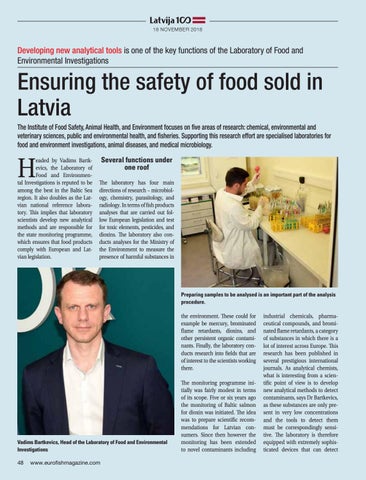
Preparing samples to be analysed is an important part of the analysis procedure.
the environment. These could for example be mercury, brominated flame retardants, dioxins, and other persistent organic contaminants. Finally, the laboratory conducts research into fields that are of interest to the scientists working there.
Vadims Bartkevics, Head of the Laboratory of Food and Environmental Investigations
The monitoring programme initially was fairly modest in terms of its scope. Five or six years ago the monitoring of Baltic salmon for dioxin was initiated. The idea was to prepare scientific recommendations for Latvian consumers. Since then however the monitoring has been extended to novel contaminants including
industrial chemicals, pharmaceutical compounds, and brominated flame retardants, a category of substances in which there is a lot of interest across Europe. This research has been published in several prestigious international journals. As analytical chemists, what is interesting from a scientific point of view is to develop new analytical methods to detect contaminants, says Dr Bartkevics, as these substances are only present in very low concentrations and the tools to detect them must be correspondingly sensitive. The laboratory is therefore equipped with extremely sophisticated devices that can detect
XXX FVSPlTINBHB[JOF DPN
# " " (*%%