Attractive investment areas for startups The innovation prompted by the Generative AI boom and the need for trust— is poised to follow a curve similar to “ethics predecessors” like the tremendous innovation in cybersecurity in the late-2000s and privacy in the late-2010s. Analogous to Cybersecurity, Generative AI innovation will unleash startup innovation that will drive productivity gains in enterprises beyond chatbots to cover use cases like generating written and visual content, writing code (automation scripts) debugging, and managing and manipulating data. However, many of the first wave of generative AI startups will fail to build profitable venture scale B2B businesses unless they explicitly address the following three core barriers: •
Inherent trust and verification issues associated with generative AI
•
Lack of defensible moats, with everyone relying on same underlying foundational models
•
Lack of sustainable business models given the high costs of running generative AI infrastructure (GPUs)
It is unclear where in the stack most of the value will accrue, whether infrastructure, models, or apps. Currently, infrastructure providers (like NVIDIA) are the biggest benefactors of OpenAI.
•
Infrastructure to cost effectively run training and inference workloads for generative AI models by breaking the GPU cost curve. We will also see AI Governance solutions to address the unintended consequences of disinformation that will be created by broader adoption of tools like ChatGPT, as well as a wide range of ethical issues.
Generative AI is ushering in a novel computing model, one that turbocharges the way computers are programmed, the way applications are built, as well as the number of people that can actually put this new compute platform to work. In the case of workstations, the number of people who could put this computing model to work was measured in hundreds of thousands of people. For PCs it was measured in hundreds of millions. For mobile devices it was billions of people. The number of applications grew exponentially with each subsequent computing model. With Large Language Models the number of productivity applications is going to grow exponentially because it will enable anyone and everyone to write their own applications. Most successful startups will be in the application layer. Especially those startups making use of the democratization of generative AI, but which take it to everyday workflows by using intelligent workflow automation and leveraging proprietary verticalized data sets to provide the most productivity improvements to end users.
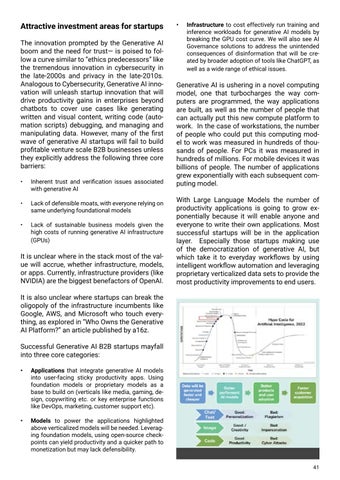
It is also unclear where startups can break the oligopoly of the infrastructure incumbents like Google, AWS, and Microsoft who touch everything, as explored in “Who Owns the Generative AI Platform?” an article published by a16z. Successful Generative AI B2B startups mayfall into three core categories: •
Applications that integrate generative AI models into user-facing sticky productivity apps. Using foundation models or proprietary models as a base to build on (verticals like media, gaming, design, copywriting etc. or key enterprise functions like DevOps, marketing, customer support etc).
•
Models to power the applications highlighted above verticalized models will be needed. Leveraging foundation models, using open-source checkpoints can yield productivity and a quicker path to monetization but may lack defensibility. 41