POWER MODULES
Advanced DC/DC Converters Simplify Industrial, Medical, and Transportation Power System Design Author: Rolf Horn Contributed by Digi-Key's North American Editors
With the increased use of electronics across industrial, transportation and medical applications, designers of the supporting power subsystems need to ensure high performance in physically and electrically demanding environments, while also meeting strict regulatory and safety requirements. At the same time, they must stay within ever tightening budget and design schedule constraints. The DC/DC converter has evolved dramatically over time to meet many of these requirements. They have decreased in size for higher power density, to save space, and offer wide input ranges to simplify inventory and lower the bill of materials (BOM). Other enhancements to make a designer’s task easier include low-noise outputs, tighter load regulation, strong protection and safety features, and remarkable attention to thermal management. However, as designers might expect, not all DC/DC converters are the same, requiring them to be discriminating in their selection to ensure design and application success. HOW DC/DC CONVERTERS WORK As the name implies, a DC/DC converter takes a voltage as input from a DC source and converts it to an output that is at another DC voltage. The output can be either lower (buck converter) or higher (boost converter) than the input voltage. DC/DC converters are either isolated or 12
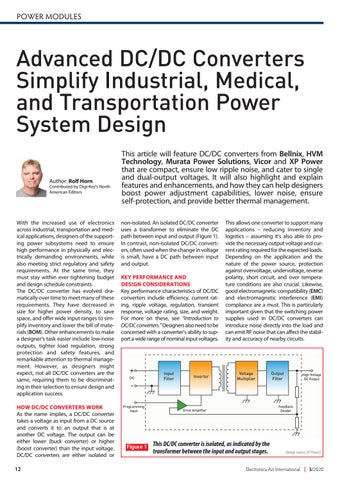
This article will feature DC/DC converters from Bellnix, HVM Technology, Murata Power Solutions, Vicor and XP Power that are compact, ensure low ripple noise, and cater to single and dual-output voltages. It will also highlight and explain features and enhancements, and how they can help designers boost power adjustment capabilities, lower noise, ensure self-protection, and provide better thermal management. non-isolated. An isolated DC/DC converter uses a transformer to eliminate the DC path between input and output (Figure 1). In contrast, non-isolated DC/DC converters, often used when the change in voltage is small, have a DC path between input and output. KEY PERFORMANCE AND DESIGN CONSIDERATIONS Key performance characteristics of DC/DC converters include efficiency, current rating, ripple voltage, regulation, transient response, voltage rating, size, and weight. For more on these, see “Introduction to DC/DC converters.” Designers also need to be concerned with a converter’s ability to support a wide range of nominal input voltages.
Figure 1
This allows one converter to support many applications – reducing inventory and logistics – assuming it’s also able to provide the necessary output voltage and current rating required for the expected loads. Depending on the application and the nature of the power source, protection against overvoltage, undervoltage, reverse polarity, short circuit, and over temperature conditions are also crucial. Likewise, good electromagnetic compatibility (EMC) and electromagnetic interference (EMI) compliance are a must. This is particularly important given that the switching power supplies used in DC/DC converters can introduce noise directly into the load and can emit RF noise that can affect the stability and accuracy of nearby circuits.
This DC/DC converter is isolated, as indicated by the transformer between the input and output stages.
(Image source: XP Power)
Electronica Azi International | 5/2020