INSIGHT » CYBER-SECURITY
fact, this has conversely led to the curious trend of ‘military spec’ standards, originally developed for the armed forces, migrating into the consumer and commercial markets, because they are seen as a strong guarantee of reliability and ruggedness. Unfortunately, the proliferation of consumer electronics in military applications is opening up potential vulnerabilities. The use of consumer-grade hardware and services to handle secure data – sometimes even in breach of official rules or guidelines – has been blamed for several damaging information leaks, among them US officials’ emails and US intelligence services’ hacking tools. ASYMMETRIC THREATS In general, it can be argued that the spread of cheap, powerful, mass-produced technology has, in some areas, tended to tilt the balance of power away from large organisations, such as armies and government agencies. The very nature of this imbalance lends itself to one of a modern military’s greatest fears: asymmetric warfare, or low cost attacks that generate enormously costly damage. These concerns are driving increasing
www.international.electronica-azi.ro
investment on cyber-defence, as well as spending on research into new military technologies. NATO saw a 60% in cyber security incidents in 2016, and officials called for a corresponding increase in defensive spending. Recent US budget proposals ask for a $1.5 billion cyber-security budget for the Department of Homeland Security alone, and total US federal government’s annual cyber-security spend is estimated to have soared from $7.5 billion a decade ago to over $28 billion today. TECHNOLOGY TO THE RESCUE? As recent news reports have shown, governments are waking up to the grave intelligence threat posed by officials and staff who use insecure devices to handle secure information. Snatching the iPhones and easy-to-use laptops back out of the hands of staff is a tough ask, but personal security practices can still be tightened up, and platform security can be enhanced with encryption, biometric identification (such as fingerprint ID), as well as failsafe mechanisms that wipe or lock devices if they are stolen. Somewhat ironically, the consumer product sector is
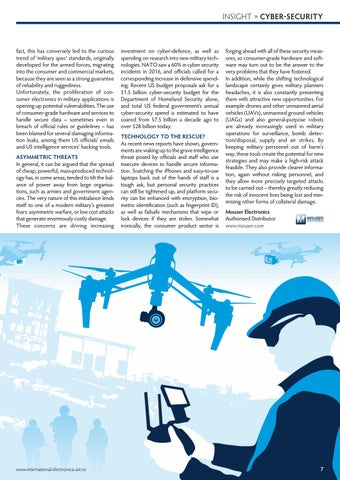
forging ahead with all of these security measures, so consumer-grade hardware and software may turn out to be the answer to the very problems that they have fostered. In addition, while the shifting technological landscape certainly gives military planners headaches, it is also constantly presenting them with attractive new opportunities. For example drones and other unmanned aerial vehicles (UAVs), unmanned ground vehicles (UAGs) and also general-purpose robots are already increasingly used in military operations for surveillance, bomb detection/disposal, supply and air strikes. By keeping military personnel out of harm’s way, these tools create the potential for new strategies and may make a high-risk attack feasible. They also provide clearer information, again without risking personnel, and they allow more precisely targeted attacks to be carried out – thereby greatly reducing the risk of innocent lives being lost and minimising other forms of collateral damage. Mouser Electronics Authorised Distributor www.mouser.com
7