Astronomical News
Sbordone, L. et al., Report on the ESO Workshop “20th Anniversary of UVES”
The online format proved very successful and attracted around 200 registered participants from all over the world, up to 120 of whom were connected at any given time.
by January 2000 (Figure 2). Manufacturing the large échelle gratings and the fluorite glasses for the blue-arm camera were the most significant technical challenges. D’Odorico also noted that the high quality of UVES, a 100%-internal ESO project, was instrumental in giving ESO the prestige and authority to subsequently review the work of instrument partners.
Sessions were recorded and the videos of each presentation have been made available via YouTube1. The PDF versions of each presentation have been uploaded to Zenodo 2. The videos and PDFs are also available via the workshop website 3. Each day’s presentations were followed by a round-table session, led by two panelists — different people on each day — and chaired by ESO’s VLT Programme Scientist Bruno Leibundgut. Summary of talks and discussions After a warm welcome from ESO Director General Xavier Barcons, the original project manager, Sandro D’Odorico, recapped the evolution of the UVES project from its inception in 1986. As per the VLT instrumentation programme, the original plan was to build two UVES instruments with different specifications. These were subsequently consolidated into a single instrument, which was shipped to Paranal in 1999 and fully commissioned
38
The Messenger 183 | 2021
Johan Kosmalski detailed the optical design of UVES, and the choices and innovations (such as the design of the collimator optics) that made it such an efficient instrument. He also described an early design for an updated blue-arm configuration that would permit capture of the whole blue wavelength range in a single shot by reducing cross-dispersion — whilst still allowing an approximately eightarcsecond slit length — and building a new blue camera with an increased field of view. Newer optics and an improved detector would increase the blue-arm efficiency by an estimated 50%. The first of the talks on scientific achievements with UVES was given by Emmanuel Jehin, who described the impact of UVES on Solar System, and in particular cometary, science. UVES has been instrumental in the study of long organic molecules released by comets and their
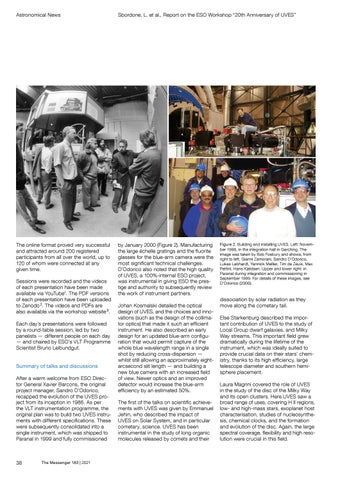
Figure 2. Building and installing UVES. Left: November 1998, in the integration hall in Garching. The image was taken by Bob Fosbury and shows, from right to left, Gianni Zamorani, Sandro D’Odorico, Lukas Labhardt, Yannick Mellier, Tim de Zeuw, Max Pettini, Hans Kjeldsen. Upper and lower right: in Paranal during integration and commissioning in September 1999. For details of these images, see D’Odorico (2000).
dissociation by solar radiation as they move along the cometary tail. Else Starkenburg described the important contribution of UVES to the study of Local Group dwarf galaxies, and Milky Way streams. This important field grew dramatically during the lifetime of the instrument, which was ideally suited to provide crucial data on their stars’ chemistry, thanks to its high efficiency, large telescope diameter and southern hemisphere placement. Laura Magrini covered the role of UVES in the study of the disc of the Milky Way and its open clusters. Here UVES saw a broad range of uses, covering H II regions, low- and high-mass stars, exoplanet host characterisation, studies of nucleosynthesis, chemical clocks, and the formation and evolution of the disc. Again, the large spectral coverage, flexibility and high resolution were crucial in this field.