Synergies with other surveys now and in the future
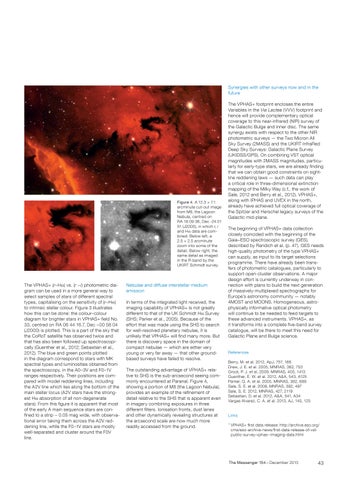
Figure 4. A 12.3 × 7.1 arcminute cut-out image from M8, the Lagoon Nebula, centred on RA 18 09 36, Dec -24 01 51 (J2000), in which r, i and Hα data are combined. Below left, a 2.5 × 2.5 arcminute zoom into some of the detail. Below right, the same detail as imaged in the R-band by the UKIRT Schmidt survey.
The VPHAS+ (r−Hα) vs. (r −i) photometric diagram can be used in a more general way to select samples of stars of different spectral types, capitalising on the sensitivity of (r−Hα) to intrinsic stellar colour. Figure 3 illustrates how this can be done: the colour–colour diagram for brighter stars in VPHAS+ field No. 33, centred on RA 06 44 16.7, Dec −00 58 04 (J2000) is plotted. This is a part of the sky that the CoRoT satellite has observed twice and that has also been followed up spectroscopically (Guenther et al., 2012; Sebastian et al., 2012). The blue and green points plotted in the diagram correspond to stars with MK spectral types and luminosities obtained from the spectroscopy, in the A0–3V and F0–1V ranges respectively. Their positions are compared with model reddening lines, including the A2V line which lies along the bottom of the main stellar locus (A2V stars have the strongest Hα absorption of all non-degenerate stars). From this figure it is apparent that most of the early A main sequence stars are confined to a strip ~ 0.05 mag wide, with observational error taking them across the A2V reddening line, while the F0–1V stars are mostly well-separated and cluster around the F0V line.
Nebulae and diffuse interstellar medium e mission In terms of the integrated light received, the imaging capability of VPHAS+ is not greatly different to that of the UK Schmidt Hα Survey (SHS; Parker et al., 2005). Because of the effort that was made using the SHS to search for well-resolved planetary nebulae, it is unlikely that VPHAS+ will find many more. But there is discovery space in the domain of compact nebulae — which are either very young or very far away — that other groundbased surveys have failed to resolve. The outstanding advantage of VPHAS+ relative to SHS is the sub-arcsecond seeing commonly encountered at Paranal. Figure 4, showing a portion of M8 (the Lagoon Nebula), provides an example of the refinement of detail relative to the SHS that is apparent even in imagery combining exposures in three different filters. Ionisation fronts, dust lanes and other dynamically revealing structures at the arcsecond scale are now much more readily accessed from the ground.
The VPHAS+ footprint encloses the entire Variables in the Via Lactea (VVV) footprint and hence will provide complementary optical coverage to this near-infrared (NIR) survey of the Galactic Bulge and inner disc. The same synergy exists with respect to the other NIR photometric surveys — the Two Micron All Sky Survey (2MASS) and the UKIRT InfraRed Deep Sky Surveys: Galactic Plane Survey (UKIDSS/GPS). On combining VST optical magnitudes with 2MASS magnitudes, particularly for early-type stars, we are already finding that we can obtain good constraints on sightline reddening laws — such data can play a critical role in three-dimensional extinction mapping of the Milky Way (c.f., the work of Sale, 2012 and Berry et al., 2012). VPHAS+, along with IPHAS and UVEX in the north, already have achieved full optical coverage of the Spitzer and H erschel legacy surveys of the Galactic mid-plane. The beginning of VPHAS+ data collection closely coincided with the beginning of the Gaia–ESO spectroscopic survey (GES), described by Randich et al. (p. 47). GES needs high-quality photometry of the type VPHAS+ can supply, as input to its target selections programme. There have already been transfers of photometric catalogues, particularly to support open-cluster observations. A major design effort is currently underway in con nection with plans to build the next generation of massively-multiplexed spectrographs for Europe’s astronomy community — notably 4MOST and MOONS. Homogeneous, astrophysically informative optical photometry will continue to be needed to feed targets to these advanced instruments. VPHAS+, as it transforms into a complete five-band survey catalogue, will be there to meet this need for Galactic Plane and Bulge science. References Berry, M. et al. 2012, ApJ, 757, 166 Drew, J. E. et al. 2005, MNRAS, 362, 753 Groot, P. J. et al. 2009, MNRAS, 400, 1413 Guenther, E. W. et al. 2012, A&A, 543, A125 Parker, Q. A. et al. 2005, MNRAS, 362, 689 Sale, S. E. et al. 2009, MNRAS, 392, 497 Sale, S. E. 2012, MNRAS, 427, 2119 Sebastian, D. et al. 2012, A&A, 541, A34 Vargas Alvarez, C. A. et al. 2013, AJ, 145, 125 Links 1
PHAS+ first data release: http://archive.eso.org/ V cms/eso-archive-news/first-data-release-of-vstpublic-survey-vphas--imaging-data.html
The Messenger 154 – December 2013
43