alue of Vintage Observatories and Historic Telescopes in • VCommunicating Astronomy with the Public
World War II were optimised for visual observing with the human eye. Moreover, vintage telescopes by the masters are optically superb. For optical excellence, Alvan Clark and John Brashear are to telescopes what Stradivarius and Guarnerius are to violins: in side-byside optical tests for colour, resolution and clarity, many modern commercial telescopes of the same aperture pale by comparison. Repeatedly, participants recounted how at star parties or public observing nights that feature both modern and vintage telescopes, without fail people would walk right by the modern equipment — even if it was fitted with a CCD-imaging system and a video screen showing an eye-catching image of a planet or galaxy — and head straight for the antique instrument, saying, “I want to look through a telescope.” Even if the image shown on the computer screen showed more colour or detail than a human eye
• CAPjournal, No. 9 October 2010
could perceive through an eyepiece, members of the general public still wanted to see a celestial object with their own eyes. Workshop participants remarked how they often heard gasps when visitors took their first-ever look through a telescope — and that years later, some members of the public still recollect how inspired and awe-struck they felt at personally viewing the rings of Saturn or the moons of Jupiter or the pale Ring Nebula in Lyra. • The clearly visible gears and setting circles of vintage telescopes can concretely demonstrate the fundamentals of the celestial sphere. Because older instruments are wholly manual, the motions of the telescope mount can be used to illustrate concepts such as celestial latitude and longitude, compensation for the rotation of the Earth, the position of the observer’s meridian, etc. One presenter recounted: “As
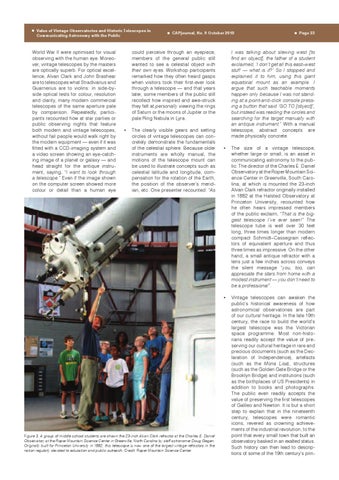
Figure 3. A group of middle school students are shown the 23-inch Alvan Clark refractor at the Charles E. Daniel Observatory at the Roper Mountain Science Center in Greenville, North Carolina by staff astronomer Doug Gegen. Originally built for Princeton University in 1882, this telescope is now one of the largest vintage refractors in the nation regularly devoted to education and public outreach. Credit: Roper Mountain Science Center.
• Page 33
I was talking about slewing west [to find an object], the father of a student exclaimed, ‘I don’t get all this east–west stuff — what is it?’ So I stopped and explained it to him, using this giant equatorial mount as an example. I argue that such teachable moments happen only because I was not standing at a point-and-click console pressing a button that said ‘GO TO [object]’, but instead was reading the circles and searching for the target manually with an antique instrument.” With a manual telescope, abstract concepts are made physically concrete. • The size of a vintage telescope, whether large or small, is an asset in communicating astronomy to the public. The director of the Charles E. Daniel Observatory at the Roper Mountain Science Center in Greenville, South Carolina, at which is mounted the 23-inch Alvan Clark refractor originally installed in 1882 at the Halsted Observatory at Princeton University, recounted how he often hears impressed members of the public exclaim, “That is the biggest telescope I’ve ever seen!” The telescope tube is well over 30 feet long, three times longer than modern compact Schmidt–Cassegrain reflectors of equivalent aperture and thus three times as impressive. On the other hand, a small antique refractor with a lens just a few inches across conveys the silent message “you, too, can appreciate the stars from home with a modest instrument — you don’t need to be a professional”. • Vintage telescopes can awaken the public’s historical awareness of how astronomical observatories are part of our cultural heritage. In the late 19th century, the race to build the world’s largest telescope was the Victorian space programme. Most non-historians readily accept the value of preserving our cultural heritage in rare and precious documents (such as the Declaration of Independence), artefacts (such as the Mona Lisa), structures (such as the Golden Gate Bridge or the Brooklyn Bridge) and institutions (such as the birthplaces of US Presidents) in addition to books and photographs. The public even readily accepts the value of preserving the first telescopes of Galileo and Newton. It is but a short step to explain that in the nineteenth century, telescopes were romantic icons, revered as crowning achievements of the industrial revolution, to the point that every small town that built an observatory basked in an exalted status. Such history can then lead to descriptions of some of the 19th century’s prin-