Water & Wastewater Treatment in Cold Climates
James Smith Cree Nation water plant opens its doors
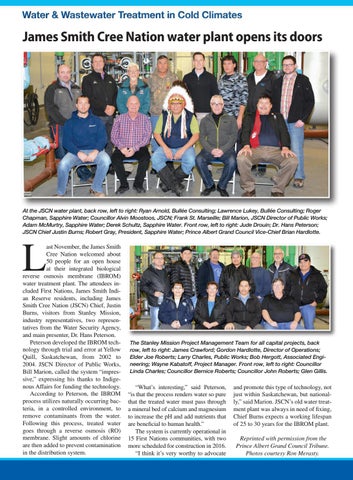
At the JSCN water plant, back row, left to right: Ryan Arnold, Bullée Consulting; Lawrence Lukey, Bullée Consulting; Roger Chapman, Sapphire Water; Councillor Alvin Moostoos, JSCN; Frank St. Marseille; Bill Marion, JSCN Director of Public Works; Adam McMurtry, Sapphire Water; Derek Schultz, Sapphire Water. Front row, left to right: Jude Drouin; Dr. Hans Peterson; JSCN Chief Justin Burns; Robert Gray, President, Sapphire Water; Prince Albert Grand Council Vice-Chief Brian Hardlotte.
L
ast November, the James Smith Cree Nation welcomed about 50 people for an open house at their integrated biological reverse osmosis membrane (IBROM) water treatment plant. The attendees included First Nations, James Smith Indian Reserve residents, including James Smith Cree Nation (JSCN) Chief, Justin Burns, visitors from Stanley Mission, industry representatives, two representatives from the Water Security Agency, and main presenter, Dr. Hans Peterson. Peterson developed the IBROM technology through trial and error at Yellow Quill, Saskatchewan, from 2002 to 2004. JSCN Director of Public Works, Bill Marion, called the system “impressive,” expressing his thanks to Indigenous Affairs for funding the technology. According to Peterson, the IBROM process utilizes naturally occurring bacteria, in a controlled environment, to remove contaminants from the water. Following this process, treated water goes through a reverse osmosis (RO) membrane. Slight amounts of chlorine are then added to prevent contamination in the distribution system.
38 | February 2016
The Stanley Mission Project Management Team for all capital projects, back row, left to right: James Crawford; Gordon Hardlotte, Director of Operations; Elder Joe Roberts; Larry Charles, Public Works; Bob Hergott, Associated Engineering; Wayne Kabatoff, Project Manager. Front row, left to right: Councillor Linda Charles; Councillor Bernice Roberts; Councillor John Roberts; Glen Gillis.
“What’s interesting,” said Peterson, “is that the process renders water so pure that the treated water must pass through a mineral bed of calcium and magnesium to increase the pH and add nutrients that are beneficial to human health.” The system is currently operational in 15 First Nations communities, with two more scheduled for construction in 2016. “I think it’s very worthy to advocate
and promote this type of technology, not just within Saskatchewan, but nationally,” said Marion. JSCN’s old water treatment plant was always in need of fixing, Chief Burns expects a working lifespan of 25 to 30 years for the IBROM plant. Reprinted with permission from the Prince Albert Grand Council Tribune. Photos courtesy Ron Merasty.
Environmental Science & Engineering Magazine