ES&E May:2007
5/22/07
9:15 PM
Page 18
Water Supply
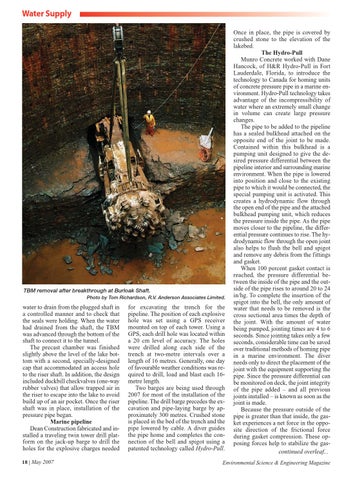
TBM removal after breakthrough at Burloak Shaft. Photo by Tom Richardson, R.V. Anderson Associates Limited.
water to drain from the plugged shaft in a controlled manner and to check that the seals were holding. When the water had drained from the shaft, the TBM was advanced through the bottom of the shaft to connect it to the tunnel. The precast chamber was finished slightly above the level of the lake bottom with a second, specially-designed cap that accommodated an access hole to the riser shaft. In addition, the design included duckbill checkvalves (one-way rubber valves) that allow trapped air in the riser to escape into the lake to avoid build up of an air pocket. Once the riser shaft was in place, installation of the pressure pipe began. Marine pipeline Dean Construction fabricated and installed a traveling twin tower drill platform on the jack-up barge to drill the holes for the explosive charges needed 18 | May 2007
for excavating the trench for the pipeline. The position of each explosive hole was set using a GPS receiver mounted on top of each tower. Using a GPS, each drill hole was located within a 20 cm level of accuracy. The holes were drilled along each side of the trench at two-metre intervals over a length of 16 metres. Generally, one day of favourable weather conditions was required to drill, load and blast each 16metre length. Two barges are being used through 2007 for most of the installation of the pipeline. The drill barge precedes the excavation and pipe-laying barge by approximately 300 metres. Crushed stone is placed in the bed of the trench and the pipe lowered by cable. A diver guides the pipe home and completes the connection of the bell and spigot using a patented technology called Hydro-Pull.
Once in place, the pipe is covered by crushed stone to the elevation of the lakebed. The Hydro-Pull Munro Concrete worked with Dane Hancock, of H&R Hydro-Pull in Fort Lauderdale, Florida, to introduce the technology to Canada for homing units of concrete pressure pipe in a marine environment. Hydro-Pull technology takes advantage of the incompressibility of water where an extremely small change in volume can create large pressure changes. The pipe to be added to the pipeline has a sealed bulkhead attached on the opposite end of the joint to be made. Contained within this bulkhead is a pumping unit designed to give the desired pressure differential between the pipeline interior and surrounding marine environment. When the pipe is lowered into position and close to the existing pipe to which it would be connected, the special pumping unit is activated. This creates a hydrodynamic flow through the open end of the pipe and the attached bulkhead pumping unit, which reduces the pressure inside the pipe. As the pipe moves closer to the pipeline, the differential pressure continues to rise. The hydrodynamic flow through the open joint also helps to flush the bell and spigot and remove any debris from the fittings and gasket. When 100 percent gasket contact is reached, the pressure differential between the inside of the pipe and the outside of the pipe rises to around 20 to 24 in/hg. To complete the insertion of the spigot into the bell, the only amount of water that needs to be removed is the cross sectional area times the depth of the joint. With the amount of water being pumped, jointing times are 4 to 6 seconds. Since jointing takes only a few seconds, considerable time can be saved over traditional methods of homing pipe in a marine environment. The diver needs only to direct the placement of the joint with the equipment supporting the pipe. Since the pressure differential can be monitored on deck, the joint integrity of the pipe added – and all previous joints installed – is known as soon as the joint is made. Because the pressure outside of the pipe is greater than that inside, the gasket experiences a net force in the opposite direction of the frictional force during gasket compression. These opposing forces help to stabilize the gascontinued overleaf...
Environmental Science & Engineering Magazine