OCTOBER 2018 www.esemag.com @esemag.com
Headworks screening can be challenging for smaller WWTPs CSA introduces a new standard for WWTP design Mechanical pump seals can cut energy and water use
Intelligent Solutions For
WASTEWATER TREATMENT Online and Portable Instrumentation • • • • • • • •
Multi Parameter Single – Dual – Multi-Channel-Wireless Optical Fluorescence Dissolved Oxygen Near Infra Red Total Suspended Solids pH, ORP Microwave Density Ultrasonic Interface Level Spectrophotometric Online Spectrophotometric Laboratory
Flowmetering • Ultrasonic Doppler – Transit Time • Insertion/Immersion/Clamp-On • Venture/Flume Partially Filled Conduit
Wastewater Samplers • Indoor or Outdoor • Refrigerated or Non-Refrigerated • Portable or Stationary
Septage Receiving Systems • Fully Automated Control and Data Collection • Integrated Billing System
Additional Solutions For: Flow – Level – System Integration – Field Service
Mississauga, Ontario Montreal, Québec
(800) 595-0514 www.cancoppas.com controls@cancoppas.com
CONTENTS
October 2018 • Vol. 31 No. 5 • ISSN-0835-605X
COMING IN OUR DECEMBER 2018 ISSUE This issue will offer our 40,000 readers across Canada a strong and diverse range of articles.
EDITORIAL FOCUS
28
18 FEATURES 6 8 10 14 18 20 23 24 26 28 30 32 33 34 38 40 42 44 48 52 56 57
Rising waters, rising costs —Editorial Comment Study finds greater ratio of microplastics downstream of WWTPs Modelling full-scale granular sludge sequencing tank performance Northlands MB First Nation’s new WWTP addresses two key issues High-resolution inspection technology used to evaluate bar-wrapped aqueduct —Cover Story Six things to consider when selecting solenoid valves for reverse osmosis systems FOG busting research improves anaerobic digestion and reduces clogs Study finds stormwater ponds are not a major source of greenhouse gas emissions St. Thomas’ digester replacement project delivers savings, helps with sustainability goals Headworks screening can be challenging for smaller WWTPs Reliable river flow measurement helps ensure adequate water supplies N.S. Boat Harbour pulp and paper waste cleanup plan getting clearer Leaders issue joint statement on North American climate change initiatives Rainy River commissions water disinfection byproduct reduction study Electro-oxidation removes NH3 from landfill leachate, easing WWTP loading CSA introduces a new standard for WWTP design in an era of climate change Considerations when selecting a sodium hypochlorite pump Vaughan establishes stormwater climate change risk assessment strategies Upgrading to mechanical pump seals saves energy and water Proper equipment and procedures ensures accurate data from soil samples BC firm seeking contaminated site for full-scale WW technology evaluation Proper irrigation and drainage for landscape beds can cut water use
4 | October 2018
FEATURED TOPICS • Wastewater treatment and collection systems • Stormwater management • Drinking water supply, treatment and distribution systems • Disinfection and filtration
BONUS CONVENTION CIRCULATION AT: • Manitoba Water & Wastewater Association • Aboriginal Water & Wastewater Association of Ontario
Ad Booking Deadline:
November 15, 2018 1-888-254-8769 sales@esemag.com www.esemag.com
Product Showcase Environmental News Professional Cards Ad Index
www.esemag.com
Water and Wastewater Operations Forum: Looking at trends and issues impacting operators
Contact us to reserve your ad space.
DEPARTMENTS 59 62 62 66
Consulting Engineering in Canada: Experts in environmental consulting share their opinions, experiences and values
@ESEMAG
Environmental Science and Engineering Magazine Environmental Science & Engineering Magazine
We understand the challenge of finding the right balance between plant e�ciency and compliance with industry standards and legal requirements.
OBSERVE + CONSERVE You meet your e�ciency goals and reduce costs without compromising on water quality.
Endress+Hauser helps you to improve your processes: • With a comprehensive portfolio of measuring instruments and tailor-made services • With reliable industry application expertise • With optimized maintenance routines through instruments with self-diagnostic functionalities
Do you want to learn more? www.ca.endress.com
EDITORIAL COMMENT BY PETER DAVEY
Rising waters, rising costs
A
s this issue went to press, we had yet to claims. Over the last 10 years, water losses for learn the full damage from hurricane personal property claims have doubled to 40% Florence or typhoon Mangkhut. While the (of dollars paid in losses).” most devastating images to see from these storms are those of houses and treasured posTAKING ACTION sessions being swept away, the impact of heavy Two articles in this issue highlight how stakerain, wind and storm surges on infrastructure, holders and organizations are taking action to notably wastewater systems, is profound. protect against climate risks. It makes sense to place wastewater treatment Chris Wolnik and Craig Schritt with the City plants at low elevations and close to water bodof Vaughan detail how their city developed ies. It saves money to use gravity to collect and detailed risk assessment tools to help decision deliver wastewater and to locate a treatment makers identify vulnerable areas and assets. (See plant close to its discharge point. However, this article “Vaughan establishes stormwater climate makes them vulnerable to flooding from rain change risk assessment strategies”, page 44). or storm surges, especially when located on the During a heavy storm this April, Vaughan’s coast. risk information maps and protocols were put In 2012, Hurricane Sandy damaged wastewato the test. Operations staff were able use a flood ter infrastructure in New York and New Jersey protocol map that was developed, to prioritize at a cost of $3 billon and resulted in the release their calls and routes to minimize flood risk and of over 41 billion litres of untreated and partially property damage. treated sewage. Climate resiliency is also being factored into Hurricane Harvey, which struck Texas on building codes to help structures and assets August 25, 2017, knocked out as many as 40 withstand a variety of climate change parameters wastewater treatment plants and caused widebeyond flooding. Joe Gemin of AECOM, and Pat spread water contamination. Samples taken Coleman of Black & Veatch, discuss a standard around Houston, Texas, following Harvey, being developed by CSA in partnership with the showed “huge” levels of total coliform, as high as National Research Council of Canada. (See arti57,000 CFUs and E.Coli at 8,600 CFUs, accordcle “New CSA Standard addresses climate change ing to CNN. and WWTP design”, page 40). Earlier this year, flooding in New Brunswick CSA S900.1 – Climate Change Adaption for compromised numerous wastewater systems Wastewater Treatment Plants is being prepared and floodwaters were contaminated with to provide owners of wastewater treatment untreated sewage. The province’s Emergency plants with a methodology to assess the impact Measures Organization warned people that of climate change on their facilities. floodwater posed a risk of infection, sickness According to the article’s authors, this and gastrointestinal illness. Residents using assessment can be used to provide assurance private wells were told to disinfect and test wells to insurance companies and stakeholders that before using them. the facility and its owner have been proactive in The cost to repair wastewater infrastructure addressing climate risks. damaged by flooding is enormous. Flooding At the Global Climate Action Summit in early that affected Calgary in 2013 resulted in $13.5 September, Canada and a number of U.S. govmillion in damage to the Bonnybrook Wastewa- ernors endorsed a joint statement that, among ter Treatment Plant. other things, recognized the need to increase As part of a $1 billon upgrade and expansion resiliency of coastal communities. (See article project, Bonnybrook will be protected from “Leaders issue joint statement on climate change overland flooding with a berm on the Bow River initiatives”, page 33). side, and a new outfall further downstream to With each year seeming to bring record-breakavoid a repeat of floodwater surging into the ing storms, wildfires and temperatures, it is plant through the outfall channels. imperative that governments and facility owners That kind of preventative measure is also understand and prepare for climate change risks. needed on the private side. According to the Politicking aside, action and resources need to be Intact Financial Corporation: “Water damage mustered to protect our infrastructure, economy is now the leading cause of personal property and people from extreme weather events. 6 | October 2018
Peter Davey is Managing Editor of ES&E Magazine. Email: peter@esemag.com
Environmental Science & Engineering Magazine
WASTEWATER
EDITOR AND PUBLISHER STEVE DAVEY steve@esemag.com MANAGING EDITOR PETER DAVEY peter@esemag.com SALES DIRECTOR PENNY DAVEY penny@esemag.com SALES REPRESENTATIVE DENISE SIMPSON denise@esemag.com ACCOUNTING SANDRA DAVEY sandra@esemag.com CIRCULATION MANAGER DARLANN PASSFIELD darlann@esemag.com DESIGN & PRODUCTION MIGUEL AGAWIN production@esemag.com
TECHNICAL ADVISORY BOARD Archis Ambulkar, Jones and Henry Engineers, Ltd. Gary Burrows, City of London Patrick Coleman, Black & Veatch Bill De Angelis, P.Eng., MBA Mohammed Elenany, Urban Systems William Fernandes, City of Toronto Marie Meunier, John Meunier Inc., Québec Tony Petrucci, Stantec, Markham
Environmental Science & Engineering is a bi-monthly business publication of Environmental Science & Engineering Publications Inc. An all Canadian publication, ES&E provides authoritative editorial coverage of Canada’s municipal and industrial environmental control systems and drinking water treatment and distribution. Readers include consulting engineers, industrial plant managers and engineers, key municipal, provincial and federal environmental officials, water and wastewater plant operators and contractors. Information contained in ES&E has been compiled from sources believed to be correct. ES&E cannot be responsible for the accuracy of articles or other editorial matter. Articles in this magazine are intended to provide information rather than give legal or other professional advice. Articles being submitted for review should be emailed to steve@esemag.com. Canadian Publications Mail Sales Second Class Mail Product Agreement No. 40065446 Registration No. 7750 Undeliverable copies, advertising space orders, copy, artwork, proofs, etc., should be sent to: Environmental Science & Engineering 220 Industrial Pkwy. S., Unit 30 Aurora, Ontario L4G 3V6 Tel: (905)727-4666 Website: www.esemag.com
A Supporting Publication of
8 | October 2018
A new study suggests that wastewater treatment plants are not being effective at filtering out microplastics such as the different types shown. Photo Credit: Minnesota Pollution Control Agency
Study finds greater ratio of microplastics downstream of WWTPs
A
recent UK based study followed six river catchments in northern England to gauge the impact of treated sewage effluents as a key source of microplastics. The study’s authors found that microplastics, defined as pieces of plastic 5 mm in diameter or less, were more prevalent downstream of wastewater treatment plants than they were upstream. The implication being that wastewater treatment plants are not effective at filtering out microplastics, the study’s authors suggested. On 24 out of 28 occasions, the study team found more microplastics downstream, with one particular sampling finding downstream microplastics 69 times higher than upstream. “It has been postulated that wastewater treatment plants are the main source of microplastics to river catchments as they receive waste from industries manufacturing and using microplastics, for instance as scrubbers in cleaning and cosmetic products, as well as domestic effluent from households using products containing microplastics,” states the study. Many of the microplastics found upstream were believed to have come
from biosolids applied to agricultural land as fertilizer, the diffuse release of secondary microplastics and aerial deposition. The study attempted to find a wide variety of wastewater treatment plants that not only served both large and small population centres, but also plants that utilized different treatment methods. The six plants selected use treatments that range from activated sludge, to trickling filter and secondary biological filter. As there are no standard procedures for measuring microplastics in this context, the study team used mesh sieves to filter out the small particles. “Plastics were identified based on the fact that they were homogenous particles, with no obvious cellular structure, and could easily be dented with tweezers but not broken apart, other than for plastic foam. They were categorized into pellets/beads, fibres, and fragments/flakes,” reported the study’s authors. Microplastics recovered during the study were dominated by fibres, fragments and flakes, as opposed to beads and pellets.
Environmental Science & Engineering Magazine
Process Equipment for Wastewater, Biosolids & Biogas
We Are The Exclusive Suppliers For:
Pro Aqua, Inc. carries a complete range of market leading and innovative products. Let us show you what we can offer on your next project Providing treatment solutions for more than 25 years. • Archimedes Screw Pumps • Screens – Multi-Rake, Perf Plate, Drum, Travelling Band, Step, Climber, Vertical Pump Station Screens, Screenings Washer /Compactors • Grit Separation, Washing & Dewatering • Conveyors – Shafted & Shaftless Screw, Belt • Blowers – Rotary Screw, Rotary Lobe, Single Stage and Multistage Centrifugal, Turbo, Advanced Control, Rebuilds • Aeration – Surface, Membrane & Ceramic, Fine & Coarse Bubble, Gas & Liquid Cleaning, DO Control, AlphaMeter • Mixers – Anoxic & Swing Zones, Sludge Holding, Digester; Mechanical, Hydraulic and Gas • Tank Components – Covers, Fabric Baffles, Troughs, Weirs, Scum Baffles, Skimmers, Decanters, Swivel Joints, Telescoping Valves, Stamford Baffles, Launder Covers • Clarifiers – Primary & Secondary, Circular, Chain & Flight, Inclined Plate Settlers, Weir Washing • Biological – SBR, MBR, RBC, MBBR, Oxidation Ditch, BioMag, CoMag • Polymer – Liquid and Dry Systems • Rotary Lobe Pumps & Grinders
• Disinfection – UV, Chlorine Scrubbers, Chlorine Gas Containment • Tertiary Filters – Travelling Bridge, Disk, Membrane • Sludge Thickening & Dewatering – Disk Thickener, Gravity Thickener, Filter Press, Screw Press, Centrifuge • Anaerobic Digesters – Sludge Conditioning, In-line Screening, Degritting, Membrane Gas Holders, Liquid Mixing, Nutrient Recovery • Sludge Drying – Belt, Fluid Bed and Solar • Septage Receiving – Screens, Dump Stations, Truck Access & ID, data gathering & equipment control • Sludge Treatment, Transport & Storage – Cake Pumps, Silos, Sliding Frames, Live Bottom Hoppers, Push Floors, Truck Loading, Alkaline Stabilization • Odour Control – Tank Covers, Chemical & Biological Treatment • CSO, Stormwater & Pump Stations – Tipping Buckets, Bending Weirs, Flushing Gates, Flow Regulating, Vortex Valves, Storm Screens • Digester Gas – Gas Holders, Gas Conditioning: chilling; compressing; and removal of moisture, sulphur, carbon dioxide and siloxane, complete Co-Generation facilities
T: (905) 864-9311 F: (905) 864-8469 www.proaquasales.com 7-264 Bronte St. S., Milton, ON L9T 5A3 04.16
WASTEWATER
Simulator models a full-scale granular sludge treatment plant’s performance By Chris Bye, Peter Dold, Gillian Burger, Mark Fairlamb and Daniela Conidi
G
ranular sludge is an emerging wastewater treatment technology. It differs from traditional activated sludge flocs through the compact and spherical structure of the granules. These properties promote rapid settlement and can therefore contribute to compact treatment processes through high sludge concentrations and short settling times. Furthermore, there can be a gradient of biological environments (i.e., aerobic, anoxic, anaerobic) within the granules themselves, allowing for biological removal of both nitrogen and phosphorus in a single reactor. A granular sludge sequencing tank (GSST) plant model was formulated and set up in the BioWin wastewater treatment process simulator, and calibrated to the performance of a fullscale Nereda nutrient removal municipal wastewater treatment plant. The plant is comprised of a conventional adsorption/bio-oxidation (AB) process and a Nereda plant that was started up in 2013. The AB process treats 59% of the total influent flow and the remaining 41% is treated by two parallel Nereda reactors fed from a common buffer tank. These reactors achieve biological nitrogen and excess phosphorus removal, and remove 86% of the influent total nitrogen and 87% of the influent total phosphorus. The model calibration provides insights on a range of performance characteristics: • Amounts of granular sludge mass and granular sludge surface area required to achieve a specific process objective. • Average diameter of the granules (in mm) depending on substrate loading, solids exchange between the granules and the bulk liquid, EPS strength coefficients and the effect of gas (N₂, CH₄, CO₂) generation inside the granules. • Distribution of soluble and particulate components inside the granules. • Amount of active biomass within the granular sludge and the distribution of biomass types (ordinary heterotrophic organisms (OHO), phosphorus accumulating organisms (PAO), ammonia oxidizing bacteria (AOB), nitrite oxidizing bacteria (NOB), etc.). • Development of different growth regimes (e.g., aerobic, anoxic, anaerobic) over the granular radius. • Distribution of the reaction rates for the biological processes (growth and decay of heterotrophic and autotrophic biomass, fermentation, etc.) within the granules. • Effects of pH within the granules on reaction rates and the potential for precipitation.
®
GSST PHASES There are four distinct phases in the operation of a granular sludge sequencing tank which are simulated in BioWin: 10 | October 2018
Operational cycle of the granular sludge sequencing tank.
Mixing: The cycle starts at the beginning of the mixed phase. Typically, the reactor is full or nearly full at this point. During the mixed phase, granular sludge and non-granular mixed liquor are well mixed. The reactor may be continuously aerated during the mixed phase or may involve unaerated and aerated periods (based on either DO set point or air flow rate). Settling: The settling phase commences when mixing stops. Granules are assumed to immediately form a settled bed on the base of the reactor (with a void volume) and non-granular mixed liquor solids settle on top of the granular sludge bed. Typically, waste activated sludge (WAS) is withdrawn from the bottom of the settled non-granular solids prior to commencing feed, resulting in a high concentration of WAS solids (and small volume). The model assumes that granules are never removed directly during wasting. Only non-granular solids are wasted from continued overleaf…
Environmental Science & Engineering Magazine
Is Now
ISO 9001:2015 Certified
PRECISION CHEMICAL METERING FOR THE TREATMENT OF WATER & WASTEWATER
HYBRID DIAPHRAGM METERING PUMP
MD-3 DELIVERS A NEW LEVEL OF PERFORMANCE AND FUNCTION IN CHEMICAL METERING. PRECISE TURNDOWN VARIABLE FLOW RATE VARIABLE WORKING PRESSURE SMOOTH CHEMICAL DOSING EASY ORDERING DIAFLEX® EQUIPPED
Standard 61
PATENTED
NEMA 4X WASH DOWN
2,000:1 .03–58 GPH (.11–219.6 LPH) Up to 145 psIg (10 bar) No Pulsation Dampener Needed Single Model Number Handles All Your Needs A Blue-White® Exclusive Multiple U.S. and International Patents Pending
PERISTALTIC METERING PUMP
BUILT RUGGED ENOUGH TO HANDLE THE MOST DEMANDING MUNICIPAL WATER AND WASTEWATER TREATMENT ENVIRONMENTS. PRECISION TURNDOWN VARIABLE FLOW RATE
10,000:1 with High Resolution Motor Speed Adjustment .0002 to 33.3 GPH (.0007 to 126 LPH)
INPUT
4-20mA, 0-10Vdc, and Pulse inputs for remote external or batch control and 0-30 VDC/ contact closure remote start/stop
OUTPUT
Scalable 4-20mA or Pulse, one 250V/3A relay and three 115V/1A contact closures assignable to monitor various pump functions
PATENTED
Exclusive Built-in Tube Failure Detection System
IP66 NEMA 4X WASH DOWN
Standard 61
Multi-Tube Technology
HEAVY-DUTY PERISTALTIC PUMP TUBING: Multi-Tube is a multichannel pump tube assembly designed exclusively for Proseries-M® Peristaltic Metering Pumps. Multi-Tubes are engineered for optimum performance, including up to four times longer service life than other pump tube assemblies.
PRECISION CHEMICAL METERING FOR OVER 60 YEARS
www.proseries-m.com • www.blue-white.com
5300 Business Dr., Huntington Beach, CA 92649 USA • 00+1+714-893-8529 • sales@blue-white.com
WASTEWATER above the settled granular sludge bed. However, there is turnover of granular mass via attachment and detachment from the granule surface. Feed: Influent feed typically commences well into the unmixed settling period. At this point the upper section of the reactor should be well-clarified liquid. Influent is distributed across the base of the reactor (into the granular sludge voidage) and moves in plug-flow mode up through the reactor. At the top level, liquid overflows into launders and is displaced as effluent. Decant: At the end of the settle/feed phase, prior to commencing the next cycle’s mixed phase, there may be a small decant of clarified liquid near the top of the reactor to drop the liquid level below the launders. This prevents spillage of mixed reactor contents when the next cycle starts. BioWin’s one-dimensional biofilm model is used to mimic the granular sludge. Biofilm thickness is equivalent to granule radius. Settling of mixed liquor (non-granule) solids is based on a one-dimensional solids flux model. The bulk liquid above the bed of settled granules is divided into n equal-depth layers during settling. The granular sludge mass is represented by a biofilm with a calculated area and film thickness. Biofilm thickness is assumed to be equivalent to the “average” granule radius. The model does not predict new granule formation or consider a granule size distribution, but the average diameter and composition of granules can change dynamically depending on substrate loading, Schematic of the granular sludge sequencing tank model in settle mode. as well as physical aspects such as solids impingement/erosion. METHODOLOGY A GSST plant was set up in BioWin to represent the Nereda plant. The reported operational and physical plant data was input to the BioWin model. The plant has two parallel GSSTs with a total volume of 19,200 m3 (9,600 m3 each). The average dry weather influent flow to the Nereda portion of the plant is 28,600 m3/d. The plant was represented in BioWin using a single GSST element with a volume of 19,200 m3 and depth of 7.5 m. The major operational setting for the GSST is cycle information. The user specifies the cycle length, when settling starts, when wasting occurs, when influent feed starts, and when the small decant occurs. The GSST plant was simulated according to the dry weather operational cycle for the full-scale plant. Thickened mixed liquor is removed from the bottom settling layer of the GSST partway into the settling period, just before the GSST starts feed. Granules are never wasted from the GSST, only non-granular solids. Influent is fed to the GSST from 330 min (5:30) until 390 min (6:30) during each 6.5-hour cycle. A small decant to drop the liquid level to 96.5% of full was included prior to starting the mix/react phase; this prevents spillage of mixed liquor when mixing and aeration commences. At the start of each mixing period, the GSST was aerated at a high DO concentration to nitrify the influent ammonia fed during the previous settle period. Once the ammonia concentration in the GSST fell below a certain level, the DO concentration was reduced to promote simultaneous nitrification/ denitrification for the remainder of the mixing period. The react/mix phase in the GSST element sets the maximum time span for aeration. 12 | October 2018
The influent parameter concentrations (e.g., TCOD, TSS, VSS, TP, TN, ammonia, etc.) in the model were set to match the averages for the calibration period, March to December 2014. The influent wastewater COD fractions were estimated based on the provided effluent TCOD data and ash content of the sludge. RESULTS The GSST test plant was dynamically simulated from seed values for an extended period (e.g., four sludge retention times (SRTs) until a quasi-steady-state was reached. The GSST plant model at steady state was calibrated against average data reported for the period from March to December 2014. The predicted waste solids mass rate was 4,050 kg/d compared to the reported value of 3,900 kg/d. This is reasonable given the uncertainty over influent wastewater characteristics. Once the calibrated model reached quasi-steady-state, the predicted SRT was 37 days, which is within the reported range of 20 to 38 days. Total mass of granules and bulk mixed liquor divided by the GSST tank volume (referred to as the “net TSS concentration”) was 9.7 kg/m3 in the calibrated plant model. This is in line with the reported net TSS concentration of greater than 8 kg/m3 for the stabilized granule bed. The predicted percentage of sludge present as granules in the calibrated plant model was 86% which corresponds to the reported value of greater than 80%. Average granule diameter calculated by the calibrated model was 1.2 mm. Once the simulated plant reached steady-state, the 24-hour flow weighted average effluent concentrations of ammonia, Environmental Science & Engineering Magazine
Waste Water products plus NMac 4.65 x 4.65.pdf 1 1/24/2018 7:37:09 AM
NOX, TP, sPO4-P, TSS, etc., were compared to the respective reported values. The GSST plant model accurately predicted the average effluent concentrations over the calibration period from March to December, 2014. The data show that the plant was achieving biological nitrogen and phosphorus removal. The influent and effluent average TN concentrations were 49.4 mg N/L and 6.9 mg N/L, respectively, which is a removal of 86%. The influent and effluent average TP concentrations were 6.7 mg P/L and 0.9 mg P/L, respectively, which is a removal of 87%.
Pumps for all your waste water challenges Thickened Sludge Bio-mass Thin Sludge Dewatered Sludge Activated Sludge Lime Milk Auxiliary Flocculents Combined Sewage Flotation Sludge CLASSIC TORNADO® T1 Rotary Lobe Pumps
C
M
Y
CM
MY
CY
Chris Bye, Peter Dold, Gillian Burger, Mark Fairlamb and Daniela Conidi are with EnviroSim Associates Ltd. For more information, visit: www.envirosim.com (References are available upon request.)
CMY
K
NEMO® Progressing Cavity Pumps
N.Mac™ Twin Shaft Grinders
Full Service-in-Place (FSIP®) Pumps TORNADO® T2 Rotary Lobe Pumps
NEMO® Mini Metering Pump
NETZSCH Canada, Inc. Tel: 705-797-8426 ntc@netzsch.com www.pumps.netzsch.com
BE A LEADER IN YOUR FIELD URBAN SYSTEMS
Get the business management, leadership and enhanced technical skills you need to progress. Take the next step and advance your career through specialized leadership, with a comprehensive one year professional master’s degree.
mel.ubc.ca/us
www.esemag.com @ESEMAG
October 2018 | 13
WASTEWATER
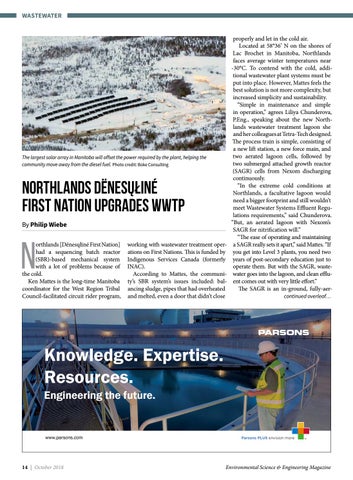
The largest solar array in Manitoba will offset the power required by the plant, helping the community move away from the diesel fuel. Photo credit: Boke Consulting
Northlands Dënesųłiné First Nation upgrades WWTP By Philip Wiebe
N
orthlands [Dënesųłiné First Nation] had a sequencing batch reactor (SBR)-based mechanical system with a lot of problems because of the cold. Ken Mattes is the long-time Manitoba coordinator for the West Region Tribal Council-facilitated circuit rider program,
working with wastewater treatment operations on First Nations. This is funded by Indigenous Services Canada (formerly INAC). According to Mattes, the community’s SBR system’s issues included: balancing sludge, pipes that had overheated and melted, even a door that didn’t close
properly and let in the cold air. Located at 58°36’ N on the shores of Lac Brochet in Manitoba, Northlands faces average winter temperatures near -30°C. To contend with the cold, additional wastewater plant systems must be put into place. However, Mattes feels the best solution is not more complexity, but increased simplicity and sustainability. “Simple in maintenance and simple in operation,” agrees Liliya Chunderova, P.Eng., speaking about the new Northlands wastewater treatment lagoon she and her colleagues at Tetra-Tech designed. The process train is simple, consisting of a new lift station, a new force main, and two aerated lagoon cells, followed by two submerged attached growth reactor (SAGR) cells from Nexom discharging continuously. “In the extreme cold conditions at Northlands, a facultative lagoon would need a bigger footprint and still wouldn’t meet Wastewater Systems Effluent Regulations requirements,” said Chunderova. “But, an aerated lagoon with Nexom’s SAGR for nitrification will.” “The ease of operating and maintaining a SAGR really sets it apart,” said Mattes. “If you get into Level 3 plants, you need two years of post-secondary education just to operate them. But with the SAGR, wastewater goes into the lagoon, and clean effluent comes out with very little effort.” The SAGR is an in-ground, fully-aercontinued overleaf…
Knowledge. Expertise. Resources. Engineering the future.
www.parsons.com
14 | October 2018
Environmental Science & Engineering Magazine
Visit WTP EQUIPMENT CORP. at WEFTEC booth 1437 27th Annual MAY 7 – 9, 2019 VENETIAN BANQUET CENTRE, VAUGHAN
19
SAVE THE DATE
ENVIRONMENTAL COMPLIANCE AND DUE DILIGENCE TRAINING EVENT A ‘MUST ATTEND’ EVENT FOR: Environmental Coordinators • Environmental Auditors • Consulting Engineers • Government Officers • Policy-Makers • Plant Managers • Hazardous Materials Supervisors & Technicians • Environmental Health And Safety Professionals • Spills And Emergency Response Teams • Environmental Health & Safety Reps. • Professional Engineers • Municipal Infrastructure Professionals • Environmental Lawyers • Pollution Control Operators • Design Engineers Produced by
▶ Learn more: www.canect.net
WASTEWATER ated, horizontal-flow rock media bed that uses a patented process to grow multiple sets of biomass that reduce ammonia in wastewater to non-detect levels, even with a lagoon effluent temperature that can fall below 1°C. SUSTAINABILITY “Northlands is one of four Manitoba First Nations dependent on diesel for power,” said Bruce Duggan, owner of Boke Consulting and an associate professor of management at the Buller School of Business at Providence University College & Seminary in Otterburne, Manitoba. Becoming sustainable is a big part of the new wastewater treatment plant on two fronts. The first is offsetting the site’s power draw through a 282-kilowatt solar array. “It’s the largest such array in Manitoba, with over 1,000 solar panels, each measuring one metre by three metres,” Duggan said. During the long summer days and even in the shorter days in winter, the solar cells will help power Northlands’
Cutaway view of a SAGR. A: HDPE liner preventing infiltration covers the sacrificial walls. B: Influent distribution chamber. C: Clean stone provides surface area for nitrifying bacteria. D: Linear aeration system creates fully-aerobic conditions. E. Effluent collection chamber. Photo credit: Nexom
grid, contributing enough energy to offset the 270,000 kWh/yr it will take to aerate the plant’s lagoons and SAGR. It will also power a new biomass heating system at Northlands’ school and a new geothermal heating system for several
buildings and houses. But, the wastewater plant does more than just generate its own power. In addition to treating the community’s wastewater, it is also being used to treat contaminated soil and groundwater. “No matter how careful you are with diesel, it will get into the ground, and when your community is built on an esker (a sand and gravel ridge), leaked diesel plumes underground easily,” said Duggan. “A small leak may seep down three metres but have a 10-metre spread.” Rather than “digging and dumping” each instance of diesel contamination, which could cost anywhere from $50,000 to over a million dollars to remediate, the contaminated soil is treating by lancing. Lancing is a process by which steel rods are pushed into the ground. Oxidizers and surfactants are injected to break down and unbind the diesel from the sand and gravel particles. Then, diesel and contaminated groundwater are pumped out through small wells. “By using the treatment plant’s lagoon and SAGR instead of consumable carbon filters for the leachate, we will be able to break down the diesel and associated chemicals and return the cleaned groundwater back to the ecosystem,” said Duggan. Philip Wiebe is with Nexom. Email: pwiebe@nexom.com
16 | October 2018
Environmental Science & Engineering Magazine
WATER
Lowering a section of the inspection tool into the aqueduct. Over 11 days, 16 sections of pipe, totaling 9,100 m, were inspected.
High-resolution technology used to inspect Bar-Wrapped aqueduct By Chris Garrett
A
fter experiencing leaks from a key bar-wrapped 90 cm diameter, 9,100 m long aqueduct, one water utility was determined to prevent future failures by embarking on a condition assessment program. The goal was to assess overall condition of the pipe can steel and bar wraps, not just the interior mortar lining, to predict future performance. Traditional methods are limited to visual inspections, either manned-entry or by utilizing camera systems. Advanced technologies have evolved to include two main categories: leak detection and pipe wall condition assessment. Both categories provide value in their own way. Leak detection is typically less expensive to initiate and it helps identify active leaks in a pipeline system, while also curtailing water loss. Pipe wall condition assessment tools aim to allow more pro18 | October 2018
active asset management by identifying susceptible pipe and applying rehabilitation prior to pipe failure. The use of high-resolution inspection technologies for pre-stressed concrete cylinder pipe (PCCP), steel and iron pipe has expanded over the last decade. These technologies, both traditional and advanced, have helped identify damaged pipe prior to catastrophic failure and their implementation is well understood, but not for bar-wrapped pipelines. The utility scheduled a shutdown to facilitate any inspection efforts. The pipeline was dewatered and access provided at pre-existing valve and blow-off vaults. Companies responding to a request for proposals were asked to perform a comprehensive non-destructive inspection of the entire pipeline and identify the location and magnitude of any defects. The bar-wrapped steel pipe was most
similar to AWWA C303, with the thickness of the steel canister fluctuating, depending on the head pressure present in various sections. Steel cylinder thickness ranged from 0.4 cm to 0.6 cm. The wire thickness and pitch was consistent throughout, with 11-gauge wire at a oneinch pitch. PICA Corporation proposed pulling an electromagnetic tool through contiguous portions of pipe, averaging almost 670 m per section. The tool would assess the condition of the steel cylinder, versus measuring the extent of any wire breaks. Unlike PCCP, where the primary failure concern is damage to the pre-stressed wires, the integrity of bar-wrapped pipe is more evenly shared between the cylinder and the bars. A cross-section of the material composition of the pipe identified between 90% – 95% of the metal presence found in the steel cylinder, versus 5% – 10% found in the wires. Between the award of contract and the fieldwork beginning, two tasks were completed. First, PICA modified its electromagnetic tool so that it could collapse through a 45 cm manhole and be rebuilt inside of a 90 cm pipe. Project manage-
Environmental Science & Engineering Magazine
ment meetings were also conducted regularly. Coordination meetings identified critical tasks to be completed prior to the inspection. Access locations were confirmed for fitness, rental equipment was secured, and it was established that the utility would also perform a visual inspection of the interior of the pipeline. Fieldwork commenced in January 2017, with crews inserting the inspection tool into the pipeline at a blow-off vault. Over 11 days, 16 sections of pipe, totaling 9,100 m, were inspected. One critical deliverable from PICA was providing inspection data within 48 hours of each inspection, identifying any "imminent failures". By locating high-risk areas, the utility would be able to perform rehabilitation work while the pipeline was already dewatered and out of service. Overall, the aqueduct was found to be in very good condition. However, PICA identified several sections that would benefit from immediate rehabilitation. Personnel entered the pipeline and mobilized to several of these locations to verify the inspection data. Cement mortar was chipped away and ultrasonic probes were used to document the changes in steel cylinder wall thickness. When analyzing the data, utility staff established baseline criteria for actionable levels of pipe wall loss and the associated confidence level. All pipe anomalies showing 50% wall loss or greater and a moderate or higher confidence level were physically inspected for verification by entering the pipe, chipping away the interior mortar lining and using a handheld ultrasonic thickness gauge for data validation. Once it was confirmed that PICA’s data was accurate, they relied on this to prepare drawings and specifications for the cost-effective rehabilitation of the aqueduct. With the inspection data verified, the utility extended the shutdown of the pipeline to address these areas. In total, 21 m of the 90 mm bar-wrapped pipe were replaced, and seven internal repairs with steel patches to address local corrosion pits had to be done. At the same time, two new access manholes were installed,
along with a manway upgrade. The inspection and repair work cost the utility $1.56 million, which is approximately 5% of the total cost if they had to replace the entire aqueduct. Chris Garrett is with PICA Corporation. For more information, visit: www.picacorp.com
Helping you make the most of every drop Through 22,000 employees working in over 400 locations across 6 continents, Stantec offers and maintenance expertise in: • Client Enterprise Solutions • Conveyance • Wastewater Treatment • Water Resources Infrastructure • Water Resources Planning and Management • Water Treatment • Wet Weather Flow & Urban Stormwater Design with community in mind stantec.com/water
ORIVAL WATER FILTERS are “Green” and Conserve Water
For Protection of: • Heat Exchangers • Spray Nozzles • Instrumentation • Pump Seals • I.E. & R.O. Units • Air Compressors • The Environment
ORIVAL
Cooling Tower
Water Source ORIVAL
Condenser
Chiller
HVAC / Full Flow
INSTRUMENTS
HEAT EXCHANGER
SPRAY NOZZLES
PUMP SEALS
213 S. Van Brunt Street Englewood, NJ 07631 (800) 567-9767 (201) 568-3311 Fax (201) 568-1916 www.orival.com filters@orival.com
Process Cooling
Features:
• Automatic Self-Cleaning • 10-12,000 gpm Units • 10 mic Filtration • Turnkey Systems • ASME Construction • No external power required
www.esemag.com @ESEMAG
O RI VA L
ORIVAL
Pollution / Wet Scrubber
Wastewater / Irrigation
October 2018 | 19
WATER
Six things to consider when selecting solenoid valves for reverse osmosis systems By Rob Lindquist
M
embrane-based reverse osmosis (RO) filtration systems offer valuable service in a wide variety of industrial and commercial water systems. They purify, improve taste, and provide savings in food and beverage processing; increase energy efficiency in boilers; and supply a range of other benefits in applications from water jet cutting, vehicle washing and humidification to restaurant and grocery use. One important component of these systems, typically used at several critical points, is the solenoid valve. Design engineers working for original equipment manufacturers (OEMs) face multiple options and issues when selecting these complex, highly engineered devices. Beyond the usual considerations of correct sizing and wattage, many current models may exhibit worrisome performance problems, as well as difficulties relating to certifications, availability, ease of assembly and support, among others. Fortunately, valve technologies are now available that avoid most of these problems, while providing significant benefits for the OEM and end user alike. There are six key things to consider when selecting solenoid valves for reverse osmosis systems.
Leakage past a valve’s seat can foul RO system membranes, which can increase replacement intervals and costs. Photo credit: Navintar, Stockadobe.com
Some statements will indicate that a product “complies” with a certain standard. However, untested and uncertified compliance does the OEM little good in jurisdictions that may require the certification itself. Look for valves that possess all the certifications necessary for the intended application.
be caused simply by poor connection system design. However, it can also be due to out-of-specification pressure, or thermal stress on the connection or other parts of the valve. Not all composite valves are designed or rated for the higher pressures and temperatures inherent in some RO system applications. For example, leakage past DOES IT HAVE THE PROPER WILL IT BE AVAILABLE a valve’s seat can foul RO membranes, CERTIFICATIONS? WHEN NEEDED? which can increase replacement intervals. OEMs must accommodate new regWhen evaluating valve makers, con- Each time membranes are replaced it can ulations in many parts of the world, sider availability issues such as quick cost thousands of dollars in time and including those specifying the use of shipment programs, local coverage, and material. Selecting a proven valve that leadfree products and more. Regula- the specific inventory of required com- does not leak when closed can eliminate tions and their means of adoption have posite valves. What are the lead times this additional cost. been changing with relative rapidity. and delivery schedules? Request the supCaution is advisable. In specifying com- pliers’ record of meeting shipment dates CAN IT CONNECT AND INSTALL EASILY, SECURELY, posite valves for RO systems, pay close for its quick-ship program. AND ECONOMICALLY? attention to how the certification status of each product is stated. IS IT RELIABLE? Connections can be a major concern Some don’t mention NSF certification Unfortunately, it is not uncommon when specifying composite valves for and this could legally preclude use of for some composite valves used for RO RO applications. an OEM’s RO system incorporating the applications to leak, even after only a few For example, valves utilizing tradicontinued overleaf… vendor’s valve in certain areas. thousand operating cycles. This issue may 20 | October 2018
Environmental Science & Engineering Magazine
EXCLUSIVE FINANCIAL SECURITY PROGRAM for engineers, geoscientists and their families Turn savings into more money in retirement with a RRIF, LIF or annuity
Get group pricing
Lower fees
More income in retirement
How much more? $344,371 Retail plan
$407,822 Engineers Canada-sponsored RRIF
$ 63,450 more*
Program participants get free investment guidance Start today – contact Angela Harvey at 1-866-788-1293 ext. 5786 or angela.harvey@gwl.ca or visit www.infosite.grs.grsaccess.com/engineers-canada Sponsored by:
Assumptions: The individual MER (management expense ratio) was calculated using the average Canadian equity mutual fund of 2.34 per cent obtained from Morningstar January, 2010. The group IMFE (investment management fee and expense) was calculated using the Jarislowsky Fraser Canadian Equity fund of 1.19 per cent plus GST. We’ve assumed a rate of return of five per cent on an investment of $500,000. $25,000 was withdrawn at the end of each year for 12 years. The accumulated assets in the chart have been rounded to the nearest dollar. Great-West Life and key design are trademarks of The Great-West Life Assurance Company (Great-West Life), used under licence by its subsidiaries, London Life Insurance Company (London Life) and The Canada Life Assurance Company (Canada Life). As described in this advertisement, group retirement, savings and income products are issued by London Life and payout annuity products are issued by Canada Life.
Sustainable Ecosystems
WATER
Soil retaining system helps urban trees reach It can be difficult to install a standard IS IT AVAILABLE IN BOTH threaded valve into a system and achieve NORMALLY CLOSED AND maturity NORMALLY OPEN VERSIONS? the preferred upright valve alignment.
tional NPT and solvent bond connections are often a source of frustration. These By Eric Keshavarzi may require considerable trouble and expense in equipment design, installation and assembly. are now advanced reenThere infrastructure and sustypes of quick connect technology tainability goals are of that incan maximize ease andimportance, speed, while and also creasing preventing leaks. achieving them requires techSeveral situations makein integranical knowledge and can training varied tion of valve components intotrees purified fields. Integration of soil and into water and ROsubstantially systems especially difficult urban areas improves susand time-consuming. tainability and helps alleviate some of our Often, desiredecological performance charactermost pressing challenges. istics are maximized by using, for examThese include air and water quality, rising ple, PEX tubing in one part of an RO systemperatures, flooding and erosion from tem, and PVC or copper (CTS) tubing in daily rainfall events. another part. However, this requires the The West Don Lands, in Toronto, Ondesign,is aspecification, purchase, assemtario, community that is people fobly and installation of custom fittings or cused, family friendly, environmentally adapters, at the place or places where comsustainable and beautifully designed for ponentsIt has of differing living. a Stage 1 types LEEDor NDmaterials GOLD come together. When many of these situcertification under the pilot program esations existby in the a single of equipment, tablished U.S.piece Green Building or in cases where OEMs must turn out Council. high volumes such equipment, added One notableofsustainable component, costs and lost time can be substantial. utilized in the design of the area’s streets, issue may arise called where Silva comis Another a soil retaining system posite valves threaded for NPT conCells™. Typical urban trees in the city nection must be assembled or installed. core die after approximately seven years. When a piping put together, However, Silva assembly Cells helpis extend their the valve is screwed onto the pipe with life spans, thus promoting the growth of a givenstreet torque or pressure, to the tightmature trees. ness requiredthe forCity a good seal. However, Although of Toronto had prethis procedure usually will notpart leaveofthe viously used Silva Cells as a valve aligned correctly, for instance in an stormwater management pilot program in upright position,their for use proper mounting. The Queensway, as part of site
G
Alignment adjustment may further tighten the valve. With brass or stainless steel valve bodies, such overtightening typically does no harm. But depending on the degree of rotation involved, the thermoplastic threads of composite valves may split or crack under the increased strain, requiring the entire valve to be replaced. Some valves include stops to prevent overtightening. However, this presents assemblers with almost equally aggravating problems, as they must then search for some other point in the system that can be tightened or rotated to compensate. In critical assemblies using composite valves, cautious engineers had tradiInstallation of through Silva Cells Mill Street. tionally gone thein trouble and expense of specifying unions to each end. development is new. In fact, the West Don New caninresolve this Landstechnology streets arevalves the first a Toronto problem by being available with three subdivision to be designed with this syspossible varieties union coupling on tem installed underofparking lay-bys and each end. sidewalks. Thus, pipingwas andthe valves disparate Mill Street first of subdivision types and materials may be connected street in Toronto to be designed to include quickly easily,system. with fewer this soil and retaining As thepiping lead accommodations and no custom fittings engineering consultant, R.V.Anderson or adapters.coordinated Additionally, each and NPTspecend Associates all plans coupling can be screwed onto the pipe ifications with the landscape architect. with the required for a proper seal. Abouttorque Silva Cells TheSilva valveCells is then rotated freely to the are a plastic/fiberglass proper position, and the integrated structure of columns and beams thatunion supjoint quicklyabove and easily secured. planting port paving un-compacted
Many composite valves are offered only in “normally closed” versions. This can force OEM designers to make equipment compromises. For example, they may have to purchase expensive diverter valves to compensate when not using “normally open” valves. Identify sources that offer both normally open and normally closed composite solenoid valve versions. This can offer needed design speed and flexibility, while simplifying sourcing with fewer part numbers to keep in stock. It may even save money. For instance, purchasing a normally open plus a normally closed valve and wiring them in series delivers the functionality of a diverter valve for less cost. DOES IT COME WITH soil. The structure hasTHE 92% void space RIGHT SUPPORT? and is a stable surface for the installation valves for reverse osmoof When vehicleselecting loaded-pavements. sis systems, it is important to consider the When properly installed, they can level of support available from the supplier. achieve an AASHTO H-20 load rating. It should extend beyond phone callsCode and Canadian Highway Bridge Design site visits. The Web has greatly expanded loading can also be achieved through apsupport possibilities providing techpropriate design. This for is the required load nical product information, specification rating for structures such as underground assistance with application vaults, covers andsizing grates and in areas of trafissues, and even 3 D engineering drawings fic including sidewalks and parking lots. and similar enriched content. The cell structure transfers the force to a base layer below the structure.
RobSoil Lindquist with Emerson/Asco. For withinisthe cells remains at low more information, visit: www.asco.com compaction rates, thereby creating ideal
WE DO IT ALL
CORROSION PROTECTION & SEALING SYSTEMS YOU CAN DEPEND ON
Extend Structure Life, Reduce Maintenance & Repair Costs • for industrial steelwork, pipework & road surfaces • above & below ground pipe, valves, fittings & steel • offshore marine piling protection • road, bridge, airport & asphalt applications A member of Winn & Coales International.
26 | May 2013 22 | October 2018
www.densona.com Toronto • Edmonton Denso North America Inc. 90 Ironside Cres. Unit 12 Toronto, ON M1X 1M3 Tel: 416.291.3435 Fax: 416.291.0898
Environmental Science & Engineering Magazine Environmental Science & Engineering Magazine
WASTEWATER
FOG busting research improves anaerobic digestion and reduces clogs
S
ewer clogging “fatbergs” that are made up of congealed fats, oils, grease and garbage are a menace to sewage systems, costing utilities time and money to break down and remove. Yet fats, oils and grease (FOG) are a tremendous energy source that can be broken down into biogas through anaerobic digestion. New research from the University of British Columbia (UBC) shows that FOG can be “busted” with a pre-treatment process that allows more FOG to be loaded to digesters, while keeping it a liquid at lower temperatures. The process uses microwave radiation to heat FOG to temperatures of 90°C to 110°C. While heating, hydrogen peroxide is simultaneously added in small doses. At high-temperatures. hydrogen peroxide disassociates into hydroxyl radicals, which are very strong oxidants. The combination of high temperatures and hydroxyls rapidly break down organic matter in a process that the researchers call microwave-enhanced advanced oxidation (MW-AOP). According to UBC research associate Asha Srinivasan, the process breaks down and reduces the volume of solids in FOG by as much as 80% and breaks down complex organic molecules into volatile fatty acids. Micro-organisms in anaerobic digesters can more easily break these down, boosting biogas production. Another benefit is that treated FOG remains in a liquid state at temperatures even slightly lower than room temperature. While the UBC research team initially looked at dairy manure and their recent paper focused on treating FOG on its own, Srinivasan said she believes the benefits will also help digestion at municipal wastewater treatment plants (WWTPs), allowing plants to produce more biogas and process collected FOG. MW-AOP can also be used to treat municipal sewage sludge, breaking down suspended solids content and reducing sludge volume by up to 80%, according to Srinivasan. It also increases the volatile fatty acid content in sludge, allowing anaerobic digestion to speed up. www.esemag.com @ESEMAG
A UBC method to break down fats, oil and grease can be used in municipal FOG management programs. Treated FOG (right) stays liquid at cooler temperatures. Photo credit: Clare Kiernan/UBC
While MW-AOP technology improves the solubility of FOG so it may clog less, keeping fats, oils and grease out of sewer systems in the first place remains a priority according to Barry Orr, sewer outreach and control inspector with the City of London, Ontario. London’s Your Turn pilot program encourages residents to collect kitchen FOG in compostable paper cups that can be dropped off at collection centres when filled. The cups are then delivered to a contractor that processes the waste in an anaerobic digester. In addition to keeping clog-forming FOG out of the sewer system, Orr said London is looking at diverted FOG as a valuable green energy source. “We know that people use a lot of oil, bacon and other meats and, if we could just capture that, there is a great opportunity for us getting it to the digesters,” said Orr. If the Your Turn FOG diversion program catches on in other cities, UBC’s research on microwave-enhanced advanced oxidation may be a huge benefit to anaerobic digestion plants that are handling more fats, oils and grease. “We know there is good value in the anaerobic digestion of FOG, so it’s very promising to see this research,” said Orr.
October 2018 | 23
STORMWATER
study finds Stormwater ponds not a major source of greenhouse gas emissions
S
tormwater retention ponds, which are common in developed landscapes worldwide, are not a significant source of climate-warming nitrous oxide (N₂O) emissions, a new Duke University-led study finds. Many factories, office buildings, airports, apartment complexes and retail centres, among other sites, use the ponds to collect runoff from roads, roofs, lawns and parking lots, and to filter out pollutants before the water is released into local streams or rivers. For example, the City of Toronto’s Earl Bales Stormwater Management Pond, which is one of largest stormwater management ponds in Canada, manages and treats 90% of total annual stormwater runoff from a 550-hectare catchment area. The pond helps to improve water quality, prevent erosion, and act as a source of irrigation water. Among the pollutants that stormwater ponds help remove is excess nitrogen, which, if left untreated, could spur oxygen-depleting algae blooms in downstream waters. According to Duke University, some scientists question whether there may be a trade-off to this benefit, since the process by which the ponds reduce nitrogen in runoff also produces nitrous oxide. Nitrous oxide is both a potent greenhouse gas and ozone-depleting substance. “Previous studies have suggested we might find elevated nitrous oxide emissions from these ponds, especially urban ponds where high levels of metal contaminants from road runoff might interfere with the complete reduction of the nitrogen,” said Joanna Blaszczak, a 2018 doctoral graduate of Duke’s Nicholas School of the Environment, who led the study. “Our research, which looked at 64 retention ponds in eight different cities and ecoregions across the nation, found no apparent trade-off,” she said. To conduct the study, sediment samples from stormwater ponds were collected and analyzed during the summer of 2014. Three samples each were collected from 24 | October 2018
Researcher Joanna Blaszczak collects samples from a stormwater pond as part of a study that finds stormwater ponds aren't a major source of GHG emissions, as some scientists feared. Photo credit: Jim Heffernan, Duke University
eight ponds in each city. Some ponds received runoff from heavily developed areas; some received runoff from moderately or lightly developed areas; and some were in largely undeveloped areas. The researchers measured the samples for nitrogen and metal concentrations and for the abundance of certain microbial genes that regulate the denitrification process in pond sediment. Samples were then incubated and placed in water-filled glass bottles for six hours, so the researchers could measure how much nitrous oxide was created and emitted. “We found there was almost no correlation, no single and simple link, between the intensity of nearby urban land cover and potential denitrification rates, across and within all cities,” Blaszczak said. The nitrous oxide yield from most ponds, even in heavily developed drainage areas, was within the range of rates found in freshwater bodies draining undeveloped landscapes. “This leads us to conclude that urban stormwater ponds are not likely to be
important sources of nitrous oxide to the atmosphere,” she said. While the study’s findings should help allay concerns that the ponds could be a major source of greenhouse gas emissions, other questions remain unanswered. “Stormwater ponds are essentially black boxes,” Blaszczak said. “We understand what goes into them and what flows out of them, but still have limited understanding of the chemical and biophysical processes that occur within them.” “Many of our team’s starting assumptions about how sediment chemistry would change with changing urban land use proved to be untrue,” she said. “That’s probably because urban ponds reflect previous land-use history as well as current land-use strategies. We’re only beginning to figure it all out.” Blaszczak and her colleagues published their peer-reviewed study in the journal Ecosphere. For more information, visit: www.nicholas.duke.edu
Environmental Science & Engineering Magazine
BIOSOLIDS The process is a simple and reliable solution that hydrolyses dewatered biosolids, using low-temperature steam, high-speed shearing and alkali, in an enclosed, low-pressure reactor. The project for St. Thomas also included on-site tank storage for up to nine months of biofertilizer product. The agreement also provided the city with turn-key management of the end product, including marketing, sales and best practice field application of the CFIA registered fertilizer. All of these considerations were factors in the final decision to move to a true resource recovery model. UNIQUE APPROACH This solution offers a unique approach to biosolids management. Whereas this process has previously been added to wastewater treatment plants to augment, and even optimize, existing processes and enhance resource recovery, this is the first project where plant operations were fundamentally altered around the low temperature Lystek THP process. In the case of St. Thomas, the smaller size of the plant, aging infrastructure and capital constraints made replacing the digester the most cost-effective solution for the municipality, while also facilitating the transition to a resource recovery centre.
The process hydrolyses dewatered biosolids, using low-temperature steam, high-speed shearing and alkali, in an enclosed, low-pressure reactor.
biosolids digester replacement project delivers savings and helps Sustainability By Kevin Litwiller and Sarah Mason-Renton
L
ocated between Lake Erie and Lake Huron, the city of St. Thomas, Ontario is a growing community with a current population of nearly 40,000. Like many smaller cities, St. Thomas had historically used anaerobic digesters as part of its wastewater treatment process. Biosolids from them were transported to the local landfill, which meant there was no opportunity for resource recovery. Despite maintenance and repair efforts, the city’s aging wastewater treatment plant’s digesters had begun to fail, which meant a new plan was necessary. These factors, combined with pending regulatory changes, as well as the city’s desire to have a sustainable, long-term solution, were reasons to find a better way to manage its biosolids. In partnership with XCG Consultants Ltd., the city’s project evaluation team considered two alternatives. The first was an anaerobic digestion process, which required upgrading the fail26 | October 2018
ing digesters and implementation of an energy recovery process. The second was Lystek’s THP process to produce CFIA registered biofertilizer that could be sold to the local market. In the final analysis, it was the clear economic benefits of replacing the failing digesters with a low temperature, patented and proven system that could recover resources to produce a valuable, federally registered end product that resulted in a recommendation. The Lystek approach offered significantly lower lifetime capital and operating costs than any of the alternative, short-listed options. In fact, it was determined through a detailed Net Present Value analysis that the solution would be able to provide the city with 40% reduction in cost savings. This solution would help the city to develop and implement a sustainable, cost-efficient, long-term biosolids management program, with capacity to service future growth.
®
ENVIRONMENTAL CONSIDERATIONS In addition to significant cost savings and technical merit, environmental considerations were another major factor in the decision. The project evaluation team noted that the process is “highly beneficial” through its conversion of processed biosolids into fertilizer and reuse of the large quantity of available nutrients. Biosolids typically contain significant amounts of valuable nutrients which are lost in landfills. However, the agriculture sector understands the need for high-quality nutrients and organic matter to promote robust plant growth and soil health. The performance of LysteGro biofertilizer has been repeatedly demonstrated through third-party field trials and repeat orders. Another benefit is the system’s ability to produce a product that meets, and exceeds, the toughest regulations in North America, which relate to the reduction and elimination of patho-
®
Environmental Science & Engineering Magazine
gens, while retaining essential macro- and micro-nutrients and critical organic matter. Instead of being sent to landfill, biosolids are now processed into a federally registered, Class A product that can be sold and utilized in the local market. A well-designed odour control system and quality-controlled approach to processing were other crit- The performance of LysteGro® ical points. The evaluation biofertilizer has been repeatedly team factored in Lystek’s demonstrated through third-party experience and approach to field trials and repeat orders. control and mitigate odours with a sealed, end-to-end processing, storage, transfer and end-product use system. SIMPLE AND PROVEN Originally developed in Ontario in 2000, the patented Lystek system is now being utilized by a rapidly expanding range of small, medium and large communities throughout North America. This includes cities and major metropolitan areas as large as Toronto and San Francisco, and smaller centres such as Centre-Wellington (pop. 28,000) and Guelph, Ontario (pop. 129,000). Some of these sites have been operating successfully for ten years.
RoFAS can handle whatever you throw at it. Designed to make quick work of the unusual loads of septage receiving, the RoFAS is a robust solution designed to treat the coarsest material. Want to see for yourself? Visit us at huberforum.net/rofas And stop by our WEFTEC booth 4628 to speak with an expert.
LESSONS LEARNED With low temperature thermal hydrolysis leveraged to replace, rather than augment, anaerobic digestion, higher levels of physical contamination can be present in raw wastewater. In these cases, a pre-processing step, such as supplementary grinding as well as maceration prior to thermal hydrolysis may be required to ensure the quality and integrity of the end output. Additionally, the dewatering and processing of raw wastewater and waste activated sludge can stress potential hydrogen sulfide levels released during dewatering. Understanding and identification of this possibility needs to occur early in the analysis so it can be factored into both the evaluation and design stages of the project. CONCLUSION The St. Thomas project demonstrates that replacing anaerobic digestion with the Lystek THP process can be a cost-effective solution for small to medium sized facilities with capital constraints and aging or lack of digesters. This is particularly true where the scale of potential energy production is not sufficient to make optimal use of the biogas produced. This solution has been successfully implemented to address the St. Thomas’ legacy infrastructure challenges and solids management requirements, while still prioritizing resource recovery and nutrient capture. Kevin Litwiller, BBA, and Sarah Mason-Renton, PhD, are with Lystek International. Watch a video of the St. Thomas project. www.esemag.com @ESEMAG
October 2018 | 27
WASTEWATER
Wastewater headworks screening can be challenging for smaller installations
A
plant’s headworks plays a crucial role in the pretreatment of influent for any wastewater treatment facility. It protects the operation of downstream equipment and enhances the efficiency of the overall wastewater treatment process. Because all wastewater debris starts at the headworks, proper screening and debris removal is imperative for the entire system. Pretreatment devices are, therefore, designed to remove or reduce large solids like wood, cloth, paper and plastics, while also dealing with grit and excessive amounts of oil and grease. A number of different types of equipment can be used to meet these objectives and there is not a one-size-fits-all solution that can be applied to every headworks situation. Matching the needs of the facility to the appropriate screen or debris reduction method is paramount for both protecting downstream equipment and ensuring screened out solids are handled efficiently and effectively. The wrong choice can result in headworks systems that do not meet the required level of protection of downstream treatment processes, or a system that is too costly for the plant’s requirements. RIGHTSIZING FOR SMALLER HEADWORKS Water treatment facilities in smaller towns and villages, as well as treatment works supporting institutions, prisons, resorts or remote facilities, have difficult choices to make when selecting their headworks systems. All require a solids control strategy, but lower flows and smaller budgets limit the available equipment options. The necessary equipment is called upon to effectively screen out solids and prepare them for disposal, while meeting the financial constraints of the smaller facilities. Some operators rely on manual bar screens to control the entry of large solids into their facilities. Historically, this technology was a workhorse of smaller plants, utilizing vertical bars with a 28 | October 2018
Auger Monsters, which typically use a 2 mm – 6 mm perforated plate, can provide facilities with a high capture rate and protect downstream processes.
spacing of 25 mm – 50 mm to catch debris. Manual bar screens represent an economical option, with the ability to provide a base level of protection. One of the biggest limitations of manual bar screens is the regular raking required by operators to keep the screen free of solids. With the recent increase in typical solid loading from disposable wipes in the waste stream, this unpleasant task poses a significant burden to many small facilities. Increased frequency of screen raking, particularly during storm flows, creates health and safety concerns for the operators, motivating many locations to seek more modern options. Additionally, plants are often challenged by the capture rate of solids by the vertical bars screening. This is usually not sufficient to protect the plant. An alternative to manually raked screens is automated coarse screens. These products typically also use vertical bars to capture solids before removing the screenings with an automated raking system. This type of screen is significantly costlier than manual screens in both capital expense and operational costs. Installation of automated bar screens
typically calls for civil work to modify channels, and can also require additional headroom in the headworks building to account for the automated raking system. In addition to the higher capital cost for the equipment, these modifications to existing infrastructure can quickly drive up overall project costs. Automated coarse screens also leave the facility with other challenges to overcome. First, as with manual bar screens, their vertical screening design does not allow them to capture finer materials. Perhaps more significant is the question of what to do with the materials that are screened off. Screened materials are wet and laden with fecal materials that are both odorous and difficult to dispose of. A solution to this problem is compacting equipment for the screenings. This, however, is an additional piece of equipment that must be purchased, installed and maintained. One solution for a smaller facility is an in-channel auger screen, such as the Auger Monster from JWC Environmental. This option fits into existing channels with little modification and provides the treatment plants with a fine
®
Environmental Science & Engineering Magazine
screening solution, as well as clean, dry and compacted solids at a reasonable cost. AUGER MONSTER The Auger Monster is an all-in-one headworks system that combines a grinder, a fine screen and a compactor to efficiently collect, clean and convey solids out of the channel. First, a Muffin Monster grinder shreds solids and breaks open debris, allowing soft organics to flow into the treatment system. Shredded solids are then captured by a perforated screening trough and removed from the channel by a rotating auger. As debris is removed, dual wash water zones rinse additional fecal material back into the treatment process. The dual helix auger then compacts and dewaters screenings before they are deposited into a dumpster. Some facilities choose to use continuous bagging systems to fully eliminate odours and make disposing of the screenings even easier. The innovative incorporation of a grinder into this system solves multiple issues for the treatment facility. First, it takes care of the large solids such as wood and other debris that may come to the plant’s headworks. Next, it shreds disposable wipes and rags that, if not shredded, can rope together in the auger and cause a system failure. Finally, by shredding all of the debris, captured organics are broken free and allowed to pass into the treatment system rather than be trapped in the screened material. The fine screening capabilities of the Auger Monster, which typically uses a 2 mm – 6 mm perforated plate, provide facilities with a significantly higher capture rate. This translates to less trash landing in the clarifiers and sludge systems, where it can clog pumps, valves and other treatment equipment. The Auger Monster’s ability to wash and compact solids offers plants a solution without having to buy an additional piece of equipment. Often a smaller plant will not have the capital for a screening washer. This means it must contend with smelly, wet screenings that attract both vermin and odour complaints from the community. By washing and compacting the solids, the handling and transport of the screenings is simplified and odour-free. A popular option for small, established headworks facilities, wastewater screening systems offer advanced debris reduction capabilities that can also fit easily into cramped spaces. They screen, clean and convey debris straight up and out of the sewer system, protecting the pumps downstream and leaving soft organics in the water. Prisons, in particular, are a common user of these systems. One plant recently installed a modular headworks system to remove the large amount of debris flushed by inmates. Prior to installation, treatment plant staff spent hours daily clearing pumps blocked with towels, jumpsuits, trash, shoes and bags. The new system, made up of a grinder, fine screen and compactor, shreds and removes the debris before the solids can choke the pumps. This frees plant staff from cleaning out pumps and keeps the headworks facility operating smoothly.
®
When it comes to emergency pumping systems, we have your back-up. Experience Innovation.
Since 1970, Thompson Pump has provided high quality, heavy-duty pumps for sale and rent to the Municipal and Construction markets. Our diesel-driven backup pumps are quickly replacing generator backup systems as the ideal contingency plan. Our exclusive and ecofriendly Enviroprime System® actively prevents blow-by from discharging onto the ground. Thompson’s diesel-driven backup pumps are available in sizes 3 to 18 inches and can easily handle flows up to 11,000 gallons per minute and solids up to 4 inches in diameter. 888.446.2177 | THOMPSONPUMP.COM
JWC is represented in Ontario by ACG-Envirocan. For more information, email: sales@envirocan.ca. www.esemag.com @ESEMAG
October 2018 | 29
WATER
Reliable river flow measurement helps ensure adequate water supplies By Ralf Brüning
I
n agricultural areas, a massive use of technology is needed to maintain consistent water supplies. Since such systems normally cover wide areas such as river courses or far-reaching canal systems, it is necessary to integrate a remote data transmission system. To make sure that flow is recorded constantly it is necessary to have a measurement system available which makes it possible to determine the velocity of water over the entire width of the water course, with varying flow conditions and flow levels prevailing.
It is necessary to have a measurement system available that makes it possible to determine the velocity of water over the entire width of the water course.
A cost-efficient method to acquire reli- in waters and canals with any widths or able insights on the prevailing discharge/ dimensions. Additionally, the transit time flow is the ultrasonic transit time measure- method is largely independent of conducment method. Nivus offers a system with tivity, density, temperature or viscosity. low maintenance requirements and high The measurement principle is based Page Vertical.pdf 1 2018-05-25 6:42 PM operational reliability, which can4 be used on an ultrasonic impulse transmitted
C
M
Y
CM
MY
CY
CMY
K
30 | October 2018
Environmental Science & Engineering Magazine
against the flow direction of the water needing more time to travel between two sensors (hydro-acoustic converters) than an impulse transmitted in the flow direction. The required times of flight are measured using a high accurate timing system and a signal correlation comparing both the transmitted and the received signal. The resulting difference between both times behaves in the same way as the average flow velocity within the acoustic measurement path. After that, it is possible to determine the average cross-sectional velocity (and hence the flow rate) from the average velocities measured within the individual layers considering the according velocity coefficients. Wetted area and the height between measurement paths and water surface are determined using external level signals (e.g., from ultrasonic level meters). By utilizing multiple measurement paths in various heights it is possible to gather a lot more information on the flow profile prevailing at the measurement
PLASMA-INJECTOR: COLD PLASMA SUSTAINABLE ODOR CONTROL    Â? Â?  Â? Â?  Â?  Â Â Â? €‚ƒ Â „… † ‡ Â? ‡‡ ˆ Â? Â?
spot. Total flow is then the total from individual flow values. Thus, higher accuracies can be achieved when measuring flow. Arranging multiple measurement paths crosswise reduces the impact of disturbing transverse flow which might distort measurement results. This allows for reducing the length of approach or discharge sections needed to calm down the flow profile.
an Ethernet connection. Expected flow rates at the measurement site were as high as 495 mÂł/s, with flow velocities of up to 2 m/s. To ensure continuous measurement in four levels, a measurement system based on the ultrasonic transit time principle (time of flight) was chosen. In the final stage, this system will be extended to 16 measurement paths. To prevent the measurement from disturbing influences expected at higher IMPLEMENTING RIVER velocities (e.g., caused by vibrations) and FLOW MEASUREMENT to minimize the risk of damage due to In one river application by Nivus, flow floating objects (branches, debris or simrate and velocity needed to be calculated ilar) it was decided to use streamlined and archived in order to determine val- sensors and fastening systems (covers). ues during dry and rainy periods. This Dimensions and flow profile of the meainformation can be used to control surement place were verified using a inflow rates and actively help protect mobile float-based solution. against floods. Since the measurement site was situ- Ralf BrĂźning is with Nivus GmbH ated far away from the control centre and which is represented in Canada by SPD in a remote part of the river, data had to Sales. For more information, email: be both saved on site and transmitted to sales@spdsales.com the centre using remote data transmission. This is accomplished by means of
ODOUR ELIMINATION with
SLUDGE REDUCTION 25% + Proven Reduction in Biosolid Generation 25% + Proven Energy Savings Substantial Carbon Footprint Reduction Results in Significant Cost Savings to offset Odour Control Expense See what our customers have to say about how we saved them!
‰ ‡Šˆ Š‹ Œ  Ž � �
www.esemag.com @ESEMAG
BIOLOGIC™ SR2
WWW.SCICORP.NET Come see us at WEFTEC - booth # 6918
October 2018  |  31
REMEDIATION
A timeline of the Boat Harbour cleanup. Photo Credit: Nova Scotia Lands
Nova Scotia’s Boat Harbour cleanup plan
A
provincial plan is slowly being unveiled for Nova Scotia’s largest contaminated site, known as Boat Harbour, where a 140-hectare collection of settling ponds, basins and
FAST, CONVENIENT, ECONOMICAL WATER QUALITY CONTROL.
AquaVial™ PRO
WATER QUALITY INDICATOR AquaVial™ PRO is the ideal water quality screening tool for water treatment professionals. Designed for monitoring microbial levels, biofilm formation detection, warning system for Legionella control, and efficacy confirmation of water disinfection systems. Developed in collaboration with the University of Waterloo, this advanced nanotechnology works using microbial cell wall surface recognition. Visual detection of bacteria, fungi and biofilm in 15 to 30 minutes, allows for rapid corrective action. Genemis Laboratories Inc 1.866.574.8929 sales@genemis.ca www.aquavialpro.com
32 | October 2018
coves receive tens of millions of litres of toxic wastewater, piped daily from nearby Northern Pulp mill at Abercrombie Point. Nova Scotia Environment Minister Iain Rankin announced on April 27 that the massive remediation project for contaminants like zinc, cadmium, mercury and small amounts of organic pollutants like dioxins and furans, will undergo a Class 2 environmental assessment, which typically takes 275 days, compared to the 50-day review period for Class 1 assessments. The latest figure for the cleanup of an estimated 350,000 cubic metres of contaminated material is $132 million. The goal of the cleanup is to return Boat Harbour to its original state as a tidal estuary. It first received industrial wastewater in 1967 and was sealed off from the ocean in 1972. In 2015, the Liberals passed the Boat Harbour Act, mandating the closure of the facility. The act allows time to plan and build a new wastewater treatment plant, as well as to plan the cleanup of Boat Harbour. Paper Excellence Canada Holdings Corp. has a lease to use Boat Harbour until 2030. Under this, it pays $25,000 a month to the province and covers the treatment facility’s operating costs. Actual cleanup of Boat Harbour won’t occur until 2020, and is expected to take four years at that point. But, there is plenty to keep the remediation team
busy in the meantime. In July 2018, a team under the guidance of consultant GHD will construct infrastructure necessary to carry out pilot testing, which is set to begin in August and conclude in winter 2019. This includes construction of a treatment laydown pad and dredging work compound. The treatment pad is comprised of a gated access area, a containment berm, lined sludge dewatering pad and supporting pipelines. A chain link fence will also be installed to separate the area from the operational effluent treatment plant, according to a project fact guide. Pilot project work will help project officials determine the most effective technologies to use in the cleanup phase of the project. Part of the process will include examining sediment behaviour, management, treatment, and its transport and eventual containment. The third and final stage will be the actual pilot testing of methods recommended by the design engineer, based on studies over a number of months. Planning will continue until 2020. The current phase is focused on scientific and technical planning studies, including: Phase 1 and 2 environmental site assessments, environmental baseline studies, geotechnical investigations, Mi’kmaq ecological knowledge study, bench and pilot scale testing, remedial action plan, environmental impact assessment and remedial design options, including detailed design.
Environmental Science & Engineering Magazine
CLIMATE CHANGE
Leaders issue joint statement on North American climate change initiatives
A
t the Global Climate Action Summit this September in San Fransisco, Catherine McKenna, Canada’s Minister of Environment and Climate Change, joined Jerry Brown, Governor of California, Jay Inslee, Governor of Washington, David Ige, Governor of Hawaii and Ricardo Rosselló, Governor of Puerto Rico, to endorse a joint statement on the North American Climate Leadership. The statement declares: “To protect our communities from harmful pollution, we will stand united in advancing improvements in efficiency, electrification and greenhouse gas emission performance of vehicles through information exchanges and collaboration. Our jurisdictions are already leaders on zero-carbon energy. We commit to go further, by reaffirming the commitment made at the North American Leaders’ Summit to work toward a goal of 50% of zero-carbon power generation by 2025, collectively across North America.” It goes on to say: “Connecticut, Hawaii and New York join Canada and Mexico in the Powering Past Coal Alliance, and resolve to phase out traditional coal power stations and avoid The Honourable Catherine McKenna, Canada’s Minister of Environment. new ones, without carbon capture and storage. “We also recognize that we cannot achieve the goals of the Paris Agreement by just reducing emissions from the electricity, transportation, and industrial sectors. We must remove harmful carbon from the atmosphere as fast as possible. We therefore resolve to manage natural and working lands to be a net sink of carbon; to protect and increase carbon storage capacity; and to integrate priority actions and pathways into GHG mitigation plans by 2020. Maintaining natural and working lands protects communities, economies, and ecosystems that depend on them, which in turn has significant for co-benefits for climate mitigation and adaptation. “Given the importance of ecosystem services, we encourage collaborative efforts to build robust observation and model• Lowest cost treatment for ling networks for mitigation and adaptation efforts, seek a betemerging contaminants ter integration of ocean observation systems and foster com• On-site wastewater/leachate plementary research on oceans and climate change.” treatment system The leaders also committed to increasing economic and • Chemical reactor with socio-ecological resilience of coastal communities and marine oxidant and catalyst ecosystems in the context of climate change through enhanced Leachates cooperation on ocean management. They also resolved to Phenols & BTX Also: PCBs deepen cooperation through existing platforms that seek to Package water and waste Polycyclic Aromatic incorporate the cost of carbon pollution into decision making. Hydrocarbons (PAHs) treatment systems for remote Finally, they recognized the importance of the Social Cost and First Nations Lignins communities of Carbon, a critical tool for assessing damages associated with Creosotes carbon pollution. Naphthenic acids www.globalclimateactionsummit.org
Destroying a wide variety of pollutants
bipurewater.com www.esemag.com @ESEMAG
October 2018 | 33
WATER
Rainy River commissions disinfection byproducts pilot study and WTP upgrades By Rob Sinclair
C
ontrolling the presence of trihalomethanes (THMs) and haloacetic acids (HAAs) in drinking water has been a significant challenge for both engineers and operators. These disinfection byproducts (DBPs) are defined as carcinogens and are typically present in treated water that is obtained from a water source (mainly surface) that contains a high concentration of natural organic matter. When water containing high concentrations of natural organic matter is treated with chlorine, THMs and HAAs can develop. HAAs and THMs are the main DBPs produced in the chlorine disinfection process for many surface water treatment plants in Canada. The challenge has been how to cost-effectively control these carcinogens to meet the Health Canada recommended Guidelines for Canadian Drinking Water Quality (HC-GCDWQ) maximum allowable concentrations, especially for small water treatment plants. The current HC-GCDWQ maximum allowable concentrations for THMs and HAAs are 100 ppb and 80 ppb, respec-
34 | October 2018
Pilot testing used advanced peroxidation, IX and NF membrane technologies to control THMs and HAAs.
tively. Many conventional surface water treatment plants experience THM concentrations of more than 200 ppb, well above the 100 ppb criteria. The Town of Rainy River water treatment plant regularly exceeded this limit.
KGS Group was retained by the Town of Rainy River (Pop. 900), located in north-western Ontario, near the United States border, to provide engineering consulting services: firstly, for assessment of treatment options coupled with pilot stud-
Environmental Science & Engineering Magazine
ies of two main treatment options, namely ion exchange (IX) and membrane systems; and, secondly, for the design, construction management and commissioning for the new, self-regeneration IX system. The IX system is designed to control THMs and HAAs. This project was initiated with a review of all potential options that included: magnetic ion exchange (MIEX), mixed oxidant (MIOX), advanced mixing and aeration (PAX), chlorine contact time control, nanofiltration (NF) and IX technology, advanced pre-oxidation, as well as a large raw earthen water storage area for low natural organic matter winter water for a year. A pilot program was launched for the Town, with support by the Ontario Ministry of the Environment, Conservation and Parks (MOECP). Natural Sciences and Engineering Research Council of Canada (NSERC) acknowledged that this pilot test could be beneficial to many water treatment plants in Canada and funded the project twice in 2015. The pilot program was funded again by Mitacs in early
Two fibreglass resin filters and one regeneration tank were installed at the Rainy River plant.
2016, due to its approach to practical and innovative engineering philosophy. KGS Group augmented the pilot study program with the University of Manitoba Civil Engineering Department, using
advanced peroxidation, IX and NF membrane technologies to control THMs and HAAs. KGS Group collaborated with the University of Manitoba to conduct continued overleaf…
HOW EFFICIENT IS YOUR AERATION PROCESS?
LET’S TALK
Scott McLeod, Aerzen Canada Sales Manager +1 450 424 3966 ext.226 scott.mcleod@aerzen.com
Real efficiency means operating the consumption profiles in wastewater treatment plants with precision. Aeration consumes up to 80% of total energy requirements; the greatest savings potential can therefore be found here. With our Performance3 product portfolio consisting of Blower, Hybrid, and Turbo technologies, we always find the most efficient and tailor-made solution for you. Benefit from up to 30% energy savings! LET’S TALK! We’ll be happy to advise you! www.aerzen.ca
www.esemag.com @ESEMAG
October 2018 | 35
WATER a preliminary investigation including a series of jar tests and column tests on the advanced pre-oxidation, IX filtration, and NF membrane technology. Results were shared with the Ontario MOECP, who supported KGS Group’s selection of the IX and NF for the pilot study. Application of these technologies demonstrated effective removal of the THM and HAA carcinogens.
CARCINOGENIC SUBSTANCES REMOVAL A large variety of IX resins are available for water treatment, each with unique chemical properties targeted to remove individual substances in water. KGS Group and the University of Manitoba tested commercially available resins for organic removal, with a series of jar tests, as well as column tests. Dowex Tan-1 resin proved to have the most effective organic removal rate of THE PILOT SCALE SYSTEM The pilot scale program tested the effec- approximately 80% of dissolved organic tiveness of the two selected technologies, carbon (DOC) and also reduced the total namely IX and NF, to ensure the necessary THM formation potential (TTHMFP) natural organic matter removal and asso- to below 50 ppb. It is also certified with ciated reduction in THMs and HAAs was NSF/ANSI STD 61 for potable water use. achieved. Equipment sizing with capital and operating costs demonstrated that the TREATMENT DESIGN IX system was optimal. A major concern AND INTEGRATION KGS Group managed the designwith the NF system was that the size of the system would require an expansion of the build project, using local electrical and existing building. NF was set aside, while a mechanical contractors to integrate the more detailed analysis of how IX could be new IX system into the existing plant. accommodated into a relatively old facility The design of the full-scale IX system did not require any modification to the with limited space was carried out.
water treatment plant’s current control system and building footprint. The firm designed a manual diverter valve system to re-direct water into the flow equalization tank, and then in to the IX system. After that, it returned to the existing chlorine injection point to minimize construction costs. This design boosted the removal of natural organic material in the coagulated and filtered water prior to chlorination. The Rainy River water treatment plant contained a relatively large tank that was intended for additional solids removal along with the existing treatment process, but it had never functioned as designed. The tank had been unused for the last twenty years. KGS Group incorporated it into the design, with innovative redesign of stairways and catwalks to eliminate the need for expensive building expansion beyond the project budget limits. This equalization tank was modified and painted with NSF 61 certified epoxy coating and finished with a transparent Plexiglas cover.
Waterra has expanded its product line of PES Inline Disposable Micro Filters. Our line now includes pore sizes of 0.2 micron, 0.45 micron, 1 micron and 5 micron. These capsule filters are available in two size formats — a 300 cm2 surface area version and a 600 cm2 surface area version for higher turbidity samples.
36 | October 2018
Environmental Science & Engineering Magazine
Submersible pumps were chosen to manage the space constraints, with installation in the equalization tank. There are four submersible pumps, all 3.8 kW, 5 HP, 208 V, 3-Phase, synchronized in parallel with an ultrasonic level controller and four variable frequency drives to provide hydraulic balancing for the existing and new system. Each pump produces approximately 4.7 L/s at 21 m of total head. The four pumps can produce approximately 16 L/s for the highest flow requirements associated with the maximum treatment capacity. Finally, two 1.07 m diameter, 1.83 m tall, fibreglass resin filters and one 1.07 m diameter and 1.52 m tall regeneration tank were installed at the Rainy River plant. The four submersible pumps will pump post-coagulation and filtration water through the two filters on an on-demand basis, paced by the current system outflows into the equalization tank. This system is equipped with an automatic self-regenerating process, minimizing work for the operators. Manual operation is also a practical option. The organic concentration in the IX filtered water was reduced to 20% of intake water and the required chlorine dosage for disinfection was also significantly reduced. The new IX system reduces chlorine consumption by 40%, which provides operational savings that are somewhat greater than the cost of the salt used by the IX system. The final process solution optimized the use of the limited available building footprint, thereby avoiding any need for a very expensive building expansion. The access stairway to the raised catwalk system was moved to allow the complete IX system to be installed under the catwalk. A building footprint expansion requirement would have precluded the project from moving forward because of the limited original budget, which was based on a per capita grant. The final costs for the water treatment system upgrade were about 10% greater than the grant from the Ontario government. The Town accommodated this relatively small cost as the grant value was quite arbitrary and was not based on the Town’s specific needs. Risk management was a very high priority for the project as the Town was relying on KGS Group to develop a treatment www.esemag.com @ESEMAG
solution that met Canada’s guidelines for THMs and HAAs. The step-wise process together with the rigorous pilot study program was the major risk management step to mitigating treatment risks KGS Group and the Town of Rainy River received an Award of Excellence from the Association of Consulting Engineering Companies for the Rainy River Water Treatment Plant project in 2017, as
well as a commendation by the Ontario Ministry of the Environment, Conservation and Parks. The plant has been operating for over 30 months, meeting THM and HAA water quality limits. Rob Sinclair, P.Eng., is with KGS Group. Email: rsinclair@kgsgroup.com
THE
SYSTEM FOR HDPE PIPE
THE FASTEST WAY TO JOIN HDPE PIPE — NO IFS, ANDS, OR BUTTS.
refuse-to-fuse.com © 2018 VICTAULIC COMPANY. ALL RIGHTS RESERVED.
October 2018 | 37
WASTEWATER TREATMENT
Advanced electro-oxidation technology removes Ammonia from landfill Leachate By Truman Wu
T
he application of a commercial scale pilot of an advanced electro-oxidation (AEO) treatment technology by Xogen Technologies, at a landfill in a major Canadian city, showed it could meet target removal of ammonia on economic terms, as well as deal with several other substances that were exceeding regulatory limits. Traditionally, landfill operators have dealt with leachate in a simple and inexpensive way by discharging it to a wastewater treatment plant. However, many treatment plants are struggling with tighter regulations and more stringent discharge limits. Landfill leachate is becoming a burden, mainly due to its high ammonia concentrations. Landfill leachate can easily have 30 to 50 times the ammonia concentration than is typically found in domestic sewage. Many sewage treatment plants have either stopped accepting landfill leachate or required landfills to meet certain discharge limits. That means landfill operators need to pretreat leachate before discharging into the municipal sewer. Air stripping and biological treatment are two main methods used to reduce ammonia in landfill leachate. However, both methods have significant drawbacks. Air stripping consumes a lot of energy and is very sensitive to pH and temperature. Biological treatment involves complicated treatment processes and is extremely vulnerable to temperature variations. AEO, a new treatment technology, is showing the ability to solve this problem. The process uses electricity to produce a large amount of oxidation ions which quickly react with contaminants such as ammonia, hydrogen sulfide and organics. The process is simple, clean and efficient. Xogen Technologies Inc., located in Orangeville, Ontario, has tailored its technology for the treatment of landfill leachate and has achieved many successes recently. The company has installed and 38 | October 2018
The system is turnkey and fully automated.
Item
Target Value
Achieved Value
Effluent NH3
<45 ppm
37 ppm in average
Effluent H2S
<5 ppm
<0.3 ppm
CAPEX
$633,000 (CAD)
$670,000 (CAD)
OPEX
$1.48/m³ (CAD)
$1.05~1.85/m³ (CAD)
Table 1. One month pilot test results.
tested several electro-oxidation treatment systems in various locations. The company recently completed another installation and pilot test project at a landfill located in a Canadian city. The landfill is facing pressure from the city to reduce ammonia (NH3) concentrations in the leachate, prior to discharging into the municipal sewer, or risk being cut off from the ability to discharge. A Xogen AEO system was installed at the landfill site to solve the over-strength ammonia issue. It was housed in a trailer and treated leachate at a rate of 28 LPM. After a one-month pilot test, results indi-
cated successful removal of ammonia from the leachate to achieve the targeted reduction at close to the projected cost. (See Table 1) RESULTS FOR NH₃ REMOVAL After treatment, the ammonia level in the leachate dropped from an average 94 ppm to 39 ppm on average against the 45 ppm target. The ammonia level in the leachate was reduced, based on parameters such as conductivity, hydraulic retention time and applied power density. All of these affect the cost of the treatment in terms of both capital expen-
Environmental Science & Engineering Magazine
POSITIVE DISPLACEMENT LOBE BLOWER
The principle of electro-oxidation technology.
Contaminants
Before Treatment
After Treatment
BOD (ppm)
26
<3
COD (ppm)
711
546
TKN (ppm)
110
25.3
Sulphide (ppm)
4.64
<0.02
H2S (ppm)
5
<0.3
Phenols (ppm)
0.05
<0.02
Total Coliform (CFU/100ml)
99
<10
pH
7.4
ditures (CAPEX) and operating expenditures (OPEX). The increase in costs from the initial estimate was due to having to resolve the very low conductivity of the leachate. A commercial unit is the next step and Xogen expects some further reduction in operating expenditures as commer- cial volumes are optimized, utilizing the three main variants.
system includes electricity and chemicals. Various chemicals were used to maintain and optimize the treatment process. These include a highly diluted acid to backwash and remove the scale from electrodes, some defoamer to eliminate foaming in the leachate, and some salt to increase leachate conductivity. Total operational cost of the pilot was $1.25 – $1.55 per m3 of leachate treated. This pilot test demonstrated the cost-effectiveness of advanced electro-oxidation technology to remove NH3 from the landfill leachate, while simultaneously treating other contaminants in the leachate.
OTHER TREATMENT EFFECTS During the pilot test, the Xogen AEO system also demonstrated beneficial treatment effects on other contaminants such as TKN, H2S and Total Coliforms, etc. The results are listed in Table 2. Truman Wu, P.Eng., is with Xogen OPERATING COSTS The operational cost of the Xogen AEO www.esemag.com @ESEMAG
Flow range < 10,000 Nm3/h Pressure range: < 100 kPa(g) Vacuum range: < 50 kPa(a) Sound Levels: <77 dbA @ 1m CSA/UL Certified
6.94
Xogen AEO system. Table 2. Beneficial treatment effects of the
Atlas Copco’s positive displacement blower is a century long proven, reliable technology. Design to suit any space, the ZL Series offers a cost effective, silent lobe blower alternative for any new or replacement project.
COMMITTED TO SUSTAINABLE PRODUCTIVITY We stand by our responsibilities towards our customers, towards the environment and the people around us. We make performance stand the test of time. This is what we call – Sustainable Productivity. For more information in regards to our Blowers or Low pressure compressors, please contact Mrs. Marie‐Josee (MJ) Quessy at 514.464.7095 or via email at marie‐josee.quessy@ca.atlascopco.com
Technologies Inc. Email: twu@xogen.ca
October 2018 | 39
CLIMATE CHANGE
New CSA standard addresses climate change and WWTP design By Joe Gemin and Pat Coleman
A
new CSA Group standard is being developed in partnership with the National Research Council of Canada as part of an important and timely strategy to address climate change in existing and new Canadian standards and codes. CSA S900.1 – Climate Change Adaptation for Wastewater Treatment Plants is being prepared by the Technical Committee on Wastewater Treatment Plant Design and Construction, and will provide owners of wastewater treatment plants (WWTP) with a methodology to assess the impact of climate change on their facilities. This standard is part of a broader proj-
Flow-Tronic is proud to announce that Vincent Favre has recently joined us as our North American Sales Manager. Vincent has an extensive experience in flow monitoring (wastewater, drinking and surface water) as well as remote data management and more than ten years of experience managing distributors in the US and Canada.
1-867-445-6432 v.favre@flow-tronic.com www.flow-tronic.com
40 | October 2018
ect, benefiting from millions in funding from Infrastructure Canada, enabling the National Research Council and its partners to undertake groundbreaking work to integrate climate resiliency into building and infrastructure design, guides and codes.
identify where they interact. For example, heating and ventilation (HVAC) systems are designed based on historical climate norms. Because of climate change, there could be a risk that an HVAC system designed in the past will not be sufficient to cool a building in the future. This is considered an “interaction” between the METHODOLOGY HVAC system and the increase in both The standard presents an eight-step temperature and duration of hot days. methodology, briefly outlined below. Step 6: Undertake a risk assessment: Step 1: Define the physical setting: Once important interactions are identified, The standard directs the user to place the they are given a risk score, determined by site in a physical and legal context. This multiplying the probability and severity includes jurisdictional boundaries (e.g., of an interaction. The user may decide conservation authority, watershed) and to look at past interactions and then look environmental features. forward at how their occurrence or severStep 2: Define the climate setting: ity might increase in the future. The standard provides a list of primary Step 7: Determine and evaluate adapand secondary climate events that could tation measures: Adaptation measures impact the facility (See Table 1). It directs are proposed for items with a high-risk the user to evaluate the historical pat- score. In some cases, further investigatern of events and then project how they tion may be required when a high-risk could change in the future. The standard interaction is found for which there is includes information on sources of cli- insufficient data to assess further. mate data, as well as on time horizon and Step 8: Summarize the results of the scenarios for future climate projections. assessment in a report: The report should Step 3: Define the WWTP context: document the process and prioritize The standard directs the user to define the risk. The report should recommend the WWTP facility through many lenses, where the owner should focus their cliincluding: process, structural, heating mate adaptation efforts going forward. and ventilation, utilities, sewerage system and effluent discharge. PILOT TEST Step 4: Make WWTP project considerThe draft standard was used to conations: The user develops a list of WWTP duct a pilot assessment on a plant in a components that might be impacted by cli- coastal location, and several important mate change. The standard provides a list observations were made: of over 50 sample components grouped • The assessment required a team with under eight categories: utilities; site; struc- expertise in process as well as heating and tural elements; building elements; equip- ventilation, electrical, instrumentation, ment for liquid process treatment systems; hydraulics, architecture and structural. equipment for biosolids process treatment Climate impacts on the plant structures systems; electrical systems; and instru- and equipment (e.g., the behaviour of ments and control systems. the building envelope during high winds, Step 5: Establish climate-WWTP the capacity of the HVAC system during interactions: The standard directs the warm spells, and stresses on structures user to take the list of climate parameters subject to high groundwater or corroand the list of WWTP components and sion caused by sea water intrusion) can Environmental Science & Engineering Magazine
Primary Climate Change Parameter
Secondary Climate Change Parameter
1
Higher maximum temperatures/more hot days
1
2
Higher minimum temperatures/fewer cold days
2
Changes in average groundwater level
3
Warm spells/heat
3
Invasive species
4
Precipitation extremes
4
Changes in migration patterns
5
Droughts or dryness
5
Changes in algae blooms
6
Changes in wind patterns
6
Changes in stream oxygen concentration
7
Blowing snow/blizzards
7
Erosion
8
Lightning/electrical storms
9
Winter/ice storms
Flooding
Table 1. Examples of primary and secondary parameters.
be as significant as climate impacts on the process. • The level of detail available on the plant impacts the effort required to conduct an assessment. A plant with inadequate documentation or with equipment near the end of its asset life will take more time to assess than a newer facility. • A site visit is important. The assessment is best done if the operator walks through the facility with the team explaining how the plant has responded to past climate events. • The team assessing a plant should refrain from seeking information on the plant until they understand the expected changes in the climate parameters in the area. The collection of data can be oner ous. Therefore, the team should make sure they only ask for what is required.
CONCLUSION Canada is experiencing the impacts of climate change, and the public relies on wastewater infrastructure to be resilient to these changes, continuing to protect both public and environmental health. Climate change can lead to an increase in the frequency and duration of intense and catastrophic events. In these cases, a facility must be able to survive the event and recover any treatment capacwww.esemag.com @ESEMAG
ity lost. In situations where the change entails a shift from the historical pattern on which structures or equipment are designed, then the equipment may need to be replaced or undergo structural modification. CSA S900.1 provides a structured framework that gives comprehensive guidance for a thorough assessment that would result in a report the owner can use to plan mitigation measures. This report can also provide stakeholders and insurance companies with an assurance that the owner/operator of the infrastructure is proactive in addressing potential challenges posed by climate change. Joe Gemin, P.Eng., is with AECOM. Pat Coleman, C.E.M., P.Eng., is with Black & Veatch Canada. Email: colemanpf@bv.com
OIL‐FREE POSITIVE DISPLACEMENT SCREW BLOWERS DRIVING DOWN ENERGY COSTS A reliable supply of compressed air is critical to ensure process continuity. Incorporating Atlas Copco’s proven screw technology and long standing internal engineering practices, the ZS Screw Blowers Series guarantees exceptional energy efficiency and reliability.
Flow range < 10,500 Nm3/h Pressure range: < 120 kPa(g) 18‐355 kW – 575V units “Plug & Play” c/w integrated VFD for simplified field installation. Up to 80% turndown capacity. Up to 30% more energy efficient than lobe blowers CSA/UL Certified
COMMITTED TO SUSTAINABLE PRODUCTIVITY We stand by our responsibilities towards our customers, towards the environment and the people around us. We make performance stand the test of time. This is what we call – Sustainable Productivity. For more information in regards to our Blowers or Low pressure compressors, please contact Mrs. Marie‐Josee (MJ) Quessy at 514.464.7095 or via email at marie‐ josee.quessy@ca.atlascopco.com
October 2018 | 41
WATER
Choosing the right sodium hypochlorite pump can prevent off-gassing By Tom O’Donnell
T
he use of sodium hypochlorite is common in many industrial applications and for potable water disinfection. Sodium hypochlorite, which has the chemical formula NaOCl or NaClO, is an oxidizer whose reactions can be extremely corrosive. When used in concentrated forms, the solution, if handled improperly, can burn exposed skin and cause severe eye damage. Also, when sodium hypochlorite solutions come in contact with some metals, flammable hydrogen gas may be created. If these containers are heated, they may explode due to the buildup and release of chlorine gas. From a production standpoint, the main challenge in handling sodium hypochlorite is overcoming its tendency to “offgas” when it is being pumped or metered. Off-gassing occurs when it begins to decompose in a storage tank or transfer pipe. When this decomposition occurs, which happens at an accelerated rate in higher pH concentrations and at elevated ambient temperatures, it transforms into a salt solution that generates oxygen bubbles. As these accumulate in the pumping or metering system’s suction lines, they can cause a loss of prime, which will inhibit process effectiveness. Therefore, any operation that uses large amounts of highly concentrated sodium hypochlorite must identify and utilize pumps that will not be susceptible to off-gassing. Neptune Series 7000 pumps are available in PVC and Kynar® materials, Always use a high-stroking pump model with a short stroke which are suitable for sodium hypochlorite applications. length. This operational configuration is less likely to permit the accumulation of gas in the pump head, which will lead to
Building Better Communities At Associated Engineering, our vision is to shape a better world for future generations. That is why we have been a carbon-neutral company since 2009. Sustainability is part of our business as well as every project we undertake. Our holistic approach considers climate change impacts to create sustainable and resilient solutions. Associated Engineering provides consulting services in planning, engineering, landscape architecture, environmental science, project management, and asset management. We specialize in the water, infrastructure, environmental, transportation, energy, and building sectors
www.ae.ca
42 | October 2018
Environmental Science & Engineering Magazine
a lower risk of off-gassing and result in optimized performance. If the operation requires the pumps to be idle for an extended period of time, gas can build up in the suction lines and pump head. In these conditions, it is recommended that the pump be outfitted with a bypass line that features an automated valve so that the sodium hypo chlorite can be recirculated when it is not being actively fed by the pump. Storage tanks should not be located in direct sunlight. The higher ambient tem peratures that can be created by direct sunlight will increase the sodium hypochlorite’s off-gassing rate. Higher-than-needed concentrations will increase the rate of off-gassing. The proper concentration should also be combined with a metering pump featuring a straight-through head design so that no gas can nest and bind the pump. This will also reduce the rate of off-gassing. When configuring the pumping system, a short, flooded suction-pipe arrangement with the suction piping traveling down from the storage tank to the metering pump is most effective. This design allows any gas bubbles that are produced to flow back to the storage tank, rather than into the pump. This also means that the metering pump should not be mounted on top of the storage tank, unless the pH level of the sodium hypochlorite is very low. If the setup allows, an air vent should be used to purge the valve in the head of the metering pump. Purging the pump head will enable any trapped sodium hypochlorite to be evacuated, which will prevent it from reaching the pump head.
likely that gas will accumulate in the pump head. In addition, these pumps can be outfitted with an automatic vent valve that allows any trapped gas to be purged from the pump head. Most models of this nature are also offered with manual control, automatic control or fully programmable control features that allow them to produce flow rates of up to 76 L/hr. Motor-driven diaphragm metering pumps feature a straight-through flow path, which effectively eliminates any areas within the pump head where gas can nest or lodge. The pumps are self-priming, available in capacities to 1,135 L/hr, and can be provided with automatic frequency control. A micrometer dial can adjust the pump’s capacity up to a 10:1 turndown ratio while it is running. Depending on the needs of the specific application, the pumps can be available in PVC and Kynar materials of construction, which are ideal for sodium hypochlorite service, and all parts within the gearbox are submerged in oil for extended service life.
®
CONCLUSION Sodium hypochlorite is one of the most versatile bleaching, cleaning, deodorizing and disinfecting compounds available. However, while its advantages are myriad, sodium hypochlorite must be handled carefully, especially when used in higher concentrations. The overriding operational concern is its propensity to off-gas, particularly when it is used in solutions with higher pH levels and at elevated temperatures. If the harmful effects that off-gassing can have are not taken into consideration before a metering pump is selected, the IDENTIFYING THE RIGHT PUMP result could be an operation that will face Mechanically actuated diaphragm excessive downtime, caused by pump malfunctions that can lead to expensive pumps (electronic or motor-driven) work well in sodium hypochlorite applica- repair or replacement. tions. This is because the pump piston is attached to the diaphragm, with the Tom O’Donnell is with Neptune and PSG. Email: tom.odonnell@psgdover.com forward (positive) movement of the piston ensuring positive diaphragm return, www.psgdover.com. which optimizes the pump’s suction capabilities. More specifically, the best choices for sodium hypochlorite handling are metering pumps that have a high stroking speed (300 strokes per minute) and short stroke length, which makes it less www.esemag.com @ESEMAG
HIGH SPEED MAGNETIC BEARING TURBO BLOWER
INNOVATION AT WORK Atlas Copco’s high‐speed magnetic bearing turbo blower is a decade long proven, reliable combination of revolutionary technologies. The ZB VSD offers a range of features and benefits all integrated into one package.
Flow range < 12,000 Nm3/h Pressure range: < 120 kPa(g) Highest energy efficiency in the industry. Fully integrated “Plug & Play” package factory assembled and tested for simplified field installation. CSA/UL Certified
COMMITTED TO SUSTAINABLE PRODUCTIVITY We stand by our responsibilities towards our customers, towards the environment and the people around us. We make performance stand the test of time. This is what we call – Sustainable Productivity. For more information in regards to our Blowers or Low pressure compressors, please contact Mrs. Marie‐Josee (MJ) Quessy at 514.464.7095 or via email at marie‐ josee.quessy@ca.atlascopco.com
October 2018 | 43
STORMWATER
Municipal governments are taking action on climate change, as they bear its brunt, experiencing flooding, property damage and potential impact to resident safety. (Photo by Marty Haas, Stockadobe.com)
Vaughan establishes stormwater climate change risk assessment strategies By Chris Wolnik and Craig Schritt
M
unicipal governments are taking action on climate change, as they bear its brunt, experiencing flooding, property damage and potential impact to resident safety. It will continue to affect municipal owned assets, infrastructure and operations which are designed to manage stormwater, more frequently and with greater impact in the future. The City of Vaughan in Ontario has implemented a stormwater charge and collaborated with local and regional governments and the Toronto Region Conservation Authority (TRCA). In 2011, the Regional Municipality of York established a Climate Change Working Group comprised of representatives from its local area municipalities. The objectives of the working group 44 | October 2018
included: sharing leading practices on climate change management, and providing mutual learning and networking. It conducted a joint climate change risk assessment on stormwater and wastewater management in 2014. With participation from the Cities of Vaughan and Markham, Town of Aurora, as well as York Region, TRCA and Lake Simcoe Conservation Authority, they conducted a three-day climate change risk workshop using the climate change risk assessment methodology and tool developed by Deloitte for the City of Toronto. The outcome was a better understanding of key aspects of a typical climate change risk assessment. In 2015, Vaughan decided to build on the risk assessment workshop exercise by
working with the Ontario Climate Consortium (OCC), led by the TRCA, to conduct a climate change risk assessment of key stormwater infrastructure components. OCC received funding support from the Great Lakes Integrated Sciences Assessments Centre to advance climate change adaptation action plans in York Region by establishing the frameworks, tailoring data management systems and enhancing staff capacity for conducting risk assessments of municipal assets and services. Steps in an environmental risk assessment include risk identification, analysis and treatment. They can be a useful decision-support tool in assisting decision-makers in identifying what would be considered “acceptable risks” and those that must be managed. The next step is to prioritize strategies to reduce the severity and probability of occurrence of environmental risks. One of the unique aspects of the risk identification phase was the development of vulnerability maps. This involved taking asset data from stormwater ponds, pipes, ditches and culverts and plotting it against a variety of factors associated with climate change impacts. The vulner-
Environmental Science & Engineering Magazine
ability maps provided a geospatial reference for some of the key parameters that warranted further investigation during the risk assessment exercise. More than 22 informational maps were created, including: historical flood calls and known pipe defects; low lying areas and regional storm flood lines; catch basins overlaid with depth to the water table; and stormwater pond construction data overlaid with storm sewers. Another key step in the risk identification phase involved developing eight climate indicators, including parameters such as heavy rain accumulation in one day and five days, as well as days with rainfall greater than 30 mm and greater than 100 mm. The risk analysis phase involved several components, including developing indicators, determining impacts and consequences. During indicator development, the team discussed one climate change indicator and determined what the impact would be for each of the four asset categories: stormwater ponds, stormwater pipes, ditches and culverts. (See Table 1) continued overleaf…
The safe solution. U.S.F. S.F Fabrication’s Hatch Safety Grate System is available in a variety S.F. ariety of configurations to meet virtually ually any application. The system allows for routine maintenance of pumps uall and equipment when closed and may act as an additional barrier er when open. It allows ngs without exposing themselves to people to move freely lly around the hatch opening dangerous fall-through. All Hatch Safety ety Grates feature: • Tamp Tamper-res r istant 316 SS hinges res and nd hardw har are • Po Powder-coated aluminum grates to resist corrosion res • Hold old open devices to lock the grates in their full upright and open position • Ca Can be ret r rofitted into existing access openings
Our experienced team provides a quick turnaround on quotes, drawings and deliveries. Call us today 1.800.668.4533 or email us at sales@engineeredpump.com
1635 Industrial Ave. • Port Coquitlam, BC V3C 6M9 Phone: 604.552.7900 • Fax: 604.552.7901 sales@engineeredpump.com • www.engineeredpump.com
Electrically operated and portable, the Hydrolift-2 actuator is the ideal choice for the frequent user of the Waterra Inertial Pumping System with moderate to extreme pumping requirements.
This actuator eliminates the fatigue that can be
experienced on large monitoring programs and it can result in a big boost to your field sampling program. The power and endurance you need — without breaking a sweat.
• suitable for use with Standard Flow, High Flow & Low Flow inertial pumps • fully adjustable — adapts to almost any size casing or protective well casing & can also be used with flush grade well completions • perfect for purging & sampling 2" diameter monitoring wells up to 200 feet deep • most efficient well development system available
www.esemag.com @ESEMAG
October 2018 | 45
STORMWATER Table 1: Risk analysis – Stormwater mains for three climate change indicators.
The next component of the risk analysis process involved determining the consequence of each risk source for the stormwater asset under review. The team used a table showing people, environment, cost (including reputation), infrastructure and logistics. Each had five predefined levels. For example, a stormwater main that was subjected to an extreme one-day rainfall (>52 mm) could result in surcharging, overflow and eventually flooding. If cost damages were incurred, representing a 5% – 10% capital/operating budget variance, the consequences would be considered moderate under the cost category. Therefore, the consequence would be considered moderate. The final component of the risk analysis process involved determining the top risks. (See Table 2) The final phase is risk treatment, which involves implementing measures to reduce or mitigate risk. Stormwater system adaptation options include: increasing capacity,
replacement of pipes for sewage, altering road maintenance, and re-vamping various land-use developments (parking lots, parks, etc.). Two main strategies exist with respect to flood prevention and control: subsurface-oriented and surface-oriented. In the former, network capacity is increased, generally by replacing pipes limiting the discharge with larger diameter ones or by installing subsurface storage. In surface-oriented solutions, open waters such as ponds or channels are constructed in which stormwater may be stored and delayed following heavy rainfall events. As the team reviewed the stormwater climate change risk assessment, a prioritization of risk treatment options started to emerge, particularly related to flood prevention and control. Collection of data for risk assessment is an important part of the process, but the real fun comes in how you use it. As discussed earlier, one of the deliverables
The idea of clean water is easy to grasp.
from the climate change risk assessment project was a series of maps depicting various stormwater concerns, e.g., infrastructure in areas with a high water table, in low lying areas, and areas with flood complaints from residents. Each of these concerns appeared on a map, independent of one another. Upon project completion, the City of Vaughan started looking at ways of using the data as part of the risk treatment process. One use for the data was to enhance the City’s Heavy Rain Protocol. It is implemented by operations staff to prepare and react to heavy rain projections. In order to prioritize areas of the City for operations staff to ensure stormwater infrastructure is working effectively, a high level map was created by overlaying the areas of concern. For example, parts of the City may have infrastructure like a stormwater pond in areas with a high-water table, but a low number of flood calls from residents. This would have a lower priority Stormwater Quality Services include: Ministry of the Environment Compliance Inspections Oil/Grit Separator Unit Tracking Stormwater Flood Response Lab Analysis Stormwater Ponds Small Spills Removal Jellyfish® Filter Consulting
If you have a Stormwater issue, we’ll solve it!
Specialists for the Inspection, Maintenance and Repair of Stormceptor® Units and Jellyfish® Filters
Simply put . . . all life depends on it. 46 | October 2018
519-647-3729 minotaurltd.com
Environmental Science & Engineering Magazine
Table 2: The top six identified risks.
compared to areas with infrastructure in low lying areas, but with a high number of flood calls from residents. Priority areas were colour coded on the map, and a quick-look legend was added, outlining the concerns for each of the City’s blocks. Along with this map, a worksheet for each block was developed so operations staff could record concerns and work completed. During one April 2018 storm, the
flood protocol map was a useful tool. It ensured operations staff could prioritize their routes to ensure the most vulnerable areas received the most attention, minimizing flood risk and property damage for residents. The results from the Climate Change and Risk Assessment Study have also been used in the creation and enhancement of several other programs and pilot projects. The City of Vaughan success-
fully applied for funding to complete a low impact development retrofit pilot project to aid in reducing flood risks and adapt to the pressures from climate change. Implementation of this project is expected to be completed late 2018 and monitoring completed in 2019. Chris Wolnik and Craig Schritt are with the City of Vaughan. Email: chris.wolnik@vaughan.ca
#BIOSOLIDS HAPPEN! …and because they do, you need proven, reliable, end-to-end, organics management solutions.
TF: 888.501.6508 www.lystek.com · info@lystek.com www.esemag.com @ESEMAG
October 2018 | 47
PUMPS
Upgrading to mechanical pump seals conserves water and improves energy efficiency By Mark Savage and Sam Ajram
T
he environmental performance of products and processes in all sectors is increasingly coming under critical review. Sustainability, conservation of natural resources and reduced environmental contamination directly influence the design and selection of equipment. There are many processes that can be addressed to improve sustainability and minimize environmental impact, while at the same time maintaining or reducing operating costs. Included in these processes are centrifugal pumps that are used in most industrial manufacturing, processing and municipal water and wastewater operations. One of the vital components of a centrifugal pump is the seal around the rotating shaft
which passes through a stationary pressure casing or housing. The seal stops the liquid or gas from escaping to the environment. Sealing systems are vital in maintaining pump efficiency, reliability, energy consumption, water usage and control of emissions. These factors can materially facilitate total life-cycle cost reduction and sustainability objectives. Sealing performance can be considerably improved in most centrifugal pump applications by upgrading from traditional compression packing to a mechanical seal technology. COMPRESSION PACKING When sealing a centrifugal pump, the objective is to allow the rotating shaft to enter the wet area of the pump, without
allowing large volumes of pressurized fluid to escape. The discharge pressure of the pump will force fluid back behind the impeller, where it attempts to exit by way of the rotating drive shaft. To minimize this leakage there needs to be a seal between the shaft and the pump housing that can contain the pressure of the process being pumped, and also withstand the friction caused by the shaft rotating. Compression packing has been used to seal centrifugal pumps for well over 100 years. Also referred to as gland packing, it is a braided, rope-like, and lubricated material that is packed around the shaft in rings, physically stuffing the gap between the shaft and the pump housing, within a stuffing box.
Us @ Visit oth #642 o EC B WEFT
48  |  October 2018
Environmental Science & Engineering Magazine
WATER LEAKAGE AND CONSUMPTION For compression packing to work, some leakage must be maintained to lubricate and cool the packing material. So the packing rings allow for an adjustable, close-clearance leak path parallel to the axis of the shaft. But, as the packing ages through use, some of the lubricant that is embedded into the packing is lost, reducing the volume of the packing rings. The pressure that squeezes the rings together is also reduced, increasing the amount of leakage. Periodic adjustment of the packing follower will bring the pressure back into specification, and control the excess leakage. But, increasingly, that maintenance is not always being performed at required intervals, or adjusted correctly. As the number of centrifugal pumps that incorporate the use of compression packing has decreased, the training and understanding of packing maintenance has waned. Consequently, under-tightening and over-tightening of the packing rings is a
www.esemag.com @ESEMAG
Cutaway of a pump showing the packing seal chamber.
prevalent and growing misapplication of maintenance of centrifugal pumps, with critical consequences to both water consumption and energy draw. Under-tightening results in too much leakage. Even when properly adjusted, packing leakage can amount to many litres of liquid leaked per minute. This can be either aqueous solutions comprised of varied benign or caustic chemical compo-
sitions, or particles in suspension or slurry, depending on what is being pumped. The heavier the suspension or slurry content is in the liquid being pumped, the more water is needed to get packing to work reliably. Typically, a clean external flush is piped into the stuffing box through a lantern ring, which keeps the packing lubricated, cool and flushed of continued overleaf…
October 2018 | 49
PUMPS sive heat which degrades the packing. Increased friction also wears the shaft prematurely. From an energy consumption perspective, that additional friction of the packing gripping the shaft creates increased drag, requiring more drive power to turn the shaft. It is that drag which creates an additional, and significant, parasitic energy draw. The importance of this friction-induced energy draw is critical to assessing the energy efficiency of compression packing. But, this is not the only factor influencing energy usage with compression packCutaways of mechanical seals for pumps. ing. When examining the energy draw component of a total life-cycle cost analabrasives and chemicals. FRICTION AND PARASITIC ysis, other factors need to be considered. These include: (a) the external flush that Normally, some portion of the leak- ENERGY DRAW age is continually being released into the Friction is always present in centrifugal is piped into the stuffing box. This presatmosphere. pumps using compression packing due to surized water or fluid needs to be moved Under-tightening of the packing rings the large surface area of the packing rings from a source location to the packing and use of external flushes increase this in contact with the shaft. Over-tighten- which requires a pump that draws elecatmospheric release proportionately, ing of the packing rings restricts leakage tricity. (b) In applications like mining, along with the potential for environ- flow, increases friction between the pack- where compression packing is more commental impact. ing and the shaft, and generates exces- monly used, water added via the packing flush to maintain a clean environment around the packing needs to be removed later. (c) The energy transferred from the hot metal of the pump to the fluid within the packing chamber. These energy draws are not typically measured directly. Instead, current and voltage fluctuations utilized by the pump motor are assessed under varied operating conditions to determine how much power is being consumed by parasitic influences. This enables packing energy deficiencies to be identified. MECHANICAL SEALS An alternative to compression packing is the mechanical seal, which resolves many of the sustainability and environmental-impact issues inherent in compression packing. These mechanical seals require a much lower water and energy demand, and have substantially reduced leakage, making them much more efficient at containing volatile or hazardous fluids, aqueous solutions and slurry suspensions. In addition, mechanical seals require no maintenance, once installed. A mechanical seal is comprised of a stationary primary element which is fixed within the pump housing, and a rotating mating element fixed to the 50 | October 2018
Environmental Science & Engineering Magazine
shaft. Precisely machined, these two components are pressed together by a flexible load element, meeting at a wear face, while the extreme tolerance precisions between the two elements minimize leakage. Wear faces are supported on an extremely thin lubricating film, typically 0.25 microns thick. Available in a wide variety of types, arrangements and materials, mechanical seals are found in the majority of centrifugal pumps today. MINIMIZED WATER CONSUMPTION AND LEAKAGE Mechanical seals require very little flush water injected into the seal chamber. Compression packing used in abrasive pumping applications requires significant volumes of water to be injected into the stuffing box. In comparison, a mechanical seal in the same service requires only a small fraction of this water volume. These seals create an extremely restrictive leak path perpendicular to the axis of the shaft, between the two sliding seal faces. This results in almost no leakage to the atmosphere.
are well suited to reduce or eliminate volENVIRONMENTAL IMPACT Efforts made toward improving sus- atile or hazardous fluids and their harmful tainability, whether by reduced water and vapours from escaping into the environenergy use, or by eliminating the dis- ment. They should be specified as the stancharge of harmful fluids and gases, not dard sealing solution, particularly when only provide a benefit to the environment the pumped fluids present a hazard. by reducing environmental impact, but also a benefit to manufacturers by reduc- Mark Savage and Sam Ajram are with John Crane, Inc. For more information, ing operational costs. email: annie.wood@johncrane.com, or Mechanical seals in centrifugal pumps, ES&E march 2017 Ad.pdf 1 10/03/2017 11:32:33 AM and particularly dual mechanical seals, visit www.johncrane.com
You are looking for a partner who understands your objectives. We are your solution for automation.
WE ARE THE ENGINEERS OF PRODUCTIVITY.
REDUCED POWER CONSUMPTION The amount of power required to drive a mechanical seal is up to 80% less when compared to compression packing. This is primarily because the seal faces have less frictional energy losses due to the extremely precise mating between the stationary and rotating elements. Additional energy reduction requirements are from the reduced need for flush water to be pumped into the seal, which is required with compression packing. C
M
Y
CM
MY
CY
CMY
K
DUAL MECHANICAL SEALS Designed to ensure maximum sealing safety, dual mechanical seals are typically defined as a single assembly that contains a pair of seals. A cavity is formed between the two seals within the assembly that is filled with a barrier or buffer fluid that separates the pumped liquid from the atmosphere and environment. Dual mechanical seals allow for near complete control over the seal operating environment and the fluid film lubricating the seal faces. They provide maximum elimination of leakage of the fluid being handled in centrifugal pumps. www.esemag.com @ESEMAG
Increase the productivity and reliability of your production systems. How? It’s easy: Get us involved in project engineering as early as possible. Our mutual dialogue results in process automation solutions which increase the safety of your systems and reduce your total costs of operation throughout the entire manufacturing process. Learn more at: www.festo.ca/processautomation
October 2018 | 51
REMEDIATION
Proper equipment and procedures ensures accurate, usable data from soil samples By David Kaminski
I
n all types of environmental testing, using proper sample collection methods is vitally important, as the data analyzed in the laboratory is only as good as the quality of samples collected in the field. Soil testing and sampling is no different than any other kind of environmental testing in this regard. Collecting soil samples by the correct methods is the only way to get accurate, usable data. When collecting soil samples to test for volatile organic compounds (VOCs), every action performed from the time that the soil cores are collected to the preparation of the samples for shipment can affect VOC recovery and overall quality of those samples. Soil samples
can show significant losses in VOC concentration within only seconds of opening soil cores. Due to this inherent volatility of soil samples, following an exact and careful methodology that covers all parts of the sampling process is of the utmost importance. PROPER COLLECTION AND HANDLING OF SOIL CORES One of the primary factors that can affect VOC recovery in soil samples is the time spent handling the soil core after the liner is opened. Other factors that may contribute to the rate at which VOCs are lost from the core include the soil type (consolidated vs. unconsolidated), soil
moisture content, disturbances of the soil core integrity, ambient temperature and the amount of heat generated by the soil coring method. Considering all the possible ways that a soil core can lose VOCs, it is vital to follow the best practices while handling the cores and collecting soil samples. First, use a soil coring tool with a liner. Acrylic liners are most common and have the advantage of being easily opened along their length for sampling. It’s best to cap the acrylic liner immediately after collection to preserve VOCs. The liner should not be split until immediately before it is going to be sampled. Once the liner is split, the sample must
Christopher George, P.Eng., PMP, has been appointed as RVA’s newest Regional Manager. Based out of RVA’s Sudbury office, Chris specializes in wastewater engineering. Chris joined RVA following graduation with a Bachelor of Engineering in Civil Engineering from Lakehead University in 2005. This appointment recognizes Chris’s commitment to RVA, and our clients, as demonstrated through his dedicated efforts and increased responsibility for Business Development, Project Management and Technical Engineering. Chris was appointed a Principal of RVA in January of 2018.
RVAnderson.com 52 | October 2018
416 497 8600 Environmental Science & Engineering Magazine
be collected as soon as possible. If the samples cannot be taken immediately after the cores are drawn, it may be necessary to keep the core liners on ice to regulate the temperature of the cores until they are sampled. Finally, before sampling, screen the cores for high VOC concentrations to better select quality samples. One common mistake to avoid is sampling from the container used for screening the samples rather than from an undisturbed core section. Another practice to avoid is taking a second soil core for samples after screening the initial boring, as there is no guarantee that samples from different locations will match in terms of their VOC content. Lastly, bulk sampling methods should be avoided in favour of field-preserved or sealed sampling methods. There are three different methods of actually sampling a soil core to send to the lab for analysis, all with their own advantages and limitations to consider. These are bulk, sub-core and sampling using an En Core® sampler.
The En Core sampler has several advantages over field preservation and bulk sampling methods.
BULK SAMPLING Bulk sampling is done by essentially cutting or scooping the sample from an unlined soil core, then packing that sample in a wide-mouth jar with no preserva-
tion. The lab will then take this jar and prepare a small sub-sample from it to be analyzed. Many factors can affect the accuracy of samples collected using the bulk samcontinued overleaf…
The Spectra Field-Pro features a heavy-duty, all-inclusive design that offers the user increased flexibility with no external cables, chargers or batteries to worry about. Designed by consultants, for consultants. • HEAVY DUTY CONSTRUCTION • LARGE CAPACITY BATTERY INCLUDED PROVIDES 8 HOURS OF OPERATION • BUILT-IN VOA STAND • ADVANCED ELECTRONIC FLOW CONTROLLER MAINTAINS A STEADY FLOW RATE • BUILT-IN STORAGE COMPARTMENT – FOR CHARGING CABLES, FIELD BOOK, TOOLS, WELL KEY, ETC. • ALL CABLES INCLUDED – TO ENABLE USE OF ALTERNATE (115 VOLT AC) POWER SOURCE • EZ-LOAD PUMP HEAD ANGLED ON TOP OF UNIT
www.esemag.com @ESEMAG
October 2018 | 53
REMEDIATION pling method. These include: soil type; microbe content of the soil; time taken to collect the sample; air space left in the jar; ambient temperature; hold time of the sample in the jar before it is prepped and analyzed; time spent subsampling in the lab; and, finally, whether the jar was properly sealed after the sample was collected. Grit from the soil can often catch on the rim of the jar and prevent it from sealing. Due to all of these possible issues, accuracy of bulk sampling varies widely, from just 0.01% of true value up to 95%. Studies have shown that bulk sampling, at best, gives an indication of the presence of VOCs but not an accurate estimation of concentration.
Core samplers and EasyDraw syringes are widely used for this reason. Vials used in sub-core sampling are typically supplied by the laboratory as part of a soil sampling kit, and are generally pre-preserved and weighed to allow easy calculation of the soil sample’s weight. Once preserved, the holding time for samples using sub-core field preservation methods is 14 days, as long The sampler is removed from the T-handle and as the samples are cooled at 4oC. placed in a pre-labeled VOC-proof bag. Field preserved sampling is divided into two sub-methodologies: high level accepted across North America, and is and low level analysis. High level analyrequired in many Canadian provinces. sis is used when VOC concentrations are Either sub-core sampling equipment or greater than 200 µg/kg. Samples requiran En Core sampler can be used. ing high level analysis are preserved in Field preserved sampling is done by methanol. Low level analysis is used FIELD PRESERVATION SAMPLING collecting plugs or sub-cores from the when the VOC concentrations are less Collection of field preserved samples soil core that are placed in vials filled than 200 µg/kg, or where the analytiis covered by US EPA Method 5035A, with a preservative. Soil sub-core sam- cal detection limits used are lower than which was implemented in 1997 and ples are best collected using a soil core a lab can achieve with a 50:1 dilution of updated in 2002 to standardize sam- sampling tool designed to capture an methanol in water. pling and field preservation and avoid approximately 5-gram or 10-gram samLow level samples are preserved in the random error and low bias present ple of soil to achieve a 1:1 ratio of soil to sodium bisulfate solution. In low level in bulk sampling. This method is widely preservative (weight to volume). Terra analysis, carbonate or calcareous soils
WEFTEC 2018 New Orleans | October 1-3 Visit us at booth #4517
HARDERSHARPERFASTERSTRONGER Check out our featured product online before the show.
sithechopper.cranepumps.com
54 | October 2018
Environmental Science & Engineering Magazine
can react with the bisulfate solution. So, it is important to first check the soil for effervescence prior to collecting these samples, to prevent the vial from cracking or bursting. Two vials are collected for low level analysis. The second sample is used for quality control and as a replicate, since the entire volume of the sample is required for analysis. High level samples are diluted for analysis. There are some limitations to low level analysis. It is considered to be only semi-quantitative because the aqueous solution used is a poor solvent for soil VOCs. This causes results to be biased low. In addition, high concentrations of acetone can be formed by the preservative itself in some organic-rich soils. Despite the limitations of low level analysis, sub-core sampling using field preservation techniques is an effective methodology and is widely accepted by regulators. It is an advantageous method for laboratories because it requires no further preparation of samples by the laboratory doing the analysis. It also doesn’t require any special tools or procedures for the laboratory to process samples. In addition, VOC concentrations in samples collected using field preservation remain stable throughout the 14-day hold time and beyond. There are disadvantages to sub-core sampling with field preservation. For example, the seals of the vials used to collect samples can leak, causing a loss of preservative or VOCs. Another issue is the need for more experienced field staff, as the process used to collect field preserved sub-core samples is more complicated than other methods. Lastly, shipping restrictions may apply to high level samples as they contain methanol (although this typically is not an issue if the samples are properly labeled and have a volume of less than 500 mL). THE EN CORE SAMPLER The only alternative method to subcore sampling with field preservation within US EPA Method 5035A is sampling using an En Core sampler. This is the only commercially available sampler listed in Method 5035A and is both a sampling tool and a sample container. There are three major components to the En Core sampler: the reusable T-hanwww.esemag.com @ESEMAG
dle, which holds the sampler and is used to push it into a soil core; the En Core sampler itself, which is where the soil sample is collected and stored; and the cap, which seals the sampler shut for transport to the lab. Once the sample is collected, excess dirt is cleaned from the sampler upon removing it from the soil, the cap is snapped into place on the sampler and then the sampler is removed from the T-handle and placed in a pre-labeled VOC-proof bag to be shipped to the lab. The En Core sampler has several advantages over field preservation and bulk sampling methods. Because it eliminates transfer of the soil sample into vials and the need to weigh vials in the field, it allows for more sample throughput per day. Additionally, it requires minimal training to use effectively, doesn’t require field staff to handle preservative in the field and has a long shelf life (no preservative expiration dates to consider). Because there are no preservatives involved in field work using the En Core, there are no sample shipping restrictions and ran-
dom errors in sample results, which often come from mistakes in field preservation, are much less common. Finally, En Core samples are shipped to the laboratory in a proprietary VOC-proof bag, which further prevents random error in results. The En Core sampler delivers such consistent results, in spite of variations in the experience of the field staff, that it is often used to minimize liability concerns. There are some limitations to the En Core sampler. If it is being used under sampling Method 5035A, the samples must be preserved at the lab within 48 hours. Samples are reported in dry weight, so an extra jar of soil must be collected to measure the moisture content of the soil at the laboratory. Lastly, the per-sample cost of using the En Core sampler is higher than that of the field preserved sub-core method. However, some of this extra cost is offset by time savings. David Kaminski is with QED Environmental Systems Inc. For more information, visit www.qedenv.com
Find your
BLANKET! with Markland’s Automatic Sludge Blanket Level Detector Helps you: Operate de-sludge pumps only when necessary Prevent carryover Optimize feed density Reduce Energy Use
Contact Markland today. Call 905-873-7791 • 1-855-873-7791 in NA markland@sludgecontrols.com
A half century of service to the water and wastewater industry
www.sludgecontrols.com
October 2018 | 55
WASTEWATER
BC firm seeking wastewater-contaminated site for full-scale technology evaluation
B
BI Pure Water’s next step is to evaluate a production version of its new advanced oxidation process (AOP) for wastewater treatment.
I Pure Water has been approved for a $350,000 federal grant for a production version of Biperliminate™, its new advanced oxidation process (AOP) for wastewater treatment. The company is seeking a federal or government wastewater-contaminated site for deployment of the production system. The grant is designed to reduce the risk for customer implementation. The technology has already been successfully pilot tested on municipal landfill leachate in British Columbia, an Alberta landfill leachate high in phenol, and a legacy industrial site in Vancouver high in naphthalene and xylenes (creosote). Advanced oxidation technologies have gained interest in recent years because of their outstanding technical characteristics for eliminating a variety of pollut-
GREAT TANKS • GREAT SERVICE (519) 469-8169 | WWW.GREATARIO.COM 56 | October 2018
ants in water and wastewater, according to market researcher BCC Research LLC. With increased public awareness of emerging contaminants, the market for AOPs is expected to grow. AOPs such as UV plus peroxide and ozone are used in the U.S. on various wastewaters, including those at heavy industrial sites. Pollutants are reduced to water and carbonates/vinegar by an AOP. BI Pure Water is seeking the assistance of a municipality/jurisdiction and consulting or process engineers to identify an ideal treatment site with the following parameters: • A landfill leachate contaminated with industrial refractories, e.g., phenol, PAHs. • Before or after sewage treatment (where a sewage treatment plant may be under-performing or disrupted due to pharmaceuticals, industrial chemicals, etc.). • Old industrial site, e.g., creosote, dyes, poly-chlorinated biphenyls. • Refinery or frac waters, e.g., naphthenic acids, PAHs, coal tar waters. • Pulp mill wastes (large molecules not digestible by bacteria-lignins). • Many other wastewaters with low BOD + high COD, such as, refractory or too toxic to bacteria. Sites may include those requiring a lower upfront capital cost, less time to process the wastewater, lower temperatures, or a smaller footprint than biology. In many cases the system can replace granular activated carbon and stripping. The Build in Canada Innovation Program (BCIP) helps Canadian companies of all sizes to move their state-of-the-art goods and services from the laboratory to the marketplace. The program helps innovators land a first major reference sale, sell their innovation but keep the intellectual property, and other benefits, by financing a government project. For more information, email: ianw@bipurewater.com
Environmental Science & Engineering Magazine
WATER system operation. It is installed for each zone at the high elevation to minimize suction of sediment into the line when the water drains. A drain is installed at each planter area to collect surface runoff. DETERMINING DRIPLINE LENGTH AND FLOW The distance between the laterals and the spacing of emitters is based on soil type, plant materials and slope of the ground. Laterals are spaced properly in order to deliver full coverage to planted areas. They are available with emitters 300 mm, 450 mm and 600 mm apart. The maximum length of a landscape dripline lateral is determined by the maximum allowable pressure loss in the laterals. A properly designed landscape irrigation system can greatly reduce the volume of wasted water. Photo by Bonepony, Stockadobe.com
Proper irrigation and drainage for landscape beds can cut water use and improve plant health By Jahangir Chowdhury
I
rrigation to landscape planters is important when drought conditions persist. Moisture deficiency in the plantation beds can significantly affect plant health and survival, but over-irrigation may be more detrimental to some species if water is not properly managed. A properly designed landscape irrigation system can greatly reduce the volume of wasted water. SUBSURFACE DRIPLINE IRRIGATION Subsurface dripline irrigation systems are usually the most efficient since they irrigate only the root zone and minimize runoff and evaporative loss. This system delivers water slowly to the soil, so attention must be paid to ensure that this low-volume system is being run long enough to deliver appropriate quantities. Fertilizer can be easily injected into inline drip systems and distributed directly to plant root zones, which prevents human and animal contact. Ferwww.esemag.com @ESEMAG
tilizer injectors can also be used to add chlorine if clogging in the dripline occurs. A subsurface dripline irrigation system is a simple grid of drippers formed by parallel emitter tubing lines. Emitter lines consist of about 17 mm polyethylene tubing with factory installed drip emitters at specific intervals. Subsurface emitter lines are usually buried 150 mm to 300 mm below the surface and installed with air vents, automatic flushing ends and a planter drain. A 120 mesh (0.125 mm) filter is also installed in the mainline downstream of the fertilizer injector to prevent clogging of the emitters. The emitter lines, or dripline laterals, are connected by 25 mm headers on both sides. The header provides a method for flushing the lines by an automatic flush vent. The vent flushes any sediment from the tubing each time the system starts up, and then closes down to allow normal
SOIL TEXTURE AND PRECIPITATION RATES Soil type and properties will greatly affect the design of dripline irrigation system. The soil’s intake rate, or how fast it absorbs water, dictates how quickly water can be applied by the irrigation system. Coarse, sandy soil absorbs water very quickly, while silts and clay have a very low intake rate. Fine textured soils, once wet, retain moisture longer than coarse-grained soils. Subsurface dripline systems rely on the soil to evenly spread water throughout the planting area. The more homogeneous the soils in the planting area, the more uniform the water distribution. Site topography will also affect application and flow of water. The design of the system must take into account the slopes on the site, since runoff may occur with slopes of 3% or greater. Precipitation rate (PR) is the rate at which landscape dripline applies water (maximum flow) to the soil. Precipitation rate can be calculated for a subsurface irrigation by using the following formula: Precipitation rate (mm/hr.) = [Maximum flow (m3/hr) x 1000] ∕ [Planting area (m2)] Assuming a planting area of 30 m2, the precipitation rate calculated for maximum flow of 0.756 m3/hr would be 25 mm/hr. Once the precipitation rate is determined, the designer can select the soil texture. If they are unsure of the exact soil type, or know that soils will continued overleaf…
October 2018 | 57
WATER differ on a site, they can use the mini- OPERATIONAL COMPONENT DESIGN In order to maximize the efficiency of mum recommended emitter spacing and the maximum recommended flow a subsurface dripline irrigation system, rate to ensure that water is evenly dis- a controller valve with battery operated timers is needed for each zone on the tributed. supply line. It needs four separate irrigation programs which can have differOBTAINING SITE INFORMATION Obtaining site information is a very ent start times, watering days, day cycles, important step in the design procedure. and station timing. The control valve is Designers need to create a map showing typically used to automatically activate the size, shape, elevation contours and the inline drip system when required. distance from the water and electricity Operators can determine irrigation fresources to the area to be irrigated. The quency and what time of day it occurs. map should also indicate where there The valve needs to have both internal and are slopes and in which direction and external manual open/close control to open and close the valve without electrihow steeply the ground slopes. Water for the planter irrigation is usu- cally energizing the solenoid if necessary. A flow meter needs to be installed ally provided by a municipal watermain. If watermain pressure is too low or too onto the 50 mm service line immedihigh, the designer needs to adjust the ately after the source watermain. The design and equipment selection to pro- velocity safety limit for the service line vide a system that operates correctly with is 1.5 m/s or less, with an operating presthese pressure variations. Excess water sure of no more than 60 psi. One soil moisture sensor is needed from the plantation beds is connected to per zone, at the driest location inside municipal stormwater catch basins. the plantation area. These can be used
to control individual valves or to override the irrigation controller. Moisture sensors can override the irrigation controller timer if there is too little, or too much, water in the soil. Proper installation is crucial to the effectiveness and long-term operation of any inline drip system. Prior to installation of the last connection on every header, the system should be flushed thoroughly to keep all pipes and fittings clear of dirt and debris. In order to maintain a consistent and healthy level of moisture in the soil a regular operating schedule must be prepared and the controller properly programmed. Jahangir Chowdhury, M.Sc., P.Eng., is with AECOM. Email: jahangir. chowdhury@aecom.com
Waterra HS-2 Oil/Water Interface Sensors and WS-2 Water Level Sensors are advanced products that utilize the most recent electronic technology. Their tough polyethylene reels protect the stainless steel tape from damage and dirt while their lightweight and slim profile make them very portable. Our sophisticated HS-2 ultrasonic sensors are more sensitive in a broader range of hydrocarbon products than conventional optical systems and they produce the quickest interface detection available. Innovative design features, compactness, portability and reliability — all at a competitive price. • extremely low power consumption
• Kynar® or polyethylene coated 3/8" stainless steel flat tape
• membrane on/off switch
• powered by 4 AA cells
• sensitivity adjustment (WS-2)
• metric or imperial
• auto shut-off
• open reels also available
58 | October 2018
Environmental Science & Engineering Magazine
PRODUCT & SERVICE SHOWCASE ELECTROMAGNETIC INSERTION FLOW METER
The AVI-MAG is Flow-Tronic’s hot tap full profile electromagnetic insertion flow meter. Installed under pressure without the need to interrupt water supply, the specific design of its multi-electrode sensor compensates for variable flow profiles and provides high accuracy. Easily deployed and removed for inspection, cleaning or calibration, the AVI-MAG is a low-cost and proven flow monitoring device. ACG – Envirocan T: 905-856-1414 F: 905-856-6401 E: sales@acgtechnology.com W: www.acgtechnology.com
RADAR AREA/VELOCITY FLOW METER
The Flow-Tronic Phoenix system is a new non-contact Radar area/velocity flow meter, specially designed for river, irrigation canal and large channel monitoring applications. The advanced beam angle of 32 degrees allows a full velocity spectrum measurement and provides highly accurate flow measurement. Level can be monitored with an ultrasonic sensor or a Radar sensor. ACG – Envirocan T: 905-856-1414 F: 905-856-6401 E: sales@acgtechnology.com W: www.acgtechnology.com
ENGINEERED SKID SYSTEMS
CHEM-FEED® Engineered Skid Systems are efficient, tough and lightweight. Units for single or dual metering/dosing pump configurations are offered. CHEM-FEED skids are constructed of 6061-T6 polyester powder coated aluminum and have welded joint construction. They are easily mountable with optional wall mount bracket. Skid systems will accommodate any Proseries®-M chemical
www.esemag.com @ESEMAG
metering injector pump, diaphragm or peristaltic. Simply drop it in place and make your connections. Blue-White Industries T: 714-893-8529 F: 714-894-9492 E: sales@blue-white.com W: www.blue-white.com
METERING PUMPS
Proseries-M® MD-3 Chemical Metering Pumps deliver precision chemical feed for the treatment of municipal water and wastewater. The Hybrid MD-3 Diaphragm Pump has 2000:1 turndown and smooth chemical dosing with no pulsation dampener required. Proseries-M® MD-3 has near continuous flow which results in no gas build up or loss of prime. With 380 strokes per minute, the Proseries-M® MD-3 provides a remarkably steady flow. Blue-White Industries T: 714-893-8529 F: 714-894-9492 W: www.blue-white.com, www.proseries-m.com
ELECTRIC ACTUATORS
The Chemline V Series Reversible Rotary Electric Actuators have output torques up to 8,860 in.-lb. They are ideal for butterfly valves up to 20 ˝and ball valves up to 6 .̋ These actuators feature molded polyamide 6.6 covers, die cast aluminum bases with thermally bonded epoxy powder coating, and NEMA 4X rated enclosure. NEMA 7 and 9 enclosures are available. Chemline Plastics T: 800-930-CHEM (2436) F: 905-889-8553 E: request@chemline.com W: www.chemline.com
BLOCK WATER FROM ACCESSING ASSETS
Road erosion, premature concrete failure or water ingress into wastewater systems? Denso’s 12 ˝LT tape has been proven for nearly a century to block water from accessing assets. It
won’t harden or crack and is the perfect solution to protect concrete and prevent I&I. Applied in minutes, requiring minimal surface preparation, no mixing or curing, it can be buried immediately. Denso North America T: 416-291-3435 E: sales@densona-ca.com W: www.densona.com
PLUG-AND-PLAY FLOW METER
The new Picomag from Endress+Hauser is a simple, reliable and maintenance-free plug-and-play flow meter for utilities in a pocket-sized format. Picomag offers customers easy commissioning with Bluetooth, using its SmartBlue App, as well as seamless system integration thanks to IO-Link technology. Endress+Hauser Canada T: 905-681-9292 F: 905-681-9444 E: info@ca.endress.com W: www.e-direct.endress.com/ca/ picomag
FLOW MEASUREMENT
Proline 300/500 flow measurement technology provides continuous on-board diagnostics and meter verification with Heartbeat Technology™, and fast commissioning and intuitive operation via display, web server and WLAN. It offers maximum flexibility with configurable I/O. Endress+Hauser Canada T: 905-681-9292 F: 905-681-9444 E: info@ca.endress.com W: www.ca.endress.com/proline300500
MONITOR CHEMICAL USAGE AND CONTAIN SPILLS
The SpillSafe LX™ Drum Scale from Force Flow accurately monitors amount of chemical used and remaining, and provides protection against uncontained chemical spills. An automatic deploying spill bladder keeps overall platform October 2018 | 59
PRODUCT & SERVICE SHOWCASE height to a minimum for easy drum changeout, while still allowing up to 250 litres of spill containment. The SpillSafe LX helps you comply with Environment Canada spill containment requirements. Force Flow T: 925-686-6700 F: 925-686-6713 E: info@forceflow.com W: www.forceflowscales.com
CHLORINE EMERGENCY SHUTOFF
The Eclipse Chlorine Emergency Shutoff System stops a chlorine leak within seconds of detection by automatically closing the ton container or cylinder valve. While mounted, the actuator allows the valve to be manually opened or closed. Halogen Valve Systems are the only systems that confirm that the valve was torqued closed to the institute recommended standard. Halogen Valve Systems T: 949-261-5030, 877- 476-4222 F: 949-261-5033 E: info@halogenvalve.com W: www.halogenvalve.com
AUTONOMOUS REMOTE VEHICLE MONITORING SOLUTION
The HYCAT Autonomous Surface Vehicle (ASV) is the newest component in the Xylem brand Autonomous and Remote Vehicle Monitoring Solutions. This unique ASV provides a total solution for your site. Sensors have plug-and-play capabilities, allowing the HYCAT to be customized to your specific site needs. It can also be easily deployed by two people in remote locations, not requiring ramp/dock launch access. Hoskin Scientific E: salesb@hoskin.ca, Burlington, ON E: salesv@hoskin.ca, Burnaby, BC E: salesm@hoskin.ca, Montreal, QC W: www.hoskin.ca
60 | October
DRUM SCREEN
The HUBER Drum Screen LIQUID provides reliable fine screening with maximum separation efficiency for the maximum retention of fibres and hair. Special sealing between the channel and the front-end screen basket opening prevents unscreened wastewater from passing through the screen basket. A cost-efficient solution, the LIQUID also provides high throughput capacities and maximum operating reliability. Huber Technology T: 704-990-2053 E: huber@hhusa.net W: www.huber-technology.com
FILTERRA BIORETENTION
Filterra® is similar to bioretention in its function and application, but has been optimized for high volume/flow treatment and high pollutant removal. Its small footprint is ideal for Low Impact Development (LID) and Green Infrastructure (GI) Design, and it is commonly used on highly developed sites such as landscaped areas, parking lots and streetscapes. Imbrium Systems T: 800-565-4801 E: info@imbriumsystems.com W: www.imbriumsystems.com
SLUDGE BLANKET LEVEL DETECTOR
Markland’s Sludge Gun® is a handheld sludge blanket level detector which measures solid-liquid interface levels in clarifiers, tanks and lagoons, by detecting sludge/silt/ biosolids in densities ranging from light flocs to thick blankets. It helps plant operators eliminate unnecessary pump-
ing/dredging, prevent carryover, and monitor sludge bed depth for regulatory compliance. Markland Specialty Engineering T: 855-873-7791 (NA), 905-873-7791 E: markland@sludgecontrols.com W: www.sludgecontrols.com
INTRODUCING THE NEWEST ENHANCEMENT TO OUR FLAGSHIP MEASUREMENT SOLUTION!
Master Meter’s Octave Ultrasonic Commercial & Industrial Meter is now available with floating flanges. This new design creates value for utility department crews by significantly reducing the overall weight of the product, greatly increasing installation agility, while decreasing the speed of install. The decreased weight provides the additional benefit of a reduced transportation-related carbon footprint. The stainless-steel Octave continues to provide best-in-class measurement performance and an ultra-wide turndown ratio to ensure that every drop is recorded. The Octave – precise measurement using the Sound of Science™. Master Meter Canada Inc. T: 866-761-1535 W: www.mastermeter.com
TWIN SHAFT GRINDER
Capable of fragmenting various materials, the NETZSCH N.Mac™ Twin Shaft Grinder is the ideal equipment for wastewater treatment, biogas plants, food, animal processing, and other applications. The housing construction is available in Channel and Inline to allow installation into effluent channels or for flange assembly upstream from a pump. The cartridge design provides easy servicing and maintenance.
NETZSCH Canada T: 705-797-8426 F: 705-797-8427 E: ntc@netzsch.com W: www.pumps.netzsch.com
Environmental Science & Engineering Magazine
LONG-TERM FLOW METERING
The latest portable measurement system made by NIVUS GmbH operates reliably with minimum maintenance and provides an intuitive operating concept. The NivuFlow Mobile 750 Flow Meter was specially developed for wastewater applications in part filled canals as well as in part filled and full pipes. A range of new pipe and wedge sensors featuring compact dimensions is ideal for use in smaller flumes. SPD Sales T: 905-678-2882 F: 905-293-9774 E: info@spdsales.com W: www.spdsales.com
ENGINEERED METAL DOORS
USF Fabrication, Inc. manufacture a complete line of engineered metal doors for underground utility access. They have been fabricating solutions since 1916 with over 160,000 sq ft of manufacturing space. This allows them to offer the best lead times in the industry. Their friendly and knowledgeable staff is committed to providing customers with the right product for their application and shipping it when they need it. USF Fabrication T: 604-552-7900 F: 604-552-7901 E: sales@engineeredpump.com
ACCOMMODATE DYNAMIC MOVEMENT
The Style W257 dynamic movement joint from Victaulic is preassembled and reduces installation complexity for threaded rod installations of the AWWA M11 harness and C219 bolted sleevetype joints. It can accommodate differential settlement and seismic movement in large-diameter piping systems. The joint is available in 14 ˝to 78 ,˝DN350 to DN1950 sizes and is designed to be direct buried. Victaulic T: 905-884-7444 E: rhys.jardine@victaulic.com W: www.dynamicmovementjoint.com www.esemag.com @ESEMAG
CONTROLLING CONTAMINATED GROUNDWATER
Waterloo Barrier is a low permeability cutoff wall for groundwater containment and control. It is a new design of steel sheet piling, featuring joints that can be sealed after the sheets have been driven into the ground, and was developed by researchers at the University of Waterloo. It has patent/patent pending status in several countries. Canadian Metal Rolling Mills assisted in developing the product. Waterloo Barrier T: 519-856-1352 F: 519-856-0759 E: info@waterloo-barrier.com W: www.waterloo-barrier.com
DISPOSABLE GROUNDWATER FILTERS
Waterra has expanded its product range of PES Inline Disposable Filters to now include pore sizes: 0.2 micron, 0.45 micron, 1.2 micron and 5 micron. These capsule filters are available in two size formats: a 300 cm² surface area version and a 600 cm² surface area version for higher turbidity samples. Waterra Pumps T: 905-238-5242 F: 905-238-5704 E: sales@waterra.com W: www.waterra.com
HS-2 OIL/WATER INTERFACE SENSORS
Waterra HS-2 Oil/ Water Interface Sensors represent some of the most advanced technology available today for hydrocarbon product layer measurement. To define the product layer, these devices utilize a proprietary ultrasonic sensor which is more
sensitive in a broader range of hydrocarbon products than conventional optical systems. These quality sensors are now also available with Kynar (PVDF) jacketed tapes. Waterra Pumps T: 905-238-5242 F: 905-238-5704 E: sales@waterra.com W: www.waterra.com
RUGGED AND RELIABLE PERISTALTIC PUMP
The Spectra FieldPro is the most popular peristaltic pump that Waterra has sold. The FieldPro combines the MasterFlex EasyLoad II pump head with a powerful motor and power supply in a rugged aluminum case. It will work all day on a full charge, and includes a 12 Ah AGM battery, smart charger and storage compartment — everything you need in a portable peristaltic pump. Waterra Pumps T: 905-238-5242 F: 905-238-5704 E: sales@waterra.com W: www.waterra.com
ADVANCED AND PORTABLE WATER LEVEL INDICATOR
Waterra’s WS-2 Water Level Sensors are advanced products that utilize advanced electronic technology. The WS-2 features an innovative design as well as compactness, portability and reliability — all at a competitive price. WS-2 tapes are available with Kynar (PVDF) or polyethylene jackets and graduated in imperial or metric units. Waterra Pumps T: 905-238-5242 F: 905-238-5704 E: sales@waterra.com W: www.waterra.com
October 2018 | 61
ES&E NEWS HALIFAX AIRPORT LOSES BID TO DELEGATE WASTEWATER COMPLIANCE
ing wastewater from the airport, but the Halifax International Airport Authority filed a complaint in February of 2018 When Halifax Water detected glycol that argued enforcement and compliin the wastewater during the winter of ance of wastewater quality was Halifax 2015-2016, it disrupted processes at its Water's responsibility, not the airport’s. Aerotech Wastewater Treatment Facility, On August 27, 2018, however, despite which serves a nearby business complex the hearing’s dissection of a prior settleand the Halifax International Airport. ment agreement, the Nova Scotia UtilHalifax Water determined that at ity and Review Board ruled that it’s the least some of the glycol — an antifreeze responsibility of the airport, not Halifax formulation — was being discharged by Water, to ensure discharges from airport a commercial tenant in the business of property into the Aerotech system are recovering and recycling glycol used in compliant with the water commission's the de-icing of aircrafts. wastewater standards. In 2017, the Halifax Regional Water In closing submissions at the comCommission threatened to stop accept- mission hearing, counsel for Halifax
Water suggested that, “utilities generally viewed operation and maintenance activities as distinct from enforcement and compliance.” Halifax Water estimated that it would cost $207,500 for the airport authority to make the necessary infrastructure changes that would enable it own regulatory enforcement for the business complex. Part of the three-person Board’s ruling additionally stated: “The Board also finds that Halifax Water’s Rules do not require it to be primarily responsible for ensuring that the Airport Authority’s external tenants comply with the rules for discharges being made by them into the Airport Wastewater System, a system which is neither owned nor controlled by Halifax Water.”
NOW AVAILABLE IN CANADA!
TURBO ADVANTAGES
ACCIDENTS AT WATER AND WASTEWATER PLANTS
WITHOUT LIMITATIONS
Proven single-stage, integrally-geared turbocompressor technology with the highest levels of Reliability, Efficiency, Turndown, Maintainability and Affordability
Following two deaths at Canadian water plants in recent months, and two worker deaths at a wastewater treatment One-Stop Diffuser Expertise plant in Wichita Falls, Texas, 10 peodisks, tubes & strips ple were injured in the U.S. following a World’s first rubber membrane diffusers since 1975 • Featuring OxyStrip diffusers Large Air Bubble Mixing Technology wastewater plant explosion in Chicago • “Turndown is more important than efficiency” – now you can have both! ® 16:1 air burst driven mixing • Highest efficiency and widest turndown – 8:1 & with Dual-Air on August 30,Ideal 2018. mixing for: Innovative, Anoxic Basins Most energy-efficient mixing The two Canadian deaths, which Aeration Basins No in-basin moving parts Sludge Mixing Easy installation occurred in Winnipeg in late May, and Drinking water storage tank mixing Fredericton in August, both involved fatal Sewage pump station grease capWinnipeg busting & odorworker control was a 58-yearHYDRO-PULSE falls. The BUBBLETRON Industrial Applications Large Bubble Mixing Technology old employee at liquor the water Large Air Bubble Mixing Technology Food processing applications, blendingtreatment plant, &who a widefell rangewhile of mixing applicationsat the top of a IDEAL MIXING FOR: working Ideal mixing for: Innovative, air burst driven mixing Anoxic Basins• Innovative, air-burst driven mixing •MostAnoxic, Aeration & Swing Tanks • Sludge Tanks energy-efficient mixing chemical storage Aeration Basins in-basin moving parts HYDRO-LOGIC ENVIRONMENTAL INC.tank. •No Drinking Sludge Mixing• Energy-efficient, up to 50% less power Easy installationwater storage tanks • Channel Mixing Applications 762in-basin Upper St. James St., Suite 250, Hamilton, ON L9C 3A2 • Ph: 905-777-9494 • Fax: 905-777-8678 Drinking tank mixing• No In Fredericton, the death involved an • Sewage pump station grease cap busting & water odorstorage control moving parts Sewage pump station grease info@hydrologic.ca www.hydrologic.ca • Industrial and Food Processing Applications…and more! cap busting & odor control• Easy installation 18-year-old contract worker who was Industrial Applications Food processing applications, liquor blending part of a construction crew installing & a wide range of mixing applications a secondary clarifier tank at the Barker HYDRO-LOGIC ENVIRONMENTAL INC. 762 Upper St. James St., Suite 250, Hamilton, ON L9C 3A2 • Ph: 905-777-9494 • Fax: 905-777-8678 Street wastewater treatment plant. info@hydrologic.ca www.hydrologic.ca AIR RELEASE/VACUUM BREAK The two worker deaths at the TexVALVES FOR SEWAGE & WATER as-based wastewater treatment plant RGX RBX “ANTI-SURGE /ANTI-SHOCK” in July were the result of exposure to 10-YEAR WARRANTY • ALL STAINLESS fatal levels of hydrogen sulfide during routine repairs. According to a news report in the Times Record News of Wichita Falls, the maintenance workers had removed their breathing masks and air tanks. One worker, the newspaper reported, suggested that the men’s tanks had been running low and were in the process of being changed. In the Chicago accident, 10 people were T: 905-777-9494 • F: 905-777-8678 • info@hydrologic.ca • www.hydrologic.ca injured following an explosion at the Cal762 Upper James Street, Suite 250, Hamilton, Ontario, Canada L9C 3A2
BUBBLETRON
HYDRO-LOGIC ENVIRONMENTAL INC. 62 | October 2018
Environmental Science & Engineering Magazine
ES&E NEWS umet Water Reclamation Plant’s sludge concentration building, which caused part of the building’s roof to collapse. Early reports from the Office of Fire Investigation suggest that the explosion was caused by the use of a welding torch in an area of the building with significant methane gas present. The damaged plant, in operation since 1922, is the oldest of seven wastewater treatment facilities owned by the Metropolitan Water Reclamation District (MWRD) of Greater Chicago.
HUBER TECHNOLOGY RELOCATES ITS NORTH AMERICAN HEADQUARTERS
Barrie • Belleville • Brampton • Collingwood • Kingston • Ottawa WWW.AINLEYGROUP.COM
Delivering proven infrastructure planning & engineering solutions
to satisfied clients for over 50 years
Markham, ON 905-747-8506 Vancouver, BC 604-251-5722 Edmonton, AB 780-455-4300 Consulting • Engineering • Construction • Operation
HUBER Technology, Inc. announced the relocation and expansion of its North American headquarters to Lincoln County, Black&Veatch_ND.14_ProCard_TP.indd North Carolina. HUBER’s expansion also includes the addition of manufacturing capabilities, which will bring even quicker turnaround times and expanded capacity. According to the Lincoln Economic Development Association, the move represents an eleven million dollar investment in Lincoln County. HUBER Technology said it plans to bring all of its existing jobs with them to Lincoln County and expects to add jobs once the manufacturing component is in production.
WeKnowWater@BV.com www.bv.com
1
2014-11-12 10:29 AM
www.huber-technology.com
ALBERTA LEVIES FINE, CHARGES IN PCB AND PESTICIDE LEAKS
On August 15, 2018, the Provincial Court of Alberta fined FortisAlberta Inc. $300,000, following the major electricity provider’s guilty plea for violating PCB Regulations and the Canadian Environmental Protection Act, 1999. The charges stem from the company’s release of approximately 325 litres of oil containing 3.61 grams of polychlorinated biphenyls (PCBs) into the environment during the spring of 2016, when it also failed to promptly notify an enforcement officer or other designated person of the release. According to the enforcement from Environment and Climate Change Canada, the fine will be directed to the
ENGINEERING INDUSTRY LEADERS IN: Hydraulics • Structural • Geotechnical • Environmental • Hydrogeology Municipal • Mechanical • Electrical • Geographic Information Systems (GIS)
Science • Imagination • Collaboration www.kgsgroup.com WINNIPEG
MISSISSAUGA
THUNDER BAY
REGINA
SEATTLE
Innovative, Fit-for-purpose Solutions www.stantec.com/water
continued overleaf…
www.esemag.com @ESEMAG
October 2018 | 63
ES&E NEWS Environmental Damages Fund. FortisAlberta reported that one of its transformers, located in the town of Hinton, had leaked oil containing PCBs. An investigation conducted by enforcement officers found that FortisAlberta discovered staining around the transformer on October 19, 2015, and that when the transformer failed on April 19, 2016, due to a lack of oil, a fresh oil release was found. On April 22, 2016, FortisAlberta became aware that the transformer contained PCBs. In other environmental violation news in Alberta, the City of Edmonton is now facing seven charges over
alleged pesticide releases that took place between May 11 and September 9, 2016. One of the counts falls under the province's Pesticide Sales, Handling, Use and Application Regulation, while the other six relate to the Environmental Protection and Enhancement Act. The province alleges that an individual with the City of Edmonton caused an adverse effect and failed to report the release to a director as soon as possible. The individual also allegedly released pesticide into the environment in an amount, concentration or level or at a rate of release that caused or may cause a significant adverse effect; and used, applied, supplied, handled, transported, displayed,
Insitu Groundwater Contractors • • • • • P: 519-763-0700 F: 519-763-6684 • 48 Dawson Road Guelph, ON N1H 5V1
Dewatering systems Mobile groundwater treatment systems Well and pump installation and maintenance Pump, filter, generator rentals Sediment tank rentals Insitu groundwater remediation systems
www.insitucontractors.com
stored or disposed of a pesticide in a manner or at a time or place that causes or is likely to cause an adverse effect contrary to regulations.
BC WILDFIRES MAX OUT HEALTH CANADA’S AIR QUALITY INDEX
As wildfire smoke blanketed Western Canada this summer, Health Canada’s Air Quality Health Index (AQHI) reached a 10+ rating as a warning of very high health risks and major concentrations of fine particulate matter in the air. The 10+ rating led health officials to recommend limiting strenuous outdoor activities, particularly for seniors or children, or if the individual exhibits symptoms of coughing or throat irritation. A provincial state of emergency was issued on August 15, when there were 566 wildfires burning in British Columbia, with 29 evacuation orders affecting approximately 3,050 people. The AQHI takes live data from fine particulate matter, ground-level ozone and nitrogen dioxide, then calculates those levels through its reporting software program. According to the B.C. Centre for Disease Control, gases in wildfire smoke include carbon monoxide, nitrogen oxides and volatile organic compounds. Some of the compounds in wildfire smoke are known to be carcinogenic, such as polycyclic aromatic hydrocarbons (PAHs), benzene and free radicals. B.C. has experienced four of the worst fire seasons on record in the past decade.
NWT, FEDERAL GOVERNMENT CELEBRATE END OF 11-YEAR TUNDRA MINE REMEDIATION
INTERPROVINCIAL CORROSION CONTROL Leaders in the Cathodic Protection Industry…Since 1957 CORROSION CONTROL PRODUCTS Burlington, Ontario Canada Regional Offices: Montreal, Calgary Lewiston, New York, USA
Tel: 905-634-7751 • Fax: 905-333-4313 www.Rustrol.com
64 | October 2018
After 11 years and $110 million, the Tundra Mine remediation project in the Northwest Territories has cleared all remaining ore residue at the former gold mine located some 240 kilometres northeast of Yellowknife. Tailings at the mine — which began operations in 1964 and ceased in the mid-1980s — have been consolidated and covered by a geomembrane liner and gravel. The Tundra Mine is one of three mines that reverted to the Government of Canada in 1999 when the owner, Royal Environmental Science & Engineering Magazine
ES&E NEWS Oak Mines Inc., went into receivership. The contract for Phase 2 of the remediation was awarded to a joint venture between Tlicho Environmental Engineering Services Ltd. and Aboriginal Engineering Ltd. Although full remediation of the Tundra site began in 2011, officials spent more than a decade prepping the site. This work initially included dam repairs, landfill repairs, geotechnical inspections of dams, water management and water quality monitoring. Later, officials progressed to the removal of buildings and hazardous waste, construction of a non-hazardous landfill, and the capping of mine openings. Lastly, water treatment was carried out on-site to treat the water in the tailings containment area, according to federal project documents. When full remediation kicked off, site workers treated hydrocarbon-contaminated soil, decommissioned dams at the former gold mine, and started some regrading work. For the next five years, Crown-Indigenous Relations and Northern Affairs Canada will actively monitor the site through an adaptive management phase. This includes remote monitoring assisted by cameras and sensors, as well as visits to site to take samples and measurements. The project will then move into the monitoring phase. During its life cycle, the Tundra Mine produced some 3,250 kg of gold from 187,714 tons of ore.
over 25 years in the industry, Ivey focuses on remediation technologies that provide market-leading solutions to environmental consultants, environmental contractors, and oil and gas companies to restore air, soil, and groundwater quality. TerraCorrect is based in Deerlijk, Belgium and has provided products and solutions for sludge and groundwater treatment and has over 20 years of experience in remediation and soil treatment. The agreement was signed by George (Bud) Ivey, founder and president of Ivey, and Glenn Heernaert, founder and owner of TerraCorrect. The signing event was attended by Michelle Gartland, senior trade commissioner at the Embassy of Canada, and former deputy director of CleanTech with Global Affairs Canada.
Prize for producing reduced graphene oxide (rGO), a material that can be used to purify water, from agricultural waste products. In their project, Caleb Liow Jia Le and Johnny Xiao Hong Yu (pictured) developed a new method to produce reduced graphene oxide (rGO), a material that has huge potential to purify water. Using durian rind and sugarcane bagasse the students found a more environmentally friendly and cheaper method for producing rGO. In its citation, the Jury highlighted the www.iveyinternational.com wide local benefits of the students’ method: “This year’s winning project inspires communities to find local solutions to improve SINGAPORE STUDENTS WIN water quality and resource recovery. The STOCKHOLM JUNIOR WATER project developed a leading edge, inexPRIZE 2018 pensive, and widely applicable method to Two students from Singapore, Caleb clean water. ” Liow Jia Le and Johnny Xiao Hong Yu, won the 2018 Stockholm Junior Water continued overleaf…
IVEY INTERNATIONAL, TERRACORRECT SIGN REPRESENTATIVE AGREEMENT
Following developments in the Canadian-European Comprehensive Economic and Trade Agreement (CETA), Canadian company Ivey International Inc. and TerraCorrect of Belgium signed a National Technology Representation Agreement on September 18, 2018, with the support of the Canadian embassy in Brussels. Ivey is an international, award winning, Canadian-based environmental technology company located in Vancouver, B.C., and specializes in the development and application of innovative air, soil, and groundwater remediation products. With www.esemag.com @ESEMAG
October 2018 | 65
Advertiser INDEX
ES&E NEWS Get listed in ES&E Magazine’s
Consultants, Products & Services Guide Register your company at esemag.com/get-listed
COMPANY PAGE ACG Technology........................................67 ADS Environmental Technologies...........30 Aerzen........................................................35 Associated Engineering...........................42 Atlas Copco................................... 39, 41, 43 BI Pure Water............................................33 Blue-White.................................................11 Canadian Odour Conference...................30 Cancoppas...................................................3 Chemline Plastics.....................................34 Cole Engineering Group...........................48 Crane Pumps & Systems..........................54 Denso ........................................................22 Endress + Hauser........................................5 Engineered Pump.....................................45 Envirocan .................................................67 FCI – Fluid Components International...23 Festo..........................................................51 Flow-Tronics.............................................40 Force Flow.................................................50 Genemis Laboratories..............................32 Great West Life..........................................21 Greatario...................................................56 Halogen Valve Systems............................16 Harmsco Filtration Products ..................48 Hoskin Scientific.......................................49 Huber Technology....................................27 Imbrium Systems.....................................68 Ivey International.......................................2 Lystek International.................................47 Markland Specialty Engineering.............55 Minotaur Stormwater Services...............46 NETZSCH Canada......................................13 Orival Water Filters...................................19 Parsons......................................................14 Pro Aqua......................................................9 RV Anderson..............................................52 SciCorp International...............................31 Sentrimax..................................................25 Smith & Loveless........................................7 SPD Sales...................................................52 Stantec......................................................19 Thompson Pump......................................29 Uniqair.......................................................31 University of British Columbia................13 USF Fabrication........................................45 Victaulic.....................................................37 Waterra.................................... 36, 45, 53, 58 WSP............................................................17 WTP Equipment Corp...............................15
66 | October 2018
When asked how they would like to take this project further, Johnny Xiao Hong Yu said: “We will definitely try to think of ways to improve it and make it even more sustainable, even more environmentally friendly, so that it can be used to make an impact in the future.” The Stockholm Junior Water Prize was presented by its patron, Crown Princess Victoria of Sweden, at an award ceremony during World Water Week in Stockholm on August 28, 2018. The competition is open for young people between the ages of 15 and 20 who have conducted water-related projects of proven environmental, scientific, social or technological significance. This prize received more than 10,000 entries from all over the world. www.worldwaterweek.org
ids, bleach and pesticide residues. The potential environmental impacts of grey water include shellfish contamination, algal blooms, lowered oxygen levels in the ocean and introduction of microplastics, said WWF Canada. WWF Canada said that although the impacts of grey water are similar to sewage, ships passing through Arctic waters in Canada are not required to adhere to any specific regulations for grey water and ships are not monitored for dumping grey water into the sea. Transport Canada rules for grey water are much more stringent for waters below the 60th parallel. The WWF Canada report argues that regulations governing grey water disposal in the Arctic are overdue for an overhaul as shipping traffic and grey water disposal is expected to increase rapidly in the next 20 years. www.wwf.ca
ES&E ADVISORY BOARD MEMBER CONTRIBUTES TO OXFORD ENCYCLOPEDIA
GREY WATER DUMPING IN CANADIAN ARCTIC TO DOUBLE BY 2035, WWF STUDY FINDS
The amount of untreated grey water dumped in Canadian Arctic waters is projected to double by 2035 if left unregulated, according to a new report commissioned by World Wildlife Fund Canada. As climate change makes the region more accessible, grey water from vessels’ galleys, showers and laundry is being released in increasing amounts into the fragile Arctic marine ecosystem, said WWF Canada. Passenger vessels, such as cruise ships, produce about 250 litres per day per person of grey water and cargo vessels produce about 125 litres per day per person. Grey water can contain nutrients such as nitrogen and phosphorus, oil and grease, detergent and soap residue, metals (such as copper, lead and mercury), bacteria, pathogens, hair, organic matter including food particles, suspended sol-
Archis Ambulkar, an environmental expert with Jones and Henry Engineers Ltd. and a member of ES&E’s technical advisory board, has recently contributed to the Oxford Research Encyclopedia, which is a global reference database for professional communities on advanced topics. Ambulkar has provided detailed insights into the pressing topic of present times, “Nutrient Pollution and Wastewater Treatment Systems”, in the environmental science section of the encyclopedia. The narrative covers aspects such as nutrients cycle in the environment, polluted waterways in the world, point and non-point pollution sources, pretreatment programs, wastewater systems, nutrients removal technologies, resource recovery systems, pollution reduction strategies and waterways remediation processes. He is also the author of “Guidance for Professional Development in Drinking Water and Wastewater Industry”, a book published by the International Water Association (United Kingdom). For more information, email: archis.ambulkar@gmail.com
Environmental Science & Engineering Magazine
REDEFINING
SOLIDS CONTROL
LEARN MORE AT Booth 4429
Authorized Distributor
905.856.1414 | www.acgtechnology.com
EF A continuation and evolution of the most globally recognized oil grit separator (OGS) - Stormceptor ÂŽ
ÂŽ
www.imbriumsystems.com