THE EUROPEAN – SECURITY AND DEFENCE UNION
The NIS Directive establishes cybersecurity measures at European level for the first time
The NIS Directive – a European approach to cybersecurity risks by Dr Andres Schwab MEP*, European Parliament, Strasbourg/Brussels
In recent years, the frequency of cyberattacks on network systems in the European Union has increased dramatically. In February 2016, Telekom Austria’s mobile internet service was hit by a cyberattack that caused temporary access outages for millions of users in its home market. The cyberattacks on Sony PlayStation in December 2014, on the French TV Channel TV5 in 2015 and on the German Bundestag should not be forgotten. There also was a cyberattack on the Polish airline LOT in June 2015, where hackers attacked the ground computer systems, which are used to issue flight plans and around 1,400 passengers were grounded at the airport.
Dr Andreas Schwab MEP has been a Member of the European Parliament since 2004. Born in 1973, he studied law in Freiburg and at the Institut d’Etudes Politiques in Paris and obtained an L.L.M. from the University of Wales in Photo: © European Union, 2011 – EP
2000. He worked as a consultant for the European Convention in the Department of European Affairs of the Baden-Würt-
temberg State Ministry while obtaining a doctorate in law in 2002 and absolving his second state law exam in 2003. Prior
National solutions are not sufficient
to his election to the European Parliament, Mr Schwab was a
These cyberattacks show that an effective solution to face cybercrime and to guarantee cybersecurity is indispensable. Especially the possibility of attacks on operators of essential services poses a major threat to the European Union. Disruptions of infrastructures of services such as energy, water, transportation and health can have serious negative effects. This is especially true, since systems like the railway-system or the energy-network for example are transnationally connected in the European Union. So not only can disruptions of the different networks have an effect on the national economy and society, which should not be underestimated, but they are likely to
government assistant lawyer at the Ministry for Culture, Youth and Sport in Stuttgart and Private Secretary to the Minister. He is the EPP Group Coordinator in the Committee on the Internal Market and Consumer Protection (IMCO).
affect neighbouring states and the European Union as a whole. Hence, national solutions to the problem of threats for our IT-infrastructure are not sufficient with regard to cross-border networks, there has to be a common European strategy, which makes the European Union more resilient.
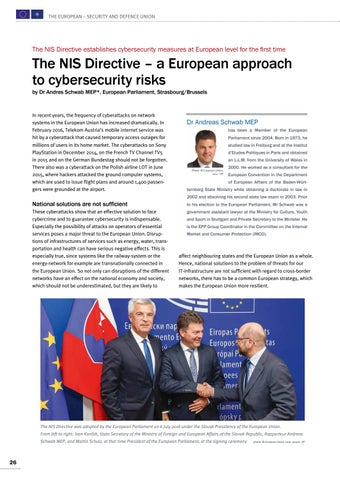
The NIS Directive was adopted by the European Parliament on 6 July 2016 under the Slovak Presidency of the European Union. From left to right: Ivan Korc˘ok, State Secretary of the Ministry of Foreign and European Affairs of the Slovak Republic, Rapporteur Andreas Schwab MEP, and Martin Schulz, at that time President of the European Parliament, at the signing ceremony
26
photo: © European Union 2016, source: EP