Security and Defence
nt projects
i Parliamentary supervision of the Bundeswehr (Ed/hb, Paris) When the Federal Republic of Germany was founded in 1949, it was not intended to have an army. It was only in 1955 that armed forces (“Bundeswehr”) were established,
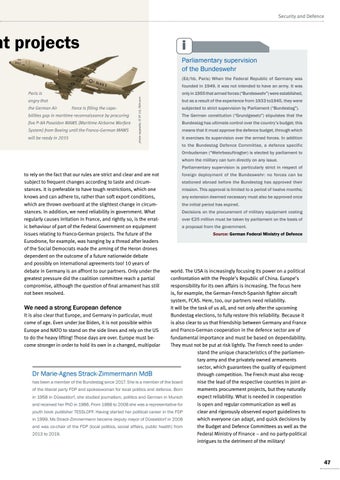
angry that the German Air
Force is filling the capa-
bilities gap in maritime reconnaissance by procuring five P-8A Poseidon MAWS (Maritime Airborne Warfare System) from Boeing until the Franco-German MAWS will be ready in 2035
photo: sagesolar, CC BY 2.0, Flickr.com
Paris is
but as a result of the experience from 1933 to1945, they were subjected to strict supervision by Parliament (“Bundestag”). The German constitution (“Grundgesetz”) stipulates that the Bundestag has ultimate control over the country’s budget; this means that it must approve the defence budget, through which it exercises its supervision over the armed forces. In addition to the Bundestag Defence Committee, a defence specific Ombudsman (“Wehrbeauftragter) is elected by parliament to whom the military can turn directly on any issue. Parliamentary supervision is particularly strict in respect of
to rely on the fact that our rules are strict and clear and are not subject to frequent changes according to taste and circumstances. It is preferable to have tough restrictions, which one knows and can adhere to, rather than soft export conditions, which are thrown overboard at the slightest change in circumstances. In addition, we need reliability in government. What regularly causes irritation in France, and rightly so, is the erratic behaviour of part of the Federal Government on equipment issues relating to Franco-German projects. The future of the Eurodrone, for example, was hanging by a thread after leaders of the Social Democrats made the arming of the Heron drones dependent on the outcome of a future nationwide debate and possibly on international agreements too! 10 years of debate in Germany is an affront to our partners. Only under the greatest pressure did the coalition committee reach a partial compromise, although the question of final armament has still not been resolved.
foreign deployment of the Bundeswehr: no forces can be stationed abroad before the Bundestag has approved their mission. This approval is limited to a period of twelve months; any extension deemed necessary must also be approved once the initial period has expired. Decisions on the procurement of military equipment costing over €25 million must be taken by parliament on the basis of a proposal from the government. Source: German Federal Ministry of Defence
world. The USA is increasingly focusing its power on a political confrontation with the People’s Republic of China. Europe’s responsibility for its own affairs is increasing. The focus here is, for example, the German-French-Spanish fighter aircraft system, FCAS. Here, too, our partners need reliability. It will be the task of us all, and not only after the upcoming We need a strong European defence Bundestag elections, to fully restore this reliability. Because it It is also clear that Europe, and Germany in particular, must is also clear to us that friendship between Germany and France come of age. Even under Joe Biden, it is not possible within and Franco-German cooperation in the defence sector are of Europe and NATO to stand on the side lines and rely on the US fundamental importance and must be based on dependability. to do the heavy lifting! Those days are over. Europe must beThey must not be put at risk lightly. The French need to undercome stronger in order to hold its own in a changed, multipolar stand the unique characteristics of the parliamentary army and the privately owned armaments sector, which guarantees the quality of equipment Dr Marie-Agnes Strack-Zimmermann MdB through competition. The French must also recognise the lead of the respective countries in joint arhas been a member of the Bundestag since 2017. She is a member of the board maments procurement projects, but they naturally of the liberal party FDP and spokeswoman for local politics and defence. Born expect reliability. What is needed in cooperation in 1958 in Düsseldorf, she studied journalism, politics and German in Munich is open and regular communication as well as and received her PhD in 1986. From 1988 to 2008 she was a representative for clear and rigorously observed export guidelines to youth book publisher TESSLOFF. Having started her political career in the FDP which everyone can adapt, and quick decisions by in 1999, Ms Strack-Zimmermann became deputy mayor of Düsseldorf in 2008 the Budget and Defence Committees as well as the and was co-chair of the FDP (local politics, social affairs, public health) from Federal Ministry of Finance – and no party-political 2013 to 2019. intrigues to the detriment of the military!
47