THE EUROPEAN – SECURITY AND DEFENCE UNION
France-Germany: frictions on armamen (Ed/hb, Paris) With its mastery of cutting-edge technologies, including in armaments, Germany is a sought-after partner in cooperation projects. However, current cooperation on armament projects, particularly between France and Germany, is subject to considerable friction. France, used to the rapid decision making inherent in its centralised and presidential system, is unhappy with the pace of progress on large-scale projects like the future fighter aircraft or joint combat tank. It is critical of Germany’s painstaking and therefore slow parliamentary procedures on matters affecting the Bundeswehr and armaments. Conservative political circles in Paris are even going so far as to question the whole concept of Franco-German cooperation on armament projects and claim that France’s independent decision-making capacity is being undermined. There is often little knowledge of the deeply rooted reasons for the parliamentary procedures the newly created German forces, the Bundeswehr, were subjected to after the second world war. The notion of a “parliamentary army”, that Germans consider essential because of their past history, does not always elicit much sympathy in Paris.
Our partners partners need reliability
Specificities of German parliamentary democracy in armaments policy by Dr Marie-Agnes Strack-Zimmermann MdB, member of the Bundestag and the federal board of the Free Democratic Party (FDP), Berlin
T
he model of the German Armed Forces, the Bundeswehr, as a “parliamentary army” has always been viewed on the French side with suspicion, as a factor hampering Franco-German cooperation. Our French friends, accustomed to a centra lised presidential system with rapid decision making, see the German system as slow and subject to blockages, unable to make quick decisions and take immediate action. The fact that our armaments industry is privately owned and not organised by the state, is seen as an additional obstacle to rapid decision making.
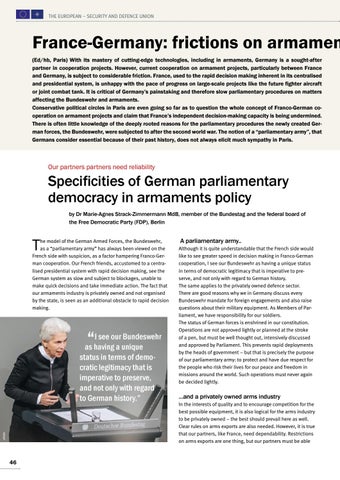
I see our Bundeswehr “as having a unique
photo:
status in terms of democratic legitimacy that is imperative to preserve, and not only with regard to German history.”
46
A parliamentary army.. Although it is quite understandable that the French side would like to see greater speed in decision making in Franco-German cooperation, I see our Bundeswehr as having a unique status in terms of democratic legitimacy that is imperative to preserve, and not only with regard to German history. The same applies to the privately owned defence sector. There are good reasons why we in Germany discuss every Bundeswehr mandate for foreign engagements and also raise questions about their military equipment. As Members of Parliament, we have responsibility for our soldiers. The status of German forces is enshrined in our constitution. Operations are not approved lightly or planned at the stroke of a pen, but must be well thought out, intensively discussed and approved by Parliament. This prevents rapid deployments by the heads of government – but that is precisely the purpose of our parliamentary army: to protect and have due respect for the people who risk their lives for our peace and freedom in missions around the world. Such operations must never again be decided lightly.
...and a privately owned arms industry In the interests of quality and to encourage competition for the best possible equipment, it is also logical for the arms industry to be privately owned – the best should prevail here as well. Clear rules on arms exports are also needed. However, it is true that our partners, like France, need dependability. Restrictions on arms exports are one thing, but our partners must be able