Security and Defence
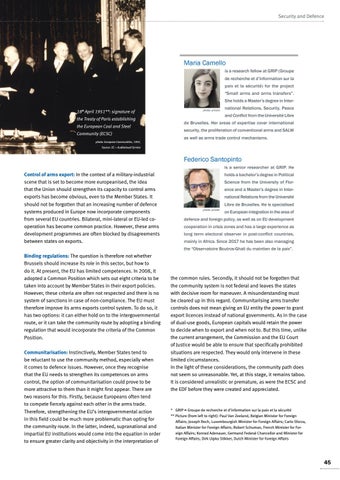
Maria Camello is a research fellow at GRIP (Groupe de recherche et d’information sur la paix et la sécurité) for the project “Small arms and arms transfers”. She holds a Master’s degree in Inter18th April 1951**: signature of the Treaty of Paris establishing the European Coal and Steel Community (ECSC) photo: European Communities, 1992,
photo: private
national Relations, Security, Peace and Conflict from the Université Libre
de Bruxelles. Her areas of expertise cover international security, the proliferation of conventional arms and SALW as well as arms trade control mechanisms.
Source: EC – Audiovisual Service
Federico Santopinto is a senior researcher at GRIP. He
Control of arms export: In the context of a military-industrial scene that is set to become more europeanised, the idea that the Union should strengthen its capacity to control arms exports has become obvious, even to the Member States. It should not be forgotten that an increasing number of defence systems produced in Europe now incorporate components from several EU countries. Bilateral, mini-lateral or EU-led cooperation has become common practice. However, these arms development programmes are often blocked by disagreements between states on exports.
holds a bachelor’s degree in Political Science from the University of Florence and a Master’s degree in International Relations from the Université Libre de Bruxelles. He is specialised photo: private
on European integration in the area of
defence and foreign policy, as well as on EU development cooperation in crisis zones and has a large experience as long term electoral observer in post-conflict countries, mainly in Africa. Since 2017 he has been also managing the “Observatoire Boutros-Ghali du maintien de la paix”.
Binding regulations: The question is therefore not whether Brussels should increase its role in this sector, but how to do it. At present, the EU has limited competences. In 2008, it adopted a Common Position which sets out eight criteria to be taken into account by Member States in their export policies. However, these criteria are often not respected and there is no system of sanctions in case of non-compliance. The EU must therefore improve its arms exports control system. To do so, it has two options: it can either hold on to the intergovernmental route, or it can take the community route by adopting a binding regulation that would incorporate the criteria of the Common Position. Communitarisation: Instinctively, Member States tend to be reluctant to use the community method, especially when it comes to defence issues. However, once they recognise that the EU needs to strengthen its competences on arms control, the option of communitarisation could prove to be more attractive to them than it might first appear. There are two reasons for this. Firstly, because Europeans often tend to compete fiercely against each other in the arms trade. Therefore, strengthening the EU’s intergovernmental action in this field could be much more problematic than opting for the community route. In the latter, indeed, supranational and impartial EU institutions would come into the equation in order to ensure greater clarity and objectivity in the interpretation of
the common rules. Secondly, it should not be forgotten that the community system is not federal and leaves the states with decisive room for maneuver. A misunderstanding must be cleared up in this regard. Communitarising arms transfer controls does not mean giving an EU entity the power to grant export licences instead of national governments. As in the case of dual-use goods, European capitals would retain the power to decide when to export and when not to. But this time, unlike the current arrangement, the Commission and the EU Court of Justice would be able to ensure that specifically prohibited situations are respected. They would only intervene in these limited circumstances. In the light of these considerations, the community path does not seem so unreasonable. Yet, at this stage, it remains taboo. It is considered unrealistic or premature, as were the ECSC and the EDF before they were created and appreciated.
* GRIP = Groupe de recherche et d’information sur la paix et la sécurité ** Picture (from left to right): Paul Van Zeeland, Belgian Minister for Foreign Affairs; Joseph Bech, Luxembourgish Minister for Foreign Affairs; Carlo Sforza, Italian Minister for Foreign Affairs; Robert Schuman, French Minister for Foreign Affairs; Konrad Adenauer, Germand Federal Chancellor and Minister for Foreign Affairs; Dirk Uipko Stikker, Dutch Minister for Foreign Affairs
45