Migration and Asylum
EU has to “The demonstrate its
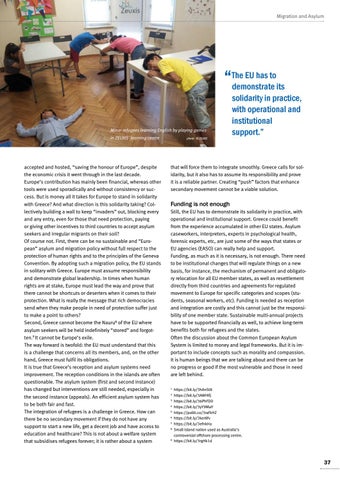
Minor refugees learning English by playing games in ZEUXIS' learning centre
accepted and hosted, “saving the honour of Europe”, despite the economic crisis it went through in the last decade. Europe’s contribution has mainly been financial, whereas other tools were used sporadically and without consistency or success. But is money all it takes for Europe to stand in solidarity with Greece? And what direction is this solidarity taking? Collectively building a wall to keep “invaders” out, blocking every and any entry, even for those that need protection, paying or giving other incentives to third countries to accept asylum seekers and irregular migrants on their soil? Of course not. First, there can be no sustainable and “European” asylum and migration policy without full respect to the protection of human rights and to the principles of the Geneva Convention. By adopting such a migration policy, the EU stands in solitary with Greece. Europe must assume responsibility and demonstrate global leadership. In times when human rights are at stake, Europe must lead the way and prove that there cannot be shortcuts or deserters when it comes to their protection. What is really the message that rich democracies send when they make people in need of protection suffer just to make a point to others? Second, Greece cannot become the Nauru8 of the EU where asylum seekers will be held indefinitely “stored” and forgotten.9 It cannot be Europe’s exile. The way forward is twofold: the EU must understand that this is a challenge that concerns all its members, and, on the other hand, Greece must fulfil its obligations. It is true that Greece’s reception and asylum systems need improvement. The reception conditions in the islands are often questionable. The asylum system (first and second instance) has changed but interventions are still needed, especially in the second instance (appeals). An efficient asylum system has to be both fair and fast. The integration of refugees is a challenge in Greece. How can there be no secondary movement if they do not have any support to start a new life, get a decent job and have access to education and healthcare? This is not about a welfare system that subsidises refugees forever; it is rather about a system
photo: © ZEUXIS
solidarity in practice, with operational and institutional support.”
that will force them to integrate smoothly. Greece calls for solidarity, but it also has to assume its responsibility and prove it is a reliable partner. Creating “push” factors that enhance secondary movement cannot be a viable solution.
Funding is not enough Still, the EU has to demonstrate its solidarity in practice, with operational and institutional support. Greece could benefit from the experience accumulated in other EU states. Asylum caseworkers, interpreters, experts in psychological health, forensic experts, etc, are just some of the ways that states or EU agencies (EASO) can really help and support. Funding, as much as it is necessary, is not enough. There need to be institutional changes that will regulate things on a new basis, for instance, the mechanism of permanent and obligatory relocation for all EU member states, as well as resettlement directly from third countries and agreements for regulated movement to Europe for specific categories and scopes (students, seasonal workers, etc). Funding is needed as reception and integration are costly and this cannot just be the responsibility of one member state. Sustainable multi-annual projects have to be supported financially as well, to achieve long-term benefits both for refugees and the states. Often the discussion about the Common European Asylum System is limited to money and legal frameworks. But it is important to include concepts such as morality and compassion. It is human beings that we are talking about and there can be no progress or good if the most vulnerable and those in need are left behind. https://bit.ly/3hAnSt8 https://bit.ly/3AWHlfj 3 https://bit.ly/36PhFDD 4 https://bit.ly/3yY9MaY 5 https://politi.co/3raFkHZ 6 https://bit.ly/3ker8fv 7 https://bit.ly/3efnkHa 8 Small island nation used as Australia’s controversial offshore processing centre. 9 https://bit.ly/3rgHk1d 1 2
37