THE EUROPEAN – SECURITY AND DEFENCE UNION
democratic majorities conclude that the only “Once choice is between control and the Refugee Con-
vention, the latter will lose out. There is, however, a third way that could work: humane control through cooperation.” Gerald Knaus
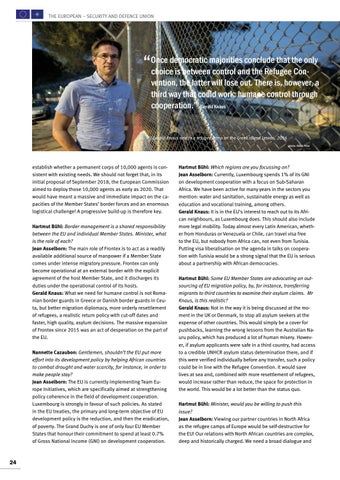
Gerald Knaus next to a refugee camp on the Greek island Lesvos, 2016 photo: Nikos Pilos
establish whether a permanent corps of 10,000 agents is consistent with existing needs. We should not forget that, in its initial proposal of September 2018, the European Commission aimed to deploy those 10,000 agents as early as 2020. That would have meant a massive and immediate impact on the capacities of the Member States’ border forces and an enormous logistical challenge! A progressive build-up is therefore key. Hartmut Bühl: Border management is a shared responsibility between the EU and individual Member States. Minister, what is the role of each? Jean Asselborn: The main role of Frontex is to act as a readily available additional source of manpower if a Member State comes under intense migratory pressure. Frontex can only become operational at an external border with the explicit agreement of the host Member State, and it discharges its duties under the operational control of its hosts. Gerald Knaus: What we need for humane control is not Romanian border guards in Greece or Danish border guards in Ceuta, but better migration diplomacy, more orderly resettlement of refugees, a realistic return policy with cut-off dates and faster, high quality, asylum decisions. The massive expansion of Frontex since 2015 was an act of desperation on the part of the EU. Nannette Cazaubon: Gentlemen, shouldn’t the EU put more effort into its development policy by helping African countries to combat drought and water scarcity, for instance, in order to make people stay? Jean Asselborn: The EU is currently implementing Team Europe Initiatives, which are specifically aimed at strengthening policy coherence in the field of development cooperation. Luxembourg is strongly in favour of such policies. As stated in the EU treaties, the primary and long-term objective of EU development policy is the reduction, and then the eradication, of poverty. The Grand Duchy is one of only four EU Member States that honour their commitment to spend at least 0.7% of Gross National Income (GNI) on development cooperation.
24
Hartmut Bühl: Which regions are you focussing on? Jean Asselborn: Currently, Luxembourg spends 1% of its GNI on development cooperation with a focus on Sub-Saharan Africa. We have been active for many years in the sectors you mention: water and sanitation, sustainable energy as well as education and vocational training, among others. Gerald Knaus: It is in the EU’s interest to reach out to its African neighbours, as Luxembourg does. This should also include more legal mobility. Today almost every Latin American, whether from Honduras or Venezuela or Chile, can travel visa free to the EU, but nobody from Africa can, not even from Tunisia. Putting visa liberalisation on the agenda in talks on cooperation with Tunisia would be a strong signal that the EU is serious about a partnership with African democracies. Hartmut Bühl: Some EU Member States are advocating an outsourcing of EU migration policy, by, for instance, transferring migrants to third countries to examine their asylum claims. Mr Knaus, is this realistic? Gerald Knaus: Not in the way it is being discussed at the moment in the UK or Denmark, to stop all asylum seekers at the expense of other countries. This would simply be a cover for pushbacks, learning the wrong lessons from the Australian Nauru policy, which has produced a lot of human misery. However, if asylum applicants were safe in a third country, had access to a credible UNHCR asylum status determination there, and if this were verified individually before any transfer, such a policy could be in line with the Refugee Convention. It would save lives at sea and, combined with more resettlement of refugees, would increase rather than reduce, the space for protection in the world. This would be a lot better than the status quo. Hartmut Bühl: Minister, would you be willing to push this issue? Jean Asselborn: Viewing our partner countries in North Africa as the refugee camps of Europe would be self-destructive for the EU! Our relations with North African countries are complex, deep and historically charged. We need a broad dialogue and