Migration and Asylum
Nannette Cazaubon: Violating EU law! Gerald Knaus: Yes, it is a violation of EU law, but it has also been effective and popular and so it continues. But there is a third option at sea: humane control in line with EU law and without pushbacks, through cooperation with neighbours like Turkey or Morocco. The goal is still to reduce irregular arrivals, but without illegal expulsions. For this, the EU must offer third countries credible incentives. To answer the question why Turkey, currently hosting 3,7 million Syrian refugees, has an interest in helping the EU. Hartmut Bühl: But the 2016 EU-Turkey statement pledged considerable financial support for four years, didn’t it? Gerald Knaus: Yes, but when the promise of substantial help for refugees in Turkey was not renewed in early 2020, the arrangement broke down. Alas, the New Pact on Migration and Asylum, currently being discussed in Brussels, is largely silent on this central issue of what to offer neighbours like Turkey, Morocco or Tunisia in exchange for their essential cooperation in reducing irregular arrivals without violating the Refugee Convention.
There is, however, a third way that could work: humane control through cooperation. Nannette Cazaubon: Mr Knaus, both refugees and migrants have few chances of entering the Union legally. So, what kind of cooperative border regime should we have in the EU? Gerald Knaus: Humane borders are borders where thousands do not drown. 2016 was the deadliest year in history for irregular migrants crossing to the EU, with more than 4,500 dead only in the Central Mediterranean. There is a strong moral case for discouraging dangerous departures of irregular migrants from Africa. At humane borders, the dignity of anyone arriving is respected through humane reception, which requires the capacity to determine refugee status reliably and expeditiously. The EU does not need more Frontex at its borders, it needs more asylum case workers. More EU border guards do not reduce the number of arrivals. Hartmut Bühl: Minister, is this idea consistent with existing needs? Jean Asselborn: A mid-term assessment is foreseen in order to
Nannette Cazaubon: Minister, I would like to take up Mr Knaus’ remark on the new Pact on Migration and Asylum of September 2020. Does this pact really have a chance of being implemented? Jean Asselborn: Indeed, negotiations on the Pact risk failing again. Currently, the most disputed issues are the compulsory border procedures, rejected by the South, and the solidarity mechanism, including the new concept of return sponsorship, rejected by the Visegrad countries (V4+)2. Their blocking positions, in combination with the need for consensus and the package approach, give no window of opportunity for the Pact.
Hartmut Bühl: Minister, you regularly intervene in favour of upholding the principle of non-refoulement and the implementation of a strong human rights monitoring mechanism at the external borders.... Jean Asselborn: ...yes, but unfortunately, I feel more and more isolated! Gerald Knaus: Indeed, the no-pushback position is on the defensive worldwide. Pushbacks have been a popular policy in Australia, Israel and the US under Donald Trump. Once democratic majorities conclude that the only choice is between control and the Refugee Convention, the latter will lose out.
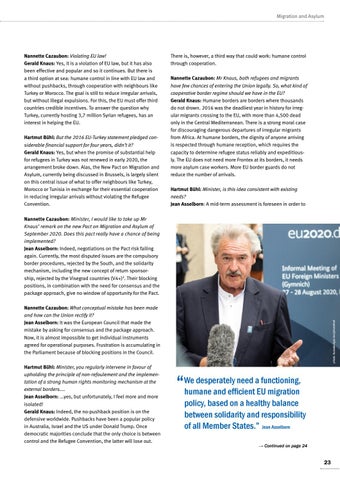
photo: Auswaertiges Amt/photothek
Nannette Cazaubon: What conceptual mistake has been made and how can the Union rectify it? Jean Asselborn: It was the European Council that made the mistake by asking for consensus and the package approach. Now, it is almost impossible to get individual instruments agreed for operational purposes. Frustration is accumulating in the Parliament because of blocking positions in the Council.
desperately need a functioning, “Wehumane and efficient EU migration
policy, based on a healthy balance between solidarity and responsibility of all Member States.” Jean Asselborn → Continued on page 24
23