Mono Ardilla
ECO
Squirrel Monkey
T
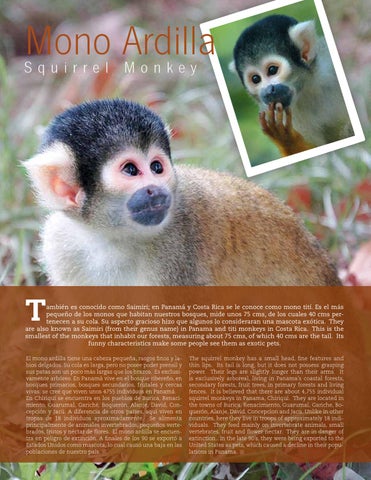
ambién es conocido como Saimiri; en Panamá y Costa Rica se le conoce como mono tití. Es el más pequeño de los monos que habitan nuestros bosques, mide unos 75 cms, de los cuales 40 cms pertenecen a su cola. Su aspecto gracioso hizo que algunos lo consideraran una mascota exótica. They are also known as Saimiri (from their genus name) in Panama and titi monkeys in Costa Rica. This is the smallest of the monkeys that inhabit our forests, measuring about 75 cms, of which 40 cms are the tail. Its funny characteristics make some people see them as exotic pets. El mono ardilla tiene una cabeza pequeña, rasgos finos y labios delgados. Su cola es larga, pero no posee poder prensil y sus patas son un poco más largas que los brazos. Es exclusivamente arbóreo. En Panamá vive en el bosque ribereño, en bosques primarios, bosques secundarios, frutales y cercas vivas; se cree que viven unos 4755 individuos en Panamá. En Chiriquí se encuentra en los pueblos de Burica, Renacimiento, Guarumal, Gariché, Boquerón, Alanje, David, Concepción y Jacú. A diferencia de otros países, aquí viven en tropas de 18 individuos aproximadamente. Se alimenta principalmente de animales invertebrados, pequeños vertebrados, frutos y néctar de flores. El mono ardilla se encuentra en peligro de extinción. A finales de los 90 se exportó a Estados Unidos como mascota, lo cual causó una baja en las poblaciones de nuestro país.
66
The squirrel monkey has a small head, fine features and thin lips. Its tail is long, but it does not possess grasping power. Their legs are slightly longer than their arms. It is exclusively arboreal, living in Panama’s coastal forests, secondary forests, fruit trees, in primary forests and living fences. It is believed that there are about 4,755 individual squirrel monkeys in Panama, Chiriqui. They are located in the towns of Burica, Renacimiento, Guarumal, Gariche, Boquerón, Alanje, David, Concepcion and Jacu. Unlike in other countries, here they live in troops of approximately 18 individuals. They feed mainly on invertebrate animals, small vertebrates, fruit and flower nectar. They are in danger of extinction. In the late 90’s, they were being exported to the United States as pets, which caused a decline in their populations in Panama.