Creating a Calm Schooling Arena
HORSE WELFARE GUIDELINES
Know







Official Magazine of the United States Equestrian Federation
US EQUESTRIAN
MAGAZINE
Volume LXXXIX, Fall 2025
PUBLISHED BY
The United States Equestrian Federation, Inc.
CHIEF MARKETING & CONTENT OFFICER
Vicki Lowell | vlowell@usef.org
EDITOR-IN-CHIEF
Debbie Elliot | delliot@usef.org
CREATIVE DIRECTOR
Candice McCown | cmccown@usef.org
ADVERTISING DIRECTOR
Kim Russell | 859 225 6938 | krussell@usef.org
DIRECTOR OF SPONSORSHIP & SALES
Layson Griffin | lgriffin@usef.org
ASSISTANT DESIGNERS
Kendall Neubeiser, Kate Strom
EDITORIAL STAFF
Kim Russell
CONTRIBUTING WRITERS
Andrew Ellis, Sarah Coleman, Helen Townes, Natalie Voss
Equestrian Magazine (ISSN 1548-873X) is published five times a year: Horse of the Year Special Edition, Spring, Summer, Fall, and Winter, by the United States Equestrian Federation®, 4001 Wing Commander Way, Lexington, KY 40511; Phone: (859) 258-2472; Fax: (859) 231-6662. (ISSN:1548-873X). NOTE: Effective Spring issue of 2018, Equestrian magazine will be published and provided electronically and only four editions will have printed copies and be provided by U.S. Mail. The Winter issue will only be provided electronically. The Horse of the Year issue will be mailed only to competing members as of the date of publication and the year immediately prior to the date of publication. USEF is not responsible for the opinions and statements expressed in signed articles and paid advertisements. These opinions are not necessarily the opinions of USEF and its staff. While the Federation makes every effort to avoid errors, we assume no liability to anyone for mistakes or omissions. It is the policy of the Federation to report factually and accurately in Equestrian and to encourage and to publish corrections whenever warranted. Kindly direct any comments or inquiries regarding corrections to Debbie Elliot delliot@usef.org or by direct dial 859-225-6941. POSTMASTER: Send address changes to US Equestrian, 4001 Wing Commander Way, Lexington, KY 40511. Canadian Publications Agreement No. 40845627. For Canadian returns, mail to Canada Express, 7686 #21 Kimble Street Mississauga, Ontario, Canada, L5S1E9. (905) 672-8100. Reproduction of any article, in whole or part, by written permission only of the Editor. Equestrian: Publisher, United States Equestrian Federation®, Chief Executive Officer, William J. Moroney (859) 225-6912. Director of Advertising, Kim Russell (859) 225-6938. Copyright © 2025 Equestrian is the official publication of the United States Equestrian Federation, the National Governing Body for Equestrian Sport in the USA, and is an official publication of USEF.
Published at 4001 Wing Commander Way, Lexington, Ky 40511 USequestrian.org


AWARDS
The magazine staff is pleased to share these notable accomplishemnts it has received at the American Horse Publication Media Awards.
2024
First Place: Advertisement
Second Place: Editorial Design Honorable Mention: Editorial Design
2022
Third Place: Cover Design Honorable Mention: Feature Article
2021 Honorable Mention: Editorial Design
2020
First Place: Advertisement
Third Place: Editorial Design Honorable Mention: Editorial Design
2019
Third Place: Cover Design
2018
Overall Publication Winner
First Place: General Excellence
First Place: Editorial Design
Second Place: Feature Article
2017
Second Place: Digtial Publishing


As a life-long equestrian with deep connections in that world and over 30 years of working in real estate sales, I can help you find your perfect horse property in this tight market.
I have already closed on one prestigious farm this year and have another in contract- both off-market properties in North Salem and Bedford. I always have a small inventory of off-market farms and land in the Northern Westchester and Fairfield, Connecticut and can help refer you to top equestrian property brokers in other areas in the country.
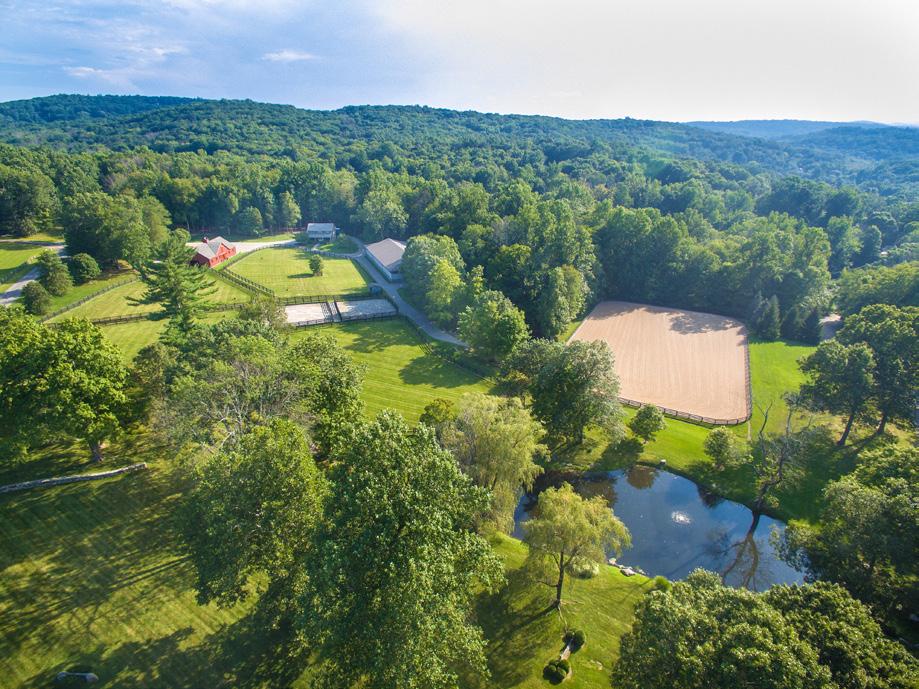
+15 Acre Equestrian Property Sold off-market | North Salem, NY

PARTNERS



SPONSORS









The only FDA-approved PSGAG for the treatment of equine arthritis proven to:1,2
• Reduce inflammation
• Restore synovial joint lubrication
• Repair joint cartilage
• Reverse the disease process
Adequan® i.m. (polysulfated glycosaminoglycan) is recommended for the intramuscular treatment of non-infectious degenerative and/or traumatic joint dysfunction and associated lameness of the carpal and hock joints in horses. WARNING: Not for use in humans. CAUTION: Federal law restricts this drug to use by or on the order of a of a licensed veterinarian.
BRIEF SUMMARY: Prior to use please consult the product insert, a summary of which follows: CAUTION: Federal law restricts this drug to use by or on the order of a licensed veterinarian. INDICATIONS: Adequan® i.m. is recommended for the intramuscular treatment of non-infectious degenerative and/or traumatic joint dysfunction and associated lameness of the carpal and hock joints in horses. CONTRAINDICATIONS: There are no known contraindications to the use of intramuscular Polysulfated Glycosaminoglycan. WARNINGS: Do not use in horses intended for human consumption. Not for use in humans. Keep this and all medications out of the reach of children. PRECAUTIONS: The safe use of Adequan® i.m. in horses used for breeding purposes, during pregnancy, or in lactating mares has not been evaluated. For customer care, or to obtain product information, visit www.adequan.com. To report an adverse event please contact American Regent, Inc. at 1-888-354-4857 or email pv@americanregent.com.
Scan to see why
adequan.com/horse-owners/talk-to-your-veterinarian
1. Kim DY, Taylor HW, Moore RM, Paulsen DB, Cho DY. Articular chondrocyte apoptosis in equine osteoarthritis. The Veterinary Journal 2003; 166: 52-57. 2. Burba DJ, Collier MA, DeBault LE, Hanson-Painton O, Thompson HC, Holder CL: In vivo kinetic study on uptake and distribution of intramuscular tritium-labeled polysulfated glycosaminoglycan in equine body fluid compartments and articular cartilage in an osteochondral defect model. J Equine Vet Sci 1993; 13: 696-703.


SPONSORS












A New Season to Prioritize Horse Welfare

Dear USEF Members:
It was an exciting summer of competitions that included Pony Finals, Junior Hunter Finals – East & West, Eventing Young Rider Championships, FEI North American Youth Championships for Dressage and Jumping, and the USEF/USA Vaulting National Championships. Wherever you competed, we hope it was a success! Speaking of success, I’d like to congratulate the U.S. Jumping Team for their victory in the Mercedes-Benz Jumping Nations Cup CSIO5* at CHIO Aachen, and the Defender U.S. Eventing Team for their second-place finish in the UBS-Cup CCIO4-S*. The results of these teams — as well as many others we have on the road this summer — were truly nothing short of outstanding, as an old friend of mine always says, “Everybody’s talking about it!”
In line with the seasonal shift to fall, US Equestrian is strengthening our educational focus on horse welfare with the creation of the USEF Horse Welfare Stoplight Guidelines. The goal of this educational reference guide — which labels interactions between humans and horses as “green,” “yellow,” and “red” — is to offer clear examples of what actions are acceptable, what warrants further attention, and what needs to be immediately addressed by officials and reported to USEF for further review. We hope that these guidelines help US Equestrian members have a better understanding of the impact certain actions can have and help us all protect our loyal equine partners in competition and in training.
When there has been a suspected violation or unethical treatment, USEF’s Regulations department conducts an in-depth, fact-gathering investigation to ensure a fair process. You can learn more about the disciplinary and resolution process in this issue’s How It Works section.
We’ve written about our USEF Community Outreach Program being an important part of US Equestrian, supporting equine-based learning organizations that impact the lives of thousands of people. In this issue, we roll out the first in a series of “Community Conversations,” where representatives from Community Outreach Organizations sat down with us to discuss mental health awareness and the important role that horses can play in supporting emotional and personal growth.
While we all enjoy attending horse shows, the warm-up ring can be a place of stress and anxiety for horses, riders, and even spectators like parents.
Our feature on warm-up ring etiquette offers tips on how the schooling area can be transformed into a calm, confidence-building place — something we are all striving towards.
Not all equestrian competitions take place in the saddle. In this issue’s Juniors’ Ring, we meet four young riders who turned their love of hobby horsing into an international event. These entrepreneurs hosted the second annual United States Hobby Horse Championships in August, where competitors from across the U.S. and around the world gathered to compete in hunter/jumper, dressage, show jumping, and an even barrel racing classes on their hobby horses.
Along with colorful leaves and crisper air, fall often brings fields of fresh young grass due to increased rain. Our latest Vet’s Corner explains how the fructans and sugars in this baby grass increase the risk of laminitis. Learn how you can recognize, treat, and prevent this painful disease by following the advice of our veterinary expert.
As we enter this new season, US Equestrian remains committed to improving horse safety and well-being through education, rules, and policy updates as well as new testing protocols. We have had senior members of the US Equestrian staff traveling the country attending horse shows (across various breeds and disciplines), holding town halls to review the state of horse welfare in our sport. These have been well-attended and have been very enlightening for all participants. Clarity around USEF processes, regulations, rules, education, and a whole host of fielded questions have all led to positive collaborative feedback from our members in attendance. I have attended many of them personally, and I am so pleased to see and report that the overwhelming feedback is exactly what we all know — the horse is why we do what we do. It’s apparent to me that all of us want to work towards ensuring our powerful bond, and the sanctity of it, continues to be upheld. Please continue providing any feedback or ideas via e-mail to feedback@usef.org.
See you at the ring!

President


US Equestrian Hosts Town Halls Focused on Equine Safety & Welfare
US Equestrian hosted a series of town hall events throughout the summer and fall of 2025 that focused on equine safety and welfare. These discussions were designed to facilitate conversation between the Federation and participants across breeds and sports as US Equestrian considers how it can better support the well-being of our equine partners.
The town halls were open to all and included USEF staff panelists, as well as affiliate organization representatives when possible.
Each town hall centered around a series of potential rule changes or concepts relevant to the discipline at each horse show. The events were designed to identify broad areas of horse welfare that are on the minds of attendees, and also to workshop the most practical ways rules and policies can address those concerns. Town hall audiences came prepared with opinions and perspectives from all corners of their sport, from trainers and riders to officials and veterinarians, and they provided specific, productive ideas on how to address the problems they see. Not all possible rule changes discussed by USEF staff or by attendees at all events will turn into new rules, but internal discussions at the Federation have continued after each town hall, and many of the suggestions will be part of the next rounds of new rules.
One example of how town halls can shape welfare changes happened early on in the schedule. The first town hall event took place on June 11 at Split Rock Hunter Jumper Classic II at the Kentucky Horse Park in Lexington, Ky. This event occurred just before the Federation’s mid-year board meeting and gave US Equestrian and the US Hunter/Jumper Association perspective on the collapse rule in the hunter/jumper disciplines, and how concerned participants were about the welfare implications of horse collapses.
As of July 1, a Presidential Modification went into effect that better defined collapses and required horses suffering a collapse to leave the show grounds for at least seven days and undergo veterinary medical assessment before returning. The goal of these changes was to ensure horses or ponies who have collapsed in unexplained circumstances (e.g., not a trip, stumble, or intentional rolling) can be properly treated for any previously-undiagnosed medical condition, receive adequate rest, and ideally may be sent home to be seen by a veterinarian who is familiar with the horse and could best identify subtle changes. Response from attendees of the town hall at Split Rock helped shape the parameters of this modification, as many pointed out that owners may not be aware of a horse collapse. The requirement that collapsed horses leave the grounds is designed, in part, to make it more likely owners are informed about the incident and can stay in the loop on their horse’s status.
Town hall attendees also received an overview of the investigations process to better understand how the Federation handles reports of rule violations from participants. Average timelines for each part of the horse welfare investigation process are available at usef.org/compete/regulation/reporting-processes. There, you can also find a guide for how USEF officials gather evidence, and what kind of details in a report help them investigate a complaint effectively.
Additional town halls are planned for late autumn and winter. The schedule of town hall events is available at usef.org/forms-pubs/ pqhOtcLkQSU and will be updated as new dates are announced. There will also be a virtual town hall toward the end of 2025 for those who cannot attend an in-person event.
In the meantime, if you have thoughts on how to improve welfare in your horse sport, you can email us at feedback@usef.org


US Equestrian Awards Opportunity Fund Grants to 13 USEF Community Outreach Organizations for Vital Initiatives
US Equestrian has awarded $90,500 in USEF Opportunity Fund grants to 13 USEF Community Outreach Organizations (COO) following a comprehensive review process.
The 2025 USEF Opportunity Fund grants will support an expansive list of projects that will further the missions of these high-impact organizations. Examples of the initiatives that were selected for funding include increasing resources to expand participation, purchasing safety equipment, and investing in important infrastructure improvements. This support is vital to these organizations and their life-changing work with people and horses. Grantees are listed below in alphabetical order:
• Cranberry Sunset Farm (Marstons Mills, Mass.)
• Ebony Horsewomen (Hartford, Conn.)
• Forward Stride (Beaverton, Ore.)
• GallopNYC (New York, N.Y.)
• Horse SenseAbility (Sherborn, Mass.)
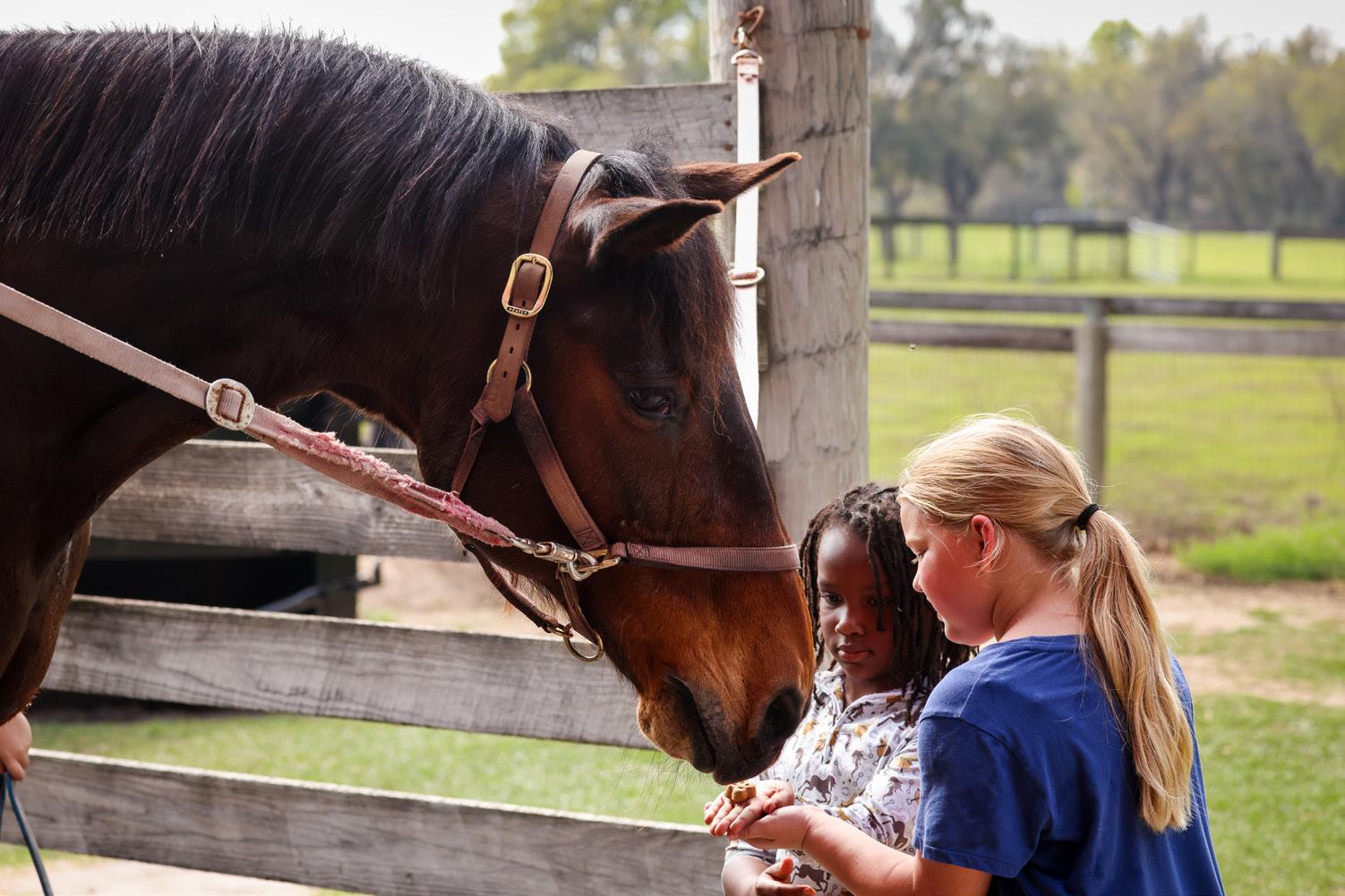
• Horses N Heroes (Ocala, Fla.)
• Havenwood Equestrian Center (Radford, Va.)
• Kentucky Horse Park Foundation Mustang Troop (Lexington, Ky.)
• Kindle Hill Foundation Charity (Blue Bell, Pa.)
• Little Bit Therapeutic Riding Center (Redmond, Wash.)
• Lucky Orphans Horse Rescue (Dover Plains, N.Y.)
• Manes For Movement (Torrance, Calif.)
• Speaking of Horses (Barboursville, Va.)
These grants were made possible by the generous contributions of members, partners, competition organizers, and the USEF Board of Directors.
“I encourage everyone to consider joining our efforts by contributing to this program and the great work these organizations are doing to bring horses and people together to grow and become stronger. You can help increase access to the power of horses by making a donation and showing your support today,” stated Tom O’Mara, US Equestrian President.
How You Can Make a Difference
• Donate – Donate today to help fund grants for the USEF Community Outreach Organizations.
• Shop USEF – Show your support with the purchase of a USEF Community Outreach Program pin . 100% of the proceeds from pin sales will be contributed to the USEF Opportunity Fund.
• Volunteer – Find a USEF Community Outreach Organization near you and get involved.
The USEF Opportunity Fund
The USEF Opportunity Fund aims to extend the reach and impact of these outstanding organizations to improve access to the power of horses and to bring the joy of horse sports to as many people as possible. One hundred percent of funds raised for the Opportunity Fund are dedicated to supporting the USEF Community Outreach Program and its 40 recognized USEF Community Outreach Organizations.

Young students bond with a horse at Horses N Heroes in Ocala, Fla.
#1 EQUINE HEALTH BRAND
We make one-of-a-kind health and wellness solutions for one-of-a-kind horses.
US Equestrian Board of Directors Approves Rule Changes Designed to Improve Equine Welfare
In keeping with its ongoing commitment to equine welfare, US Equestrian advanced a number of rule changes and modifications at its mid-year meeting June 16-17, 2025, in Lexington, Ky. Directors heard updates on the organization’s strategic plan, the path to the 2028 Olympic Games in Los Angeles, as well as its vision of continual enhancements to the welfare and integrity of equine sport.
General Rule Changes
GR402.1 Testing: The Board approved changes to this rule allowing the Federation to test hair in addition to blood and urine from horses. Hair testing allows regulators to detect certain prohibited substances such as barbiturates (including the euthanasia drug) more readily and for a considerably longer period of time than blood or urine. This change, effective July 1, 2025, is intended to help detect and discourage the use of banned substances. A full list of substances banned in hair tests is available on the USEF website usef.org/compete/regulation/ drugs-medications
GR843 Veterinary Services on Competition Grounds: This new rule that becomes effective December 1, 2025, will require veterinarians treating horses on competition grounds to register with the Federation, though it would not mandate they become US Equestrian members. The purpose of this change is to ensure event organizers have contact information for practicing veterinarians in the event they need to issue communication about disease outbreaks, biosecurity, and best practices for rule compliance.
Referred General Rule Changes
Changes to Chapter 3 regarding Hunter/Jumper competition mileage and points, GR803 regarding whip use, GR843 regarding blood on a horse, and GR848 regarding return to competition were referred to upcoming meetings later this year, as the Board wanted additional work on the proposals before voting.
Presidential Modifications
Under GR153, modifications to the application of Federation rules may be made by the President. These are applicable only for the duration of the current competition year and are intended to be followed by a formal rule-making process.
One Presidential Modification was approved and impacts two rules dealing with horse collapses at Hunter, Jumper,
and Hunter/Jumper Competitions. The intent is to ensure our equine partners receive appropriate care and are fit to compete before they return to the ring after an unexplained collapse. This Presidential Modification will address our concerns about the impermissible administration of substances and ensure there is sufficient time for a licensed veterinarian to examine the horse and evaluate their fitness to compete.
Effective July 1, the following changes were applied:


GR122 Falls: Language will be added stating that “in the disciplines of Hunter, Jumper, Hunter Jumper Seat Equitation disciplines, a horse is considered to have fallen when, while it is not being ridden, any part of the horse’s body, except for the hooves, unintentionally touches the ground or an obstacle and the ground, even if the horse stands back up afterward.”
GR849.8 Collapse Rule: This rule will be modified to state that any horse/pony who collapses at a Hunter, Jumper, or Hunter/Jumper competition is barred from competing for a minimum of seven (7) days afterward, and is not permitted on the grounds of a Federation-licensed competition during that time. The horse may compete again only if a licensed veterinarian files a form with the Federation attesting the horse has been examined and is fit to return to competition.
Position Statements
The Board approved position statements for the organization on Equine Overuse and on Equine Safety and Welfare.
The Equine Safety and Welfare statement emphasizes US Equestrian’s commitment to ensuring horses are fit to compete, maintaining optimal conditions for equine welfare, increasing uniformity, integrity, and clarify through oversight, providing lifetime care for horses, and sharing information that enhances safety for every horse, every day.
The Equine Overuse statement acknowledges the growth of competition calendars in several disciplines, which has resulted in more opportunities for horses to compete frequently. US Equestrian wants to make sure horses are assessed regularly for signs of discomfort related to overuse and that the highest standards of care and treatment are in place to protect them.
For details on other nothworthy rule changes, please visit usef.org/ media/press-releases/us-equestrian-board-of-directors-approves-rule



Para Equestrian Dressage Events, Quota Places, and Venue for LA28 Paralympic Games Confirmed

Para Equestrian Dressage will be part of the competition at the Los Angeles 2028 Paralympic Games. The Para Equestrian program will consist of 11 medal events: Individual Championship and Individual Freestyle Championship for Grades I, II, III, IV, and V as well as a Team Championship. Para Equestrian retains the 78 quota places it had in Paris in 2024. The decision was taken by the Governing Board of the International Paralympic Committee (IPC) following an extensive review process.
The LA28 Organizing Committee for the Olympic and Paralympic Games also confirmed that Santa Anita Park in Arcadia, Calif., will be the venue of the Para Equestrian events.
“We are very happy with the announcements made by the IPC and LA28,” Sabrina Ibáñez, FEI Secretary General and President of the Association of Paralympic Sports Organizations (APSO), said. “The Paris 2024 Olympic and Paralympic Games, set against the breathtaking backdrop of the Château de Versailles, were unforgettable and brought tremendous excitement to equestrian sport. Athletes and horses from 30 nations competed in Para Equestrian Dressage in Paris, the largest turnout since Para Equestrian became part of the Paralympic program in 1996. Both the Olympic and Para Equestrian Dressage Events were historic successes attracting massive live crowds and captivating broadcast and streaming audiences around the world.”
“We are pleased to confirm that our Paralympic quota places remain unchanged for LA28. We look forward to showcasing the sport at its highest level, with thrilling performances and worldclass competition, Ibáñez continued. “Santa Anita Park in Arcadia will provide first-class facilities to both the Olympic and Paralympic equestrian events, setting the stage for unforgettable Games.”
The LA28 Paralympic Games will be held August 15-27, 2028. The Games will comprise of 23 sports, including the LA28 proposed sport of Para Climbing, and 560 medals events. A total of 4,480 athletes are expected to compete. The FEI discipline at the LA28 Paralympic Games will be Para Equestrian Dressage. A total of 78 athletes will compete in 11 Para Equestrian medal events. As is the case in all equestrian events, women and men will compete as equals.
The US Paralympic Team after winning gold in the Paris 2024 team competition.

In & Around the Ring
“C ommunity is everything in the Morgan world. The turnout is amazing, each person knows and is invested in the horses, and is genuinely there to have a good time.”
- Adam Lagosz, Connecticut Morgan Horse Association Vice President.
Right: Laura Kraut’s mount, Baloutinue, relaxing in his stall at the 2025 La Baule CSIO5* FEI Jumping Nations Cup.
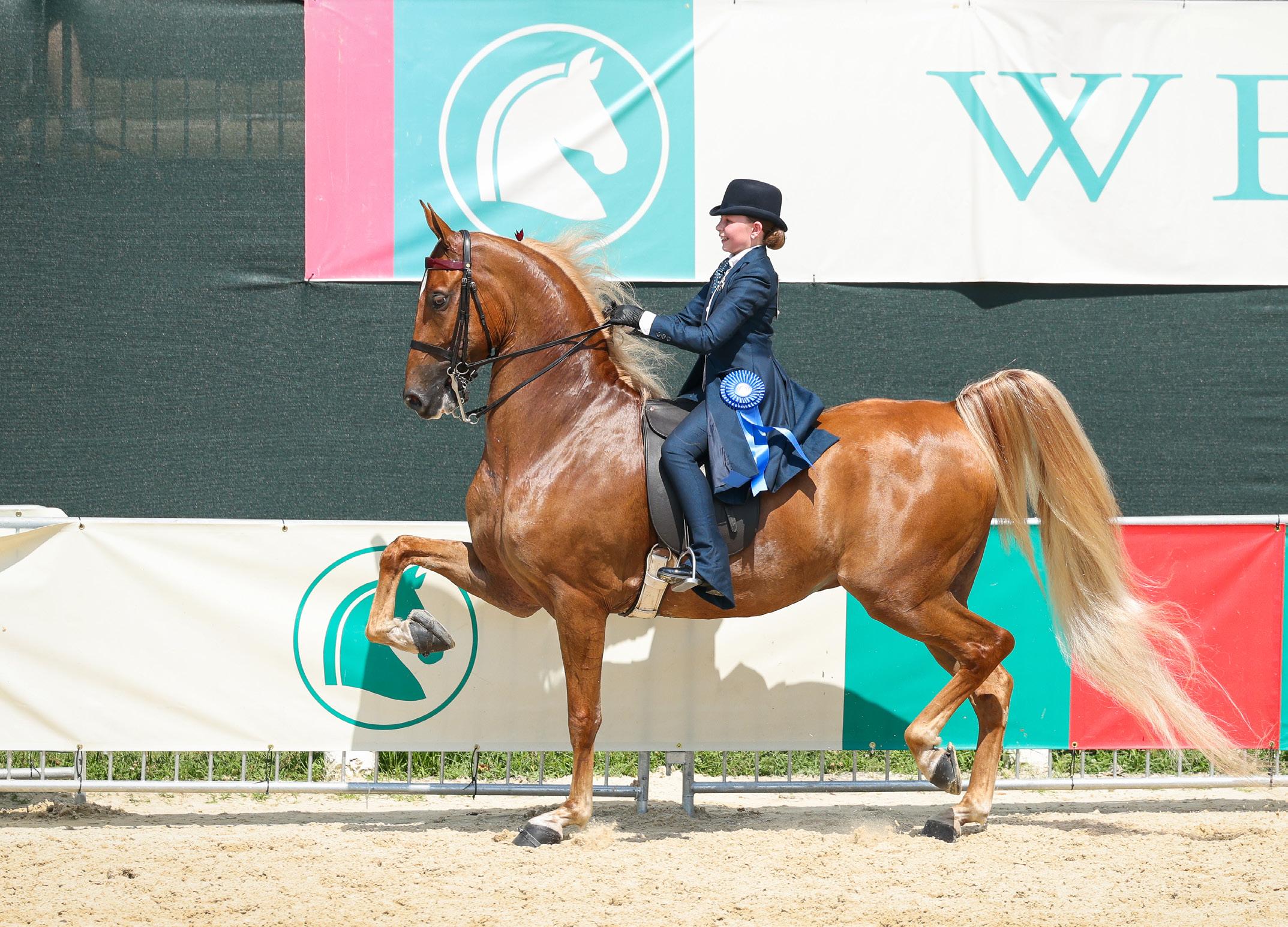
Opposite top: Signature Cocktail and Nora Hansen show off their blue ribbon at the 2025 Lexington Junior League Horse Show, which is known as the first leg of the Saddlebred “Triple Crown.”
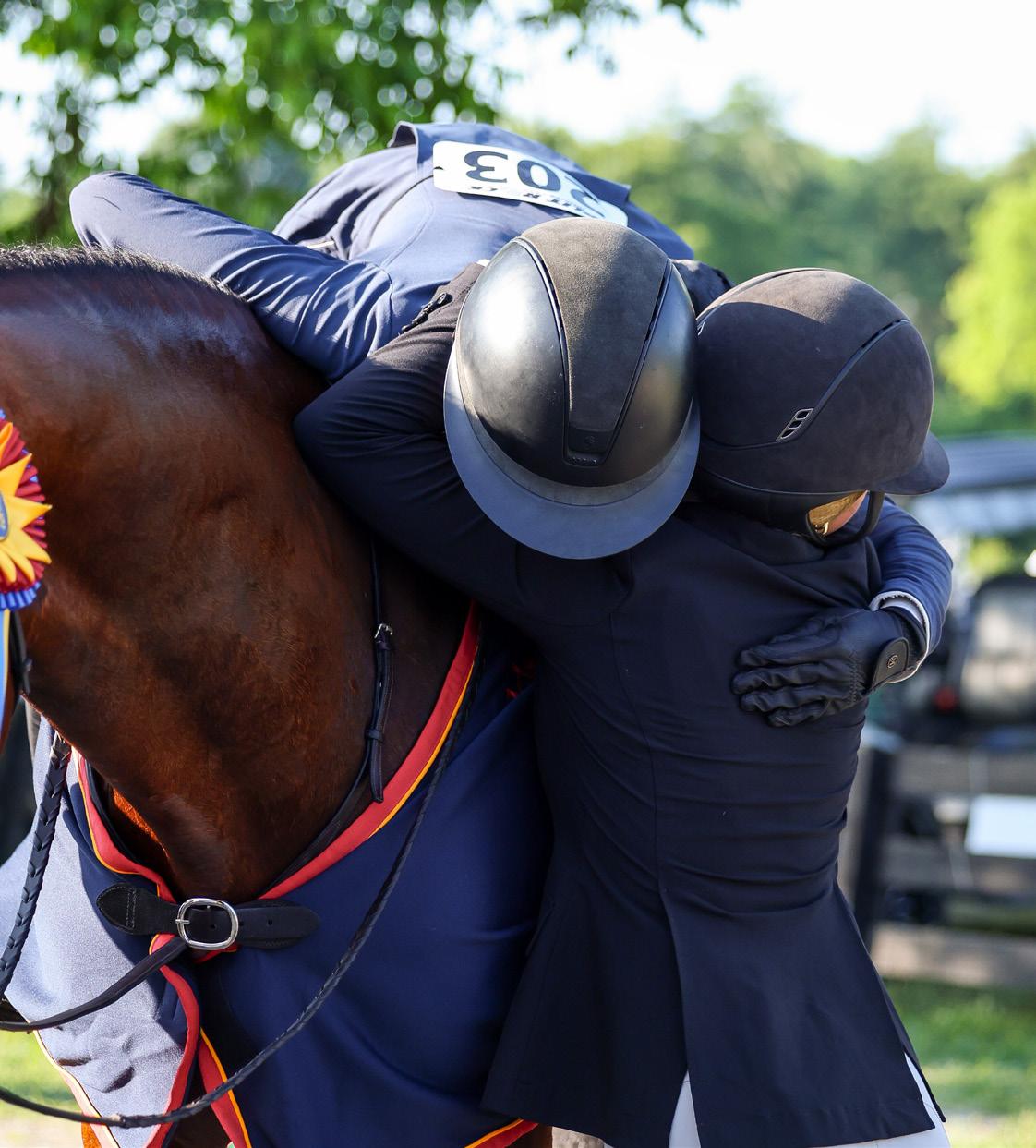
Opposite bottom: Young riders show camaraderie at the 2025 Adequan®/ USEF Junior Hunter National Championship.

“
Children loved him as the cute Breyer Horse they could play with, and both professionals and amateurs in the industry loved him for being so correct in form. What a super horse Snoopy was, with an extra special style in the ring and an extra personality to match.”
- Owner Becky Gochman honoring Catch Me (“Snoopy”) following his death at age 18.
Preventing and Treating Laminitis
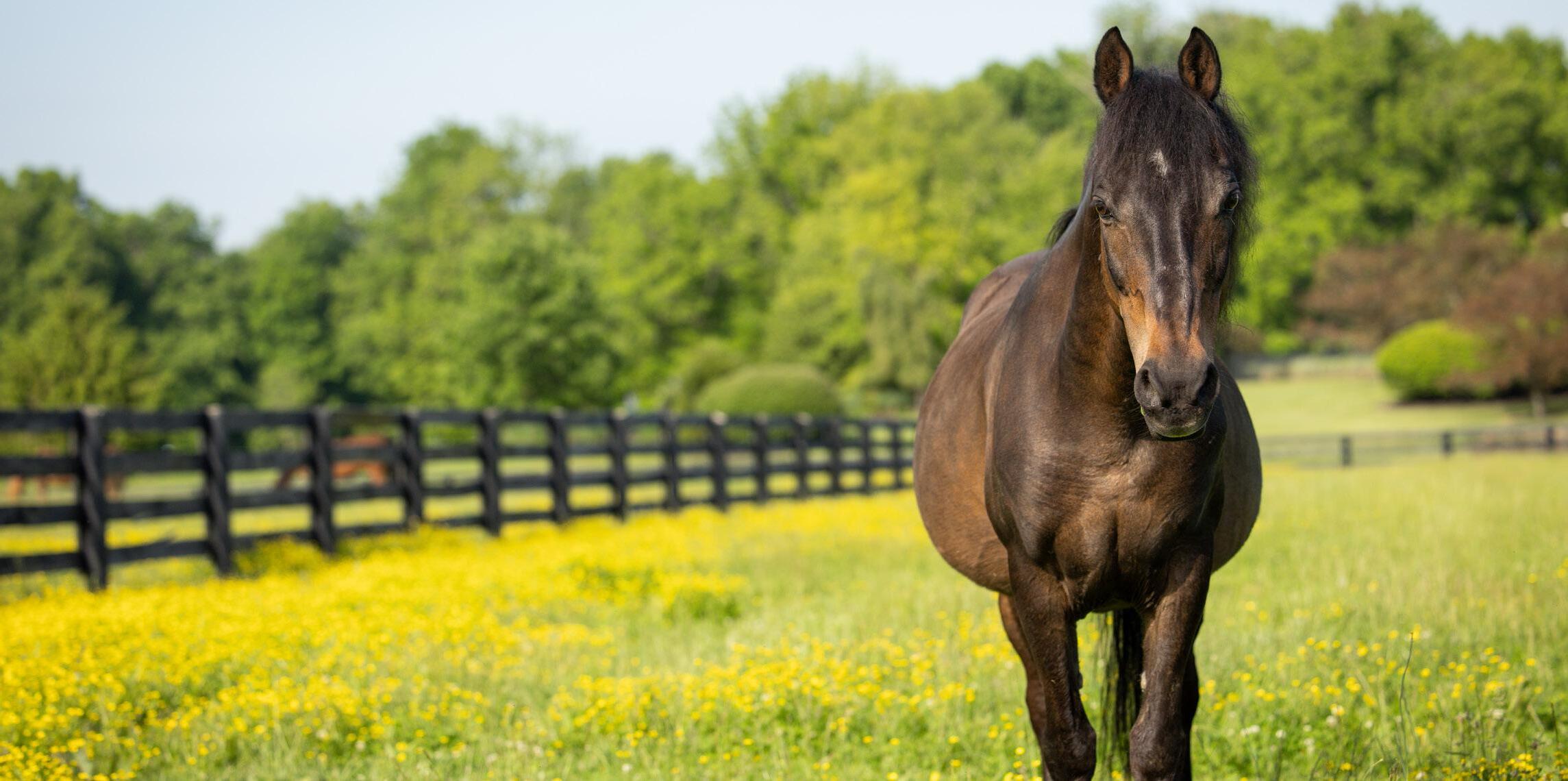
Young grass in the fall can be deceptively rich and contain high levels of fructans and sugars that may trigger laminitis.
by Sarah Coleman
Laminitis involves inflammation of the laminae, intricate and important structures that attach the hoof wall to the coffin bone.
Known for its pain and difficulty to control once it has started, laminitis can affect every age, breed, and type of equine — including donkeys and mules. While many horse owners are aware of the risk of laminitis in the spring, during which time they may muzzle their horses or increase stall time to prevent overeating, the inflammatory disease can also be prevalent in the fall when increased rain brings fresh, baby grass that is high in fructans and sugars.
What Is Laminitis?
A basic understanding of equine limb anatomy is necessary to understand laminitis. The leg bone inside the hoof capsule that is closest to the ground and bears the most weight is called the coffin bone (also known as the pedal bone, P3 and the third or distal phalanx); this is the bone that is most affected by laminitis. The coffin bone is suspended inside the horse’s hoof wall by structures called laminae, which act as hook-and-loop fasteners to keep the bone in place.
Laminae are very intricate and important supporting structures for the horse’s hoof, but they’re also vulnerable to damage, explained Dr. Matt Durham, DVM, DACVSMR, Senior Technical Services Veterinarian for Platinum Performance®. Simply put, “-itis” means inflammation, so laminitis is inflammation of the laminae. Mild inflammation can progress over time to prompt mechanical separation of the laminae from the hoof wall and cause severe pain.
With no supporting structures keeping the coffin bone in place, it may rotate within the hoof capsule and “sink” downward. In severe cases, the bone may penetrate the sole of the hoof. While decreasing the inflammation may relieve the initial symptoms (before the coffin bone rotates), the laminae remain damaged and more susceptible to repeated trauma.
Causes: More Than Just a Diet Dilemma
Like colic, laminitis can occur for a multitude of reasons, including sepsis (a systemic infection), carbohydrate overload (e.g. if a horse that gets into the grain bin and overeats), exposure to toxins (such as a horse standing in black walnut shavings), mechanical overload or endocrine disease.
Mechanical overload can be caused by a few different things, including repeated concussion on improperly trimmed hooves, being worked on hard surfaces, or when one limb bears most of the horse’s weight because of an injury on the other (also called “supporting limb laminitis”).
However, studies estimate that up to 90 percent of laminitis cases in mature horses and ponies are linked to endocrine disorders, which are caused by hormonal disorders (and can be compared to Type 2 diabetes in humans). While endocrinopathic laminitis is the most common type of laminitis, it is also the most avoidable. “Over 90 percent of [laminitis cases] are caused by endocrinopathic disease,” Dr. Durham said.
PHOTO: SHELLEY PAULSON PHOTOGRAPHY
PHOTO:

This means that laminitis is a symptom of something larger — in this case, insulin dysregulation or equine metabolic syndrome (EMS), a disorder associated with an inability to regulate blood insulin levels. “This cause is by far the most dangerous in terms of the number of horses that are affected,” Dr. Durham continued.
Symptoms of Laminitis
A horse experiencing laminitis can be heart wrenching to witness. They may stand with their legs stretched out in front of them (called a “sawhorse” stance) to try to take as much weight as possible off their sore hooves. They may also lie down and be reluctant to rise or unwilling to move much at all.
A laminitic horse may also:
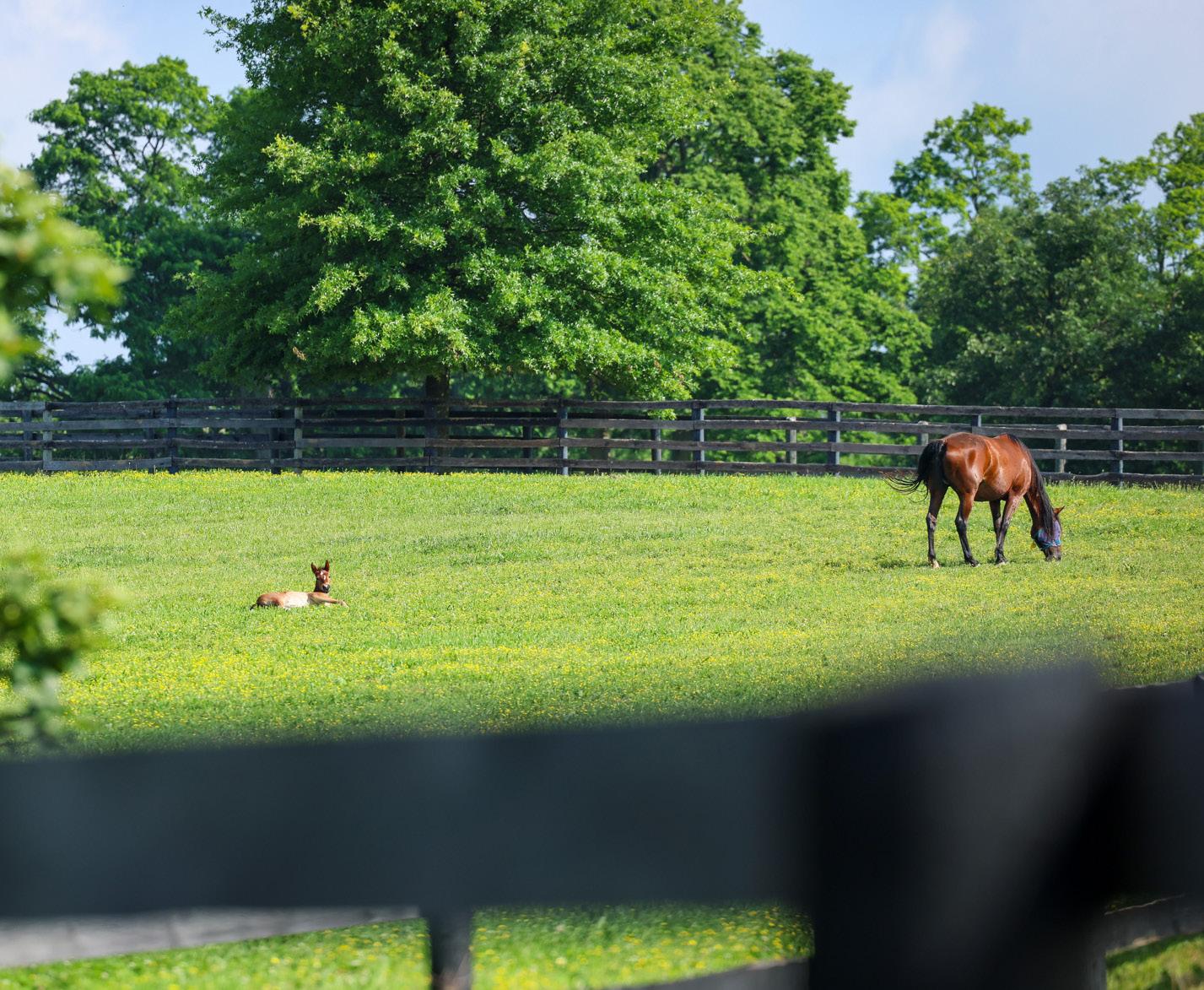
If your horse appears to be having a laminitic episode, call your vet immediately. An accurate assessment of where the horse is in the disease process, and determining how much damage has already been done, are key to choosing the correct treatment and preventing physical damage to the horse’s laminae.
The vet will begin with a physical exam, often watching the horse move before handling their hooves, looking at their hoof shape, feeling for an elevated digital pulse, and palpating the coronary bands and sole. If laminitis is suspected, radiographs are often taken to determine the severity of the damage inside the hoof wall. The views are specifically looking for any degree of rotation of the coffin bone.
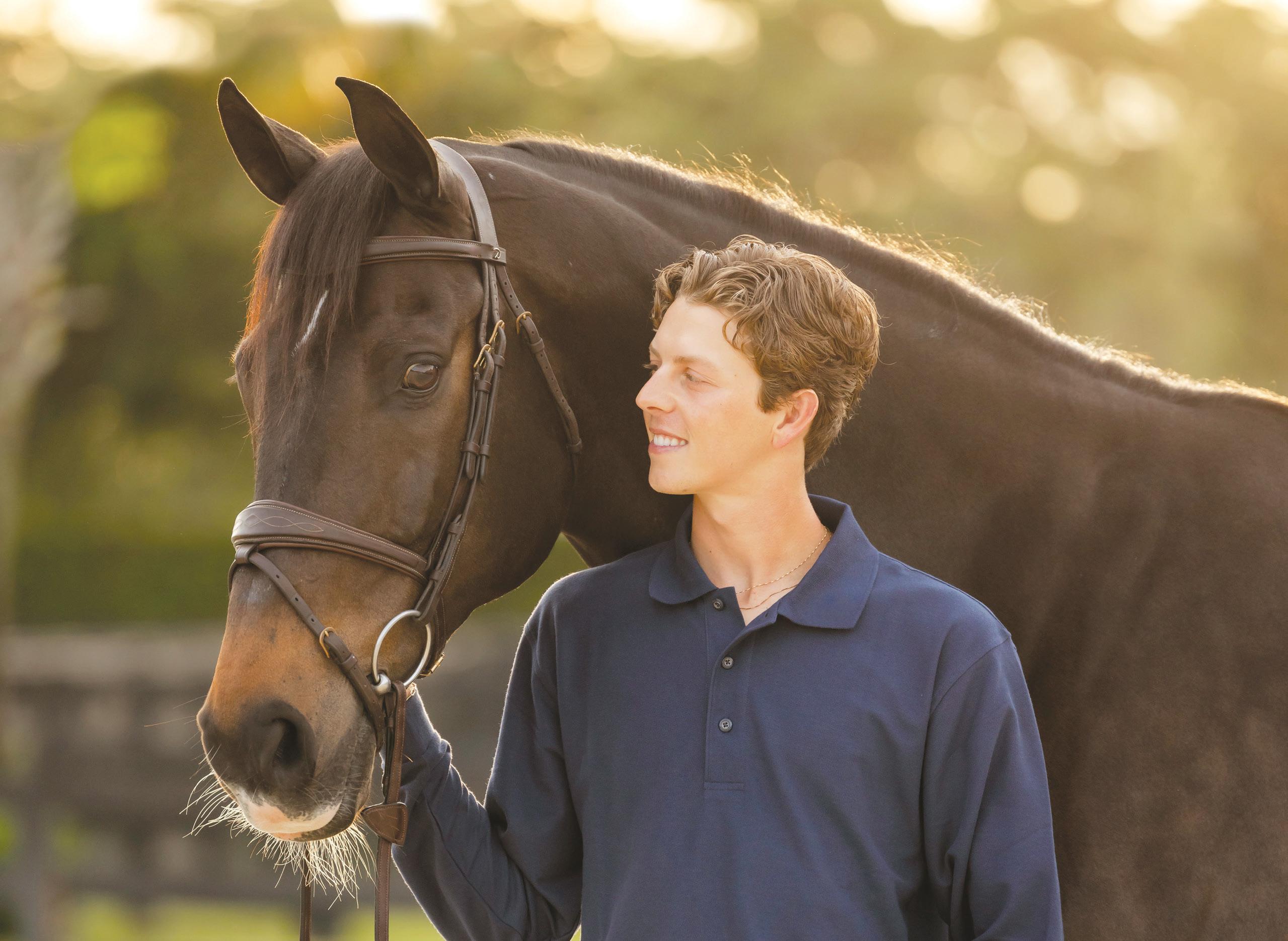
How to Find a Digital Pulse
The ability to locate a digital pulse is critical to being able to determine if your horse’s pulse is “bounding,” which is a hallmark of laminitis, said Dr. Durham.
“A bounding digital pulse suggests inflammation, and this is present with laminitis,” he explained. “It’s also present with a foot abscess.”
There are multiple places where a horse’s digital pulse can be felt, but often the easiest is the artery that runs over the fetlock. To find the digital pulse there, follow these steps:
STEP ONE: Squat and run your hand down the back of the horse’s leg, starting at the back of their knee or hock. Stop when you reach their fetlock.
STEP TWO: Slide your index and middle fingers around to just inside their fetlock. Feel for the soft, squishy area and press slightly harder to locate what feels like guitar strings — these are the digital arteries.
STEP THREE: Press until you feel the pulse and hold for 5 to 10 seconds. If you can’t find the pulse, adjust how hard you’re pressing; pressing too hard will cut off the blood flow and you won’t feel the pulse. Pressing too softly won’t allow you to feel the pulse at all.
STEP FOUR: Pay attention to what the pulse feels like so you can compare it with your horse’s other three legs.
While learning the technique, practicing on a horse immediately after exercise can help, since the digital pulses are naturally stronger during the recovery period.
Treatment
A horse in an acute laminitic episode, no matter the cause, will benefit from cryotherapy. Placing the affected limb in a continuous ice slurry for the first 36 to 72 hours of treatment can be of tremendous benefit, as cold temperatures will help reduce the inflammation in the hoof capsule, decreasing the breakdown of the laminar attachments and improving comfort. Non-steroidal anti-inflammatories will also help ease the horse’s pain and assist in reducing inflammation.
Therapeutic shoeing is often a necessity for horses who have experienced laminitis. If a podiatrist (someone with both a veterinary degree and experienced in farriery) is not working on the horse, it’s imperative that the horse’s veterinarian and farrier work together to support the animal in the best possible way. There are a myriad of methods and modalities to shoe a laminitic horse as each case is different; diligence on behalf of both the vet and the farrier is needed.
Prevention
While being cognizant of footing, utilizing quality farriers, and shutting feed room doors can head off many issues that can cause laminitis, these measures cannot dispel the most likely cause of the disease: endocrine disorders. Management is key to mitigating laminitis risk in metabolically challenged horses.
Dietary management encompasses both weight loss and carbohydrate regulation, according to Dr. Durham, whether these calories come from pasture, hay, or commercial feeds. “Management really is about controlling sugar intake, so the biggest thing is grain,” he said. Metabolically challenged horses cannot regulate blood insulin levels; when these horses eat meals high in carbohydrates (sugar), their bodies produce more insulin than needed and are slow to metabolize the sugar.
“Grain has a very high starch content …. Enzymes in the [horse’s] saliva and in the pancreas start to break starch down, and then it gets absorbed in the small intestine, which is essentially a bunch of glucose going right into the system. If grain can be avoided, it should be,” Dr. Durham advised.
While many horse owners believe in the mantra of “forage first,” a diet primarily made up of hay or grass is not always ideal for horses who are prone to endocrine-related laminitis. Soaking the hay to strip out some of the sugars is possible, but Dr. Durham warns not to then give the water from the hay to the horse. “You have to throw out the water because that’s sugar water. You’re then giving them a sugary drink if you give it to the horse,” he explained.
Horses with EMS can experience extreme spikes in insulin if they consume fresh, green grass, which can then trigger laminitis. While EMS horses are typically overweight, some affected horses can look normal or even have a thin body condition requiring specific nutritional needs to ensure proper nourishment without sparking an insulin overload, Dr. Durham explained. “We want to limit the sugars, and calories, but make sure that all of those important amino acids, minerals, and vitamins are being fed,” he said. A wellness formula, such as Platinum Performance® Equine, can provide the vitamins, minerals, omega3s and antioxidants the horse needs.
Endocrine-related laminitic episodes are often not something from which a horse “heals” completely. Even if the horse loses weight and is placed on an appropriate diet with minimal starches and sugars, their feet will carry the trauma to their laminae forward and are always at risk of recurrence.
While there are medications, such as metformin, available to improve insulin sensitivity, the best weapons against laminitis are regular farrier visits and nutritional control. “Your farrier knows your horse’s feet and they know laminitis, so they’re likely to pick up on subtle changes early,” Dr. Durham explained. In addition, “make sure your grain is stored safely and don’t allow your horse to get obese.”
LEGEND™ SERIES
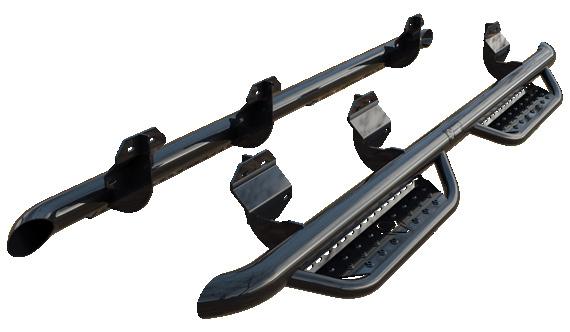
From grille guards & bumpers to headaches racks and runnings steps, the Legend ™ series is made for those who work hard and play even harder. Fabricated by hand in Shiner, Texas, the Legend ™ series is built tough for long days on the road.


“The Thought of Change Was Petrifying”
byDebbie Elliot

Show manager and announcer Andrew Ellis battled opioid addiction for 15 years after suffering a bad fall as a teenager.
I grew up in a horse family in North Carolina, where my mom, Effie, and stepdad, Nick, were both avid riders. Nick was actually a professional steeplechase jockey but then went back to school to get a doctorate and became a scientist. My sister, Sassy, and I both rode as juniors growing up. In 1984 when I was 14, I was riding with a trainer named Max Bonham in Camden, South Carolina, and a horse flipped over with me and fractured my femur. That led to years of ongoing medical problems stemming from the accident. By the time I was in my 30s, I’d had both hips replaced and had been on heavy painkillers for 15 years — which we know now is not a good thing. I was prescribed Oxycontin and Percocet and became addicted to them and also drank heavily. I took the opioids legally and had a standing prescription for them, but I don’t blame my doctors even though I know a lot of people have animosity towards the healthcare industry. I really feel like my doctors were trying to do the best thing for me, and that was to help me deal with my pain and to make me comfortable. They didn’t know the danger back then. I was hooked on opiates from around 1995 to 2011, when my friend, Brad Charles, called me and said: “Your mom and I were talking, and basically, you need to go to rehab.” I was managing a horse show in Houston, Texas, at the time. Work had really taken off, and I was managing multiple shows but was spreading myself too thin and on the road for 46 weeks of the year ... I never slowed down. It was an easy world for my addiction to flourish and take over. Deep down I knew I had a problem, I just didn’t realize that it was as serious as it had become. When part of you is justifying the fact that what you’re taking is for a legitimate medical
Andrew Ellis, with his wife, Catherine Ellis, who is a trainer and rider of top-level show hunters.
Equine laundry care
Dry your rain-soaked horse equipment quickly and safely. Revolutionize equestrian care with drying cabinets that keep your gear protected, preserved, and always ready to perform.
EFFICIENT DRYING
Quickly dry wet gear, whether freshly washed or soaked from use. Ideal for saddles, blankets, boots, and more, ensuring everything is ready for your next ride.
ENHANCED LONGEVITY
By minimizing wear and tear, drying cabinets help prolong the life of expensive equestrian gear, saving on replacement costs.
HYGIENE AND SAFETY
Thorough drying prevents mold and bacteria growth, ensuring clean and hygienic equipment for both you and your horse.

“AFTER
THE
REHAB,
reason, it makes you blind to the effects of what’s going on. I started to watch the walls crumble around me personally. My life was becoming out of control.
The thought of change was petrifying when you’ve lived your life a certain way for so long. My mom and Brad persuaded me to go to a rehab facility called Samaritan Colony in Rockingham, North Carolina, and they definitely saved my life. It was not glitz and glamour; it was a very humbling experience and I met a lot of great people there. Before I went to rehab, I had an awareness that I had a problem, but it was after the first day or two there that I was able to admit that I was an alcoholic and an addict. I am grateful to my mom for bringing me into the world, and for helping to save my life when I was 40 years old.
FIRST DAY OR TWO IN
I WAS ABLE TO ADMIT THAT I WAS AN ALCOHOLIC AND AN ADDICT.”
For the first year after I got sober, I just stayed grounded around North Carolina where my parents’ farm was. I took it easy and went to Alcoholics Anonymous meetings every day and immersed myself in the AA program. I also went back to school and studied to be a licensed substance abuse counselor at a local community college. I didn’t practice as a counselor but I wanted to educate myself on addiction, so I immersed myself in recovery for two years while I still worked for horse shows (but just not as many).
I have been sober for almost 15 years now, and the biggest challenge has been restructuring my lifestyle socially to be able to still have fun and co-exist with my friends who are not in recovery. If I’m at a horse show, I’ll go out to dinner with the judges and other horse show staff who don’t have alcohol or drug issues, but they do drink. I like to say that I have enough tools in my sobriety toolbox to exist in any situation. The skills I’ve acquired at rehab and going through AA and the 12 Steps have made me a much better human being and a much better employee. Horse shows can be quite a taxing environment and take a real emotional toll because there is a lot of pressure. Being in recovery makes it easier for me to cope with that as it requires a lot of self-examination and self-introspection. You get a lot more comfortable in your own shoes, and that translates into everyday life.
I knew my wife, Catherine, casually for many years from horse shows but we didn’t start dating until 2013. She’s only really known me as sober, which is probably a good thing. She’s a professional trainer and rider, and she doesn’t really drink, but she might have half a glass of wine here or there. I’m a big believer that it’s better for somebody in recovery to be with somebody who’s not in recovery. I’m truly blessed that I have her because she’s been tremendously supportive and understanding.
I’ve learned everything is about balance, so I pick and choose the horse shows I want to do. I still work a lot of shows — I do the in-gate at pretty much all the big indoor shows including the National Horse Show, the Pennsylvania National, and the Capital Challenge. I stay busy, but I don’t stay obsessively busy. You are on the road a lot in the horse show industry, and it was a carnival lifestyle for me for a long time. Now as life’s matured, I’ve been able to pick and choose what I do. I have been able to find AA meetings or 12 Step programs anywhere I’ve traveled in America and even in some countries outside of the U.S., or I’ll attend online meetings via Zoom. Not a day goes by that I don’t talk to somebody in the horse show world who is in recovery or trying to get sober. I have been pretty vocal about my recovery on social media, so I have a lot of people calling to say they have a friend or know a rider who is struggling and asking if I’ll help them. I then try to work with them and reach out to talk every day. There is a really good community of sober people




in the hunter world and we have our own informal group that involves a lot of text messaging back and forth and to support each other. This is such a unique industry, and we’re on the road so much, non-horse people don’t really understand the horse world and the challenges.
The struggles that horsemen and women go through and the pressures they face are so unique to our industry. Everyone who I’ve crossed paths with has been incredibly supportive of my sobriety and my journey. I’ve worked for horse show managers that have let me leave work early and go to an AA meeting because I was just at that place in my life where I needed to go. I try to be vocal about it because I feel like there’s such a stigma around addiction. The horse world is traditionally a
“NOT A DAY GOES BY THAT I DON’T TALK TO SOMEBODY IN THE HORSE SHOW WORLD THAT IS IN RECOVERY OR TRYING TO GET SOBER.”
place where people can struggle with mental health. We don’t slow down; we patch ourselves up and go on to the next show. The pressure is so great to just keep going; it is something that we need more awareness about. USHJA recently started offering affordable on-demand mental health services [all USEF members are eligible for three sessions with a licensed state-wide provider]. In the past, it was easier for people to take a pill to combat their anxiety or competition fears. People need to realize that there are natural and less debilitating ways to deal with their fears and problems.
During COVID, we started a Facebook group called “Jump Sober” and would host conference calls and Zoom meetings with people who were struggling. We don’t do as much with it anymore, but I’ll still post inspirational quotes and messages of encouragement. Now we have a very close-knit texting group of horse show people who are trainers, judges, and staff, and we all text each other regularly to check in. I was at a horse show recently where one of the judges is newly sober. He was having a tough day, so he called me on the radio to come over to the judge’s booth, and I sat with him for half an hour and just provided support. Then after the show, we had an hour meeting together. Sometimes you can’t make it to an AA meeting when you need to because you’re stuck at a horse show, but there’s a saying in recovery that “it only takes two people to make a meeting.”
The first step to recovery is admitting you have a problem. Nobody should be ashamed of addiction or alcoholism because it is a disease. There is no shame in taking that first step to ask for help; it is very brave of somebody to stand up and do that. I encourage people who are struggling to go to an AA, an NA [Narcotics Anonymous] or a 12-step meeting, or to find an addiction counselor. Reach out to someone you know in the horse world who is in recovery who can direct you to the right resources. People should be proud to take the steps to recover and to accept that they are not morally weak or bad, just addicted. I get a lot of joy from helping other people as one of the steps in AA is to carry the message to another alcoholic or addict and pay it forward.
October is National Substance Abuse Awareness Month. If you or someone you know has a problem with drugs or alcohol, please visit samhsa.gov for recovery resources and information. For information on USEF’s mental health resources for equestrians, please visit usef.org/membership/mental-health-resources.
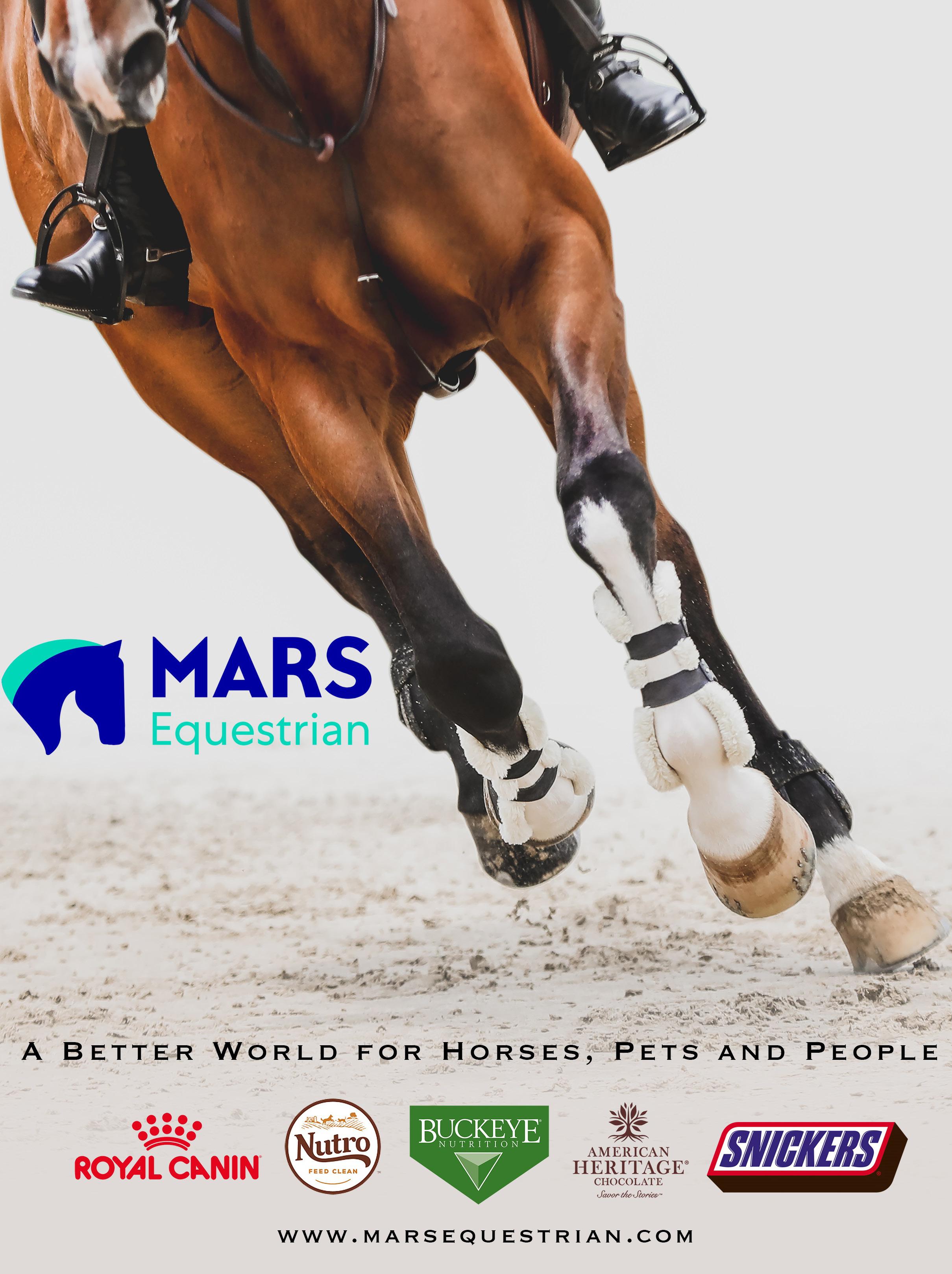
Stick Horses, Real Stakes: Inside Competitive Hobby Horsing
The United States Hobby Horse Championships was created by four young equestrians who are passionate about hobby horsing.
by Debbie Elliot
Many of us had a hobby horse when we were kids, which we ran around our backyard on dreaming of one day owning a real horse. While the popular toy dates back to the early 1800s in London, the sport of hobby horsing has evolved over recent decades as enthusiasts gather from around the world to compete. Modern day hobby horsing originated in Finland, and the Nordic country is now home to the largest global organization supporting the sport, the Finnish Hobbyhorse Association, which hosts an international competition each year.
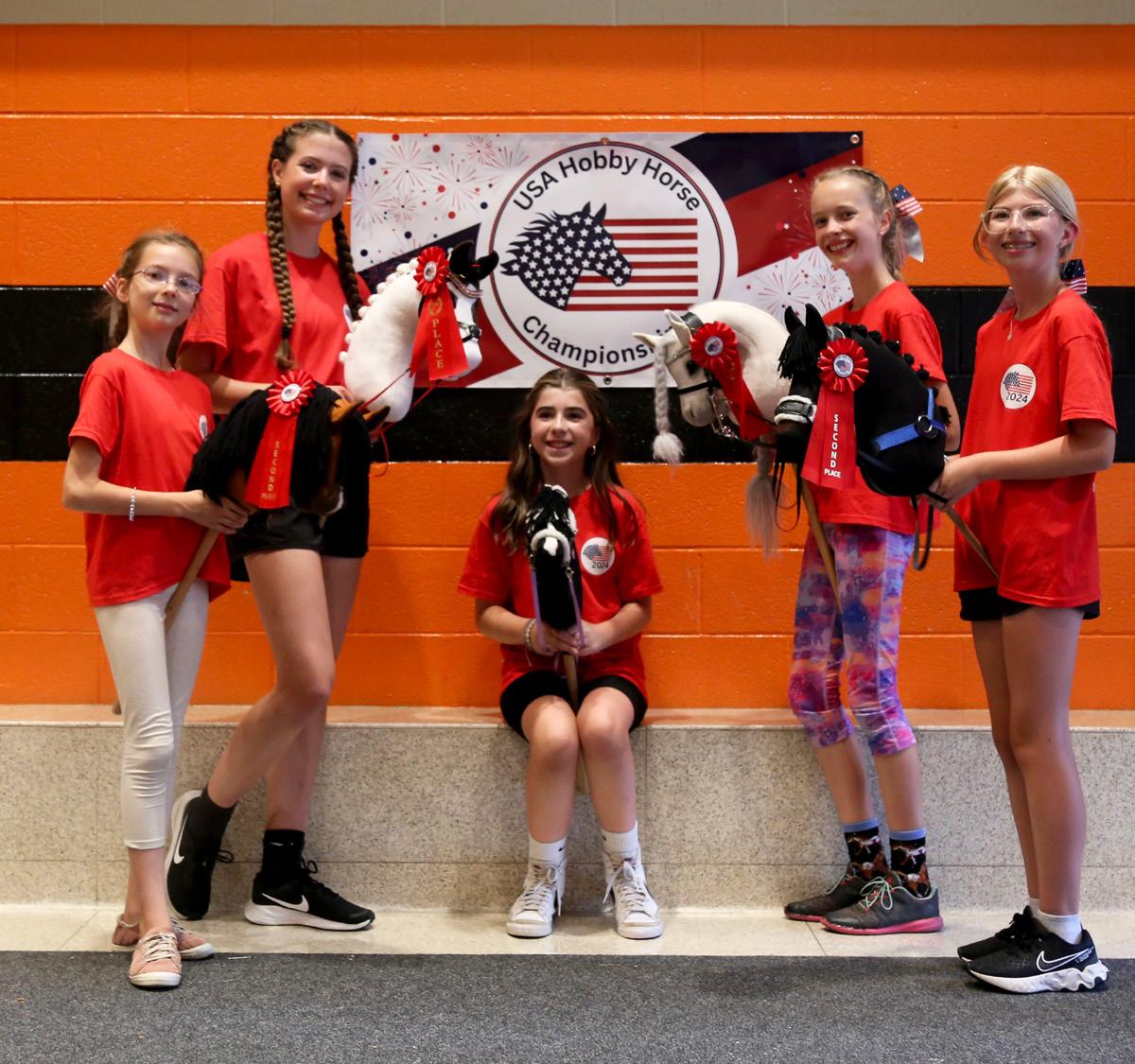
U.S. teens Mica Zandstra, 19, Mackenzie Carlson, 15, Mirabelle Whitman, 14, and Liliana Whitman, 11, all became passionate about hobby horsing and began pursuing the activity independently. Not only did they learn to ride and jump their hobby horses, but they each learned how to make their own.
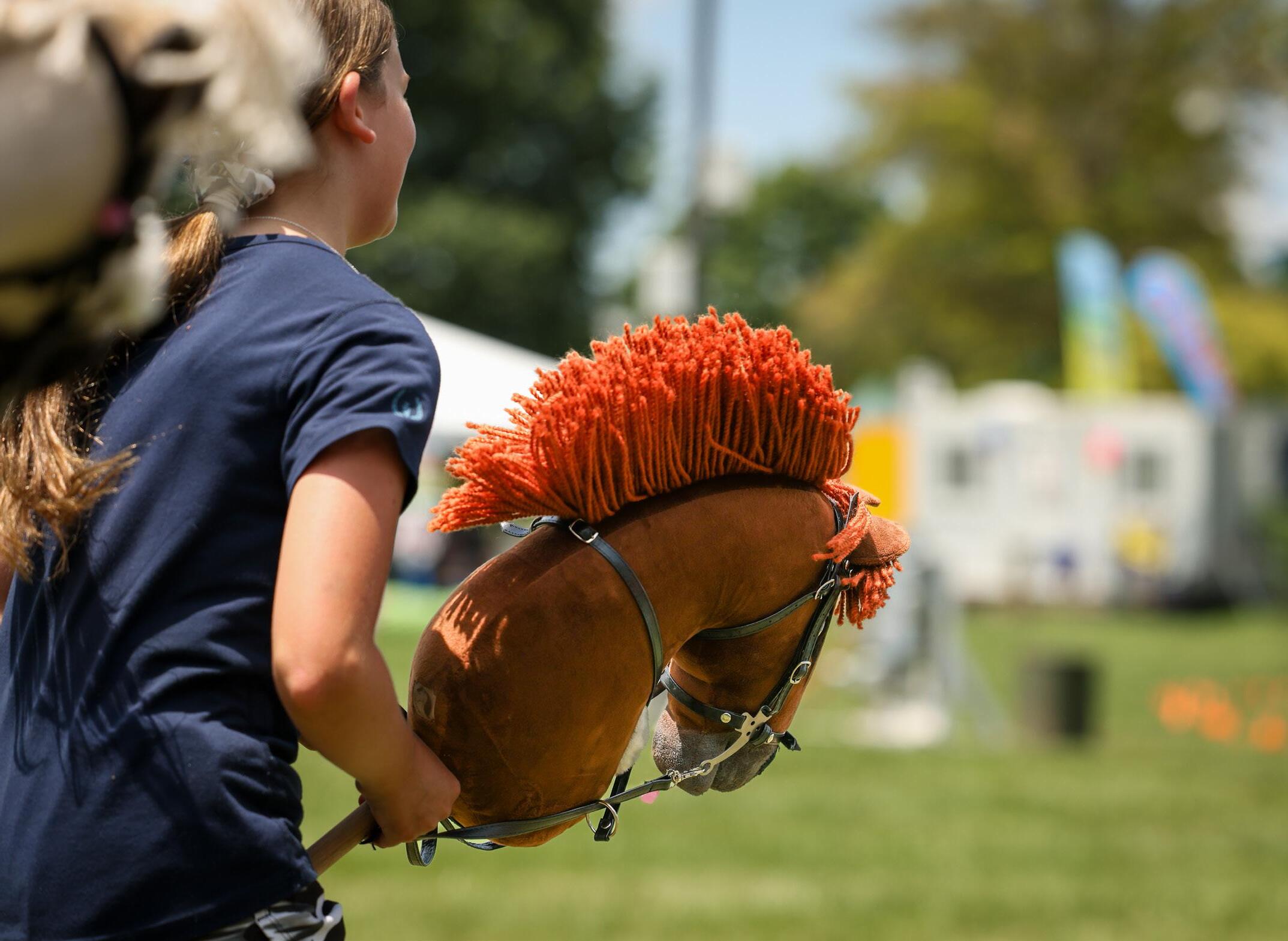
“A lot of people compare hobby horsing to track and field or to real horse riding, and it’s completely different from both of those,” Mackenzie


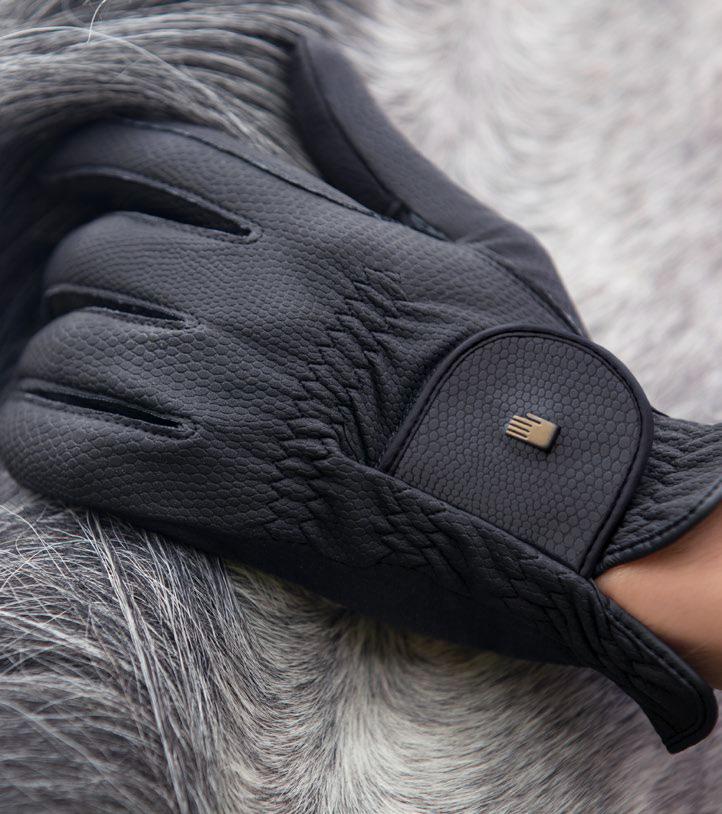
Roeck-Grip® Lite gloves are made with Roeckl's exclusive Roeck-Grip® material that provides soft, breathable comfort on hot summer days! Like Roeck-Grip and Roeck-Grip Winter, the Roeck-Grip Lite fits like a second skin, giving the rider a close contact feel, and is even touchscreen compatible! Roeck Grip Lite gloves are available in Black, White, and the new Naval Blue!
Left: Mackenzie Carlson and Mica Zandstra organized a hobby horse meet-up at the 2025 BreyerFest at the Kentucky Horse Park in Lexington, Ky.
Right: LeMieux’s hobby horse collection includes accessories such as bridles and ear bonnets.
explained. “We definitely jump hurdles, but there’s also a lot of creativity involved.” Mirabelle added that “mostly everything that hobby horses use is handmade. We make the horses, the jumps, the tack, etc. There’s a lot of artistry and I think that’s what sets it apart from other sports.” The hobby horses themselves are made by taking a pattern of what they want their horse to look like and then turning it into a three-dimensional fabric sculpture.
The girls, who are all young riders from different parts of the Midwest — Mica is from Chicago, Ill., Mackenzie is from Almont, Mich., Mirabelle and Liliana are from La Farge, Wis. — met online via Instagram or through their Etsy stores and bonded over their mutual love of hobby horsing.
“We got together and had this idea to host a championship competition because we all wanted to compete and felt that this sport was growing,” Mica explained. After meeting online and dreaming about the possibility of hosting their own event, the girls “got on FaceTime calls and started planning the competition, and then the parents got involved.”
The inaugural United States Hobby Horse Championships (USHHC ) was held in August 2024 at Almont Middle School in Almont, Mich., and the young organizers were immediately blown away by the attention the event received. They initially posted a sign-up sheet online to gauge interest, deciding that if they had less than 30 people apply then they would scrap the idea. “At one point, Mica said to me, ‘Mom, there’s 60 people coming.’ And I was like, ‘What?’” Kristin Zandstra recalled. “We had to make sure we could actually host an event! All of a
sudden, we needed party rentals and food trucks.”
That number quickly doubled, ultimately totaling over 120 competitors and 400 spectators. The Washington Post, New York Times, and Inside Edition covered the competition after it went viral on Instagram, and fans from as far away as Hawaii, California, and Europe traveled to the small town of Almont [40 miles north of Detroit] to compete.
The 2025 USHHC took place on August 2, with the number of participants more than doubling from the previous year. There were nearly 300 hobby horse devotees signed up for classes in seven different disciplines: Flat, Hunter/Jumper, Show Jumping, Dressage, Barrel Racing, Western Trail, and Puissance.
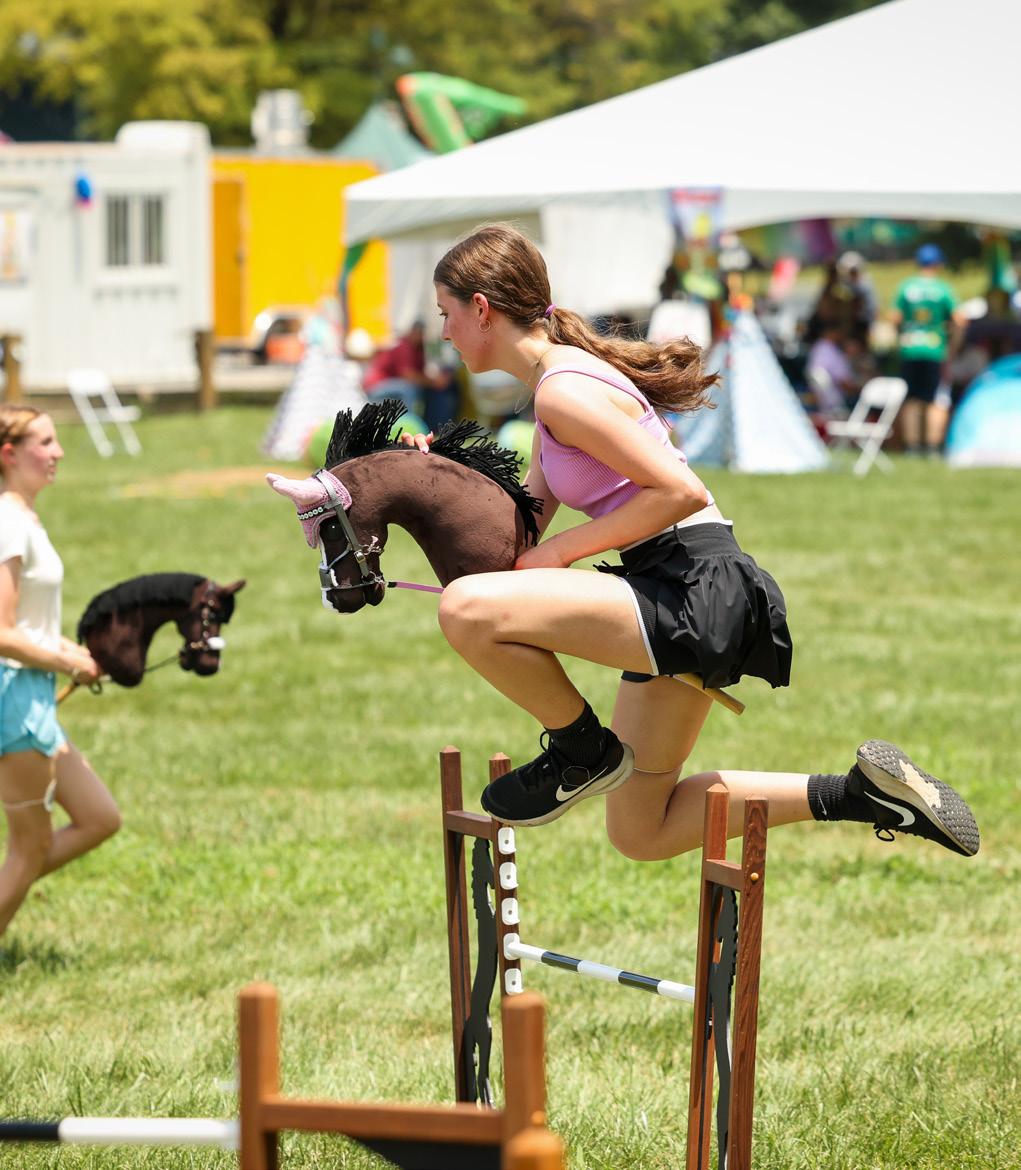
“For show jumping [with heights ranging from 1” to 3”], it is just like real show jumping. You get faults for knocking fences down, refusals, etc. and it is timed,” Mirabelle said. Mackenzie went on to explain that “with hunters, it is also a lot like real life and is judged on the rider and horse’s form as if you were at a horse show.”
In Western trail, competitors have to open gates, go around cones, walk over poles, etc., while they are judged on how the horse behaves and on their pace. “For dressage, we go off of the judging sheets for real horse riding, and we transfer it over to hobby horsing,” Mica said. “The tests are a little bit simpler just because it can be a lot more tiring to do a whole test on foot! But movements like piaffes and pirouettes are the same.”
“A lot of people see hobby horsing and think it is really easy, but it is way harder than it looks and

If you want to try hobby horsing but don’t have the time or creative skills to make your own, LeMieux has a stable of professional-looking hobby horses to choose from. Some are inspired by real life horses such as Lemon, LeMieux’s rescue pony mascot, or influencer Harlow White’s Connemara, Popcorn. While others represent different breeds and disciplines such as Chancer the thoroughbred, Flash the paint, or Freya, the bay eventer. All the hobby horses can be accessorized with tack, ear bonnets, halters, and ribbons. Visit lemieux. com/us/toys/hobby-horse to shop the collection.

is very athletic,” Mirabelle explained. “It’s great for your legs and is a lower body workout. You need good body awareness, agility and strength.” In addition to physical strength and coordination, Mackenzie said, “if you are jumping, you have to figure out your distance from the jump, how you’re going to take off, and the number of strides. It helps with our jumping on real horses too.”
While the girls held a lottery system for most of the class applications for the 2025 championships, those wanting to compete in dressage had to record and submit videos of themselves doing a test that Mica created. She then filled out a judging sheet for each application, and the top 15 rankings were invited to attend the competition.
Along with the different disciplines, the 2025 USHHC hosted vendors selling hobby horse-related merchandise like tee-shirts and tack, sponsors awarded prizes, and there was the opportunity to meet other hobby horse athletes. “We recommended hotels on the website, which is fun because then all the hobby horses end up in the same hotel,” Mirabelle and Liliana’s mom, Rebecca Whitman, said. “The whole lobby of the hotel was filled with hobby horses!”
“One of the coolest things about hobby horsing is that you do not have to compete if you do not want to,” Mirabelle said. “With a lot of sports, it’s always about competing and getting to the next level. I love competing, so I want to go to all the shows, but I can also just trail ride out and have fun as well.”
Above: (Left to right) The United States Hobby Horse Championships team of Liliana Whitman, Mica Zandstra, Avery Carlson, Mirabelle Whitman, and Mackenzie Carlson.
Left: The hobby horse dressage test includes movements like piaffes and pirouettes, just like in real life dressage.
Ahead of their second annual championships, the girls were most excited about “seeing so many people who love the same thing — and usually are so far apart — get together to hobby horse,” Mackenzie said. “Last year there were so many people saying what a wonderful day they had ... it was just crazy to see something that we spent all this time creating and then everybody just loved it. That was really special.”
“This community is really strong,” continued Mica, who has made many close friends in Europe through online hobby horse groups.
Hobby Horse Disciplines
Flat: This class is judged on how well your horse behaves at the walk, trot, and canter. Competition is done in a group, and riders follow the judge’s directions.
Hunter/Jumper: The Hunter/Jumper class is focused on style. Horses should have good manners, smooth style and a graceful overall appearance.
Show Jumping: This competition is about speed and accuracy! Points are deducted for fallen rails and refusals, and going off course leads to disqualification.
Barrel Racing: All about speed, this competition is the fastest of the day. Riders complete a figure eight around the barrels as fast as they can.
Western Trail: In this competition, horse and rider navigate a series of obstacles like gates, bridges, and poles in a course to demonstrate good manners and control.
Puissance: Puissance is reserved for those ready to fly to new heights! Riders line up to attempt to sail over the bar as it rises after each round.
Dressage: Dressage is a dance that involves a specific set of required moves in a performance of the rider's design.
For more details, please visit ushhchampionships.com/disciplines
How It Works: The Regulation Department
The disciplinary process aims to enforce rules that ensure the ethical treatment of horses and a fair playing field for all.
by Debbie Elliot
The USEF Regulation department handles reports and complaints regarding rule violations and other disciplinary matters including horse welfare concerns, while the Safe Sport department is in place to protect athletes from abuse and misconduct.
The Regulation department has a fourstep process for handling reports: intake, investigation, assessment, and action. This can involve informal resolutions or formal disciplinary proceedings. The goal of the Regulation department is to create a fair playing field for all, to protect the health and welfare of all horses in equestrian sport, and to enforce rules related to the ethical treatment of horses.
“Anytime you’re speaking up for and fighting for those who can’t fight for themselves, it is a greater responsibility to try to work as hard as you can to protect them,” John Lathrop said.
“The USEF rules clearly define the standards for ethical treatment of the horse. Integrity in the enforcement process is essential. The process must be fair, transparent, and consistent,” Sonja Keating, US Equestrian General Counsel & Chief Operating Officer, said.
The Disciplinary Process
USEF has recently made updates to its disciplinary processes, including new penalty guidelines, a revised warning card system, and improved web resources to enhance transparency and efficiency. The organization also sought independent law enforcement experience when it hired John Lathrop in the newly-created role of Integrity Unit Investigator. Lathrop is a former detective with the Lee County Sheriff’s Office in Fort Myers, Fla., where he worked in the property crime, violent crime, intelligence, and homicide units before he retired from law enforcement and moved to Kentucky.
“At the Lee County Sheriff’s Office, we were very much involved in protecting animals, children, and people who can’t protect themselves,” Lathrop said. He is now transferring those skills to the protection of horses by investigating allegations of mistreatment or abuse. “Anytime you’re speaking up for and fighting for those who can’t fight for themselves, it is a greater responsibility to try to work as hard as you can to protect them and make sure they are safe,” Lathrop said.
The Investigation Process
Lathrop’s priority is to stay neutral, decipher the facts, and not assume that every allegation that is reported is legitimate. He carries out investigations by developing leads and gathering evidence. “These are skills I’ve learned over the years during my time in law enforcement,” Lathrop said. “I start all my cases exactly the same. Once it is assigned to me, I do a cursory review and organize my thoughts about the case, read all the documents, review the witnesses, and analyze all the information that we have at the beginning. The techniques that I would use in the sheriff’s office were the same, whether it was a burglary or a homicide.
“It is a timeline in chronological order of how the investigation unfolds, so you are telling the story from A to Z.”
Lathrop proceeds to interview the witnesses, develop further leads from those witnesses, and gather evidence from them such as photos, videos, or screenshots. After 25 years with the sheriff’s office, Lathrop is highly experienced at talking with people, gathering information, and encouraging witnesses to tell him details. “Sometimes the smallest detail matters, even if they don’t know the whole story,” he explained. “It’s all pieces of the pie.” Incidents that happen during shows are often filmed, however those that occur at home, at barns or in the warmup ring, usually are not, making first-person testimony vitally important.

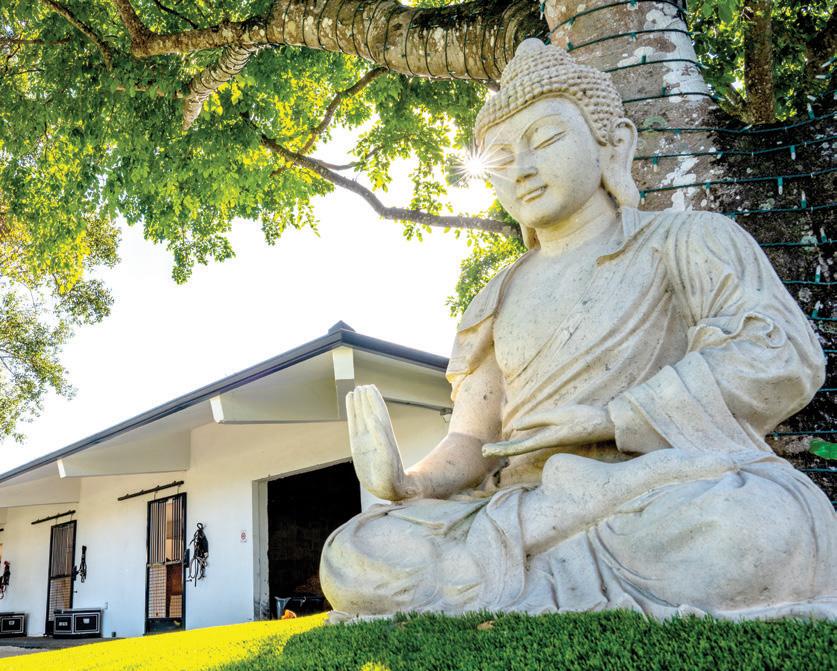
Zen Elite Equestrian Center, located in Southwest Ranches, Florida is everything the name suggests and much more.
The state-of-the-art facility hosts a spacious covered arena, two huge outdoor arenas and a full rehab/spa.
From the cascading waterfalls in the rider’s lounge, to its peaceful statues and inviting gardens, Zen Elite Equestrian Center envelops visitors in a spa-like relaxed atmosphere.
But Zen Elite is more than just soothing to the soul. The facility is unique in its scope, hosting grassroots dressage and jumping lesson programs in the same arenas where international trainers are preparing for national and world competitions.
Owner, Heidi Humphries’ vision is legendary, in that it supports the future of horse sport in the spa-like serene atmosphere that is Zen Elite Equestrian Center.



As the equestrian community is very close knit, some people may be worried about coming forward, but all reports can be submitted confidentially and anonymously online by completing a Horse Abuse & Unethical Treatment Report Form at USEF.org or by texting 2USEF. USEF’s Anti-Retaliation Policy protects people who participate in proceedings.
“Often people come forward when they see something extremely disturbing or after they choose to leave a barn, trainer, or facility. We then have to call witnesses who are currently still in the program, who are sometimes reluctant to participate,” Lathrop revealed. “My job is to encourage them to tell me the truth. We want the same thing. We want the horses to be protected. Eventually, if we pursue the case and send a notice of allegation letter, then we will call the respondent [the person being investigated].” Next, they have the opportunity to talk to Lathrop or send him a letter to explain their side of the situation. “It encourages them to tell the truth and give me all the details.
“We really want to educate people,” Lathrop stressed. “These aren’t people who are deliberately abusive. These are people who may have used harsher training techniques than called for because maybe they don’t have the skills to train the right way. Or a lot of our cases involve frustration, the horse refuses to jump, etc., so out of exasperation, they hit or mistreat the horse, which is not OK.”
The Resolution Process
Once Lathrop’s investigation is completed, it is reviewed internally for an outcome determination. “A determination must be made whether the evidence substantiates a rule violation,” Keating explained. “If not, then the matter will be closed. If so, then a decision is taken on whether to offer an informal resolution or proceed with formal disciplinary action and a hearing. Informal resolutions vary widely based on the facts and circumstances of the particular situation, including the severity of the offense and whether it is a first-time occurrence.
“It is important to understand the context of what happened,” Keating stressed, clarifying that USEF cannot base regulatory action solely on video evidence from TikTok or other social media platforms. “The evidence must be authenticated,” she explained. “We need to demonstrate its reliability and verify that it fairly and accurately represents the event it depicts. While digital forensics can analyze the metadata and provide insights, the testimony of an eyewitness to the incident is essential.”
USEF might offer a suspension to someone who has committed a violation. However, if they refuse it, then the member is afforded a hearing before a neutral hearing panel. “USEF has penalty guidelines for the unethical treatment of the horse and for drug and medication violations,” Keating explained. “These are just that — guidelines. Mitigating factors may warrant a departure from the guidelines while aggravating factors may justify a higher penalty. The penalties are published online and in the US Equestrian magazine (in “For the Record”). This transparency helps facilitate the informal resolution of most matters where the parties agree to the outcome. This approach is ideal because it saves everyone time and expense and avoids what may feel like an adversarial process. In the end, we want a fair outcome,” she concluded.
MEMBERS’ RIGHTS
Before any adverse action is taken by the Federation, you will be afforded:
• Notice of the charges or alleged violations in writing
• An opportunity for a hearing
• A reasonable amount of time before the hearing to prepare a defense
• A hearing at a time that is practicable for you to be able to attend
• Fair notice and an impartial hearing
• A hearing before a disinterested and impartial body of fact finders
• The identity of the Hearing Committee panel members who will be presiding over the hearing
• An opportunity to bring a representative or legal counsel, at your own expense, to present your case
• An opportunity to call witnesses and present oral and written evidence and argument
• An opportunity to confront and cross-examine adverse witnesses
• An opportunity to request a record be made of the hearing
• A reasoned written decision following your hearing












Be Informed: Know What to Look for in a Good Working Student Experience
by Natalie Voss
A
successful working student experience is driven by clear communication, managing expectations, and a few best practices.

For many young, motivated equestrians, the opportunity to become a working student is a dream come true. The details of the arrangement vary from trainer to trainer, but the concept of a working student position is rooted in an eager learner trading their hard work for the chance to ride and train with a respected mentor. The role can be a rewarding way for students to learn the ins and outs of how a barn runs, while offsetting the expense that would normally come with rigorous training and showing.
Jordan Allen, who parlayed a successful junior career in the hunter, jumper, and equitation rings into a spot on the University of South Carolina hunt seat team, sees her time as a working student as a crucial part of her identity as a rider. Allen spent multiple years as a working student for Ken and Emily Smith’s Ashland Farm in Lexington, Ky.
“It sounds cliché, but it was such a great opportunity,” Allen recalled. “I never expected to learn so much from it and have so much freedom within it. I think our sport is filled with many people who want to become professionals.” Although she didn’t personally follow the professional route, “it’s invaluable how much you learn from a business standpoint as a working student,” Allen added.
However, for every rider like Allen who had a rewarding experience as a working student, there are also those who have come away from the experience feeling disillusioned. The nature of a “work for ride time” arrangement can leave a student vulnerable, or a trainer frustrated. Fortunately, there are safeguards that students, parents, and trainers can follow to make sure the position works for everyone.
Know What to Expect
First, it’s important to recognize that the best working student jobs are challenging, with long hours and physical labor — and those hours won’t always be spent in the saddle.
Allen said the time she spent setting jumps for Ken Smith to train, and the days she spent holding horses for the veterinarian and the farrier were just as valuable to her education as her riding time. Without them, she would have missed the chance to understand her horses’ needs out of the tack or comprehend how a training and sales business works.
A working student should have a written agreement detailing expectations, such as barn chores.




Utilize the latest technology with T3 Matrix Saddle Pads for maximum comfort and freedom of moment

BUCAS ROECKL
MYLER BITS®
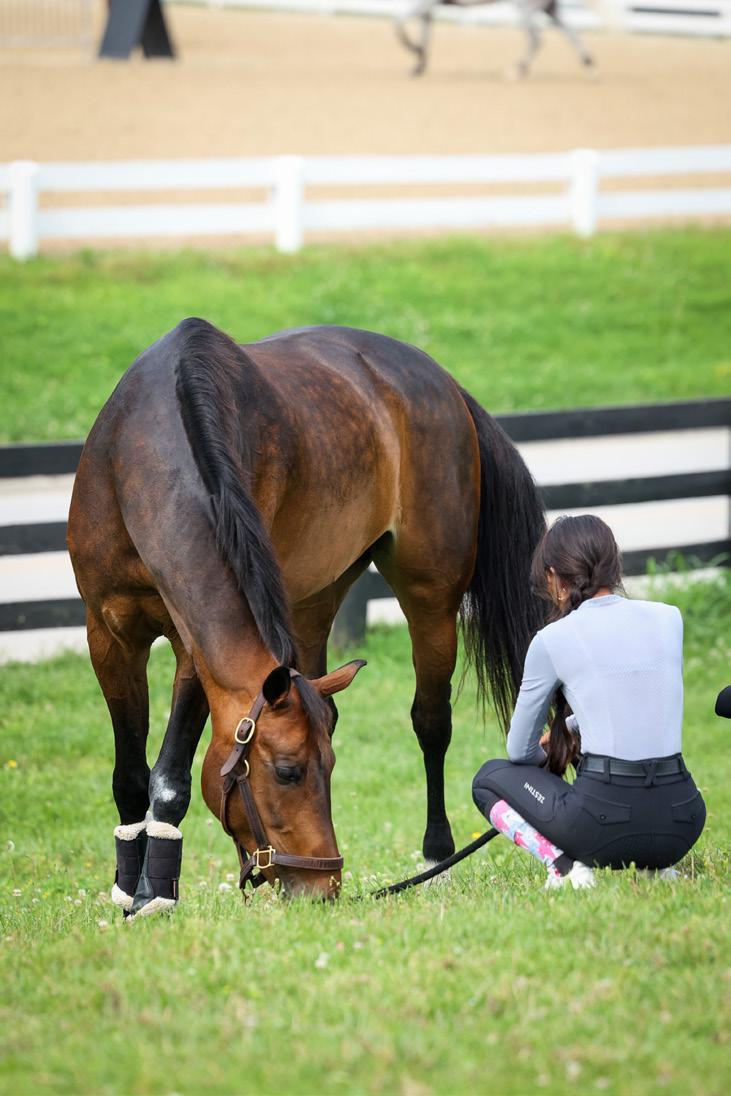
US Equestrian and our Safe Sport department are committed to helping protect all equestrians, especially our junior competitors, both inside and outside of the competition ring.
“There were a lot of days when I wouldn’t ride,” Allen said.
Although Allen is a firm believer in hard work for hard work’s sake, she is also careful to point out that even a diligent working student may not get to show the most talented horse in the barn every weekend. The decisions on who gets those opportunities are multifactorial at many barns and may shift for multiple reasons over time. Still, she also believes that hard work trumps talent when talent doesn’t work hard.
Andre Dignelli, a hunter/jumper trainer and owner of Heritage Farm in Katonah, N.Y., said he has a soft spot in his heart for young riders who are willing to go the extra mile with whatever task they’re given — and who know how to make the most out of the opportunities that come their way.
“I think there’s a misconception that a working student should come to a stable and ride all day,” said Dignelli. “That’s the privilege part. That’s why you’re working.”
Dignelli is willing to brainstorm with young students and their parents to figure out ways they can save money on show expenses or schooling opportunities. However, he said it’s also important for working students (and their parents) to understand that most trainers aren’t saving money on a working student if they’re under 18 and have school commitments. At a large barn with an appropriately run program, the needs at home and at the show likely require full-time staff in place whether the student is there pitching in or not.
The most crucial thing in a successful working student program is clear expectations. On a micro level, Allen recalled weekly meetings at Ashland where staff and students organized everyone’s schedules and tasks for the week, citing the practice as a simple way for everyone to feel supported and purposeful. On a macro level, Dignelli commits to writing out his expectations for a student’s hours, responsibilities, and days off, and any parameters about riding time. If the student is a child and will rely on family members for transportation, Dignelli wants parents to be aware of those expectations as well. Many parents of his students don’t have horse experience themselves, and Dignelli wants them to learn as much as possible about the barn where their child will be working. “This is a family commitment,” he said.
Be Prepared
Beyond work expectations, it is helpful to know whether the trainer is an instructor you or your child will mesh with. Seek out current clients to learn more about the trainer’s reputation within their sport, and their teaching and management styles.
The terms of any working student position should be clarified in a written contract, and both the student, the trainer (and parents, if applicable) should be aware of the terms for job duties, hours, time off, and other parameters. If the prospective student is a young adult who will be compensated and working full-time, the working student role may include housing. The specifics of lodging should be detailed in a written agreement, including specifications about availability of electricity, running water, climate control, as well as whether or not the housing will be shared with others and whether the student will be expected to share a bedroom or bathroom with others. The working student could require housing at horse shows, and the plans for this should also be clearly defined.
Once You’ve Started
After the student begins working, Dignelli encourages regular check-ins to make sure everyone feels the written parameters are being followed.
“I think you owe it to them to get together once a week and ask, ‘How is this working out?’ ‘Is this what you wanted it to be?’” he said. “A positive environment is good for everybody. If someone sours in the wrong job, they are better off leaving to go do something else. One of the things I love about Heritage is that the morale is good.”
Sometimes a position that sounded like a dream job can end up being different from what you expected going in — which can be a hard pill to swallow if you’ve uprooted your life to take a job or had high hopes for a step forward in your show career.
PHOTO:
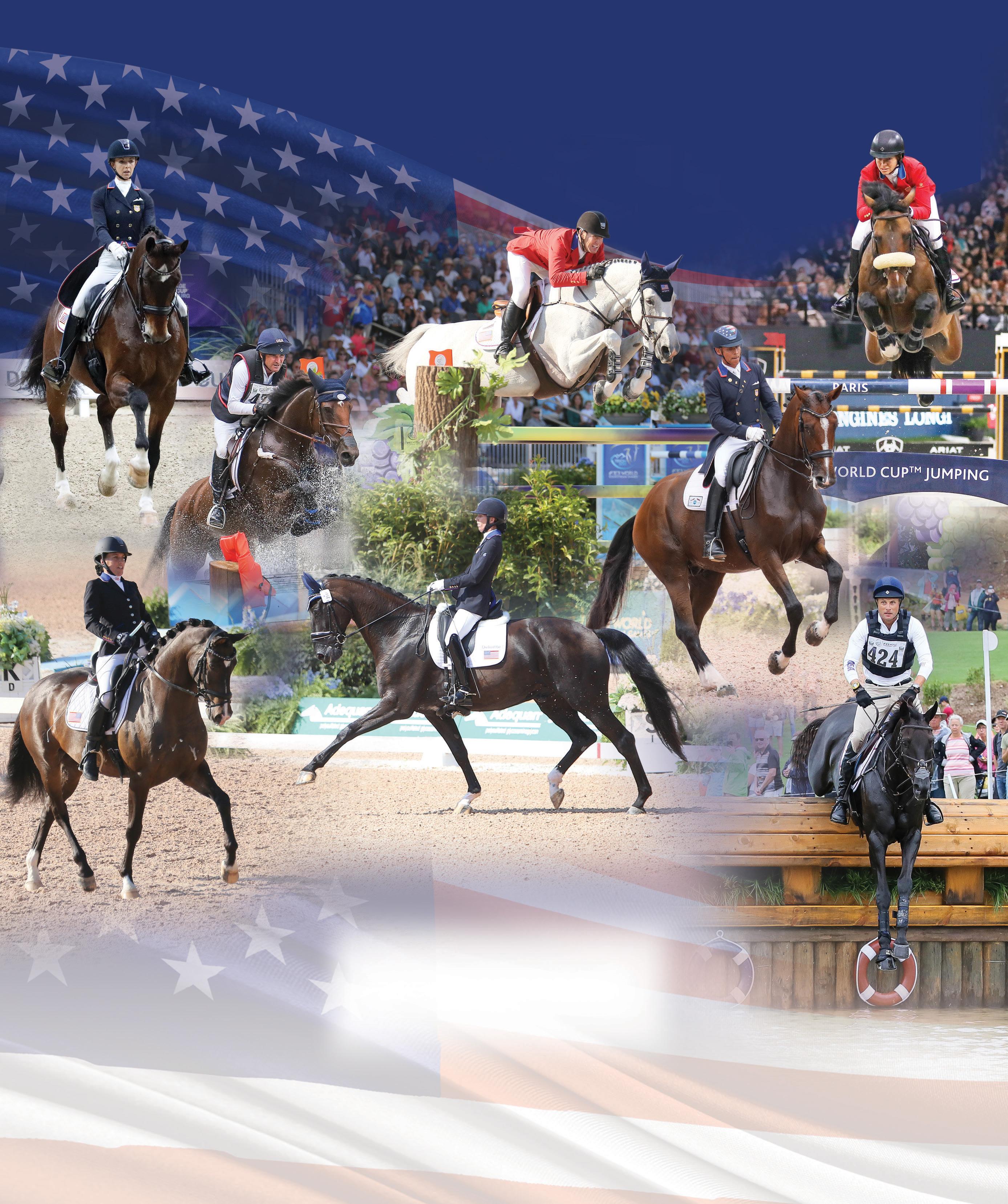
Working students have the opportunity to ride a variety of different horses.
Here are some red flags (drawn from real-life examples) that adult working students or parents should be aware of before accepting a position.
• Consistent lack of communication or adherence to a written agreement about working hours, time off, lodging, job duties, lessons, etc.
• Slow or incomplete payments in the case of paid positions
• Withholding medical treatment or knowingly requiring someone to ride without medical clearance after suffering a serious injury
• Repeatedly preventing a student from breaking for a meal or hydration, or encouraging eating disorders
• Changing housing situations without warning, especially if housing is lacking utilities, privacy, or has pest problems
• Verbal abuse when managing or training the student (a trainer raising their voice does not qualify, but criticism that is overly personal, includes name-calling, or designed to be degrading is inappropriate and ineffective)
• Talking down other students, staff members, or clients to the student or encouraging bullying or hazing
• Requiring a student to ride green or dangerous horses above their ability, despite protest
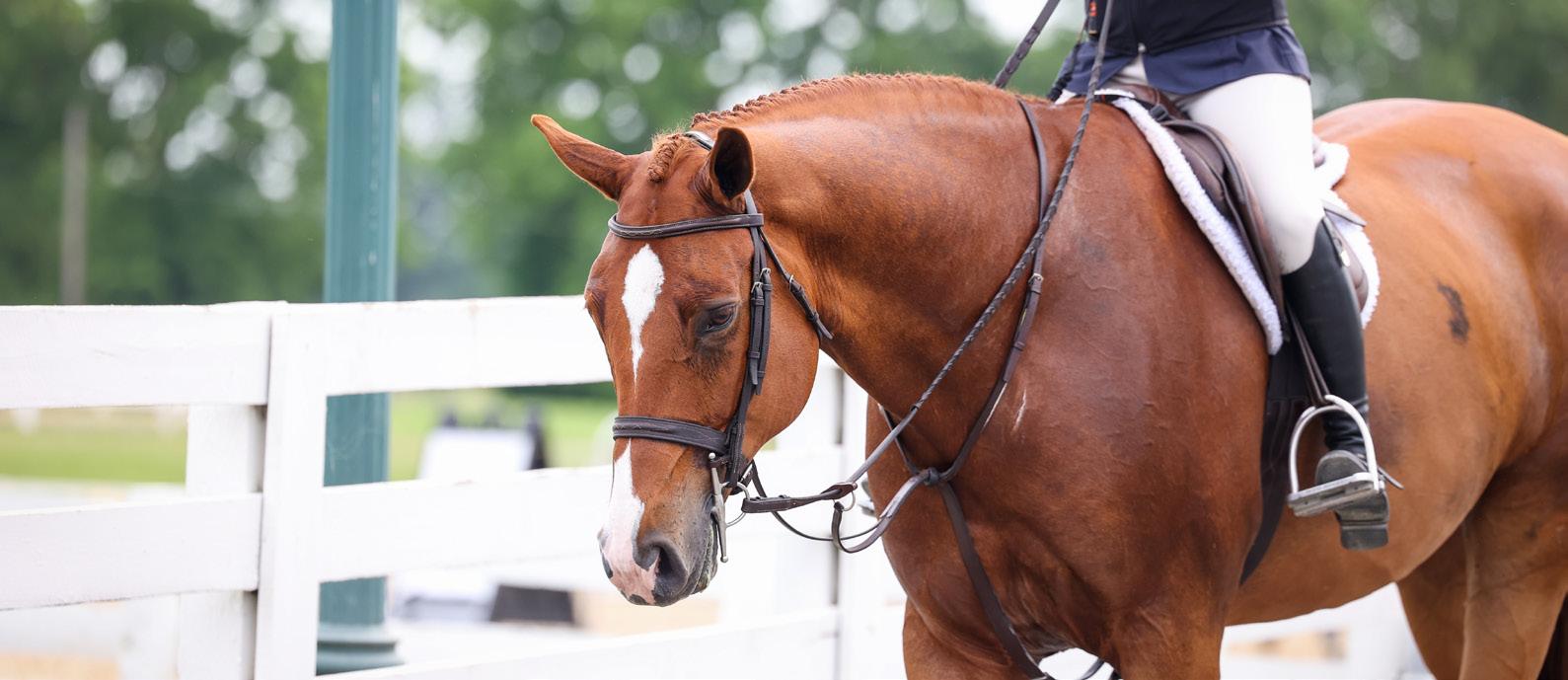
Even in a well-organized program, a working student and trainer sometimes just don’t click, whether it’s a matter of mismatched teaching/learning styles, or the student realizing their performance or professional goals no longer fit with their long-term plans.
“I’m a very strong-willed person and I wouldn’t stay anywhere I wasn’t happy,” said Allen. “Sometimes situations don’t work. And that’s OK too, as long as you do a good job in a respectful manner.”
Additional Reminders When Working Student Is Under 18
If the working student is under 18, students, parents, and trainers should remember that Minor Athlete Abuse Prevention Policies (MAAPP) apply in all situations, and interactions with the minor must occur in an open and observable space. Parents should inquire about lodging arrangements if the student will be traveling to shows, and clarify who will be overseeing the student’s work. The MAAPP for travel and lodging applies.
Before committing to a working student position, experts suggest adult students or parents vet the prospective employer or trainer. This should involve background checks (NSCI is a reputable online vendor for these) and checks of the Safe Sport Sanction list on the USEF.org website at usef.org/safe-sport/sanction-list
The U.S. Center for SafeSport offers short, online training sessions for minors of varying age groups, as well as parents, to help them understand MAAPP’s rules and purpose, learn about the hallmarks of a healthy sport environment, and give them guidelines for reporting violations. Parents or guardians should talk with their children about physical and emotional boundaries and encourage them to report behavior that makes them feel unsafe. For more information, visit the USEF Safe Sport Hub on the website.
Non-sexual misconduct, including harassment, bullying, physical or emotional misconduct should be reported to USEF. Sexual misconduct should be reported to the U.S. Center for SafeSport.
For more information on becoming a working student, watch this USEF Learning Center video at usef.org/learning-center/videos/six-tips-on-being-successful-working-student
TRUSTED BY THE BEST
CHARLES ANCONA
NEW YORK
CUSTOM FIT & DESIGN


NOV. 6–9, 2025
W. SPRINGFIELD, MA Eastern States Exposition
• An Unparalleled Educational Program.
• The Largest Horse-Related Trade Show in North America.
• The “Marketplace” featuring quality consignments for horse & rider.
• The Fantasia (sponsored by Myhre Equine Clinic) — Equine Affaire’s signature musical celebration of the horse on Thursday, Friday and Saturday nights.
• Breed Pavilion, Horse & Farm Exhibits, Horses for Sale and Demonstrations — Enjoy meeting horses of all shapes, sizes, breeds, colors, and disciplines!
• NEW! Donkey Extravaganza — Learn all about donkeys through clinics, demos, educational exhibits, and more!
• NEW! Wheels & Deals Boulevard — Sell or buy a used horse trailer, truck, tractor, or ATV!
• Equine Fundamentals Forum — Educational presentations, exhibits, and fun activities for new riders and horse owners, young and old, plus arts and crafts for kids.
• The Versatile Horse & Rider Competition (sponsored by Chewy) — A fast-paced timed and judged race through an obstacle course with $5,500 at stake!
• Breed Bonanza (sponsored by Sentinel by Kent and Blue Seal) — A unique under saddle class showcasing the best features of horses of all breeds.
• Adoption Affaire — Find and adopt your next horse at the Adoption Affaire.
• Drive A Draft — Enjoy a gentle giants experience learning to drive draft horses!
Featured Clinicians:
Cole Cameron
(Colt Starting, Ranch Riding, Roping)
Ken McNabb
(General Horsemanship, Cow Work)
Jason Irwin
(Trailer Loading, General Horsemanship)
Luke Reinbold
(General Horsemanship, Cow Work)


Gabriela “Gaby” Reutter (Hunter/Jumper)
Vitor Silva (Dressage)
Phyllis Dawson (Eventing)
Luke Gingerich (Liberty, Reining, Western Dressage)
Jennifer Truett (Dressage)
Jessica Axelsson (Driving)
Bronwyn Irwin
(Pole Bending, Barrel Racing & Youth)
Scot MacGregor (Easy Gaited Horses)
Kendra Clarke (Lunge Lessons)
Wendy Murdoch (Biomechanics, Murdoch Method™)
Sam & Kellie Rettinger (Draft Horses)
Canadian Cowgirls Drill Team (Drill Teams)
Additional presenters to be announced soon!












Horse Welfare Stoplight Guidelines: Know the Signs


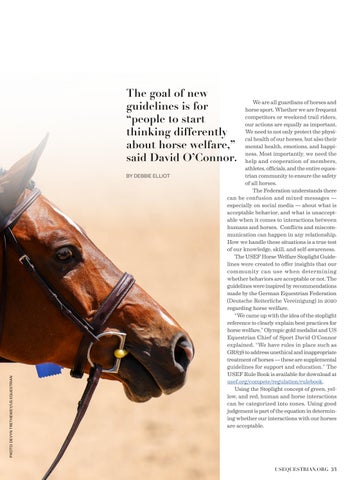
The goal of new guidelines is for “people to start thinking differently about horse welfare,” said David O’Connor.
BY DEBBIE ELLIOT
We are all guardians of horses and horse sport. Whether we are frequent competitors or weekend trail riders, our actions are equally as important. We need to not only protect the physical health of our horses, but also their mental health, emotions, and happiness. Most importantly, we need the help and cooperation of members, athletes, officials, and the entire equestrian community to ensure the safety of all horses.
The Federation understands there can be confusion and mixed messages — especially on social media — about what is acceptable behavior, and what is unacceptable when it comes to interactions between humans and horses. Conflicts and miscommunication can happen in any relationship. How we handle these situations is a true test of our knowledge, skill, and self-awareness.
The USEF Horse Welfare Stoplight Guidelines were created to offer insights that our community can use when determining whether behaviors are acceptable or not. The guidelines were inspired by recommendations made by the German Equestrian Federation (Deutsche Reiterliche Vereinigung) in 2020 regarding horse welfare.
“We came up with the idea of the stoplight reference to clearly explain best practices for horse welfare,” Olympic gold medalist and US Equestrian Chief of Sport David O’Connor explained. “We have rules in place such as GR838 to address unethical and inappropriate treatment of horses — these are supplemental guidelines for support and education.” The USEF Rule Book is available for download at usef.org/compete/regulation/rulebook
Using the Stoplight concept of green, yellow, and red, human and horse interactions can be categorized into zones. Using good judgement is part of the equation in determining whether our interactions with our horses are acceptable.


Green: Green actions mark normal behavior that is fun to watch because the horse looks happy, willing, and content. The connection between the horse and person is harmonious and in sync.


=Yellow: Yellow interactions “may make you uncomfortable and squirm a little if you witness them,” O’Connor said. Some actions in the yellow category may be acceptable for very short time periods but may escalate to mistreatment if pressure or conflict increases to the next level. “The yellow means pause — is something starting that is concerning? Maybe it resolves itself quickly, and then that’s OK, but if it is prolonged or rough then something needs to be said,” he explained.

XRed: A red interaction is “when there are clear signs of inappropriate actions and it makes you immediately think: ‘That is not OK,’” O’Connor said.
Stoplight Behavior Examples
Green conduct is harmonious and involves cooperation and understanding between horse and human. The athlete is understanding and sensitive to their horse’s needs, and confident and consistent in their interactions. This involves technically correct application of the aids, and a comprehensive and fair approach.
When observing the horse’s movement or appearance, the horse should be exhibiting a natural carriage for their breed, and they should be supple and well balanced. Look for evenly paced gaits, a forward and positive demeanor, relaxed ears, and a soft eye. The horse’s head and neck position can show if they are calm or in distress. The natural position is for the face to be slightly in front of or at the vertical.
Another key indicator of a horse’s comfort is their mouth. The ideal situation is a closed, content mouth with supple chewing or movement, occasional opening of the mouth, and salivating lips.
Equipment is part of every equestrian sport. It must be properly used at all times, and all tack should fit the horse correctly to avoid discomfort. For example, nosebands should allow sufficient room for chewing and breathing.
Yellow conduct indicates miscommunication is occurring between athlete and horse. Increasing pressure is being put on the horse resulting in signs of insecurity, stress, or tension in the horse’s movement or eyes, dull paces, and tiredness or strain.
Signs from the mouth area include grinding teeth, open mouth or the showing of teeth, cramping lips, and the tongue being either above the bit or protruding to the front or side.
Other concerns could be an athlete or equipment periodically creating restrictive head and neck posture, or inappropriate use of a whip or spurs. Tack and equipment such as bits, nosebands, boots and bandages should not be too tight. Alternatively, a too loose bridle can cause discomfort or be a safety hazard.
Red interactions may involve aggressive behavior towards the horse, inappropriate emotional outbursts, using techniques deliberately aimed against or to punish
the horse, or rough and incorrect use of aids. Other examples are continually restrictive head and neck posture with hyperflexion; excessive use of or injury from spurs, whips or other equipment; and excessive lunging.
If the horse is lame, exhausted, or profusely lathered in sweat from overwork and stress, this also falls into the red zone. If the horse’s tongue is pinched or turning blue, or there is blood or rawness around the mouth or in the saliva, this too is in the red zone.
Sometimes athletes can be acting in the red zone and not even realize what their actions look like to the outside world, O’Connor stated. “We’re in a world where our actions have to be acceptable, not only to ourselves, but also to the public,” he explained.
Red zone incidents don’t happen very often, but when they do, immediate steps need to be taken in accordance with USEF rules. “There are multiple different ways to handle the situation if you feel like what happened was so egregious that you need to say something,” O’Connor explained, adding that at horse shows, “there are always officials around, and they are going to have a response. If something does bother you, then it must be reported. It’s the right thing to do for the horses, and the right thing to do for the athlete.”
When to Report — and How
If you are at a USEF competition, actions in the red zone should be immediately reported to a USEF competition official. Depending on the situation, the official’s contact with the athlete can be:
• Advisory in nature and provide clarification on both sides.
• Cautionary in nature, potentially involving the trainer for more a comprehensive resolution.
• Depending on the situation, a verbal warning, a Recorded Warning, a Yellow Card Warning, disqualification, elimination or other penalties may result.
An equestrian acting in the yellow category may not necessarily be formally disciplined. “They might just need somebody to come up and say, ‘Just take a
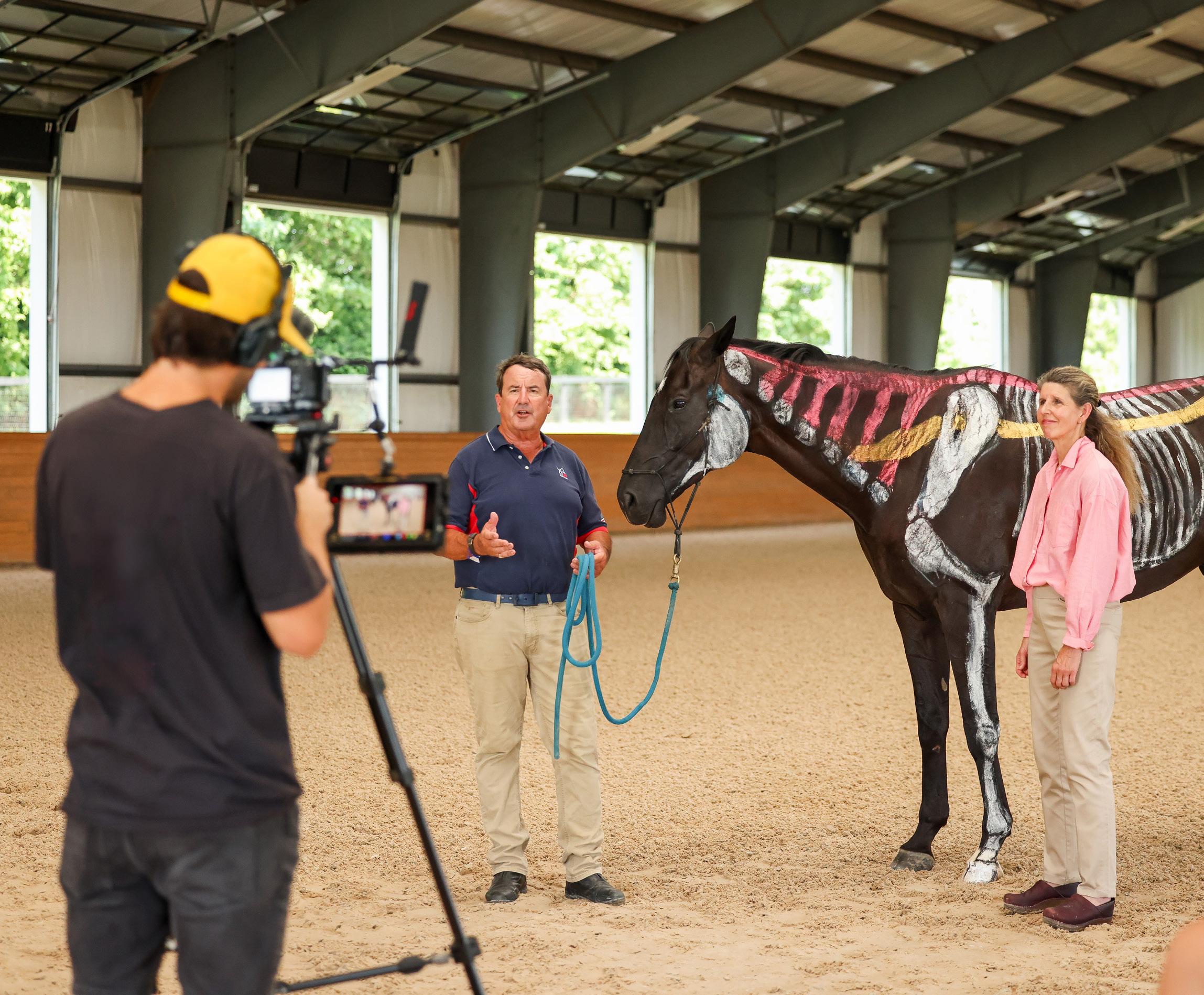
“Know the Signs” Horse Welfare Video Series
USEF partnered with Dr. Christin Finn and David O’Connor to shoot a series of videos to showcase the stoplight horse welfare guidelines. Dr. Finn painted skeleton, muscular structure, and ligaments onto O’Connor’s horse, Sammy (pictured above), to demonstrate how it looks when he is moving naturally, comfortably, and pain-free, and to show how different actions impact horses.
To watch the series and for more videos on horse welfare please visit usef. org/horse-welfare and click on “Protecting Horses” or scan the QR code.

David O’Connor and Dr. Christin Finn explain the stoplight horse welfare guidelines with David’s horse “Sammy” for a new video series.
Off The Record looks happy and comfortable with Will Coleman on the cross-country course at 2025 CHIO Aachen.
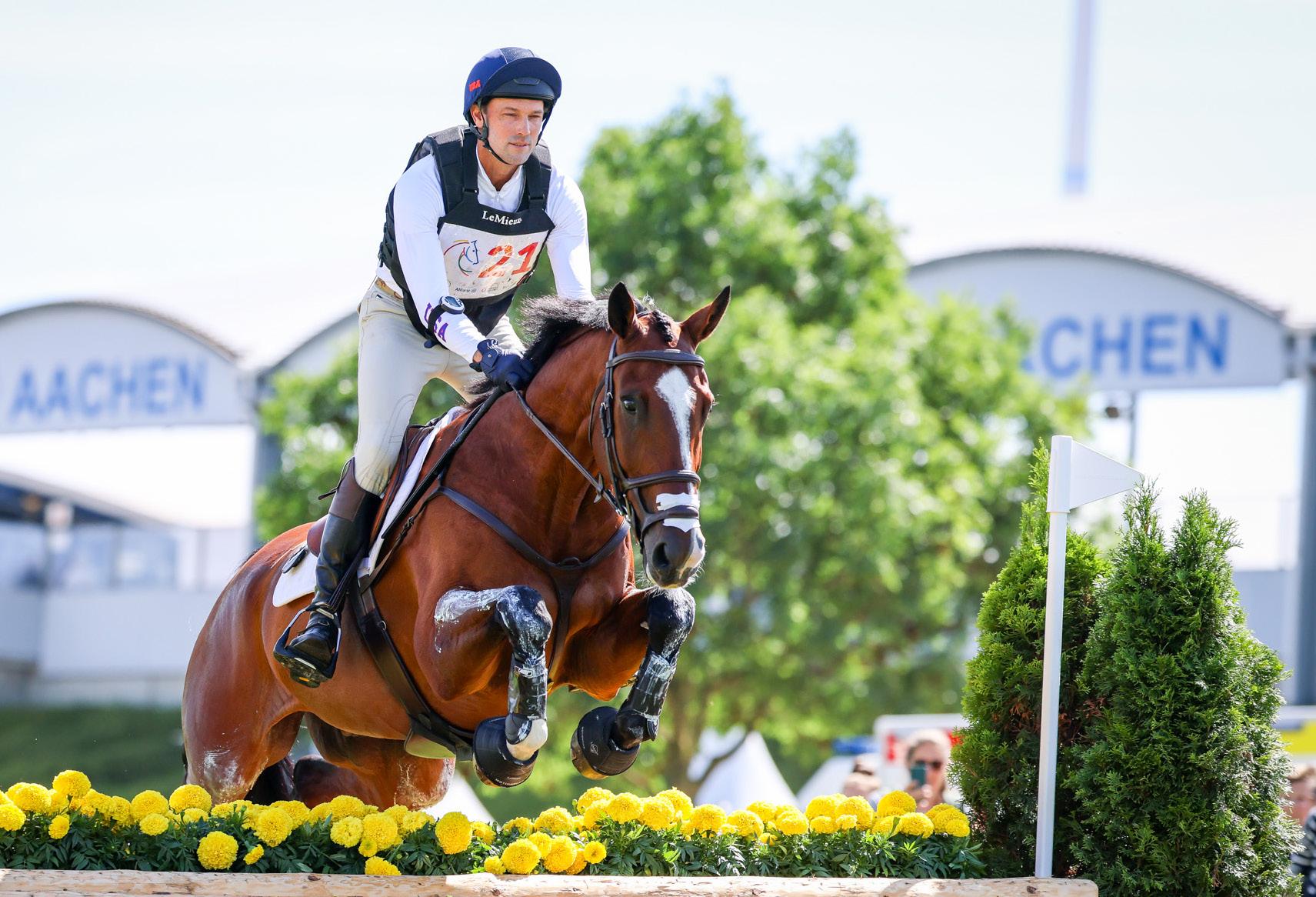
break, take five minutes and think about this and take the emotion out of it,’” O’Connor said. “Most people will talk themselves into good actions after you break the cycle.” He stressed that maltreatment at this level “is not always deliberately abusive. It could be someone who is anxious and frustrated in the moment.” However, if there is a “huge negative reaction from the athlete back to the official, then that will suddenly take it to the next level and could be something that could be sanctioned.”
If you witness an act that jeopardizes the safety of a horse, complete a Horse Abuse & Unethical Treatment Report Form at USEF. org or by contacting USEF directly. You can also anonymously submit a report by text or WhatsApp to 28733 (2USEF).
Ultimately, “we are just trying to get guidelines out there so people can start to think about improving horse welfare,” O’Connor said. “If you can have it in your mind ahead of time about where these lines are before any incidents happen, then you’re going to be way more confident on how to interact with an official when something does happen.”
While most incidents are witnessed at competitions, O’Connor stressed that “there’s not one set of ethical treatment at horse shows and one set of ethical treatment back at the barn,” and you should act in the green zone no matter where you are.
Impact of Mistreatment on the Horse’s Body
Having grown up with a father who is an artist, Dr. Christin Finn, DVM, VSMT, CVA, CCRT has combined her artistic background
with her veterinary knowledge to create a visually impactful method of showing what happens inside a horse. She displays the skeleton, muscle structure and ligaments by painting a live horse so that people can see how certain movements cause tension, which then leads to distress and injury. “I specialize in osteopathic work, structural work and manual therapy, and I can see how a horse should be moving, for example, issues with the extension of the neck or engagement of the hind end,” said Dr. Finn, who is based in Kingston, Wash. “Aside from using computergenerated images, it’s nearly impossible to fully appreciate what happens when you ride a horse until it’s painted directly onto the horse’s body and you see them move,” she explained.
Dr. Finn has filmed a series of videos with O’Connor to clearly demonstrate the USEF Horse Welfare Stoplight Guidelines, and to show the negative impact inappropriate actions have on our horse’s health. It is important to realize how the beautiful the machine that is the horse’s incredible structure works, she said. “They’re powerful and graceful at the same time. Their bodies are designed to work in a certain way and when people try to force that into a way that it is not meant to work, you get tension, resistance, and lameness,” Dr. Finn explained. “To achieve a fulfilling partnership with your horse, you should understand how their body works,” then the horse is more likely to be comfortable, happy and stay sound. “We all need to honor the partnership,” she added.
“WE’RE IN A WORLD WHERE OUR ACTIONS HAVE TO BE ACCEPTABLE, NOT ONLY TO OURSELVES, BUT ALSO TO THE PUBLIC.”
– David O’Connor

Look for evenly paced gaits, a forward and positive demeanor, relaxed ears, and a soft
eye.
“TO ACHIEVE A FULFILLING PARTNERSHIP WITH YOUR HORSE, YOU SHOULD UNDERSTAND HOW THEIR BODY WORKS.”
– Dr. Christin Finn
Hyperflexion (or rollkur) creates extreme tension in the ligament system and overly stretches the muscle, according to Dr. Finn. It then tips the lumbosacral area forward, which is the most mobile part of the spine, and can cause trailing legs. “When we talk about rollkur in the neck, the hyperflexion is simply what you can see — but what is happening in the back? That’s really what we’re damaging,” she said. Hyperflexion causes pain in the neck but also means that the horse can’t see where it is going because its head is on its chest. “It causes extreme stress for a horse that is moving powerfully in a direction that they can’t see, plus they can’t swallow, and they can’t move their temporomandibular joint (TMJ), which is extremely important for balance,” Dr. Finn said. She went on to explain that yawning is a sign of a healthy TMJ and shows that the horse is releasing both physical and mental tension. Yawning activates the hyoid — which connects the tongue, jaw, and throat to deeper structures of the body — and then lifts the shoulder blades.
Rollkur also has a negative impact on the longissimus muscle, which runs on either side of the spine from the pelvis to the neck. “It is the biggest force of locomotion in the horse’s whole body,” Dr. Finn explained. “When we’re putting the horse into the hyperflexed position, we’re doing a lot of damage to the longissimus muscle, which is meant to work in relaxation, not tension.”
Ill-fitting or too tight tack can cause a multitude of issues and health ailments. “There’s no need for tightness. How can this big, beautiful animal move to their fullest if they’re tightened down?” Dr. Finn asked. This includes nosebands, in particular flash nosebands if overtightened, which can prevent the horse from moving their mouth and jaw and impact their ability to swallow. (You should be able to slide two fingers between the noseband and the side of the horse’s jaw; a flash strap should be snug but not tight enough

It is never too early to learn about equine welfare to prioritize our horse or pony’s needs.
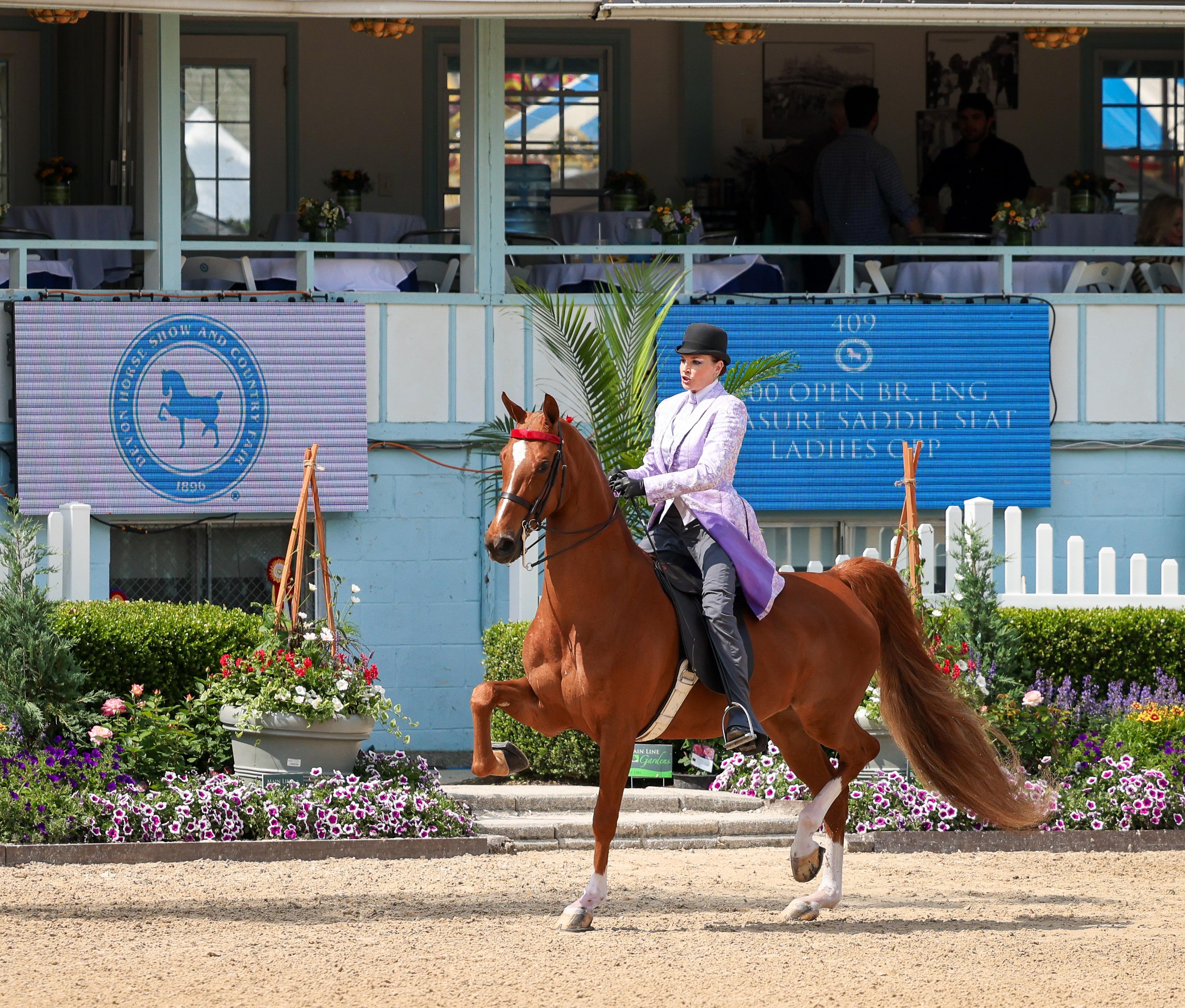
to pull the cavesson down onto the nose.) “There are advantages to the flash supporting the bit, but it doesn’t have to be tight,” she said. Girths should also not be so tight that the horse can’t expand their rib cage to breathe and can cause sores. “When the saddle doesn’t fit appropriately, it impacts the function of the spine, the muscles over the top line, and the ligaments because they are being pinched.”
No matter what discipline people train in, the fundamentals should be the same, and that has to involve the correct physiological development of the spine. “The horse’s back has to be strong, and that doesn’t happen by accident,” Dr. Finn said. “We all know about the muscles, but it is the ligament system that determines the connection
of the head to the back and how that muscle can develop,” she continued. “The ligaments, mouth, neck, and back are all very significant.”
Dr. Finn concluded that the goal with the anatomy videos is to communicate with athletes and trainers how — from the functional anatomy standpoint — they are inadvertently contributing to lameness and long-term damage to their horse when they do certain movements.
“We have this joyful dream as children to be at one with this beautiful and powerful horse, and then somewhere along the way, the dream gets sidetracked,” she said. “How can we get back to that dream so that we can all enjoy a happy, sound, ideally performing partner for the long term?”
When observing the horse’s movement or appearance, the horse should be exhibiting a natural carriage for their breed.



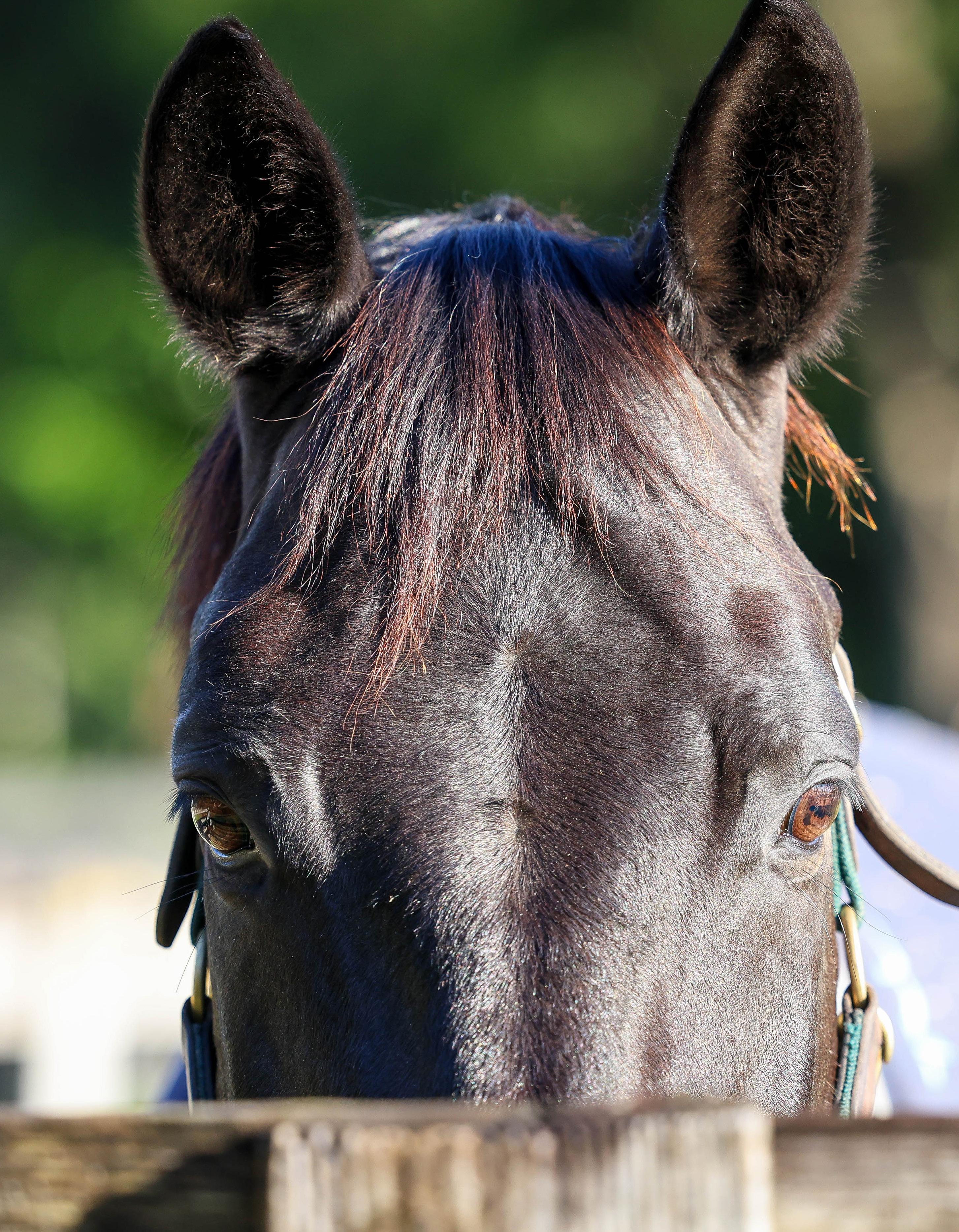

– REV. LYNNE BRYAN PHIPPS
USEF’s inaugural Community Outreach Conversation brought together equine-assisted services experts to discuss the horse’s role in mental health.
By Debbie Elliot
Since it was launched in 2021, the USEF Community Outreach Organization initiative has had a huge impact on the lives of thousands of people with physical and mental disabilities by supporting 40 equine-based learning organizations across the United States. These organizations support the positive impact horses have within their local communities, while also meeting high standards of horse and human welfare.
On June 10, 2025, Mikhail Proctor, USEF Director of Membership Development & Community Engagement, hosted the first in a series of “Community Conversations” in which he sat down with representatives from USEF Community Outreach Organizations to discuss the importance of mental health awareness and the role that horses can play in supporting emotional and personal growth.
Joining Proctor for the inaugural Community Conversation were:
• Dr. Sally Broder, Executive Director of HorseSensing, a long-term residential program for veterans and people in recovery from addiction based in Shelbyville, Ky.
• Rev. Lynne Bryan Phipps, Executive Director of Beachwood Center for Wellbeing, which offers Integrative Equine Therapy for treating anxiety, grief, trauma, and PTSD at five centers (RI, PA, MD, FL, and CA) in the U.S.
• Lynn Thomas, a licensed clinical social worker and the co-founder of Horses for Mental Health, a nonprofit advocacy organization that spreads awareness about the benefits of incorporating horses for mental health and personal growth services.
MENTAL HEALTH BARRIERS
Tackling mental health issues is a complex process and can involve both internal and external barriers. “A very simple internal barrier could be pride, not wanting to ask someone for help and feeling like it makes you look weak,” explained Dr. Sally Broder. “There’s also generally a
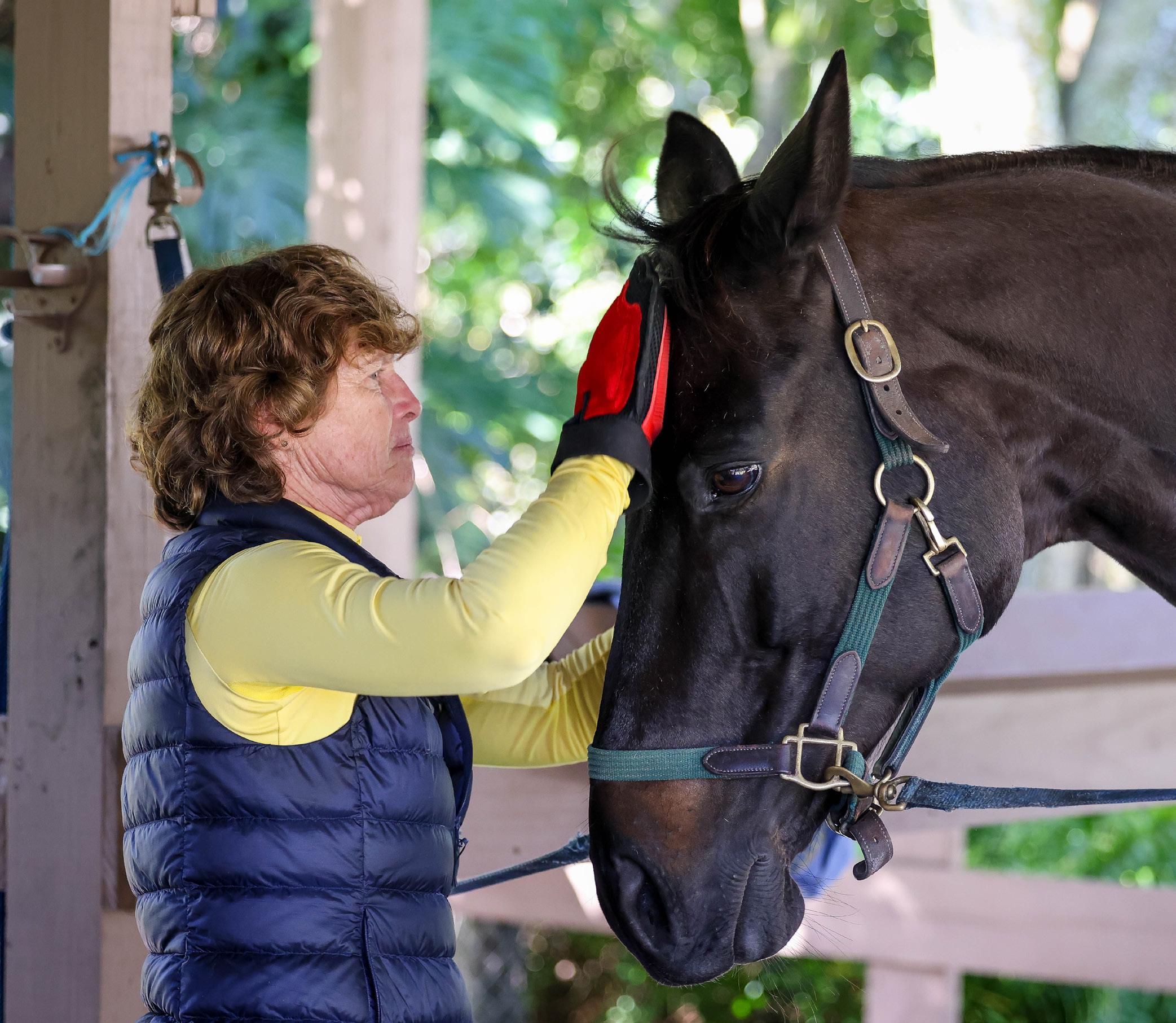
stigma related to mental health and mental illness that can make people hesitant to reach out.” Geographical barriers can be an additional issue, Dr. Broder said, explaining that in her home state of California it is often more acceptable to seek therapy for self-improvement, whereas in Kentucky (where HorseSensing is located) people can be less likely to ask for help or they may come from a family where it is frowned upon. “Sometimes you have to get creative and not call it therapy,” Dr. Broder said, which is when working with horses can be an advantage. “We can do horse activities that are very therapeutic, and the person doesn’t feel like it’s got the label of therapy.”
Rev. Lynne Bryan Phipps shared a statistic that one in five adults, and one in six young people (age 6-16 years) experience mental health issues each year. However, only 50 percent of them seek professional help, due to stigma, access, and the capacity to access. “It is really important to realize that this is not something that only happens to ‘someone over there.’ It is something that happens to each and every one of us, whether it’s because we’re overwhelmed or because there’s something that is way too big for us going on in our life,” Phipps stressed.
Lynn Thomas added that part of the issue is really understanding what mental health is. “I think some people think it means that we’re in some extreme mental state, and we are having a hard time functioning in life,” she said. “Actually, a lot of it is that we are functioning in life, but we’re not functioning as well as we could be.” These issues can emerge as feeling burnt out, chronically stressed, being more temperamental than usual, or not sleeping well. “That goes along with the issue of stigma, as some people think we’re supposed to be able to handle it ourselves ... meaning ‘I’m mentally strong and mentally healthy,’ and should be able to cope with it.”
Thomas compares working with a therapist to be at your peak performance mentally to working with a coach to improve yourself as an equestrian. “‘Why do I have to live in this chronically burned-out state?’” she asked rhetorically. “I don’t have to because there’s actually ways to address that and to refill our cups.” Thomas pointed out that therapy incorporating horses can be beneficial even if you are around horses all the time. “Whether you have no horse experience or whether you are a professional equestrian, we’ve seen these programs be effective in combating that stigma [around mental health],” she said.
THE ROLE HORSES PLAY IN MENTAL HEALTH
Horses, as prey animals, maintain a profound awareness of their environment, which is a crucial skill for their survival, Phipps explained. “They are also phenomenal communicators because their only means of survival is to make sure that the whole herd knows whatever is going on, whenever it is happening,” she said. Humans and horses have shared a partnership spanning over 3,000 years, fostering what Phipps described as a deeply “symbiotic relationship.”
One of the benefits of working with horses is that forging a connection with them can break down the barriers between ourselves and the world around us. At the most fundamental level, we can rebuild what is means to know something with our whole body rather than just to think it with our brains. “In our culture, we spend so much time thinking, thinking, thinking,” Phipps continued, “we get completely in our heads and we forget that we have a whole body that knows.” Through interactions with horses, people are able to reconnect with their bodies, minds, and souls, stimulating the release of oxytocin, a bonding hormone known to significantly reduce stress.
When we do get stuck in our minds, the connection with horses can help us find our way through that, too. “We are helping people build neural pathways from the fight or flight part of their brain to the conscious part of their brain,” Phipps explained. “You can’t access that if you’re afraid. You have to access it from that calm, connected, and trusting place. Horses do a phenomenal job helping people feel experience safety.”
Beachwood Integrative Equine Therapy, which has five centers in the U.S., utilizes this profound connection between humans and horses to help people address emotional and psychological issues. If you have ever noticed yourself behaving like a young child when you are stressed, you are being very human and getting through a difficult situation the way you learned to do it. Phipps underscored the importance of engaging our entire being rather than solely the part that might be responding to past trauma. “As we become older and developmentally more capable of caring for ourselves, we need to make sure that we’re responding to life — not reacting to it,” she said. “The horses are part of a process that helps our entire body learn how to operate from
“A HORSE WILL SHOW YOU WHAT’S THERE, WHETHER OR
Touching or brushing a horse can encourage people to open up.

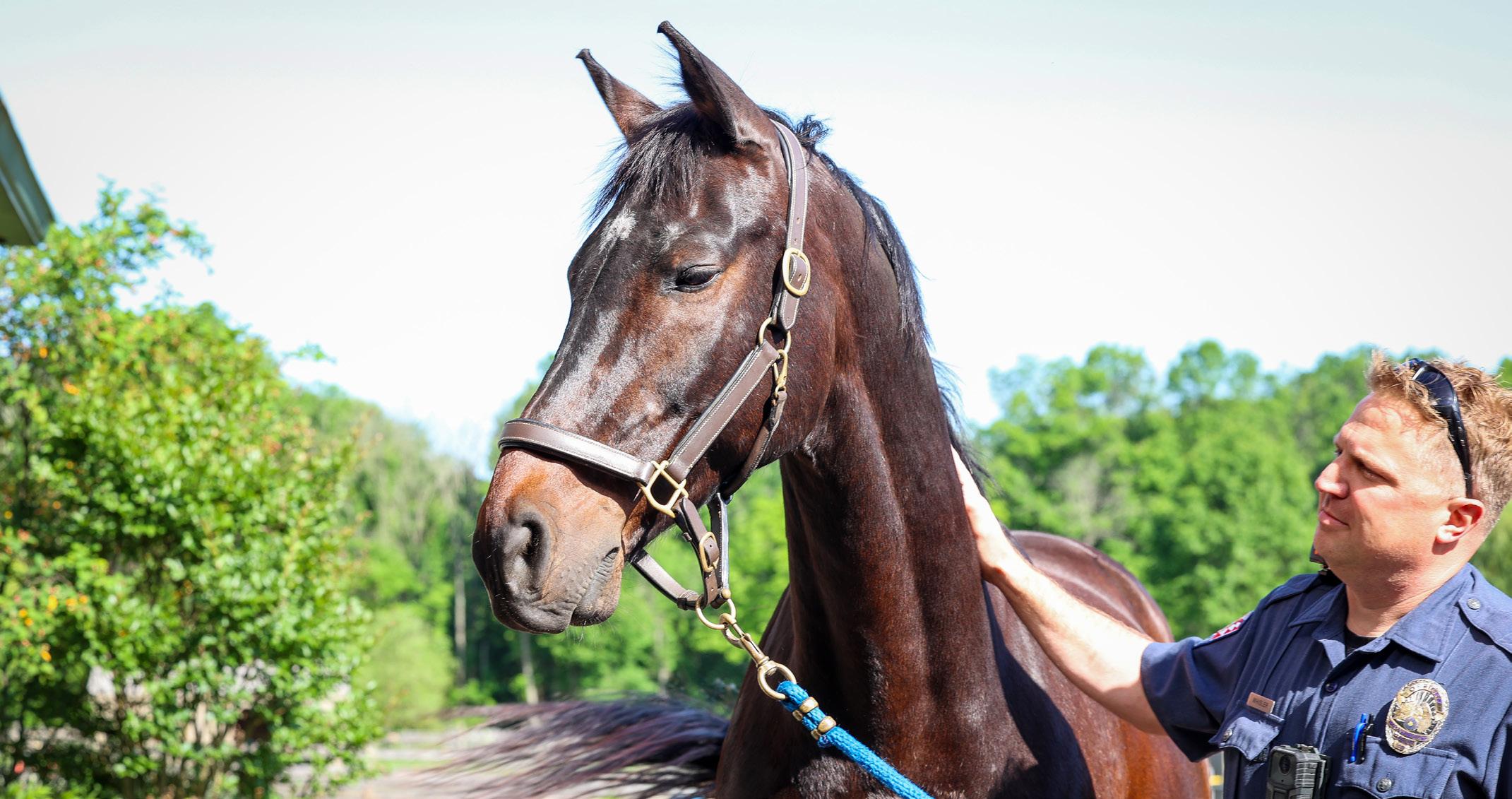
our whole self, not just from the part of us that experienced something really big and really scary at some point in our life.”
Top: Horses are “remarkable communicators,” said Rev. Lynne Bryan Phipps, Executive Director of Beachwood Center for Wellbeing.
Bottom: First responders receive mental health benefits from horses at Kindle Hill Foundation in Blue Bell, Pa.
Dr. Broder described the role of the horse in equine-assisted therapy as “a transitional object.” She went on to explain that “you’ll be standing with the person and encouraging them to pet, brush or breathe with the horse, and it’s amazing what they start talking about because of the ability of the horse to match their heart rate with theirs.” Dr. Broder encourages clients to put their hands on the horse, because the stress goes through their arms and body, into the horse’s body, and is metabolized by the horse. “Virtually everyone feels differently after they’ve been in the presence of a horse, but one of the great benefits is that they start talking about things they didn’t think they wanted to talk about ... it just starts to flow and in an easy way and not a forced way,” she said, adding that a lot of deep work can be done because horses are sentient animals that reflect our emotions. “As you start to calm down, the horse calms down even more ... it’s such a great biofeedback loop that we have with the horses we use in therapy.”
“WE CAN DO HORSE ACTIVITIES THAT ARE VERY THERAPEUTIC, AND THE PERSON DOESN’T FEEL LIKE IT’S GOT THE LABEL OF THERAPY.”
- DR. SALLY BRODER
Phipps explained that one reason why horses are uniquely different to other animals from a therapeutic standpoint is that they are prey animals, not predators. “A dog will show you what you want to see. A horse will show you what’s there, whether or not you want to see it,” she said. “Horses create a profoundly safe, nonjudgmental place to help people see their resilience, capability, and what they’ve actually come through.” Could you work with cows, goats, or other prey animals? “Possibly, but horses have phenomenal emotional intelligence. They can read, feel, perceive, and understand emotional expressions — whether they’re verbal or nonverbal, expressed, or unexpressed.”
Thomas shared the story of a veteran who was in a very dark place and intended to end his life. He went to tell the horses goodbye, and as he said goodbye to each horse, they laid down. “That had a big impact,” she said. “He started working through that darkness and became at least open to maybe he could get help.” As he started working through his struggles, each horse stood up one at a time. “For him, it felt like they were standing up to show him that it’s possible to get back up again.”
Due to amazing breakthroughs such as this, “Equine-assisted services to benefit people is the fastest growing sector of the equine industry,” Thomas stated. “It is a great benefit for the horses as well as humans.”
THE SILENT ACCEPTANCE OF THE HORSE
One aspect of horses that we all know is the feeling of nonjudgment, Dr. Broder explained. “They’re aware of how you are reacting to them, but they’re not judging you,” she said. At HorseSensing, many people come with tremendous guilt and shame over their past, feeling like they are not good enough to be part of society because of whatever they’ve been through, she went on to say. “What they’ve told me repeatedly is that they feel redemption through the horse being able to accept them. That
is part of the huge healing process for our guys because they don’t accept themselves and they don’t feel accepted in society … that gives them a little bit of self-esteem back,” which is the first building block to getting out of the mindset that they aren’t part of society. They develop a feeling of acceptance, redemption, and a sense of worth because the horse feels that they are worthy, according to Dr. Broder.
“When people feel truly seen, heard, validated and accepted no matter what, and there’s no judgment ... that’s where healing can happen,” Thomas added.
Phipps noted that many of the individuals who come to the Beachwood Center for Wellbeing have experienced deep trauma — often caused by other people. Whether it’s emotional or physical abuse, growing up without a sense of safety, or being exposed to profoundly unsafe situations, these experiences can make it incredibly difficult to trust others, especially in an office or clinical therapy setting. However, horses offer a different kind of relationship and experience. They can hold space, build trust, and help those who have been deeply traumatized begin to heal. “Most of the stories that we hear from clients contain an element of experiencing ‘something that was way too big for you,’” she explained.
Phipps shared that veterans often tell her they love doing this work because the horse seems to understand what they have been through, and how difficult it is to have a bond with people who are not veterans. “It’s a healing moment for the person because all of a sudden they realize they’ve been hiding in the armadillo shell,” Phipps continued. Horses can be a bridge — gently reconnecting people to themselves and, eventually, to others. “Everybody wants to connect. We might not think we want to connect because we’ve had horrible experiences with connection, but ultimately that’s what we’re trying to heal,” she said.
Ride On’s Trailfest gives kids and adults with disabilities the opportunity to experience open space.
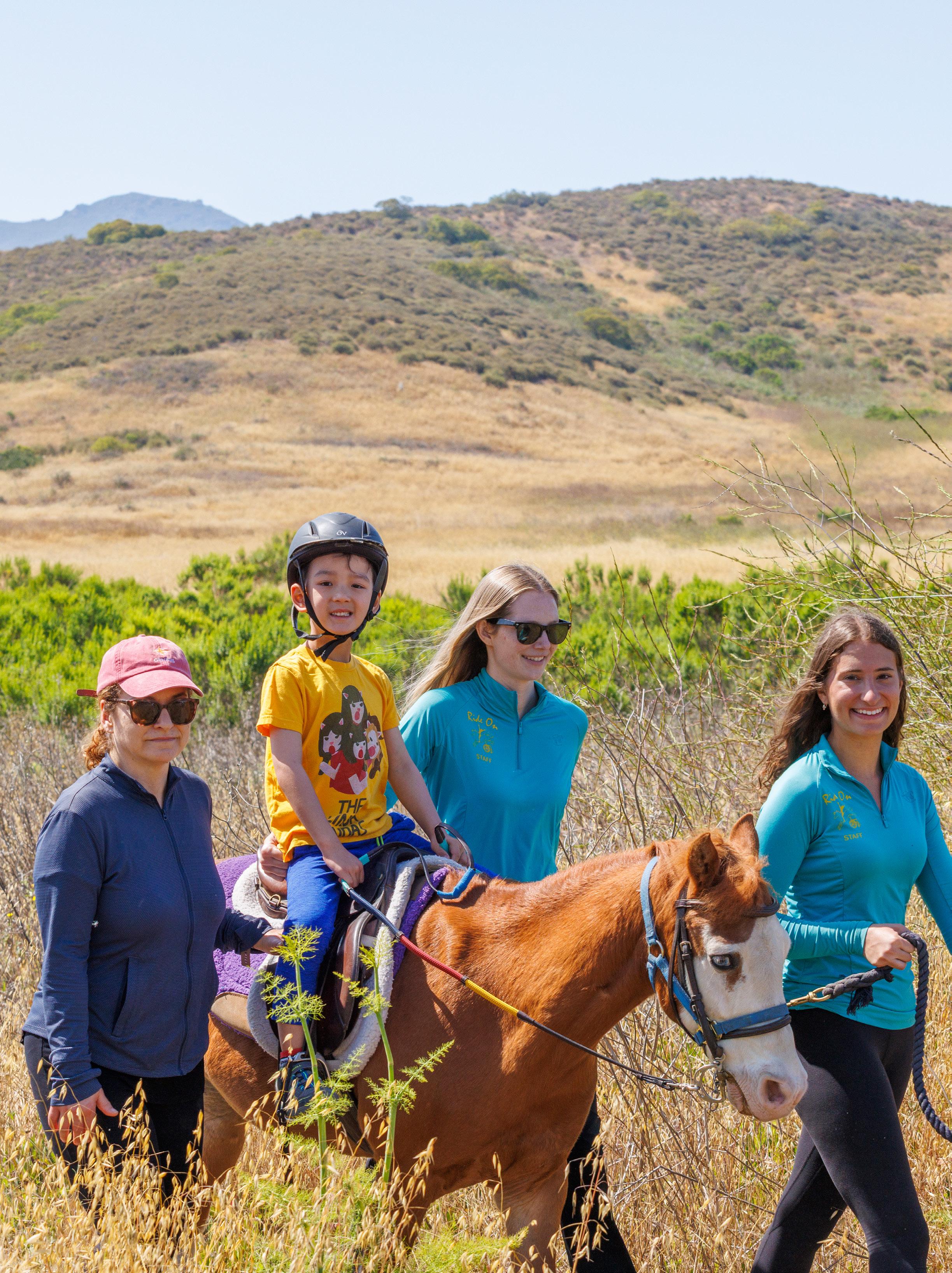

THE HEALING POWER OF NATURE
Spending time in nature brings proven mental and physical benefits, from lowering cortisol to calming the nervous system. While therapy in arenas and barns with horses is valuable, taking riders out on the trail taps into a deeper level of connection and healing. Since Ride On Therapeutic Horsemanship was founded in 1994 in Chatsworth, Calif., it has given over 140,000 lessons and therapy treatments to people with physical, intellectual, and cognitive disabilities, along with treating at-risk youth and veterans. In addition to their weekly lessons, Ride On also hosts an annual Trailfest event during which riders can leave the arena and take a beautiful trail ride through the Rancho Sierra Vista National Park with the stunning backdrop of Boney Mountain and the Pacific Ocean beyond.
“We have been hosting Trailfest for 20 years, and it really is my favorite day of the year,” said Ride On co-founder and Co-Chief Executive Officer, Bryan McQueeney. “We used to hold it at Paramount Ranch in Agoura Hills, but that was burned down in the Woolsey Fire in 2018,” he explained. Trailfest has since moved to the Rancho Potrero Community Equestrian Center in Thousand Oaks, Calif.
“Our riders have an amazing experience at each of our adaptive riding centers, but going out in the open spaces is more challenging for them to do on horseback. They have the same desires and get the same benefits of building a relationship with these amazing animals, but they need a support system to go with them,” McQueeney said. “We transport our entire safety net of volunteers and staff out to the open space, and then we take everybody out for trail rides.” Trailfest offers Ride On students 30-minute trail rides winding through the stunning Southern California landscape throughout the day, and caters to approximately 100 riders, many of whom have side walkers or are on lead lines. The horses for Trailfest are carefully selected from the Ride On herd to ensure they are calm and quiet when out of their usual environment on the trail. The fun day also features raffles, hayrides, and a catered lunch.
“Trailfest gives our kids and adults with disabilities the opportunity to come and
experience the same thing that anybody could experience in the open space,” explained Sara Jones, Co-Chief Executive Officer, who first joined Ride On as a volunteer 29 years ago. “Our kids are mostly confined to the arena during the lessons, so bringing them out here and allowing them to do something like this is really cool for them. We also encourage families to raise funds and to come out and participate in the event,” she added. The non-profit, which is the only PATH International (Professional Association of Therapeutic Horsemanship International) premier accredited center in the Los Angeles area, holds several other fundraising events throughout the year, including their annual horse show at the Los Angeles Equestrian Center. The twoday show hosts a variety of classes including dressage, equitation, obstacle courses, and a costume competition.
Nancy Richardson, who is visually impaired, began riding at Ride On in 2022 after the therapeutic riding program she attended in Santa Barbara closed down. “I love that they focus on English riding and dressage here, as opposed to most places that are Western-oriented,” said Richardson, who has been riding since she was 10 years old. “It is more challenging, and I am always learning new techniques about how me and the horse can work better together. If I don’t ride regularly, I get antsy. It’s my passion and I need it,” she added. Another thing that Richardson says she needs to do more is to relax, which is where Trailfest is a huge asset, especially after “working hard in the arena concentrating on learning dressage posting and diagonals,” she said. “Sometimes I just need a nice relaxing trail ride as it’s good for your body and muscles.”
Sarah Wright, a Ride On student with Cerebral Palsy, also gets great joy from Trailfest, and said that riding in general is one of her favorite therapies. “I love horseback riding. I love that it helps my hips to walk. I love being on the horse,” she said.
Visit usef.org/about-us/community-building/community-outreach/ride-on-therape utic-horsemanship.

REACH FOR THE STARS!
























professional portfolio, US Equestrian encourages student athletes to include the number of Interscholastic years of achievement. It is important to highlight your dedication and commitment to the program by listing the number of years you were a lettering athlete. US Equestrian also provides athletes the option to send your current school a letter from our president, Tom O’Mara, showcasing your achievements.





Learn more and sign up today! usef.org/go/equestrianathlete



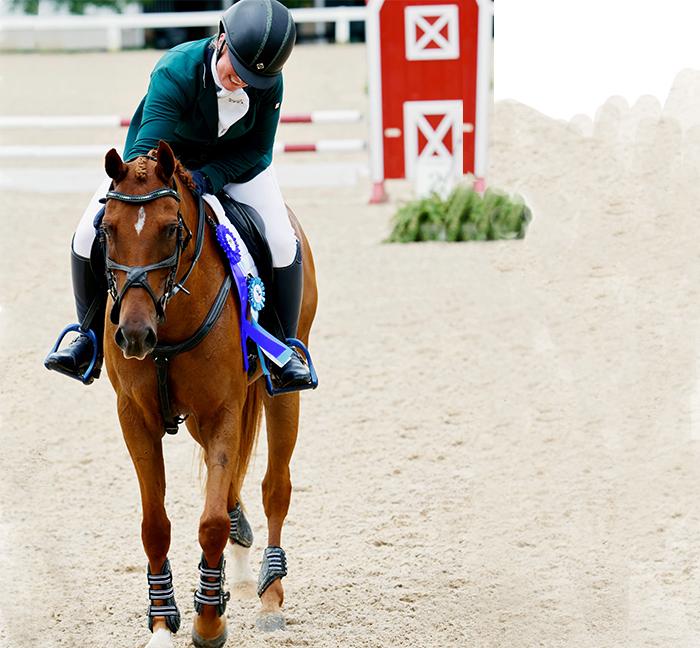
Optimal
To find a veterinarian near you who offers PulseVet® shock wave therapy, visit Zomedica.com/PulseVet
To learn more, call or click Zomedica.com • 800.245.4417 info@zomedica.com

•90% success in treating back pain and kissing spines
•Helps speed the healing of tendon and ligament injuries
•81% improvement in horses with Navicular Syndrome
•Clinically proven to reduce lameness associated with chronic orthopedic conditions


Navigating the Warm-Up Ring Safely
By
following
schooling
area rules and etiquette, the experience can go from chaotic to confidence building.
BY HELEN TOWNES

The warm-up ring at a horse show can be an unpredictable and daunting place. Riders preparing to compete often feel some level of nerves, and their horses may be adjusting to an unfamiliar setting. Plus, trainers are keyed up and trying to coach their clients with limited space and time. If it doesn’t go well, the warm-up ring experience can leave riders feeling even less confident for their upcoming classes. Even worse, it can be dangerous, with disorder leading to collisions or falls. Fortunately, there are ways to make the warmup ring at a horse show calm, safe, and productive. When riders and trainers understand the rules and are committed to working together and sharing the space, the schooling ring provides a great opportunity to prepare under saddle and over fences without having to perform for a judge. And when that warm-up is successful, both horse and rider have the best shot at a confident entrance and successful experience in the show ring.
The USEF Rulebook has extensive rules and regulations regarding horse show warm-ups for a variety of different disciplines, many of which were initially devised by David Distler, an FEI jumper judge since 1989 and the Steward General of the FEI. Distler remembers noticing the need for more oversight in the show jumping warm-up ring during the 1996 Olympics in Atlanta, Ga. “I went to my office and sat down at my computer, and I came up with 16 rules, and I posted them during those Olympic Games,” he recalled. Distler’s list of rules was soon adopted by the FEI, and not long after, by USEF. “It comes down to education and responsibility. When you go out there in the warm-up area, when you’re training, when you’re riding, you have the responsibility to do what’s right, not just according to the rules, but how the horse is treated,” Distler emphasized. “We must protect our sport. We must protect our animals. [That includes] doing what’s right in the warm-up areas.”
Depending on the size and rating of the show, several factors can help make the warm-up ring run smoothly and efficiently. For classes offering $10,000 and up in prize money, there must be a licensed C1 ring steward or a certified schooling supervisor (an “R” C1 steward for classes $25,000 and up) to
Only essential people like trainers or grooms should be allowed in the warm-up ring.

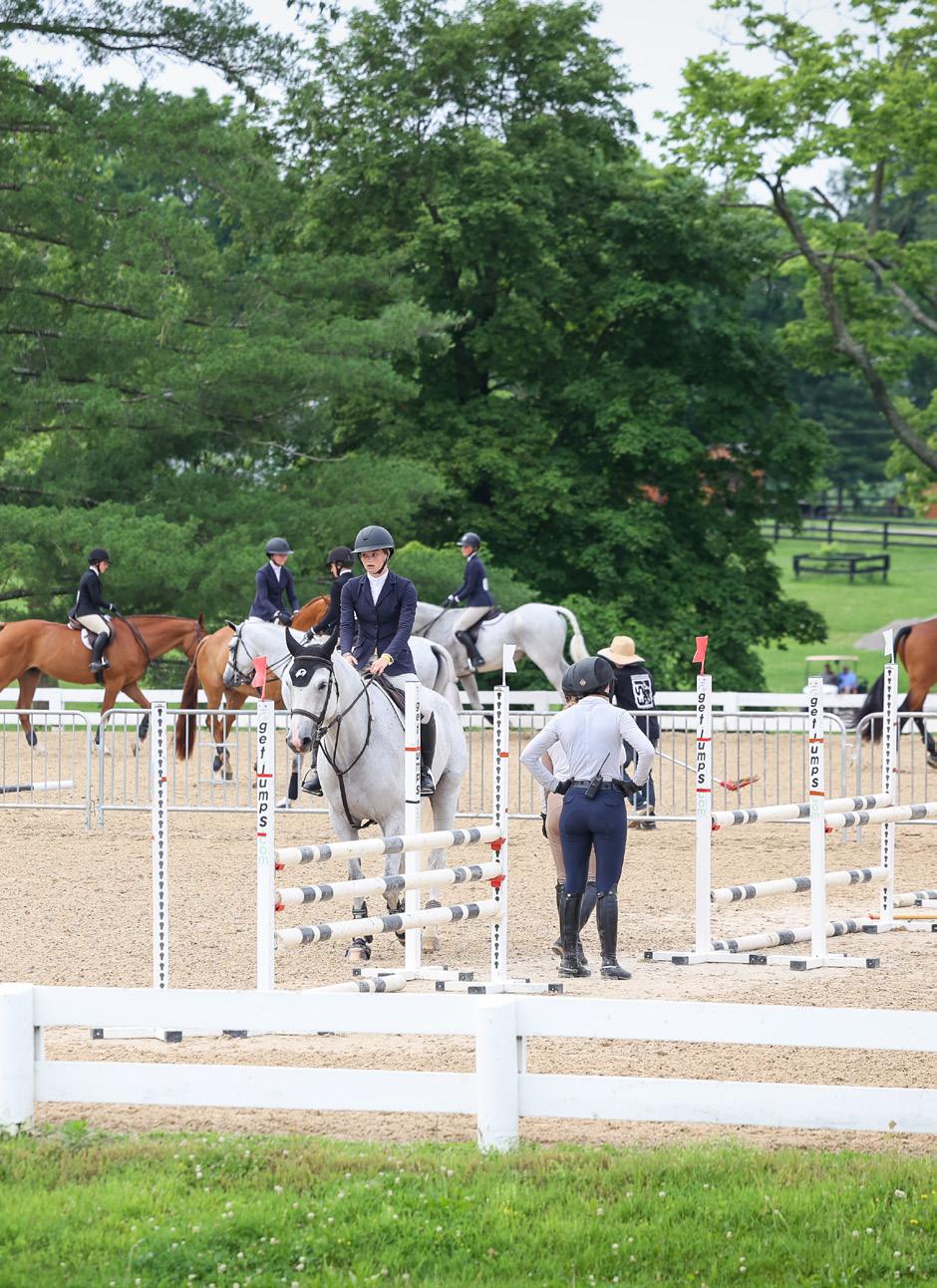
Riders admitted to the warm-up ring should be preparing for an upcoming class to avoid overcrowding.

The warm-up ring is a place to for riders to calmly interact with their trainer and prepare for their class.
oversee warm-up areas, report dangers, and enforce safety. Otherwise, stewards are floating around the show and can’t be counted on to spot or solve problems in the warm-up ring. Most show organizers will provide a clearly marked warm-up or schooling area near each competition ring, ideally included on the facility map to make it easy to find. All warm-up jumps must use FEI-approved safety-release cups for spread obstacles, and flags can help indicate from which direction the jump should be approached (red flag on the right, white flag on the left). Jumps must be set properly and at an appropriate height for those warming up. Most small to medium-sized shows don’t have enough staff to monitor every ring, however, and it’s up to the riders and trainers to work together in a courteous and safe fashion. Ideally, the horse and rider pairs admitted to the warm-up ring should be those preparing for an upcoming class, and the group limited in number to prevent overcrowding, but this isn’t always possible. The reality is that even with rules in place and the best intentions, the warmup ring at a horse show can still be a scene of mayhem as the unpredictability of human and equine behavior unravels the best of intentions. There is also a timing hierarchy in the warm-up ring, and Charlotte Skinner-Robson, a
judge, horse show manager, Chair of the USHJA Jumper Working Group and USHJA Jumper VP, pointed out that having hands-on schooling supervisors or trained volunteers at the warmup ring can help keep things under control. “For the bigger classes, [they] can even assign jumps [in the warm-up] based on when riders are going in the ring, and then there’s never a problem of someone taking a jump too long because it’s based on their order of go,” she explained.
Of course, things don’t always go according to plan, and it can be difficult for the steward or volunteer to confirm who is entering the arena at any given time. Sinead Halpin Maynard, a 5* event rider and coach who represented the U.S. at the World Equestrian Games in 2014, gave an example of a disorganized scenario: “They [the steward] are just counting heads and people are sneaking in or going in the wrong order, and then riders aren’t being let in because there are six people in there, but they’re not the next six riders [to show],” she said. “It gets stressful because that volunteer is overwhelmed, and it’s very difficult to have a conversation. If it was an easy solution, we would have figured it out,” she added.
Because of the mercurial nature of horse shows, the weight of warm-up etiquette falls squarely on the backs of the trainers and their
riders. There are common sense “traffic rules” for riders, such as those warming up over jumps generally staying on the inside of the ring while those flatting are on the outside. However, some riders may be unacquainted with the rules or just too nervous or distracted and ride against the flow of traffic, not pass left shoulder to left shoulder, or stop abruptly on the rail with riders behind them. Others monopolize jumps, “save” them by having their trainer or groom sit or stand in front of them, or inadvertently cut off other riders heading to a jump or on the backside of the fence. Still others hack side by side, chatting with friends, taking up valuable space and potentially creating hazards. Halpin Maynard stressed that “one of the hardest things I see is a horse getting T-boned in the warm-up ring. You know that’s going to stay with that horse for a long time.”
Riders should note that a red ribbon in the forelock means that a horse may be sensitive about being approached head-on, possibly after a traumatic incident. Meanwhile, a red ribbon in the tail means they may kick, a yellow ribbon signifies a stallion, and a green ribbon identifies a young or inexperienced horse.
YOUR HEAD NEEDS TO BE ON A SWIVEL WHEN YOU’RE IN THE WARMUP RING.”
— Janet Fall

Jumps must be set properly and at an appropriate height for those warming up.
Janet Fall, an FEI and USEF Steward and Jumping Judge, emphasized the importance of riders always paying attention. “Your head needs to be on a swivel when you’re in the warm-up ring. Be aware if there’s a horse with a red ribbon in its forelock, because that means it has trouble with head-on traffic. If it’s got a red ribbon in its tail, don’t crowd it or you’ll get kicked. Is there a horse coming down to a jump who might spook right when you’re moving that liverpool?”
Lynne Dennis, a trainer based in Portland, Ore., with over 40 years of experience working with amateur hunter/jumper riders, reminds equestrians to pick up after themselves just as they do in other life situations. “Don’t set fences, warm up, and then leave them there. If you set up an in-and-out, take it down after you’re done with it. If you lay out canter poles, roll them back when you’re finished,” she advised. Other warmup guidelines encourage riders to act intuitively and share space with those around them. Just like when driving, you have to share the road and play well with others.
“Don’t bring an entourage to your warm-up fence. Only the people who are going to raise and lower it,” said Fall. “Leave the dog, the toddler, and the stroller outside. They don’t belong. Don’t stop on the rail and talk to your mom or your trainer — the rail is to ride on. And no phones, no texting, no checking your videos. Do it somewhere else, not in the warm-up ring!” she emphasized. It’s also important for riders to communicate loudly and assertively while in the warm-up ring: “Call your fences,” Fall encouraged. “A ‘heads up’ can help, too.” It’s not just about good manners or etiquette, although these things are important, she said. It’s about being aware of your own needs as a competitor or trainer and balancing those needs with the needs — and safety — of the other riders and horses.
Fall pointed out that occasionally trainers will want to use the warm-up ring to give lessons, which she discourages if a class is in progress. “Don’t do that if people are warming up for a class. Find a ring that’s over for the day and ask if you can do a lesson there,” she said. Halpin Maynard’s pet peeve is “that trainer who is yelling and screaming. I find it especially difficult when somebody is berating a student who’s nervous. We know so much now about horse and human nervous systems and how they handle their nerves, and when they get into that red zone of stress, they can’t hear you anyway.” Halpin Maynard added that trainers shouldn’t pressure riders to do a lot of jumping in the warm-up ring, especially if the atmosphere is chaotic.
“I think the stress of the warm-up ring is very real. One of the key things for people to recognize is that your flat work should be the bulk of your
IF YOU DON’T UNDERSTAND A RULE, ASK.”
—
David Distler

warm-up, and it should feel really good,” she explained. “We can grow from a little bit of pressure, but we are not made for an extended time in that red zone. You have to be able to use the warm-up space in a way that doesn’t blow up your own or your horse’s nervous system. We also need to keep having the conversation with our students about a) what do they need to feel the most prepared, and b) to get out of the box a little and realize that riding in the warm-up area is not mandatory,” Halpin Maynard stated.
There are also alternative options to the warm-up ring, especially for riders or horses who need more personal space. “At most of these venues, there are other places where you can warm up or pre-ride,” she said. Dennis reminded riders that “there’s such a thing as over-schooling in the warm-up ring, drilling your horse and getting them frustrated. Remember the adage: ‘Don’t leave your best jump in the warm-up.’”
Dennis went on to share her favorite story of pre-show pandemonium. “I can still remember being in a chaotic warm-up area with many of my peers. We were all intensely schooling our clients and clearly not aware of each other, raising our voices and shouting over each other. A very distinguished and well-known trainer walked in and said, “Everyone stop!” We all did, of course, and then she said in a very quiet, polite, but
NO PHONES, NO TEXTING, NO CHECKING YOUR
VIDEOS.
DO IT SOMEWHERE ELSE, NOT IN THE WARM-UP RING!”
— Janet
Fall
firm voice: ‘There is no need to shout!’” Dennis recalled. “We all got back to work and conducted ourselves as we should have in the first place.”
The warm-up ring at a horse show is often a whirlwind of activity, and can be tense, unpredictable, and sometimes overwhelming. Regardless of whether it’s a small schooling show or a major competition, riders are managing pre-class jitters, their horses are navigating a new environment, and trainers are hustling to give last-minute pointers. But the schooling ring doesn’t have to feel like a pressure cooker. Distler emphasized that self-advocacy is invaluable. “If you don’t understand a rule, ask. There are so many people out there — schooling supervisors, stewards, judges — who understand the rules and most of them are more than willing to explain.”
With shared awareness, adherence to etiquette, and mutual respect among riders and coaches, the warm-up ring can become a constructive space to settle nerves, fine-tune performances, and build confidence. A focused, respectful warm-up can pave the way for a smooth, composed performance when it counts the most — inside the show ring.
The full USEF Rulebook can be found at usef.org/compete/ regulation/rulebook, or downloaded at the Apple App Store and from Google Play.
Penalties for Rule Violations
OFFICIAL NOTICES
Contributed by the Regulation Department unless otherwise indicated. The following official notices are only intended to give penalty information for a given case and not to disclose the factual basis for each violation or penalty. For matters heard by the Hearing Committee, a Hearing Panel decides each case based on the evidence presented at the hearing and takes into account many factors that may raise or lower a given penalty. For example, the Hearing Committee takes into account such things as whether the violation was intentional or unintentional, the nature of the violation, the credibility of witnesses, Penalty Guidelines, penalties in similar cases, past violations of Federation rules by a respondent, and many other mitigating factors.
US Equestrian members can access and search the United States Equestrian Federation Suspension List online at USequestrian.org. Hover over the Compete tab on the homepage. In the menu that appears, click Ineligibility List under Rules, Regulations, and Grievances.
SHANNON ECKEL, of Aiken, SC violated Chapter 7, GR702.1.d, of this Federation, in that on or about July 31, 2021, the horse COBAIN, who was boarded and in training at her business, Hat Trick Sporthorses, and who was under her care, custody, and control, refused to load onto her trailer to travel to and compete at the 2021 Stable View Summer Classic II Horse Show in Aiken, SC. She had previously taken the horse to this competition on July 29 and 30, 2021. Following his refusal to load, she returned the horse to his stall where she left him tied and unattended while she took other horses to the competition. She did not notify her on-site stable help that she was leaving the horse tied in his stall. In addition, despite admitting that the horse showed signs of colic and despite treating him for colic, she did not communicate with onsite stable help to provide proper attention to the horse, and she did not secure appropriate veterinary care for the horse. Her conduct contributed to the unintentional death of Cobain.
The Federation resolved this matter through an informal resolution with Ms. Eckel to which she fully cooperated with the Federation and was represented by Counsel. In determining the proper penalty, the Federation took into account the seriousness of the violations and determined that the following penalties were appropriate.
For this violation of the rule, pursuant to Chapter 7, GR703.1.b SHANNON ECKEL shall be found not in good standing, and effective May 16, 2025 and until further notice, she is hereby expelled from membership with the Federation, and is denied all the privileges of membership including the ability to hold or exercise office in the Federation, attend or participate in Federation
meetings, hold license(s) as an USEF or FEI official, compete in international competitions or receive USEF automatic insurance coverages, or participate in USEF group insurance programs. Furthermore, Ms. Eckel shall also be suspended from competing or taking any part whatsoever in Licensed Competitions as an exhibitor, participant or spectator pursuant to the provisions of Chapter 7, GR703.1b, and any horse or horses, completely or in part owned, leased, or of any partnership, corporation or stable of yours, or shown in your name or for your reputation, whether such interest was held at the time of the alleged violation or acquired thereafter, shall also be suspended pursuant to the provisions of Chapter 7, GR703.1c.
During the expulsion Ms. Eckel is excluded from all competition grounds (cannot be on grounds from the time participants are admitted on the competition grounds until the last time for departure). For example, suspended individuals may not be on competition grounds during schooling or other such days prior to the start of the competition for any purpose, including such things as: coaching riders, training or schooling horses, or trailering horses on or off competition grounds during Licensed Competitions for that period. Furthermore, suspended individuals are excluded from: (1) competition grounds as an exhibitor, participant, or spectator; (2) from participating in all Federation affairs and activities; (3) from holding or exercising office in the Federation or in any Licensed Competition; and (4) from attending, observing, or participating in any event, forum, meeting, program, clinic, task force, or committee of the Federation, sponsored by or conducted by the Federation, or held
in connection with the Federation and any of its activities.
The Federation retains jurisdiction, and no sooner than six (6) months from May 16, 2025, may Ms. Eckel apply to the Federation for reinstatement based upon affirmative proof of total rehabilitation, including proof that she has truly accepted responsibility for her actions and has taken steps to reform herself.
SHANNON ECKEL was also fi ned in the amount of $2,500, pursuant to General Rule 703.1.k.
This is official notice of actions taken by the United States Equestrian Federation, Inc. Hearing Committee Panel on April 21, 2025.
ASHLEE WATTS of College Station, TX, violated Chapter 7, GR702.1.a, GR702.1.c, GR702.1.d, and GR702.1.f of this Federation, and the USEF Code of Conduct, in that on October 2, 2024, the criminal court in Brazos County, Texas indicted, charged, and found her guilty of felony animal cruelty related to the treatment of the mare, ALLIE. Furthermore, the Texas State of Administrative Hearings (“SOAH”) issued a decision against Ashlee Watts on the basis that, while providing post-surgical care to ALLIE, she failed to meet the standard of care, performed unnecessary and unauthorized treatment, failed to keep adequate and truthful veterinary records, and engaged in illegal animal cruelty by using a “hotshot” or handheld cattle prod to repeatedly shock ALLIE in an effort to get her to stand.
During a Zoom video hearing, the Hearing Panel gave consideration to the written submissions and evidence submitted by the parties. Dr. Watts was given proper notice of the Complaint and hearing and was represented by Counsel throughout
the proceedings. Dr. Watts nor her Counsel were present for the hearing. The evidence establishes that the Federation met its burden of proof in this reciprocity case. Dr. Watts exhausted her administrative remedies before the Veterinary authorities in Texas, and defended herself through a full multi-day criminal trial in which she was afforded due process protections and a full opportunity to defend herself and confront the prosecution’s witnesses. Although the evidence presented in the criminal case involved numerous lay and expert witnesses and was naturally more extensive, in both cases Dr. Watts was found to have committed the same basic acts outlined above. Dr. Watts chose not to attend the hearing before the USEF Hearing Panel, or to submit any evidence or witnesses to rebut the Federation’s case. Accordingly, the written record amply demonstrates a violation of the aforementioned rules and Code of Conduct.
In determining the proper penalty for the violation, the Hearing Panel noted the brutality and lack of empathy that characterized her acts toward ALLIE, a horse that was under her treatment and care as a licensed veterinarian. As the Texas Commission of Licensing and Regulation put it, her actions toward ALLIE were “horrific, cruel, and deliberate.”
The Hearing Panel also noted the Judge’s comments in the Punishment Hearing to the effect that jail time was changed to probation not because the Judge discounted her actions but rather because she would no longer be in a position to commit a similar crime since her veterinary license had been revoked.
The Federation, as the National Governing Body of Equestrian sport has a mission and purpose to advance and safeguard
the horses that make the sport possible. In the Hearing Panel’s view, Dr. Watts mistreatment of ALLIE shocks the conscience and is inimical to the fundamental principles that undergird the sport of equestrian. Accordingly, the Hearing Panel ruled unanimously that Respondent must be expelled from membership in the Federation for at least ten years, and can only be reinstated after that time period if she can provide sufficient evidence at a hearing to satisfy the exacting requirements for proving total rehabilitation.
For this violation of the rules, the Hearing Panel members present directed that pursuant to Chapter 7, GR703.1.f ASHLEE WATTS shall be found not in good standing, and that effective May 30, 2025 and until further notice, she is hereby expelled from membership with the Federation, and is denied all the privileges of membership including the ability to hold or exercise office in the Federation, attend or participate in Federation meetings, hold license(s) as an USEF or FEI official, compete in international competitions or receive USEF automatic insurance coverages, or participate in USEF group insurance programs.
Furthermore, Ashlee Watts shall pursuant to Chapter 7, GR703.1.b also be suspended and forbidden from the privilege of taking any part whatsoever in any Licensed Competition and is excluded from all competition grounds (cannot be on grounds from the time participants are admitted on the competition grounds until the last time for departure). For example, suspended individuals may not be on competition grounds during schooling or other such days prior to the start of the competition for any purpose, including such things as: coaching riders, training or schooling horses, or trailering horses on or off competition grounds during Licensed Competitions for that period. Furthermore, suspended individuals are excluded from: (1) competition grounds as an exhibitor, participant, or spectator; (2) from participating in all Federation affairs and activities; (3) from holding or exercising office in the Federation or in any Licensed Competition; and (4) from attending, observing, or participating in any event, forum, meeting, program, clinic, task force, or committee of the Federation, sponsored by or conducted by
the Federation, or held in connection with the Federation and any of its activities. Any horse or horses, completely or in part owned, leased, or of any partnership, corporation or stable of hers, or shown in her name or for her reputation, whether such interest was held at the time of the alleged violation or acquired thereafter, shall also be suspended pursuant to the provisions of Chapter 7, GR703.1c. Regulations as to suspended persons are set forth in detail in General Rule 704.
The Federation retains jurisdiction, and no sooner than ten (10) years from May 30, 2025, may Ashlee Watts apply to the Federation for reinstatement based upon affirmative proof of total rehabilitation.
ELIZABETH ANDERSON VAN DE KERCKHOVE, of Watsonville, CA, violated Chapter 4, GR410, of this Federation, in connection with the Temecula Valley National Premier I Horse Show held April 15 – 19, 2025, in that she, as Trainer exhibited the horse, SHADES OF BROWN NUTMEG, after it had been administered and/or contained in its body methocarbamol in a plasma concentration exceeding the maximum permitted level.
For this violation it was determined that ELIZABETH ANDERSON VAN DE KERCKHOVE be censured pursuant to Chapter 7, GR703.1.a and fined $1,000, pursuant to Chapter 7, GR703.1.k. It was further directed that for this violation of the rules all trophies, prizes, ribbons, and monies, if any, won by SHADES OF BROWN NUTMEG at said competition must be redistributed pursuant to Chapter 7, GR703.1.h.
BRIDGIT DOUGLAS , of W Bridgewater, MA, violated Chapter 4, GR410, of this Federation, in connection with the Tryon Welcome 3 Horse Show held April 3 – 6, 2025, in that she, as Trainer, exhibited the horse, MTM DELIGHT, after it had been administered and/or contained in its body flunixin in a plasma concentration exceeding the maximum permitted level.
For this violation it was determined that BRIDGIT DOUGLAS be censured pursuant to Chapter 7, GR703.1.a, and fined $1,000, pursuant to Chapter 7, GR703.1.j. It was further directed that for this violation of the rules all trophies, prizes, ribbons, and monies, if any, won by MTM DELIGHT at said competition must be


redistributed pursuant to Chapter 7, GR703.1.g.
MELISSA BRUSIE , of Wellington, FL, violated Chapter 4, GR411.1.i, of this Federation, in connection with the Global Dressage Festival 11 Horse Show held March 20 – 23, 2025, in that she, as Trainer, failed to properly file an Equine Drugs and Medications Report Form documenting the administration of hydroxyzine prior to exhibiting the horse, ATOMIC BLOND.
For this violation it was determined that MELISSA BRUSIE be censured pursuant to Chapter 7, GR703.1.a and fined $1,500, pursuant to Chapter 7, GR703.1.k.
JENNIFER HINMAN, of North Salem, NY, violated Chapter 4, GR410, of this Federation, in connection with the Old Salem Farm March II Horse Show held March 21-23, 2025, in that she, as Trainer, exhibited the horse, WITH ME, after it had been administered and/or contained in its body flunixin in a plasma concentration exceeding the maximum permitted level.
For this violation it was determined that JENNIFER HINMAN be censured pursuant to Chapter 7, GR703.1.a and fined $1,000, pursuant to Chapter 7, GR703.1.j. It was further directed that for this violation of the rules all trophies, prizes, ribbons, and monies, if any, won by WITH ME at said competition must be redistributed pursuant to Chapter 7, GR703.1.g.
MARJORIE JUDD , of Baton Rouge, LA, violated Chapter 4, GR410 and GR414, of this Federation, in connection with Pin Oak Charity Horse and Breed Show held March 19 – 22, 2025, in that she, as Trainer, exhibited the horse, CALLAWAY’S ALREADY GONE, after it had been administered and/or contained in its body flunixin in a plasma concentration exceeding the maximum permitted level, which was administered within 12-hours of competition.
For this violation it was determined that pursuant to Chapter 7, GR703.1b and GR703.1f, MARJORIE JUDD shall be found not in good standing, suspended from membership, and forbidden from the privilege of taking any part whatsoever in any Licensed Competition for two (2) months and is excluded from all Competition grounds (cannot be on grounds from the time participants are admitted on the Competition grounds until the last time for departure). For example, suspended individuals may not be on Competition grounds during schooling or other such days
prior to the start of the Competition for any purpose, including such things as: coaching riders, training or schooling horses, or trailering horses on or off Competition grounds during Licensed Competitions for that period. Furthermore, suspended individuals are excluded from: competition grounds as (1) an exhibitor, participant or spectator; (2) from participating in all Federation affairs and activities; (3) from holding or exercising office in the Federation or in any Licensed Competition; and (4) from attending, observing, or participating in any event, forum, meeting, program, clinic, task force, or committee of the Federation, sponsored by or conducted by the Federation, or held in connection with the Federation and any of its activities. Regulations as to suspended persons are set forth in detail in General Rule 704.
The two-month suspension shall commence on March 1, 2026, and terminate at midnight on April 30, 2026. Any horse or horses owned, leased, or of any partnership, corporation or stable of hers, or shown in her name or for her reputation (whether such interest was held at the time of the alleged violation or acquired thereafter), shall also be suspended, pursuant to Chapter 7, GR703.1c, for the same period.
MARJORIE JUDD was also fined $3,000, pursuant to Chapter 7, GR703.1j. In connection with this penalty all trophies, prizes, ribbons, and monies, if any, won by CALLAWAY’S ALREADY GONE at said competition were redistributed pursuant to Chapter 7, GR703.1g.
DONNA PACE, of Danbury, CT, violated Chapter 4, GR410, of this Federation, in connection with the Old Salem Farm March II Horse Show held March 21 – 23, 2025, in that she, as Trainer exhibited the horse, CARLTON HILL, after it had been administered and/or contained in its body methocarbamol in a plasma concentration exceeding the maximum permitted level.
For this violation it was determined that DONNA PACE be censured pursuant to Chapter 7, GR703.1.a and fined $1,000, pursuant to Chapter 7, GR703.1.k. It was further directed that for this violation of the rules all trophies, prizes, ribbons, and monies, if any, won by CARLTON HILL at said competition must be redistributed pursuant to Chapter 7, GR703.1.h.
CAROLYN MAINARDI , of Granby, CT, violated Chapter 4,
GR411.1.i, of this Federation, in connection with the Ocala Winter Festival Horse Show held February 11-16, 2025, in that she, as Trainer, failed to properly file an Equine Drugs and Medications Report Form documenting the administration of Cyproheptadine and 5-Hydroxydantrolene prior to exhibiting the horse, KERUSA.
For this violation it was determined that CAROLYN MAINARDI be censured pursuant to Chapter 7, GR703.1.a and fined $2,000, pursuant to Chapter 7, GR703.1.k.
LISA TOMASELLI, of Southbury, CT, violated Chapter 4, GR410, of this Federation, in connection with the Ocala Winter Finals Horse Show held March 4-9, 2025, in that she, as Trainer, exhibited the horse, CYRUS, after it had been administered and/or contained in its body methocarbamol in a plasma concentration exceeding the maximum permitted level.
For this violation it was determined that LISA TOMASELLI be censured pursuant to Chapter 7, GR703.1.a and fined $1,500, pursuant to Chapter 7, GR703.1.j. It was further directed that for this violation of the rules all trophies, prizes, ribbons, and monies, if any, won by CYRUS at said competition must be redistributed pursuant to Chapter 7, GR703.1.g.
AVA ELENA ALVAREZ , of Reddick, FL, violated Chapter 4, GR410-411, of this Federation, in connection with the Ocala Winter II Horse Show held March 13 – 16, 2025, in that she, as Trainer, exhibited the horse, ISN’T SHE LOVELY, after it had been administered and/or contained in its body cetirizine. The facts and mitigating factors in this case supported the following penalty even though it is below the suggested range for Category II Violations outlined in the Drugs and Medications Penalty Guidelines.
For this violation it was determined that AVA ELENA ALVAREZ be censured pursuant to Chapter 7, GR703.1.a and fined $1,500, pursuant to Chapter 7, GR703.1.j. It was further directed that for this violation of the rules all trophies, prizes, ribbons, and monies, if any, won by ISN’T SHE LOVELY at said competition must be redistributed pursuant to Chapter 7, GR703.1.g.
EMILY SMITH , of Rembert, SC, violated Chapter 4, GR410 - 411 of this Federation, in connection with the Winter Premier Horse Show held January 17 –January 19, 2025, in that she, as Trainer and Owner, exhibited the horse, VERA VITA, after it
had been administered and/or contained in its body detomidine, 3-carboxydetomidine, and 3-hydroxydetomidine.
For these violations it was determined that pursuant to Chapter 7, GR703.1b and GR703.1f, EMILY SMITH shall be found not in good standing, suspended from membership, and forbidden from the privilege of taking any part whatsoever in any Licensed Competition for two (2) months and is excluded from all Competition grounds (cannot be on grounds from the time participants are admitted on the Competition grounds until the last time for departure). For example, suspended individuals may not be on Competition grounds during schooling or other such days prior to the start of the Competition for any purpose, including such things as: coaching riders, training or schooling horses, or trailering horses on or off Competition grounds during Licensed Competitions for that period. Furthermore, suspended individuals are excluded from: competition grounds as (1) an exhibitor, participant or spectator; (2) from participating in all Federation affairs and activities; (3) from holding or exercising office in the Federation or in any Licensed Competition; and (4) from attending, observing, or participating in any event, forum, meeting, program, clinic, task force, or committee of the Federation, sponsored by or conducted by the Federation, or held in connection with the Federation and any of its activities. Regulations as to suspended persons are set forth in detail in General Rule 704.
The two-month suspension shall commence on January 1, 2026, and terminate at midnight on February 28, 2026. Any horse or horses owned, leased, or of any partnership, corporation or stable of hers, or shown in her name or for her reputation (whether such interest was held at the time of the alleged violation or acquired thereafter), shall also be suspended, pursuant to Chapter 7, GR703.1c, for the same period.
EMILY SMITH was also fined $3,000, pursuant to Chapter 7, GR703.1j. In connection with this penalty all trophies, prizes, ribbons, and monies, if any, won by VERA VITA at said competition were redistributed pursuant to Chapter 7, GR703.1g.
CATHERINE BRASSARD , of Aiken, SC, violated Chapter 4, GR410, of this Federation, in connection with the Winter Spectacular XI Horse Show held March 12 – 16, 2025, in that she,
as Trainer exhibited the horse, COURCHEVAL, after it had been administered and/or contained in its body methocarbamol in a plasma concentration exceeding the maximum permitted level.
For this violation it was determined that CATHERINE BRASSARD be censured pursuant to Chapter 7, GR703.1.a and fined $1,000, pursuant to Chapter 7, GR703.1.k. It was further directed that for this violation of the rules all trophies, prizes, ribbons, and monies, if any, won by COURCHEVAL at said competition must be redistributed pursuant to Chapter 7, GR703.1.h.
ROBERT BRASWELL , of Ocala, FL, violated Chapter 4, GR410, of this Federation, in connection with the Winter Spectacular IX Horse Show held February 25 - March 2, 2025, in that he, as Trainer, exhibited the horse, BLUEPER, after it had been administered and/or contained in its body dexamethasone in a plasma concentration exceeding the maximum permitted level.
For this violation it was determined that ROBERT BRASWELL be censured pursuant to Chapter 7, GR703.1.a and fined $2,000, pursuant to Chapter 7, GR703.1.j. It was further directed that for this violation of the rules all trophies, prizes, ribbons, and monies, if any, won by BLUEPER at said competition must be redistributed pursuant to Chapter 7, GR703.1.g.
GREG CROLICK, of Clarkston, MI, violated Chapter 4, GR410, of this Federation, in connection with the WEF 9 Horse Show held March 4 – 9, 2025, in that he, as Trainer exhibited the horse, JAPAN HS, after it had been administered and/or contained in its body methocarbamol in a plasma concentration exceeding the maximum permitted level.
For this violation it was determined that GREG CROLICK be censured pursuant to Chapter 7, GR703.1.a and fined $1,000, pursuant to Chapter 7, GR703.1.k. It was further directed that for this violation of the rules all trophies, prizes, ribbons, and monies, if any, won by JAPAN HS at said competition must be redistributed pursuant to Chapter 7, GR703.1.h.
PATTI SCHINDLER, of Ocala, FL, violated Chapter 4, GR410, of this Federation, in connection with the Winter Spectacular IV Horse Show held January 21-26, 2025, in that she, as Trainer and Owner, exhibited the horse, PINCH HIT, after it had been administered and/or contained in its body methocarbamol in a
plasma concentration exceeding the maximum permitted level.
For this violation it was determined that PATTI SCHINDLER be censured pursuant to Chapter 7, GR703.1.a and fined $1,000, pursuant to Chapter 7, GR703.1.k. It was further directed that for this violation of the rules all trophies, prizes, ribbons, and monies, if any, won by PINCH HIT at said competition must be redistributed pursuant to Chapter 7, GR703.1.h.
CARA CHESKA of Wellington, FL, violated Chapter 4, GR410, of this Federation, in connection with the WEF 3 Horse Show held January 21-26, 2025, in that she, as Trainer, exhibited the horse, AXEL, after it had been administered and/or contained in its body dexamethasone in a plasma concentration exceeding the maximum permitted level.
For this violation it was determined that CARA CHESKA be censured pursuant to Chapter 7, GR703.1.a and fined $2,000, pursuant to Chapter 7, GR703.1.j. It was further directed that for this violation of the rules all trophies, prizes, ribbons, and monies, if any, won by AXEL at said competition must be redistributed pursuant to Chapter 7, GR703.1.g.
AMANDA WISE of Wagener, SC, violated Chapter 4, GR410 of this Federation, in connection with the Winter Encore Horse Show held on January 31–February 2, 2025, in that she, as Trainer, exhibited the horse, PINKY PROMISE, after it had been administered and/or contained in its body trazadone.
For this violation it was determined that pursuant to Chapter 7, GR703.1b and GR703.1f, AMANDA WISE shall be found not in good standing, suspended from membership, and forbidden from the privilege of taking any part whatsoever in any Licensed Competition for three (3) months and excluded from all Competition grounds (cannot be on grounds from the time participants are admitted on the Competition grounds until the last time for departure). For example, suspended individuals may not be on Competition grounds during schooling or other such days prior to the start of the Competition for any purpose, including such things as: coaching riders, training or schooling horses or trailering horses on or off Competition grounds) during Licensed Competitions for that period. Furthermore, suspended individuals are excluded from: (1) competition grounds as an exhibitor, participant or spectator; (2) from participating in all





Vetericyn® makes the most advanced, effective, and safe products to keep horses healthy. Whether it’s cleaning wounds, treating hoof or eye issues, or conditioning and cleaning the coat, horse lovers trust Vetericyn for total equine wellness.
Federation affairs and activities, (3) from holding or exercising office in the Federation or in any Licensed Competition; and (4) from attending, observing or participating in any event, forum, meeting, program, clinic, task force, or committee of the Federation, sponsored by or conducted by the Federation, or held in connection with the Federation and any of its activities. Regulations as to suspended persons are set forth in detail in General Rule 704.
The three-month suspension shall commence on January 1, 2026, and terminate at midnight on March 31, 2026. Any horse or horses owned, leased, or of any partnership, corporation or stable of hers, or shown in her name or for her reputation, (whether such interest was held at the time of the alleged violation or acquired thereafter), shall also be suspended, pursuant to Chapter 7, GR703.1c for the same period.
AMANDA WISE was also fined $3,000 pursuant to Chapter 7, GR703.1j. In connection with this penalty all trophies, prizes, ribbons, and monies, if any, won by PINKY PROMISE at said competition were redistributed pursuant to Chapter 7, GR703.1g.
PHILIPPA MELSKI , of Lake Oswego, OR, violated Chapter 4, GR410, of this Federation, in connection with the National Sunshine 1 Horse Show held October 30 - November 3, 2024, in that she, as Trainer, exhibited the horse, NAVIGATOR, after it had been administered and/or contained in its body methocarbamol in a plasma concentration exceeding the maximum permitted level.
For this violation it was determined that PHILIPPA MELSKI be censured pursuant to Chapter 7, GR703.1.a and fined $1,000, pursuant to Chapter 7, GR703.1.k. It was further directed that for this violation of the rules all trophies, prizes, ribbons, and monies, if any, won by NAVIGATOR at said competition must be redistributed pursuant to Chapter 7, GR703.1.h.
KOBI RHODES , of Wellington, Florida violated Chapter 7 GR702.1.a, GR702.1.d, and GR702.1.f; Chapter 8, GR838.1.a and the USEF Code of Conduct in connection with the WEF 11 Horse Show held March 18 – 23, 2025, in that he was witnessed in the $30 ring excessively whipping the horse, LARGO DE BRINCO, after each of the 5 times the horse refused the jump. These actions were witnessed by exhibitors and spectators who were concerned enough about what they saw to alert Competition Officials.
The Federation resolved this matter through an informal resolution with Mr. Rhodes to which he fully cooperated with the Federation and was represented by Counsel. In determining the proper penalty, the Federation took into account the seriousness of the violations and determined that the following penalties were appropriate.
For this violation it was determined that pursuant to 703.1.b and General Rule 703.1.f, KOBI RHODES shall be found not in good standing, suspended from membership, and forbidden from the privilege of taking any part whatsoever in any Licensed Competition for four (4) months and are excluded from all Competition grounds (cannot be on grounds from the time participants are admitted on the Competition grounds until the last time for departure). For example, suspended individuals may not be on Competition grounds during schooling or other such days prior to the start of the Competition for any purpose, including such things as: coaching riders, training or schooling horses or trailering horses on or off Competition grounds during Licensed Competitions for that period. Furthermore, suspended individuals are excluded from (1) competition grounds as an exhibitor, participant or spectator; (2) from participating in all Federation affairs and activities, (3) from holding or exercising office in the Federation or in any Licensed Competition; and (4) from attending, observing or participating in any event, forum, meeting, program, clinic, task force, or committee of the Federation, sponsored by or conducted by the Federation, or held in connection with the Federation and any of its activities. Regulations as to suspended persons are set forth in detail in General Rule 704.
The four-month suspension shall commence on March 1, 2026, and terminate at midnight on June 30, 2026. Any horse or horses, completely or in part owned, leased, or of any partnership, corporation or stable of his, or shown in his name or for his reputation (whether such interest was held at the time of the alleged violation or acquired thereafter), shall also be suspended pursuant to General Rule 703.1.c for the same period.
KOBI RHODES was also fined $4,000, pursuant to Chapter 7, GR703.1.j.
Try Nutrena® and


Peace of Mind


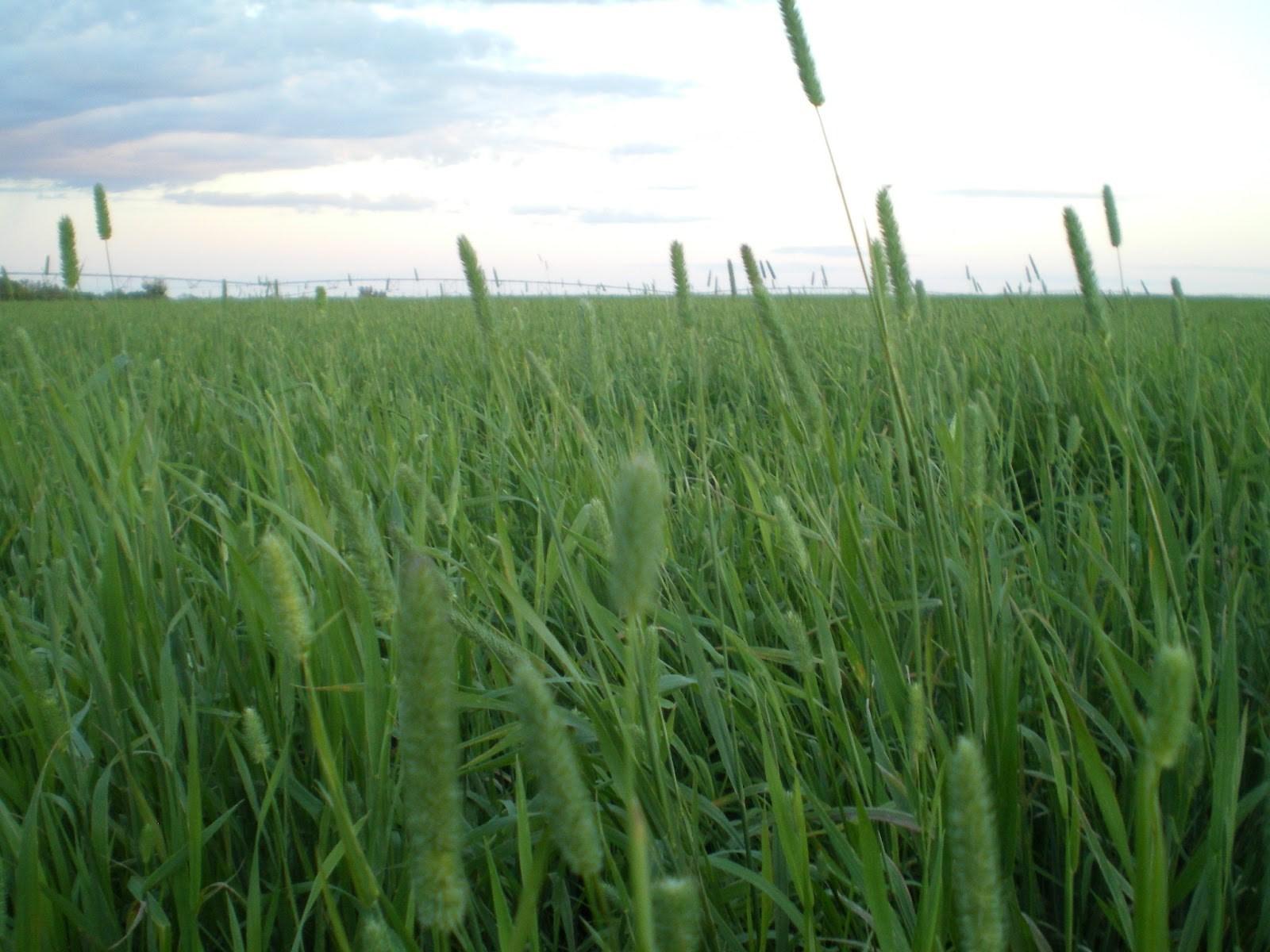


Give Your Horse the GOLD Standard in Digestive Support


The Ultimate Digestive Aid
Around 60 to 70% of horses suffer with some level of digestive disturbance.
Researched and veterinarian-approved AssureGuard Gold provides powerful digestive support in an easy-to-feed, daily pelleted formula.
Our proprietarily processed psyllium and special enteric coated pellets ensure delivery of beneficial microbes and other key ingredients to the hindgut, where they are most effective.
AssureGuard Gold’s patented formula works to support the entire digestive tract, from the stomach to the hindgut, offering a complete solution for common digestive challenges.