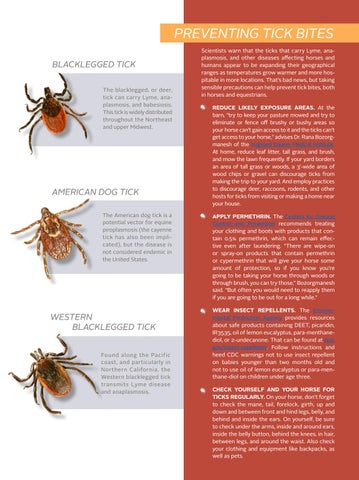
PREVENTING TICK BITES BLACKLEGGED TICK The blacklegged, or deer, tick can carry Lyme, anaplasmosis, and babesiosis. This tick is widely distributed throughout the Northeast and upper Midwest.
AMERICAN DOG TICK The American dog tick is a potential vector for equine piroplasmosis (the cayenne tick has also been implicated), but the disease is not considered endemic in the United States.
WESTERN BLACKLEGGED TICK Found along the Pacific coast, and particularly in Northern California, the Western blacklegged tick transmits Lyme disease and anaplasmosis.
Scientists warn that the ticks that carry Lyme, anaplasmosis, and other diseases affecting horses and humans appear to be expanding their geographical ranges as temperatures grow warmer and more hospitable in more locations. That’s bad news, but taking sensible precautions can help prevent tick bites, both in horses and equestrians. REDUCE LIKELY EXPOSURE AREAS. At the barn, “try to keep your pasture mowed and try to eliminate or fence off brushy or bushy areas so your horse can’t gain access to it and the ticks can’t get access to your horse,” advises Dr. Rana Bozorgmanesh of the Hagyard Equine Medical Institute. At home, reduce leaf litter, tall grass, and brush, and mow the lawn frequently. If your yard borders an area of tall grass or woods, a 3’-wide area of wood chips or gravel can discourage ticks from making the trip to your yard. And employ practices to discourage deer, raccoons, rodents, and other hosts for ticks from visiting or making a home near your house. APPLY PERMETHRIN. The Centers for Disease Control and Prevention recommends treating your clothing and boots with products that contain 0.5% permethrin, which can remain effective even after laundering. “There are wipe-on or spray-on products that contain permethrin or cypermethrin that will give your horse some amount of protection, so if you know you’re going to be taking your horse through woods or through brush, you can try those,” Bozorgmanesh said. “But often you would need to reapply them if you are going to be out for a long while.” WEAR INSECT REPELLENTS. The Environmental Protection Agency provides resources about safe products containing DEET, picaridin, IR3535, oil of lemon eucalyptus, para-menthanediol, or 2-undecanone. That can be found at epa. gov/insect-repellents. Follow instructions and heed CDC warnings not to use insect repellent on babies younger than two months old and not to use oil of lemon eucalyptus or para-menthane-diol on children under age three. CHECK YOURSELF AND YOUR HORSE FOR TICKS REGULARLY. On your horse, don’t forget to check the mane, tail, forelock, girth, up and down and between front and hind legs, belly, and behind and inside the ears. On yourself, be sure to check under the arms, inside and around ears, inside the belly button, behind the knees, in hair, between legs, and around the waist. Also check your clothing and equipment like backpacks, as well as pets. USEQUESTRIAN.ORG 95