EXCLUSIVE INTERVIEW
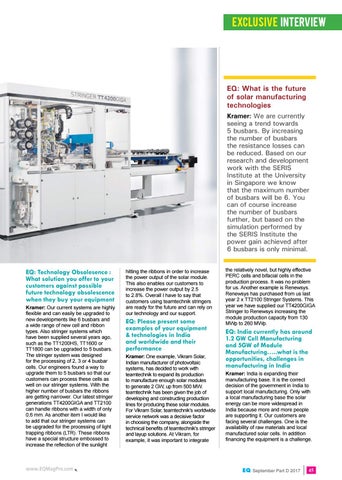
EQ: What is the future of solar manufacturing technologies Kramer: We are currently seeing a trend towards 5 busbars. By increasing the number of busbars the resistance losses can be reduced. Based on our research and development work with the SERIS Institute at the University in Singapore we know that the maximum number of busbars will be 6. You can of course increase the number of busbars further, but based on the simulation performed by the SERIS Institute the power gain achieved after 6 busbars is only minimal. EQ: Technology Obsolesence : What solution you offer to your customers against possible future technology obsolescence when they buy your equipment Kramer: Our current systems are highly flexible and can easily be upgraded to new developments like 6 busbars and a wide range of new cell and ribbon types. Also stringer systems which have been supplied several years ago, such as the TT1200HS, TT1600 or TT1800 can be upgraded to 5 busbars. The stringer system was designed for the processing of 2, 3 or 4 busbar cells. Our engineers found a way to upgrade them to 5 busbars so that our customers can process these cells as well on our stringer systems. With the higher number of busbars the ribbons are getting narrower. Our latest stringer generations TT4200GIGA and TT2100 can handle ribbons with a width of only 0,6 mm. As another item I would like to add that our stringer systems can be upgraded for the processing of light trapping ribbons (LTR). These ribbons have a special structure embossed to increase the reflection of the sunlight
www.EQMagPro.com
hitting the ribbons in order to increase the power output of the solar module. This also enables our customers to increase the power output by 2.5 to 2.8%. Overall I have to say that customers using teamtechnik stringers are ready for the future and can rely on our technology and our support.
EQ: Please present some examples of your equipment & technologies in India and worldwide and their performance Kramer: One example, Vikram Solar, Indian manufacturer of photovoltaic systems, has decided to work with teamtechnik to expand its production to manufacture enough solar modules to generate 2 GW, up from 500 MW. teamtechnik has been given the job of developing and constructing production lines for producing these solar modules. For Vikram Solar, teamtechnik's worldwide service network was a decisive factor in choosing the company, alongside the technical benefits of teamtechnik's stringer and layup solutions. At Vikram, for example, it was important to integrate
the relatively novel, but highly effective PERC cells and bifacial cells in the production process. It was no problem for us. Another example is Renewsys. Renewsys has purchased from us last year 2 x TT2100 Stringer Systems. This year we have supplied our TT4200GIGA Stringer to Renewsys increasing the module production capacity from 130 MWp to 260 MWp.
EQ: India currently has around 1.2 GW Cell Manufacturing and 5GW of Module Manufacturing‌..what is the opportunities, challenges in manufacturing in India Kramer: India is expanding their manufacturing base. It is the correct decision of the government in India to support local manufacturing. Only with a local manufacturing base the solar energy can be more widespread in India because more and more people are supporting it. Our customers are facing several challenges. One is the availability of raw materials and local manufactured solar cells. In addition financing the equipment is a challenge.
EQ
September Part D 2017
45Â