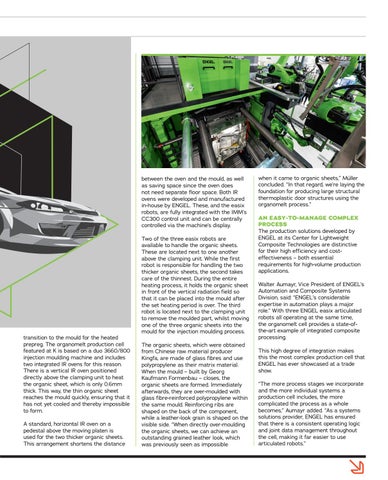
between the oven and the mould, as well as saving space since the oven does not need separate floor space. Both IR ovens were developed and manufactured in-house by ENGEL. These, and the easix robots, are fully integrated with the IMM’s CC300 control unit and can be centrally controlled via the machine’s display.
transition to the mould for the heated prepreg. The organomelt production cell featured at K is based on a duo 3660/800 injection moulding machine and includes two integrated IR ovens for this reason. There is a vertical IR oven positioned directly above the clamping unit to heat the organic sheet, which is only 0.6mm thick. This way, the thin organic sheet reaches the mould quickly, ensuring that it has not yet cooled and thereby impossible to form. A standard, horizontal IR oven on a pedestal above the moving platen is used for the two thicker organic sheets. This arrangement shortens the distance
Two of the three easix robots are available to handle the organic sheets. These are located next to one another above the clamping unit. While the first robot is responsible for handling the two thicker organic sheets, the second takes care of the thinnest. During the entire heating process, it holds the organic sheet in front of the vertical radiation field so that it can be placed into the mould after the set heating period is over. The third robot is located next to the clamping unit to remove the moulded part, whilst moving one of the three organic sheets into the mould for the injection moulding process. The organic sheets, which were obtained from Chinese raw material producer Kingfa, are made of glass fibres and use polypropylene as their matrix material. When the mould – built by Georg Kaufmann Formenbau – closes, the organic sheets are formed. Immediately afterwards, they are over-moulded with glass fibre-reinforced polypropylene within the same mould. Reinforcing ribs are shaped on the back of the component, while a leather-look grain is shaped on the visible side. “When directly over-moulding the organic sheets, we can achieve an outstanding grained leather look, which was previously seen as impossible
when it came to organic sheets,” Müller concluded. “In that regard, we’re laying the foundation for producing large structural thermoplastic door structures using the organomelt process.” AN EASY-TO-MANAGE COMPLEX PROCESS The production solutions developed by ENGEL at its Center for Lightweight Composite Technologies are distinctive for their high efficiency and costeffectiveness – both essential requirements for high-volume production applications. Walter Aumayr, Vice President of ENGEL’s Automation and Composite Systems Division, said: “ENGEL’s considerable expertise in automation plays a major role.” With three ENGEL easix articulated robots all operating at the same time, the organomelt cell provides a state-ofthe-art example of integrated composite processing. This high degree of integration makes this the most complex production cell that ENGEL has ever showcased at a trade show. “The more process stages we incorporate and the more individual systems a production cell includes, the more complicated the process as a whole becomes,” Aumayr added. “As a systems solutions provider, ENGEL has ensured that there is a consistent operating logic and joint data management throughout the cell, making it far easier to use articulated robots.”