Interfaith leaders preach the truth about our planet BY SHALOM KRISTANUGRAHA Over the past few months, I interviewed five people who, in one way or another, engage in environmental justice work from a faith-based perspective. Some are ordained clergy in their faith traditions; others work with nonprofit organizations. Some are American born and bred; others hail from and reside in different countries. All of them have shared unique stories and valuable insights about what inspires them, motivates them, and sustains them in the work that they respectively do. At the age of 37, she converted to Judaism, where she found a spiritual home. Eventually, after obtaining an Master’s degree in Jewish Studies and teaching Hebrew school for some time, she attended rabbinical school, the Academy of Jewish Religion in New York. In 2005 she was ordained as a rabbi and obtained certification as a chaplain through Neshama: Association of Jewish Chaplains in 2010. She worked as a staff chaplain at the Brigham and Women’s Hospital for ten years, before moving to hospice chaplaincy for a few more years.
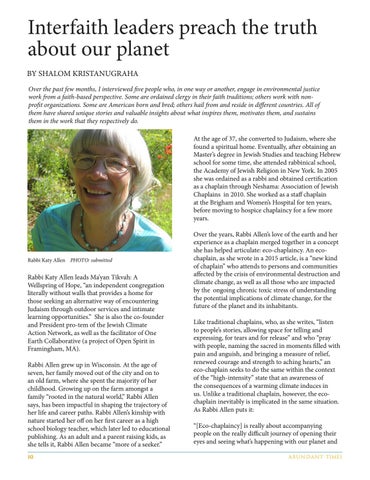
Rabbi Katy Allen PHOTO: submitted
Rabbi Katy Allen leads Ma’yan Tikvah: A Wellspring of Hope, “an independent congregation literally without walls that provides a home for those seeking an alternative way of encountering Judaism through outdoor services and intimate learning opportunities.” She is also the co-founder and President pro-tem of the Jewish Climate Action Network, as well as the facilitator of One Earth Collaborative (a project of Open Spirit in Framingham, MA). Rabbi Allen grew up in Wisconsin. At the age of seven, her family moved out of the city and on to an old farm, where she spent the majority of her childhood. Growing up on the farm amongst a family “rooted in the natural world,” Rabbi Allen says, has been impactful in shaping the trajectory of her life and career paths. Rabbi Allen’s kinship with nature started her off on her first career as a high school biology teacher, which later led to educational publishing. As an adult and a parent raising kids, as she tells it, Rabbi Allen became “more of a seeker.” 10
Over the years, Rabbi Allen’s love of the earth and her experience as a chaplain merged together in a concept she has helped articulate: eco-chaplaincy. An ecochaplain, as she wrote in a 2015 article, is a “new kind of chaplain” who attends to persons and communities affected by the crisis of environmental destruction and climate change, as well as all those who are impacted by the ongoing chronic toxic stress of understanding the potential implications of climate change, for the future of the planet and its inhabitants. Like traditional chaplains, who, as she writes, “listen to people’s stories, allowing space for telling and expressing, for tears and for release” and who “pray with people, naming the sacred in moments filled with pain and anguish, and bringing a measure of relief, renewed courage and strength to aching hearts,” an eco-chaplain seeks to do the same within the context of the “high-intensity” state that an awareness of the consequences of a warming climate induces in us. Unlike a traditional chaplain, however, the ecochaplain inevitably is implicated in the same situation. As Rabbi Allen puts it: “[Eco-chaplaincy] is really about accompanying people on the really difficult journey of opening their eyes and seeing what’s happening with our planet and ABU ND ANT TIMES