12
International
Tuesday, September 25, 2012
BUSINESS
German business climate falls despite ECB bond plan
Reuters
BERLIN - German business sentiment dropped for a fifth successive month in September to its lowest level since early 2010, showing the European Central Bank’s plan to buy the bonds of weak euro states has failed to convince firms the worst of the crisis is behind them. The Munich-based Ifo think tank said on Monday its business climate index, based on a monthly survey of some 7,000 firms, fell to 101.4 in September from 102.3 in August, defying expectations for a slight rise,. A Reuters poll of 45 economists had forecast a slight increase to 102.5. “September’s fall in the German Ifo business survey is a reminder that even the euro-zone’s strongest
economies are suffering from a serious economic downturn,” Jennifer McKeown, an economist at Capital Economics wrote in a note. “While Germany might have avoided a recession in the third quarter, it seems like only a matter of time before the economy starts to contract. This will make support for the peripheral economies even more difficult to muster.” Business confidence in the Neth-
erlands also fell in September to -6.7 points from -4.6 in August, data showed on Monday. Dragging on the Ifo index was a sharp decline in sentiment among manufacturers, although companies in retailing and wholesaling reported a slightly brighter mood. Tough austerity measures in many European states have weakened demand for German exports, and a weaker global economic environ-
ment threatens to crimp demand from emerging economies. Industrial group Bosch (ROBG. UL) and steelmaker ThyssenKrupp (TKAG.DE), have announced plans to introduce “Kurzarbeit” or government-subsidized short-time work at German plants. While the German economy steamed ahead in the first three months of the year, saving the euro zone from recession by growing 0.5 percent, it lost momentum in the second quarter, with growth slowing to 0.3 percent. The Finance Ministry warned in its monthly report last Friday that data pointed to economic growth weakening in the remainder of the year. Many
economists are now predicting a contraction for the third and possibly the fourth quarters. Last week Markit’s composite Purchasing Managers Index (PMI), showed Germany’s private sector shrank for a fifth month, and a separate index for the euro zone showed that the ECB’s aggressive new bondbuying plan has so far failed to inspire any major improvement in business at ailing euro zone companies. The ECB’s plan and a decision by Germany’s Constitutional Court this month to allow the ratification of Europe’s new rescue mechanism, had sent a wave of optimism through markets.
Asian stocks sink as global economy fears rise Associated Press
HONG KONG — Asian stocks mostly drifted lower Monday as investors’ growing concerns about the shaky global economy overpowered any remaining optimism over central bank stimulus efforts. Crude oil tumbled while the dollar rose against the euro but fell against the Japanese yen. Tokyo’s Nikkei 225 index dropped 0.4 percent to 9,070.78 and Seoul’s Kospi index shed 0.2 percent to 1,999.18. Hong Kong’s Hang Seng was down less than 0.1 percent to 20,724.17 while Sydney’s ASX S&P 200 fell 0.4 percent to 4,388.60. Benchmarks in Singapore and Indonesia also fell. Strategists at Credit Agricole CIB wrote in a research note that the “euphoria emanating” from recent moves by the Federal Reserve, European Central Bank and Bank of Japan to stimulate growth is “fading quickly.”
“The reality of weak growth and underlying structural tensions is coming back to haunt markets.” The Fed vowed in mid-September to buy billions in mortgage securities each month until the economy improves in a third round of what is known as quantitative easing, or QE3. The ECB and Bank of Japan followed with their own renewed bond-buying plans. “There is this struggle between optimism towards QE3 and the concern about the global economic slowdown,” said Louis Wong, a director at Phillip Securities in Hong Kong. “So investors are weighing the easing measures of central banks and the health of the global economy.” China’s Shanghai Composite Index rose 0.3 percent to 2,032.44, reversing losses earlier in the day. However, the benchmark is still at its lowest point since January 2009. Chinese stocks are being hurt
Toyota Motor Corp. Vice Chairman Takeshi Uchiyamada poses for photographers as he puts a plug to the newly-developed compact electric vehicle “eQ” during a press conference in Tokyo Monday, Sept. 24, 2012. Toyota is boosting its green vehicle lineup, with plans for 21 new hybrids in the next three years, a new electric car later this year and a fuel cell vehicle by 2015 in response to growing demand for fuel efficient and environmentally friendly driving.
by a dispute between China and Japan over disputed islands that has heightened tensions between Asia’s two biggest economies. They’re also under pressure as investors worry about what Chinese authorities will do to restart growth amid the country’s economic slowdown. Wong said it’s unlikely that Chinese authorities will unveil any major stimulus
measures ahead of the National Day holiday next week or an expected but still unscheduled Communist Party meeting to hand over power to a next generation of leaders. “This inaction by the Chinese government also weighs,” Wong said. Asian markets were also reacting to some downbeat economic reports released over the weekend.
The U.S. Labor Department said that the unemployment rate rose in more than half of states last month, the latest evidence that hiring remains tepid across the world’s biggest economy. The World Trade Organization, meanwhile, cut estimates for global trade growth for this year and next. Both reports came out on Friday after Asian markets closed.
AP Photo/Koji Sasahara
Bali News
International
Tuesday, September 25, 2012
5
Otonan: Real ‘Birthday’ Celebration for Companions
Month by month has gone by and another year is coming. Time is so significant to humans when he performs action and writes down his story of life. When having arrived at certain point, he may need a short break for an introspection and commemoration of a beautiful moment in his lifetime. Yes, it’s commonly known as birthday, an annual celebration of the day on which one was born. Etymologically, there may have been a common ‘misperception’ here where birthday in the Gregorian calendar should be celebrated on the same day as the word suggests and not the same date (should be birth date). On the contrary, otonan in the Balinese (Hindu) tradition is similar thing but of different context. This one is celebrated every 210 days on the same day based on Javano-Balinese wuku year. So, it can be said a real birthday. For example, if one was born on Wednesday (day) Kliwon (five-day week) Dungulan (one of thirty wukus), he will celebrate his otonan on the same day as above. Another difference between the two is the dating system, particularly on the starting point of new date. If the Gregorian starts at 00:01, the wuku at the sunrise. Sometimes, there is also misunderstanding among some Balinese to determine the day of a baby that was born at dawn, let’s say on Wednesday Kliwon Dungulan at 04:00. Based on Gregorian calendar, the day and date have belonged to the next (Thursday) and will become its ‘birth date’ later. However, its otonan should not follow this calendar system, but as the baby was born at 04:00, it should belong to Wednesday (Buda) based on the wuku system. This misdating may often inflict mistakes in determining his otonan day and its character does not accord with the Hindu astrology. This then needs something like ritual adjustment in Hindu belief to the appropriate day through an exorcism rite as mentioned in palmleaf manuscript that commonly used as reference like Wrehaspati Kalpa. Otonan in Balinese tradition is actually a private and comprehensive ritual that only celebrated by the family internally. By certain kinds of oblation, the ritual is intended for one’s inner and outer self along with his kanda empat or four companions that are believed to accompany him since birth to the end of lifetime and even the period after death. They are expressed in personification as amniotic fluid, vernix cascosa, the afterbirth and the blood. In Hindu belief, the names of the four companions will change in keeping with the increasing age of the human self and so are the places where they indwell. The four will loyally keep the self in this world. If ‘spiritual’ communication and empowerment run well among the five, one will never feel fearful wherever he goes and can do healing. As loyal and eternal companions, too, they will accompany the self around the clock. By doing this, they will know every single deed of the self during its interaction with corporeal body. After death, on facing the court of Yama, no facts can be hidden or no lies can be told, as the four companions will deliver the true witness. In essence, otonan is an immensely important celebration for the Hindus. It constitutes right moment to reorganize, encourage the relationship of human self with the four integrated companions as the otonan contains two dimensional aspects, both sekala (visible) and niskala (invisible). By this, it is also expected to promote harmony between the body with soul and finally reach eternal bliss here and after. (IBP/Doc)
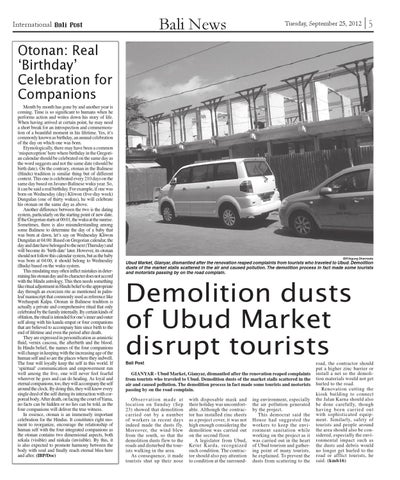
IBP/Agung Dharmada
Ubud Market, Gianyar, dismantled after the renovation reaped complaints from tourists who traveled to Ubud. Demolition dusts of the market stalls scattered in the air and caused pollution. The demolition process in fact made some tourists and motorists passing by on the road complain.
Demolition dusts of Ubud Market disrupt tourists
Bali Post
GIANYAR - Ubud Market, Gianyar, dismantled after the renovation reaped complaints from tourists who traveled to Ubud. Demolition dusts of the market stalls scattered in the air and caused pollution. The demolition process in fact made some tourists and motorists passing by on the road complain. O b s e r va t i o n m a d e a t location on Sunday (Sep 23) showed that demolition carried out by a number of workers in recent days indeed made the dusts fly. Moreover, the wind blew from the south, so that the demolition dusts flew to the roads and disturbed the tourists walking in the area. As consequence, it made tourists shut up their nose
with disposable mask and their holiday was uncomfortable. Although the contractor has installed zinc sheets as a project cover, it was not high enough considering the demolition was carried out on the second floor. A legislator from Ubud, Ketut Karda, recognized such condition. The contractor should also pay attention to condition at the surround-
ing environment, especially the air pollution generated by the project. This democrat said the House had suggested the workers to keep the environment sanitation while working on the project as it was carried out in the heart of Ubud tourism and gathering point of many tourists, he explained. To prevent the dusts from scattering to the
road, the contractor should put a higher zinc barrier or install a net so the demolition materials would not get hurled to the road. Renovation cutting the kiosk building to connect the Jalan Karna should also be done carefully, though having been carried out with sophisticated equipment. Similarly, safety of tourists and people around the area should also be considered, especially the environmental impact such as the dusts and debris would no longer get hurled to the road or afflict tourists, he said. (kmb16)