STORE BRANDS l WINE AND BEER their overall corporate growth strategy plans, and the demand is carrying over to the wine category,” said Kate Helm, senior manager of private brands at E. & J. Gallo Winery. She noted that E. & J. Gallo doubled its private brand volume sales between 2014 and 2018 and is on track to repeat that performance through 2022. “We’ve experienced double-digit volume growth in each of the last nine years and forecast similar growth again in 2021.”
ACTION AT THE HIGH END
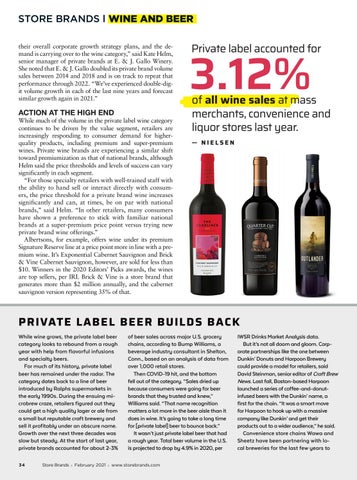
While much of the volume in the private label wine category continues to be driven by the value segment, retailers are increasingly responding to consumer demand for higherquality products, including premium and super-premium wines. Private wine brands are experiencing a similar shift toward premiumization as that of national brands, although Helm said the price thresholds and levels of success can vary significantly in each segment. “For those specialty retailers with well-trained staff with the ability to hand sell or interact directly with consumers, the price threshold for a private brand wine increases significantly and can, at times, be on par with national brands,” said Helm. “In other retailers, many consumers have shown a preference to stick with familiar national brands at a super-premium price point versus trying new private brand wine offerings.” Albertsons, for example, offers wine under its premium Signature Reserve line at a price point more in line with a premium wine. It’s Exponential Cabernet Sauvignon and Brick & Vine Cabernet Sauvignon, however, are sold for less than $10. Winners in the 2020 Editors’ Picks awards, the wines are top sellers, per IRI. Brick & Vine is a store brand that generates more than $2 million annually, and the cabernet sauvignon version representing 35% of that.
3.12%
Private label accounted for
of all wine sales at mass merchants, convenience and liquor stores last year. — NIELSEN
PR IVAT E L A BE L BEE R B U I L D S B A C K While wine grows, the private label beer category looks to rebound from a rough year with help from flavorful infusions and specialty beers. For much of its history, private label beer has remained under the radar. The category dates back to a line of beer introduced by Ralphs supermarkets in the early 1990s. During the ensuing microbrew craze, retailers figured out they could get a high quality lager or ale from a small but reputable craft brewery and sell it profitably under an obscure name. Growth over the next three decades was slow but steady. At the start of last year, private brands accounted for about 2-3% 34
Store Brands
l l
February 2021
032-035_SBR_WineBeer_0221_v6.indd 34
l l
of beer sales across major U.S. grocery chains, according to Bump Williams, a beverage industry consultant in Shelton, Conn., based on an analysis of data from over 1,000 retail stores. Then COVID-19 hit, and the bottom fell out of the category. “Sales dried up because consumers were going for beer brands that they trusted and knew,” Williams said. “That name recognition matters a lot more in the beer aisle than it does in wine. It’s going to take a long time for [private label] beer to bounce back.” It wasn’t just private label beer that had a rough year. Total beer volume in the U.S. is projected to drop by 4.9% in 2020, per
IWSR Drinks Market Analysis data. But it’s not all doom and gloom. Corporate partnerships like the one between Dunkin’ Donuts and Harpoon Brewery could provide a model for retailers, said David Steinman, senior editor of Craft Brew News. Last fall, Boston-based Harpoon launched a series of coffee-and-donutinfused beers with the Dunkin’ name, a first for the chain. “It was a smart move for Harpoon to hook up with a massive company like Dunkin’ and get their products out to a wider audience,” he said. Convenience store chains Wawa and Sheetz have been partnering with local breweries for the last few years to
www.storebrands.com
1/26/21 4:40 PM