When she joined Couche-Tard in April 2017, the company was heavily on a merger-andacquisition path and was on the verge of finalizing its purchase of San Antonio-based CST Brands Inc. With integration being the top priority following the CST closing that June, the company tackled the complexity of bringing both organizations into sync.
“You can learn a lot from that innovation,” she noted.
Since then, Hall Lefevre and her team have rolled up their sleeves to bring CoucheTard’s entire global Circle K network onto the same technology page.
Moving forward, items in Couche-Tard’s technology pipeline are centered on delivering frictionless experiences to customers, Hall Lefevre shared.
Acknowledging that it is easy to chase shiny objects, Couche-Tard’s current technology agenda has taken shape with three key principles in mind:
Taking the In-House Route
• Taking the pain points out of the shopper experience; • Redefining convenience; and • Achieving operational efficiency. “We look for things that are going to be super differentiating,” said Hall Lefevre. To that end, the company launched the Circle K Ventures Fund about a year and a half ago. Willing to invest significant amounts of money, the fund is a way for Circle K to connect with startups.
“We look for things that are going to be super differentiating.” — Deb Hall Lefevre, Alimentation Couche-Tard Inc./Circle K
One recent collaboration to come from the fund is Circle K’s partnership with third-party app Jackpocket, which will bring the mobile lottery option to more than 1,300 Circle K stores across Arkansas, Colorado, New Hampshire, New York, Ohio and Texas.
When talking retail technology these days, a lot of the focus is on Amazon or big-box retailers like Walmart; however, large retailers have hundreds of stores and machines and data centers. On the other hand, c-stores have a much smaller footprint, so the systems that work for big-box stores do not work for convenience, according to 7-Eleven’s Suri, who also noted that c-store retailers face cost and budget pressures that other retailers don’t. 7-Eleven takes an in-house route to technology, often developing proprietary solutions. One example is handheld hardware to handle in-store capabilities such as inventory checks. The Irving, Texas-based retailer is known for embracing innovation — from a cashierless store in Dallas to its 7NOW delivery platform — and is continually looking for ways to expand digital touchpoints with customers that define their experience and the store of the future. According to the CIO, the game is changing with convenience operators not only facing competition from other retailers, but also from tech companies. This is making it crucial to find solutions that work for today’s convenience retailing environment, as well as tomorrow’s. Suri took on his role at 7-Eleven four years ago — his first job in the retail space. He was attracted to the business, and to the c-store consumer who he says adopts new technologies faster than the corporate world. “I’m a software engineer at heart, but I love retail,” he said. He believes there’s much opportunity out there for the convenience channel, but it comes with a challenge: what the market is saying may not necessarily work for every c-store. “How are you making decisions to create a competitive advantage?” Suri posed.
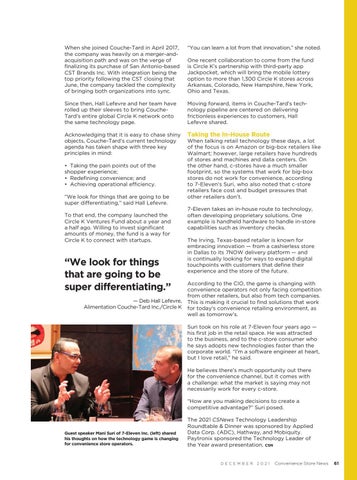
Guest speaker Mani Suri of 7-Eleven Inc. (left) shared his thoughts on how the technology game is changing for convenience store operators.
The 2021 CSNews Technology Leadership Roundtable & Dinner was sponsored by Applied Data Corp. (ADC), Hathway, and Mobiquity. Paytronix sponsored the Technology Leader of the Year award presentation. CSN
DE CE MB E R
60-61_Tech_CSN_1221_v1.indd 61
20 21
Convenience Store News
61
12/6/21 3:21 PM