FOODSERVICE
Main Competitors for Foodservice Program
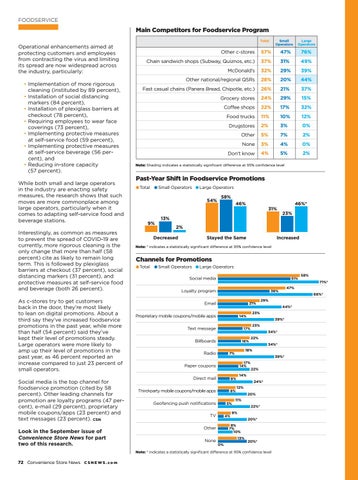
• I mplementation of more rigorous cleaning (instituted by 89 percent), • Installation of social distancing markers (84 percent), • Installation of plexiglass barriers at checkout (78 percent), • Requiring employees to wear face coverings (73 percent), • Implementing protective measures at self-service food (59 percent), • Implementing protective measures at self-service beverage (56 percent), and • Reducing in-store capacity (57 percent). While both small and large operators in the industry are enacting safety measures, the research shows that such moves are more commonplace among large operators, particularly when it comes to adapting self-service food and beverage stations. Interestingly, as common as measures to prevent the spread of COVID-19 are currently, more rigorous cleaning is the only change that more than half (58 percent) cite as likely to remain long term. This is followed by plexiglass barriers at checkout (37 percent), social distancing markers (31 percent), and protective measures at self-service food and beverage (both 26 percent). As c-stores try to get customers back in the door, they're most likely to lean on digital promotions. About a third say they’ve increased foodservice promotions in the past year, while more than half (54 percent) said they’ve kept their level of promotions steady. Large operators were more likely to amp up their level of promotions in the past year, as 46 percent reported an increase compared to just 23 percent of small operators. Social media is the top channel for foodservice promotion (cited by 58 percent). Other leading channels for promotion are loyalty programs (47 percent), e-mail (29 percent), proprietary mobile coupons/apps (23 percent) and text messages (23 percent). CSN Look in the September issue of Convenience Store News for part two of this research.
Total
Operational enhancements aimed at protecting customers and employees from contracting the virus and limiting its spread are now widespread across the industry, particularly:
Small Large Operators Operators
Other c-stores
57%
47%
76%
Chain sandwich shops (Subway, Quiznos, etc.)
37%
31%
49%
McDonald’s
32%
29%
39%
Other national/regional QSRs
28%
20%
44%
Fast casual chains (Panera Bread, Chipotle, etc.)
26%
21%
37%
Grocery stores
24%
29%
15%
Coffee shops
22%
17%
32%
Food trucks
11%
10%
12%
Drugstores
2%
3%
0%
Other
5%
7%
2%
None
3%
4%
0%
Don't know
4%
5%
2%
Note: Shading indicates a statistically significant difference at 95% confidence level
Past-Year Shift in Foodservice Promotions Total
Small Operators
Large Operators
54%
9%
58% 46%
31%
13%
46%* 23%
2%
Decreased
Stayed the Same
Increased
Note: * indicates a statistically significant difference at 95% confidence level
Channels for Promotions Total
Small Operators
Large Operators
Social media
51%
Loyalty program 21%
Proprietary mobile coupons/mobile apps
16%
Radio Paper coupons
8% 5%
TV
4%
22% 24%*
12% 20%
11% 22%*
9% 20%*
8% 7% 10%
Other None
34%*
14%
8%
Geofencing push notifications
34%* 22%
39%* 17% 14%
Third-party mobile coupons/mobile apps
23%
18%
7%
Direct mail
44%* 39%*
17%
Billboards
66%*
29%
23%
14%
Text message
71%*
47%
36%
58%
13% 0%
20%*
Note: * indicates a statistically significant difference at 95% confidence level
72 Convenience Store News C S N E W S . c o m
68-72 FoodServiceStudy_CSN_0820.indd 72
8/4/20 9:48 AM