REAL ESTATE
TODAY’S TOP REAL ESTATE TECH TOOLS By Al Urbanski
S
andy Sigal wasn’t a real estate person who found technology, Sandy was a tech person who found real estate. The co-founder and CEO of the Calabasas, Calif.-based NewMark Merrill Companies--which owns and operates 80-plus open-air shopping centers in California, Colorado, Illinois, and Washington—was not the heir of a family-owned real estate dynasty. He was a personal computer whiz kid during the dawn of the PC who, at the age of 12, was already programming and developing accounting and project management software for local companies. After graduating college at age 20, Sigal was hired by West Venture Companies, a California-based homebuilder, to computerize their business processes. He ended up as the company’s CEO, left it to start NewMark Merrill, and purchased West Venture’s retail assets, which consisted of 15 centers and four projects under development. “One of the first great tools we found was Datex, which tracks percentage rent payments for all retail classes and top national retailers,” Sigal said. “We could check that data to see who’s late with rent, who’s paying on time, where rents were below market. That enabled us to do trend analyses when we were looking to buy a center.” NewMark Merrill subsequently acquired Datex.
NewMark Merill was also the first developer to use Placer.ai. Some seven years ago, Placer.ai’s co-founder Noam Ben-Zvi, who’s based in California, paid a visit to Sigal to see if he thought the company’s mobile-based location analytics platform could provide a valuable service to retail real estate developers and expanding retailers. He did, and invited Ben-Zvi to join him at NewMark Merrill’s booth at the next ICSC show to introduce it to attendees. Today, Placer.ai’s ICSC show booth is twice as big as NewMark Merill’s. “What’s really great is that tenants now use the same tools that we use, including Placer. Now we are all looking at the same data. We ask a lot more questions, and they’re a lot more smart,” Sigal said. “What tenants do we renew? Who’s strong and who’s weak? We can isolate the locations where they succeed and where they fail.” Sigal says that the good news about new real estate tech tools is that they give their users very accurate information about what’s really going on. The bad news, he added, is that there are always users who maintain a slight edge. Following is a review of some of the top real estate tech tools being used by both landlords and tenants in the retail sphere.
ESRI
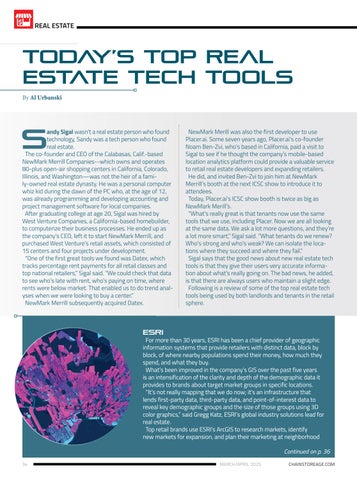
For more than 30 years, ESRI has been a chief provider of geographic information systems that provide retailers with distinct data, block by block, of where nearby populations spend their money, how much they spend, and what they buy. What’s been improved in the company’s GIS over the past five years is an intensification of the clarity and depth of the demographic data it provides to brands about target market groups in specific locations. “It’s not really mapping that we do now; it’s an infrastructure that lends first-party data, third-party data, and point-of-interest data to reveal key demographic groups and the size of those groups using 3D color graphics,” said Gregg Katz, ESRI’s global industry solutions lead for real estate. Top retail brands use ESRI’s ArcGIS to research markets, identify new markets for expansion, and plan their marketing at neighborhood Continued on p. 36 34
MARCH/APRIL 2025
CHAINSTOREAGE.COM