

2020ENGINEERING DIMENSIONS
The careful consideration OF A COMPLAINT













ENGINEERING DIMENSI O N S

ASSOCIATION BUSINESS
5 Editor’s Note
6 President’s Message
8 CEO/Registrar’s Report
33 Introducing PEO Council 2020–2021
40 GLP Journal
41 2021 Council Elections Call for Candidates, Voting Procedures and Election Publicity Procedures
50 In Council
NEWS AND COMMENTARY
9 Marisa Sterling takes over PEO presidency at virtual AGM; PEO members earn S.E. Wolfe and V.G. Smith awards; PEO adopts National Professional Practice Exam; 2020 Volunteer Leadership Conference goes online; Engineering organizations advocate for restarting of economy; University engineering team develops COVID-19 tool for healthcare sector
19 Bulletin Board
20 Profile: Engineering firm creates Ontario’s first temporary pandemic response unit
22 Awards
32 Viewpoint: The need for radical change from within
52 Letters
26 WHAT’S IN A COMPLAINT?
By Adam Sidsworth
PROFESSIONAL ISSUES
21 Professional Practice: Five situations when practitioners should contact insurance professionals
ADVERTISING FEATURES
51 Professional Directory
54 Ad Index

DIGITAL EDITION
Read Engineering Dimensions from anywhere! Visit engineeringdimensions.ca to read our current digital edition, view issue archives, print and share articles and download the magazine as a PDF document.
ENGINEERING DIMENSIONS
PUBLICATIONS STAFF
Editor
Nicole Axworthy editor@peo.on.ca
Associate editor
Marika Bigongiari
Associate editor
Adam Sidsworth
Senior graphic designer
Stephanie Katchmar
Graphic designer
Cindy Reichle
Manager, communications
Duff McCutcheon
Digital communications coordinator
Michelle Yiu
ADVERTISING SALES
Account executive
Charlene Woron cworon@dvtail.com
Dovetail Communications
30 East Beaver Creek Road
Suite 202
Richmond Hill, ON L4B 1J2
Tel: 905-886-6640
Fax: 905-886-6615
EXECUTIVE STAFF
CEO/Registrar
Johnny Zuccon, P.Eng., FEC registrar@peo.on.ca
Acting deputy registrar, licensing and registration
Linda Latham, P.Eng.
Deputy registrar, regulatory compliance
Linda Latham, P.Eng.
Deputy registrar, tribunals and regulatory affairs
Johnny Zuccon, P.Eng., FEC
Chief Administrative Officer
Vacant
Director, communications
David Smith
Director, finance
Chetan Mehta, MS, MBA
Director, information technology
Michelle Wehrle
Director, human resources
Lolita Holden, CHRL
PEO COUNCIL
Officers
President
Marisa Sterling, P.Eng., FEC president@peo.on.ca
Past President
Nancy Hill, P.Eng., LLB, FEC, FCAE
President-elect
Christian Bellini, P.Eng., FEC
Vice president (elected)
Darla Campbell, P.Eng., CSR-P
Vice president (appointed)
Arthur Sinclair, P.Eng.
Executive Members
Arjan Arenja, MBA, P.Eng.
Michael Chan, P.Eng., FEC
Lorne Cutler, MBA, P.Eng.
Councillors
Councillors-at-large
Leila Notash, PhD, P.Eng., FEC
Sandra Ausma, PhD, P.Eng.
Michael Chan, P.Eng., FEC
Eastern Region councillors
Randy Walker, P.Eng., FEC
Chantal Chiddle, P.Eng., FEC
East Central Region councillors
Arthur Sinclair, P.Eng.
Peter Cushman, P.Eng.
Northern Region councillors
Ramesh Subramanian, PhD, P.Eng., FEC
Luc Roberge, P.Eng., FEC
Western Region councillors
Wayne Kershaw, P.Eng., FEC
Peter Broad, P.Eng., FEC
West Central Region councillors
Warren Turnbull, P.Eng., FEC
Lisa MacCumber, P.Eng., FEC
Lieutenant governor-in-council appointees
Arjan Arenja, MBA, P.Eng.
Robert Brunet, P.Eng.
Todd Bruyere, P.Eng.
Lorne Cutler, MBA, P.Eng.
Andy Dryland, C.E.T.
Qadira C. Jackson Kouakou, BA, BSW, LLB
Iretomiwa Olukiyesi, P.Eng.
Sherlock Sung
Engineers Canada Directors
Christian Bellini, P.Eng., FEC
Danny Chui, P.Eng., FEC
Nancy Hill, P.Eng., LLB, FEC, FCAE
Kelly Reid, P.Eng., IACCM CCMP
Changiz Sadr, P.Eng., FEC
Engineering Dimensions (ISSN 0227-5147) is published bimonthly by the Association of Professional Engineers of Ontario and is distributed to all PEO licensed professional engineers. Engineering Dimensions publishes articles on association business and professional topics of interest to the professional engineer. The magazine’s content does not necessarily reflect the opinion or policy of the Council of the association, nor does the association assume any responsibility for unsolicited manuscripts and art. All material is copyright. Permission to reprint editorial copy or graphics should be requested from the editor.
Address all communications to The Editor, Engineering Dimensions, PEO, 40 Sheppard Avenue West, Suite 101, Toronto, ON M2N 6K9. Tel: 800-339-3716.
Engineering Dimensions is a member of Canadian Business Press.
Indexed by the Canadian Business Index and available online in the Canadian Business and Current Affairs Database.
US POSTMASTER: Send address changes to Engineering Dimensions, P.O. Box 1042, Niagara Falls, NY, 14304.
CANADA POST: Send address changes to 40 Sheppard Avenue West, Suite 101, Toronto, ON, M2N 6K9.
Canada Publications Mail Product Sales Agreement No. 40063309. Printed in Canada by Renaissance Printing Inc.
SUBSCRIPTIONS (Non-members)
Canada (6 issues) $33.90 incl. HST
Other (6 issues) $40.00
Students (6 issues) $16.95 incl. HST
Single copy $4.50 incl. HST
Visit: peo.on.ca/about-peo/engineering-dimensions
Approximately $5.00 from each membership fee is allocated to Engineering Dimensions and is non-deductible.
Recyclable where facilities exist
CONNECT WITH US Web: peo.on.ca Tel: 800-339-3716
twitter.com/PEO_HQ
linkedin.com/company/peo---professional-engineers-ontario facebook.com/ProfessionalEngineersOntario
TRUSTING THE PROCESS
By Nicole Axworthy
LET US KNOW
To protect the public, PEO investigates all complaints about unlicensed individuals or companies, and unprofessional, inadequate or incompetent engineers. If you have concerns about the work of an engineer, fill out a Complaint Form found on PEO’s website and email it to complaints@peo.on.ca. If you suspect a person or company is practising engineering without a licence, contact PEO’s enforcement hotline at 800-339-3716, ext. 1444, or by email at

The production of our annual July/ August issue is always an exciting time for us here Engineering Dimensions. It’s the one issue each year in which we get to introduce you to PEO’s new Council president through an in-depth feature profile and a captivating cover image. Each year, we anticipate that their vision will spark new life in Council priorities and bring about change that will only improve PEO’s processes. And we also look forward to spending time with this individual as we interview and photograph them for these very pages.
This year, however, the COVID-19 pandemic put a slight delay on our fun. Because we were unable to go through with our planned photoshoot of 2020–2021 PEO President Marisa Sterling, P.Eng., FEC, we have decided to put the feature article on hold. In the meantime, you can get a sense of Sterling’s priorities in her first official President’s Message (p. 6) since being installed as president at the regulator’s virtual annual general meeting in May (p. 9). It’s clear that she’s not letting these unsettling times stop her efforts in making PEO a better—and more

This issue, we also introduce you to the rest of the members of PEO Council for 2020–2021 (p. 33), who have so far only been able to gather virtually instead of in-person around the board-
room table to make the important decisions needed to keep things moving—including approving new practice guidelines and making the necessary bylaw changes to streamline the process for holding electronic meetings of Council and committees (p. 50).
As for this issue’s theme, Associate Editor Adam Sidsworth takes you on the journey of PEO’s complaints process in “What’s in a complaint?” (p. 26). Several steps are put in motion when someone formally submits a complaint alleging professional misconduct against a professional engineer or certificate of authorization holder. Each case involves investigators, lawyers and a thorough review by the Complaints Committee, which makes a formal decision as to whether the matter is referred to discipline—possibly every engineer’s worst nightmare.
While you’re here, be sure to click over to page 20, where we profile an up-and-coming engineering firm that helped create Ontario’s first temporary pandemic response unit in anticipation of the onslaught of COVID-19 cases earlier this year. It’s a story of resilience, hard work and specialized skill to get the job done in an unusually quick two-week timeline.
As we look ahead to PEO’s 2021 Council elections in January, everything you need to know to nominate members for next year’s Council can be found starting on page 41. Be sure to make note of the important deadlines if you want to get involved. e
PEO, as the provincial engineering regulator, must investigate all complaints lodged against professional engineers. In this issue, we explore how PEO’s Complaints Committee—in collaboration with PEO staff—conducts PEO’s complaints process. We also introduce you to the members of PEO Council for 2020–2021.
OUR APPETITE FOR TRANSFORMATION
By Marisa Sterling, P.Eng., FEC

In recent months we have seen significant societal, business and personal change with the COVID-19 pandemic, an upswell in protest movements against anti-Black racism and calls for widespread accountability in our institutions. These events have tipped my thinking of how critical it is, now more than ever, that PEO change its organizational and regulatory culture in order to realize our transformation goals. Author Peter Drucker tells us, “Culture eats strategy for breakfast.” The National Association of Corporate Directors informs us that the ability of a board to integrate culture into its discussions about strategy, risk and performance is important to achieving goals that stick.
I am not suggesting PEO let go of everything it knows. Instead, I want to draw on the positive aspects of our culture, turn them to our advantage and offset some of the unhelpful aspects. Recent examples of this are PEO’s CEO/registrar and staff pivoting to receive licence and certificate of authorization applications by email as well as quickly implementing the National Professional Practice Exam, which was handled by remote proctoring due to the COVID-19 emergency, for applicants who had registered for the cancelled March sitting of our Professional Practice Exam (see p. 13).
PEO has complex decisions to make this year about who and what we license and how we govern ourselves. We will need buy-in from Council, our committees, volunteers, staff and partners. Our north star is resolute: to protect the public interest. To stay focused on our north star will ensure we make meaningful change as we reimagine PEO together.
LETTING GO OF THE STATUS QUO
I am humbled and honoured to have this platform to share my thoughts with an audience reach of over 100,000. I am aware of the responsibility I have as the elected president and chair of Council. I write this article with an authenticity about my experience as a white woman and reflections of my positionality in PEO, in the engineering profession and in society. Culture change for PEO will need to look at our policies and processes through the lens of whether they are discriminatory or reinforcing systemic racism. This may not be immediately obvious to us, as these are the systems we have accepted, tolerated and grown accustomed to. However, to do our part to ensure we remove any systemic inequity in engineering regulation, we need to examine and remove those actions and behaviours that are oppressive and unjust.
PEO made a positive step forward in 2011 with its Equity and Diversity Policy. Other engineering regulators have gone further. Demographic data of licence holders is being collected—Alberta currently collects Indigenous status, and New Brunswick conducted a diversity survey this year. System bias is being revealed—Manitoba took an intersectional approach
to dismantling bias. And codes of ethics are explicit—Nova Scotia and New Brunswick codes state that their members “shall treat equitably and promote the equitable treatment of all clients, colleagues and coworkers, regardless of race, religion, gender, sexual orientation, age, physical or mental ability, marital or family status and national origin.”
In addition, the Ontario College of Teachers has committed to create a guideline to address anti-Black racism, and the Canadian Institute of Planners and the Canadian Society of Landscape Architects have a policy and action plan respectively addressing reconciliation with Indigenous Peoples.

I have chosen to include a fern, as it is the west African Adinkra symbol of endurance and resourcefulness and an acknowledgement of those who have endured many adversities and outlasted much difficulty.
LEARNING FROM MACRO-CULTURE
I have a lot to learn about the history of oppression in engineering and regulation, and I am committed to the work of holding up oppressed voices. I do fear that I might say the wrong thing here, but I have courage that my words will bring us together and activate change. I write this message settled on Indigenous land and want to acknowledge the Mississaugas of the Credit First Nation, who have given me much. I am grateful and humble to live on this land; however, gratitude and humility are not enough.
PEO’s transformation must respond to the macro-culture influences fundamentally altering the way the public live, work and relate to one another. At the recent virtual Volunteer Leadership Conference (see p. 14), there was significant alignment to the Fourth Industrial Revolution with digital technology that is blurring the lines between physical, digital and biological spheres, and the macro-ethical expectations of engineering work to consider its collective social responsibility. At the same time, reports of embedded systemic racism and injustices in Canada’s legal, institutional and policy frameworks also need to be considered: the Report of the Working Group of Experts on People of African Descent on its mission to Canada by the United Nations General Assembly (2017); the Truth and Reconciliation Commission of Canada: Calls to Action (2015); and The Business Case for Women on Boards by The Conference Board of Canada (2020).
The only way to reverse systemic inequity is to proactively intervene. I hope you will join me this year to put aside our past investment in the status quo, not fear the future as a threat and embrace change with zeal. e
NOTRE SOIF DE TRANSFORMATION
Par Marisa Sterling, P.Eng., FEC
Ces derniers mois, nous avons assisté à des changements importants au niveau de la société, des entreprises et des personnes, une recrudescence des mouvements de protestation contre le racisme anti-Noir et des appels à une responsabilisation généralisée de nos institutions. Ces événements m'ont fait réfléchir à l'importance cruciale, aujourd'hui plus que jamais, d'un changement de la culture organisationnelle et réglementaire de PEO afin d'atteindre nos objectifs de transformation. L'auteur Peter Drucker nous dit : « La culture mange la stratégie au petit déjeuner. » L'Association nationale des directeurs d'entreprise nous informe que la capacité d'un conseil d'administration à intégrer la culture dans ses discussions sur la stratégie, les risques et les performances est importante pour atteindre des objectifs qui tiennent la route. Je ne suggère pas que PEO lâche tout ce qu'elle sait. Je veux plutôt m'appuyer sur les aspects positifs de notre culture, les tourner à notre avantage et compenser certains des aspects négatifs. Des exemples récents de cela sont le PDG/ registraire et le personnel de PEO qui se sont adaptés pour recevoir les demandes de licence et de certificat d'autorisation par courriel ainsi que la mise en œuvre rapide de l'examen national de pratique professionnelle, qui a été géré par la surveillance à distance en raison de l'urgence COVID-19, pour les candidats qui s'étaient inscrits à la session annulée de mars de notre examen de pratique professionnelle (voir p. 13).
Cette année, PEO doit prendre des décisions complexes concernant les personnes et les objets que nous autorisons et la manière dont nous nous gouvernons. Nous aurons besoin de l'adhésion du Conseil, de nos comités, des bénévoles, du personnel et des partenaires. Notre voie est toute tracée : protéger l'intérêt public. En restant concentrés sur notre voie, nous pourrons apporter des changements significatifs en réimaginant PEO ensemble.
LÂCHER
PRISE DU STATU QUO
Je suis humble et honorée d'avoir cette plateforme pour partager mes réflexions avec un public de plus de 100 000 personnes. Je suis consciente de la responsabilité qui m'incombe en tant que présidente élue et présidente du Conseil. J'écris cet article avec une grande authenticité sur mon expérience en tant que femme blanche et des réflexions sur ma position au sein de PEO, dans la profession d'ingénieur et dans la société. Le changement de culture pour PEO devra examiner nos politiques et processus sous l'angle de leur caractère discriminatoire ou du renforcement du racisme systémique. Cela peut ne pas être immédiatement évident pour nous, car ce sont les systèmes que nous avons acceptés, tolérés et auxquels nous nous sommes habitués. Cependant, pour faire notre part afin d'éliminer toute iniquité systémique dans la réglementation technique, nous devons examiner et supprimer les actions et les comportements qui sont oppressifs et injustes.
PEO a fait un pas en avant en 2011 avec sa politique d'équité et de diversité. D'autres organismes de réglementation de
l'ingénierie sont allés plus loin. Les données démographiques des titulaires de permis sont en cours de collecte—l'Alberta recueille actuellement le statut d'Autochtone, et le NouveauBrunswick a mené une enquête sur la diversité cette année. Les préjugés du système sont révélés—le Manitoba a adopté une approche inter-sectionnelle pour démanteler les préjugés. Et les codes d'éthique sont explicites—les codes de la NouvelleÉcosse et du Nouveau-Brunswick stipulent que leurs membres « doivent traiter équitablement et promouvoir le traitement équitable de tous les clients, collègues et collaborateurs, indépendamment de leur race, religion, sexe, orientation sexuelle, âge, capacité physique ou mentale, état matrimonial ou familial et origine nationale. »
En outre, l'Ordre des enseignants de l'Ontario s'est engagé à créer une ligne directrice pour lutter contre le racisme antiNoir, et l'Institut canadien des urbanistes et l'Association canadienne des architectes paysagistes ont respectivement une politique et un plan d'action concernant la réconciliation avec les Peuples Autochtones.
APPRENDRE DE LA MACRO-CULTURE
J'ai beaucoup à apprendre sur l'histoire de l'oppression en matière d'ingénierie et de réglementation, et je m'engage à faire entendre les voix des opprimés. Je crains de dire ce qu'il ne faut pas dire ici, mais j'ai le courage de dire que mes paroles nous rassembleront et activeront le changement. J'écris ce message, installée sur des terres indigènes et je veux rendre hommage aux Mississaugas de la Première nation Credit, qui m'ont beaucoup donné. Je suis reconnaissante et humble de vivre sur cette terre ; cependant, la gratitude et l'humilité ne suffisent pas.
La transformation de PEO doit répondre aux influences de la macro-culture qui modifient fondamentalement la façon dont les citoyens vivent, travaillent et se comportent les uns envers les autres. Lors de la récente conférence virtuelle sur le leadership des volontaires (voir p. 14), on a constaté un alignement significatif de la quatrième révolution industrielle sur la technologie numérique qui brouille les frontières entre les sphères physique, numérique et biologique, et sur les attentes macro-éthiques du travail d'ingénierie pour prendre en compte sa responsabilité sociale collective. En même temps, il faut aussi tenir compte des rapports sur le racisme et les injustices systémiques ancrées dans les cadres juridiques, institutionnels et politiques du Canada : le Rapport du Groupe de travail d'experts sur les personnes d'ascendance africaine sur sa mission au Canada par l'Assemblée Générale des Nations Unies (2017) ; la Commission de la Vérité et de la Réconciliation du Canada : Calls to Action (2015) ; et The Business Case for Women on Boards par le Conference Board du Canada (2020). La seule façon de remédier à l'iniquité systémique est d'intervenir de manière proactive. J'espère que vous vous joindrez à moi cette année pour mettre de côté notre investissement passé dans le statu quo, ne pas craindre l'avenir comme une menace et adopte le changement avec zèle. e
ADAPTING TO OUR REMOTE ENVIRONMENT
By Johnny Zuccon, P.Eng., FEC

It seems like only a short time ago that the world as we knew it was much different. But here we are, four months since closing our physical office, and I’ve really started to miss the old routine of getting up, gearing up for work, putting on a suit, working at my desk, walking around the office, then coming home to unwind. I even miss the daily grind of driving in the chaos that is Toronto traffic. Subconsciously, I think this routine provided a much-needed balance for my emotional well-being. Now, like everyone
As I write this column, planning has begun for our staff’s eventual return to our headquarters. We have engaged external expertise to provide guidance and recommendations to implement a gradual, phased-in approach, once we can do so in a safe, responsible manner that ensures the health and safety of our staff, volunteers and visitors.
Until then, we continue to adapt to working in a remote environment. Movement to a digital strategy over the next few years is part of the action plan approved by Council in the wake of the external regulatory review completed in 2019. So, we’re taking the opportunity to reassess our processes and develop and implement electronic and virtual solutions, where possible.
To this end, several new technologies have been introduced to facilitate the remote work environments of our staff, including:
• Implementing softphone software that allows staff to make telephone calls over the internet via their computer, laptop, tablet or smartphone as if they were in the office;
• Upgrading our phone system to the cloud;
• Employing Zoom software for staff to conduct virtual meetings;
• Converting to email distribution for many regulatory communications that were previously issued by Canada Post; and
• Proceeding with migration to Office 365 and hybrid cloud infrastructure that will further enable the use of cloudbased software.
UPGRADES TO OUR LICENSING SYSTEM
We have also developed several solutions in the area of licensing that have enabled us to continue to effectively carry out our mandate:
• P.Eng. applications—We updated our P.Eng. application form and modified processes so that applications can be submitted to PEO by email during the COVID-19 pandemic.
• New licences and seals—We issued licences to applicants whose files were near completion at the time of our office closure. We instituted processes to permit
the electronic distribution of more than 200 seals in a digital format, and with some workarounds and revised processes, we approved an additional 194 licences in early June.
• Applications advancing—Processes have been adjusted to allow for more than 400 applications to advance electronically to the stage of experience assessment. Since the shutdown, 150 academic assessment results, as well as 20 Experience Requirements Committee interview outcomes, were communicated by email.
• Certificate of authorization (C of A) applications and renewals—PEO has transitioned to a new process for receiving and approving new C of A applications. C of A renewals are now online via the portal and holders are able to manage their accounts online.
Further, we advanced implementation of the National Professional Practice Exam (NPPE) as a replacement for the PEO-administered Professional Practice Exam (PPE) (see p. 13). Although our original intent was to transition in time for the September NPPE sitting, the cancellation of the March sitting of the PPE due to the pandemic prompted staff to make the necessary arrangements to offer applicants in June the opportunity to write the NPPE, which was conducted by remote proctoring. I’m happy to report that more than 70 per cent of applicants accepted this invitation and wrote the NPPE.
We’ve since implemented the online registration and administration system required to complete the transition to the September sitting of the NPPE. We are also making provisions to hold a special sitting of the PPE—likely in the fall—for any remaining applicants who did not pass an element of the PPE and must rewrite the exam.
OUR VIRTUAL AGM
Another significant transition undertaken was hosting our 98th Annual General Meeting (AGM) and 534th meeting of Council virtually on May 30 (see p. 9). I was pleased to see so many of our members participate in the AGM through the Zoom platform. In fact, with more than double the participation of our typical in-person AGM, a serious discussion has been sparked on using a virtual/in-person hybrid format for our 2021 meeting.
Finally, as we continue to move forward with our enterprise transformation, I’m pleased to introduce Lolita Holden, CHRL, who joined PEO on June 8 as our new director of human resources (HR). Holden is a seasoned professional with a wealth of experience that spans over 20 years and includes leading HR teams within various profit and nonprofit organizations. In her most recent position, she served as director, human resources and chief diversity officer with the Ontario College of Trades. I’m confident Holden will be a valuable asset to us during this critical time of change for our organization. e
MARISA STERLING TAKES OVER PEO PRESIDENCY AT VIRTUAL AGM
By Adam Sidsworth

Marisa Sterling, P.Eng., FEC, received PEO’s presidential chain of office for 2020–2021 at PEO’s virtual 2020 Annual General Meeting (AGM), which was broadcast live on May 30.
“I understand this is an unprecedented, uncertain and constantly changing time,” Sterling addressed attendees in her inaugural address to AGM delegates. “I want to recognize the rapid changes you have all had to make recently. I want to applaud your resilience as you find new ways of working, of taking care of your family and loved ones and of taking care of yourself.”
PEO’s AGM was originally scheduled to take place on April 25 in Ottawa, Ontario; however, because of the COVID-19 pandemic, Council passed a motion during its March meeting to hold its 2020 AGM virtually. Despite the challenges PEO faced while shifting to a remote operation during the two months leading up to the virtual AGM, Sterling remained committed to implementing the high-level action plan adopted by the 2019–2020
Council to address the recommendations made by Harry Cayton, international consultant to United Kingdom–based Professional Standards Authority. In 2019, Cayton conducted an audit of PEO’s performance as the provincial engineering regulator. Sterling stated: “Our governance effectiveness will strengthen as we work through our roadmap with the Executive Committee and a governance consultant. By beginning to reimagine PEO, we can establish a long-term vision to chart our course…We will reimagine our organization in a decade from now and beyond, laying the path to identify who and what we need to regulate to continue to protect the public interest.”
Yet Sterling, who ran on a platform in part “to see a diversity of people across all types of engineering disciplines to be licensed,” said in her message that “the work to establish a long-term vision for PEO will need us all working together. It will need a large group. Process matters. And people, partnerships and culture are the anchors. First and foremost, you have my commitment, as always, to be transparent, inclusive and focused on outcomes.”
NANCY HILL PRESIDES OVER MEETING
In her last act as PEO’s 2019–2020 president, Nancy Hill, P.Eng., LLB, FEC, presided over PEO’s virtual AGM. Hill acknowledged that the AGM had gone online to meet PEO’s legal requirements while adhering to the physical distancing protocol mandated by the province. On March 17, Ontario prohibited organized public events and social gatherings of more than five people under the Emergency Management and Civil Protection Act
2019 AUDITED FINANCIAL STATEMENTS
Guy Boone, P.Eng., FEC, chair of the Audit Committee, presented the auditor’s report, informing attendees that:
• Revenue fell from 2015 until 2017, when there was a deficit of $26,000;
• PEO had a surplus of $123,000 in 2018 due to aggressive cost-cutting measures undertaken by staff, with input from the Finance Committee and Council;
• In 2019, there was a surplus of $2.9 million in cash, largely due to an increase in membership, application and engineering intern (EIT) fees, as well as an increase in licence and certificate of authorization holders; and
• In 2019, there was $14.3 million in cash and marketable securities and a $2.9 million surplus.
Despite the fee increase, Boone said: “PEO has the second-lowest fees for professional engineers as compared to our provincial counterparts across Canada… and PEO continues to have the highest ratio of members to staff—823 to one—in comparison to other provincial engineering regulators in Canada.” Ninety-four per cent of delegates attending the virtual AGM voted to accept the auditor’s report.
CEO/REGISTRAR’S REPORT
At the meeting, CEO/Registrar Johnny Zuccon, P.Eng., FEC, provided the annual CEO/registrar’s report, reaffirming PEO’s commitment to become a modern professional regulator while adopting the recommendations of the 2019 external review of PEO’s performance as Ontario’s engineering regulator, even within the context of the COVID-19 pandemic. “I’m proud of how our team has responded and the dedication they’ve shown to doing as much as possible to maintain the functions and deliver our core operations in these extreme conditions,” Zuccon said of PEO staff. “I can report that while working remotely, staff have created workarounds to maintain throughput on many of our services.” Zuccon acknowledged PEO’s success during the pandemic, including the acceptance and processing of
A screenshot of Marisa Sterling, P.Eng., FEC, giving her inaugural address as PEO president during the virtual AGM
certificates of authorization electronically, the issuing of licences to applicants who were near completion and PEO’s verge of accepting new P.Eng. licence applications by email.
Zuccon also looked at PEO’s successes throughout the last year:
• The September 2019 Council approval of the high-level action plan “that will serve as the ground rules for our operation transformation” as PEO tackles the recommendations from its external regulatory performance review;
• The Council-approved activity filter to classify all PEO activities to ensure “that all change initiatives are collectively and appropriately aligned”;
• Receiving and analyzing the report of an additional external consultant that carries out an organizational review to gauge our current capacity and to better position the organization to strategically manage the change process,” and its subsequent report to reorganize PEO’s management;
• Council’s engagement of a governance consultant;
• The adoption of the National Professional Practice Exam (see p. 13); and
• A centralized banking process for PEO’s 36 chapters.
“All of the initiatives and decisions I’ve reviewed today stem from a new way of thinking,” Zuccon said. “Council has committed to stimulating a culture of change and being open to challenging the way we traditionally operate. The accepted reality is that the status quo is no longer an option if PEO hopes to remain relevant.”
NANCY HILL’S OUTGOING REPORT
President Hill gave her outgoing report to the delegates. “This Council has served over one of the most momentous terms in PEO’s history,” Hill told the delegates, adding that it followed “last year’s external regulatory performance review and our subsequent steps towards a comprehensive modernization project. This project will ensure that we remain relevant and effective as an engineering regulator in the 21st century.” Hill focused on a number of endeavours—also highlighted by Zuccon—throughout the past year, including:
• September 2019’s Council approval of the high-level action plan to implement the recommendations from the external review;
• The March 2019 approval to hire a governance consultant, helping PEO’s modernization; and
• The development of a governance and strategy roadmap that “will result in a modernized Council that’s focused on high-level strategy and guiding PEO as a regulatory leader.”
MEMBER SUBMISSIONS
At each AGM, members can present submissions as a way to express their views on matters relating to PEO. Members attending the AGM are allowed to comment and vote on each submission, although the submissions are non-binding on Council. There were seven submissions presented at the 2020 virtual AGM, with each submission presented with a 10-minute pre-recorded message from the member submitting it. They included:
• A motion forwarded by Ray Linseman, P.Eng., FEC, and seconded by John Ireland, P.Eng., FEC, petitioned Council to consider establishing a policy to have PEO become ISO 9001:1500 certified by 2022, with Linesman stating in his recording that “There are documents on PEO’s website; there are documents stored on
SharePoint. There is no auditing to see if documents are uploaded for storage. There are also areas available to staff, but it’s unclear if it’s available to all staff…[PEO needs] an independent body certifying that its documents are in a certain way.” Seventy-eight per cent of delegates approved the motion.
• Pappur Shankar, P.Eng., FEC, proposed a motion, seconded by Artemy Kirnichansky, P.Eng., FEC, that PEO defer the collection of membership fees until March 16, 2021, with Shankar stating: “Many engineers have lost their jobs. This puts them in a difficult position. Canada has lost over 2 million jobs…It’s hard to pay their dues, and in the public interest, engineers should retain their licence.” However, West Central Region Councillor Lisa MacCumber, P.Eng., FEC, noted that PEO already has a remission fee, and other delegates noted that while it is a noble idea, PEO may not be able to afford to not collect fees, and more studies need to be done to understand how engineers have been impacted by COVID-19. The motion failed, with 60 per cent voting against it.
• Tapan Das, PhD, P.Eng., FEC, proposed a motion, seconded by Joe Podrebarac, P.Eng., FEC, that Council adopt new pathways to the P.Eng. licence to recognize engineering experience attained while engineering students are in accredited undergraduate programs—including co-op placements, capstone projects and other experience opportunities—or attained while engineering graduates work outside of the traditional employee-employer relationship without a direct P.Eng. supervisor, with Das noting in his message that “there is a gap in PEO’s regulatory mandate and a risk to protect the public interest that PEO is not regulating engineering work of engineering grads developing technical innovations and creating and selling products.” Although many delegates commended the spirt of the motion and the need to expand PEO’s licensure, one delegate noted that “it is not clear how the protective licence experience could be validated to ensure they are not going astray.” The motion failed, with 67 per cent voting against it.
• A fourth motion, forwarded by Peter DeVita, P.Eng., FEC, and seconded by George Comrie, P.Eng., FEC, proposed that PEO host a series of town hall meetings across the province to engage in dialogue and breakout sessions. Each engineering discipline would be represented at the meetings and members at the meetings would be provided with various documents that define Canadian self-regulation.
The motion passed, with 69 per cent of delegates voting for the motion.
• A fifth submission, proposed by Tiberia Preda, P.Eng., and seconded by Alex Chong, P.Eng., asked that Council expeditiously investigate and pursue a partnership with Notarius so licence holders may purchase a third-party digital certificate for the signing and sealing of documents, with Preda stating that PEO has an outdated policy on digital signatures, which is heightened in the era of COVID-19 and physical distancing. Many delegates stated that digital signatures should be provided to members at no cost and that PEO should open the process to multiple vendors. However, the motion passed, with 84 per cent of delegates voting for it.
• Peter Cushman, P.Eng., proposed a motion, seconded by Keivan Torabi, P.Eng., to be placed on the agenda at the next regular meeting affirming that PEO be governed democratically and that every member of the association has an equal voice. “Democracy is a simple process: easy to understand but difficult to implement and maintain,” Cushman said in his recorded message. “Your support of this motion is a show of solidarity supporting the democratic process and respect for democracy.” Many del-
egates described the motion as vague, and the motion failed, with 77 per cent voting against it.
• And the last motion, also proposed by Cushman and seconded by Torabi, proposed that PEO restrict itself to its legislative mandate of regulation and licensing and cut off all financial support to the Ontario Society of Professional Engineers (OSPE), with Cushman noting that because of recent disagreements between PEO and OSPE, PEO should not finance OSPE. The motion failed, with 53 per cent voting against it.
RECOGNITION OF COUNCIL MEMBERS
Hill thanked the 2019–2020 Council, including retiring councillors: Past President David Brown, P.Eng., FEC, BDS, C.E.T., Eastern Region Councillor Guy Boone, P.Eng., FEC, Western Region Councillor Gary Houghton, P.Eng., FEC, Northern Region Councillor Serge Robert, P.Eng., FEC, East Central Region Councillor Keivan Torabi, and Councillor-at-Large Greg Wowchuk, P.Eng. Earlier in the program, Hill also recognized lieutenant governor-in-council appointees who served on the 2019–2020 Council but transitioned off prior to the conclusion of the term: Vajahat Banday, P.Eng., FEC, Tim Kirkby, P.Eng., FEC, Lew Lederman, QC, Nadine Rush, C.E.T., and Marilyn Spink, P.Eng.
At the same time, Hill also recognized PEO’s representatives on the Engineers Canada board, including Christian Bellini, P.Eng., FEC, who is also PEO’s new president-elect; Kelly Reid, P.Eng., Changiz Sadr, P.Eng., FEC, Danny Chui, P.Eng., FEC, and Annette Bergeron, P.Eng., FEC, who also served as Engineers Canada’s past president.

PEO MEMBERS EARN S.E. WOLFE AND V.G. SMITH AWARDS
By Adam Sidsworth

Bhavin Shukla, MEng, P.Eng., received the S.E. Wolfe Thesis Award. His thesis earned a mark of 98.1 per cent.

Yuanpeng Li, P.Eng., received the V.G. Smith Award. Li earned an average mark of 81 per cent for the seven technical examinations he wrote.
PEO is recognizing two members who accomplished high examination and thesis results in 2019.
The S.E. Wolfe Thesis Award is given to a PEO member who has passed at least one examination and whose thesis earned the highest mark for all those presented for the year. Bhavin Shukla, MEng, P.Eng., received the 2019 S.E. Wolfe Thesis Award for his report Smart Grid to Cognitive Grid. Shukla received a mark of 98.1 per cent. The award is named in honour of S.E. Wolfe, P.Eng., a past member of the Board of Examiners (now the Academic Requirements Committee).
The V.G. Smith Award is given to a professional engineer licensed within the year through PEO’s technical examination program and who attained the highest mark in any three technical papers, excluding the Professional Practice and Complementary Studies examinations. The 2019 V.G. Smith Award was given to Yuanpeng Li, P.Eng., who completed a total of seven technical examinations with an average of 81 per cent. The award is named in honour of V.G. Smith, P.Eng., a past member of the Board of Examiners (now the Academic Requirements Committee).
The S.E. Wolfe Thesis and V.G. Smith Awards are awarded annually at PEO’s annual general meeting (AGM) luncheon.

PEO ADOPTS NATIONAL PROFESSIONAL PRACTICE EXAM
By Adam Sidsworth
At its March meeting, PEO Council voted to adopt the National Professional Practice Exam (NPPE), an online, yet still in-person, multiple-choice-question exam administered by the Association of Professional Engineers and Geoscientists of Alberta (APEGA). The NPPE, which PEO began phasing in in June, will replace the paperbased, essay-question Professional Practice Exam (PPE) administered to candidates for PEO licensure. The NPPE is already used by nine other provincial and territorial engineering regulators, one provincial engineering technologist regulator and two provincial geoscientist regulators across Canada.
“Work on the necessary infrastructure to accommodate the NPPE is underway and will be ready by July 1 to allow all registrants to register for the September 14 to 16 sitting of the NPPE,” says Bernie Ennis, P.Eng., PEO’s director, policy and professional affairs. Ennis also added PEO applicants who had already applied to write the paper-based PPE in person on March 28, which was cancelled, were given the option of writing a remotely proctored online NPPE in June.
The NPPE will become a mandatory step in PEO’s licensure process, which also includes a required four years of supervised engineering experience, of which one year must be in Canada; and either an undergraduate degree from a Canadian Engineering Accreditation Board–approved program or equivalent academic background.
CREATION OF THE NPPE
The NPPE is an online exam consisting of 110 multiple-choice questions, 100 of which are chosen from a pool of what will eventually consist of 1000 questions written by subject-matter experts. And although the program is administered by APEGA, the exam is overseen by the Professional Practice Examination Committee, a national organization consisting of volunteer subject-matter experts who are responsible for updating the exam’s syllabus, reviewing and selecting questions and choosing appropriate reference materials. The other 10 questions in the core exam are experimental questions being considered for inclusion in the pool. In addition, PEO applicants will have an additional 10 questions dealing with items specific to PEO, such as the requirements for a consulting engineer designation and its distinction from the certificate of authorization.
PEO will have continuing input into the NPPE through the NPPE Advisory Committee, a panel of representatives from each participating regulator, who will make ongoing high-level decisions about the exam. The NPPE syllabus consists of six sections, including professionalism, ethics, professional practice, law for professional practice, professional law and regulation of law and the discipline process, similar to PEO’s paper-based PPE syllabus, which focuses on ethics, professional practice, engineering law and professional liability.
The fee to write the NPPE will be $200 in 2020, the same price that PEO charged for the PPE in 2019. However, because the rate that APEGA charges to each participating regulator will go up by 2.5 per cent per year per candidate writing the exam, PEO Council will have to re-examine the fee on a yearly basis. Nevertheless, PEO’s NPPE fee is lower than most participating regulators, which charge between $220 and $350.
Under the NPPE, PEO candidates for licensure will be able to choose from five sessions throughout the year to write the exam, up from the three sessions under the PPE, and sessions will be held in the same cities across Ontario as the PPE. Because the questions are now multiple choice instead of essay answers, two-and-a-half hours will be given to candidates to write the exam, down from three hours under the PPE.
PEO’s adoption of the NPPE will ensure the regulator’s licensure process conforms more closely to the majority of provincial and territorial regulators across Canada, and PEO already recognizes the NPPE written by engineers licensed from other provinces who apply for PEO membership. Additionally, because exams will be marked by computer, PEO will be able to send results to applicants within the 45-day time period required under PEO regulations.
IMPROVING THE LICENSURE PROCESS
Council made the decision to switch to the NPPE on the advice of PEO staff, who began studying recommendations by the Ontario fairness commissioner as well as the external review of PEO’s regulatory performance and is part of the regulator’s move towards an online licensing process. Throughout the 2010s, PEO faced criticism about its licensure process, with Ontario’s fairness commissioner suggesting in 2014 that PEO hire a psychometrician to confirm the validity of PEO exams to ensure that PEO is meeting its onus under the Fair Access to Regulated Professions and Compulsory Trades Act that the registration process, including the PPE, is transparent, objective, impartial and fair. The psychometrician subsequently hired by PEO offered seven recommendations, including moving over to a computer-based test and that PEO develop a way to analyze individual candidates’ test results for validity and fairness.
Further information about the NPPE can be found on PEO’s website at peo.on.ca/licenceapplications/become-professional-engineer/ professional-practice-exam.
2020 VOLUNTEER LEADERSHIP CONFERENCE GOES ONLINE
By Adam Sidsworth

PEO’s annual Volunteer Leadership Conference (VLC) was held online over a three-day period in June with the theme “Protecting the public interest: Staying aligned to our north star during rapid change” to encourage participants to help PEO focus on its future as a regulator in a time of digital growth.
The VLC, which is attended by PEO committee leaders, chapter leaders, Council members and PEO staff, is normally held on the same weekend as PEO’s annual general meeting (AGM) as a separate, inperson event. However, this year’s VLC pivoted to an online event due to the COVID-19 pandemic, which forced PEO to cancel its in-person events, including the AGM (see p. 9), and transition them to virtual meetings. Although the VLC took place over three days (June 11 to 13) to accommodate participants’ schedules, each day had an identical agenda.
“With new technologies and new applications of these technologies emerging exponentially, Professional Engineers Ontario has some key questions to answer,” said President Marisa Sterling, P.Eng., FEC, in a message that opened the conference. “Could the scope of PEO’s licensing reach further into high-tech fields of work to safeguard the public? Could PEO’s priorities have broader public consultation to stay aligned to the trust placed on our profession? What is the power of the P.Eng. licence, and what does PEO need to do to ensure it remains an effective regulator in the 21st century?”
CONFERENCE FACILITATORS
The conference was co-organized by Engineering Change Lab, a collaborative platform for individuals and organizations from across the engineering community to share perspectives and deepen understanding. Managing Director Mark Abbott, MBA, P.Eng., facilitated
A slideshow presentation given by
the morning sessions. Abbott was also joined by Engineering Change Lab’s director of strategic communications and engagement, Arlene Williams, as well as MaRS Discovery District’s design practice lead and director of design anthropology, Ariel Sim, who led the afternoon session. Based out of Toronto, Ontario, MaRS brands itself as North America’s largest innovation hub.
BREAKOUT SESSIONS
The VLC was divided into two halves, with both the morning and afternoon sessions each containing two breakout sessions, where attendees were encouraged to have in-depth conversations about PEO’s future role in a digitally evolving world. This article focuses on some of the discussions that occurred during the June 11 VLC.
BREAKOUT SESSION: EXPLORING THE PUBLIC INTEREST IN A CHANGING WORLD
During the morning’s first breakout session, one breakout group consisted of Matthew Minnick, PhD, P.Eng., chair of PEO’s Hamilton-Burlington Chapter; Leila Notash, PhD, P.Eng., FEC, councillorat-large on PEO Council; Scott Schelske, P.Eng., FEC, from the Lake of the Woods Chapter; Marta Ecsedi, P.Eng., FEC, chair of the VLC and member of the Advisory Committee on Volunteers; Dan
facilitator
Mark Abbott, MBA, P.Eng., during the virtual Volunteer Leadership Conference
Abrahams, LLB, PEO’s general counsel; and Raul Moraes, PhD, P.Eng., a PEO Government Liaison Program representative. The group was tasked with discussing major relevant forces in the future of engineering and PEO’s contribution to protecting the public interest while looking at multiple scenarios, such as a bridge’s collapse due to errors in software design or the design of a news platform’s affects on an election’s outcome, with Abrahams questioning PEO’s role within a multi-regulatory and -disciplinary world, and Moraes pondering how, in a multi-regulated future, will professional ethics guide engineers.
BREAKOUT SESSION: ENGAGING WITH A CASE STUDY
In the morning’s second session, the same breakout group looked at an online video (youtube.com/watch?v=XAwjGwJXyxg) from Soul Machines, a technological company developing digital people, an artificial intelligence (AI) platform that appears realistically human. Asked to ponder any societal consequences that engineers employed at Soul Machines would have to consider, as well as any role that PEO would play in regulating the technology in Ontario, Schelske stated that the technology, which could replace sales representatives and receptionists, would appear too human while lacking an ability to have meaningful human interactions, to which Minnick suggested building empathy into the program to allow people to be able to relate to AI with human-like appearances.
BREAKOUT SESSION: SETTING OUR COMPASS
The afternoon was broken into two components, with the first focusing on PEO living up to its full potential in protecting the public interest with respect to the full range of future engineering practices. The breakout groups were reconfigured for the afternoon, with one group consisting of former PEO president David Brown, P.Eng., BDS, C.E.T., FEC, Registrar/CEO Johnny Zuccon, P.Eng., FEC, PEO Councillorat-Large Michael Chan, P.Eng., FEC, Kingston Chapter Chair Lionel Ryan, P.Eng., and Moraes. The group pondered microethics in the digital and physical world in 2030, should PEO expand its role to protect the public interest, with environmental protection, data privacy, homelessness and income inequality becoming possible engineering concerns. Brown, who noted that as a regulator, PEO must be reactionary rather than all-encompassing in nature, debated with Ryan about the merits of right-hand protection.
BREAKOUT SESSION: NEXT STEP IN THE JOURNEY
hoped the VLC helped them place PEO in its current transformation, given its ongoing high-level action plan developed in late 2019 to improve PEO’s performance as a regulator (see “Council approves action plan to implement recommendations of external review,” Engineering Dimensions, November/December 2019, p. 50), along with its developing governance roadmap (see “PEO’s annual general meeting goes online,” Engineering Dimensions, May/June 2020, p. 50). However, Sterling noted that the third piece of the puzzle is a vision for PEO’s future, and that, Sterling noted, requires public consultation.
BITS & PIECES

As bioengineers continue to seek new methods to effectively deliver drugs to selective targets in the body and avoid damaging healthy cells and tissue, researchers are working with microbubbles—micron-sized particles filled with gas—to get the job done. One of several methods being explored is injectable tiny bubbles carrying drugs, which can be introduced intravenously and disrupted by an ultrasound beam to deliver the medication when the time is right. Photo: Polorotyy
The afternoon’s second session asked the same afternoon breakout group to explore how PEO will look as it navigates towards its future regulatory role in an exponentially technological and digital world. Zuccon noted that for the long term, PEO needs to become less of a members’ club while exploring whether the exclusive scope of practice stemming from licensure is an effective model. Zuccon also encouraged PEO to embrace a wider engineering community, such as engineering students and academia, while Brown asserted that PEO must determine which engineering disciplines must be regulated. At the end of the conference, the event’s organizers praised the smooth running of the event, although some members vocalized that there needed to be more time devoted to the breakout sessions. However, Marta Ecsedi, P.Eng., FEC, VLC Planning Committee chair, praised the community-bonding aspect of the VLC, adding that she hopes members will get a chance to “meet in person or virtually—the way of the future.” And President Sterling told attendees that she

Aerospace engineering is abuzz with the concept of a zerofuel aircraft, which uses photovoltaic solar panels to absorb sunlight as a source of energy to power its engines. Especially relevant when considering global warming, experts say the technology could have civil and commercial applications ranging from 3D mapping to providing remote internet access. Prototypes employ nano carbon fibre structural components to reduce their weight and fuel demands.
ENGINEERING ORGANIZATIONS ADVOCATE FOR RESTARTING OF ECONOMY
By Adam Sidsworth

Engineering advocacy groups across Canada and Ontario have been actively communicating to the country’s federal, provincial and municipal governments that engineers are in a good position to help stimulate the reopening of the economy following the COVID-19 pandemic.
Organizations such as Consulting Engineers of Ontario (CEO), the Association of Consulting Engineering Companies–Canada (ACEC) and the Ontario Society of Professional Engineers (OSPE) have actively highlighted the ability of the engineering profession to lead the reopening of the economy as Ontario and Canada prepare to slowly restart their economies.
The World Health Organization declared COVID-19 a pandemic on March 11, after the novel coronavirus, which has its roots in China, had infected 118,000 people, killing 4291, in 114 countries. Ontario initially declared a state of emergency under its Emergency Management and Civil Protection Act on March 17 for a two-week timeframe and then subsequently continued to renew its emergency powers. The declaration immediately banned gatherings of more than 50 people in all public spaces and effectively closed restaurants, movie theatres, concert venues, private schools and places of worship. Additionally, Premier Doug Ford announced that all non-essential businesses would be required to close by March 25, effectively closing many retail and other services. However, Ford has allowed non-essential businesses to work remotely.
With the shuttering of many sectors of the economy, Ontario lost 689,200 jobs in April, and the provincial unemployment rate rose to a staggering 11 per cent, matching a
record not seen since June 1993, and the provincial Financial Accountability Office (FAO) has reported that 2.2 million jobs—one in three in Ontario—have been affected by lost work or considerably reduced hours. Ontario’s construction was not immune, with the provincial government halting non-essential construction activities in Ontario on April 4.
However, the federal government announced a $25 billion stimulus package on March 17, and on March 25 it introduced the Canada Emergency Response Benefit to provide financial assistance to those whose income has been impacted by the pandemic. Ontario’s engineers, though, may not have been as severely impacted by the economic downturn, as the FAO has noted that approximately 70 per cent of job losses since February have been in sectors with below-average wages, notably retail, wholesale and food services. Yet Ontario’s numbers could perhaps improve after the May 19 limited reopening of the economy, which included the opening of non-essential construction work, a sector that allowed more engineers to go back to work.
CEO PROMOTES CONSULTING FIRMS
According to Bruce Matthews, P.Eng., chief executive officer of CEO, because consulting engineering firms will likely come out of the shutdown less scarred than other sectors, they can take a leadership role in helping Ontario’s economy recover, especially if the province and municipalities develop project pipelines to bring more complicated projects forward.
Although CEO does not advocate for specific projects, Matthews and his staff have met regularly with political stakeholders and their senior staff, notably the Ministry of Transportation and Ministry of Infrastructure. He hopes that the province and municipalities don’t repeat what they did during the recovery from the 2008 financial crisis, when, Matthew says, “they focused on quick projects with lower long-term impact. We need to make the shift from shovelready projects to those that are truly shovel worthy.”
Although Matthews recognizes that smaller projects, like paving of roads, will have to continue to be done in 2020, the province and municipalities should focus on more complex projects to have a longer-lasting and greater impact to stimulate the economy. Matthews cites, with optimism, the Toronto Office of Recovery and Rebuild, which is tasked with ensuring the delivery of critical city services and preparing the city for recovery and rebuild.
Another important factor, says Matthews, is that provincial and municipal clients will need to be more flexible in their spending and signing of contracts when designing projects in the era of COVID-19 and physical distancing, and he has articulated these concerns with his ongoing meetings to political stakeholders. “Flexibility and accommodation are
required to address situations where COVID-19 might result in failure to perform or in delays, including workforce and supply chain considerations,” Matthews says.
ACEC PUSHES TO REBUILD ECONOMY
National consulting engineering advocacy group ACEC has been communicating with the federal government since the beginning of the economic lockdown about the importance of the role that consulting engineers can play in maintaining the economy. In an open letter in late March to Prime Minster Justin Trudeau and other federal cabinet ministers, ACEC reminded the prime minster of the importance of consulting engineers to “retain its capacity in order to help the government mitigate the current crisis and support the post-crisis recovery.”
Since then, ACEC has been in communication with other senior members of the federal government and many of its stakeholder partners to discuss “how to stabilize and rebuild the economy through the post-crisis recovery,” to reiterate its message that the continuation of important infrastructures is vital nationwide. ACEC President and CEO John Gamble, P.Eng., C.E.T., held discussions with the leadership team at Infrastructure Canada, telling them that although consulting engineers can lead the way to economic recovery, firms need “to start designing six months to two years before the shovels are in the ground.”
In an April 9 letter to Minister of Small Business, Export Promotion and International Trade Mary Ng and Finance Minister Bill Morneau, Gamble urged the government to allow for flexibility for consulting engineering firms to apply for the federal government’s Canada Emergency Wage Subsidy. The subsidy allows firms that have lost 30 per cent of revenues in March 2020 compared to March 2019 to apply for a 75 per cent wage subsidy. Many consulting engineering firms, however, invoice for billable hours in the previous month.
And in a May 1 virtual roundtable discussion hosted by the parliamentary secretary to Public Services and Procurement Canada (PSPC), ACEC leadership met with representatives from not only PSPC but also Infrastructure Canada, Employment and Social Development Canada, the Canadian Council for Public Private Partnerships, the Canadian Construction Association and labour and construction organizations, to whom Gamble and ACEC Vice President Martine Proulx “stressed that the effectiveness of infrastructure investments depends on a robust and sustained project pipeline.”
OSPE CREATES ECONOMIC RECOVERY WORKING GROUP
OSPE, Ontario’s engineering advocacy body, developed its COVID-19 Economic Recovery Working Group to provide the provincial and federal governments “with concrete and actionable recommendations for the immediate, short- and long-term economic recovery of our province.”
First announced by OSPE Past Chair Tibor Turi, PhD, P.Eng., through a video posted on OSPE’s website (ospe.on.ca/ covid-19-video-updates), the three-stage plan to restart the economy includes a first phase of “immediate and urgent
measures needed today to create the conditions to reopen the economy”; a second phase of short-term investments to sustain the developments made in the first phase; and a third phase of medium- and long-term supports “that create a transition to a knowledge-based, innovative economy that engineers are key to helping create and sustain.”


In response to federal Infrastructure and Communities Minister Cath erine McKenna’s May 12 announcement that the federal government would allocate $3 billon worth of infrastructure funds from its existing integrated bilateral agreements with the provinces and territories towards a new COVID-19 funding stream, OSPE urged Ontario to develop a compre hensive investment pipeline document informed by municipal asset management plans “that will facilitate the prioritization of early works.” And in a sentiment also urged by CEO, OSPE is asking the province to select projects that are both shovel ready and shovel worthy. “Engineers have responded to the COVID-19 crisis by uniting to retool, pivot and otherwise discover innovative solutions to this pandemic,” the advocacy body says. “We are proud to see engineers focus on leading the way in full effect over the last few months.”


UNIVERSITY ENGINEERING TEAM DEVELOPS COVID-19 TOOL FOR HEALTHCARE SECTOR
By Adam Sidsworth

A team of graduate students is actively developing an algorithm to help hospitals and other healthcare facilities redeploy their staff during crises such as COVID-19.
Timothy Chan, PhD, LEL, professor of industrial engineering, Canada research chair in novel optimization and analytics in health, and director for the Centre for Healthcare Engineering and Centre for Analytics and Artificial Intelligence Engineering at the University of Toronto (U of T), is leading a team of graduate engineering and medical students in developing an optimization tool called Redeploy, designed to help hospitals reassign their staff when Ontario’s healthcare system is strained.
Redeploy automates the matching of available healthcare staff, including nurses, social workers, research staff and administrative staff, to new and ongoing job requests while considering numerous factors, such as shift hours and requisite skills. Redeploy, which can be uniquely tailored to each hospital’s individual circumstances and needs, is currently being tested at three Toronto-area hospitals—University Health Network, Unity Health Toronto and Michael Garron Hospital.
Chan, who was recently awarded a faculty teaching award (see p. 22), notes that Redeploy was a direct response to Ontario hospitals’ efforts to stay on top of what was expected to be a massive strain on the healthcare system during the early stages of the COVID-19 pandemic: “Hospitals developed redeployment centres early in the pandemic to coordinate the redeployments of staff to new needs,” Chan explains. “They had some idle staff and new demands, like extra nursing or healthcare professional needs, as well as door screening—a brand new need.”
Chan explains that the manual matching of staff members’ skills and availability to novel healthcare needs was a potentially hours-long process. Chan adds that hospitals would create databases or cell sheets and go down the list to make matches. But Redeploy can dramatically speed up that process. “Redeploy takes in
all of the information and tries to make a match,” Chan says. “It can potentially make better matches. If you’re going down the list manually, you’re saying, ‘Fine, I’m matching this person with this job, but I might get down the list to where I don’t have a suitable candidate anymore, because there was a suitable candidate earlier, but I’ve already matched that person.’ And unwinding is a lot of work, whereas a model can look at all the data and say, ‘This is the best combination of people to work at these jobs.’”
MICHAEL GARRON HOSPITAL BEGINS TRIALS
Taylor Martin, MHSc, P.Eng., is the manager, clinical resource team and new nursing initiatives, at Michael Garron Hospital, where he regularly works to ensure that units have the staff they need on every shift. In March, he was tasked with helping to develop the hospital’s redeployment plan. “We did a lot of planning upfront,” Martin explains about the hospital’s success at not being overwhelmed by the potential burden of COVID-19. “We did a lot of scenario planning, so it wasn’t as bad as it could have been.”
Martin explains that as part of their redeployment efforts, the hospital has approximately 60 surplus staff on any given day, and the hospital plans for two or three days ahead. “We’re matching individual employees to each area. Do they have the right skills, and when are they needed? And we’re trying not to interrupt their personal lives and also ensuring their schedules are close to their normal schedules.” Michael Garron Hospital’s CEO, who had a previous working relationship with Chan, asked Martin to lead a trial study of Redeploy. Because the trial is in its very early stages, more time is needed to show Redeploy’s impact: “Redeploy can make matches in minutes—probably hours of work in next to nothing,” Martin explains. “But there are still nuances that can’t be accounted for.” However, Martin praises the quick responsiveness and flexibility of the Redeploy team. He sees a potential for Redeploy post-COVID-19, but for now, efforts are focused on ramping up the project.
REDEPLOY’S POTENTIAL FUTURE USE
Frances Pogacar, a master of applied science student in the department of mechanical and industrial engineering at U of T, who is one of the students developing Redeploy under the supervision of Chan, sees a future for Redeploy: “This is the first step for hospitals and hospital networks to begin scheduling their staff in a more centralized way, allowing for more flexibility.” Pogacar adds: “The pandemic and Redeploy have been catalysts for the standardization and collection of skills across healthcare roles, enabling the analysis of strategies, such as targeted employee training, that would increase the robustness of the healthcare system.”
Pogacar says that as the initial COVID-19 panic settles, more hospitals are showing an interest in Redeploy: “Now that they have the breathing room to prepare before the next wave, many places have started to revamp their data collection process after learning from the first wave.” Further information on Redeploy can be found at redeploy.ca.
JULY 20–24
TInternational Low Impact Development Conference lidconference.org/virtual


AUGUST 12–14
The following events can be attended via videoconferencing (see individual websites for details).
JULY 30–31
International Conference on Civil and Environmental Engineering academicsera.com/Conference2020/ Canada/3/ICCEE
JULY 30–31
International Conference on Mechanical and Aerospace Engineering academicsera.com/Conference2020/ Canada/3/ICMAE
T TAUGUST 27
International Conference on Human Factors in Computing Systems arsss.org/Conference/8345/ICHFCS
AUGUST 27
TInternational Conference on Smart Energy Grid Engineering ieee-sege.com
TAttend Virtually Listen Watch
International Conference on Recent Advances in Engineering, Technology and Science arsss.org/Conference/8366/ICRAETS

SEPTEMBER 14–16
GeoVirtual geovirtual2020.ca
JULY 30–31
International Conference on Chemical and Biochemical Engineering academicsera.com/Conference2020/ Canada/3/ICCBE
Talking Machines
A podcast that provides a window into the world of machine learning podcasts.apple.com/us/podcast/ talking-machines/id955198749
The Structural Engineering Podcast
A weekly discussion on structural engineering topics and experiences for new engineers theengineeringpodcast.com
Engineering Heroes Podcast
A forum to listen to notable engineers and understand the important work they do engineeringheroes.com.au/#podcast-feeds
Energy and Civilization: A History, by Vaclav Smil, 2018: A comprehensive look at how energy has shaped society throughout history, from pre-agricultural foraging societies through today’s fossil fuel–driven civilization
How Innovation Works: And Why It Flourishes in Freedom, by Matt Ridley, 2020: A chronicle of the history of innovation and an argument for changing how we think about the subject
Astrophysics for People in a Hurry, by Neil deGrasse Tyson, 2017: A guide to the essential universe in succinct and easy-to-read chapters, from the celebrated astrophysicist
How Technology Works: The Facts Visually Explained, by DK, 2019: A book that demystifies the machinery that keeps the modern world going, from zip fasteners and can openers to sophisticated devices like smartwatches and driverless cars
Material Properties 101
A look at stress and strain as a fundamental part of material science and key concepts in engineering youtube.com/watch?v=BHZALtqAjeM
Why Tunnels Don’t Collapse
How simple reinforcement is used to prevent the collapse of rock tunnels youtube.com/watch?v=xNDppVTVUss
Why Does Road Construction Take So Long?
A look at how earthwork works and why road construction often takes so long youtube.com/watch?v=PIK6I6Q58Ec

ENGINEERING FIRM CREATES ONTARIO’S FIRST TEMPORARY PANDEMIC RESPONSE UNIT
By Natalya Anderson
building owner/operators, designers, developers, contractors and local authorities in complex building designs for building and fire code compliance and permit submission. The company was only just approaching three years old and had recently added two new employees—bringing their team to a total of seven—when the pandemic broke. While they were already well calibrated with work-from-home schedules and video meetings as their company’s “normal,” it was still a nervewracking time. And then they received a game-changing phone call asking them to help create Ontario’s first PRU.
TEAMWORK AND TIMELINES
“Megan received a phone call from [Cumulus Architects],” says Bourne, recalling the architectural group that had already begun working on the project with Joseph Brant Hospital in Burlington, Ontario. “We were asked to be part of a team for this project. We dropped everything but didn’t know much about it.” Having already established a supportive team-building relationship, the CodeNext employees were able to shift and share pre-existing projects while Nicoletti and CodeNext project engineer Kelly Geraghty, P.Eng., put their specialized skills to work. “I believe we were selected [by the architect] because Megan has experience in tensile membrane structures, which is the basis of the facility, and I have experience in healthcare,” Geraghty explains.
Ontario’s first temporary pandemic response unit was created for Joseph Brant Hospital in Burlington, Ontario, with the help of CodeNext’s specialized engineering team.
the CodeNext team hunkered down to ensure the project was brought from paper to field at near-impossible speed, the group stabilized a new heartbeat within the province’s healthcare industry and simultaneously shifted their own sightlines toward a new horizon. Bourne’s start-up, created with his partner, Megan Nicoletti, assists
CodeNext and the design team at Cumulus had a complementary rhythm in their approach, although the task was daunting. “Timeline, timeline and timeline—those were the challenges,” Bourne says. “On one hand, fire and safety codes are what we do, but on the other hand, healthcare involves a much more robust type of building from a fire and life safety standpoint. We were used to the timelines on those types of projects being long, with a big budget—a very different scenario from, ‘Quick, this has to happen within two weeks’…You have a whole design team, and if the facility isn’t safe, they can’t build it. They were up around the clock on this; we were communicating at 3 a.m. in the morning.”
DESIGN CHALLENGES
Geraghty says the project had to consider patients’ physical abilities, whether or not they were ambulatory, what type of equipment would be moving throughout the units, and how healthcare workers would have to move accordingly. There were several additional considerations regarding the pandemic and personal protective equipment (PPE) was just one of them.
“The location of the donning and doffing of PPE was an important aspect of the design that affected our approach,” Geraghty explains. “Typically, this should happen near the entrance into the area where we want to contain the disease. In a hospital, this is usually done in the anteroom of each patient room. However, as this is a facility that is cohorting patients, the location of this necessary protocol—and, in turn, where they collect the disposed PPE— could be an issue in terms of the amount of combustible refuse as a result of patient cohorting. There will likely be more accumulation of soiled materials in carts in this area than in a normal patient anteroom. For Joseph Brant Hospital, they decided to have the donning and doffing outside of the facility and walkway to mitigate the risk.”
Bourne says the end result was not just the first unit of its kind in Ontario but a new line of vision for CodeNext’s capabilities: “By being the first one, and by the provincial government [approving the unit], we went ahead and paved the way for any future units to take that piece of paper and say ‘Okay, we can do this.’” e
FIVE SITUATIONS WHEN PRACTITIONERS SHOULD CONTACT INSURANCE PROFESSIONALS
By José Vera, P.Eng., MEPP
There are a number of scenarios that could require an engineering practitioner to contact their firm’s insurance broker or professional liability insurance provider. Here, we share five common situations that require early communication with insurance professionals due to the risks involved.
1. Walking away from a project
PEO’s practice advisory team regularly receives calls from frustrated practitioners who are considering having their professional engineering firm walk away from a project—for example, firing a client due to non-payment. Payment is a complicated issue because sometimes the client intends to pay, but due to circumstances, is simply late.
PEO practice guidelines are silent in this matter, since payment is an issue outside of the Professional Engineers Act (PEA); therefore, it is up to the firm’s management to decide how to proceed. However, terminating a contract can have serious consequences, so management should think twice before walking away from a project, and they should consult their firm’s professional liability insurance provider as well as their firm’s legal counsel to review all available options first. If payment is an issue, depending on the circumstances and the advice of legal and insurance professionals, it may make better business sense for a firm to simply complete a project and seek payment afterwards than to walk away and be exposed to the risk of legal action for unlawful breach of contract or even claims of negligence.
2. Creating contract language
Unlike large professional engineering firms, small- and medium-sized firms often do not have their own legal department to assist with the drafting of contracts. Nonetheless, to manage contract risk, firms that do not have their own legal counsel can still consult with external lawyers. Furthermore, professional liability insurance providers can recommend contract language to use as well as contract language to avoid. Additionally, practitioners who develop contracts should consider taking a contract-writing course to help manage contract risk.
3. Developing a document retention policy
Developing a document retention policy in a professional engineering firm is an issue outside of the PEA that can cover several different laws and therefore requires the input of insurance, legal and tax professionals. Consequently, practitioners are encouraged to contact their firm’s professional liability insurance provider for information on developing an effective document retention policy for their firm.
“THE RECENT COVID-19 PANDEMIC COULD LEAD TO GREATER RISKS FOR PRACTITIONERS, SUCH AS THOSE WHO MAKE SITE VISITS. CONSEQUENTLY, PRACTITIONERS SHOULD CONSULT INSURANCE PROFESSIONALS TO BETTER UNDERSTAND INSURANCE REQUIREMENTS THAT GO FURTHER THAN THE PEA.
4. Obtaining assistance with pre-claim disputes
Some professional liability insurance providers offer preclaims assistance to help practitioners resolve potential disputes with clients before a claim is made. Although PEO takes no position on this matter, it should be noted that taking a proactive approach vis-à-vis client disagreements can sometimes stop potential problems from going any further. Consequently, if practitioners foresee that there might be a claim made by a client, it could be a good idea for their firm to contact their professional liability insurance provider at an early stage.
5. Understanding insurance requirements beyond the PEA
The PEA and its regulations set out the minimum requirements for professional liability insurance, which applies to certificate of authorization holders. Contracts and other laws may call for insurance requirements that go beyond these minimum requirements. Furthermore, the recent COVID-19 pandemic could lead to greater risks for practitioners, such as those who make site visits. Consequently, practitioners should consult insurance professionals to better understand insurance requirements that go further than the PEA.
PEO as a regulator cannot offer insurance advice. The above examples illustrate some situations where professional engineering firms should contact insurance professionals. Nonetheless, there are likely many other situations when insurance professionals should be consulted. Consequently, professional engineering firms should contact their firm’s professional liability insurance provider or broker to understand all the services they provide. e
José Vera, P.Eng., MEPP, is PEO’s manager of standards and practice.
ENGINEERING AWARDS PRESENTED ACROSS THE NATION AND BEYOND
By Marika Bigongiari
Milica Radisic, PhD, P.Eng., University of Toronto professor at the Institute of Biomaterials and Biomedical Engineering, has been awarded a Killam Research Fellowship. Photo: University of Toronto Engineering

University of Toronto electrical and chemical engineering professor Ted Sargent, PhD, P.Eng., received the Killam Prize for Engineering.
Photo: University of Toronto Engineering

David Latulippe, PhD, P.Eng., an associate professor in the department of chemical engineering at McMaster University, was named a 2020–2022 Education Innovation Fellow by the North American Membrane Society and will receive US $7,500 (C $10,200) to advance an education initiative involving membrane technologies.

Milica Radisic, PhD, P.Eng., University of Toronto (U of T) professor at the Institute of Biomaterials and Biomedical Engineering and Canada research chair in functional cardiovascular tissue engineering, has been awarded a Killam Research Fellowship. Radisic has made noted advances in tissue engineering that have resulted in new methods for growing human tissue in the lab. Her team will use the support to continue their innovative work in drug development and tissue repair. U of T electrical and chemical engineering professor Ted Sargent, PhD, P.Eng., received the Killam Prize for Engineering. Sargent holds a Canada research chair in nanotechnology and leads a large research lab dedicated to advanced materials, including quantum dots, perovskite crystals and multi-metal catalysts, the applications of which include light sensing, solar energy harvesting and carbon capture and storage. The prestigious Killam program encompasses the Killam Prizes and the Killam Research Fellowships and supports outstanding scholars working on groundbreaking projects in a wide range of fields. The winners and recipients are selected by a committee of peers.
U of T honoured engineering faculty and staff with teaching, research and administrative staff awards. The awards recognize leadership, citizenship, innovation and contributions to the faculty’s teaching, service and research missions. This year’s award recipients include Afshin Poraria, P.Eng., an undergraduate laboratory engineer who received an Innovation Award in recognition of his leadership in the planning, design and installation of the DC microgrid in the department of electrical and computer engineering’s Energy Systems Lab; Gisele Azimi, PhD, P.Eng., associate professor in both the department of materials science and engineering and the department of chemical engineering and applied chemistry and Canada research chair in urban mining innovations, who received the McCharles Prize for Early Career Research Distinction for creating an internationally recognized multidisciplinary research program that carves out a new field combining material science and chemical engineering to solve sustainability challenges related to materials and energy; Eric Diller, PhD, P.Eng., assistant professor, mechanical engineering and dean’s catalyst professor, who also received the McCharles Prize for Early Career Research Dis-
University of Toronto undergraduate laboratory engineer Afshin Poraria, P.Eng., received the university’s Innovation Award for his exceptional leadership in the planning, design and installation of the Energy Systems Lab DC microgrid.
Photo: University of Toronto Engineering


Gisele Azimi, PhD, P.Eng., an associate professor at the University of Toronto in the departments of materials science and engineering and chemical engineering and applied chemistry, received the university’s McCharles Prize for Early Career Research Distinction. Photo: University of Toronto Engineering

University of Toronto assistant professor of mechanical engineering and dean’s catalyst professor Eric Diller, PhD, P.Eng., won the university’s McCharles Prize for Early Career Research Distinction as well as the Early Academic Career Award from the Robotics and Automation Society of the Institute of Electrical and Electronics Engineers. Photo: University of Toronto Engineering
tinction in recognition of his robotics work, which aims to enable a radical approach to medical procedures and create new scientific tools; Eric Miller, PhD, P.Eng., professor in the department of civil and mineral engineering, director of the university’s Transportation Research Institute and director of the Data Management Group and research director of Travel Modelling Group, who won the Safwat Zaky Research Leader Award in recognition of his world-leading research in the areas of urban land use, transportation and the environment; Farid Najm, PhD, P.Eng., professor in the department of electrical and computer engineering, who also received a Safwat Zaky Research Leader Award to recognize his role as an international leader in the field of computer-aided design software tools for the design of large-scale integrated circuits and exceptional contributions in expanding and advancing the department’s research mission; Amy Bilton, PhD, P.Eng., FEC, assistant professor of mechanical engineering, dean’s catalyst professor and director of the Center for Global Engineering, who won an Early Career Teaching Award in recognition of exceptional classroom instruction and teaching methods; Timothy Chan, PhD, LEL, professor of industrial engineering, Canada research chair in novel optimization and analytics in health
and director of the Centre for Healthcare Engineering and the Centre for Analytics and Artificial Intelligence Engineering, who received a Faculty Teaching Award in recognition of outstanding classroom instruction and innovative teaching methods; and Mark Kortschot, PhD, P.Eng., professor in the department of chemical engineering and applied chemistry, who won the Sustained Excellence in Teaching Award for demonstrating excellence in teaching and contributing to the faculty’s teaching mission at every level since joining the faculty in 1988, including playing a key role in developing the faculty’s design curriculum.
U of T professor Eric Diller, PhD, P.Eng., was also honoured with the Early Academic Career Award from the Robotics and Automation Society of the Institute of Electrical and Electronics Engineers for his contributions in the area of magnetic wireless micro-scale robots. The award recognizes academics who have made an identifiable contribution that has had a major impact on the robotics and/or automation fields. Diller, whose research is focused on bringing magnetic wireless small-scale robots from an untested concept to application, has made significant advances in the field of novel biomedical microdevices.
U of T professor Frank Vecchio, PhD, P.Eng., has been recognized with two awards: the Arthur J. Boase Award from the American Concrete Institute for outstanding contributions made in the field of structural concrete and in recognition of work leading to the advancement of concrete modelling procedures and their application within nonlinear analysis software; and the A.B. Sanderson Award from the Canadian Society for Civil Engineering, which recognizes
Eric Miller, PhD, P.Eng., a University of Toronto professor in the department of civil and mineral engineering and director of the university’s Transportation Research Institute, won the university’s Safwat Zaky Research Leader Award.
Photo: University of Toronto Engineering

University of Toronto electrical and computer engineering professor Farid Najm, PhD, P.Eng., won the university’s Safwat Zaky Research Leader Award.
Photo: University of Toronto Engineering
outstanding contributions by a civil engineer to the development and practice of structural engineering in Canada.
David Latulippe, PhD, P.Eng., an associate professor in the department of chemical engineering at McMaster University, was named a 2020–2022 Education Innovation Fellow by the North American Membrane Society (NAMS). NAMS is charged with ushering in the next generation of membrane scientists and supports educational initiatives that introduce membranes into the science curriculum at colleges and universities and innovators in membrane education through the fellowship program. Latulippe will receive US $7,500 (C $10,200) to advance an education initiative involving membrane

Mark Kortschot, PhD, P.Eng., a University of Toronto professor in the department of chemical engineering and applied chemistry, won the university’s Sustained Excellence in Teaching Award.
Photo: University of Toronto Engineering

Engineering firm Stantec was recognized by the American Indian Science and Engineering Society (AISES) as one of the Top 50 STEM Workplaces for Indigenous STEM Professionals. Firms selected for the AISES Top 50 list were required to meet a list of criteria that included diversity recruitment efforts, recruiting for jobs in the STEM fields, actively recruiting within Indigenous audiences and sustained support of the AISES mission.
Consulting Engineers of Ontario (CEO) hosted their 18th annual Ontario Consulting Engineering Awards (OCEA) virtually in May. CEO represents the interests of over 150 consulting engineering firms that employ over 23,000 Ontarians. CEO created the OCEA to recognize the dedication and innovation advancements of their member firms within the industry. Twelve awards were presented. Dillon Consulting took home top honours with the Willis Chipman award for their project, Rehabilitation of the Historic Blackfriars Bridge in London, Ontario, which involved addressing the challenge of rehabilitating a heritage bridge to give added strength while preserving aesthetic character. Awards of Distinctions were awarded to Morrison Hershfield for Building NX; DST Consulting Engineers for Specialized Blast Engineering: The Nanticoke Powerhouse Demolition; KGS Group for the Peter Sutherland Sr. Generation Station; WSP Canada Inc. for the Salt Cay–Airside Improvements; Wood for the
Amy Bilton, PhD, P.Eng., FEC, a University of Toronto assistant professor in mechanical engineering, dean’s catalyst professor and director of the Center for Global Engineering, won the university’s Early Career Teaching Award.
Photo: University of Toronto Engineering

for the Nickel Lift Station Upgrades; and Jacobs for Duffin Creek Water Pollution Control Plant’s Phosphorus Reduction. Johanna Whitehead , a fourth-year architectural conservation and sustainability engineering student at Carleton University, has been named the 2019 win -
University of Toronto professor of industrial engineering Timothy Chan, PhD, LEL, received the university’s Faculty Teaching Award.
University of Toronto Engineering
ner of Carleton’s Co-op Student of the Year Award. Whitehead is completing a 16-month work term at Roney Engineering, a specialized structural engineering firm based in Kingston, ON. She was nominated for exceptional performance demonstrated throughout her work term, including the design of a unique accessibility ramp for a historical building at Queen’s University. The co-op awards recognize the outstanding achievements, contributions and performance of Carleton’s co-op students and their employers and are presented each year by the Co-operative Education Office.
A fourth-year biomedical engineering student has been recognized as the top University of Waterloo Engineering co-op student for his work with an organization dedicated to improving healthcare in East Africa. Eric Jihoon Song worked as a software developer on an application to allow customers in Kenya to buy needed pharmaceuticals during spring term last year at Maisha Meds. Song improved the old app by redesigning its basic data models to target user complaints, help with future scalability and ensure backward compatibility. e
Photo:
WHAT’S IN A COMPLAINT?

PEO’s approximately 92,000 licensed engineers and certificate of authorization holders are held to a high level of professionalism, meaning relatively few complaints against them are lodged in any given year. But it does occasionally occur. In this article, we explore the important role of PEO’s Complaints Committee.
by Adam Sidsworth
ASK ANY PEO MEMBER and they’ll tell you that becoming licensed to practise professional engineering in Ontario is neither quick nor easy. PEO’s licensing process typically involves earning a four-year undergraduate engineering degree from a Canadian Engineering Accreditation Board–approved program or equivalent; completing four years of supervised professional engineering experience, of which at least one year must be in Canada; and passing the Professional Practice Exam, which is scheduled to be replaced by the National Professional Practice Exam this fall (see p. 13).
The licensing process is purposely demanding, as Ontario’s engineers are expected to perform their duty ethically and with a high level of professionalism. Ontario’s Professional Engineers Act (PEA), first passed in 1922, has required—since 1937—that professional engineers practising in Ontario be licensed precisely because of the enormous responsibility that engineers have. Should an engineer’s work or conduct not meet certain standards, lives and property can be at risk. Consequently, PEO takes seriously any complaints that are levelled against its members and certificate of authorization (C of A) holders. And that is where the Complaints Committee (COC) comes into action.
The COC currently consists of 15 members— most of them professional engineers—the majority of whom volunteer their time. Two attorney general–appointed lay members, currently both lawyers, also sit on the committee. Section 24(1) of the PEA states that the COC “shall consider and investigate complaints made by members of the public or members of the association regarding the conduct or actions of a member of the association or holder of a certificate of authorization, a temporary licence, a provisional licence or a limited licence” provided that a complainant submits a written complaint to PEO (the complaint form can be found at peo.on.ca/sites/default/files/2019-09/ FormComplaint_0.pdf). Further, before the COC can take any action on the complaint, the PEA requires that:
• Two weeks notice be provided to the respondent to allow him or her to respond to the allegations and provide “any explanations or representations”; and
• The COC examines or makes every reasonable effort to examine all the relevant information, documents and records relating to the complaint.
In practice, PEO’s complaints and investigations staff, a team of PEO-licensed engineers, does the in-depth background investigations that are submitted to the COC for its consideration. The COC, after its careful deliberation, can, under section 24(2) of the PEA:
• Refer the case—in whole or part—to the Discipline Committee (DIC);
• Not refer the case to the DIC; or
• Take other appropriate action, so long as the action taken is not inconsistent with the PEA or PEO’s regulations or bylaws.
The DIC, which has the power to potentially find a member guilty of incompetence or professional misconduct, may be every engineer’s worst nightmare. The DIC has many tools at its disposal, including revoking a member’s licence or C of A, placing restrictions on the member’s licence or C of A, requiring the engineer to take additional exams or levying a fine. Additionally, as any reader of Engineering Dimensions may know, the DIC can decide to report the member’s conduct in the magazine’s Gazette section, commonly referred to as the blue pages.
INDEPENDENCE OF THE COC AND DIC
The COC process, in a sense, can be seen as a preliminary vetting of complaints. The committee carefully examines the relevant materials to ensure that it refers only cases that raise issues appropriate for
consideration by the DIC. Leah Price, BA, JD, LLM (LSE), PEO’s counsel, regulatory compliance, who is regularly tasked with prosecuting cases referred to the DIC by the COC, says that because investigations are carried out under the authority of the COC, its “role is analogous to that of the police, [while] my role is analogous to the role of the crown attorney in criminal proceedings.” However, Price is careful to note that hearings before the DIC are civil, not criminal, proceedings governed by the PEA, the Statutory Powers Procedure Act and rules passed by the DIC. “The COC acts as a screening body only and does not hear oral evidence from witnesses,” Price explains. “The COC must carefully examine the evidence in its possession and must decide whether or not there is sufficient credible evidence to justify referral to the DIC. However, the COC cannot make any findings of fact or credibility. Such findings can only be made by the DIC, which holds a full hearing.” However, Price reiterates: “It stands to reason that not all referrals will result in conviction. That occurs in the criminal system, as well. It is my job to put the case forward fairly and to always keep in mind the public interest. Whether the DIC makes a finding of professional misconduct or not is up to them.”
Indeed, the independence of the COC as a preliminary screening step is spelled out in the PEA, which states that a member of the DIC is not allowed to sit on the COC. Nor are respondents entitled to a hearing before the COC. They are, however, entitled to at least two weeks to submit a written statement and are typically offered many more opportunities to respond to information and documents throughout the investigation. Price does not generally get involved in individual investigations so that she can review COC referrals with an independent eye. However, from her experience with hearings before the DIC, she has noted that engineers sometimes make things worse for themselves by not communicating with PEO. She encourages professional engineers who find themselves the subject of a complaint to take the opportunity to communicate with the COC. “They want to hear your side of the story,” Price says. “The more information the COC has, the better job they do.”
COC AND MEMBERS’ RIGHTS
Peter Frise, PhD, P.Eng., FEC, the current chair of the COC, agrees with Price. Frise, who is a professor of mechanical and automotive engineering at the University of Windsor and the director of the university’s Centre for Automotive Research and Education, emphasizes that the COC strives to protect the public interest and consider PEO continued on p. 30
PEO’s COMPLAINTS PROCESS
A member of the association or the public (complainant) submits a complaint form, along with supporting documents, to PEO’s regulatory compliance department, alleging professional misconduct against a member or holder of a certificate of authorization (respondent).
A PEO staff investigator is assigned and carries out the investigation.
The respondent is given at least two weeks from the date of filing of the complaint—and further opportunities as the investigation proceeds—to respond to the complaint.
The COC reviews the relevant information and documents assembled during the investigation and decides whether the matter should be referred to DIC.
The COC refers the matter to the DIC for a hearing.
There is a full hearing before the DIC. PEO’s counsel, regulatory compliance or, where appropriate, an external prosecutor, presents the case for PEO. The respondent has the right to full participation, including the right to be represented by a lawyer or licensed paralegal and the right to call evidence, crossexamine witnesses, etc.
The COC decides not to refer the matter to DIC but takes other action, such as a letter of advice or voluntary undertaking.
The COC decides not to refer the matter to the DIC and takes no other action.
The complainant has the option of seeking a review by the complaints review councillor of the COC’s handling of the complaint.
The DIC renders a decision. Both PEO and the respondent have the right to appeal the decision to the Ontario Divisional Court.
continued from p. 27
members’ rights in their consideration of the matter. “Protecting the public is the focus of the Complaints Committee,” Frise says. “The committee functions in the belief that it is here to protect the public and is thus a key part of PEO’s mandate to regulate professional engineering in Ontario. The COC does its best to ensure only cases that have a strong likelihood of a successful prosecution are referred to discipline.”
Frise explains that although many PEO members may have aspirations of serving on the COC, the commitment to making wise decisions demands long hours and a solid understanding of professional misconduct and the standards of practice of the engineering profession. Many COC members have served on the committee for years—Frise, like other committee members, has served over 20 years on the COC—and although there are no specific membership criteria in the PEA as such, PEO asks that those wanting to serve on the committee have at least five to seven years of engineering practice. “It is not a committee for people at the beginning of their career,” Frise explains. “It takes many years of engineering work to develop the base of experience to understand the standards of practice and, thus, how to protect the public while being fair to engineers.” He notes that when the COC examines a complaint after it has been thoroughly investigated by PEO staff, the COC weighs it against the definition of professional misconduct, which is found in section 72 of Regulation 941 under the PEA. The list of what this can entail is extensive but includes, among other things:
• Negligence (an “act or an omission in the carrying out of the work of a practitioner that constitutes a failure to maintain the standards that a reasonable and prudent practitioner would maintain in the circumstances”);
• Harassment (“engaging in a course of vexatious comment or conduct that is known or ought reasonably to be known as unwelcome and that might reasonably be regarded as interfering in a professional engineering relationship”);
• Undertaking work that the practitioner is not competent to perform by virtue of the practitioner’s training and experience;
• Disgraceful, dishonourable or unprofessional conduct; and
• Failure to make provision for safeguarding of life, health or property of a person.
“The issues seldom boil down to a simple mistake in an engineering calculation,” Frise adds. “We can all do the routine calculations, but the matters reviewed by the COC are rarely like that. These are often human situations, and it’s often a case of ‘he said, she said’ or occasionally a personal disagreement that has unfortunately become public. Nonetheless, we put every single file through
the same rigorous process, as required by the PEA; there is no filtering of any files out of the process, even if they appear to be ‘frivolous.’ Every aspect of each file is considered and voted upon by the COC. And that’s part of the obligation we have to the public and the government. The consideration of the files is very interesting, but all of us realize that the very core of what PEO is supposed to do is to protect the interests of the public where professional engineering is concerned.”
HOW THE COC WORKS
The COC meets about eight or nine times a year, with meetings occurring at PEO headquarters in Toronto, Ontario. COC members are typically assigned 10 to 12 files for each meeting, and one member of the committee is asked to prepare and lead the presentation of each file to the rest of the committee. Preparing a file for presentation can take the lead reviewer several hours of work. “It’s not unusual to have several hundred pages of drawings, calculations, memos, emails, letters, sketches and sometimes audio and video recordings to review,” Frise notes. “We had one matter many years ago, when there was a room full of bankers’ boxes of evidence.”
Each lead reviewer leads a discussion on the case files they have reviewed, and to help sort through the at-times complex information, PEO’s investigative teams attend all COC meetings to answer committee members’ questions. Additionally, the team uses a set of criteria designed by the COC’s past chair, Chris Roney, P.Eng., BDS, FEC, to guide their discussion. Roney, in his 2019 Complaints Committee Annual Report to Council, reiterated the heavy workload on COC members, noting: “Committee meetings typically last three to six hours each and are held at least nine times per year, and each meeting requires the volunteers to spend between six and 12 hours of preparation.”
Consider that in 2019, PEO received 121 complaints. And of the 90 complaints the COC disposed of last year, only seven cases were ultimately referred to the DIC. And the number of cases referred to discipline has remained low over the last few years (see chart on p. 31). The vast majority of cases are not referred to the DIC. And a few of the cases that are not referred may have other action taken, sometimes in the form of a letter of advice or an interview with the respondent or a voluntary undertaking, which, Roney notes, is usually “an undertaking from the practitioner to undertake steps to prevent further difficulties with their professional engineering practice.”
Letters of advice, voluntary undertakings and interviews don’t happen often, as Frise notes. “We seldom invite people to a COC meeting—but it has happened,” Frise explains. “We invited one young engineer in because we were concerned that although his actions at the time weren’t very serious, there was an emerging pattern of poor behaviour. He was overstating his qualifications; he was claiming levels of ability and experience that he simply did not possess. This person had only been a professional engineer for four or five years; he wasn’t yet 30. So, we invited him to a meeting to impress upon him the imperative that he mend his ways. We have also encountered some very senior engineers who perhaps were practising beyond their abilities, or they were not using current codes and procedures. Another complaint could result in a referral to discipline.”
REVIEWING THE COC’S WORK
Section 26(3) of the PEA allows the complaints review councillor to review the handling of complaints by the COC. The request for a
DECISIONS AND ACTIONS TAKEN BY THE COMPLAINTS COMMITTEE, 2015–2019
Complaints examined and decisions rendered by the Complaints Committee
Matters referred to discipline
Matters not referred but with a decision to send a letter of advice or hold an interview
Matters not referred but with a voluntary undertaking, which was signed and accepted
Matters not referred with no further action
review may be made if the complaint is not finalized after 90 days have passed after the filing of the complaint (section 26(2)), or it can be made if the complainant is not satisfied with the handling of the complaint after it has been finalized by the COC (section 26(3)).
Complaints Review Councillor (CRC) Yufei Fiona Wang, LLB, is an attorney general appointee who is also an investigations specialist with a health profession regulator. Prior to that, she was an investigator with the Ontario College of Teachers, where she also articled. “PEO’s mandate is to serve and protect the public interest,” Wang explains. “While I’m reviewing a complaint, I try to see it from how the public would see it. This gives us an opportunity to communicate to the COC any concerns there may be.” However, because of the specific wording of the PEA, Wang is limited to reviewing the procedures of the COC rather than the merits of the complaint, and although the PEA states that Wang has full access to COC and PEO documents during her investigation, she can make only recommendations to the COC and Council. “We don’t have the power to force the COC to do anything. It’s a review to protect the public interest and improve the investigation process,” Wang explains. But although complainants are made aware of their right to ask for a CRC review, very few actually do. Consider that in 2019, there were only two applications for review: one notice by the CRC to conduct a review and four dismissals without a review.
Frise believes that the COC’s diligence is what explains its success, along with the high standards of Ontario’s engineers. “Universities do a good job of educating engineers, and PEO does a good job of
monitoring their work for four years and, if appropriate, issuing them a licence,” Frise says. “And once engineers have their licences, every responsible engineering firm has good checks and balances.”
But Frise, who estimates that he has reviewed around 1500 to 2000 cases, has advice for engineers looking to avoid being the subject of a complaint throughout their engineering career: good communication. Quite often, Frise says, misunderstandings between the client and engineer happen because of poor communication, particularly the lack of a written document describing the scope of work expected of the engineer. “Document everything you do,” Frise advises. “Have a written agreement with your clients that describes their expectations of you, including costs and timing of work. Don’t throw documents away. Don’t delete emails. Treat the job seriously, treat your work seriously and treat your clients with respect. These are your defense mechanisms.” According to Frise, complaints are often interpersonal in nature and rooted in poor documentation. “Most complaints actually begin with poor communication, and if it’s not dealt with, the problems sometimes escalate until they reach PEO and the Complaints Committee,” he says. e
THE NEED FOR RADICAL CHANGE FROM WITHIN
By Patrick Quinn, PhD, P.Eng., C.Eng., FEC, Roydon Fraser, PhD, P.Eng., FEC, and Stephen Armstrong, P.Eng., C.Eng.
For the majority of the 20th century, the definition of engineering could be largely confined to a manageable number of disciplines dominated by civil, mechanical, electrical and chemical engineering. Over the years, however, new disciplines have slowly emerged, such as agricultural engineering, geological engineering and engineering physics. Over the past 20 years, Canadian universities have also introduced a diverse array of new disciplines, from software engineering to nanoengineering, and many of these programs combine education from non-engineering departments and schools, such as computer science, chemistry and architecture. PEO has been neither keeping pace with regulating these advancing technologies and new disciplines nor providing the requisite standards of practice.
Since its inception, PEO has nurtured the yearnings of engineers for recognition, status and community belonging through its licensing control, the protected P.Eng. brand and professional engineer title, the integration of engineer volunteers in its operations and its official publication, Engineering Dimensions. PEO has become less relevant, both to its membership (nine out of 10 members fail to vote) and to society (it protects the public in a limited regulatory sense). A recent regulatory review of PEO by an outside expert said: “PEO remains fundamentally an engineers’ membership association rather than a professional regulator,” and “As the concept of engineering has developed and engineering methodologies and concepts are applied in new fields such as artificial intelligence and biotechnology, PEO’s legislation lacks the flexibility needed to accommodate engineers’ working in new roles and in new industries.”
BAND-AID SOLUTIONS
Without Council defining or admitting the primary concerns—which they avoid by controlling discussions—the solutions offered by outside experts are only Band-Aids. The governance expert PEO brought in has proposed back-to-basics rules that are required but mundane. Council has devolved to the point where agendas are so tightly controlled that healthy discussion has been virtually eliminated, alternate views and solutions are suppressed, and knowledge-based forward decision making remains elusive. Regulation now is an unacceptable restriction on the positive disruptive nature of progress in society, and self-regulation is seen as self-protection. The definition of engineering is no longer that of the industrial age and is only definable in such a broad sense as to be
almost incapable of regulation, except for demand-side legislation. In any real practical sense, PEO is heading toward solely licensing engineers to cater to demand-side legislation. Notwithstanding PEO’s sporadic discipline process, regulation of its licensees today is now almost entirely through legislation that the government deems required for public safety and through the courts for breaches of contracts or laws.
MAKING RENEWAL A PRIORITY
What remains for engineers is still the yearning for belonging, recognition and a sense of community, all of which were part of PEO’s nurturing under the P.Eng. brand prior to the creation of the profession’s advocacy society. The Ontario Society of Professional Engineers (OSPE) is now the voice of engineers in the furtherance of the profession and its recognition in the public arena. PEO—however it survives as a limited regulator or licensing body—is the only body with the means to connect engineers, who, by their membership, have shown they want to be part of an engineering community. Therefore, it must engage with OSPE in a new symbiotic partnership.
We deserve leadership that grasps the need for radical disruptive change, which includes the uninhibited discussions and debates necessary to define the problems, research the alternatives and bring consensus to solutions. The answers must come from and be led from within the profession.
The needed disruptive change won’t happen by administrative or governance changes, by restricting any opinions contrary to set views, or by eliminating our history with restrictive election laws. There is a fire in the belly of many engineers for a visible, appreciated role in society’s progress, which, despite the apathy to PEO today, will need only a spark and the emergence of an inspiring leadership for discussion to erupt—a discussion on the future of our profession, led by a get-it-done cadre that has the foresight and commitment to make renewal a priority in the profession—and it must be promoted now. It’s the first of many bold steps needed. The future of our profession is at stake and in our hands. e
Patrick Quinn, PhD, P.Eng., C.Eng., FEC, has made a leadership contribution to every progressive change issue in engineering regulation for the last 40 years. Roydon Fraser, PhD, P.Eng., FEC, is a professor of mechanical and mechatronics engineering at the University of Waterloo and a nine-time-elected past PEO councillor. Stephen Armstrong, P.Eng., C.Eng., is founder of AMGI Certified Management Consultants and a professor of innovation at the University of Toronto faculty of applied science and engineering.
INTRODUCING PEO COUNCIL 2020–2021
Executive Committee

Marisa Sterling, P.Eng., FEC President
Marisa Sterling is a distinguished engineer and academic administrator. She has over 20 years of experience working and volunteering in the engineering field, in both the private and public sectors. Most recently she served as president-elect of PEO and is currently the assistant dean and director of diversity, inclusion and professionalism at the University of Toronto’s faculty of applied science and engineering. Sterling previously worked in the consumer products industry in R&D, supply chain and brand management, and for PEO as manager of enforcement and lead of the repeal of the industrial exception. Her extensive strategic and operational stewardship has positively impacted students and engineers. Through the Ontario Professional Engineers Foundation for Education, a charity where she served as president for eight years, she has helped develop student knowledge and skills. Sterling has also advanced EIT leadership development by helping create PEO’s G. Gordon M. Sterling Engineering Intern Award, named after her late father, who was also a PEO president. With the advancements of digital technology, she has been championing the Engineering Change Lab to find ways to transform the engineering community to better serve the people of Ontario. A chemical engineer from the University of Toronto and a member of the Oxford Business Alumni Network, Sterling received the University of Toronto’s Arbor Award in 2015, the Engineers Canada Meritorious Service Award for Community Service in 2016, was named a Woman of Distinction by the Canadian National Exhibition Association in 2016, made a fellow of Engineers Canada in 2017 and received the Canada 150 Heritage Pin in 2018. In her spare time, she enjoys being a Warden of Camp 1 and annually obligating students and graduates who have the academic qualifications for the P.Eng. licence. msterling@peo.on.ca

Nancy Hill, P.Eng., LLB, FEC, FCAE Past president
Nancy Hill is a professional engineer, lawyer, patent agent and trademark agent. She is a founding partner of the firm Hill & Schumacher. For over 25 years, Hill has been managing intellectual property rights for clients worldwide, including many universities across Canada. Considered an expert in her field, Hill’s area of focus is in robotics, structural steel, healthcare and green energy, with many of her clients going on to win prestigious awards for their innovations. As a sought-after speaker on intellectual property rights, Hill has given talks at the Ontario Centres of Excellence, the Law Society of Ontario, the Certified General Accountants of Ontario, as well as many PEO chapters. She has over 20 years of experience volunteering with PEO, including as past chair of the Complaints Committee, past chair of the Awards Committee, and past chair of the Women in Engineering Advisory Committee. In 2008, Hill was invested as a Companion in the Order of Honour. In 2014, she was recognized for her influence on the engineering profession in Canada by being inducted as a fellow of the Canadian Academy of Engineering. In 2017, she was named one of Canada’s Top 100 Most Powerful Women. Hill has worked tirelessly to affect positive change within PEO and was instrumental in amending the Professional Engineers Act to include harassment as part of the definition of professional misconduct. As vice chair of the Council Term Limits Task Force, Hill was instrumental in getting Council to approve term limits for all elected councillors. nhill@peo.on.ca

Christian Bellini, P.Eng., FEC President-elect
Christian Bellini began his engineering career in 1995 at a small structural engineering firm called Blackwell. Today, he is a principal at the same firm, now with a staff of 60 and offices in Toronto, Ontario; Waterloo, ON; Victoria, British Columbia; and Halifax, Nova Scotia, and an international portfolio of projects. A key characteristic of the firm is a high level of engineering engagement at all levels, allowing Bellini to carry out engineering design daily in addition to his administrative duties. His volunteer career at PEO began in 2005, when he joined the Experience Requirements Committee, serving in later years as vice chair and chair. Over the years he has served on (and in some cases chaired) many of PEO’s regulatory committees and task forces. He was first elected to PEO Council in 2016 and most recently held the position of vice president (elected). In 2018, he was appointed to the board of directors of Engineers Canada and currently also sits on Engineers Canada’s Canadian Engineering Qualifications Board. He has contributed to various Engineers Canada initiatives, including competency-based experience assessment, the Canadian Framework for Licensure and currently as vice chair of PEO’s 30 by 30 Task Force, whose mandate relates to the Engineers Canada initiative to see 30 per cent of newly licensed engineers be female by 2030. On an academic front, Bellini has taught structures courses at the University of Waterloo and Laurentian University. He is also frequently invited as a guest critic at Architecture Studio Reviews at University of Toronto, Ryerson University and Dalhousie University. cbellini@peo.on.ca

Darla Campbell, P.Eng., CSR-P Vice president (elected)
Darla Campbell chose engineering because it offered the opportunity to become part of a profession. After 27 years of licensure in PEO, she continues to wear the P.Eng. designation with pride. Campbell has demonstrated leadership from the trenches of a construction site to the boardrooms of corporations and is the sustainability and asset management lead with Dillon Consulting Limited. She draws from her previous role with the Ontario Clean Water Agency on operational efficiencies and capital planning. She has led workshops with municipal clients on levels of service and risk considering climate change vulnerability, as well as delivered asset management training to over 200 participants from nearly 90 municipalities. Campbell holds a certificate in asset management from the Institute of Asset Management and she is a certified sustainability (CSR) practitioner from the Chartered Management Institute. She has served on boards, both corporate and not-for-profit, including experience with national and international organizations. Campbell also served as the executive director of the Ontario Coalition for Sustainable Infrastructure. She was the chair of the Strategy, Policy and Innovation Committee for the CNE Association and serves on the boards of the Canadian Network of Asset Management (CNAM), Rethink Sustainability Initiatives and Waterlution. From 2014 to 2017, Campbell was the chair of the Government Liaison Committee. dcampbell@peo.on.ca

Arthur Sinclair, P.Eng.
Vice president (appointed)
Arthur Sinclair is a senior engineer with the City of Toronto, where he manages public utility issues during design and construction of transit projects. He began his engineering career at a global mul tidisciplinary consulting firm working on public infrastructure projects from master planning, envi ronmental assessment, design, construction and contract administration. He is a hydraulic modeller with hands-on experience testing municipal sewer and watermain systems. Before joining the City of Toronto, Sinclair was the engineer of record at a specialized sewer and water optimiza tion consulting firm. He serves on the board of directors of the Ontario Professional Engineers Foundation for Education and is a member of the OSPE Infrastructure Task Force. From 2016 to 2018, he was chair of the East Toronto Chapter of PEO. Every spring, he volunteers to teach the watermain design course at the Ontario Good Roads Association. Sinclair has civil and electrical engineering degrees from the University of Ottawa. He is a member of the Canadian Society of Civil Engineers, Institute of Electrical and Electronics Engineers and Municipal Engineers Association. Sinclair is an avid runner who has run five marathons and counting. He enjoys comedy and live theatre and occasionally even dabbles in improvisational theatre and stand-up comedy at the Second City Training Centre. asinclair@peo.on.ca

Arjan Arenja, MBA, P.Eng. Appointed councillor
Arjan Arenja is a professional engineer, entrepreneur, investor and volunteer. A graduate of the University of Waterloo, he was licensed with PEO in 1994. Arenja spent his early career in consulting engineering focused on building science and structural testing with Trow Consulting Engineers (now EXP). He later moved to manufacturing with Royal Group Technologies to focus on obtaining building code approvals for innovative new building systems in Canada, US, Argentina, Poland and China. His tenure at Royal included starting up Royal Telecom Structures, a new division within Royal Group, and he later managed the Royal rainware products division. In 2007, Arenja joined Bruce Power, where he spent nearly a decade in senior project management roles. Having enjoyed his business management experience, in 2005 he enrolled in the executive MBA program at the Ivey School of Business, Western University, and graduated in 2007. His former volunteerism includes director for Telecare Direct; co-founder of the Bruce branch of the Southwestern Ontario Chapter of the Project Management Institute and various executive roles with the Georgian Bay Chapter of PEO, including GLP chair, treasurer, vice chair and chair. He was also the co-chair of the 2018 Government Relations Conference and chair of the 2018 Queen’s Park Day Subcommittee. Currently, Arenja is vice chair of PEO’s Government Liaison Committee, a member of the Finance Committee as well as a director on the board of the Electrical Safety Authority (ESA), serving on the People and Culture Committee and Regulatory Affairs Committee, and in 2019, he served on the ESA’s Audit Committee. He is also an OSPE member. Arenja lives with his wife, Angela McOrmond, in Kincardine, ON, where they enjoy investing in real estate in Grey and Bruce counties, developing high-quality rental accommodations and being president of the Kincardine Badminton Club. aarenja@peo.on.ca

Michael Kwok-Wai Chan, P.Eng., FEC Councillor-at-large
Michael Chan is a former project manager with SHL System house, regional director with Olivetti Canada Limited and manager of chapters with PEO. As PEO chapter manager for eight years, Chan helped develop PEO’s Government Liaison Program (GLP) and associated chapter GLP committees. He established principled administrative processes to effect the requisite changes, with an emphasis on fairness and transparency. His efforts led to many significant improveand advancements in the chapter system. After retiring from PEO, Chan began volunteering for the association. He joined the executive of the Willowdale/Thornhill Chapter, where he helped improve the chapter’s business plans, activity reports and operations. He also invigorated the chapter’s government relations efforts while chairing its GLP committee for two years. Chan served on PEO’s Advisory Committee on Volunteers, including three years as chair. He also served two years on PEO’s Finance Committee as vice chair and chair and three years as lieutenant governorin-council appointee. He currently serves as a member of the Discipline and Registration committees. Besides his volunteer commitments with PEO, Chan has served as a member and past president of the Federation of Chinese Canadian Professionals and a past co-chair of the Chinese Community Liaison Committee of Toronto Police Services 42 Division. He was awarded the OPEA Citizen’s Award in 2007 and inducted as a Member of the Order of Honour in 2015 to recognize his contribution to PEO and the profession. He was selected as a recipient of a Canada 150 medal for outstanding contribution and service to the community and was also awarded the 20-year Ontario Service Award. mchan@peo.on.ca

Lorne Cutler, MBA, P.Eng. Appointed councillor
Lorne Cutler graduated with a BASc in chemical engineering from the University of Toronto in 1979. He worked for Dow Chemical for four years in Fort Saskatchewan, Alberta, before returning to the Ivy School of Business at Western University, where he completed his MBA in 1985. In 1985, Cutler joined Export Development Canada (EDC), where he was responsible for signing loans in excess of $1 billion in India and the countries of central and eastern Europe and the former Soviet Union. In his capacity as senior advisor, Africa, Europe and Middle East in EDC’s International Business Development Group, Cutler was primarily responsible for country and sector development strategies, relationship management with Canadian banks and exporters interested in the region and implementation of financing facilities with international financial institutions. Upon early retirement in 2009, Cutler started a consulting firm, LAC & Associates Consulting, which focused on the areas of policy analysis and development, training, personal finance, municipal finance, small business consulting, social finance and international business development. For the past several years, Cutler has delivered a Professional Practice Exam training course for international engineering graduates for OSPE. He received a Queen Elizabeth Diamond Jubilee Medal, Ontario 150 Award and Ontario Volunteer Services Awards for his volunteer work with such organizations as Ottawa Community Loan Fund, a microfinance institution, and Jewish Family Services of Ottawa. For several years, Cutler has also been president of his local community association and treasurer of the Federation of Citizens’ Associations, an umbrella group of Ottawa community associations. lcutler@peo.on.ca
Councillors-at-large
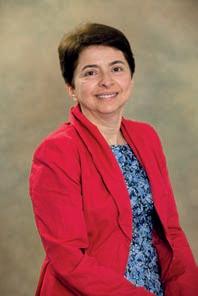
Leila Notash, PhD, P.Eng., FEC
Leila Notash is a professor in the department of mechanical and materials engineering at Queen’s University. She was an assistant professor at the University of Windsor prior to joining Queen’s. Notash grew up in Iran and received her BASc, MASc and PhD degrees in mechanical engineering from the Middle East Technical University, Turkey, University of Toronto and University of Victoria, respectively. Licensed by PEO in 1996, she joined PEO as a member of the Academic Requirements Committee (ARC) in 2003, served as the vice chair and then chair of ARC from 2015 to 2018 and was vice chair of Kingston Chapter from 2015 to 2019. Notash is an associate editor (AE) of the ASME Journal of Mechanisms and Robotics Mechanism and Machine Theory and was an AE of the CSME Transac(1999–2017). She is an elected member of the ASME Mechanisms and Robotics Committee (2016–2024) and has been the symposium/program chair/co-chair of ASME IDETC. She was a member of the CCToMM executive (1998–2004) and International Federation for the Promotion of Mechanism and Machine Science Permanent Commission on Communications (2001–2011) and was the chair of PC from 2006 to 2011. Notash has served on the Queen’s University Senate from 2009 to 2012 and 2013 to 2022. She is committed to equity, diversity and inclusivity and has championed EDI among her students. She has been a member (2009–2011, 2018–2020) and chair (2010–2012) of the Queen’s Senate Educational Equity Committee. She was the Canadian coordinator of an international capstone design project to provide collaborative international experience for undergraduate students (1997–2003). She is honoured to serve on PEO Council and contribute to the profession. leila.notash@queensu.ca

Sandra Ausma, PhD, P.Eng.
Sandra Ausma is retired after 30 years’ work in a variety of sectors, including academic research, consulting engineering and government. Ausma retired from the Ontario Public Service after serving in both the Ministry of Environment and Climate Change Resources and the Ministry of Natural Resources and Forestry. She was an OPS Amethyst Team Award recipient in 2013 for her work and leadership on the development of a national air-quality system. In 2016, her volunteer activities were recognized with an Ontario Women’s Directorate Leading Women Building Communities Award. Ausma holds a BASc in chemical engineering from the University of Waterloo and an MASc in biological engineering and PhD in land resource science (atmospheric science) from the University of Guelph. She was first elected to PEO Council as a Northern Region councillor in 2012 and was appointed vice president in 2013. She is a member of the Ontario Society of Professional Engineers (OSPE) and is a past OSPE director and past chair of the Women in Engineering Advisory Committee. sausma@peo.on.ca
Michael Kwok-Wai Chan, P.Eng., FEC
(see Executive Committee)
Regional councillors

Randy Walker, P.Eng., FEC
Randy Walker received his BEng from Ryerson University and was licensed by PEO in 1996. He started out working in an electrical department at a papermill in Trenton, ON, moved up to IT and plant engineering and then to department manager. In 2010, Walker went into construction and worked on many interesting projects at CFB Trenton and Kingston. His most recent position is automation engineer. Walker has spent 13 years in the chapter system, starting out as webmaster, moving on to chair for seven years and past chair for the previous five years. He is also a webmaster and GLP representative for the Quinte Chapter. Walker enjoys motorcycles, reading and being challenged. He is looking forward to the next few years serving as Eastern Region councillor. rwalker@peo.on.ca

Chantal Chiddle, P.Eng., FEC
Chantal Chiddle holds a civil engineering technology diploma from St. Lawrence College (Kingston) and a BEng degree in civil engineering from Lakehead University (Thunder Bay). She was licensed by PEO in 2005 and is a member of the Ontario Society of Professional Engineers. Chiddle has over 20 years of experience in the water and wastewater industry. Five years were spent working at a smaller consulting engineering firm primarily involved in municipal projects, and over 10 years of experience was gained working for utility companies, including the multi-utility company Utilities Kingston. Chiddle’s practice focus in design and project management for water and wastewater projects prepared her for her current role. In 2015, she moved to the heavy civil construction industry as a field engineer/senior engineer working on infrastructure reconstruction projects. Chiddle has spent 13 years as a volunteer in the PEO chapter system in Kingston as vice chair, chair and past chair. Her service in Kingston includes website admin, communications committee chair, the Scholarship Committee and the Education/Outreach Committee. Chiddle has assisted in organizing chapter events, as well as volunteering at more. She is an avid reader, a world traveller, a former army brat and enjoys listening to live music. She is looking forward to the challenge of giving back to the engineering profession while serving as the Eastern Region councillor and on PEO committees. cchiddle@peo.on.ca
Arthur Sinclair,
P.Eng. (see Executive Committee)

Peter Cushman, P.Eng.
EAST CENTRAL REGION COUNCILLORS
Peter Cushman is a well-recognized professional engineer with two decades of practical experience in private industry. He has contributed to the advancement of the fields of cellular networking, cyber-security and fraud management with creative solutions to complex problems. Cushman is a visionary and passionate individual and a driven entrepreneur who is a proud owner of a green-technology firm. He believes in voluntarism and giving back to Ontario’s society and its engineering community. As a teacher, he has passed on his knowledge, educating the younger generation of engineers and technologists. With his leadership and understanding of governance, Cushman has had a positive impact on the performance of several community-based organizations. He was the vice president of advocacy at the York Region

Parents Association, vice chair of Mohandes (engineers and architects) and vice chair of AlphaPlus (digital technology in adult education). As a member of the board of directors of the Markham Arts Council, he helped serve and enhance our community’s well-being and quality of life. On the board of PEO’s York Chapter, Cushman collaboratively initiated a constructive and structured approach, creating a positive impact on the public and greater engineering community. He has been an active debater on issues facing our profession for two decades. Cushman has gained valuable political experience as part of the core campaign teams of local political parties at all three levels of government. He is committed to contributing his political experience to PEO Council to defend professional self-regulation while preserving the public interest. pcushman@peo.on.ca
NORTHERN REGION COUNCILLORS
Ramesh Subramanian, PhD, P.Eng., FEC
Ramesh Subramanian received his PhD in chemical engineering from the University of New Brunswick, Fredericton in 1994, and completed postdoctoral fellowships at University of New Brunswick, University of Wisconsin-Madison and McMaster University before joining Laurentian University in Sudbury in January 2002. He was the director of the Bharti School of Engineering at Laurentian University (2010–2016), a member of the Council of Ontario Deans of Engineering (including serving as vice chair 2013–2015 and chair 2015–2016) and National Council of Deans of Engineering and Applied Science (including the Deans Liaison Committee 2013–2016). He is a fellow of Engineers Canada with volunteering experience at the Sudbury Chapter (including secretary, vice chair and chair), PEO’s Academic Requirements Committee (member since June 2013 and chair since January 2019), and Canadian Engineering Accreditation Board (higher education institution visits since January 2014 and Ontario member on the board since December 2018). Subramanian, who returned as the director of the Bharti School of Engineering at Laurentian University in July 2019, is committed to the core principles of protecting public safety, engaging PEO membership, modernizing the governance of PEO to remain as a good self-regulator, engaging stakeholders through PEO chapters, advancing PEO’s mission and seeing an increased relevance and value of a P.Eng. licence to the public, engineers and engineering graduates. As a passionate grassroots community-oriented engineering educator and mentor, he would like to see PEO establish successful outreach programs for recruiting and retaining engineers (especially women) and help them seamlessly proceed through the licensure process. rsubramanian@peo.on.ca

Luc Roberge, P.Eng.
Luc Roberge was raised in Verner, a small dairy community located in northeastern Ontario. He received his bachelor of engineering science (mechanical) from Queen’s University in 1985, was registered with PEO in 1988, and has been a member of OSPE since its inception in 2000. Roberge started his career in the pulp and paper industry with MacMillan Bloedel Ltd, went on to work in the lumber industry with Weyerhaeuser and is presently employed by Ontario Power Generation as senior manager, special projects, in the renewable energy sector. Roberge’s participation in the chapter movement started 17 years ago with the Algoma Chapter. He has also been a member of the Kapuskasing-Porcupine Chapter, where he was chair in 2019; and of the North Bay Chapter, where he was chair from 2012 to 2014. During his affiliation with the North Bay Chapter, he represented the Northern Region on the Chapter Leaders Conference Organizing Committee. Roberge was inducted into the PEO Order of Honor at the Member level in 2019. Before his involvement with PEO, he volunteered as a scout leader for four years. He is looking forward to the next few years serving as Northern Region councillor. lroberge@peo.on.ca
WESTERN REGION COUNCILLORS

Wayne Kershaw, P.Eng., FEC
Licensed by PEO in 2005 and a member of OSPE since 2000, Wayne Kershaw is a mechanical engineer with a bachelor of engineering (aerospace) degree from Ryerson University and has been running his own consulting firm, KPa Engineering Services Ltd., for the past three years. He has previously worked as an application engineer with Bosch Rexroth Canada Corp (2004–2016) and has also held positions in product development with Vasogen Inc. and Irvin Aerospace Ltd. Active with PEO’s Niagara Chapter since 2015, Kershaw has been vice chair (2016–2018). Prior to this, he had been active with PEO’s Hamilton-Burlington Chapter since 2001, where he has been vice chair (2006–2007 and 2013), chapter chair (2007–2009 and 2014–2015) and was GLP coordinator for the chapter (2008–2011). He has been a coordinator, mentor and judge for the Hamilton Engineering Challenge (2000–2003), and a mentor and judge for the Halton Engineering Challenge (2000–2010). Kershaw has also previously served as a Western Region councillor (2011–2012) and was a member of OSPE’s Board Nomination Committee in 2009, PEO’s Chapter Leaders Conference Organizing Committee in 2010 and 2011, chaired the Council Composition Task Force in 2018 and has served on several other PEO committees and task forces, including the Enforcement Committee, Legislation Committee, Financial Accountability and Reporting Task Force, Repeal of the Industrial Exception Task Force and Western Regional Congress Committee. Kershaw was also the founder/coordinator of the Western Region Government Liaison Program Academy in 2011. wkershaw@peo.on.ca

Peter Broad, P.Eng., FEC
Peter Broad has two adult children and is married to a retired nurse-midwife. He graduated with honours from Manchester University (UK) in 1969 and, after a brief stint in Australia, opted to engage in metal extraction and environmental issues. He became a chartered engineer in 1975 while in South Africa and has remained a member of the Institute of Materials, Minerals and Mining, as it is now known, ever since. In 1985, he was licensed as a professional engineer in Manitoba and later moved to Ontario, where he joined PEO’s Porcupine Chapter. After several years assisting with the local science fair and other duties, he became chapter chair (2000–2003). In 2004, he moved to London, ON, and in 2006 began working for Wardrop Engineering in Toronto, designing and assessing mineral process plants, both in Canada and overseas, before he transferred to BBA (Engineering) in 2012. He joined the Industrial Exception Repeal Task Force as chair in 2010 and later took over as chair of the Enforcement Committee, where he has continued to serve for the past 10 years, as well as serving briefly on a Professional Standards subcommittee regarding solid waste. Using the now-defunct PEO forum, he reached out to inform fellow members of changes in international technology and helped mentor new immigrants. He was inducted as an Officer in the Order of Honour in 2019. He volunteers with the Royal Canadian Legion and has led various scout troops, including one where a future Ontario’s environmental ombudsman became his assistant. broadph@rogers.com
WEST CENTRAL REGION COUNCILLORS

Warren Turnbull, P.Eng., FEC
Warren Turnbull is a retired executive with over 33 years of engineering and senior sales management experience. He holds a BASc from the University of Waterloo. Turnbull led many multi-disciplinary teams related to instrumentation, product design, maintenance, marketing and sales. Turnbull moved from successful assignments in engineering, customer technical and product development to senior marketing and sales roles at DuPont Canada Inc., Continental Group of Canada Ltd., Fabrene Inc., Flexia Corporation and Intertape Polymer Group. Turnbull was on PEO’s North Bay Chapter board and rose to become chair. For the last five years, he has served as West Central Region councillor and has been on the Joint Relations Committee with OSPE for two years, vice chair and chair of the Chapter Leaders Conference committee, a member of the (CP)2 Task Force, member and chair of the Volunteer Leadership Conference Planning Committee, a member of the Finance Committee and Discipline Committee and chair of the Regional Councillors Committee and Government Liaison Committee. For the previous five years, he held positions on the Oakville Chapter executive, including event coordinator and chair, chapter chair for two years and past chair. Turnbull led implementation of Oakville’s first all-day symposium, “The Future of Energy in Ontario,” which resulted in an ongoing partnership with the Oakville Chamber for future events. The chapter also partnered with local businesses and the town to encourage innovation in Oakville and Halton. Turnbull served on the Glen Abbey Residents Association board and was president for two terms. He chaired the Group Homes Advisory Committee for Oakville. wturnbull@peo.on.ca

Lisa MacCumber, P.Eng., FEC
Lisa MacCumber currently works as a senior engineer at the Ontario Ministry of the Environment, Conservation and Parks. MacCumber has also worked as the team lead in the automotive unit of the advanced manufacturing branch at the Ministry of Economic Development, Training, Research and Employment. Previously, MacCumber worked in the private sector as a project engineer in the automotive industry and rubber industry. She graduated from Queen’s University with a bachelor of applied science, chemical engineering degree. MacCumber is also a member of PEO and OSPE. She has volunteered with PEO at the chapter level in Mississauga and is currently serving on the Complaints, Legislation, Professional Standards, and Regional Councillors committees and as a ministry observer on a PEO Professional Standards subcommittee. MacCumber was also a member of the Women in Engineering Advisory Committee of OSPE for several years. Her other volunteer interests include working with the Westies in Need dog rescue. In her spare time, she enjoys curling in the Engineer’s Curling League, Pilates, gardening, cooking and spoiling her West Highland Terrier, Grady. lmaccumber@peo.on.ca
Appointed councillors
Arjan Arenja, MBA, P.Eng.
(see Executive Committee)

Robert Brunet, P.Eng.
Robert Brunet earned a BESc (1995) and MESc (1999) in chemical and biochemical engineering, both from Western University in London, ON. He is a licensed professional engineer in Ontario. He is registered to practise before the Canadian Intellectual Property Office and is a member of the Intellectual Property Institute of Canada. In the 1990s, Brunet worked in research and development and held senior management positions for a manufacturer of UV disinfection equipment, Trojan Technologies Inc., where he was listed as principal inventor on several US and international patents. He worked for a patent law firm for several years before founding Brunet & Co. in 2006. The firm represents Canadian and international clients ranging in size from SMEs to multinationals. His work currently focuses on intellectual property strategy, IP portfolio management and transaction due diligence. Brunet served as president of Biro Air Energy Inc., a manufacturer of patented wind turbines, from 2008 to 2011, prior to a transaction with a US company. He has served on or consulted with corporate boards in the biotech, renewable energy and water treatment space. rbrunet@peo.on.ca

Todd Bruyere, P.Eng.
Todd Bruyere is a member of the Couchiching First Nation, which is located near the town of Fort Frances in northwestern Ontario. He graduated from the University of Manitoba in 1989 with a bachelor of science degree in civil engineering, specializing in structural design. Shortly thereafter, he began work for Public Works Canada, DIAND Dedicated Unit and acted as a junior and then a senior project manager, working directly for the Department of Indian Affairs Canada. Later, he worked as a tribal council engineer for Matawa First Nations Management in Thunder Bay, ON, and then in the same position for Pwi-di-goo-zing Ne-yaa-zhing Advisory Services, which is a tribal council near Fort Frances, ON. He worked in this position for 17 years, providing engineered designs for both First Nation and non-First Nation communities, until starting his own company, Saulteaux Consulting and Engineering, in 2011. His present job has allowed him to travel to many First Nation communities throughout Ontario and assess the condition of their infrastructure. Bruyere is a member of PEO and a member of the Association of Professional Engineers and Geoscientists of Alberta. He is a founding board member of the Canadian Aboriginal Science and Engineering Association, a former advisory council member of the Native Access Program for Engineering at Lakehead University and a board member of the Rainy River District Festival of the Performing Arts. tbruyere@peo.on.ca
Lorne Cutler, MBA, P.Eng. (see Executive Committee)

Andy Dryland, C.E.T. (no bio provided) adryland@peo.on.ca

Qadira C. Jackson Kouakou, BA, BSW, LLB
Qadira Kouakou is the principal lawyer at Jaxon Law Professional Corporation, practising in the areas of wills, estates, corporate and real estate law. Kouakou holds a bachelor of arts degree in psychology, a bachelor of social work degree and a certificate in dispute resolution from York University and a bachelor of laws degree from the University of Windsor. She articled with the Canadian Union of Public Employees
and was previously a social worker with experience at the Children’s Aid Society, Toronto District Catholic School Board, Woman Abuse Council of Toronto and Wholistic Child and Family Services. Kouakou’s community involvement includes serving as an executive board member with the Canadian Association of Urban Financial Professionals, the Canadian Association of Black Lawyers, Black Pearls Community Services and serving on the Equity Advisory Group and as a community liaison for the Law Society of Ontario. qjackson@peo.on.ca

Iretomiwa Olukiyesi, P.Eng.
Iretomiwa Olukiyesi’s 25 years of experience in mechanical/manufacturing/production/engineering cuts across various industries, such as construction, automobile and consumer goods. She started her career in manufacturing as a pioneer line manager with Procter and Gamble (Nigeria) Limited where she successfully led technical teams through various stages/cycles from initial installation, execution/implementation to support/maintenance. She was promoted to department manager in the production operations of the company for a couple of years, after which she went to work in the supply chain organization where she consolidated eight warehouses into one central warehouse. Afterwards, she spent time in HR as a talent acquisition manager. She spent nine years with the company before she immigrated to Canada. Olukiyesi had a short stint with Daimler Chrysler on a third-party contract as a throughput/efficiency engineer before joining 3M Canada, her current employer, as a senior manufacturing engineer. With 3M Canada, she has worked in various capacities as manufacturing, supply chain supervisor and currently as the lead in outsource manufacturing. Olukiyesi obtained her master’s degree in advanced design, manufacturing and business from the University of Toronto. She is a licensed member of PEO and currently serves as a lieutenant governor–appointed councillor and as the Council liaison for PEO’s Education Committee. Prior to being appointed to serve on Council, she volunteered for seven years with the London Chapter of PEO as government liaison person, government liaison chair, member of the Education Committee, leader of the women in engineering and as the chapter secretary. She is actively involved as a volunteer with various charities in Canada and abroad. She mentors several people in the community and is happily married, blessed with two loving children. tolukiyesi@peo.on.ca

Sherlock Sung
After obtaining a bachelor of applied science degree from the University of Toronto, Sung has held technical positions in both the public and private sectors domestically and internationally across different industries. His employment experiences include research and development, product design, system commissioning, test and validation, quality assurance, technical instruction, operations, infrastructure management, procurement, contract administration, metrology and team supervision. ssung@peo.on.ca
WHAT THE GOVERNMENT LIAISON PROGRAM WANTS MPPs TO KNOW ABOUT PEO’s COMPLAINTS PROCESS
PEO’s Government Liaison Committee, which was created in 2011, has worked hard to train Government Liaison Program (GLP) representatives across the province on the importance of ensuring MPPs understand PEO’s regulatory mandate. PEO’s complaints process is a key part of that regulation. But why should Ontario’s 124 MPPs care about regulated professional processes such as the complaints process?
Across Canada, it has been shown that it is better for the government to work with professions on the regulation of their own sectors. In many American states and other jurisdictions around the world, the regulation of professions is carried out by a government department. But in conversations we have had with senior members of the Ontario government and the premier’s office, we understand that there is an advantage in having professions regulate themselves—there’s no cost to the government, it is more efficient, better for the public and the regulator works directly with its professionals.
MPPs in Ontario should know PEO annually receives a small number of complaints against its engineers compared to other regulated professional bodies. Since the outset of the COVID-19 pandemic, the medical profession has been in the spotlight. Over the years, the legal, teaching and accounting professions have also been subjected to public scrutiny that has called for increased public accountability. Engineers also face scrutiny, as was the case in both the Elliot Lake and Radiohead inquiries. But over the years, PEO has worked hard to defend its jurisdiction.
WHAT OTHER PROFESSIONS ARE DOING
While PEO does not receive as many complaints against its members as other regulators, there is increasing pressure to vigorously improve public accountability for all professions. We examined the complaints process of several different professional regulators, including PEO, to see how we stack up. In 2017:
• PEO had 53 complaints raised against its almost 92,000 members, or 0.06 per cent ( Professional Engineers Ontario Annual Report, 2018).
• The Ontario College of Teachers received over 720 complaints against its 233,700 members, or 0.3 per cent (Ontario College of Teachers Annual Report, 2018).
By Howard Brown
• The College of Physicians and Surgeons of Ontario received over 4276 complaints against its 36,900 physicians, or 11.51 per cent (The College of Physicians and Surgeons of Ontario Annual Report, 2018).
• The Law Society of Ontario received 4200 complaints against its over 53,700 lawyers and 9000 paralegals, or 7 per cent (Law Society of Ontario Annual Report, 2018).
• Ontario Association of Architects received 75 complaints against its roughly 4250 architects, or 1.76 per cent (Ontario Association of Architects Annual Report, 2018).
• College of Nurses Ontario saw its complaints go up by 50 per cent to nearly 2100 out of over 182,200 registered practitioner nurses and nurse practitioners, or 1.14 per cent (College of Nurses of Ontario Annual Report, 2018).
In an effort to improve its complaints process, PEO can also look at other professions and observe what they are doing. For example:
• In 2018, the Law Society of Ontario’s Professional Regulation “continued to pursue its goal of more robust triaging and increased resolution of complaints earlier in the process” (annualreport.lso.ca/pdf/AnnualReport2018-EN.pdf).
• The College of Physicians and Surgeons of Ontario issued more than 1000 cautions against practising doctors between 2007 and 2013. In 2016, the Ministry of Health commissioned a report recommending a more streamlined complaints process. Following this, the college improved its complaints procedure, including a new alternative dispute process (see cpso.on.ca/Public/Services/ Complaints).
• The Ontario College of Teachers is a relatively new body, formed in 1997. Its complaints process has benefited from emulating other professions, as opposed to the College of Physicians and Surgeons, which was formed in 1866 (oct.ca/members/complaintsand-discipline/complaints-process).
• The Ontario Association of Architects is both a regulator and an association.
• The College of Nurses of Ontario has had full use of the Health Professions Appeal and Review Board, along with an alternative dispute resolution, in place since 1995.
“We have to be vigilant in making sure the trust the government and the public has placed in PEO remains our priority,” says Jeannette Chau, P.Eng., PEO manager of Government Liaison Programs. There is always more work to be done in ensuring PEO, and all regulators, remain vigilant in its complaints process. e
Howard Brown is the president of Brown & Cohen Communications & Public Affairs Inc. and PEO’s government relations consultant.
2021 COUNCIL ELECTIONS CALL FOR CANDIDATES
All PEO members are invited to become candidates for the positions of president-elect, vice president, councillor-at-large and regional councillor (one for each of PEO’s five regions) on PEO Council.
1. Any member may be nominated for election to Council as president-elect, vice president or councillor-at-large, by at least 15 other members. The nomination must include at least one member resident in each region. [Regulation 941/90, s. 14(1)]
(a) The position of president-elect is for a one-year term, after which the incumbent will serve a one-year term as president and a one-year term as past president.
(b) The position of vice president is for a one-year term.
(c) The councillor-at-large position is for a two-year term. One councillor-at-large is to be elected in 2021.
2. Any member residing in a region may be nominated for election to Council as a regional councillor for that region by at least 15 other members who reside in the region. [Regulation 941/90, s. 14(2) and s. 15.1(2)]
(a) The position of regional councillor is for a two-year term. A member nominated for election to Council must complete a nomination acceptance form that states he or she is a Canadian citizen or has the status of a permanent resident of Canada and is a resident in Ontario [section 3(3) of the Professional Engineers Act] and consents to the nomination [Regulation 941/90, s. 15]. Nomination petitions for collection of nominators’ signatures and nomination acceptance forms may be obtained from the PEO website at www.peo.on.ca, or Ralph Martin, PEO, 40 Sheppard Avenue West, Suite 101, Toronto ON M2N 6K9. Email: rmartin@peo.on.ca; Tel: 416-840-1115; 800-339-3716, ext. 1115.
Completed nomination petitions and nomination acceptance forms are to be sent only electronically and only to the chief elections officer at elections@peo.on.ca, by 4 p.m., November 27, 2020. No personal delivery of forms will be accepted. For further information on becoming a candidate, please refer to the 2021 Council Elections Guide posted on PEO’s website.
2021 VOTING PROCEDURES
The 2021 voting and election publicity procedures were approved by the Council of PEO in June 2020. Candidates are responsible for familiarizing themselves with these procedures. Any deviation could result in a nomination being considered invalid. Candidates are urged to submit nominations and election material well in advance of published deadlines so that irregularities may be corrected before the established deadlines. Nominees’ names are made available as received; all other election material is considered confidential until published by PEO.
1. The schedule for the elections to the 2021–2022 Council is as follows:
Date nominations open October 19, 2020
Date nominations close 4 p.m., November 27, 2020
Date PEO’s membership roster will be closed for the purposes of members eligible to automatically receive election material1 January 8, 2021
Date a list of candidates and voting instructions will be sent to members no later than January 11, 2021
Date voting will commence on the date that the voting packages are sent to members, no later than January 15, 2021
Date voting closes 4 p.m., February 19, 2021
All times noted in these procedures are Eastern Time.
1Members licensed after this date may call in and request that election information be mailed to them by regular mail or, upon prior written consent by the member for use of his/her email address, via email or via telephone.
2. Candidates’ names will be listed in alphabetical sequence by position on the list of candidates sent to members and on PEO’s website. However, the order of their names will be randomized when voters sign in to the voting site to vote.
3. A person may be nominated for only one position.
4. Nomination papers are to be submitted only by email (elections@peo.on.ca) for tracking purposes. Forms will not be accepted in any other format (e.g. fax, personal delivery, courier, regular mail).
5. Only nomination acceptance and nomination forms completed in all respects, without amendment in any way whatsoever, will be accepted.
6. Signatures on nomination forms can be hand signed or electronic.
7. Signatures on nomination papers do not serve as confirmation that a member is formally endorsing a candidate.
8. Candidates will be advised when a member of the Central Election and Search Committee has declared a conflict of interest should an issue arise that requires the consideration of the committee.
9. An independent agency has been appointed by Council to receive, control, process and report on all cast ballots. This “official elections agent” will be identified to the members with the voting material.
10. If the official elections agent is notified that an elector has not received a complete election information package, the official elections agent shall verify the identity of the elector and may either provide a complete duplicate election information package to the elector, which is to be marked “duplicate,” by regular mail or email or provide the voter’s unique control number to the voter and offer assistance via telephone. In order to receive such information via email, the elector must provide prior written consent to the use of his or her email address for this purpose.
11. Council has appointed a Central Election and Search Committee to:
• encourage members to seek nomination for election to the Council as president-elect, vice president or a councillor-at-large;
• assist the chief elections officer as may be required by him or her;
• receive and respond to complaints regarding the procedures for nominating, electing and voting for members to the Council;
• conduct an annual review of the elections process and report to the June 2021 Council meeting.
12. Council has appointed a Regional Election and Search Committee for each region to:
• encourage members residing in each region to seek nomination for election to the Council as a regional councillor.
13. Candidates for PEO Council may submit expense claims. The travel allowance to enable candidates to travel to chapter events during the period from the close of nominations to the close of voting will be based on the distance between chapters and the number of chapters in each region. Such travel expenses are reimbursed only in accordance with PEO’s expense policy.
14. Council has appointed an independent chief elections officer to oversee the election process and to ensure that the nomination, election and voting are conducted in accordance with the procedures approved by Council.
15. The chief elections officer will be available to answer questions and complaints regarding the procedures for nominating, electing and voting for members to the Council. Any such complaints or matters that the chief elections officer cannot resolve will be forwarded by the chief elections officer to the Central Election and Search Committee for final resolution. Staff is explicitly
prohibited from handling and resolving complaints and questions, other than for administrative purposes (e.g. forwarding a received complaint or question to the chief elections officer).
16. On or before the close of nominations on November 27, 2020, the president will appoint three members or councillors who are not running in the election as returning officers to:
• approve the final count of ballots;
• make any investigation and inquiry as they consider necessary or desirable for the purpose of ensuring the integrity of the counting of the vote and report the results of the vote to the CEO/registrar no later than March 10, 2021.
17. Returning officers shall receive a per diem of $250 plus reasonable expenses to exercise the duties outlined above.
18. Nomination papers are to be submitted only by email for tracking purposes. Forms will not be accepted by any other format (e.g. personal delivery, courier, fax or regular mail). Candidates should allow sufficient time for their emails to go through the system to ensure that the completed papers are, in fact, received by the chief elections officer by 4 p.m. on November 27, 2020. In the event of a dispute as to when the forms were sent vs received, a candidate can provide the chief elections officer with a copy of his or her email to PEO that would indicate the time the nomination forms were sent from his/her computer. A nomination, once withdrawn, may not be re-instated.
19. If a candidate withdraws his or her nomination for election to PEO Council prior to the preparation of the voting site, the chief elections officer shall not place the candidate’s name on the voting site of the official elections agent or on the list of candidates sent to members and shall communicate to members that the candidate has withdrawn from the election. If the candidate withdraws from the election after the electronic voting site has been prepared, the chief elections officer will instruct the official elections agent to adjust the voting site to reflect the candidate’s withdrawal.
20. In the event a candidate changes his or her mind on a position and decides to run for a different position after submitting nomination forms, a newly completed nomination petition form, in addition to a new acceptance form, will be required.
21. In the event a chapter holds an All Candidates Meeting, the chapter must invite to the meeting all candidates for whom voters in that region are eligible to vote.
22. Voting will be by electronic means only (internet and telephone). Voting by electronic means will be open at the same time the electronic election packages are sent out.
23. All voting instructions, a list of candidates and their election publicity material will be sent to members. All voters will be provided with detailed voting
instructions on how to vote electronically. Control numbers or other access control systems will be sent to members by email after the election package has been sent out. The official elections agent will send out an eblast with the control numbers (PINs) every Monday during the election period. Election material sent to members electronically or by mail will contain information related to the All Candidates Meetings.
24. Verification of eligibility, validity or entitlement of all votes received will be required by the official elections agent. Verification by the official elections agent will be by unique control number to be provided to voters with detailed instructions on how to vote by internet and by telephone.
25. The official elections agent shall keep a running total of the electronic ballot count and shall report the unofficial results to the chief elections officer, who will provide the candidates with the unofficial results as soon as practically possible.
26. Voters need not vote in each category to make the vote valid.
27. There shall be an automatic recount of the ballots for a given candidate category for election to Council or bylaw confirmation where the vote total on any candidate category for election to Council between the candidate receiving the highest number of votes cast and the candidate receiving the next highest number of votes cast is 25 votes or less for that candidate category or where the votes cast between confirming the bylaw and rejecting the bylaw is 25 votes or less.
28. Reporting of the final vote counts, including ballots cast for candidates that may have withdrawn their candidacy after the opening of voting to PEO, will be done by the returning officers to the CEO/registrar, who will advise the candidates and Council in writing at the earliest opportunity.
29. Certification of all data will be done by the official elections agent.
30. The official elections agent shall not disclose individual voter preferences.
31. Upon the direction of the Council following receipt of the election results, the official elections agent will be instructed to remove the electronic voting sites from its records.
32. Election envelopes that are returned to PEO as undeliverable are to remain unopened and stored in a locked cabinet in the Document Management Centre (DMC) without
contacting the member until such time as the election results are finalized and no longer in dispute.
33. Elections staff shall respond to any requests for new packages as usual (i.e. if the member advises that he/she has moved and has not received a package, the member is to be directed to the appropriate section on the PEO website where the member may update his/her information with DMC).
34. DMC staff shall advise elections staff when the member information has been updated; only then shall the elections staff request the official elections agent to issue a replacement package with the same control number.
35. Elections staff are not to have access to, or control of, returned envelopes.
36. After the election results are finalized and no longer in dispute, the chief elections officer shall authorize the DMC to unlock the cabinet containing the unopened returned ballot envelopes so that it may contact members in an effort to obtain current information.
37. After the DMC has determined that it has contacted as many members whose envelopes were returned as possible to obtain current information or determine that no further action can be taken to obtain this information, it shall notify the elections staff accordingly and destroy the returned elections envelopes.
38. PEO will post total votes cast in the election on the PEO website on each Friday of the voting period and will post final vote totals by candidate after voting has closed. No other information related to vote totals will be made available.
39. Nothing in the foregoing will prevent additions and/or modifications to procedures for a particular election if approved by Council.
40. The All Candidate Meetings will take place the week of January 4, 2021.
41. All questions from, and replies to, candidates are to be addressed to the chief elections officer:
By email: elections@peo.on.ca
By letter mail: Chief elections officer c/o Professional Engineers Ontario 101–40 Sheppard Avenue West Toronto, ON M2N 6K9
The Election Publicity Procedures form part of these Voting Procedures.
2021 ELECTION PUBLICITY PROCEDURES
IMPORTANT DATES TO REMEMBER
Deadline for receipt of publicity materials for publication in Engineering Dimensions and on the PEO website, including URLs to candidates’ own websites
Deadline for submission of candidate material to eblast to members
Dates of eblasts to members
4 p.m., December 11, 2020
Date of posting period
Dates of voting period
1. January 11, 2021—1st eblast
2. January 25, 2021—2nd eblast
3. February 8, 2021—3rd eblast
1. January 18, 2021
2. February 1, 2021
3. February 16, 2021
January 15, 2021, to February 19, 2021
12 p.m., January 15, 2021, to 4 p.m., February 19, 2021
Note: All times indicated in these procedures are Eastern Time.
1. Names of nominated candidates will be published on PEO’s website as soon as their nomination is verified.
2. Names of all nominated candidates will be forwarded to members of Council, chapter chairs and committee chairs and published on PEO’s website by November 30, 2020.
3. Should a candidate wish to withdraw from the election, their name will remain on the website and the word “withdrawn” will appear beside their name on the PEO website.
4. Candidates will have complete control over the content of all their campaign material, including material for publication in Engineering Dimensions, on their additional material on PEO’s website and on their own websites.
5. Candidate material is readily available to the public and should be in keeping with the dignity of the profession at all times. Material will be published with a disclaimer. The chief elections officer may seek a legal opinion prior to publishing/posting of any material if the chief elections officer believes campaign material could be deemed libelous. The chief elections officer has the authority to reject the campaign material if so advised by legal counsel.
6. Candidate material may contain personal endorsements provided there is a clear disclaimer indicating that the endorsements are personal and do not reflect or represent the endorsement of PEO Council, a PEO chapter or committee or any organization with which an individual providing an endorsement is affiliated.
7. Candidate material for publication in Engineering Dimensions and any additional material they wish to publish on the website, including URLs to candidates’ own websites, must be forwarded to the chief elections officer via email at elections@peo.on.ca no later than 4 p.m. on December 11, 2020, and must be in accordance with these procedures and Schedule A attached.
8. Candidates have the option of using one of two templates to present their election material in Engineering Dimensions. Both templates are included in Schedule A of these procedures. The size of both templates is the equivalent of one-half page, including border, in Engineering Dimensions
a. Option 1: Candidates using the blank template will have discretion over the presentation of their material, including but not limited to font style, size and effects. Candidates using the blank template will be permitted to include their portrait within the template.
b. Option 2: Candidates using the fillable template must provide responses to the questions provided in the allotted space. The presentation of the fillable template is fixed and no modifications will be permitted. Candidates using the fillable template must submit their portrait separately for insertion into the designated location by PEO staff.
9. Candidates shall not use the PEO logo in their election material.
10. Candidates may include links to PEO publications but not a URL link to a third party in their material on PEO’s website. Links to PEO publications are not considered to be to a third party. For clarity, besides links to PEO publications, the only URL link that may be included in a candidate’s material on PEO’s website is a URL link to the candidate’s own website.
11. If campaign material is submitted by a candidate without identifying information, PEO staff are authorized to contact the candidate and ask if he or she wishes to resubmit material. If campaign material is received by the chief elections officer and returned to the candidate for amendment to comply with the Election Publicity Procedures, and the amended material is not returned within the prescribed time, staff will publish the material with a notation explaining any necessary amendments by staff.
12. The chief elections officer is responsible for ensuring that all candidate material (whether for Engineering Dimensions, PEO’s website or eblasts) complies with these procedures. Where it is deemed the material does not satisfy these procedures, the chief elections officer will, within three full business days from receipt of the material by the chief elections officer, notify the candidate (or an appointed alternate), who is expected to be available during this period by telephone or email. The candidate (or appointed alternate) will have a
further three full business days to advise the chief elections officer of the amendment. Candidates are responsible for meeting this deadline. Should a candidate fail to re-submit material within the three-business-day period, the candidate’s material will be published with a notation explaining any necessary amendments by staff.
13. Candidate publicity material will be published as a separate insert in the January/February 2021 issue of Engineering Dimensions and to PEO’s website in January 2021 and included in any hardcopy mailing to eligible voters with voting instructions. Links to candidate material on PEO’s website will be included in any electronic mailing to eligible voters. The chief elections officer can direct staff to activate links in eblast messages, that have not been linked by the candidate, such as links to the candidate’s own website or email address.
14. Candidate material will be considered confidential and will be restricted to staff members required to arrange for publication until published on PEO’s website. All candidates’ material will be published to PEO’s website at the same time.
15. Candidates may submit updates to their material on PEO’s website once during the posting period. Any amendments to a candidate’s name/designations are to be considered part of the one-time update permitted to their material during the posting period.
16. Candidates may post more comprehensive material on their own websites, which will be linked from PEO’s website during the posting period. Candidates may include active links to their social media accounts (Facebook, Twitter, LinkedIn, etc.) in material appearing in Engineering Dimensions, published on PEO’s election site (i.e. the 1000-word additional information candidates may submit) or included in an eblast of candidate material.
17. PEO will provide three group email distributions to members of candidate publicity material beyond the material published in Engineering Dimensions. Material to be included in an eblast must be submitted to the chief elections officer at elections@peo.on.ca in accordance with Schedule A. In the event of a dispute as to when the material was sent vs received, the material will be accepted only if a candidate can provide the chief elections officer with a copy of his or her email to PEO sent from his or her computer indicating a sent time before the deadline.
18. All material for the eblast messages must be submitted in a Word document only and must
not be included as part of the message in the transmission email. Where the email message is received in a font size or style that is different from the specifications but otherwise meets all the requirements, the chief elections officer may authorize staff to change only the size and font of the material so it conforms to specifications. Staff are prohibited from amending material in any way except with the written permission of the candidate.
19. Candidates are responsible for responding to replies or questions generated by their email message.
20. The chief elections officer is responsible for ensuring that all candidate material (whether for Engineering Dimensions, PEO’s website or eblasts) complies with these procedures. Where it is deemed the material does not satisfy these procedures, the chief elections officer will, within three full business days from receipt of the material by the association, notify the candidate or an appointed alternate, who is expected to be available during this period by telephone or email. The candidate or appointed alternate will have a further three full business days to advise the chief elections officer of the amendment. Candidates are responsible for meeting this deadline. Should a candidate fail to re-submit material within the three-business-day period, the candidate’s material will be published with a notation explaining any necessary amendments by staff.
21. PEO will provide candidates the opportunity to participate in All Candidate Meetings, which will be held at PEO offices during the week of January 6, 2021. The All Candidate Meetings will be video recorded for posting on PEO’s website. On the day of the first All Candidates Meeting, an eblast will be sent to members announcing that these video recordings will be posted on the PEO website within two business days.
22. Candidate materials from previous elections will remain on PEO’s database as part of the record of the election.
23. Caution is to be exercised in determining the content of issues of membership publications published during the voting period, including chapter newsletters. Editors are to ensure that no candidate is given additional publicity or opportunities to express viewpoints in issues of membership publications distributed during the voting period from January 17, 2021, until the close of voting on February 21, 2021, beyond his/her candidate material published in the January/
February issue of Engineering Dimensions , and on the PEO website. This includes photos (with or without captions), references to, or quotes or commentary by, candidates in articles, letters to the editor and opinion pieces. PEO’s communications vehicles should be, and should be seen to be, nonpartisan. The above does not prevent a PEO publication from including photos of candidates taken during normal PEO activities (e.g. licensing ceremonies, school activities, GLP events, etc.) provided there is no expression of viewpoints. For greater clarity, no election-specific or election-related articles, including Letters to the Editor and President’s Message, are to be included in Engineering Dimensions during the voting period. Engineering Dimensions or other PEO publications may contain articles on why voting is important.
opinion pieces. PEO’s communications vehicles should be, and should be seen to be, nonpartisan. The above does not prevent a PEO publication from including photos of candidates taken during normal PEO activities (e.g. licensing ceremonies, school activities, GLP events, etc.) provided there is no expression of viewpoints. For greater clarity, no election-specific or election-related articles, including Letters to the Editor and President’s Message, are to be included in Engineering Dimensions during the voting period. Engineering Dimensions or other PEO publications may contain articles on why voting is important.
24. Chapters may not endorse candidates, or expressly not endorse candidates, in print, on their websites or through their list servers or at their membership meetings or activities during the voting period. Where published material does not comply with these procedures, the chief elections officer will cause the offending material to be removed if agreement cannot be reached with the chapter within the time available.
24. Chapters may not endorse candidates, or expressly not endorse candidates, in print, on their websites or through their list servers, or at their membership meetings or activities during the voting period.
PEO FEES HAVE CHANGED AS OF MAY 1, 2019.
25. Councillors may use their positions to encourage candidates to stand for PEO office and members to participate in the election process but may not endorse candidates for PEO election.
procedures, the chief elections officer will cause the offending material to be removed if agreement cannot be reached with the chapter within the time available.
25. Councillors may use their positions to encourage candidates to stand for PEO office and members to participate in the election process but may not endorse candidates for PEO election.
26. Candidates may attend chapter annual general meetings and network during the informal portion of the meeting. Candidates are permitted to attend chapter functions in their current official capacity but are prohibited from campaigning while operating in their official capacity.
26. Candidates may attend chapter annual general meetings and network during the informal portion of the meeting. Candidates are permitted to attend chapter functions in their current official capacity but are prohibited from campaigning while operating in their official capacity.
27. The Central Election and Search Committee is authorized to interpret the voting and election publicity guidelines and procedures and to rule on candidates’ questions and concerns relating to them.
These Election Publicity Procedures form part of the Voting Procedures.
27. The Central Election and Search Committee is authorized to interpret the voting and election publicity guidelines and procedures and to rule on candidates’ questions and concerns relating to them.
These Election Publicity Procedures form part of the Voting

DID YOU KNOW?
The increase includes fees related to P.Eng. licences, certificates of authorization, consulting engineer designations, seals and engineering intern membership. Changes have also been made to our Financial Credit Program. Find further details, including the updated fee schedule, on our website at www.peo.on.ca.
SCHEDULE A: 2021 ELECTION PUBLICITY PROCEDURES SPECIFICATIONS FOR CANDIDATE MATERIALS
FORMAT FOR CANDIDATE STATEMENTS IN ENGINEERING DIMENSIONS
All submissions will be published with a border. If submissions are received without a border, one will be added as shown on the templates. If submissions do not fit within the chosen template, they will be mechanically reduced to fit.
Option 1: Blank template
Candidates using the blank template to present their material for publication in Engineering Dimensions must ensure the content fits in the bordered template provided at the end of these specifications. The template dimensions are 6.531 inches wide and 4.125 inches in height.
All material for publication must be submitted as a PDF document, with images in place for reference, and in Word format only, showing where images are to be placed. No other formats will be accepted.
Portraits must also be submitted as specified in the next section.
The publications staff needs both a PDF file and Word file of candidate material so they will know how candidates intend their material to look. If there are no difficulties with the material, the PDF file will be used. The Word file is required in case something isn’t correct with the submission (just a bit off on measurement, for example), as it will enable publications staff to fix the problem, if possible. A hard and/or digital copy of a candidate’s portrait is required for the same reason and for use on the PEO election website.
Option 2: Fillable template
Candidates using the fillable template must provide responses to the questions provided in the allotted space. The completed template must be submitted as a PDF document.
Portraits must be submitted separately, as specified in the portraits section below, and will be added to the template by PEO staff.
The presentation of the fillable template is fixed and no modifications will be permitted.
The profile template will be available on PEO’s elections website, www.peovote.ca
A hard and/or digital copy of a candidate’s portrait is also required for use on the PEO Elections website.
PORTRAITS/PHOTOGRAPHS
Photographs must be at least 5" x 7" in size if submitted in hard copy form so that they are suitable for scanning (“snapshots” or passport photographs are not suitable).
Only pictures taken in the last five years will be accepted. If submitted in digital form, photographs must be JPEG-format files of at least 300 KB but no more than 2 MB.
Candidates can submit a digital photo at the specifications noted, or hard copy as noted, and preferably both. In case the digital file is corrupted or not saved at a sufficiently high resolution, publications staff can rescan the photo (hard copy) to ensure it prints correctly, as indicated on the PDF.
PEO WEBSITE (CANDIDATES’ ADDITIONAL INFORMATION)
Candidates may publish additional information on PEO’s website by submitting a Word or Wordcompatible file of no more than 1000 words, and no more than three non-animated graphics in JPEG or GIF format. Graphics may not contain embedded material.
Candidates may post additional material on their own websites, which will be linked from PEO’s website. URLs for candidates’ websites must be active by December 9, 2020.
Candidates may include links to PEO publications but not a URL link to a third party in their material that is to be posted on PEO’s website. Links to PEO publications are not considered to be to a third party. For clarity, the only URL link that may be included in a candidate’s material on PEO’s website is the URL to the candidate’s own website. Candidates may include active links to their social media accounts (Facebook, Twitter, LinkedIn, etc.)
EBLAST MATERIAL
Candidates are permitted a maximum of 300 words for email messages. Messages are to be provided in 11 pt. Arial font; graphics are not permitted. For clarity, a “graphic” is an image that is either drawn or captured by a camera.
HELP
Candidates should contact the chief elections officer (elections@peo.on.ca) if they have questions about requirements for publicity materials.
Option 1: Blank template
Option 2: Fillable template
Name:
Employer and position:
Degree(s), school(s) attended, year(s) of graduation:
Employment history:
Participation on PEO Council, committee/task forces, chapters:
Candidate statement:
Other professional affiliations and community service:
Years of registration in Ontario:
2021 Maximum Council Election Allowance (regional councillors) = Base travel allowance + Regional travel allowance
For Councillor-at-Large,
COUNCIL APPROVES PUBLICATION OF TWO UPDATED PRACTICE GUIDELINES
By Nicole Axworthy
535TH MEETING, JUNE 19, 2020
At its June meeting—which was conducted online via meeting platform Zoom—Council approved the publication of two new practice guidelines, as presented at the meeting. The first, Providing Reports on Mineral Projects, defines best practices for practitioners who provide reports on mineral projects in consideration of the Professional Engineers Act At its meeting on November 18, 2016, Council had instructed the Professional Standards Committee (PSC) to revise the existing guideline Professional Engineers Providing Reports on Mineral Properties. In April and May 2019, the draft document of the new guideline was posted on PEO’s website for member and stakeholder consultation. Stakeholders such as the Canadian Institute of Mining, Metallurgy and Petroleum; Consulting Engineers of Ontario; Engineers Canada; Geoscientists Canada; Ontario Securities Commission; Ontario Society of Professional Engineers; and Professional Geoscientists Ontario were directly invited to the public consultation. The draft guideline was revised where warranted based on recommendations received, and it was approved by the PSC in May 2020.
The second guideline approved by Council, Environmental Site Assessment, Remediation and Management, highlights the professional and ethical responsibilities of professional engineers providing environmental site assessments, site remediation and environmental risk assessment and management services. It aims to provide a benchmark to evaluate the level of professional practice and quality of work required of a professional engineer practising in the field. At the same November 18, 2016, meeting, Council had instructed the PSC to revise the existing related guideline. A draft document was posted on PEO’s website from September to November 2019 for consultation and stakeholders such as the Ministry of the Environment, Conservation and Parks; Ministry of Transportation; Professional Geoscientists Ontario; City of Toronto; City of Vaughan; Ontario Society of Professional Engineers; Consulting Engineers of Ontario; and Engineers Canada were directly invited to the public consultation. The draft guideline was revised where warranted based on recommendations received and it was approved by the PSC in May 2020.
PEO’s manager, standards and practice, José Vera, P.Eng., MEPP, will collaborate with the regulator’s communications department to prepare the guidelines for publication, include a practice-
related article in Engineering Dimensions and post notices on PEO’s website to notify members of the new guidelines.
As part of the motion, the PSC subcommittees that were formed to prepare the specific guidelines were stood down by Council.
ELECTION MATTERS
At its June meeting, Council had a full discussion regarding the 2021 Council election procedures and proceeded to approve all documents related to the upcoming election, including the 2021 voting procedures, election publicity procedures, nomination form and nomination acceptance forms for the positions of president-elect, vice president, councillor-at-large and regional councillor. As part of the motion, Council also approved the recommendations contained in the 2020 Central Election and Search Committee Issues Report—as presented at the meeting and incorporated into the voting and election procedures and 2021 Council Elections Guide—which included suggestions such as clarifying the nomination requirements for the three at-large positions in the election and requiring the completion of mandatory volunteer training for all candidates.
Additionally, Council appointed new members from each region as chairs of the Regional Election and Search Committee for their regions: Luc Roberge, P.Eng., FEC, Chantal Chiddle, P.Eng., FEC, Peter Cushman, P.Eng., Peter Broad, P.Eng., FEC, and Lisa MacCumber P.Eng., FEC.
BYLAW CHANGE
Council approved a motion to amend By-Law No. 1 to streamline the process for holding electronic meetings of Council and any Council committees for which electronic meetings are legally permitted. The approved bylaw amendment replaces the current wording of section 26 with new wording that gives committee chairs the flexibility to hold a virtual meeting in lieu of an in-person meeting where circumstances warrant; using discretion appropriately; and taking all relevant considerations, including committee members’ preferences, into account.
Earlier this year, when the COVID-19 pandemic prohibited inperson gatherings, it became apparent that PEO’s process for substituting electronic meetings for in-person ones was somewhat cumbersome. As previously worded, section 26 of By-Law No. 1 required a majority of members of Council and of Council committees to consent to an electronic meeting before the meeting was held. There was, however, no mechanism for obtaining consent in advance of a meeting, although polling members to confirm consent had been used in recent meetings. In addition, the existing bylaw provision seemed to discourage electronic meetings.
In recent months, PEO has acquired technology that enables votes to be cast and tabulated as if a meeting were taking place in person, and Council has adopted Rules of Engagement for Virtual meetings.
The approved bylaw amendment will be published and communicated to the chairs of committees and staff committee advisors for implementation as needed. e


Poor voter turnout reflects relevancy of Council
I read with interest the recent election results for Council in the May/ June 2020 issue of Engineering Dimensions (“Christian Bellini wins 2021–2022 presidential term,” p. 9) . It was reported that 10.5 per cent of PEO membership voted. By any measure, this poor turnout demonstrates the failure of Council to be relevant to the membership. It is time to look at the evidence and make changes. How can we, as engineers, expect the public to value what we do if we do not even value our own elected representatives?
Are engineers just spear carriers for corporate clients?
I am a retired geotechnical/geological engineer from the federal government. I have spent 20 years as an engineer-in-residence at local elementary schools teaching about the engineering profession and challenging young students to work in teams on simple engineering challenges/projects. I had several opportunities to explain the moral and ethical foundation of the engineering profession in observing the teams’ interactions and the significance of the iron ring symbol that we wear (the Ritual of the Calling of an Engineer).
To quote the Hon. Paul R. Bélanger from the Executive Summary of his Report of the Elliot Lake Commission of Inquiry (2014) on the collapse of the Algo Centre Mall roof/parking deck:
“Some engineers forgot the moral and ethical foundation of their vocation and profession—to hold paramount the safety, health and welfare of the public. They occasionally pandered more to their clients’ sensitivity than to their professional obligation to explore the logical scientific consequences of their obligations.”
When I was an engineering student at Queen’s University, I remember an article in the arts faculty newspaper calling engineers “the spear carriers for the whore of Babylon.” I was appalled by the epithet and hoped the oaths we made at the iron ring ceremony at graduation (and the ring we wear on our writing hand) would remind us in the future of our moral and ethical obligations to society and to the profession.
Recently, I have been involved in studying and opposing a waste disposal project that potentially would pose a threat to the environment and the health and safety of the public living near the waste disposal site. When our community group provided expert scientific evidence to question the safe conditions of the site, the Ontario Ministry of the Environment, Conservation and Parks left it up to the proponent’s engineering consultants to respond to these safety concerns. The consultants, instead of refuting the scientific evidence, decided to write a report slandering and attempting to discredit the scientist involved. That was acceptable to the provincial regulator.
We asked for the Ontario Ministry of the Attorney General Environmental Review Tribunal to have the experts from both sides explain and argue their scientific conclusions but were refused.
Do people have to die as in Elliot Lake or Walkerton before we expose the corrupt practices that are the extension of the lack of morality and ethics in our profession?
Slandering and discrediting another expert in a public report without impunity should not be okay. It should not be accepted in our profession. This is the very essence of morality and ethics. This behaviour should be exposed, otherwise we are what we were called all those years ago: just spear carriers for corporate clients.
Thomas Henry William Baker, P.Eng., Russell, ON
Marco Parmegiani, P.Eng., Richmond Hill, ON
No place for anti-women viewpoint
Laura Goetz, EIT, Belleville, ON
I am writing in response to a letter that was published in the latest edition of Engineering Dimensions, titled “Promoting gender parity” (May/June 2020, p. 53). For context, I am a female EIT in the civil engineering sector. I am currently pursuing a master’s degree and have two years of work experience at a civil engineering consulting firm in Ontario.
Reading this letter brought me great frustration. I am frustrated because the viewpoint expressed by Vince Janzen, P.Eng., does not need space in a magazine; this viewpoint has enough coverage already. Women in this industry are constantly reminded that we are the minority. By publishing this letter, the viewpoint that “men and women are equal but not the same” is validated. What does this even mean? He goes on to say that some jobs are female dominated and
some are male dominated. Are we just supposed to accept that? As a woman who has been successful in this male-dominated industry thus far in my career, should I now give up and go to a profession that is female dominated? Is this the point of view you want to promote in the magazine? I know that it is not. We need to know that the people in charge are working towards inclusion and are not okay with the status quo. We need to know they support women and want to see them succeed in this industry.
I have been involved with and volunteered for programs to help young women become more interested in STEM fields (Go ENG Girl and Women in Science in Engineering), and while I agree they are great ways to encourage young women to consider engineering and STEM-related fields, I don’t think they’re enough. The 30 by 30 initiative is a great way to ensure that we are constantly working to support “increased participation and retention of engineers who are women.” In my opinion, this isn’t really a “hard target,” as Janzen states in his letter. Yes, the target is 30 per cent, but it’s not as though we will be licensing those who are not qualified. Is the author of this letter really upset that three out of 10 of his coworkers may be women? This is an outdated viewpoint that I am frankly just tired of hearing.
Writing this type of letter is not something I would typically do, but I hope it will make a difference in what you choose to include (or not include) in your publication, which lots of young people (both men and women) read and may be influenced by.
Reprinted flowery ‘90s “women in engineering” cover is offensive
Dale D. Kerr, P.Eng., Sutton West, ON
Just reading the latest edition and the article about the history of Engineering Dimensions (“Four decades of Engineering Dimensions,” May/June 2020, p. 24). Years ago, I complained about the cover of a particular issue (September/October 1995), and I find it has been reproduced in this retrospective. I found it offensive that an issue with a focus on women in engineering would have a flower on the cover, implying some sort of softness in women engineers. Why wasn’t an engineering background used, like a building under construction or an industrial setting? I am disappointed that this cover has been reprinted in the magazine.
LETTERS TO THE EDITOR are welcomed, but must be kept to no more than 500 words, and are subject to editing for length, clarity and style. Publication is at the editor’s discretion; unsigned letters will not be published. The ideas expressed do not necessarily reflect the opinions and policies of the association, nor does the association assume responsibility for the opinions expressed. Emailed letters should be sent with “Letter to the editor” in the subject line. All letters pertaining to a current PEO issue are also forwarded to the appropriate committee for information. Address letters to editor@peo.on.ca.
30 by 30 gives us a framework to implement change
Samantha Dutcyvich, EIT, Fernie, BC
I am writing in response to a letter published in the latest edition of Engineering Dimensions titled “Promoting gender parity” (May/June 2020, p. 53). I have read that letter 30 times now, both to myself and the people in my life. I have debated whether or not to send this letter, because I was worried about the potential professional repercussions of having to sign my name.
I am a young female engineering intern (EIT). In fact, this year I am due to get my professional designation after four years of being a registered EIT. I work as an engineering intern in industry—think construction, forestry, mining, oil and gas. I respect and understand Vince Janzen’s viewpoint—it is something I am affronted by constantly in my career.
The letter ended with the sentence: “I fully support encouraging women to be engineers, but I do not support the 30 by 30 initiative and the way it is being promoted and justified.” I would like to pose a question to Vince in response: If you want to support women as engineers, what is your plan to support them?
If we, as engineers, can’t propose a target and attempt to build and execute a plan to achieve that target, then what are we supposed to do? Women are leaving engineering and not returning. I had a colleague go on maternity leave for her first child. The day after she left, our colleagues began betting on how long she
would stay on maternity leave before resigning. I thought to myself, “Got it. My career is over once I have children.”
Or, a year and a half into my first job, when my partner graduated university and found work as an EIT, my coworkers would swing by my desk to ask when I was quitting to start my family now that I had a stable income, despite the fact that I was working as an EIT myself.
Vince, have you ever had to make a choice between your career and your children? I would bet that when your daughter was born, your coworkers celebrated and were elated for you. For my colleagues, it became the central joke in our office: “Another one bites the dust.”
As a young female EIT, I know we need more women in this profession to act as supports and voices in conversations that we are not allowed to be engaged in. My frustrations derive from my own needs. I am a female EIT, and the one thing I dream of is working for someone like me.
Sitting idle and pretending there is no problem isn’t working. There are studies from universities around the globe that provide statistics and evidence that show women are disproportionately leaving this profession due to factors related to working culture.
I don’t know what the road looks like to get there, but introducing initiatives to get to 30 by 30 gives you a framework to implement change. That change might not be raising the newest all-female generation of engineers. Sometimes, that change looks like making sure you keep the ones you already have.
The redesigned peo.on.ca features
» Streamlined navigation to help users discover PEO’s resources quicker and easier;
» Improved organization and more sophisticated search functions;
»New graphics and a clean, modern aesthetic; and
»A fully responsive and dynamic layout that provides a better user experience across multiple platforms, including mobile.

We’ve also changed the structure of the content, so you’ll get more from a quick read.
We’d love to hear what you think. If you would like to share your experience of the redesigned website or can’t find what you’re looking for, send us an email at media@peo.on.ca.
You can also stay connected on social media by following PEO on Twitter, Facebook and LinkedIn.
Engineers responsible for certificates of authorization: Have you done your PEAK elements?

Show the public, your colleagues and clients you’re committed to competence, professionalism and transparency. The PEAK program helps you and your firm publicize your efforts to stay current in your practice and knowledgeable about your ethical obligations.
After you get your licence renewal notice, log into the member portal on PEO’s website and start at the PEAK menu tab. Your PEAK completion status and practising status are posted online on PEO’s directory of practitioners.