The experience has influenced how Vashi approached serving as executive editor of the Emory Wheel during her senior year. “It is important to find stories no one else is looking for, ignored stories, because you will find they have value,” Vashi says. “Even though the people we are reporting on with these cold cases are dead, there is still meaning in giving a true historical record of what happened and setting the record straight.” One notable aspect of the course is the license students are given to consider the cases from any avenue they choose. “Usually in a class, it is the professor imparting information to the students. What we are trying to do here is trust in the students to take ownership of the class. History, journalism, creative nonfiction—students with different interests and skills approach it in different ways,” Gadsden says. “What really matters is that students are doing original research that generates fresh information we don’t know anything about. On any given day I don’t know what someone is going to bring in.” In their research on the James Brazier case, students have dissected FBI files, pored through public records, and discovered longhidden trial transcripts from the civil case brought against Dawson police by Hattie Bell Brazier, James Brazier’s widow. Senior history major Erica Sterling 15C took the Cold Cases class in spring 2014 and this spring undertook an independent study project to delve into the cases of Joseph Jeter, a housing project manager shot and killed by a white police officer in Northwest Atlanta in September 1958, and Maceo Snipes, a World War II veteran shot in the back by alleged members of the Ku Klux Klan for daring to
vote in a 1946 Taylor County primary election. Sterling says the research is tricky because students aren’t quite sure what they’ll find. “I’ve gone through newspaper articles from the time, NAACP records, FBI files—you sort of have to close in on it and build around it. You look at what is public record, and you try to come up with answers. In many instances, no one has looked at what we are looking at until now,” she says. “I would say the most challenging aspect is not finding anything. There are times when you are searching for information, and hours will have gone by and your work has yielded very little. That is frustrating, but if you don’t find what you are looking for, you might find something you don’t expect. You just have to trust the process and keep working.” Students have examined the case through lenses of economics, medical neglect and malpractice, feminism, sociology, and witness intimidation by local law enforcement during the FBI investigation. “The class is constantly evolving because we are thinking of the classes as generations, each building on the previous classes’ work and insights. Their findings reshape the stories we can tell,” Gadsden says. After exploring the materials related to the James Brazier case and an explanation of the research topics previous classes had covered, political science and journalism major Scott Schlafer 15C homed in on what he saw as the gross mishandling of Brazier’s medical treatment. “Having read about his treatment, it was clear he did not receive the kind of medical care he should have. There was a disparity in the treatment he got from what a white male
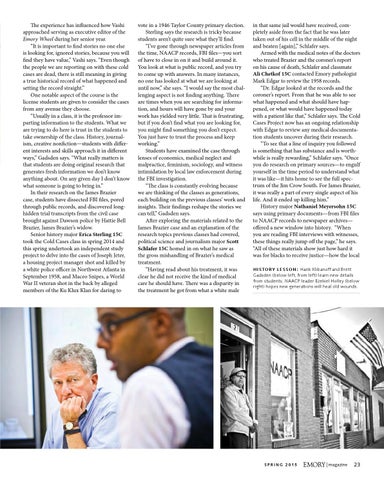
in that same jail would have received, completely aside from the fact that he was later taken out of his cell in the middle of the night and beaten [again],” Schlafer says. Armed with the medical notes of the doctors who treated Brazier and the coroner’s report on his cause of death, Schlafer and classmate Ali Chetkof 15C contacted Emory pathologist Mark Edgar to review the 1958 records. “Dr. Edgar looked at the records and the coroner’s report. From that he was able to see what happened and what should have happened, or what would have happened today with a patient like that,” Schlafer says. The Cold Cases Project now has an ongoing relationship with Edgar to review any medical documentation students uncover during their research. “To see that a line of inquiry you followed is something that has substance and is worthwhile is really rewarding,” Schlafer says. “Once you do research on primary sources—to engulf yourself in the time period to understand what it was like—it hits home to see the full spectrum of the Jim Crow South. For James Brazier, it was really a part of every single aspect of his life. And it ended up killing him.” History major Nathaniel Meyersohn 15C says using primary documents—from FBI files to NAACP records to newspaper archives— offered a new window into history. “When you are reading FBI interviews with witnesses, these things really jump off the page,” he says. “All of these materials show just how hard it was for blacks to receive justice—how the local h i s t o R y l e s s o n : Hank Klibanoff and Brett Gadsden (below left, from left) learn new details from students; NAACP leader Ezekiel Holley (below right) hopes new generations will heal old wounds.
SPRING 2015
15-EU-EMAG-0023 Emory Magazine Spring 2015.indb 23
magazine
23
4/27/15 5:34 PM