“We have to be tackling this from multiple angles.” —Eric Hunter
Less than a month after the Rollins epidemiology study was released, the National Institutes of Health (NIH) announced that it was awarding a five-year, $35.6 million grant to the Emory Consortium for Innovative AIDS Research in Nonhuman Primates (CIAR-NHP). The consortium is a collaboration of scientists and investigators from an array of disciplines—from immunology to pathology to biostatistics—who’ve come together with the common goal of developing an effective, lasting vaccine for HIV. “It’s an indication of the quality of research that is going on here,” says Eric Hunter, professor of pathology at the School of Medicine and the Emory Vaccine Center and the grant’s coprincipal investigator. “We have to be tackling this from multiple angles. This grant is going to give us the resources to really explore approaches that are going to move the vaccine field forward, because it involves multiple investigators from multiple viewpoints.” “The type of research we’re doing is expensive in terms of animals and people,” adds Guido Silvestri, professor of pathology and laboratory medicine and division chief of microbiology and immunology at Emory’s Yerkes National Primate Research Center.
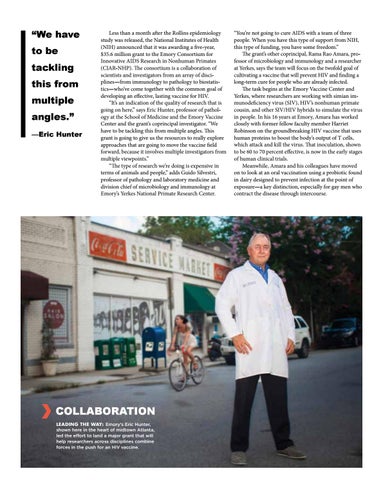
COLLABORATION LEADING THE WAY: Emory’s Eric Hunter, shown here in the heart of midtown Atlanta, led the effort to land a major grant that will help researchers across disciplines combine forces in the push for an HIV vaccine.
“You’re not going to cure AIDS with a team of three people. When you have this type of support from NIH, this type of funding, you have some freedom.” The grant’s other coprincipal, Rama Rao Amara, professor of microbiology and immunology and a researcher at Yerkes, says the team will focus on the twofold goal of cultivating a vaccine that will prevent HIV and finding a long-term cure for people who are already infected. The task begins at the Emory Vaccine Center and Yerkes, where researchers are working with simian immunodeficiency virus (SIV), HIV’s nonhuman primate cousin, and other SIV/HIV hybrids to simulate the virus in people. In his 16 years at Emory, Amara has worked closely with former fellow faculty member Harriet Robinson on the groundbreaking HIV vaccine that uses human proteins to boost the body’s output of T cells, which attack and kill the virus. That inoculation, shown to be 60 to 70 percent effective, is now in the early stages of human clinical trials. Meanwhile, Amara and his colleagues have moved on to look at an oral vaccination using a probiotic found in dairy designed to prevent infection at the point of exposure—a key distinction, especially for gay men who contract the disease through intercourse.