Electric Slide
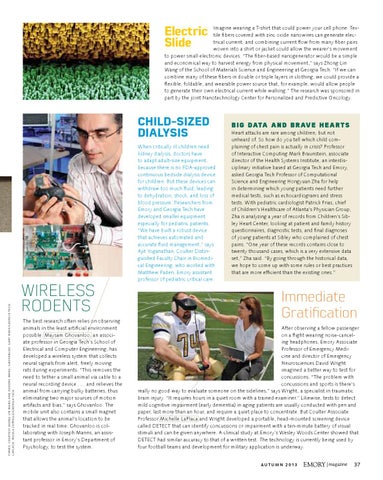
Imagine wearing a T-shirt that could power your cell phone. Textile fibers covered with zinc oxide nanowires can generate electrical current, and combining current flow from many fiber pairs woven into a shirt or jacket could allow the wearer’s movement to power small electronic devices. “The fiber-based nanogenerator would be a simple and economical way to harvest energy from physical movement,” says Zhong Lin Wang of the School of Materials Science and Engineering at Georgia Tech. “If we can combine many of these fibers in double or triple layers in clothing, we could provide a flexible, foldable, and wearable power source that, for example, would allow people to generate their own electrical current while walking.” The research was sponsored in part by the joint Nanotechnology Center for Personalized and Predictive Oncology.
fibers : courtesy Z hong L in W ang and X udong W ang ; ghovanloo : gary mee k / georgia tech ; laplaca : N icole C appello / georgia tech
Child-sized dialysis
Wireless rodents The best research often relies on observing animals in the least artificial environment possible. Maysam Ghovanloo, an associate professor in Georgia Tech’s School of Electrical and Computer Engineering, has developed a wireless system that collects neural signals from alert, freely moving rats during experiments. “This removes the need to tether a small animal via cable to a neural recording device . . . and relieves the animal from carrying bulky batteries, thus eliminating two major sources of motion artifacts and bias,” says Ghovanloo. The mobile unit also contains a small magnet that allows the animal’s location to be tracked in real time. Ghovanloo is collaborating with Joseph Manns, an assistant professor in Emory’s Department of Psychology, to test the system.
When critically ill children need kidney dialysis, doctors have to adapt adult-size equipment, because there is no FDA-approved continuous bedside dialysis device for children. But these devices can withdraw too much fluid, leading to dehydration, shock, and loss of blood pressure. Researchers from Emory and Georgia Tech have developed smaller equipment especially for pediatric patients. “We have built a robust device that achieves automated and accurate fluid management,” says Ajit Yoganathan, Coulter Distinguished Faculty Chair in Biomedical Engineering, who worked with Matthew Paden, Emory assistant professor of pediatric critical care.
B i g Data a n d B r av e H e a r t s
Heart attacks are rare among children, but not unheard of. So how do you tell which child complaining of chest pain is actually in crisis? Professor of Interactive Computing Mark Braunstein, associate director of the Health Systems Institute, an interdisciplinary initiative based at Georgia Tech and Emory, asked Georgia Tech Professor of Computational Science and Engineering Hongyuan Zha for help in determining which young patients need further medical tests, such as echocardiograms and stress tests. With pediatric cardiologist Patrick Frias, chief of Children’s Healthcare of Atlanta’s Physician Group, Zha is analyzing a year of records from Children’s Sibley Heart Center, looking at patient and family history questionnaires, diagnostic tests, and final diagnoses of young patients at Sibley who complained of chest pains. “One year of these records contains close to twenty thousand cases, which is a very extensive data set,” Zha said. “By going through the historical data, we hope to come up with some rules or best practices that are more efficient than the existing ones.”
Immediate Gratification After observing a fellow passenger on a flight wearing noise-canceling headphones, Emory Associate Professor of Emergency Medicine and director of Emergency Neurosciences David Wright imagined a better way to test for concussions. “The problem with concussions and sports is there’s really no good way to evaluate someone on the sidelines,” says Wright, a specialist in traumatic brain injury. “It requires hours in a quiet room with a trained examiner.” Likewise, tests to detect mild cognitive impairment (early dementia) in aging patients are usually conducted with pen and paper, last more than an hour, and require a quiet place to concentrate. But Coulter Associate Professor Michelle LaPlaca and Wright developed a portable, head-mounted screening device called DETECT that can identify concussions or impairment with a ten-minute battery of visual stimuli and can be given anywhere. A clinical study at Emory’s Wesley Woods Center showed that DETECT had similar accuracy to that of a written test. The technology is currently being used by four football teams and development for military application is underway. Autumn 2013
magazine
37