EDUCATE
Sean Butler sings the praises of the allotment, and demonstrates how it’s possible to add a touch of creativity to their design Allotments have existed for hundreds of years, with evidence suggesting that they may have been in use as far back as Anglo-Saxon times. Plots were fenced off and measured in rods – a measurement that we still use now; the most common size is 10 rods, equivalent to around 253m². The system we have today can be traced back to the 19th century, when land was given to the labouring poor so they could grow food. In 1908, the Small Holdings and Allotments Act came into force, followed by 1919’s Land Settlement Facilities Act, which made land available to all. In December 2013, I purchased a 10-rod allotment plot and gave it to my wife for Christmas. You might be cringing at the thought, but my wife enjoys gardening as much as I do. Being a designer and landscaper, this could not be any ordinary plot, and once it was built we became known by our fellow allotmentees as ‘the Chelsea gardeners’. It had a pergola entrance at each end, a picket fence to contain it, brick paved and metal-edged cockleshell paths, raised circular beds, and, of course, a deck to relax and sip tea on a Sunday morning, completed with mandatory shed. I have fond memories of gardening with both my grandfathers at their allotments, so I planted two standard roses in their memory – only for them to be stolen the very next day! Out of all the plants we grew that year, including 2,000 tulips so that we could have cut flowers at home, my favourite thing was going down on Christmas Day and picking two stems of Brussels sprouts for our Christmas Day dinner – so rewarding! Allotments and other areas for growing vegetables, fruit and cut flowers need not look so dull. Take for example, the gardens at
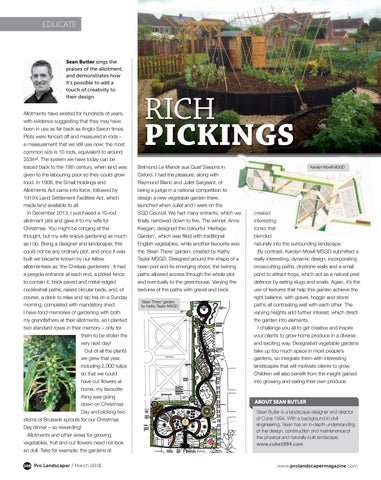
RICH PICKINGS Belmond Le Manoir aux Quat’Saisons in Oxford. I had the pleasure, along with Raymond Blanc and Juliet Sargeant, of being a judge in a national competition to design a new vegetable garden there, launched when Juliet and I were on the SGD Council. We had many entrants, which we finally narrowed down to five. The winner, Anne Keegan, designed the colourful ‘Heritage Garden’, which was filled with traditional English vegetables, while another favourite was the ‘Bean There’ garden, created by Kathy Taylor MSGD. Designed around the shape of a bean pod and its emerging shoot, the twining paths allowed access through the whole plot and eventually to the greenhouse. Varying the The 'Bean There' Heritage Vegetable Garden at Le Manoir: Masterplan textures of the paths with gravel and brick Scale 1:50
Karolyn Mowll MSGD
'NORTH ENTRANCE' Chestnut wood arch with woven split hazel detailing
Rosa rugosa Alba hedge to 100cm ht
Reclaimed brick path with Everedge metal reusable edging (800 mm wide)
‘Bean There’ garden by Kathy Taylor MSGD
Perennial planting
Perennial planting with 'insect hotels' on chestnut posts
Vegetables & pollinator friendly planting
Existing bay tree pruned
N Bumble bee wildflower mix
Information area
Bumble bee wildflower mix
'CEDEC' compacted gravel path (700 mm wide) edged with Everedge metal edging (reusable)
Lavenders
Vegetables & pollinator friendly planting
Annuals, perennials, vegetable edging
'CEDEC' compacted gravel path (700 mm) edged with Everedge metal edging (reusable) Vegetables & pollinator friendly planting
Existing parterre garden
Existing path
Wild strawberries and pollinator plants Existing Birch hedge
Annuals, perennials, vegetable edging
Heritage apple tree boundary trained iin lattice to max.1800 ht
Heritage apple tree boundary trained in lattice to max.1800 ht
Vegetables & pollinator friendly planting
Post & wire support for apple lattice boundary Peeled chestnut posts100 x 1800mm ht (above ground level) at approx 4m intervals. End posts are strutted. Horizontal galvanised wires, tensioned, at 300 mm intervals.
Vegetables & pollinator friendly planting
Existing bay tree: pruned
Existing bay tree pruned
Wild strawberries & pollinator plants
Pond
3 willow compost containers Information board
Mixed native hedge with Salix caprea for early pollinators
ABOUT SEAN BUTLER
Day lilies and pollinator plants
Pear trees x 3 in Whichford Pottery pots
Bark mulch
Sean Butler is a landscape designer and director of Cube 1994. With a background in civil engineering, Sean has an in-depth understanding of the design, construction and maintenance of the physical and naturally built landscape. www.cube1994.com
Emergent planting
Information point: CEDEC circle with embedded granite sett Open Pollinated Logo
2 Oak benches 800 mm wide Vegetables
Perennials & annuals
Oak perching benches x 3
6 bespoke bean supports Reclaimed brick path: running bond 700 mm wide
Vegetables
Leaf mould area Bark mulch paths at 700mm wide
Vegetables
Lavanders x 4
Bark mulch path 700mm
Reclaimed brick path 800 mm wide
Vegetables
Bark Mulch
Vegetables Vegetables Rose & sweet peas to climb arch
Low teucrium hedge
Existing road way
Bark chip path held in place with Everedge edging
Chestnut wood arch with woven split hazel detailing
Door
Fruit cage
Honeysuckle
'SOUTH' ENTRANCE
NOTES
Information board
2 lines of bricks set into existing pathway connect the 2 areas of the garden 2 Half standard Bay trees in Whichford terracotta pots
Reclaimed brick path 800 mm wide Information board
Low teucrium hedges Limit of tree protection zone
The garden design is based on the shape of a runner bean as it germinates and grows. Three types of path: brick, compacted gravel, and mulch, form the shape of the bean, and stems. The paths interweave, as two winding stems, northwards up the garden. The wider brick paths are the main access to the garden for casual visitors while the narrower compacted gravel and bark paths are also for use as gardeners' paths.
200 mm raised beds in tree protection zone: retaining structure is a 300mm ht continuous weave hazel hurdle (backed with landscape fabric)
To ensure that visitors recognise the 'Bean There' Heritage Vegetable Garden as distinct from other areas of Le Manoir garden, there are:
+ 200 mm raised bed
�
108 Pro Landscaper / March 2018
Vegetables
Existing hedge
Ornamental and bee friendly planting (Perennials and annuals)
Vegetables
Quercus hispanica Luccombe (protected tree)
� � � � �
+200 step up
Bark mulch path
Clear entry points though 2 arches, (one at the north end and one at the south) into the main planting area. Woven hazel raised beds in the tree protection zone and hazel & willow detailing on the chestnut arches and bean supports. Boundaries: Apple tree lattice on west and north boundaries adjacent to existing parterre vegetable garden to make a light distinction between the two areas. Plant labels are simple: reusable but distinctive. Signage at entrances and within the garden. The Open Pollinated logo on the ground at the meeting of paths
www.prolandscapermagazine.com
The garden is designed to be sustainable, practical and attractive (to visitors and pollinating insects). Decorative, flowering and edible herbs line many of the paths and under plant the hedging and lattice apple boundary. Vegetables in the upper garden are planted more decoratively while the lower garden suits a radiating linear arrangement with bean supports as foci in each unit. Crops can be rotated in a clockwise direction around this seed-shaped area. Woven compost containers are provided and comfrey plants are grown for bees and for providing compost.
Hartley Botanic Glass house (roof runoff to percola under greenhouse)
Sean Butler.indd 108
created interesting tones that blended naturally into the surrounding landscape. By contrast, Karolyn Mowll MSGD submitted a really interesting, dynamic design, incorporating crosscutting paths, drystone walls and a small pond to attract frogs, which act as a natural pest defence by eating slugs and snails. Again, it’s the use of textures that help this garden achieve the right balance, with gravel, hoggin and stone paths all contrasting well with each other. The varying heights add further interest, which direct the garden into elements. I challenge you all to get creative and inspire your clients to grow home produce in a diverse and exciting way. Designated vegetable gardens take up too much space in most people’s gardens, so integrate them with interesting landscapes that will motivate clients to grow. Children will also benefit from the insight gained into growing and eating their own produce.
There is a wildlife pond with a seating area so that visitors may pause there and perching benches near the central information board. 2 willow compost containers
Irrigation is provided to all parts of the garden via a drip irrigation network while rain from the green house roof is to be returned directly to the soil under the green house as part of the tree protection order.
19/02/2018 13:37
Title
Master Plan 1:50 Drawing Number
Drawn By
Date