Pro Landscaper is published 12 times per year by Eljays44 Ltd. The 2024 subscription price is £128. Subscription records are maintained at Eljays44 Ltd, BizSpace, Courtwick Lane, Littlehampton, West Sussex, BN17 7TL, UK. Articles and information contained in this publication are the copyright of Eljays44 Ltd and may not be reproduced in any form without the written permission of the publishers. The publishers cannot accept responsibility for loss of, or damage to, uncommissioned photographs or manuscripts.
Whilst every effort has been made to maintain the integrity of our advertisers, we accept no responsibility for any problem, complaints, or subsequent litigation arising from readers’ responses to advertisements in the magazine. We also wish to emphasise that views expressed by editorial contributors are not necessarily those of the publishers. Reproduction of any part of this magazine is strictly forbidden.
Welcome
At Pro Landscaper, we don’t often take the time to give ourselves a pat on the back. By the time one magazine has been published or one event takes place, we’re already looking ahead to the next one. But as someone who had little to do with the organisation of the event but had the good fortune to attend, I’m taking this opportunity to praise the Pro Landscaper team – and all our entrants, partners, judges and our wonderful and entertaining host David Dodd –who made this year’s Project Awards a resounding success.
We took the decision this year to make the awards a standalone event in the horticulture calendar, hosting it at Farnham Castle in Surrey on 12 July before going straight into our inaugural Summer Party.
It isn’t just that these events were fun (though they were) and went as smoothly as hoped (though they did); what made them a success is seeing the industry come together and celebrate each other and their achievements. The Pro Landscaper Project Awards are our chance to shine a spotlight on projects with a value of less than £100k and those behind them who use a limited budget to create an impressive outdoor space, recognising the skill and expertise that goes into this. We were thrilled to see so many people get behind this and raise a glass to our winners.
So, congratulations to all those who took home an award – but I’m also putting all modesty aside and saying ‘cheers’ to those at Pro Landscaper who made it a night to remember. See you at next year’s Project Awards!
19
Giving the Industry a Voice
Having stepped into the role eight months ago, Perennial’s CEO
CONTENTS August 2024 BUSINESS
Jamie Gault shares how the charity is championing and supporting the sector
25
Four Valuable Audiences for Ads
Matt Freestone highlights a handful of target audiences for adverts on Facebook and Instagram
29
Let’s Hear It From:
Penelope Walker
The award-winning garden designer brought joy to her debut at the RHS Chelsea Flower Show this year
35 A Seamless Design
Katerina Kantalis created a modern and vibrant outdoor room in this back garden in Clapham
41 Country Paradise
The garden of a Grade II-listed house in Cambridgeshire has been transformed by Robert Myers Associates
47 City Skylines
A historic building has been transformed into modern offices with Frosts Landscapes delivering a series of terraces
61
Covering All Bases
The inaugural Pro Landscaper on Tour took us to Renson’s inspirational NOA Park in Ghent, Belgium
67
Beyond Ambition
There are plenty of ways to take your business to the next level. Hear how four landscapers are achieving their goals
73 Move with the Times
How can specifier programmes help you to stay ahead of the curve and keep your skillset up to date?
79
The Future Belongs to Diversity
Mark Straver on the native vs non-native debate and why you don’t necessarily have to choose between the two
80
Jumping Ship
A change of venue might not be what the RHS Hampton Court Palace Garden Festival needs, explains Lewis Normand
83
Five Minutes With:
Matthew Pottage
The Royal Parks’ newly appointed head of horticulture and landscape strategy on his new role and future ambitions
8
Pro Landscaper Project Awards 2024
The 12 category winners have been revealed at a ceremony in Surrey as well as this year’s Supreme Winner
26
Bad Influence
Gareth Wilson warns against taking advice from social media – it's not always well-informed
52
Rock and Roll
Natural stone is a versatile material. Matt Evans shares how best to seamlessly implement it into a project
HTA DESIGN ACHIEVES B CORP CERTIFICATION
Landscape architect and design company, HTA Design has become a Certified B Corporation, reflecting the company’s commitment to tackling climate change and social inequality.
After a year-long assessment conducted by B-Lab, the non-profit behind the B Corp movement, HTA Design surpassed the minimum 80 point score and achieved an overall B Impact Score of 136.1. The score is calculated against five Impact Areas; Governance, Workers, Community,
Environment and Customers. The Environment impact area assesses a company’s overall environment management practices, as well as its impact on air, climate, water, land and biodiversity.
ROUNDUP Industry Updates
Juliet Sargeant secures the win for Best in Show with Disney’s the Lion King inspired community garden at this year’s RHS Hampton Court Garden Festival.
Celebrating the 25th anniversary of Disney’s West End musical, the Lion King Community Garden looks to “rethink the English Garden”, with climate change in mind. The garden’s recycled, crushed red brick soil is planted with swathes of resilient grasses, plants and trees, such as Bulbinella frutescens, Zanthoxyllum simulans and Gleditsia Skyline, to pay homage to the Pridelands.
Its overall planting scheme and colour palette reflects the bright hues of Julier Taymor’s theatrical design.
The Lion King Community Garden garden designer, Juliet Sargeant comments on the win, saying it is a “privilege” to event exhibit at the show; “but to have been awarded Best Show Garden is amazing, especially given the calibre of gardens this year.”
On top of Best in Show, Sargeant’s design also earned her a Silver-Gilt medal and the RHS Environmental Innovation Award. rhs.org.uk
HTA Design earned a 43.4 in its Environment impact area, the highest of any UK architecture practice to date.
Partner and head of landscape at HTA Design took to LinkedIn to share the news, writing; “As a practice, we believe the goal of B Corp aligns very closely with our culture and core values.”
The company says this achievement now offers an ‘invaluable framework’ against which to measure ‘future progress’.
HTA Design joins a growing cohort of B Corps, including the likes of Tyler Grange, Ground Control, and Austin Design Works. hta.co.uk
LI’S
DIGITAL PRACTICE & TECHNOLOGY FOR LANDSCAPE CONFERENCE: THERE “CAN’T BE AN OVER RELIANCE” ON AI
Delegates at the LI's conference heard how AI can be a “sidekick” but “there can’t be an over reliance on the tool”.
Panellist Harvey Kirchgaesser, a graduate landscape architect at WSP, told those who attended the conference that this could lead to a loss of skill, thought and processes.
AI can be a “touchy subject for some” who are concerned about cybersecurity, data protection and biases too. “But carrying out a self-assessment can help to determine how the available tools might improve efficiency," he says.
The panel was chaired by Mike Shilton, director of product management at Transoft Solutions and included Tamae Isomura, senior landscape architect at Ground Control.
Isomura advised going in with “a blank canvas” in mind when using AI tools, and asking whether AI needs to be used for that particular task. She adds that AI shouldn’t replace jobs, but job descriptions might need “redefining”.
There will “always be a need for human input”, agrees Kirchgaesser. In his mind, there are two key benefits of AI: the processing speed to analyse data and the extra time this offers for creativity, and the different outlooks it can provide.
There is, however, a risk that landscape architects might face “more pressure” to turn work around faster if using AI, he adds. "Fee structures might also change," says Isomura. Early adopters might profit more initially, but the benefit could fade fast, she concludes. landscapeinstitute.org
PROVENDER NURSERIES
BECOMES FIRST TRADE NURSERY CONTROL POINT FOR IMPORTS
Provender Nurseries has become the first trade supplier to have a Control Point after a change in import rules earlier this year.
This means a faster, smoother transition of plant imports, reduced costs and therefore cost saving for customers at Provender, says Stuart Tickner, head of nursery, biosecurity and production.
It has spent the last three years working towards gaining its status as a Control Point. This comes after the government announced it would be switching to a new system for importing plants post-Brexit. Since the end of April, all imports need to go through a Border Control Post or an inland Control Point. The new Control Point at Provender Nurseries is a “huge asset”, says Tickner. "We can unload our own stock, bypassing the Border Control points at ports ensuring all plants are unloaded here with our own experienced, trained staff.”
For the first six months to a year, the Kent-based nursery will solely handle its own plant imports to develop its onsite operations, says managing director Richard McKenna. It will then look to open its Control Point to offer import suppliers and hauliers. Two employees are undertaking the Authorised Operators Status pilot scheme. provendernurseries.co.uk
NURTURE GROUP’S ENVIRONMENTAL COMMITMENT REFLECTED IN LATEST REBRAND
Nurture Group renames its pest control business to better reflect the company’s environmental and sustainability focused policies and practices.
Nurture Pest Control, formerly Rokill Limited, was acquired by Nurture in 2021. It provides services to commercial, domestic and public sector clients across Britain. This rebrand is the latest step in its expansion whereby it purchased four pest control businesses to provide nationwide coverage.
Chris Evans, chief operating officer for Nurture Group Workplace Solutions, says off the back of adopting the Group’s sustainable ethos, “now was the right time” to align its pest control brand with the rest of the Group.
“Our focus is on keeping pests out of premises and in the external environment
IDVERDE
ACQUIRES ACORN ENVIRONMENTAL MANAGEMENT GROUP
idverde expands its green service portfolio with the acquisition of Acorn Environmental Management Group.
The Coventry-based grounds maintenance and landscape creation company says this
where they belong, and where we can support them as an essential part of the eco-system by providing natural habitats, in which they can thrive.”
Nurture Pest Control moved into its new, purpose-built facilities in Ringwood, Hampshire, which will become a regional hub, on top of acting like a showroom. nurture-group.co.uk
latest acquisition marks a ‘significant milestone in its growth trajectory’.
Kristian Lennard, CEO of idverde UK, comments on why Acorn is a good fit to existing idverde portfolio: “The company has been developed on strong foundations and is underpinned by innovation and a focus on training and development of their services.”
Based in the Midlands, Acorn, is known for its range of services, including tree
Online exclusives
FIVE REASONS TO ENTER THE PRO LANDSCAPER SUSTAINABILITY & BIODIVERSITY AWARDS
There is less than a month left to enter the Pro Landscaper Sustainability & Biodiversity Awards.
30 UNDER 30 – A CATCH UP WITH ASHLEIGH AYLETT Ashleigh Aylett has just been announced as one of the finalists for RHS Young Designer of the Year.
RHS YOUNG DESIGNER FINALIST
OLLIE PIKE RETURNS TO TATTON RHS Young Designer of the Year
Finalist 2023, Ollie Pike returns to the RHS Flower Show Tatton Park to reveal his second show garden, “This Garden Isn’t Finished Without You.”
surgery, arboriculture consultancy, landscaping, ecological mitigation and grounds maintenance. Kevin O’Rouke, owner of Acorn Environmental Management Group, adds: “We sought to find a genuine partner who will help us move the business forward and continue its development. I am confident that idverde is the right home for our business to continue its growth journey.” idverde.co.uk
Edge Hill by Tom Howard Garden Design and Landscaping Ltd has been revealed as the Supreme Winner at the 2024 Pro Landscaper Project Awards in association with Nth Degree Clerkenwell.
The Wimbledon-based project won the Design and Build £50k to £100k category, with judges calling it “a fantastic design for an awkward shape that marries with the house architecture and has been wonderfully executed.” They said it was an “impressive scheme” with “superb detail” and an “effective contrast of materials”.
Sixty-seven projects were shortlisted across 12 categories, each of which recognise schemes created with a budget of less than £100k, from temporary installations to community green spaces.
Prolific landscaper David Dodd – founder of The Outdoor Room and owner of Pots & Pithoi – hosted the ceremony, held at Farnham Castle in Surrey on 12 July.
Following the awards, Pro Landscaper held its first Summer Party in association with Landscapeplus. Guests sipped cocktails, ate pizza, and enjoyed stunning views over the historic market town of Farnham.
Thank you to all those who attended and congratulations to this year’s winners!
In its penultimate year before becoming a roaming show, the RHS Hampton Court Palace Garden Festival took over its usual haunt, against the backdrop of the iconic fountains. After 2025, it will return to the grounds every two years, alternating with the Badminton Estate in Gloucestershire. For some, this is a saving grace and a chance to reinvigorate the annual event. But there’s also a lot that this show still has to offer. Take Juliet Sargeant’s show garden which celebrated 25 years of The Lion King in the West End and brought a dose of colour and vibrancy. Then there are all the opportunities that Hampton Court has available for new and up-and-coming designers looking to dip their toe into the show garden arena, such as the Pocket Planting and the Get Started Gardens. It arguably needs bigger budgets and higher energy, but there are still plenty of possibilities. (Read Lewis Normand’s take on this year’s show on page 80).
The Mediterraneo Garden
JULIET SARGEANT: “WE’VE GOT TO CHANGE THE WAY WE DO THINGS”
This year’s Best in Show winner also picked up RHS Hampton Court’s first Environmental Innovation Award, having built a threemetre-high wall without using concrete.
Designer Katerina Kantalis Contractor Phil Sutton Landscapes
MEDAL GOLD MEDAL
Designer James Miller, Saachi Parasrampuria, Marko Yau Winds of Change
Best Get Started Garden Best Resilient Pocket Planting Best Construction Award
16 HIGHLIGHTS OF RHS HAMPTON COURT PRESS DAY
From a Wimbledon inspired court and clubhouse to numerous designer debuts to gardens inspired by international travel, there was an eclectic mix at this year’s show.
People’s Choice Award winners
RHS’ PEAT-FREE DEADLINE “NEEDS TO BE EXTENDED” OR ALLOW EXEMPTIONS
Majestic Trees has made significant strides in its transition to become a peat-free nursery – but managing director Steve McCurdy has concerns that the RHS’ 2026 deadline is overly ambitious.
Designer Sarah Mayfield The Moonshadow Moth Garden
Designer Flora Scouarnec and Victoria Pease-Cox Contractor Acacia Gardens
Designer Nilufer Danis Contractor Acacia Gardens
The Way of Saint James
The RHS Hampton Court Palace Garden Festival was a dazzling showcase of horticultural innovation and creativity. As the largest annual flower show in the world, it continues to be a beacon of inspiration for garden enthusiasts. This year's festival not only lived up to its reputation but also set new standards, particularly with the standout contributions from designers Katerina Kantalis and Freddie Strickland.
not only added a modern and industrial edge but also complemented the earthy tones and textures typical of Mediterranean landscapes. The rusted appearance of Corten steel blended beautifully with the greenery, creating a warm and inviting atmosphere. Her use of this material highlighted her innovative approach to garden design, combining aesthetics with practicality.
The EDGE Winning
Kinley’s Corten edging featured in award-winning gardens at RHS Hampton
Court
Defining the Adventure Within Garden
Metal landscape edging: the sustainable choice
Corten adds flair to Mediterranean retreat
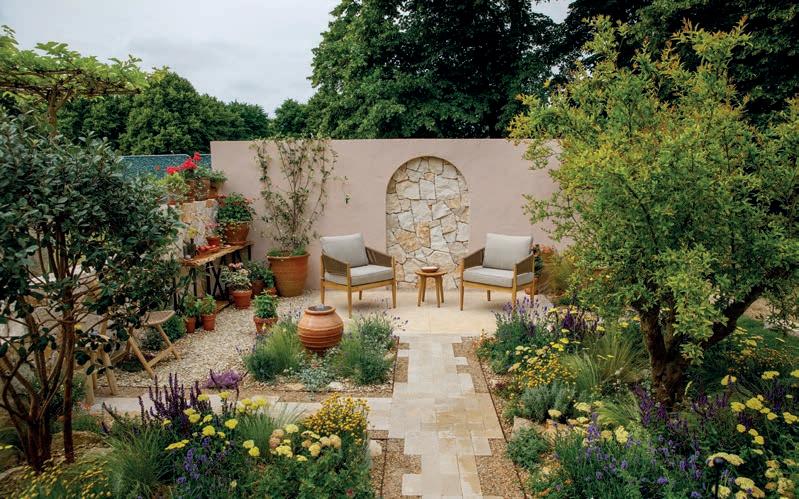
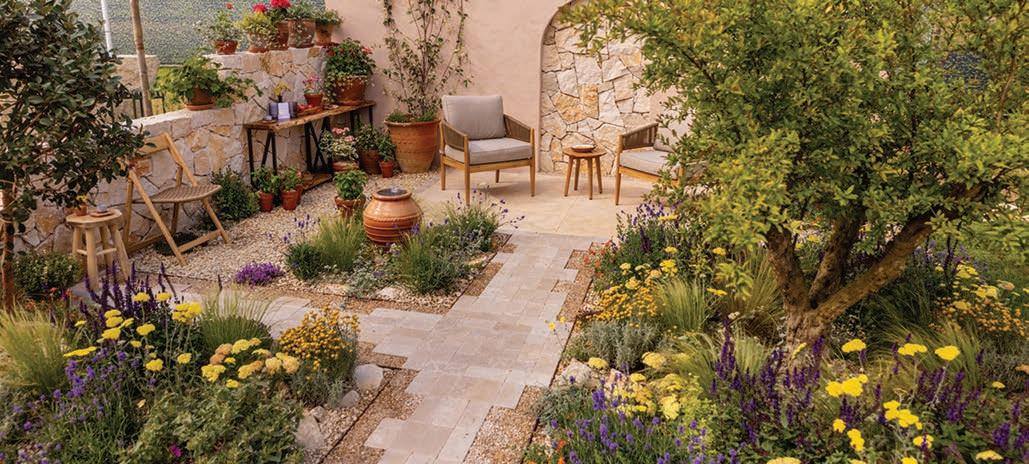
Katerina Kantalis emerged as one of the festival's stars, winning the Best Get Started Garden award and the Best Construction Award in this category for The Mediterraneo Garden. This garden was a Mediterraneaninspired retreat. Kantalis’ design was lauded for its meticulous attention to detail and the seamless integration of various elements that created a harmonious and inviting space.
Central to The Mediterraneo Garden's appeal was the use of Fort Corten Steel edging, provided by Kinley, a UK innovator and manufacturer of creative metal landscape edging. This material
“The metal edging was integral to the path design through the garden, adding structure between the planting beds and path,” she comments.
“The edging helped to contain the self-binding gravel, but also jointly allowed for us to have a seamless continuation of the various gravel sizes through the garden.” She observed that it was “beautifully fabricated with rounded edges which fitted the look and feel of the garden” that “focused on elegance and beauty, with a touch of rustic which is evocative of the Mediterranean garden.”
Kantalis was confident that showcasing the Kinley edging would serve as inspiration for many amateur and professional garden landscapers.
Freddie Strickland also made a significant impact at the festival with his RHS Adventure Within Garden. This stood out for its playful and adventurous spirit. His garden was a testament to his belief that gardens should be interactive and enjoyable. By incorporating elements that encouraged exploration and play, Strickland's design appealed to the child in everyone, making his garden a favourite among visitors. His design featured Kinley's Fort Corten Steel edging, showing the material's versatility and ability to fit into various garden styles.
He praised Kinley's edging, calling it “a brilliant product” that was easily installed despite challengingly tight curves in the design. He was impressed with its performance, saying that it “easily stood up to the challenge of retaining the gravel pathway that enabled many thousands of visitors to walk through the garden.”
While timber landscape edging may come from a renewable source, its short lifespan means it has to be replaced more frequently; this soon negates its short-term environmental benefits. Concrete edging also uses finite resources that are already in unsustainably high demand and can only be recycled as coarse aggregate. The durability and recyclability of metal landscape edging therefore make it the most sustainable option. Steel and aluminium are more resistant to frost or impact damage than, and both contain a high percentage of recyclable content. Landscape gardeners who like to push creative boundaries while creating sustainable, sympathetic environments are increasingly looking to metal landscape edging from Kinley. kinley.co.uk
Independent horticultural training academy, TASK , announces its new collaboration with London Stone , supplier of natural stone paving
WORDS: ASHLEIGH BROWN
TASK Academy is centrally located in rural Worcestershire, and provides a broad range of landscaping and land-based courses for individuals and businesses.
Launched in September 2022, it is a leading independent training academy, set up to support the horticultural industry –it is the ideal setting and environment for students to immerse themselves in practical skills training.
Taught in small groups by industry experts, courses are specifically designed to combine a high level of training with hands-on practical experience, providing students with the opportunity to develop skills, knowledge, and inspiration.
We have many plans working together in providing unparalleled support and education for our attendees and industry
Rupert Keys, founder and managing director, TASK Academy
Founder and managing director, Rupert Keys, has been in the landscaping industry for over 30 years, formerly as a landscape contractor with his previous business ‘Keyscape
Design and Construction Ltd’ and as the founder of TASK Academy Ltd since 2022.
Keys is now also a judge with the Association of Professional Landscapers and British Association of Landscape Industries, as well as being a teacher and mentor working with the APL Apprenticeship scheme and at the Cotswold Garden School.
“As a team, we have a huge range of experience within the industry which we’re keen to share with students and employers to address the industry skills gap,” says Keys. “Our focus is to improve the expertise of current and future generations.”
Since the training centre was built and set up in 2022, the curriculum available has more than doubled, along with the expansion of its training and industry partnerships. And in the spirit of a shared ethos and desire to upskill the industry, as a whole, TASK collaborated with London Stone at the beginning of June 2024.
TASK ACADEMY
TASK PARTNERS WITH LONDON STONE
London Stone is renowned for its comprehensive range of paving, decking, and bespoke stone, providing high quality products and superior customer service to a broad range of client types that include landscape contractors, garden designers, property developers, architects and homeowners.
The new collaboration will mean that London Stone customers will be able to access exclusive discounts with TASK, attend talks and special events – as well as providing students with the opportunity to choose from specific courses run at all the London Stone showrooms, as it aims to provide help and support by providing the materials for students to learn from.
“London Stone is the perfect partnership as they are one of the leading landscape product suppliers in the country, and after two years of talks, we felt that the relationship between TASK would assist in providing students the knowledge and support dealing with current and future material options,” says Keys.
It further underpins
[London Stone’s] culture of continuous learning and improvement of the industry
Diana Catrinoi-Cornea, marketing director, London Stone
Since its passion, dedication, and commitment for the industry is shared with TASK, the partnership will provide both the industry and the public with the opportunity to learn the theory and ‘hands-on’ practical skills, including all installation techniques which are kept up to date alongside the British Standards.
Diana CatrinoiCornea, marketing director at London Stone, comments on the collaboration, saying it “further underpins [London Stone’s] culture of continuous learning and improvement of the industry.”
London Stone will assist with the promotion of a wide variety of courses that are offered at TASK, as well as TASK being able to offer up-to-
date quality landscaping materials and the services that London Stone provides.
This newfound relationship also hopes to diversify funding sources through grants, partnerships, and sponsorships, as well as implement cost-effective measures without compromising on quality.
And since balancing costs with affordable tuition fees is just one of the challenges faced by the independent training academy, by offering flexible payment plans or scholarships to make education more accessible, the two companies believe that it is partnerships like this that will help in overcoming the skills shortage across the industry.
“We have many plans working together in providing unparalleled support and education for our attendees and industry,” says Keys.
With the uptake in efforts to tackle the climate and the biodiversity crisis, land-based professions seem to be growing in demand, meaning that relationships such as this between TASK and London Stone are the key to stop exacerbating the current skills shortage impacting the industry.
LONDON STONE BIRMINGHAM SHOWROOM
LONDON STONE FLORENCE GREY PORCELAIN PAVING: GABY PILL AT RHS MALVERN 2019
DESIGNBOARD CHARCOAL USED BY KEYSCAPE LANDSCAPES, DESIGNED BY MARTYN WILSON
TASK ACADEMY
Co�aborate with Bakers to elevate your outdoor designs
We want to partner with you to create the perfect bespoke garden room for your clients and your design. You can lean on our expertise in construction and installation whilst having the freedom to put your stamp on the look and feel.
So, why not partner with us at
Bakers Garden Buildings?
With over 40 years of expertise, we can partner with you to create the perfect customised garden building with a 10-year warranty to seamlessly fit into your garden design.
You can decide on the materials, colours, size, and style to create a bespoke garden building that perfectly complements your designs.
‘Bakers have an outstanding commitment to quality and are hugely valued by our team. When specifying an outdoor room for our clients, we feel confident that they will be thoughtfully considered and harmonised into our overall schemes.’
What’s next?
Adding life to gardens since 1985
Discover more inspiration for garden designers, landscapers and homeowners.
A VOICEtheGivingindustry
CEO Jamie Gault is determined for Perennial to become the charity of the industry and to support a growing need for its services
Demand for Perennial’s services has skyrocketed. In an average year, its service users might jump by around eight percent; but last year, casework leapt up by 42%.
The horticultural charity is facing an “unprecedented demand”, underpinned by a “continued cost of living crisis” and “pressure on statutory services, both in health and social care,” says Jamie Gault, its new CEO.
We want to reach people and support them before they reach crisis point
“It illustrates the many challenges that people working in horticulture and their families are facing, and our focus on early intervention and prevention is increasingly important. We want to reach people and support them before they reach crisis point.”
The charity is now at “quite a pivotal moment” as it celebrates its 185th-year milestone this year. “We want to be the charity of the industry and for everybody in the horticulture industry to know who we are, what we do and that we are there if they ever need our support. And focusing on the industry is key to making that happen.”
So, Gault has spent the last eight months gaining an understanding of the organisation – from its headquarters in Leatherhead to Perennial's gardens to its services team scattered across the country – and those it supports. His focus has been on “strengthening the organisational capacity to meet the unprecedented demand” and “using informed decisions to undertake a strategy refresh to set the direction of the charity for the next five years. I wanted to ensure it is fit for purpose and to futureproof it to meet the changing needs of the horticulturists we support.”
He joined Perennial last November from a background in financial services, management consultancy and – for the last 16 years – the charitable sector. Most recently, he’d worked for a carers’ support organisation which was “very much about helping people to improve the quality of their lives” through early intervention and prevention. The synergies to Perennial drew him to the charity.
Within the first three weeks of his new role, Gault had visited all three of Perennial’s gardens – The Laskett in Herefordshire, York Gate in Yorkshire and Fullers Mill in Suffolk – its two pledge gardens as well as pipeline gardens. He sees these as the “shop window” to the charity which might “bring people in who then might decide to support us in a number of different ways” – be it as a volunteer or as a supporter. “The gardens are important in achieving that so they are part of the wider strategy and part of the outreach and engagement.”
Partnerships are also key to expanding its reach, impact and access to services. Take Perennial’s recent one with kit manufacturer Stihl. An equipment replacement fund has been set up to donate tools and PPE to those in need, and bespoke items were auctioned off to raise money for Perennial at the opening of Stihl’s new Contra House facility in Surrey – all of which could help the charity to engage with those who might not otherwise have discovered it.
says Gault, who adds that more apps will be coming on board soon.
“We are a user-centric organisation underpinned by a programme of continued improvement; we want to develop our service offering to provide even more comprehensive support, and that leads into the overall ambition to have a sustainable impact that will align with our mission to build better futures for people in horticulture and their families.”
These all are part of the five strategic objectives for the charity moving forward, another of which is to become a data-informed organisation so that it can make informed decisions about the direction and the strategy of the charity. Its Wellbeing Survey, for instance – which closed in June – will provide a snapshot of the horticultural industry as well as informing Perennials future service provision.
Run in conjunction with the University of Exeter, which will undertake the analysis, the survey will be run annually, with this year’s results due to be published towards the end of the year and openly available to all.
“What we want to do is give the industry a voice. That’s very much the survey, which was referenced in the House of Lords and helped to promote conversation and debate around the industry. We want to do more of this and the survey would support that.”
This year’s Wellbeing Survey was launched at an event at the Royal Botanic Gardens, Kew, another part of Gault’s strategy to raise awareness of the charity. Perennial’s The Laskett also had an autobiographical show garden at this year’s RHS Malvern Spring Festival, which won the People’s Choice Award. This ensures Perennial is exploring as many touch points as possible.
We probably have a community now of something in the region of approaching one million people who we can support, should they need it
Then there’s the partnership with Carers UK, whose app helps carers to manage their lives, something which Gault says is “critical”, with around 12-15% of the horticulturists Perennial supports also being unpaid carers.
“This is part of our strategy to help support people; you will never replace one-to-one support, but different people need different levels of support, and some of it can actually be self-help.” Perennial has therefore launched a series of apps to support its core services: Be Money Smart, for financial help; Be Health Smart, for taking control of physical and mental health; Be Career Smart, to help people achieve their career aspirations; and Be Life Smart.
“These are a set of resources to support you during life’s challenges, and they complement the early intervention and prevention strategy,”
“We support anybody working with grass, trees, flowers or plants, both those currently working or who have retired. The House of Lords report said there are now 800,000 people working in horticulture in the United Kingdom, and that does not include retirees. So, we probably have a community now of something in the region of approaching one million people who we can support, should they need it.”
That’s a significant amount of people potentially reaching out to Perennial for help. And whilst Gault is working hard to ensure the charity is set up for this demand, the industry can play its part too, be it through volunteering, becoming a partner, donating or fundraising –or even telling your employees or colleagues about Perennial and the support it can provide. Head to perennial.org.uk to find out more.
THE PEOPLE’S CHOICE AWARD AT RHS MALVERN SPRING FESTIVAL
PRO LANDSCAPER BIODIVERSITY
NET GAIN WORKSHOPS DAY
11 SEPTEMBER 2024 • LONDON
FACILITATE, CONNECT AND COLLABORATE
ABOUT THE EVENT
BNG regulations are now in place and impact every new commercial development. This provides the UK landscaping sector with a massive opportunity to demonstrate its value, influence and shape projects at much earlier stages.
To be able to realise this, there needs to be new levels of collaboration and connections between the key stakeholders involved from planning, through to implementation and post project maintenance.
With so much at stake, an eagerness and hunger in the industry to have open discussions that overrides competitive interest, now is the right time to bring the industry together.
PURPOSE OF EVENT
To connect all the key stakeholders that need to be part of the discussion. This will facilitate conversations that helps set out what action is needed to enable the UK landscaping sector to realise opportunities that BNG presents.
FORMAT OF EVENT
The day will kick off a keynote and industry panel outlining where we are today, future direction and broader industry views on potential opportunities for our sector.
This will help set the context for the discussions that form the heart of the day, with delegates getting the opportunity to take part in facilitated workshops along with their peers. The outputs from each workshop will be used to inform a best practice guide.
SUPPORTING PARTNER:
Workshop groups will include:
• Planning
• Communication
• Implementation
• Maintenance / Enforcement
Schedule of the day
09:30 Registration, tea and coffee 10:00 Welcome to day
10:05 Keynote – BNG Policy
10:25 Industry Panel – BNG in action: What have we learned?
11:10 Refreshment break
11:30 Workshops – round one 13:00 Lunch and networking
14:00 Workshops – round two
15:30 Key takeaways – The BNG Action Plan for landscapers 16:00 Close
Who should participate?
• Commercial landscapers/contractors
• Grounds maintenance contractors
• Landscape architects
• Planning and public space management teams in local authorities
• Suppliers and solution providers
• Developers/landowners/investors
AS K THE EXPERTS
Is a framework agreement all it’s cracked up to be?
There
are pros and cons to this type of agreement, explains Ken White
As a commercial landscaper, entering into a framework agreement with an organisation can bring about a mix of opportunities and challenges, and understanding these aspects is crucial for deciding whether such an arrangement aligns with your business goals and operational capabilities.
What are the pros?
One of the most significant advantages is the assurance of a steady revenue stream. Long-term contracts provide financial stability, allowing you to plan better, invest in your business, and manage cash flow more effectively. Framework agreements can also often cover large-scale projects or multiple sites, presenting substantial growth opportunities. Securing such a contract can enhance your portfolio, providing a strong reference for future bids and helping to build a robust reputation.
bidding for new projects. The focus can shift from seeking new clients to maintaining and enhancing services for existing contracts.
So, what are the cons?
Understanding these aspects is crucial for deciding whether such an arrangement aligns with your business goals
There’s the commitment to the agreed terms and conditions. This rigidity can be problematic if market conditions change or if the scope of work evolves in a way that was not anticipated. It requires careful contract management and sometimes difficult renegotiations. And while maintaining high standards is a positive aspect, it also adds pressure to consistently deliver top quality service over a long period. Any lapse in service quality can jeopardise the relationship and future opportunities.
The panel
HOLLY YOUDE
Chair of the APL, Holly Youde, is a director at Urban Landscape Design in the North West and The Landscape Academy, a purpose built training centre dedicated to landscaping in the UK.
JAKE CATLING
Jake founded his domestic landscaping company, The Landscaping Consultants, aged just 24. He is now a BALI board director, host of the Landscape Performance Podcast, and has delivered various award-winning gardens and outdoor spaces.
KEN WHITE
With guaranteed work over a set period, you can optimise your operations. This predictability allows for more efficient allocation of resources, better workforce planning, and the potential for investing in equipment and technology that improve service delivery.
These agreements foster long-term relationships with clients too. A strong, ongoing relationship can lead to better communication and understanding of the client's needs, resulting in higher customer satisfaction and potential for contract renewals or additional projects.
With a framework agreement in place, you can reduce the time and money spent on marketing and
In a bid to secure the framework agreement, you might offer competitive pricing that could narrow profit margins. Over the long term, this could impact financial sustainability, especially if costs increase due to inflation or other factors are not accounted for in the original pricing.
Committing substantial resources to a framework agreement can be risky if other opportunities arise too. This commitment might limit the ability to take on new, potentially lucrative projects, thereby restricting business growth in other areas.
A framework agreement can create a dependency on a single or a few major clients. If the client faces financial difficulties or decides to terminate the contract, the landscaper could experience a significant business impact, highlighting the importance of maintaining a diversified client base.
So, carefully assess all these factors to ensure the benefits outweigh the risks and align with your long term strategic objectives.
Ken White, former chairman of the APL, leads the multi-award-winning Frosts Landscape Construction, which carries out large commercial and private estate projects across the UK.
ROSEMARY COLDSTREAM
Rosemary has won numerous awards for her work, creating high quality gardens for both domestic and commercial clients. She is a fully registered member of the SGD and sits on the board of directors at BALI.
JILAYNE RICKARDS
Based in Cornwall, Jilayne Rickards is a multi-award-winning garden designer who puts sustainability and biodiversity at the heart of her designs, including her show gardens at Chelsea, both of which have been relocated to the Eden Project.
Success in the landscape industry is deeply personal and goes beyond societal benchmarks like awards and accolades. While these external validations can serve as initial markers, they often don't lead to true fulfilment. The definition of success is now further complicated by social media, which often causes people to compare their behind-the-scenes realities with others' highlight reels which can diminish their sense of achievement and contentment.
RETHINKING success
Jake Catling takes a personal and holistic approach
To cultivate a healthier and more satisfying sense of success, it is essential to turn the focus inward and set personal metrics aligned with individual values and aspirations. For example, building a renowned landscaping business might be a common goal, but it's not everyone's dream. Some professionals find greater fulfilment in maintaining a balanced family life and creating beautiful, sustainable outdoor spaces for their community. This shift in perspective underscores the importance of defining success on one's own terms, based on personal objectives and the satisfaction derived from progress.
Several factors can reshape an individual's view of success over time. Initially, many are driven by the need for external validation. However, adopting a growth mindset – where success is seen as a continuous pursuit of goals rather than merely hitting milestones – can lead to a deeper appreciation of one's journey in the landscape industry. Success is not a fixed state; it is relative and personal, centred on setting out to achieve something and succeeding, regardless of the scale of the accomplishment. While one may experience moments of success, it is not a permanent state. Continuous effort and growth are required to sustain it.
at the expense of health, family, or happiness. In our industry, there is significant pressure and sacrifice. Early on, individuals might endure hardships, but it is essential to evaluate whether the trade-offs are worthwhile. For instance, during major events like the RHS Chelsea Flower Show, teams face long, gruelling days. The sense of accomplishment and joy of showcasing skills can make the effort worthwhile, but it is important to balance these intense periods with moments of rest and enjoyment to avoid burnout.
Measuring daily success can be as simple as assessing how you feel at the end of the day. If you have accomplished your tasks without overwhelming stress and leave work feeling satisfied, that is a success. Regular reflection, such as documenting weekly wins and losses, provides a balanced view of progress and helps individuals appreciate their journey.
While one may experience moments of success, it is not a permanent state. Continuous effort and growth are required to sustain it
Celebrating small achievements plays a crucial role in this mindset. Whether it’s successfully completing a garden project, securing a new client, or enhancing a green space, success lies in doing what you set out to do.
Additionally, celebrating others' successes can be equally fulfilling. Recognising that each person’s accomplishments are unique to their journey fosters a culture of appreciation and support. Balancing the cost of success is another critical aspect. Achieving goals should not come
In a team setting, celebrating successes – big or small –can foster a positive work environment and motivate everyone for future challenges. Acknowledging hard work and enjoying moments of accomplishment together strengthens bonds and creates a supportive atmosphere. Success in the landscape industry is a personal journey, not just a destination. It is about setting goals, working towards them consistently, and celebrating milestones along the way. By aligning the definition of success with personal values and maintaining a healthy balance, true fulfilment can be achieved.
Remember, success is not just about what you achieve but also about enjoying the journey and sharing it with those around you.
Check out the Landscape Performance Podcast, with Catling and Grayson as the hosts, on Spotify, Google & YouTube
Founded by award-winning landscaper Jake Catling and performance coach Sam Grayson, Hyphae Learning partners with businesses to help them to attract, train and retain talent, with learning resources and innovative tips.
HYPHAE LEARNING
better prices BETTER PATIOS
Transform your garden with Nustone's wide range of high quality paving options
At Nustone, we believe every garden deserves to look its best, and our passion for transforming outdoor spaces is reflected in the satisfaction of our customers.
We stock a wide range of paving options, including sandstone, porcelain, granite, slate, limestone and travertine, offering something to suit every taste, design and budget.
With over 20 years in the stone paving industry, we're dedicated to helping customers turn gardens, patios, pathways, and driveways into sights to behold and spaces our customers are proud to call their own.
From ordering free samples and providing your first quotes to delivery and aftercare, we ensure the best possible experience. So, you can rest assured that when you choose Nustone, you're dealing with professionals.
We are thrilled to hold an 'Excellent' rating on Trustpilot. Thanks to our team of stone enthusiasts and their ongoing expertise, we've helped hundreds of thousands of satisfied customers create inspiring new
patios, from domestic projects to extensive commercial overhauls.
As a proud, direct importer of high quality paving, we eliminate the middleman, allowing us to provide quality and affordability under the same roof. Plus, our own fleet of delivery vehicles allows us to offer next-day and express services, ensuring that you get your goods as soon as possible and are on your way to enjoying your new patio in no time.
Exclusive trade prices
As a trade customer, you'll enjoy benefits and perks that will streamline your supply chain by making the whole process quick, easy, and cost-effective.
A Nustone Trade Account will give you access to an online ordering system that allows you to place your orders with your trade discounts already applied. You can also reward yourself by earning points with each order, which you can redeem for even further discounts on future purchases.
With discounted premium delivery options, dedicated customer support and favourable wholesale pricing, our goal is to make it easy for you to order the products you need to run your business without the hassle of dealing with middlemen.
You can also benefit from a free business listing on our 'Find A Landscaper' page which helps residential customers to find landscaping professionals in their area, driving extra business to your door.
Whether you're a builder, contractor, or retailer, we have a wide selection of high quality
stone products to choose from –all at thoughtful prices, so you can offer your customers the best for less. Join thousands of active members who are already taking full advantage of the benefits of a Nustone Trade Account and start experiencing the difference for yourself.
Whether you are a landscaper, architect, seasoned DIY enthusiast, or a first-time patio layer, we're here to pave the way and help make your dream a reality. Contact us via phone, email, live chat, WhatsApp, or in person at one of our showrooms. We're here to help every step of the way. Better Patios. Better Prices. nustone.co.uk
KANDLA GREY PORCELAIN
KANDLA GREY SANDSTONE
QUARTZITE PORCELAIN
4 VALUABLE AUDIENCES for ads
Matt Freestone shares a selection of key audiences every landscaper can retarget using ads on Facebook and Instagram
Facebook and Instagram (Meta) ads can be pretty expensive to run. Often landscapers tell me they don’t need 20-40+ more enquiries a month, and the investment wouldn’t make sense given how busy they already are.
Despite that, though, I believe every landscaper should try Meta ads themselves, even if it’s on a low budget. Why? Because of Meta’s audience section and the retargeting opportunities the platform creates. It’s widely accepted that it takes an average of eight touch points with a company before you decide to buy – this makes those targeting opportunities incredibly valuable.
Running low budget Meta ads targeting homeowners who have already shown some interest in getting their garden done with you can be a very profitable marketing strategy.
Here’s four audiences to consider creating through Meta’s ads manager platform to increase marketing touch points:
1
WEBSITE VISITORS
Using the Meta pixel, you can track homeowners who have visited your website. Maybe they were checking you out but then their bell rang…and they forgot to enquire.
2
SOCIAL MEDIA ENGAGERS
If they are regularly engaging with your content on Facebook and Instagram, it’s likely that they know and trust your brand. By retargeting them with video ads, you can continue to build that brand awareness.
YOUR EMAIL LIST
3 4
Upload your email subscribers to Meta to show them ads. By hitting them on both channels, when the time comes for them to get their garden done, you should be the first company that comes to mind.
PREVIOUS QUOTES
Upload a list of past quotes. I did this recently for a client of mine and he got re-enquired by a lead he got two years ago. They remembered the initial visit and had been saving up the money, and he closed a £49k project as a result.
These audiences may be quite small, so your budgets don’t need to be big to continue to be shown to these potential clients. Why not give it a go and see the potential for yourself.
Matt Freestone is a social media specialist who’s worked with household names such as Deliveroo, Warner Music and Currys PC World and has experience growing Facebook, TikTok and Instagram pages online to millions of followers. He set up and now runs New Leaf Media, a marketing agency that specialises in finding landscapers more enquiries, site visits and projects through innovative social media marketing and appointment booking processes.
newleafmediaco.com
MATT FREESTONE
BAD INFLUENCE
Ensure you’re taking advice from the right sources, warns Gareth Wilson
As many of you will know, I am a huge fan of social media.
There is now a plethora of platforms to communicate and share information and to build your own profile. However, I’m getting increasingly frustrated by some of the misinformation spewed out by so-called influencers on Instagram, Facebook and the dreaded TikTok!
I went to visit an expert witness project in the north-east of the country, where I met with the client and a young contractor. The project on the face of it was of a decent standard, but the fall of the paving was way out. I asked the contractor how he worked his falls out and he said he put a line on his level for a 1-60 fall! Asking where he’d picked up this appalling information, he said Instagram. Well, I won’t print my reply! But I have recommended my services regarding training going forward and told him to delete whoever the influencer was as they are completely clueless.
Many influencers are simply chasing views and likes, at the cost of accurate information and good advice
I have seen so called influencers giving other terrible advice such as R9 porcelain paving being acceptable to use outdoors (as opposed to the minimum R11), and timber decking subframes laid directly on the ground without the minimum 60mm shadow gap for airflow. These are fundamental errors that no decent landscaper should be making.
Posts about pricing on social media are also causing many contractors problems. This doesn’t help manage the expectations of our collective customer base and
budget. Budgets for jobs shared online can be misleadingly cheap, or simply not representative. In some instances, for example, landscaping influencers’ products are supplied materials free of charge. The cost of landscaping work also varies vastly throughout the country: for example, a 200m2 patio will cost up to 30-40% more in London than, say, Newcastle (take into account ULEZ charges, cost of living, tolls, access and parking fees, etc.). Unfortunately, social media is leading to clients pressuring contractors to push prices lower than is fair, based on misleading information and unreasonable expectations informed by social media.
This does not just affect the hard landscaping world. It is rife within the horticulture social media world too. Here, I see clueless influencers obviously quoting straight out of books and – as they don’t fully understand what they are talking about – vital information is missed out. I’m afraid many influencers are simply chasing views
a hypocrite: I admit it’s very satisfying getting thousands of likes and a million views. But there’s a moral responsibility that comes with that. I endeavour to provide good and accurate advice, and if I’ve made mistakes (and I have), I hope I’ve always corrected these.
I reflect on the fact that one of the world’s leading plantsmen and horticulture expert, RHS show garden planting specialist John Cunningham, has – at the time of writing – 501 followers. Think about that, folks.
The takeaway from this is to be very careful where you obtain guidance on social media platforms. Many influencers are poorly informed; they repeat misinformation from others, and they are ‘book read’ with no actual experience. They may create visually appealing reels, but that’s about it!
GARETH WILSON
Leaving college at 17, Gareth has worked in the landscape industry since 1989. Progressing onto high-end projects, he has picked up seven RHS gold medals. He is a member of multiple professional bodies. He provides technical and product advice to large companies, mentors and trains contractors and garden designers in landscape construction and on show gardens logistics across the UK. Gareth also provides mediation services, he is a member of the BS7533:102 committee and is an industry awards judge. gkwilsonlandscaping.co.uk
Bespoke British Made Outdoor Kitchens
Combining style with extreme durability, KönigOutdoor kitchen cabinetry is created using sintered stone external surfaces and an internal weatherproof structure.
Each KönigOutdoor kitchen is made to order in Britain with turnkey advice and support available for you and your client, from design through to aftercare.
www.konigoutdoor.co.uk
“I
NEEDED SOMETHING THAT FEEDS THE SOUL, NOT JUST THE BANK BALANCE”
Penelope Walker’s genuine passion for charity Panathlon made her first Chelsea garden a joyful experience
WORDS: NINA MASON
Penelope Walker is without a doubt a ‘glass half full’ person. Her sunny disposition instantly puts you at ease, and that’s despite us talking straight off the back of Walker relocating her All About Plants garden immediately after the RHS Chelsea Flower Show closed its doors this year.
Fortunately, she's off to Dorset that weekend, with plans to visit The Newt in Somerset – so it’s not a complete break from horticulture. “If I were to retire tomorrow, I would still go to gardens and see plants.”
It’s quite a turnaround for someone who admits that she didn’t come into garden design for a love of them. “I’m no Frances Tophill. My story doesn’t start with me as a three-year-old with an immaculate vegetable trug or winning awards at nine for my courgettes. I do love plants, but that’s not what led me into it.”
Walker’s first career was “really black and white”, working in finance in the city “with zero creativity”. “Where I grew up [in South London], lots of people just worked in the city, it was a natural place to be. I went in because I wanted to make money, but then realised that I didn’t want to sell out in that way. I needed something that feeds the soul, not just the bank balance.”
And “there’s nothing that focuses your attention like a loss,” says Walker, whose father passed away when she was 29. It shifted her focus. She’d recently acquired her own garden and around the same time too and, by chance, met a garden designer and visited RHS Chelsea for the first time.
“It was a real lightbulb moment when I had my eyes opened to the whole industry. I was quite ignorant about it before and wasn’t really aware that it was a thing. So, I started looking into it and working out what skills I’d need and how that would fit, and I felt I had the skillset to become a designer. I’ve always had an interest in being creative and in architecture, I love being outdoors, and I love good design.”
It was probably a bit of a bonkers idea to go into an industry that you don’t have lots of knowledge in and then try to be selfemployed
hunter. He was certainly a founder of The Rhododendron, Camellia and Magnolia Group. I was lucky enough to train alongside a lady who had been trained by Beth Chatto too and another chap whose parents had grown clematis. I felt so fortunate and like all the stars were aligning.”
After a year, Walker started to pick up clients through the nursery, being “really honest with them” about her level of experience in garden design. “It was probably a bit of a bonkers idea to go into an industry that you don’t have lots of knowledge in and then try to be self-employed. So, I’ve learned every single lesson the hard way – but I’ve learned the lessons.”
Walker is what she calls a “design-led garden designer”. She retrained on a short course to “dip my toe in”, which only further fuelled her newfound passion, finding interest in the construction side too, “that kind of minutia detail” needed to get a job completed well. It sparked a realisation that she needed to learn more about plants, though, so she went to work for The Place for Plants in Suffolk “They were very, very knowledgeable. One of the owners [Rupert Eley] is actually a judge in the floral displays at Chelsea. I think his great, great grandfather was a plant
She’s now eight years into running her own practice, Llevelo Garden Design. Despite a marketing consultant warning against using the name Llevelo – which Walker says has no official meaning – she wanted to build a brand and have a name that was completely unique. It’s where her background, including a degree in Business, comes in handy. She also wanted to focus on offering “excellent customer service” off the back of “working with really demanding customers with really high expectations in finance”.
The practice boasts a wide range of projects from Walker’s base in Suffolk, having moved out of the city, and later Essex, years ago.“I’m slowly moving north,” she laughs. But it sounds as though she’s unlikely to move any time soon from Suffolk, where there’s “really nice beaches and lovely open spaces, loads of colour and real chocolate box villages – I love it.”
It’s the ideal location for taking on a variety of work too, not just locally but in her former home counties.“In Essex, the projects are slightly smaller as we’re getting closer to London, and the demand is for more geometric and more modern gardens, especially the further south you go. In Suffolk, you’re more likely to get a larger garden; it can be several acres and you’re not going to manipulate and design every inch of it – some of it has to be natural. Then obviously in London, you move into really small gardens and rooftop terraces, and I love
If you’re following your heart and doing what you’re meant to be doing, then it will work itself out in the end
every inch counts. So, that diversity brings so much joy to my work.”
As you may have already guessed, there are no regrets in switching from the high pressure of working in the city.“I was speaking to a lot of people at Chelsea who were thinking about going into garden design. Yes, it’s financially difficult to transition and you have to retrain. But if you’re following your heart and doing what you’re meant to be doing, then it will work itself out in the end.”
It certainly seems to have for Walker, who won her first Silver Gilt medal at the show for The Panathlon Joy Garden which was
the charity – which hosts sports competitions for those with SEND – at a local networking event. After becoming aware of Project Giving Back, which helps charities to exhibit gardens at Chelsea, she pitched the idea of a show garden to Iceton.
“Panathlon has been going for about 25 years, but it’s not a well known charity. The reality is that, because it’s such an unknown charity, unless you have a child with a special educational needs and disabilities then you’ve probably never heard of them – though demand for their services goes up each year. Last year, over 62,000 children attended a Panathlon event. So, as with all charities and businesses, it’s making sure that the funds are there to meet demand, and Chelsea was a part of their growth plan to gain a broader awareness of their brand.”
Walker was determined that the garden have a positive message about the children helped by Panathlon.“For some of the children attending a Panathlon event it’s the first time they’re allowed to compete, which can really change that child’s self-belief and is amazing to witness.”
“Independent research in October 2023 reported that due to Panathlon, 92% of schools reported increased self-belief and pride in Panathlon participants, which has long-term ramifications, says Walker.“Our system is very good at looking after people with special
Sunken seating area with fire table designed by Llevelo
educational needs and disabilities up until the age of 18 and then there’s a lot less support. But if you believe you can get a job and you’re an active person in society then that’s better for everyone. So, I’m completely invested in what Panathlon does. I felt glad to have found them. To believe in everything that you’re doing at Chelsea definitely helps on those challenging days.”
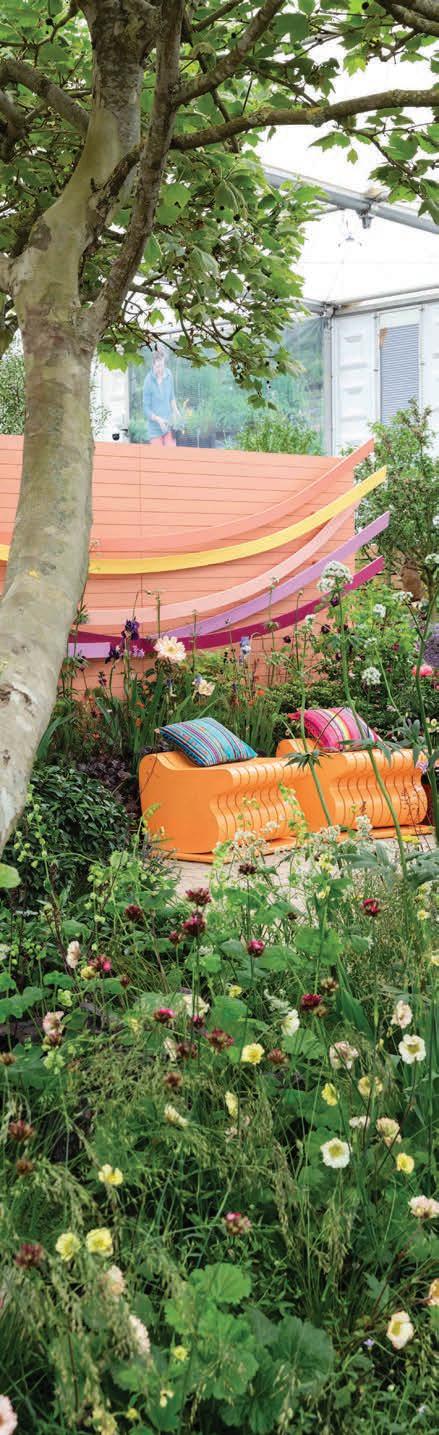
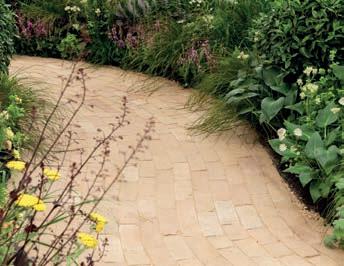
Walker wanted her first show garden to promote a message of inclusivity and joy, but “joy is intangible and completely subjective”. So, she researched what people associate with being joyful. Curves and colour came up repeatedly, both of which were therefore incorporated throughout the design, from the winding path of Vande Moortel bricks to the vibrant rear boundary, which features timber sculptures weaving across it, or “ribbons” as an “acknowledgement of celebration – celebration being a part of joy, but also celebrating the children’s sporting success.”
I’m completely invested in what Panathlon does. I felt glad to have found them. To believe in everything that you’re doing at Chelsea definitely helps on those challenging days
The garden has now been relocated to Marjorie McClure School in South London, which has “really strong links with the charity” and is “delighted” with the new addition.“You know what it’s like, schools never have any budget; so, to get a garden that has been to Chelsea that has these amazing trees and all this colourful planting is amazing. They’re over the moon, which is really nice to have seen that response.”
Prior to this year, Walker’s Chelsea experience had been designing stands. Whilst
she says it wasn’t a “huge shift” to design a garden, there “was a shift mentally – there’s a lot more pressure.” She’s still caught the ‘Chelsea bug’, though, with ambitions to design a garden for the RHS Hampton Court Palace Garden Festival where “there is less pressure on space” as it is outside central London.
Outside of shows, Walker is eager to explore the possibility of commercial work. “It’s quite a different animal to residential. I love working with residential clients, but I’d love to get more involved with hotels and
luxury spas, the more high-end boutique section of the market, where it’s very much about client experience. They try to create a certain ambiance and I strongly believe that part of that narrative is within the landscape as well.” Having already created joy through her first Chelsea garden, Walker will certainly be able to create any atmosphere a commercial client desires – and all with a smile.
Having purchased a Clapham property that required an extension and refurbishment, the clients were eager to revitalise the space by adding hard landscaping, texture, colour, and specific areas of interest. And with a love for design and interesting styling, they were also not afraid to make bold choices.
One key consideration for this design that garden designer Katerina Kantalis, was challenged to take on, was making a physical connection between the interior and the garden space. With tall sliding patio doors that 1 High springtime colour with a tapestry of greens and burgundy.
fully opened, the clients were keen on creating a garden that captivates from every angle, whether viewed from the kitchen, diner, or the lounge. Creating a seamless indoor-outdoor living experience, however, isn’t just about ensuring a smooth transition from the house into the garden, but is also about treating the space as an ‘outdoor room’ and producing a scheme and palette as if it’s an interiors project.
Kantalis started by retaining the existing Tibetan cherry tree that stood within the garden to add instant maturity to the new space.
To ensure privacy, Kantalis incorporated contemporary screening with slatted fencing of increasing height. Additionally, a rear raised bed with a row of birch trees at the garden's far end provided privacy from the neighboring property. It also created a focal point, visible from the house, as well as adding vertical interest to the garden's landscape.
For this project, the clients had also opted for exquisite materials, meaning that the budget was allocated to integrate Siberian larch slatted fencing, imparting a contemporary aesthetic, and which over time, will gracefully develop a silvery patina.
To infuse a a touch of sophistication, Kantalis opted for limestone pavers arranged diagonally in a contemporary pattern, creating a visually striking contrast against the slab khaki porcelain paving on the main pathways and patio.
Employing these angled features within the design helped to detract from the conventional rectangular layout of the garden, while also creating a sense of progression from the house towards the rear of the garden.
Certain areas of the paving were crafted into triangular points, while limestone cobbles were artfully positioned to suggest a directional flow towards the garden's end. The use of statement flooring creates definitionand interest in this small outdoor space.
Lighting played a pivotal role in elevating the overall ambiance too. Selecting statement lights to make a lasting impression, the lighting design focuses on warmth and subtlety, fostering a seamless connection between the kitchen and garden, transforming them into a unified space in the evening.
Instead of conventional options, Kantalis chose contemporary 'art' wall lights that seamlessly integrate into the garden's design, serving as both functional and aesthetic elements.
Kantalis then established two seating areas within the garden: a cosy area perfect for enjoying morning coffee, contrasting with a more formal lounge seating area at the rear which was embraced by the birch trees and planting beds.
Within the planting beds, lay a plant selection that was carefully curated to evoke a contemporary naturalistic ambience in the garden. Inspired by the existing Tibetan cherry (Prunus serrula), a harmonious colour palette of burgundy, green, and white hues dictated the plant combinations throughout.
To introduce the vertical interest, Himalayan birch 'Ramdana River' (Betula utilis subsp. Jacquemontii) and soft tree fern (Dicksonia antarctica) were incorporated.
Shrubs like Physocarpus opulifolius and Hydrangea paniculata were also chosen to add depth and seasonal appeal.
Grasses and ferns were strategically planted in the garden as companion species to complement the Acer and Betula. Additionally, Japanese anemones and agapanthus were selected for their flowers.
Although Kantalis had to remove one tree in the garden, she ended up keeping the other existing tree, as well as planting an additional five trees. Despite only having a small space to work
with, Kantalis wanted to ensure that she was adding as much as possible back into the garden.
Kantalis tried to minimise the amount of porcelain paving used, so she only utilised this for the paths, with the majority of the space
2 View into the garden
3 Fern shadow play
4 View from the lounge into the garden
5 Statuesque torc pots creating a focal point
6 Statement lighting
incorporating limestone cobbles instead, as this provided better drainage and are a natural stone.
Maximising the use of planting beds, Kantalis brought the planting beds into the garden, which allowed her to minimise the amount of hard
landscaping in the garden and ensure that plants took priority.
Fortunate that there weren't many challenges to this project, apart from some material delays, the main challenges were having to go through the house which adds extra time to a project. However, being a London situated domestic garden, this is something that Kantalis encounters on a regular basis.
One refreshing aspect that helped Kantalis was the clients' decision to prioritise the garden first and complete their house renovations afterward. Having learnt from previous projects, Kantalis says
she was grateful that they had taken this approach. The clients then worked with the interior designer who was given a brief to ensure the garden and interior blended as one. The results, therefore, for both the inside and outside, were seamlessly matched.
7 Time to sit and relax within the garden
8 The garden before the transformation
9 Limestone paving detailing
10 Limestone paving detailing
ABOUT
Embracing both her Australian upbringing and her Greek heritage, Kantalis’ lifelong passion for gardens, nature, food, and the outdoors paved the way for a journey into garden design. Upon relocating to the UK, Kantalis retrained at The British Academy of Garden Design, leading to the establishment of her garden design studio in Crystal Palace, London. Her approach to garden design combines the interplay of subtle curves with geometric patterns, inspired by Mediterranean landscapes her designs integrate permeable materials and emphasise texture and pattern, incorporating vibrant colours. katerinakantalis.co.uk
REFERENCES
Porcelain paving London stone
londonstone.co.uk
Planters Torc pots torcpots.com
Limestone stackers Mandarin stone mandarinstone.com Plants Evergreen nursery evergreen-nurseries.co.uk
Select ‘Best in Class’ - Jointing Technology for Every Project - New & Repointing
Patio Grout by GftK, the best 1-part, air-drying, paving joint mortar!
- Unique with big advantages! EASIER to apply by wet slurry techniques, it is FASTER because it fully self-compacts into the joints, with no additional finishing or tooling required. Patio Grout then gives BETTER results, including higher strengths, and better optimised performance, with higher resistance and durability than any other 1-part material. For both DIY and professional use.
GftK vdw 400 plus Color, the best cement-based, flowable jointing mortar!
- Highly flowable and self-compacting, polymer-modified, cement slurry, paving jointing mortar. Ideal for both natural stone and external porcelain tile paving, with light, medium and heavy traffic loadings. It is fast setting, walkable after a few hours, then achieves high strength and is very resistant to frost and de-icing salts. A proven track record over 20 years. For professional use only.
- The unique, 2-part epoxy, dust-free, fast-curing, no shrinkage cracks, plus a sheen free finish. It can be applied in cold ( > 5oC) and wet weather conditions, is very high flow and self-compacting, for ease of application, resulting in optimum strengths. Fully resistant to traffic, de-icing salts, and jet-washing. The way forwards with no more delays, plus the highest performance and durability.
GftK vdw 815+, the narrow joint version of 850+ with the same benefits
- Based on the same state-of-the art technology as GftK vdw 850+, but designed for narrow joints from 3mm wide in larger format natural stone paving, and also absolutely ideal for external porcelain tile paving grouting, and without delay - No waiting required. Supplied in smaller 10kg units for fast and residue-free, wet-slurry grouting of porcelain paving.
Visit: www.NCCStreetscape.co.uk
Email: sales@NCCinAction.co.uk Call: 01257 266696
OUTDOOR LIVING MADE EASY
Our stylish new outdoor kitchens are made from powder coated aluminium and 100% recycled polywood. Choose from a sink unit or a 3 piece set that includes a worktop with ice bucket, cabinet and portable trolley, all including a cover. Available in 4 unique colour schemes that will complement any garden aesthetic.
Pair with our recycled composite decking, cladding or fencing materials for a durable, low-maintenance outdoor space you’ll enjoy for years to come.
Scan to view our outdoor kitchens
Cotton Outdoor Kitchen, also available in Smoke, Oak and Taupe.
paradiseCOUNTRY
ROBERT MYERS ASSOCIATES
PARK HOUSE, CAMBRIDGESHIRE
Robert Myers Associates accepted the redesign of the Grade II listed house, set back in the middle of the countryside. With stunning views from within the house and a modernised interior, the overall project brief encompassed a number of internal alterations to the house – including the construction of a new kitchen wing, a conservatory, a new garage and a parking court.
PROJECT DETAILS
Project value
Undisclosed
Build time
Final landscape construction works completed in July 2020
Size of project 3000 square metres Awards
Winner: Society of Garden DesignersBest Large Residential Landscape & Garden
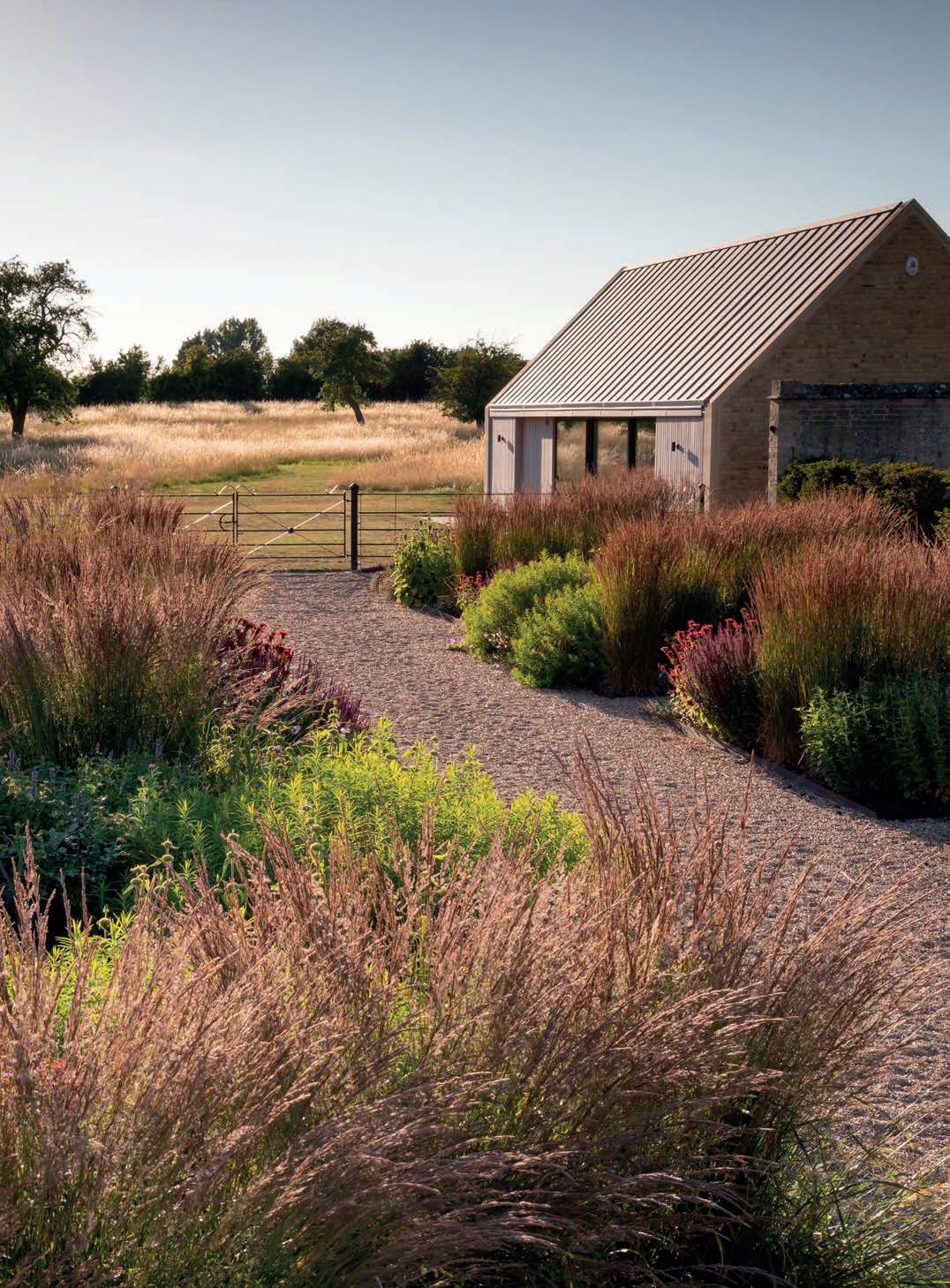
This was accompanied by a comprehensive reworking of the gardens, including a dining terrace, new planting, the development of a meadow and orchard, a kitchen garden and a reconfigured swimming pool garden with a pool house – all whilst creating a beautiful flower garden that draws the eye out and into the landscape and reflects the scale and height of the house.
Robert Myers Associates was to design a contemporary planting scheme which embraced and connected the historic house with the new 21st century pool building, as well as to introduce a sense of place and excitement by slowly revealing greater detail as visitors would progresses through the garden, to discover water, texture, and flowering colour.
Based on the extensive brief, Robert Myers Associates created a “landscape masterplan” for the entire site. The proposal included the restored and enhanced setting of the house, improved external access and circulation, as well as the creation of new garden spaces and increased the wildlife value of the site.
Myers specifically mentioned the use of a colour palette of pink, blue, purple, and red with a contrasting structure of hedges and grasses for winter structure, with the aim to extend the flowering season with semi and non-native plants, all whilst introducing additional water for birds and insects.
The design also followed five specific guiding principles:
- To create a series of garden spaces at different scales that allow for various uses relating to the new site boundaries and the re-profiled buildings;
- To restore the character of the Victorian approach and planting on the east side of the house;
- To improve circulation around the site, respecting the site's history whilst creating a contemporary design that meets the client's needs; - To enhance and reinvigorate the setting of the listed building;
- And to improve biodiversity and wildlife value.
A new kitchen extension to the main house and a stand-alone pool building re-defined the existing boundaries and views out. Originally, the house and
garden had been divided up into family and service wings by an old garden wall which hid one from the other.
The line of this wall led to the creation of a strong diagonal axis between the open prairie style flower garden and the more compartmentalised pool and vegetable gardens.
A new parking court was therefore created between the proposed garage and the house, recreating the sense of the original service court that once existed here. And the existing swimming pool having originally been within the walled enclosure was then replaced with a new pool, and a pool house which was
constructed to the south, both facing across the garden. The existing boundary wall to the east was extended as a result, to complete the enclosure of the space, and supported a proposed greenhouse to the east.
Robert Myers Associates ensured that the plant beds were arranged around a series of reflecting water tanks and planted with structurally clipped hedges, mixed grasses, and herbaceous plants. These include plants attractive to wildlife for their nectar and berries.
The original site provided a lime-rich, loamy, free-draining soil with an open south-eastern aspect, laid down to grass with views of the historic orchard. Planting was restored in the northern section of the paddock, with new parkland trees to the south.
The new planting design also addressed this lack of biodiversity on site by introducing a wide variety of perennial, shrub and tree planting punctuated in the flower garden by pools of water. This provided
a ready source of nectar and berries for birds and insects alongside the water tanks which created a valuable source of water for pollinating moths and bees.
Winter structure was provided as planned, by the beech hedges and grasses giving shelter for insects and birds and the path surfaces throughout the flower garden are all permeable gravel to follow sustainable urban drainage principles.
Robert Myers Associates successfully fulfilled all five of the specific guiding principles and provided a full comprehensive re-working of the gardens.
ABOUT
Robert Myers Associates is an international landscape architecture and garden design practice working in urban and rural environments. It undertakes commissions from private individuals, rural estates, developers, and institutions such as cathedrals, universities, and schools. It was listed in Country Life’s Top 100 experts on exteriors and interiors, and it has won many awards, including the Society of Garden Designers’ Grand Award 2017 for the Magic Garden at Hampton Court Palace and six gold medals at the RHS Chelsea Flower Show. robertmyers-associates.co.uk
Woodscape showcases its contribution to the Southsea Coastal Scheme
It’s nice to be
BESIDE THE SEASIDE!
The Southsea Coastal Scheme, valued at over £180m, is the UK's largest local authority-led coastal defence project. Spanning 4.5km from Old Portsmouth to Eastney, it aims to protect over 10,000 homes, 700 businesses, historical structures, and key access routes from flooding. This effort, which started in September 2020, seeks to replace aging defences and enhance the seafront for future generations, blending community protection with the preservation of the area's unique heritage.
Woodscape, renowned for its expertise in crafting bespoke street furniture, joined the project early, during stages two and three, invited by landscape architects LDA Design, who recognised Woodscape’s capacity to deliver on the demanding designs required for the scheme. The collaboration aimed to develop seating for the promenade that would capture the nautical essence of the ferryboats navigating Portsmouth Harbour,
marrying form and function with local aesthetic themes.
Material selection was critical due to the harsh weather conditions found in coastal environments. Woodscape worked closely with the Environment Agency to select Kebony®, a thermally treated softwood, which Woodscape had used on a previous project. Kebony® was favoured for its durability and sustainability, aligning with the project’s long-term environmental and practical goals.
Woodscape’s contributions included an array of custom street furniture designed to enhance both functionality and visual appeal along the Southsea seafront. The seating solutions provided were bespoke and
innovative designs, including double-sided seating with granite bases, equipped with backrests and armrests to ensure comfort and longevity. In addition, straight and curved timber-slatted wall-top seats were also created, tailored to offer comfortable resting spots for visitors while withstanding the rigors of the coastal environment.
A standout feature of Woodscape’s contribution was the creation of timber-framed swing seating. This design added
a nostalgic and playful element to the promenade, inviting visitors to enjoy a unique and engaging seating experience. The swings, besides being a hit for their recreational appeal, reinforced the promenade’s blend of traditional and contemporary design elements.
This phase of the project also saw the inclusion of fixed and removable hardwood bollards to provide enhanced area security by controlling access whilst maintaining a consistent aesthetic style, harmonising with the overall design of the seafront. The bollards, like the seating, were designed with durability
Landscape Architect LDA Design
Contractor VolkerStevin
Client Portsmouth City Council, Environment Agency, Coastal Partners
and style in mind, ensuring that they complement the rest of the project’s elements while offering practical benefits.
Woodscape’s role in the Southsea Coastal Scheme highlights its expertise in delivering bespoke, high-quality street furniture. Its ability to navigate material constraints, ensure structural stability, and coordinate on a large scale has been crucial in transforming Southsea’s seafront into a resilient, vibrant space that respects its historical context. It also demonstrates Woodscape’s commitment to sustainable, aesthetically pleasing designs that enhance public spaces while meeting rigorous project demands. It doesn’t end there either, as the development continues, you’ll see more bespoke street furniture from Woodscape being installed along this beautiful seafront.
Contact Woodscape about your street furniture requirements
Tel 01254 685 185
Email sales@woodscape.co.uk Web woosdcape.co.uk
Showcasing the UK landscape sector’s green credentials
2024 PROJECTS, PRODUCTS AND CONTRACTS
Commercial Build project | Commercial Design project | Domestic Build project | Domestic Build project | Maintenance Contract | Sustainable Product of the Year - Hard Landscaping | Sustainable Product of the Year - Soft Landscaping
2024 COMPANY AND PEOPLE
Arboriculture Company | Garden Design Company | Grounds Maintenance Company | Landscape Architecture Studio | Landscaping Company | Supplier | Sustainability and Biodiversity Leader
The Pro Landscaper Sustainability & Biodiversity Awards aim to reward and recognise the environmental benefits that companies and projects in the sector provide.
Contact the team for partnership opportunities lewis.everle@eljays44.com | 01903 777588 luke.chaplin@eljays44.com | 01903 777582
Contact Ollie or Kai to enter ollie.finch@eljays44.com | 01903 777579 kai.webb@eljays44.com | 01903 777585
These awards are on a mission to showcase the most important innovation and initiatives across the UK landscaping sector, from design, to construction, to product supply and manufacturing.
Size of project
9,800 square feet of terraces
CITY Sk ylines
FROSTS LANDSCAPES
NORTHCLIFFE HOUSE
The former state-of-the-art print and production facility for the Daily Mail, a Grade II listed industrial building, has undergone a transformation into a modern office space. This reimagining combines the building's heritage features with forward-thinking design, resulting in approximately 186,700 sq ft of Grade A workspace and 9,800 sq ft of landscaped terraces.
1 Filtered views beyond to the Southbank
The newly created terraces, spanning three floors, offer breathtaking views of the London skyline. The seventh-floor communal rooftop garden has been meticulously designed to maximise outdoor activities. It features an amphitheatre-style seating arrangement, integrated tables and benches, set amongst the intricate and striking soft landscaping. The terraces face south, providing ample sunlight and creating inviting spaces for office staff to relax and socialise while overlooking the Thames.
The grid layout, a hallmark of Townshend Landscape Architects, required precise setting out and fabrication tolerances to ensure the paving and planters remained aligned. To address the challenges of supporting small stone pieces, Frosts Landscapes coordinated the paving layout design, incorporating oversized granite slabs with false joints and marker studs to indicate drainage points below. Additionally, threshold drains were used to prevent water ingress into the buildings.
The grid layout required precise setting out and fabrication of the Portuguese granite paving and glass-reinforced plastic planters.
The glass-reinforced plastic planters were designed and fabricated in sections according to specific dimensions. The designs also integrated Kebony benches, tables, totems, sockets, USB charging points, lights, and an automatic irrigation system.
Frosts Landscapes strategically placed cylindrical planters on the paving to create visual breaks within the spaces, whilst the Kebony bleacher seating on the seventh level was added to create a unique feature to the roof terrace, and some benches also include storage compartments for irrigation equipment and lighting drivers.
The cantilevered tables, built into the planters, required localised strengthening and support of the glass-reinforced plastic to ensure their stability. Loading limitations restricted the planter heights and soil depths to 450mm meaning that instant hedge units and Double U cordon pleached fruit trees were used to act as a windbreaks and comply with planning requirements for privacy screening to adjacent existing buildings.
Jasmine screens were also used in key locations. The rest of the planting is traditional Townshend design with multistem trees, feature shrubs, and elegant herbaceous perennials under-planted with seasonal bulbs. All hedging and specimen plant stock was hand-selected at source, and the rest of the plants were contract grown in the UK.
In the back-of-house areas, Frost Landscapes used existing paving and cobbles which were cleaned and re-set to ensure alignment and levels. Sections of the seventh level were also lifted and re-laid to create a new
2 Seating areas are flanked by dense and verdant planting
3 Magnificant Cornus kousa var. chinensis in flower
4 Level 7 bleacher seating and terrace
5 Free-standing furniture fill the alcoves
6 Long and narrow terraces with instant Carpinus betulus hedging
arrangement that allows for level access from the new service lifts. To introduce biodiversity to the project, wildflower turf was installed on the green roofs of the lift shafts and service buildings on the eighth level.
Frosts increased the sustainability of the project by using a series of recycled materials such as green waste compost within substrates and planters made from Bioresin incorporating recycled plastic bottles.
The pedestals and reservoir boards used are 80% recycled ppc, and the existing concrete pavers were re-used in back of house areas whilst existing cobbles were kept and re-used underneath new decorative cobbles.
The project presented several challenges, including working with Grade II listed architectural features, assuming full design responsibility for the Stage 4 Design, and dealing with limited loading capacities on the existing and new roof slabs, which necessitated storing materials
across the floor plate. The long and narrow terraces posed difficulties in terms of access and material movement. Additionally, delays in the building and facade packages impeded progress due to the space they occupied.
The positioning of the tower crane through the building required its early removal to facilitate the closure of the roof. Although some preload out was managed, the restricted space prevented its implementation on all floors. Consequently, internal hoists, lifts, and stairs were utilised to transport most of the materials. This required careful coordination with other trades – in particular, Frosts Landscapes teamed up with the atrium and M&E contractor to ensure interfaces were managed and access simplified.
7 Planting brought into terraces to connect with building 8 Condition of terraces before the transformation
ABOUT
Since 1959, the Frosts name has become synonymous with quality and style. The future of Frosts Landscapes as an employee owned business is in the hands of directors Alistair Bayford, Adrian Meeker, George Mowbray and Jon Salem, who are dedicated and passionate about the landscape industry. frostslandscapes.co.uk
SUPPLIERS
Monchique Granite Pavestone pavestone.co.uk
Planters Europlanters europlanters.com
Plants Robin Tacchi Plants robintacchiplants.com
Trees and hedging Smits Tree Nursery smitsbv.nl
Green screens Mobilane mobilane.com
Bespoke Kebony stepped seating units Urban Concepts urbanconceptsltd.co.uk
Shire Green Roof Substrates greenroofsubstrates.co.uk
Rock and Roll
In a world where we’re surrounded by artificial, I personally think a landscape or garden design should be as naturalistic as possible. An immersive place to unwind, switch off and escape from the madness of modern-day life. With the exception of only the most contemporary of schemes, I’d always suggest using a natural stone element in some form as part of your hard landscaping materials palette. If used effectively, natural stone can instantly ground a design with an air of establishment, soften an area of structural detail and create essential balance with planting – the most natural of all elements.
Within the context of a wider design, natural stone can transport you to another area of the country, a habitat that exists beyond the boundary or even a far-flung continent (depending how it’s used). Paving, boulders, walling, cladding – you name it, there’s an application. Suppliers are engineering new innovative products all the time and so research is key.
When specifying, I’d always be conscious of how it ages and weathers as it can change dramatically over time
Although porcelain and other options have their benefits and place, it and other manmade products are harder to recycle and remove from sites at the end of their life cycle. Natural stone remains the more sustainable option, something we should all be considering when discussing paving materials with clients.
Natural stone comes in all shapes, sizes and colours, and can add warmth and
character to a space. When specifying, I’d always be conscious of how it ages and weathers as it can change dramatically over time. I’d usually recommend sealing a natural stone; this helps with durability and longevity. Read up on your product choice – they vary in terms of application, and some are more sustainable than others in terms of their chemical content. There are many types of limestone paving, with different characteristics depending where
Natural stone is incredibly versatile and can really complement a project, explains Matt Evans
in the world it originates. These factors affect not only the look of the limestone, but also the way it performs in your scheme. Sandstone can add real character to a design due to its multi-coloured characteristics –two pieces rarely look the same, so be mindful of porosity and staining with sandstone. Think ‘right product, right place’ – does it work for your site?
Guiding the journey through a space with natural stone as a pathway material is commonplace, but I think where successful designs really harness the power of natural stone is when you look to use stone for other features. A perfectly placed boulder, a dry-stone wall detail or clad section of
CED STONE GROUP
walling, or perhaps a self-binding aggregate pathway. Pairing the design with the right type of stone is key, and researching stylistically speaking what works in terms of colour and texture within a design should be one of the first design tasks.
Think about how the natural stone links with the wider materials palette; for example, pairing Corten or mild steel with Purbeck or Cotswold stone screams rustic charm with a contemporary twist. Red brick alongside flint detailing is typical of an East Anglian farmhouse or older rural project, and large format porcelain with a limestone paver edging detail could be a nice way of doing something far more contemporary but still using a natural stone element to soften. As always, the devil is in the detail.
Creating waterscapes with natural stone is something that takes an eager client and larger budget, but it can absolutely transform a space. Using feature stones to create cascading water across changes in level brings movement, sound and biodiversity into a design. Boulder placement and (without wanting to sound like I’m banging a drum for 80s garden features) ’rockery’ planting can quickly add vertical interest and a sense of establishment to even the most level and un-interesting of sites.
In our studio, we have jars of aggregate samples; one of my favourites is a crushed seashell. Delicate, detailed and specific, this product (only used in the most apt of circumstances) is evidence that natural stone doesn’t just tick the paving box.
Natural stone can be tactile – the cladding you brush past on a wall as you climb a staircase, a perfectly chosen boulder, honed and sealed to be sat on with a drink in the shade, the whacked down self binda your children learn to ride their bikes on down a long garden path or the interplay between planting and a drystone wall or gabion basket detailing a level change. Don’t overlook this natural element – who knew rock could bring life and soul to the party?
Matt Evans is the managing director and design lead at The Garden Room Living and Landscape Studio, based in Poole, Dorset. The Garden Room is a young, creative design studio founded by partners in life and design, Matt and his wife Elle Evans. Located just a stone’s throw from the shores of Poole Harbour and the Jurassic Coast in Dorset, they operate across Dorset, London and the south of England offering garden design, project management and planting as well as specialist aftercare. thegardenroomstudio.com
3 ROCK-SOLID
suggestions
Nustone
Kandla Grey Sandstone Paving
Featuring light tones throughout, this Indian stone brightens up any garden to create an added sense of space.
Price: From £22.48/m2 nustone.co.uk
Weathered and rough, these rustic and atmospheric boulders will make an attractive addition to an outdoor space and will look like they have been there forever.
Price: £250/tonne cedstone.co.uk
Feature stones
Often working from simple sketched ideas & concept drawings, Allgreen's mason’s skill and craftmanship bring your vision to life.
Price including VAT: POA allgreen.uk
Gabbro Boulders
MATT EVANS
TECTONIX
Trentino Porphyry
Porphyry is our favourite natural stone at Tectonix due to its vibrant colours, ranging from purplish-red to greenish-brown, which stem from its iron content. Formed through the slow cooling of igneous material, it is exceptionally strong and weather-resistant, making it perfect for high-traffic areas. Used as a paving product since Roman times, porphyry’s warm earth tones; greys, browns, rusts, buffs, and violets, offer a unique blend of beauty and durability, making it a timeless and versatile paving option. tectonix.co.uk
NATURAL STONE
Market-leading materials and products that will rock your outdoor projects
NUSTONE
Kandla Grey Sawn & Honed Sandstone
Kandla Grey Sandstone Paving is a versatile, natural stone which suits any modern or traditional patio design. The range of light tones will brighten any dark areas in your garden to create an added sense of space and provide a neutral and tasteful backdrop. This choice of natural stone paving offers charm and appeal, with each paver featuring its own unique tones formed naturally over thousands of years, promising a finish filled with character. nustone.co.uk
RYNO
TerraSmart® Rail Paving System
TerraSmart® Rail is the ultimate raised paving system for natural stone on terraces and podiums. It uses superstrong, 100% recyclable aluminium joists and rails to create a lattice framework that provides continuous support for pavers. This addresses any inherent fault lines in natural stone, as the continuous support from the rails eliminates reliance on individual pedestals and accommodates various paving layouts and intricate edge details. The system is fully non-combustible with a Euroclass A1 fire rating, a 30-year warranty with hidden and visual wind uplift restraint options. rynosystems.com
AZPECTS LTD
EASYJoint Original
EASYJoint is the ‘Landscapers Favourite’ paving jointing compound. This product was first developed in 2009 and has now evolved to meet user demands and keep up with the latest trends in the industry. The EASYJoint family now has nine products within the range. This all-weather sweep-in joint compound is a very quick, effective, and aesthetically pleasing way to fill joints between paving. Making hard landscaping even easier because the product is best installed in wet conditions; rain or shine, it goes in fine. azpects.co.uk
CRESCENT STONE
Sandstone
Renowned for its durability and versatility, sandstone is a staple in commercial construction and landscaping. Our clients benefit from various colours, including the famous Kandla Grey, Rippon Buff, and Raj Green. The rich Autumn Brown tones, unique Two Tone patterns, and striking Sagar Black complete our diverse range. Sandstone's inherent strength, weather resistance, and low maintenance make it ideal for various applications. From elegant facades to robust paving, our sandstone delivers exceptional value and longevity. For integrating premium sandstone, limestone, granite, marble, and/or porcelain pavers into your product line, contact Crescent Stone, your trusted B2B partner in natural stone solutions. crescentstone.co.uk
TRADE PRICE STONE LTD
Premium Black Brazilian Slate
Trade Price Stone is the UK’s largest Brazilian Slate importer and delivers across the country. Prized for its durability, versatility and natural beauty, Premium Black Brazilian Slate is considered a stylish choice by professional landscape designers and contractors – whether for contemporary or traditional projects. Large stockholdings mean quick delivery of black and grey slates with honed or natural finishes. Trade Price Stone has a large collection of standard sizes to choose from, all at the best trade-only prices. Large format tiles are a speciality. Custom/bespoke designs and shapes are created using in-house CNC equipment. tradepricestoneltd.co.uk
The fresh new exhibition showcasing the world of stone products within the landscaping industry, StoneScape Expo is the only place for landscapers, landscape architects, developers, contractors, local authorities and garden designers to witness the future of all things stone.
STONESCAPE EXPO, 15-16 OCTOBER 2024, EXCEL LONDON
Street furniture typically suggests purely practical uses, serving multiple vital roles in urban environments, from essential resting places, casual seating for conversations, outdoor dining, or offering practical amenities that support daily activities and promote sustainable transport choices.
However, the main purpose of street furniture, according to industry experts, is to connect people with nature. So, when paired with well thought-out planting elements, street furniture offers a sense of escapism, somewhere to relax and enjoy in the hustle and bustle of the city.
“Given the vast variety in street furniture, the uses are practically endless,” says Mihaela Blaginova, sales export manager at ETE Ltd. “From planter benches and uniquely designed benches to play tables and more, our aim is to encourage people to spend more time outdoors, enjoying nature comfortably.”
PRACTICAL More than just
With each new inquiry, suppliers observe a growing demand for more functional and sustainable urban furniture, with customers increasingly seeking pieces that combine usefulness with sustainability
connect communities with nature.”
More specifically, with carefully coordinated layouts and collaboration, designs can enhance public safety, especially from risks such as vehicle borne attack.
There is a need for street furniture that can adapt to dense urban settings and serve multiple purposes
Ashley Tarry, sales director, Woodscape Ltd
As one of the largest urban furniture designers in Eastern Europe, ETE Ltd uses materials that offer the flexibility needed to achieve unique designs, challenging the notion that they might limit creativity.
Each of its designs undergoes a series of tests among our team to ensure comfort, usefulness, and functionality,“we consider the needs of all groups of people to create inclusive and accessible outdoor spaces,” says Blaginova.
Most designs recently will support urban ecology, says brand manager at Logic, Alfie Johnston. By incorporating planters or green walls to increase biodiversity in city centres, “there has been a great emphasis placed on brining nature and greenery to places to
To integrate these expanded functionalities, street furniture design must be approached with a multidisciplinary mindset.
“Exploring modular design principles and paring elements of relaxation, work, play with clear walk-through zones and
functionality,” says Johnston. “Sustainability best practices such as rainwater collection systems (SuDS), could be incorporated to make street design more beneficial to the environment.”
The key is to design with flexibility, creating timeless pieces that can evolve alongside the changing needs of our cities.
According to Ashley Tarry, sales director at Woodscape Ltd, there is definitely a growing demand for multifunctional street furniture as architects, urban planners, and developers increasingly recognise the value of public spaces that offer more than just basic amenities.
“There is a trend towards creating vibrant, interactive, and sustainable environments that enrich public life,” says Tarry.
The demand is driven by three main factors; urbanisation, community engagement and technological integration.
“As towns and cities grow, there is a need for street furniture that can adapt to dense urban settings and serve multiple purposes. There is also a rising interest in public spaces that foster community interaction and social activities, and the smart city movement drives the need for furniture that incorporates technological advancements,” says Tarry.
Woodscape aims to cater to these evolving demands using innovative designs, providing solutions that are both functional and forward-thinking.
LOGIC BESPOKE STREET FURNITURE
ETE LTD
GREENER Going
With a rather controversial reputation, suppliers are eager to break the stigma around
Often used where natural grass is not a viable option and instead used as replacement for concrete or tarmac surfaces, the demand for artificial grass is here to stay for various reasons. For those with mobility issues, Andy Driver, commercial director for Evergreens UK Group Limited, explains how an artificial lawn provides a secure and weather-resistant surface and a permeable alternative to decking, paving and hard landscaping.
“Or it can also be an allergen-free alternative for those with seasonal sensitivity,” says Driver, “it opens a durable, family-friendly outdoor living area at any aspect.”
Similarly, director at Quickgrass, Richard Archer has worked with several families to supply sensory gardens for autistic children. For autistic people, textures and smells can often be triggering, combine that with the ever-changing conditions of natural grass – from dry and hard to wet and muddy
these can have a huge effect on a routine and have the potential to cause distress to the user. By adding artificial grass to a domestic garden, the user can control the conditions and have a more consistent, safer, outdoor experience. Where there is a demand, there will always be a supply. But being aware of the controversy, suppliers are working hard to ensure that products are being made as sustainably as possible and are always looking for the next best option.
“I have an appreciation that not all grass will grow in all places,” says George Davies of George Davies Turf. “I also appreciate that not everybody will want gravel or paving, as there is still the desire for the ‘greenness’ that grass provides.” And although Davies will always promote real grass where appropriate, “at the same time, I'd much rather try and give my landscapers the best and most sustainable option in the market when they’re sourcing artificial grass.”
I appreciate that not everybody will want gravel or paving, as there is still the desire for the ‘greenness’ that grass provides
George Davies, George Davies Turf
according to Driver, with Ilias Addarkaoui from Nomow confirming that its turf uses origin backing as an alternative to the standard latex backing, as it is polyethylene and effectively the same raw material as the yarns which ensures that the product is 100% recyclable. Likewise, Archer says that they too have removed the latex elements of its products which has also made the turf lighter in weight and more permeable. Lasting up to 10 years depending on footfall, suppliers continue to look towards research and developments to provide their clients the very best option for both planet and preference.
End-of-life recyclability has been the holy grail of synthetic turf suppliers for many years,
EVERGREENS UK GROUP LTD
EVERGREENS
Create the perfect space for relaxation
With OASE waterfalls
Whatever space you have to work with, adding moving water always improves the sense of relaxation. And you can create the perfect atmosphere using OASE’s stainless steel waterfalls.
With three sizes of waterfall available (30, 60 and 90 cm) you can be sure there’s one that will fit in the space you have to work with. They come with a threaded hosetail and can be recessed into a wall or screwed onto it.
If you’re not working with a pool or a pond, you can use OASE’s selfcontained reservoirs. These mean you don’t need to worry about open water. The pump and all the technology are hidden away meaning your water feature can be enjoyed from any angle.
All OASE features are available with optional LED lighting to ensure the space looks great at any time of the day or night.
OASE makes all the equipment needed to keep these features running, including energy efficient pumps with high quality German engineering. Find OASE technology, including Waterfalls at your local retailer today.
Discover more at oase.com
CoveringALL BASES
NOA Park is a unique experience, and that’s no hyperbole. There isn’t another site like it in the world. Spanning 30,000m2 – a whopping 25,000m2 of which is outdoors –NOA Park brings together 30 high-end outdoor living brands to create a green oasis near the historic Belgium city of Ghent.
From a pavilion ‘floating’ on a lake to a hidden pool to an infrared sauna, the 12 garden settings which make up the park have been designed to offer inspiration for both domestic and commercial clients.
“The outdoor designs have sparked ideas that I am eager to implement in my own projects," says Adam Stewart, managing director of Utopia Landscapes – one of a dozen landscapers and garden designers to join the first Pro Landscaper on Tour trip to visit NOA Park in July.“The combination of exterior and interiors products was perfect.”
The outdoor designs have sparked ideas that I am eager to implement in my own projects
Adam Stewart, managing director, Utopia Landscapes
The park is the brainchild of Renson, a luxury brand known around the world for its innovations in ventilation, sun protection and outdoor living. It needed a new production site on top of its headquarters in Waregem as well as a new showroom which had to be conceptual and beautiful. Originally, the garden took up just 4,000m2, but the pandemic sparked a change of plan which saw the outdoor space grow five-fold.
The first Pro Landscaper on Tour saw a group of garden designers and landscapers visit Renson ’s awe-inspiring NOA Park in Belgium
Renson brought on board Hilde Baekelandt to lead the project. Utilising her background in the high-end outdoor furniture market, Baekelandt engaged 30 partners to provide products from flooring and lighting to furniture, rugs, fencing, gates, plants, saunas, outdoor kitchens and grills, all complementing Renson’s various pergolas and pavilions scattered throughout – a concept that gives NOA Park its name, reminiscent of Noah uniting the animals in the ark. There are ‘premium partners’ and ‘decoration partners’ on either one- or three-year agreements, all of which have been carefully selected by Baekelandt.
A stroll through the park starts outside the entrance to the 380m-long building with a view over the plaza, which is currently being redeveloped. The area will provide a place for people to gather alongside a stylish bar and an outdoor television – offering inspiration for hotels, perhaps, or restaurants. This is bordered by three different settings – the Pavilion, Eden and the Lounge.
Visitors then come across the City, where a series of contemporary spaces show what’s possible in an urban area, from an outdoor kitchen and dining area to a swimming pool, table football and car charging stations.
A small house called the Lodge then feels like an ideal staycation spot overlooking the lake.
The centrepiece of NOA is arguably the luxurious pavilion that stretches across the lake, which has an Asian aesthetic, with contemporary materials and Taxidium distichum, for instance. This is followed by the large Residential garden, which includes an outdoor kitchen, pool, outdoor tennis table, seating areas and a Corten steel firepit as well as internet connection throughout.
The vision behind showcasing all the brands working together in correlation with each individual pergola was brilliant to see – something I’ll look back to for future gardens
In the Wellness garden, a sauna, jacuzzi and relaxation room create the atmosphere for unwinding, and the Office –the final garden setting – offers a place to work surrounded by nature. Throughout the park, there are also three sculptures which soften the commercial aesthetic.
Against each of the settings is a glass sign that details the partners involved in creating that space, and each of the products incorporated has a QR code for the visitor to scan for more information on the brand and product.
“The NOA Park experience was great – seeing all the luxury brands, which we're aligned to as well. Seeing other products on show has definitely given me food for thought,” says Samuel Moore, managing director of Consilium Hortus.
“I knew that NOA Park was going to be great, but it’s only when you see it in person can you appreciate the full concept behind it,” adds garden designer Lucy Willcox. “The level of detailing and how each garden had been conceived and put together was very inspiring. The vision behind showcasing all the brands working together in correlation with each individual pergola was brilliant to see – something I’ll look back to for future gardens."
Unusually, perhaps, no products are sold at NOA. "We don't sell anything here, we don't quote prices and we don't make offers – it's really about the experience,” says Baekelandt. It’s something that impressed Design Only Garden’s Taylor Gee, who says: “NOA Park was created purely to provide a great experience and immerse its visitors, in which it succeeded.”
Inside the 5,000m2 building, a sample bar sits at the back of the showroom, filled with catalogues and samples from
NOA’s partners. It's the end destination after walking through ‘The Ark’ – or the outdoor experience indoors.
Renson wanted the building to look like a pergola, with a glass showroom and aluminium profiles. The green wall provides a “relation to nature”, fulfilling Renson’s slogan of ‘creating healthy spaces’.
It's not just the look that required careful consideration, though.“Sustainability was extremely important when putting together this new building,” says Baekelandt.“We needed to be more eco minded, so it was important to use as little energy and produce as little waste as possible. So, we have a minimal CO2 footprint, and we have no water discharge.”
Nature is utilised to aid this. Rain, for instance, is collected in two large storage facilities next to the production site, holding 1.7 million litres which can be used for the water-intensive process of powder coating aluminium. The sediment is then removed, and the water reused. There’s an extra tank holding 800,000L for watering the garden during the dry seasons (which we’re told – despite it pouring with rain the
entire duration of our visit – do occur occasionally). More than 100 boreholes help to geothermally heat the building and 6,700 solar panels harness the sun’s energy.
Then there’s the screens.“We are a company not just making pergolas and pavilions but also screens; this is a very important part of our business, and we have here the screens in front of the building and on the back,” says Baekelandt. On a hot day, the screens go down, and the temperature inside drops by a comfortable three degrees.
Another large consideration for Renson was the site’s location – it’s right next to a motorway which sees tens of thousands of cars passing on a daily basis. Whilst being a great marketing tool – “the visibility is huge; the building is nearly 400m wide, so everybody sees it,” says Baekelandt.
The noise pollution needed to be drowned out, so Renson brought in students from the University of Ghent, who considered aspects like the noise being reflected on the surface of the infinity pool. Their suggestions were fed back to the landscape architect, who adjusted the initial plans.
NOA Park was created purely to provide a great experience and immerse its visitors, in which it succeeded
Taylor Gee, Design Only Gardens
The park opened two years ago and welcomes mostly B2B clients, though anyone can visit.
Around 14,000 people experienced NOA last year, both professional and private visitors, and 110 events were hosted. The landscapers and garden designers who joined Pro Landscaper on Tour’s opportunity to explore the site said they saw the value in visiting and seeing more than one brand in such an inspiring setting. They also experienced firsthand how Renson is “market leading” for its innovations.
Founded in 1909, Renson remains a family business owned by the fourth generation, Paul Renson. The week after we visit, it’s due to celebrate its 115-year milestone, having grown to 1,600 employees across the globe and an annual turnover of around €300m. It still manufactures everything – all its pavilions and pergolas – in Belgium, something which Baekelandt says Renson is extremely proud of.
Quality runs throughout its product range too.“We've stuck to our principles and have been recognised as one of, if not the most expensive products in the pergola market – and we are
proud of that,” says John Haeffele, Renson’s UK and Ireland sales manager for outdoor.
“We've incorporated the best components and fully comply to Eurocode – which is the difference between having strength in the actual column posts whereas most are just fixed on the low-level footing. This is going to become far more important in the future and is something that we’ve invested in; there are only three companies that have got it. We also have the best warranties on the market.”
There’s the standard 10-year warranty or – for a maintenance fee of around £70 a year –there's a 15-year warranty that clients can take out on the powder coating.“The garden should give owners the ability to be outside in all seasons and the structure should support and allow them to do this.”
striking aluminum pergolas, especially the ultra-stylish Amani structure,” add Jake and Ethan Thorne of Green Genie.
Take the minimalist design of the Lapure, a patio cover with fabric. This is “in some ways the first stop towards making a pergola,” says Haeffele. It has a fully retractable roof with lighting and four options of screen intensity including a picture window option. We offer twenty standard RAL options for the frame and a full range of colour options for the screen fabrics.
We were blown away by the stunning and structurally striking aluminum pergolas, especially the ultrastylish Amani
Darren Williams, managing director, Hide Landscapes
“It’s a stronger construction than standard awnings, so they should last longer. This is our introduction to the pergola range.”
The Algarve is “the introduction to the blade roof” with a fixed canvas roof option too, and the bestselling Camargue features a rotatable blade roof opening 150 degrees and with fully integrated accessories that fit within the frame itself, making it “much more attractive”.
Then there’s the newest addition to the range, which has been designed from all three of these – the Amani, which means ‘peace’ in Swahili. The luxury louvered canopy launched to the UK market at this year’s RHS Chelsea Flower Show through Renson’s Premium ambassador, Garden House Design. It has been in the making for six years and now forms the heart of the company’s showroom at NOA Park.
“The first thing you notice when you walk in is the Amani pergola; it’s like a mini house with all the extra add ons that have been included,” says Darren Williams, managing director of Hide Landscapes. "We were blown away by the stunning and structurally
Being able to tailor Renson products to client requirements is a key selling point for all its products, says Haeffele; but the Amani takes this to another level. Its exterior sides can feature up to four options on a single beam including screens, curtains, fixed walls and sliding or folding doors. Accent lighting and specific spotlighting can create distinct personal areas. Fixed blades allow pendant lighting and ceramic heaters to be positioned anywhere in the roof blade space. Even the placement of the columns can be adjusted. All RAL colours and finishes can be provided to complement any outdoor design.“The Amani is definitely something that I've never seen before; no-one else has got that at the moment,” adds Sam Moore.
It’s the cherry on top of an array of high-end products on display at NOA, all of which are linked through their connection to quality. “Walking around the facility was truly a breathtaking experience, and I found the entire setup to be incredibly inspiring,” says Landscapia’s Marc Lane.“What really stood out to me was how the facility felt more like a contemporary art gallery showcasing high-end products rather than just a showroom. It was clear that a lot of thought and effort went into creating such a unique and visually stunning space.”
There’s little doubt that Baekelandt and the team at Renson have carefully constructed every inch of NOA Park. Next year, the three-year partnerships will be up for renewal, and the 30 brands on display across the site could change – which gives yet another reason to keep going back to NOA Park for a different experience each time.
Interested in visiting NOA park in Belgium? Get in touch with John Haeffele: john.haeffele@rensonuk.net +44 7720 804 943.
INTERESTED IN PRO LANDSCAPER ON TOUR VISITING YOU?
The new event offering from Pro Landscaper brings together landscapers and garden designers with the industry’s leading suppliers, offering a unique opportunity to network with fellow industry professionals and learn more about some of the innovative products available on the market.
Get in touch with Tom Dennison to find out more: tom.dennison@eljays44.com | +33 771 702 589
GREENER SOLUTIONS FOR SUSTAINABLE LANDSCAPES Beyond hard engineering:
Greenfix is revolutionising landscapes with its nature-friendly solutions
The traditional approach to erosion control and soil stabilisation has shifted in recent years with “green" solutions that integrate with nature replacing "grey" hard engineering. When landscapers are creating slopes and retaining walls, they can now opt for materials which give a vegetated appearance without sacrificing long term stability.
Natural England’s Green Infrastructure Framework aims to provide nature-rich, climateresilient urban areas, while improving access to green spaces and enhancing biodiversity in towns and cities. This has placed the focus for designers onto methods that support these aims
and shifting emphasis away from “grey” solutions, which in practical terms usually means concrete.“Green/Grey” measures offer a compound solution of materials needed to create a permanent structure while also supporting a vegetated aspect to enhance biodiversity.
Greenfix Geoweb® cellular confinement system is one of the most adaptable of these “green/ grey” materials. For earth retention systems, it offers a design flexibility that is not possible with rigid materials. Geoweb® walls feature horizontal terraces of cells that are effectively a series of pockets which can be planted or seeded as required. The 120-year design life of the environmental degradation-resistant HDPE panels ensures longevity of the structural element, and the perforated cells allow rainwater
to infiltrate through the wall face, minimising runoff.
Opt for materials which give a vegetated appearance without sacrificing long term stability
Geoweb’s three-dimensional cellular structure can also be used to stabilise topsoil for sustainable vegetation on slopes up to 60°. The system prevents severe erosion caused by surface runoff. The other method for creating a vegetated earth retention system is MSE (mechanically stabilised earth) bags. Greenfix’s Greenlok® is a UK manufactured geotextile bag. Vegetation can be achieved through a variety of methods, including internal seeding, hydroseeding or by placing Greenfix’s pre-seeded Covamat™ over the bags. The Greenlok bags also have advantages for landscape designers as they can be used to create curves and more complex structures.
Greenfix’s Coir based blankets and meshes can control surface erosion caused by rainwater and repair damaged areas. A frequent issue we are
given is that vegetation has been stripped away and subsequently topsoil lost from slopes and watercourse banks. The Riparian owner, someone who owns land that borders a natural watercourse, is responsible for maintaining the health of the waterway. This includes preventing erosion and maintaining vegetation along the banks. Biodegradable blankets are the ideal solution for providing manageable vegetation on slopes and banks. In the last few years new products, such as our Embankment Mat for high energy waterways, have largely removed the need to resort to plastic based mats.
We pride ourselves on finding the right solution for our customers to achieve the desired result, offering materials which maximise biodiversity and sustainability. Greenfix also offers CPD approved seminars. For more information, email info@greenfix.co.uk Website: greenfix.co.uk Tel: 01386881493
GREENFIX COVAMAT™
GEOWEB®
GREENLOK®
GEOWEB® EARTH RETENTION SYSTEM
Beyond
AMBITION
How do you go from being a one-person operation to an employer with a healthy bank balance and a happy workforce?
WORDS: ANNA MUGGERIDGE
Being your own boss can be incredibly rewarding. But you’d be forgiven for sometimes wondering if it is really worth it while you’re knee-deep in mud, clearing out an old pond on a wet Wednesday afternoon. What you have to think of is that even the most successful entrepreneurs had their days in that pond, too –metaphorically speaking.
Growing your business and becoming successful is not exclusively about profits. The most successful leaders look at the bigger picture, from the people they work with, be they employees or fellow business owners, to raising industry standards and awareness, to providing the best service possible to the clients. Here, we talk to some top names in the landscaping field to discover how they have achieved their success.
“Setting goals was crucial from the start,” says Marc Murray of Murray Landscapes, who started his business mowing lawns for his gran and her neighbours and has since gone on to receive an award for the best landscaping company in Scotland. “I had a clear vision of where I wanted the company to be in the future, and I set both personal and company goals to provide direction and purpose. Putting the plan together involved careful analysis, market research, and considering various factors. While we had a general timeline in mind, we focused more on achieving specific milestones and goals rather than strict time limits.”
For Marc Lane, founder of the multi-award-winning Landscapia, goals give you a sense of purpose but are transmutable. “I think you should see goals as an aim rather than a set thing you have to achieve because goals change. All you need to know is that every goal you’re taking is stepping in
While we had a general timeline in mind, we focused more on achieving specific milestones and goals rather than strict time limits
Marc Murray, Murray Landscapes
the right direction. There’s a straight road and a winding road. I went down the winding road for years but now I’m pretty much on the straight road. I might divert occasionally, there might be a shiny new thing taking my attention, but I’ll still be travelling in the same direction. I think goals really are a direction rather than a destination.”
Being prepared to adapt and change plans is essential in the landscaping industry, which is quite literally open to the elements. Rather than allowing yourself to become demotivated and seeing this as a setback, accept that change is necessary and is part and parcel of any successful business.
“There have been instances where we have set targets that turned out to be unachievable,” says Murray. “In some cases, we realised it along the way as we faced unexpected challenges or limitations. When that happened, we made necessary adjustments and set more realistic goals. I don’t think it’s a big issue when you come up against things out of your control.”
“We might make a plan for the next three weeks, but I guarantee that it will have changed six times by the end of week three,” says Adam Geldart of Gel Landscaping, which won this year’s Pro Landscaper Business Award for best new company under two years old. “When it comes to our goals, we accept that plans might change. We don’t think it affects our goals in the end; we just might need to adapt them along the way.”
Olly Gregson of Hardwood Landscapes factors in changing goals as part of his business plan. “People often ask what our five-year goal is, but because the industry and our company are fast-paced and developing, I’ve never had clarity on that. I think planning for six months ahead is a much more realistic parameter because if we give something a really good go for six months, that’s normally long enough to tell whether it’s going to work. I think if you’ve really pressure tested it but it’s not working, don’t be too proud to go back to the drawing board.”
When it comes to our goals, we accept that plans might change. We don’t think it affects our goals in the end; we just might need to adapt them along the way
Adam Geldart, Gel Landscaping,
Gregson says he left school directionless and without any motivation. Needing to get a job, he followed in his father’s footsteps and began working in landscaping seven years ago. Soon after, he decided he wanted to work for himself and that was when his ambition really kicked in. He now has 13 employees and a turnover of £1.2m per year. He sees growth not just in financial terms but also through the calibre of the company he keeps. This network has been achieved through a rather bold strategy of revealing all in a behind-the-scenes documentary on YouTube released weekly.
If you’ve really pressure tested it but it’s not working, don’t be too proud to go back to the drawing board
Olly Gregson, Hardwood Landscapes
“I think the most important and powerful thing we’ve done is simply telling everyone what we do. If we have an idea, we tell people what it is. We’re not scared to share it or worried about it being stolen –I think that’s a very dated and limiting mindset. We have found that people will reach out if they see us doing something wrong and they’ll offer advice, and if we try something that someone else has tried and failed at, people will get in touch and tell us the pitfalls to look out for. All of the engagement we’ve had from this has been incredibly constructive.”
Lane has also focused this year on adopting strategic alliances and has found that they are paying dividends. “If you’re not great at something but another company is, rather than battling and competing, why not work together and recommend each other? Or bring each other in? You may have someone out of your industry, such as a developer or an architect who could really do with your services, especially if you’ve got the same clientele; you could offer the right client enough for the full service rather than try to go it alone. I think if we all work together more, we’ll definitely get a better outcome.”
While Murray’s business has seen it collaborate with big names such as DeWalt and RBS, it is also the positive feedback he has received on smaller achievements from
satisfied clients that he is most proud of, which he says comes through great teamwork. “I'm proud of the strong and dedicated team we have built, who consistently deliver as it’s the people that make Murray Landscapes.”
Recruiting loyal, dedicated employees who are skilled and knowledgeable is fundamental for the successful growth of any business. After all, they are representing you to clients. It’s a top concern for Gel Landscaping, which has set a long-term goal to open a training centre that will help develop skills as well as teach people about the materials and how to use them properly. Geldart sees this as an opportunity for the landscaping industry as a whole to benefit from. “Poor work is damaging our industry. If we had this training centre, we could teach people how to use certain products and even how to price a job correctly.”
Gregson concurs and says that in this sector, it can be especially difficult to attract and retain the right staff. “A big part of getting the right people in is making them feel involved and invested, and letting them have a creative say in what we do in the company direction.” Through the transparency of the weekly video drops, Gregson has found recruitment easier, especially for senior roles, as people already have a good idea of what to expect when they apply for a position.
The biggest thing a coach gives you is accountability. When you’re head of the company, who tells you off? Who keeps you on track?
shouldn’t stop just because you are the head of your own company. In fact, the better understanding you have of all areas of your business, the better business decisions you’ll make, which will increase profitability and growth. And if you have goals, it can be hard knowing how to go about achieving them.
Marc Lane, Landscapia
Education isn’t exclusive to a prospective workforce, though, and
“Train your brain. Start reading, listen to podcasts,” says Lane. “You don’t have to be the best in the business at everything, but it is really important to have a good understanding of everything.”
For the last few years, Lane has also been working with a business coach, which he says has seen his business grow exponentially faster than he would have been capable of achieving himself.
“The business had been going for about 15 years, but it hadn’t moved significantly. We’d won a few awards, but we weren’t growing at a quicker pace. I noticed that Walker Landscape and Design run by Ben and Grace Walker – which is a great company that had been around for a while like we had – was suddenly doing extremely well and growing rapidly. So, when I saw Ben at an event, I asked him how they’d done it, and he told me it was a business coach. Before that, I’d sort of thought a business coach was airy-fairy stuff and I didn’t see the benefit.”
Lane employed the services of Nick Ruddle from ActionCoach and things took off from there. “You set your goals for every 90 days and you’re really held accountable. That’s the biggest thing a coach gives you is accountability. When you’re head of the company, who tells you off? Who keeps you on track?
If you’re not great at something but another company is, rather than battling and competing, why not work together and recommend each other?
Marc Lane, Landscapia
the 90-day planning goals. I have wavered at some points about whether to continue with him, but every time I have done so, I have looked back and seen this has been a positive change – not only in the business but for me as a person.
I needed to change in order for the business to change.”
A big part of getting the right people in is making them feel involved and invested, and letting them have a creative say in what we do in the company direction
Olly Gregson, Hardwood Landscapes
“We meet with Nick every month to discuss issues, frustrations, what has gone well or badly, and
As an entrepreneur, you will undoubtedly have to take a few risks along the way, but whether you choose to dive into the deep end or just dip a toe in shallow water is the individual’s decision.
“Taking calculated risks is essential for success,” says Murray. “However, it's important to carefully assess potential risks and rewards. We weigh the potential benefits against the potential drawbacks before making decisions, ensuring that the risks we take are calculated and aligned with our objectives.”
Gregson holds his hands up and readily admits, “I take too much risk, which is why it’s great to be surrounded by people like Matt, who was my first-ever employee and whom I’ve recently appointed as a director. He’ll give me a reality check.”
Gregson also consults people in his network of connections which he’s built up over the years.
“To make meaningful growth, you have to take risks, as long as the risk is founded on a genuine passion for the industry. I think it is important to take risks and to reinvest in the company. Our growth so far has been purely off reinvested revenue. None of that would have been possible if we had been risk averse.”
Most recently, the biggest risk he has taken in business is hiring the two videographers who are documenting everything they do. “They are currently not directly monetised, so are being paid out of our company cashflow, and it’s a huge strain on everything else in the business. But so far, it has led to some fantastic opportunities for us and people are talking about us.”
In the end, it is the business owner who will define what success looks like, whether it’s increased profits, sustainable growth or a happy workforce. “If I can walk around our yard and offices and see people smiling and doing great work, then I think that’s a great representation of me and my company,” says Gregson.
In Adam Geldart’s case, success is more personal. “My wife Lisa got seriously ill from cancer, and I knew I had to dig deep to make sure she wouldn’t ever have to work again. But now, as she’s recovering, she’s come on board as a director, and we have started to grow the business together. If Lisa turns around and says, “You’ve done really well today”, that means more to me than anything else. That’s what makes me push further each day. Leaving something for my son to take over and trying my best so that we have a nice life together are what is important to me.”
Top 10 tips FROM OUR FOUR ENTREPRENEURS
Don’t give up. Persevere.
Be happy in what you do
Learn from your mistakes. Everyone gets things wrong, but you’ll grow and get better at what you do.
Know your numbers and business structure. If you want to grow a meaningful, sustainable company, you can’t do it by being just a tradesman; you have to be a business owner, which is a very different thing.
Have clarity on why you want to grow. Don’t just keep adding to your revenue and overheads aimlessly because you’ll end up suddenly needing £100k per month just to survive and not really understand why.
Network. It’s very easy as a business owner to get so caught up in the day-to-day that you feel like you can’t take time off to network, but actually it’s those networking opportunities that will really accelerate your growth.
Set goals. Have a path from A to B. Don’t beat yourself up if you don’t quite make it there or it changes, just make sure you’re still going forwards not sideways or backwards.
Measure and celebrate progress. As much as it’s important to look forward, it’s also important to look back and pat yourself on the back for what you’ve achieved so far.
Delegate work to free up your time to grow the business.
Maintain a healthy work-life balance. Don’t just say it, mean it. When you leave the office or the garden or yard, go for a walk and clear your head so that when you get home, your time is for the family.
For full details on all jobs, please go to horticulturecareers.co.uk
NORTH SURREY ASSISTANT CONTRACT MANAGER GLENDALE
Location: London
Are you a leader? Are you proactive? Are you resultsdriven? If you identify with the above, this role was made for you! Glendale has a great new opportunity for an assistant contract manager to support the general manager in the day to day operation of the contract, planning the tasks and resources to ensure a high quality, efficient and safe service. And most importantly, you will be joining a company that can offer valuable career prospects and believes in investing in its people, from a competitive salary to training and development.
For more details, please go to horticulturecareers.co.uk
LANDSCAPING FOREMAN
NT KILLINGLEY LTD
Location: Derbyshire
NT Killingley Ltd is looking for a landscaping foreman who is self-motivated with the ability to use their own initiative. The successful candidate will be responsible for supervising a team on site, large scale woodland and shrub planting, mature tree planting, seeding & turfing, timber & agricultural fencing, street furniture installation, completing site based paper work such as daily briefings, and general landscaping duties. Applicants will need to be hard working with a positive attitude and be able to interpret landscape architect drawings. A full UK driving license with experience of towing is preferred.
For more details, please go to horticulturecareers.co.uk
Call 01903 777 579 or email ollie.finch@eljays44.com with your vacancy For full details on all jobs, please
LIVING WALL & ROOF GARDEN MAINTENANCE OF COMMERCIAL & PRIVATE PROPERTIES
PRITCHARD & PRITCHARD
Location: London
An exciting opportunity has arisen for an enthusiastic applicant to join the Pritchard and Pritchard living wall and green roof maintenance team in London working on commercial and domestic properties. All applicants will need to demonstrate good communication skills and friendly customer service. This role will suit someone with good plant knowledge, and/or experience of horticulture. Alternatively, a recognised horticultural qualification would be required. The role will involve working as part of a team and every day will be varied. A UK driving licence is required.
For more details, please go to horticulturecareers.co.uk
LANDSCAPING SUPERVISOR
YGS LANDSCAPES
Location: Devon
As a supervisor, you will help manage multiple projects from start through to completion. You will ensure that all works are completed on time, budget and to the highest of standards. You will have good communication skills and be able to negotiate with clients and all staff from site workers to directors, in a professional and fair manner. Health and safety issues will be a top priority in this role. Supervisors will maintain an understanding of all YGS procedures and systems and consistently work towards continual improvement whilst assisting the business to achieve and maintain ISO 9001, ISO 14001 and ISO 45001 certification and other future goals and accreditations.
For more details, please go to horticulturecareers.co.uk
MOVETIMES
with the
Specifier programmes are just one example of how a business can work together with the industry to enhance its profile and positioning, whilst gaining some much-needed collaborative opportunities
WORDS: ASHLEIGH BROWN
As the skill set of landscapers is seemingly getting bigger and bigger and bigger, the generational gap in experience seems to grow too.
A trending pattern that can be found in many industries, but one where you often hear the phrase, “I’ve been doing it like this for 20 years and never had a problem!” Until of course, you have a problem.
But in this day and age, there's no time for excuses. Clients want the job done quickly and right first time. And given how costly particular projects can be, it's no wonder why clients can become easily angered if something isn’t installed correctly.
So, what can be done?
“Stop resisting change,” says Gareth Wilson “Do the training, do the CPDs, and invest in your company, by investing in your knowledge because knowledge is power.”
People need to remember that things are moving on now, and you've got to move with the times. If you don't, you're going to get left behind
Gareth Wilson
Independent expert witness, hard landscaping expert, mediator, and garden consultant – Gareth Wilson has more than his fair share of job titles and experience under his belt.
As well as being on the British standards committees for modular pavements, Wilson also started to provide his own training
programmes about four years ago, which he believes is the key to success.
“People need to remember that things are moving on now, and you've got to move with the times. If you don't, you're going to get left behind,” says Wilson. And with his expert witness work, Wilson mentions how he sees a lot of installation errors due to the clear lack of knowledge and this is where it seems the industry is stuck in its ways.
CABINEX AND BEEFEATER EUROPE
“At the end of the day, you turn up at the job to make money and if it starts costing you money through installation error, you’re not helping yourself,” says Wilson.
“Instead, invest in your company and turn to training and specifier programmes!
“Learn the skills and do the job right first time, which will inevitably save you money in the long run.”
Training programmes aren’t just about education but can be a core route into strategic alliance relationships according to business coach, Nick Ruddle.
Having made the conscious decision to just purely focus on the landscape industry, Ruddle teaches people how to build a successful business.
"These people spend years trying to get to the point of being a brilliant landscaper, but don't always have a lot of time to learn how to be a great businessperson,” says Ruddle. “So, I help to bring those business skills up to the next level.”
One way in which Ruddle does this is by strongly encouraging them to have multiple strategic alliance relationships with companies that complement their products.
“Whether it's garden designers, architects, interior designers, developers, etc., once you've got those trusted alliances and relationships, you get multiple business from them. So, it's
not just one referral, it's a commercial referral,” says Ruddle.
One thing that could be improved within the industry, according to Ruddle is that collaboration together,“saying that I've never heard the word collaboration so many times as I have in the last couple of years,” says Ruddle
“But I think there's room for more collaboration between designers and contractors, and there needs to be more collaboration with the suppliers of products, because they've got a lot of experience and there are so many opportunities for working collaborations.”
Taking these recommendations from Wilson and Ruddle, collaborating with suppliers and participating in training programmes, would not only help designers and contractors to be better equipped, as they will have more tools in their “sales toolbox,” but it will enable them to really give the client what they need, without wasting time or financial risk.
products being included in their designs. Ormiston is determined to ensure that designers are included in the entire process from start to finish, tailoring the course to suit both design and installation.
“Thirdly, we have created an incentive and reward programme for partners with a range of trips to manufactures and suppliers, plus a competitive element and the opportunity to get away for the day at some great events,” says Ormiston.
The fourth element is that Life Outdoors will look after the installation of products and administer warranties directly with the end client taking away any concerns over the installation and after sales process.
Having worked with Ruddle over the last decade, Ormiston shares his belief that the collaboration between suppliers and designers is vital to becoming more recognised.
I've never heard the word collaboration so many times as I have in the last couple of years
Nick Ruddle
Following the advice and launching its first specifier programme later this year, Life Outdoors aims to support the industry in a number of ways.
“Firstly, we want to train partners on our product range to give them confidence to recommend a brand and understand the benefits of premium products,” says Craig Ormiston, managing director of Life Outdoors.
“Particularly when there are so many poor-quality cheap alternatives, we hope to achieve this level of confidence through a programme of training and experience days at our design centre.”
Secondly, by assisting in the design process and providing full component drawings for designers to include in their overall plans – this will give the designers a heightened level of awareness of the
Having opened his company in 2003, Ormiston has evolved Life Outdoors over the last two decades from offering traditional African Lapa to now providing consumers and trade partners with access to the highest quality range of premium outdoor living products.
“We deal directly with clients looking to create a premium outdoor living space, but over half our business comes from collaborating with the landscape trade,” says Ormiston.
Essentially, a design business using the knowledge that it has accumulated over the last 20 years to create unique outdoor living spaces, its products are sold as a result of the design process – working collaboratively with consumers and trade professionals.
UK distributor for Fire Magic products, a Renson Ambassador, and a Cubic Outdoor Living Design Centre, in addition to being one of the new Cabinex Pro design centres – Life Outdoors has established its strategic alliance relationships across the supply chain.
Now, it looks to the future and the network of possibilities that specifier programmes present.
GARETH WILSON
LIFE OUTDOORS: SPECIFIER PROGRAMME
“I would like to see the programme become a real benefit to the industry. We would like to increase knowledge of the products available and create a really useful resource,” says Ormiston.
“Ultimately the end clients will get the greatest reward as they should have the best products designed in the best manner.”
And as suppliers across the globe begin to increase collaborative offerings, such as Renson opening its NOA Outdoor Living Park in the heart of Belgium, as visited by Pro Landscaper on Tour – the collaborative effort between Renson and over 25 premium outdoor living suppliers, showcases what is possible in this expanding market.
So, what can be had out of these specifier programmes?
For Matt Richards, managing director of BeefEater Europe and Cabinex Europe, a specifier programme is a way to access the professionals behind high end installations. “We present our products and provide assets to enable them to include in concepts in initial design,” says Richards.
As the overseer of the import and distribution of BBQ’s and modular outdoor kitchens across the UK’s B2B market, Richards is key to engage with architects, landscapers, builders, and designers to inform them of the options that are available within his outdoor kitchen offering.
“It’s beneficial to us because it helps seed possibilities from the initial design,” says Richards. “It’s beneficial to the specifier as it empowers them to offer informed choices for their client, and it’s beneficial to the ultimate consumer because the get early opportunity to assess viability and cost.
“Factoring the ‘finishing touches’ in early will yield a better final result.”
Richards works through trusted partners to deliver this service – partners such as Life Outdoors as it is ideally placed to collaborate with these specifiers.
“Our relationship with Life Outdoors has evolved over time. Targeting end users is all well and good, but heading upstream to the professionals that design the project, enables long term, and repeat business,” says Richards.
“We see real value in specifier programmes and, if businesses have a good grasp of how to deploy it, then it is definitely something the industry should be investing more time and money into.”
Something clearly backed by the supplier, specifier programmes also offer contractors the hands-on experience required, and for designers – peace of mind!
At first glance, specifier programmes are designed for contractors – teaching candidates the ins and outs of each product, and how to install it safely and correctly.
But designers should definitely be getting involved, “because then, as the designer who may be overseeing the job, project managing or even project monitoring the job, you can actually see that the job is being done up to standard and the product is being installed correctly,” says Wilson.
It’s beneficial to the specifier as it empowers them to offer informed choices for their client
Matt Richards
When hiring a contractor, Wilson would recommend that designers have a list of criteria to hand, including but not limited to; an up-to-date portfolio – and one that matches the type of project required; continuing professional development; updated and relevant list of terms and conditions; as well as listed construction (design and management) regulations. Then, ask the important questions!
“Do you have a specifier or installer certification?”
These specific details determine the difference between a trustworthy contact, and a colleague likely to try and pull the wool over your eyes.
So, by creating training programmes that accommodate every sector within the industry, you provide an equal playing field and therefore equal opportunities – with the added bonus of having everyone together in one room. (Cue networking and relationship building).
So, what do we know now?
Across the industry, professionals within varying sectors share the same perspective.
Embrace the changing times and learn from each other. Whilst the industry grows,
AUGMENTED
grow with it, as Wilson says, “build your knowledge and keep building. Never think you know it all.”
Invest in creating strategic alliance relationships by investing in yourself. Specifier programmes are just one example of how businesses can work together, to support one another, and to boost a company positioning. Made for contractors, installers, suppliers, and designers alike – collaboration is the key to success across the board.
CABINEX AND BEEFEATER EUROPE
CABINEX: DESIGN YOUR OWN
CIS Street Furniture offer a diverse range of street furniture which will complement any location.
As a result of the built environment compaction can inhibit or prevent natural root growth of trees. CIS SUDs compliant resin bound tree grilles are a great way of enhancing the sustainability of your project for future generations. Find out more at our website below.
Tel: 01483 203388 www.cis-streetfurniture.co.uk
Mark Straver on why going native is not always the answer
DIVERSITY The future belongs to
Our climate patterns are shifting, and no one can attest to this fact more than the nurserymen and women who work outside all year round. We know things are changing because we are seeing it happen in front of our eyes. Our native wildlife is in trouble, and animals and insects are adapting their behaviours in line with the changing weather; birds are migrating to the UK earlier in the year, animals are reproducing earlier, and insects are active for longer. The horticulture industry can support our struggling wildlife through these tumultuous times by ignoring one misunderstood practice: choosing native plants exclusively.
The horticulture industry can support our struggling wildlife through these tumultuous times by ignoring one misunderstood practice
something we all advocated for 10 years ago; but this approach is not the way forward if we are to grow gardens that support our wildlife in today's climate. While our native plants are shifting their flowering times in line with the changing weather patterns, we still need to do more to ensure a diverse environment for our wildlife. Our native birds and insects love the non-native options. Many crab apples in the UK are from North America and keep our birds and bees going from autumn through to early spring, even in the coldest winters.
based in the South of France and likes to use a lot of drought-tolerant plants from the Greek Islands and deserts in America to extend the season.
We need to educate more people about creating diverse habitats for wildlife. When we speak to garden designers who come to our nursery, they are always on board with the concept and understand the importance of choosing plants to extend the flowering season. Some well-meaning but misguided councils request native-only planting schemes, and tree growers in Germany and Holland face restrictions as their local authorities insist on using only native trees.
Essentially, we want to give wildlife more food for as long as possible throughout the year. We can do this by ensuring they have food and pollen for longer; if the party is starting earlier and ending later, why are we not serving the food to our guests for longer? We need to choose a greater variety of longer flowering trees, shrubs and perennials – the best of which can often be found in other countries.
Native plants are important, of course, and choosing native-only planting schemes was
Some of my favorite non-natives that bloom well into the late summer and autumn are Heptacodium miconioides (seven son flower tree) from China, Tetradium daniellii (bee-bee tree) from Korea, and Lagerstroemia 'Natchez' from Mexico.
Expert propagator and author Marina Christopher has been saying 'more is more' for years – more variety and non-native plants equals a balanced ecosystem. Dry gardening guru Olivier Filippi has also written many books about using greater diversity. Olivier is
Letting nature lead the way and choosing plants that work in harmony with our climate patterns is just one piece of the environmental puzzle – an important piece, but one that is also often misunderstood, and we think it's time to bust this myth!
MARK STRAVER
Mark Straver is a thirdgeneration nurseryman based in Hampshire and has worked with plants since the age of 16. He is joint owner and director at Hortus Loci, which he founded with Robin Wallis in 2011. He’s known in the gardening world for his ability to source the best wholesale plants internationally, using his extensive knowledge, connections, and experience in the industry.
hortusloci.co.uk
JumpingSHIP
Lewis Normand wonders whether moving venues is the right solution to giving the RHS’ garden festival a needed boost
Ihave just gotten home from Press Day at the RHS Hampton Court Palace Garden Festival, which got me thinking. The RHS announced earlier this year that Hampton Court would become a wandering show, being held at Badminton in Gloucestershire and Sandringham in Norfolk as well as at the Hampton Court Palace grounds on a rolling basis. The idea being to ensure that a large RHS flower show will be available to a wider audience geographically every two to three years.
I’m not against the idea of shows moving location; actually, I think it can be incredibly useful and the idea of getting to a wider audience is always welcome. My initial observation is that the decision to move venues may make sense – but only if you look at it from one perspective.
The first area where I am sad to see change is in the loss of the iconic Hampton Court Palace event, the world’s largest annual flower show. While Chelsea may get all the attention and funding, Hampton is a much more accessible showground. There is space to breathe and enjoy your day, far more than you ever find at Chelsea. I will concede that the history of the show is perhaps not as storied as Chelsea, being only established in 1990; but I have a real fondness for it, having long supplied gardens and formerly spent all week selling plants from a nursery trade stand on multiple occasions.
I am generally one to promote change and I will do my best to support both new venues, but currently I see more logistical issues with them than advantages
I am generally one to promote change and I will do my best to support both new venues, but currently I see more logistical issues with them than advantages. I have been to Badminton and Sandringham, neither of which are very easy to access, with narrow countryside roads surrounding both and no motorways nearby. Badminton is 22 miles from a train station, so I would expect long (and I do mean long) queues of traffic to enter the site. Logistically, they are
not great to deliver into either, though we will, as always, ask a great deal of our delivery drivers to ensure we can supply gardens and trade stands with our lovely peat-free plants.
I am anxious that getting to the shows may be difficult for people regardless of how locally they live. Anyone who has driven to Hampton Court will know that the roads are often very slow and traffic tiresome. It does have the advantage, however, of being accessed through several entrances and by different modes of transport. I hope the RHS works hard to ensure the same freedoms are afforded to visitors to these shows.
I have been wondering why these changes are being made in the first place. I’m aware that there has been a falling income and footfall to the show and the reason we stopped selling as a nursery trade stand was because it became increasingly difficult to turn a profit. I know other nurseries who have said the same. The cost to the visitor is pretty high too. Transport and possibly parking, tickets, food and drink and the purchase of endless plants can make for an expensive day out. It is possible that the public have become jaded with the availability of the show meaning that ‘there’s always next year’. But
I personally think that cost is the biggest factor to supressing attendance numbers
I personally think that cost is the biggest factor to supressing attendance numbers. I suspect that if ticket prices were halved and the cost of attending as a trade stand was similarly reduced that the buoyant and lively atmosphere of the show would return in no time.
I did enjoy this show, but it felt like it needed a couple of glasses of fizz and a band playing to inject the atmosphere that made me fall in love with the show well over a decade ago. That same atmosphere which has seen me back time and time
again as a multi-garden supplier, barrow-boy style plant seller and as a visitor looking for a fun day in a beautiful setting, with like-minded, plant-loving people. I hope that we are not seeing a baby thrown out with the bath water situation, with the RHS looking to move location to try and find the Va Va Voom of the show, when it is likely easier to achieve with a new approach to this lovely old show.
Lewis has worked in a wide variety of roles within horticulture over a 20-year career. He has lectured on garden design and horticulture, and designed gardens in the UK, Europe and the Middle East. Since 2011, Lewis has focused on nursery sales, now working as sales manager at Bernhard’s Nurseries, and has helped to launch a number of new plants into the UK plant market. He is a specialist supplier to show gardens, supplying more than 100 gardens at major shows.
LEWIS NORMAND
VISITORS AT THE DITTON GATE FOR THE RHS HAMPTON COURT FLOWERS AFTER HOURS EVENT IN 2022
It’s about the journey as well as the destination, stresses Christopher Martin
Earlier this year, I arrived back at London Paddington Station. My train had been a little delayed, though not as bad as it had been previously. The train I had travelled on was crowded; some people were having to stand. It was a hot day, and the air conditioning wasn’t working, seat reservations hadn’t uploaded so there was some confusion and frustration flying around in equal measure. Also, at-seat power wasn’t working, in my carriage at least, so I wasn’t able to work, having drained my laptop giving a presentation previously. Writing this down now, I am reminded that none of this is alien when moving about by train in the UK, and I could have been describing any number of my recent – quite expensive – journeys.
One thing, however, made this trip different. On my way out of the station I was met with this image, this advertisement by Network Rail. As an aside, I am always at a slight loss as to why Network Rail and train operators advertise at train stations. If you find yourself at a train station, likelihood is you’re getting a train, so do you really need to be told about trains? Moving forwards, through the lens of a new Labour Government looking to change behaviours to increase sustainable transport mode share, advertising at some of the most
congested points along the UK road network might be better. When you’re sitting in traffic on the M6, being told that it takes less time to get the train seems like a good use of advertising revenues. So, I was met with this advertisement. It reads, “Nothing beats being there”. Reading this I was struck by what this messaging was saying to me. I was hearing, maybe being influenced by my journey, that the most important thing is getting where you want to go, and the journey doesn’t matter. In the grand scheme, getting where you want to be is the ultimate aim; but a transport provider should be selling the journey, and compelling people to choose the train to get there.
A transport provider should be selling the journey, and compelling people to choose the train to get there
What this boils down to is that we need to be smarter with how we communicate transport choices, and we need to make sure that the ways of moving about that are best for people, place, and planet, are the most enjoyable journeys. This means that we need to work on the quality of journeys we provide first and foremost. Travelling by train has never been such useful time. We can have meetings on the train, work uninterrupted, have lunch, or relax; we cannot do any of this behind the wheel. With these advantages secured, and polished, we then need to communicate that the journey is as important as being there.
We do not have to think long and hard to remember a car advertisement, of a smiling figure behind the wheel, having the time of their lives driving around empty roads, before a tag line such as, ‘for the joy of the journey’ flashes in front of the screen, and this is what sustainable travel is competing with.
Christopher is an influential urban designer and planner working all over the globe to help communities improve their public spaces; as well as supporting cities and governments to develop strategy, change policies, and make great places possible. He is co-founder and director of Urban Strategy at Urban Movement; a trustee of the UK charity for everyday walking – Living Streets; past vice chair of the UK Urban Design Group; and is a member of the United Nations Planning and Climate Action Group. urbanmovement.co.uk @ChrisCities
CHRISTOPHER MARTIN
Five minutes with MATTHEW POTTAGE
Having made a name for himself at the RHS across the last two decades, Matthew Pottage takes on his new venture as head of horticulture and landscape strategy at The Royal Parks charity
How did you first come into the landscaping industry?
I find the plant world fascinating, and have always felt an emotional connection to trees, and to old landscapes. I love the positive impact gardening can have on both people and biodiversity, but I fell in love with gardening from an early age; a passion shared by my grandmother who was happiest in her garden. This led to training at Bishop Burton College near York, followed by 20 years at the Royal Horticultural Society, where nearly half of my time was spent as curator of RHS Garden Wisley in Surrey.
characteristics of the parks, and in a way which is both sustainable and able to deal with our changing climate.
What would you say have been the biggest challenges in horticulture over recent years?
We have an opportunity to be experimenting with a broader range of plants in the parks, especially in conditions where our native plants are no longer flourishing
Can you tell us a bit about your new role?
At the Royal Parks charity, we protect, conserve, maintain and care for the Royal Parks, including their natural and designed landscapes and built environment to a high standard – consistent with their historic, horticultural, environmental, and architectural importance, so that everyone will always be able to enjoy these exceptional green spaces.
The Royal Parks manages some of the most significant parks in the world, bringing together people, biodiversity, and horticulture. The opportunity to support both the planet and its people through these landscapes excites me, and my role, which is new to the charity, will involve working across all eight parks to support the head gardeners and park managers, to realise this in a way which is sensitive to the different
The changing climate is perhaps the most significant, and it isn’t simply about hotter, drier summers, but it’s also about huge weather extremes and trying to work within those parameters. It feels like Mother Nature throws a new weather pattern at us each year, which can have a lasting impact on our parks and gardens, especially for older trees. London’s micro-climate often emphasises the long-term warming effects that the climate is transitioning to, and we have an opportunity to be experimenting with a broader range of plants in the parks, especially in conditions where our native plants are no longer flourishing. We cannot sit still and pretend climate change isn’t happening. But we can, and must, diversify our planting palettes and move away from traditional monocultures.
the visitors through exciting horticulture that really puts The Royal Parks firmly on the map for those wishing to see inspirational planting that is sensitive to the changing climate. There is already a lot of wonderful content in the parks, but more that we can do.
We can learn so much from both Mother Nature and fellow gardeners
If you had any words of wisdom for the future generations joining the industry, what would they be? Never be afraid to try new things – we can learn so much through experimentation and being observant. People often look, but don’t see, and we can learn so much from both Mother Nature and fellow gardeners.
What are your goals for the future?
My next steps are very much focused on learning about all the parks, and where the opportunities lie to further delight and inspire