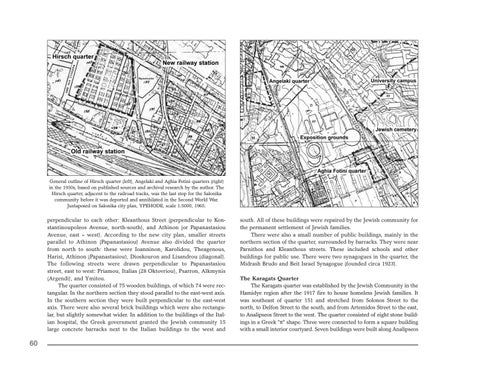
General outline of Hirsch quarter (left), Angelaki and Aghia Fotini quarters (right) in the 1930s, based on published sources and archival research by the author. The Hirsch quarter, adjacent to the railroad tracks, was the last stop for the Salonika community before it was deported and annihilated in the Second World War. Juxtaposed on Salonika city plan, YPEHODE, scale 1:5000, 1965.
perpendicular to each other: Kleanthous Street (perpendicular to Konstantinoupoleos Avenue, north-south), and Athinon (or Papanastasiou Avenue, east – west). According to the new city plan, smaller streets parallel to Athinon (Papanastasiou) Avenue also divided the quarter from north to south: these were Ioanninon, Karolidou, Theagenous, Harisi, Athinon (Papanastasiou), Dioskouron and Lisandrou (diagonal). The following streets were drawn perpendicular to Papanastasiou street, east to west: Priamou, Italias (28 Oktovriou), Psarron, Alkmynis (Argendi), and Ymitou. The quarter consisted of 75 wooden buildings, of which 74 were rectangular. In the northern section they stood parallel to the east-west axis. In the southern section they were built perpendicular to the east-west axis. There were also several brick buildings which were also rectangular, but slightly somewhat wider. In addition to the buildings of the Italian hospital, the Greek government granted the Jewish community 15 large concrete barracks next to the Italian buildings to the west and
60
south. All of these buildings were repaired by the Jewish community for the permanent settlement of Jewish families. There were also a small number of public buildings, mainly in the northern section of the quarter, surrounded by barracks. They were near Parnithos and Kleanthous streets. These included schools and other buildings for public use. There were two synagogues in the quarter, the Midrash Brudo and Beit Israel Synagogue (founded circa 1923). The Karagats Quarter The Karagats quarter was established by the Jewish Community in the Hamidye region after the 1917 fire to house homeless Jewish families. It was southeast of quarter 151 and stretched from Solonos Street to the north, to Delfon Street to the south, and from Artemidos Street to the east, to Analipseos Street to the west. The quarter consisted of eight stone buildings in a Greek "Ď€" shape. Three were connected to form a square building with a small interior courtyard. Seven buildings were built along Analipseos