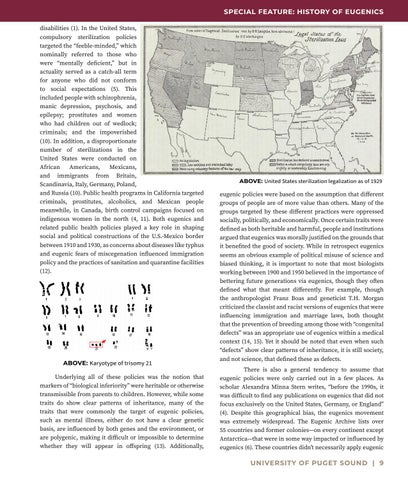
SPECIAL FEATURE: HISTORY OF EUGENICS disabilities (1). In the United States, compulsory sterilization policies targeted the “feeble-minded,” which nominally referred to those who were “mentally deficient,” but in actuality served as a catch-all term for anyone who did not conform to social expectations (5). This included people with schizophrenia, manic depression, psychosis, and epilepsy; prostitutes and women who had children out of wedlock; criminals; and the impoverished (10). In addition, a disproportionate number of sterilizations in the United States were conducted on African Americans, Mexicans, and immigrants from Britain, Scandinavia, Italy, Germany, Poland, and Russia (10). Public health programs in California targeted criminals, prostitutes, alcoholics, and Mexican people meanwhile, in Canada, birth control campaigns focused on indigenous women in the north (4, 11). Both eugenics and related public health policies played a key role in shaping social and political constructions of the U.S.-Mexico border between 1910 and 1930, as concerns about diseases like typhus and eugenic fears of miscegenation influenced immigration policy and the practices of sanitation and quarantine facilities (12).
ABOVE: Karyotype of trisomy 21 Underlying all of these policies was the notion that markers of “biological inferiority” were heritable or otherwise transmissible from parents to children. However, while some traits do show clear patterns of inheritance, many of the traits that were commonly the target of eugenic policies, such as mental illness, either do not have a clear genetic basis, are influenced by both genes and the environment, or are polygenic, making it difficult or impossible to determine whether they will appear in offspring (13). Additionally,
ABOVE: United States sterilization legalization as of 1929
eugenic policies were based on the assumption that different groups of people are of more value than others. Many of the groups targeted by these different practices were oppressed socially, politically, and economically. Once certain traits were defined as both heritable and harmful, people and institutions argued that eugenics was morally justified on the grounds that it benefited the good of society. While in retrospect eugenics seems an obvious example of political misuse of science and biased thinking, it is important to note that most biologists working between 1900 and 1950 believed in the importance of bettering future generations via eugenics, though they often defined what that meant differently. For example, though the anthropologist Franz Boas and geneticist T.H. Morgan criticized the classist and racist versions of eugenics that were influencing immigration and marriage laws, both thought that the prevention of breeding among those with “congenital defects” was an appropriate use of eugenics within a medical context (14, 15). Yet it should be noted that even when such “defects” show clear patterns of inheritance, it is still society, and not science, that defined these as defects. There is also a general tendency to assume that eugenic policies were only carried out in a few places. As scholar Alexandra Minna Stern writes, “before the 1990s, it was difficult to find any publications on eugenics that did not focus exclusively on the United States, Germany, or England” (4). Despite this geographical bias, the eugenics movement was extremely widespread. The Eugenic Archive lists over 55 countries and former colonies—on every continent except Antarctica—that were in some way impacted or influenced by eugenics (6). These countries didn’t necessarily apply eugenic
UNIVERSITY OF PUGET SOUND | 9