learn
design
share
Active Crossover for Active Loudspeakers With steep 3-way filters By Alfred Rosenkränzer (Germany)
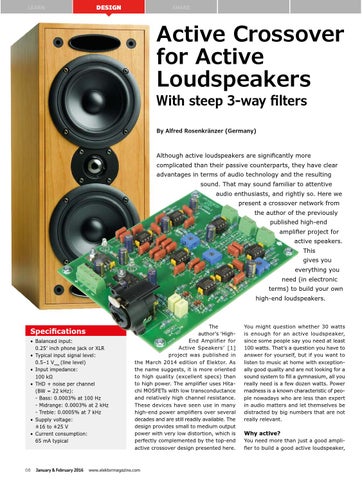
Although active loudspeakers are significantly more complicated than their passive counterparts, they have clear advantages in terms of audio technology and the resulting sound. That may sound familiar to attentive audio enthusiasts, and rightly so. Here we present a crossover network from the author of the previously published high-end amplifier project for active speakers. This gives you everything you need (in electronic terms) to build your own high-end loudspeakers.
Specifications • Balanced input: 0.25’ inch phone jack or XLR • Typical input signal level: 0.5–1 Vrms (line level) • Input impedance: 100 kΩ • THD + noise per channel (BW = 22 kHz): - Bass: 0.0003% at 100 Hz - Midrange: 0.0003% at 2 kHz - Treble: 0.0005% at 7 kHz • Supply voltage: ±16 to ±25 V • Current consumption: 65 mA typical
68
January & February 2016
The author’s ‘HighEnd Amplifier for Active Speakers’ [1] project was published in the March 2014 edition of Elektor. As the name suggests, it is more oriented to high quality (excellent specs) than to high power. The amplifier uses Hitachi MOSFETs with low transconductance and relatively high channel resistance. These devices have seen use in many high-end power amplifiers over several decades and are still readily available. The design provides small to medium output power with very low distortion, which is perfectly complemented by the top-end active crossover design presented here.
www.elektormagazine.com
You might question whether 30 watts is enough for an active loudspeaker, since some people say you need at least 100 watts. That’s a question you have to answer for yourself, but if you want to listen to music at home with exceptionally good quality and are not looking for a sound system to fill a gymnasium, all you really need is a few dozen watts. Power madness is a known characteristic of people nowadays who are less than expert in audio matters and let themselves be distracted by big numbers that are not really relevant.
Why active? You need more than just a good amplifier to build a good active loudspeaker,