www.efmd.org
Volume 07 | Issue 03 | 2013
EFMD
A new soft-skills solution for business schools and students EFMD aisbl
Global Focus Volume 07 | Issue 03 | 2013
Email: info@efmd.org
Phone: +32 2 629 08 10 Fax: +32 2 629 08 11
Rue Gachard 88 – Box 3 1050 Brussels, Belgium
A major new study explores the future challenges facing business schools
You give students the educAtion AdvAntAge. now give them the Reflect tm AdvAntAge. • Built by the Graduate Management Admission Council and powered by Hogan Assessments • Based on 10 key competencies identified by 800 corporate recruiters • Students have access to hundreds of resources to improve on their own • Heightened personal awareness makes students more attractive to corporate recruiters • Provides data beyond GPA or GMAT© score • Benchmark your class performance against other students and graduate business professionals
To learn more about the Reflect tool visit gmac.com/reflect
® INSIDE THIS ISSUE © 2013 Graduate Admission Council & Hogan Assessment Systems, Inc. All rights reserved. Reflecttm is a trademark and the GMAC logo, GMAC® and Graduate Management Admission Council® are registered trademarks of the Graduate Management Admission Council in the United States and other countries.
IMPM Still going strong after 18 years
Resilience What it is and how to get it
MBA OK Recruiters still love MBA grads
Walk the talk Managing a management school
Soft skills Why they matter so much
No class Is this the end for the classroom?
NEW
1st EFMD Global Network
Americas Annual Conference The Role of Business Schools in the Americas The EFMD Global Network Americas Annual Conference has been designed for all those interested in management education and development. It brings together EFMD Global Network members, companies, educational institutions and other associations that have an interest in the Americas.
27–29 April 2014
New EFMD Career Services Network EFMD is launching a new networking group focused on Career Services 20–22 November 2013 The first conference will be hosted by IE Business School, Madrid, Spain The programme will be ideal for anyone in charge of and responsible for taking strategic decisions in the field of career services. Under the conference theme ‘Developing a Successful Career Services Strategy in your School’, participants will investigate, discuss and explore a broad range of issues related to career services such as: > An overall picture of career services by Universum that will explore students trends in career services, but also the students and employers perspective on career centres > The strategic importance of career services for a business school
Escola De Administração De Empresas De São Paulo Da Fundação Getulio Vargas
More information: info@efmdglobal.org / www.efmdglobal.org
> Job mobility > Internationalisation More information: www.efmd.org/index.php/events/event/ 172-2013-efmd-career-services-conference Contact: virginie.heredia-rosa@efmd.org
In focus
EFMD Global Focus: Volume 07 Issue 03 | 2013
1
Volume 07 Issue 03 | 2013
In focus
T
his is the 21st issue of the magazine since it was launched in January 2007, so we can, to some extent, claim that Global Focus has “come of age”.
Global Focus was conceived as a way of improving communication between the EFMD and its members. But it was always regarded as something rather more sophisticated than a simple PR tool. It was seen as a forum for lively debate and information on the major current issues of management education and a way for EFMD to formulate, consolidate and share policy on the basis of its European underpinning and its increasingly global outreach and vision. It has played a full part in the work of EFMD, publicising and reporting on meetings and conferences and providing background briefings and interviews with key speakers as well as, for example, explaining the development of policy in key areas such as accreditation. The seven years covered by these 21 issues have, of course, been among the most volatile and disruptive in the long history of management education. And their effects have yet to become totally apparent. Global Focus has worked hard to keep up with these developments though a wide range of articles and features that particularly address the key issues facing EFMD member organisations. Many of the sector’s best-known and most effective thinkers and players have contributed articles or shared their thoughts in interviews. Most of the issues of the magazine have also been accompanied by specialist supplements covering particular subject areas in more detail. The magazine has also been a front-runner in its use of graphic design and in embracing new digital communications technology. It was always seen as both a traditional printed product and as an online resource. It was an early adopter of technology allowing the entire magazine and supplements to be accessed in audio and one of the first Western media outlets to publish a full version translated into Chinese. Unfortunately there has not been space to take a quick retrospective look at Global Focus and also highlight the leading articles in this issue as is normal in “In Focus”. But rest assured that there is the usual eclectic and diverse mix. Please enjoy this issue and continue to do so for the next 21!
21
Global Focus celebrates its 21st birthday – 21 issues delivered over seven years!
We are always pleased to hear your thoughts on Global Focus, and ideas on what you would like to see in future issues. Please address comments and ideas to Matthew Wood at EFMD: matthew.wood@efmd.org
2
www.efmd.org/globalfocus
Volume 07 Issue 03 | 2013
Contents Global Focus The EFMD Business Magazine
1
Executive Editor Matthew Wood matthew.wood@efmd.org
6
Advisory Board Eric Cornuel Howard Thomas John Peters Consultant Editor George Bickerstaffe georgebickerstaffe@gmail.com
In focus
The future is out there Andrew Crisp reports on a major new study that explores the future challenges facing business schools
10 Preparing leaders for tomorrow’s businesses The world is changing so fundamentally that business leaders who act as if the old rules still apply will find themselves and their organisations side lined or overtaken completely. However, say Thomas Malnight and Tracey Keys, those who adapt to this new world will be well placed to make the most of the opportunities it will offer
Contributing Editors Leslie Breitner Anthony Buono Jean-Christophe Carteron Andrew Crisp Fiona Dent Michael Desiderio Matthew Gitsham Viki Holton María Helena Jaén Tracey Keys Dora Koop Sabine Lauria Christophe Lejeune Thomas Malnight George Pennington Martine Plompen Gilbert Probst Michelle Sparkman Renz Loick Roche Irina Sennikova Lea Stadtler
Moving on from Rio Last year’s Rio+20 UN summit may have been something of a disappointment but there were still some significant and positive outcomes say Anthony Buono, Jean-Christophe Carteron and Matthew Gitsham
Design & Art Direction Jebens Design www.jebensdesign.co.uk
24
Photographs & Illustrations © Jebens Design Ltd / EFMD unless otherwise stated Editorial & Advertising Matthew Wood matthew.wood@efmd.org Telephone: +32 2 629 0810 EFMD aisbl Rue Gachard 88 – Box 3 1050 Brussels, Belgium www.efmd.org/globalfocus ©
EFMD
16
20 Coping with complexity Personal resilience is an increasingly necessary tool to face the stress of a complex work environment. Fiona Dent and Viki Holton describe what it is and how to attain it
Employers still in love with MBAs Management education is increasingly valued by companies worldwide, according to the 2013 Corporate Recruiters Survey. Christophe Lejeune and Michelle Sparkman Renz report
28 The disappearing classroom Michael Desiderio describes how new technology is knocking down the walls of the Executive MBA for business leaders
32 PhDs and DBAs: two sides of the same coin? Laura Maguire, Elena Revilla and Angel Diaz look at the differences (and even more the similarities) between the traditional PhD programme and the newer Doctor of Business Administration
Contents
EFMD Global Focus: Volume 07 Issue 03 | 2013
3
36
20
The IMPM innovations and teaching approach The International Masters in Practicing Management (IMPM) programme is 18 years old but continues to be seen as one the world’s most innovative senior management degree programmes. Leslie Breitner and Dora Koop explain how the programme has retained its freshness for so long
40 Accreditation – how to get it right María Helena Jaén outlines how to make the accreditation process as pain-free and rewarding as possible
44
24
44
Leslie Breitner and Dora Koop explain how the IMPM programme has retained its freshness as one the world’s most innovative senior management programmes. page 36
Walking the talk: managing a management school It is one of the oldest and most common complaints – management schools are great at giving good advice to others but themselves rarely practise the management skills they preach. But it can be done. Loick Roche and Sabine Lauria explain how
48 ACE project offers new opportunities The new EFMD-backed Alliance of Chinese and European business schools (ACE) offers new opportunities for mutual understanding and increased co-operation says Martine Plompen
52 Soft skills in the business and personal world George Pennington provides a psychologist’s perspective on why training in soft skills is vital for business (and personal) life
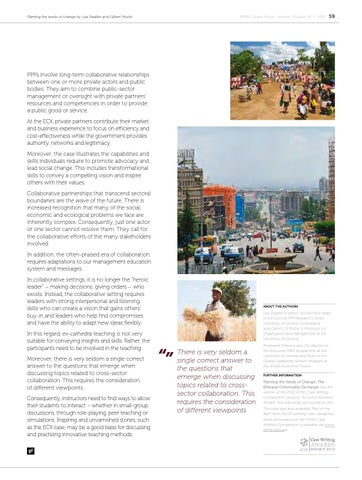
56 Planting the seeds of change Lea Stadtler and Gilbert Probst describe how the Ethiopia Commodity Exchange came into being and the lessons it holds
60 More EQUAL than others? The European Quality Link (EQUAL) is one of the less well-known bodies in which EFMD is involved but is also one of the most innovative and long-standing. Irina Sennikova explains its role
4
www.efmd.org/globalfocus
International Deans’ Programme >
2013/14
Gain unique insights into the multiple roles of deans of business and management schools in a cohort of around 20 participants from around the globe
> Visit a diverse range of business and management schools, take time out to network with your counterparts, re-energise and reflect on strategies for your own school, and create new strategic alliances
> Engage in debates about issues under the Chatham House rule
Format: Round-table debates, learning sets, interactive activities co-designed with the participants and host institutions with optional psychometric questionnaires and 360-degree feedback
Previous participants include 100 deans from: Australia, Belgium, Brazil, Canada, Chile, China, Columbia, Czech Republic, Denmark, Estonia, Finland, France, Germany, Ireland, Korea, Latvia, Lebanon, Lithuania, New Zealand, Norway, Portugal, Saudi Arabia, South Africa, Spain, Switzerland, The Netherlands, Turkey, UK, Ukraine, USA
EFMD Global Focus: Volume 07 Issue 03 | 2013
UK 5-6 December 2013 Saïd Business School, Oxford Imperial College Business School, London
Hong Kong April 2014 Three Hong Kong business schools
Denmark & Sweden 3-4 June 2014 Copenhagen Business School, Copenhagen Lund School of Economics and Management, Lund University, Lund
Fees: “The best part of my IDP cohort has been meeting a global subset of leaders of business schools from all around the world, having the opportunity to compare the priorities and agendas of leaders of business schools. This is a valuable experience that – even in our e-connected world – is not yet possible without this very personal exchange of views and insights.” Professor Per Holten-Andersen, President, Copenhagen Business School, Denmark
For members of ABS and/or EFMD €5000 (€5500 for non-members) Early bird fee for members until 15/10/13 €4750 (€5250 for non-members)
Contact: sstrickland@the-abs.org.uk or vrginie.heredia-rosa@efmd.org
Registration: www.efmd.org/business-schools/idp
Twitter: @Londonabs @EFMDnews www.efmd.org www.associationofbusinessschools.org
5
6
www.efmd.org/globalfocus
The good news is that more than seven out of ten respondents believed business is a force for good in society. However, few expect business to continue as it is
137
The See the Future study had 5,375 respondents drawn from 137 countries
Andrew Crisp reports on a major new study that explores the future challenges facing business schools
The future is out there by Andrew Crisp
EFMD Global Focus: Volume 07 Issue 03 | 2013
T
urmoil is probably too strong a word but “uncertain” may not be strong enough to describe the landscape that business schools are operating in today.
Much has been written and many conference speeches given about the impact on business schools of the global financial crisis, growing international competition, the importance of sustainability and ethics, and more recently the likely impact of new technologies. To put some data behind these predictions and get a view of what students and employers are thinking, CarringtonCrisp, with the support of EFMD, has recently run a new study called See the Future. With 5,375 respondents drawn from 137 countries, the data clears away some of the fog for those planning their business school’s future. Conducted online, the study sought to seek the views of prospective students, current students, alumni and employers. Questions were set out under five broad headings: the role of business; the value of a business education; sustainability, ethics and corporate social responsibility; internationalism; and the place of technology. Data was collected in May 2013. The good news is that more than seven out of ten respondents believe business is a force for good in society. However, few expect business to continue as it is. The same number also expects business models to change to allow better engagement with society. Over 81% agree that business and business education needs to be about more than just maximising shareholder value. The starting point for the study was to understand better the attitudes to business as a whole.
7
Recent media coverage of business, whether it has been the performance of the banks, chief executives of car companies using executive jets when their businesses are failing, youth unemployment in the eurozone or even cities going bankrupt in the US, will undoubtedly influence perceptions especially among young people. While an overwhelming majority of respondents agree that business leaders should behave ethically at all times, 8% of prospective undergraduates disagree and the number rose to 15% among current postgraduates from China and 13% of current Indian undergraduates. Given the interest in changing business models and moving away from shareholder value, it is not surprising that more than 80% of respondents also agree that “sustainability and ethics should be embedded in all business education programmes”. Many schools have already introduced ethics and sustainability modules to their business programmes but the demand from both employers and students is that these subjects be a seamless part of the curriculum whether students are studying finance, marketing, HR or any other aspect of business. Of course, before thinking about curriculum, schools need to consider what attracts students to them. Rankings have long been known to have a significant influence, yet the only business school rankings that considered sustainability in a major way, Beyond Grey Pinstripes, was recently suspended. Despite the absence of sustainability in rankings, just under half of all respondents in the See the Future study agree that “schools that don’t teach sustainability, corporate social responsibility and ethics should be ranked lower than those that do”.
81% 80% Over 81% of respondents agreed that business and business education needs to be about more than just maximising shareholder value
More than 80% of respondents also agree that “sustainability and ethics should be embedded in all business education programmes”
8
www.efmd.org/globalfocus
80% Over 80% of all managers/directors agree that “I expect my organisation to use technology to deliver more workplace learning in the future"
Without sustainability rankings, prospective students will seek other measures of a school’s commitment to such issues. Over 60% of respondents in the study agree “business schools should run projects to give back to local, national or international organisations and communities”. Many examples already exist – from supporting reading schemes in local primary schools through to helping social enterprises in emerging economies. The study data seems to suggest such projects may have a quantifiable impact on business school selection among potential candidates. Many prospective students suggest that choice of school is often based on study outcomes, most often associated with their future careers. For many years money was a focus of those outcomes as students sought highly paid jobs in banking and consulting. Money remains important, especially given the high fees associated with many business degree programmes. However, the study suggests that more students value a business education as a way to a more fulfilling job rather than a more highly paid one. For many graduates, employment may also have an international dimension whether that means working overseas or simply dealing with international organisations and companies. Over the last 20 years internationalism has become an accepted part of a business school’s offer, delivering little by way of differentiation from competitor schools. So what do students and employers really want when they talk about internationalism?
60% Over 60% of respondents in the study agree “business schools should run projects to give back to local, national or international organisations and communities”
To start with, more than two-thirds of all current and prospective students would be interested in studying abroad for all or part of their degree. The US remains the most popular destination with the UK second but Singapore and China are on the rise, ranking fourth and sixth respectively with many respondents. Selection of where to study internationally is primarily based on the reputation of a school and of a country but employment prospects on graduation also play a part. For more than 30% of those responding to the survey the attraction of an international study destination was based in part on “the sporting and cultural profile of that country”. Just think about the Premier League in the UK. In 2012/13 the television coverage of the League reached 212 territories with a total audience of 4.7 billion in 643 million homes and more than 185,000 hours of coverage. If your business school is in a city which shares the same name as a Premier League football club, that’s an awful lot of name awareness when a student starts searching Google. Of course, few decide where to study based on a football team but when in conversation about global brands with young people in China and the first three spontaneous answers are Nokia, Manchester United and David Beckham, the power of sport becomes clearer. Employers perhaps have a less emotional view of how internationalism should fit into a business school.
If your business school is in a city which shares the same name as a Premier League football club, that’s an awful lot of name awareness when a student starts searching Google
The future is out there by Andrew Crisp
EFMD Global Focus: Volume 07 Issue 03 | 2013
Almost all agree that a good business education should develop an understanding of business in different parts of the world. Interestingly, though, just over a third of all managers and directors also agree that “graduates should learn another language as part of their degree”.
Despite the embrace of technology among prospective and current students, around three-quarters agree that “I don’t believe an online degree offers the same opportunities for a student as traditional campus study”. While MOOCs may offer a cheaper alternative plus the opportunity to study at a time and place convenient to the student and the potential to study under some of the best teachers from around the world, there is still some way to go to convince students and employers that the opportunity offers the same benefits as traditional campus study.
Increasingly that language learning might be delivered via technology, perhaps utilising native speakers at the end of a Skype connection rather than lecturers in the classroom. And it is technology, especially MOOCs (massive open online courses), which currently account for much of the discussion about the future in business schools.
Where technology and learning seem likely to have a greater impact in the short term is in informal settings as well as the workplace.
The See the Future study found a degree of scepticism about MOOCs but at the same time a desire to embrace technology for learning. The generation entering business schools today has grown up with digital technology. It is a core part of their lives. They expect it to be a part of education and understand it offers the opportunity not just to enhance the classroom experience but for lifestyle learning around their other commitments. More than 50% of all prospective and current students agree that they “would not study a business programme in a MOOC” though around 40% would study for some of their business degree online. Around half of all managers/directors agree that “I am uncertain of what a MOOC offers and how it can be part of a business degree” and that “I would not recruit a graduate who had only studied online”.
9
50% More than 50% of all prospective and current students agree that they “would not study a business programme in a MOOC”
Over 70% of prospective students, current students and alumni want lifestyle learning, using technology to learn without disrupting work and family commitments. Delivered via video and podcasts or through apps on a smartphone or tablet, technology offers the opportunity for “anytime anywhere learning” with students getting taster sessions or the chance to bring skills up to date. At the same time, more than 80% of all managers/ directors agree that “I expect my organisation to use technology to deliver more workplace learning in the future”. Predicting the future is a difficult business. Should a business school focus on money or fulfilment, China or Chicago, sustainability or shareholder value, on campus or online? Whatever choices schools make, there is no escaping the “unknown unknowns” as Donald Rumsfeld, former US Secretary of State for Defence, put it.
70% Over 70% of prospective students, current students and alumni want lifestyle learning, using technology to learn without disrupting work and family commitments
But customer insight does provide the opportunity for informed choices.
ABOUT THE AUTHOR
Andrew Crisp is co-founder of CarringtonCrisp and one of the authors of the See the Future report. For more information on the report, please contact Matthew Wood at EFMD matthew.wood@efmd.org
10
www.efmd.org/globalfocus
I
n our interviews with 156 CEOs and other senior executives from around the world for our book Ready: The 3Rs of Preparing Your Organization for the Future (with co-author Kees van der Graaf) we identified two distinct types of leaders. The first group is made up of people who are holding on to the past. They often lead firms that are caught in a short-term trap; that is, they focus on delivering immediate results at the expense of long-term planning. The second group consists of people who are investing in preparing for the future by working to understand how the world is changing, what it means for their organisation and what they need to do about it. They also recognise that making the fundamental changes to their business models that this requires will take time, and thus cannot be delayed. This article highlights some of the changes reshaping the world and the five challenges facing leaders as a result. It also explores what these changes mean for business schools as they prepare the next generation of leaders.
PREPARING LEADERS FOR TOMORROW’S BUSINESSES The world is changing so fundamentally that business leaders who act as if the old rules still apply will find themselves and their organisations side lined or overtaken completely. However, say Thomas Malnight and Tracey Keys, those who adapt to this new world will be well placed to make the most of the opportunities it will offer
Preparing Leaders for Tomorrow’s Businesses by Thomas Malnight and Tracey Keys
Five areas of critical change Leaders can only prepare their organisations for the future if they can take an informed view of what it will look like. Our research highlights five areas in which major changes are occurring. CRITICAL CHANGE 1 Competition Competition is no longer limited to firms that look, act and think alike. Emerging competitors are players with fundamentally different business models, value propositions and mindsets. Competition is just as likely to come from outside your industry as within it; banks are now facing pressure from telecommunications companies offering mobile banking, for example. CRITICAL CHANGE 2 Growth The battle for future growth is not just between companies but also between growth markets and economic systems. This fight will be centred in the BRICS and other high-growth markets where bottom of the pyramid models often prevail. The mindset here is centred around exploiting high growth. One Asian CEO told us: “If we don’t double our size every two to three years, we will soon become irrelevant”. Success in these markets will come through newly developed market-relevant offerings not through attempts to leverage or repurpose old products or models.
EFMD Global Focus: Volume 07 Issue 03 | 2013
11
Competition is moving beyond products and services to being based on what consumers are willing to pay for and what influences their desire to engage
CRITICAL CHANGE 3 Consumers Businesses talk about fighting to own the consumer but it is consumers who are gaining power, influence and choice. Many products and services are becoming commoditised as consumers become more connected, mobile and demanding. They expect more but are often not willing to pay extra for it. They participate in communities of similar interests where their power further multiplies. Competition is moving beyond products and services to being based on what consumers are willing to pay for and what influences their desire to engage. CRITICAL CHANGE 4 Talent Generations X and Y are moving to the forefront, bringing new expectations and demands. Old notions of loyalty based on time spent at a company are irrelevant today; it is commitment that counts. In return, employees want jobs that are exciting and meaningful at organisations where they can make an impact on the company and the world. Jobs emphasising limited roles and gradually increasing responsibilities will be rejected as impact replaces loyalty in attracting the talent needed for future success. CRITICAL CHANGE 5 Society Society expects more of business than philanthropy or propaganda; companies increasingly need to make a positive contribution to society if they want “permission” to be successful. Visionary leaders are focusing on the need for shared value or prosperity and the importance of responsible capitalism.
156
156 CEOs and other senior executives from around the world were interviewed for Ready: The 3Rs of Preparing Your Organization for the Future
12
www.efmd.org/globalfocus
Five challenges for leaders in preparing for the future Our discussions with leaders suggest that the challenges facing leaders in the years to come will fall into five main areas.
CHALLENGE 1 Ambiguity Leaders will have to be able to manage ambiguity if they are to succeed in a future that is likely to be characterised by volatility and uncertainty. “If you are not able to manage ambiguity, and you need to understand everything before you start doing anything, you narrow everything and reduce your options and possibilities,” Clara Gaymard, the president and CEO of GE France, told us. “This will not work in the future.” Managing ambiguity requires moving beyond consistency and predictability to look at the implications of change from the outside in – that is, what is happening in our environment and then what it means for us – rather than focusing on optimising today’s products, markets and functions. It demands an attitude of what must we do in the future to succeed as opposed to what can we do to incrementally improve results today.
Managing ambiguity requires moving beyond consistency and predictability to look at the implications of change from the outside in – that is, what is happening in our environment and then what it means for us
CHALLENGE 2 Contradiction Businesses today operate in two time frames: the immediate and the very long term. Pressure to deliver results today is intense and growing but so too is the need for fundamental, not incremental, change to succeed in the long term. Doing both at the same time requires confronting the short-term, long-term gap – the metaphorical distance between the goals, attitudes and definitions of success that characterise each period. Tongaat Hulett, the South African agricultural business, offers an example of how this can be done. Some 90% of its executives focus on efforts that directly affect profits today while the remaining 10% focus on developing relationships and business models to prepare for the future, CEO Peter Staude told us. “When you work in areas like [Africa and agriculture], you have to get your basics right first,” he said. “However, you also have to recognise that to win future marathons, to grasp future opportunities, you have to work constantly on these projects as part of your regular activities, both for risk mitigation and to develop long-term growth opportunities.” Addressing contradiction requires twodirectional thinking.
90% 2
Businesses today operate in two time frames: the immediate and the very long term
An example of managing these two time frames is for 90% of an organisation's executives to focus on efforts that directly affect profits today while the remaining 10% focus on developing relationships and business models to prepare for the future
That is, you need to think forward from where you are today so that you can focus, prioritise and accelerate activities to deliver immediate results at the same time as you think backwards from your goals for the future to identify the changes that you must make today in order to reach that future position.
Preparing Leaders for Tomorrow’s Businesses by Thomas Malnight and Tracey Keys
CHALLENGE 3 Engagement No one individual or organisation has all the insights needed to succeed in the future. To that end, leaders must engage with stakeholders inside and outside their organisation if they are to identify and shape the opportunities and challenges ahead. This requires rethinking relationships from a learning perspective and finding new ways of working together. A major barrier to engagement is trust – a characteristic not often associated with business today but which must be central to the thinking of future leaders. Leo Yip, the chairman of Singapore’s Economic Development Board, told us: “Who you are as a leader is based on your sense of purpose, values and everything else about you. These things have to be consistently translated into your decisions, your actions, your priorities and who you are as people interact with you. Only then can you build trust. Without trust, you cannot have leadership.”
CHALLENGE 4 Co-creation Applying old formulas to new situations will not work; instead, leaders need to manage the co-creation of new answers. The challenge is to identify both what will be needed to succeed and applying these new approaches and solutions. For this, leaders need a mindset that prizes curiosity, continuous exploration and creativity.
EFMD Global Focus: Volume 07 Issue 03 | 2013
13
CHALLENGE 5 Purpose Traditional business rigour and discipline are likely to remain important in years to come but they will not be enough on their own; leaders must also address people’s need for meaning and purpose. “The biggest malaise of the 21st century is a lack of meaning in people’s lives,” Anand Mahindra, the chairman of Mahindra & Mahindra Group, told us. “You have to tell people to work toward a transcending goal, toward something more than achieving the next quarter’s earnings.” Paul Polman, CEO of Unilever, highlights the importance of purpose in his call for responsible capitalism as an enabler of future success. “There is a huge opportunity for businesses that embrace this new model of responsible capitalism but it does require a different approach. This goes well beyond CSR. It’s about moving to a licence to lead .”
Traditional business rigour and discipline are likely to remain important in years to come but they will not be enough on their own; leaders must also address people’s need for meaning and purpose
14
www.efmd.org/globalfocus
How can business schools help to prepare tomorrow’s leaders? The first step for business schools preparing tomorrow’s leaders is the same as that required of today’s leaders: recognising that the tools and approaches that worked in the past may not be sufficient in future. Business education, just like many other industries, is facing increasing cross-industry competition, more demanding consumers and financial pressures. Future success – both for business schools and their clients and students – will require understanding and shaping of what it will take to compete in an environment built around ambiguity and contradiction. It will be dependent on engagement and it will emphasise the need for co-creating new answers rather than relying on traditional remedies; it must also recognise the growing importance of purpose and meaning. Essentially, the reinvention challenge is two-fold – reinvent the business school and reinvent how it helps clients achieve future success. Relinquishing outdated approaches and building new ones fit for the future will not be easy for executives nor for business schools. But perhaps the most important challenge is recognising that preparing leaders to lead tomorrow’s businesses is a journey, one that not only affects the leaders being trained but the educational institutions that do the training.
Perhaps the most important challenge is recognising that preparing leaders to lead tomorrow’s businesses is a journey, one that not only affects the leaders being trained but the educational institutions that do the training
If business schools want to step up to this challenge, they need to move beyond the traditional classroom environment and burgeoning business of webinars to: • focus on what it is going to take for leaders (and their businesses) to succeed in the future not what has worked in the past • move from providing lecturers on knowledge to co-creating answers that are personally relevant for tomorrow’s leaders • view education not as a series of episodic events that provide answers but as a continuous process of learn-understand-co-create-apply-learn • understand that preparing tomorrow’s leaders is a human process. The world is becoming more complex, ambiguous and connected. Relationships and support networks in education are as important as in any other sphere of life. It is time for business schools to practise what they preach and do the same thing we are asking organisations to do. Come down from the ivory tower and become partners in co- creating tomorrow’s leaders.
ABOUT THE AUTHORS
Thomas Malnight is professor of strategy and general management at IMD, Lausanne, Switzerland. Tracey Keys is the director of Strategy Dynamics Global SA, a consultancy. They are also the authors and publisher of The Global Trends Report 2013 (www.GlobalTrends.com) and of Ready: The 3Rs of Preparing Your Organization for the Future, with co-author Kees van der Graaf (www.3RsReady.com).
EFMD Global Focus: Volume 07 Issue 03 | 2013
15
16
www.efmd.org/globalfocus
Last year’s Rio+20 UN summit may have been something of a disappointment but there were still some significant and positive outcomes say Anthony Buono, Jean-Christophe Carteron and Matthew Gitsham
Moving on from Rio by Anthony Buono, Jean-Christophe Carteron and Matthew Gitsham
EFMD Global Focus: Volume 07 Issue 03 | 2013
17
A
little over a year ago, roughly 50,000 people – government leaders, corporate executives and civil society groups including NGOs, youth movements and higher education institutes – travelled to Rio de Janeiro in Brazil for the largest UN summit ever organised, the Rio+20 UN Conference on Sustainable Development. Given the gravity of the social and environmental challenges that were raised during the summit – as well as the promise of real change – there was considerable disappointment, almost to the point of dismay, that government leaders failed to reach any significant agreement. Kumi Naidoo, the international executive director for Greenpeace International, referred to the Conference as “a failure of epic proportions”. The Pew Charitable Trusts, a global research, public policy and environmental organisation, noted that as a “once-in-a-decade meeting with so much at stake, it was a far cry from a success”. Even UN Secretary General Ban Ki-Moon lamented that Rio + 20 had “not lived up to the measurement of the challenge”. But one outcome of the summit – the agreement to develop a set of global Sustainable Development Goals to guide policy and strategy among governments, the private sector and civil society over the next two decades – may with time come to be seen as an important milestone. These goals, which are likely to include specific global targets on such areas as nutrition, education, gender equality, health, energy and climate, have enormously important implications for business – and for business schools.
50k In retrospect, Rio + 20 may also ultimately be seen as demonstrating the fact that it is no longer just government leaders who need to agree on policy
Roughly 50,000 people including government leaders, corporate executives and civil society groups travelled to Rio de Janeiro in Brazil for the Rio+20 UN Conference on Sustainable Development – the largest UN summit ever organised
Such goals can be significant. The noted economist Jeffrey Sachs has argued that while efforts to agree to legally binding deals between governments on global issues typically fall well short of expectations, non-binding goals have actually proved to be powerful enablers of change. They bring much-needed co-ordination to coalitions of the willing and enable unconventional partnerships of governments, NGOs and businesses to sidestep those who want to prevent change. In retrospect, Rio + 20 may also ultimately be seen as demonstrating the fact that it is no longer just government leaders who need to agree on policy. Indeed, an important result from the Rio summit is the ambition of the partnerships that have emerged between the private sector and civil society.
18
www.efmd.org/globalfocus
Research indicates that we have quite a different view of the role of the business leader compared with that of a generation ago
That message has been reinforced over the past year. In New York at the recent UN Global Compact Leaders’ Summit, business leaders put forward their own proposals for how to maximise business’s contribution to the Sustainable Development Goals. At their heart was a call to business schools to reform curricula to develop informed, committed and skilled business leaders who can lead companies to more sustainable outcomes.
A sizeable and growing proportion of business leaders have recognised that the forces shaping today’s world are requiring them to play a completely different kind of role on the world stage. In the substantial consultations that have been taking place over the past year business leaders such as Unilever’s Paul Polman, Nestlé’s Peter Brabeck, Pepsi’s Indra Nooji, DSM’s Feika Sijbesma, GSK’s Andrew Witty and numerous others from businesses small and large around the world have been pushing to make the Sustainable Development Goals as ambitious as possible.
Three hundred representatives of the world’s business schools gathered at Rio+20 as part of the UN Global Compact’s Principles for Responsible Management Education (PRME) initiative. They have acknowledged this call to action and have already reached a number of ambitious agreements themselves.
These leaders grasp that addressing today’s global challenges – helping everyone improve their quality of life at the same time as respecting planetary boundaries – means working in partnership with unusual bedfellows. These initiatives could ultimately transform the way key markets work, with a growing awareness that it is not only the right thing to do but that it can also be highly profitable. Research from Ashridge Business School’s partnership with the International Business Leaders Forum indicates that we have quite a different view of the role of the business leader compared with that of a generation ago. Business leaders today must have a more nuanced understanding of the major societal forces shaping our world in addition to a genuine personal passion for running a profitable business by serving the interests of wider society. Helping to address societal challenges through core business activities is becoming the primary means by which these individuals and their organisations can create value and is at the heart of their leadership role. In the run up to Rio+20, chief executives of some of the world’s most influential companies sent a clear message to business schools in a UN report, Leadership in a Rapidly Changing World. Because of their central role in shaping how business leaders think and act business schools are crucial to ensuring that today’s (and especially tomorrow’s) leaders are equipped for the new kind of role they need to play on the world stage.
250
The Higher Education Sustainability Initiative attracted hundreds of endorsers and commitments from 250 universities in about 50 countries
Indeed, the UN Secretary General singled out higher education in his report to the UN General Assembly following the summit, noting “the Higher Education Sustainability Initiative attracted hundreds of endorsers and commitments from 250 universities in about 50 countries. This initiative is transformative, global in reach and could reach thousands of graduates from universities and business schools”. Business school leaders at Rio+20 asked for help in leading the kind of curriculum and cultural change required within their schools. This was aimed at the people who do so much to shape how business schools work – from governments and business leaders to the people who oversee business school rankings and accreditations. EFMD, one of the three main accrediting bodies for business schools globally, has significantly updated its EQUIS accreditation standards to place sustainability and responsibility at its core, as important as internationalisation and corporate partnerships. This decision is a transformative lever for change, and is likely to have significant influence in accelerating change in management education in the years to come.
Moving on from Rio by Anthony Buono, Jean-Christophe Carteron and Matthew Gitsham
EFMD Global Focus: Volume 07 Issue 03 | 2013
19
56
In addition, one of the two main rankings for business schools globally has started ranking business schools on the quality of their MBA programme’s emphasis on sustainable development. Business schools have started organising themselves to work more effectively for systemic change by creating regional chapters and a global champions group within the PRME initiative.
PRME Champions provide similar leadership within business schools as the UN Global Compact’s LEAD initiative in which 56 prominent multinational corporations are taking the lead in advancing corporate sustainability as a universal norm
Significant change is indeed occurring but it is still only a fraction of the world’s business leaders who are currently engaging in this new kind of leadership. A much larger proportion are still operating with an outmoded blueprint of what today's leaders and companies need to be
Modelled on the UN Global Compact’s LEAD initiative, in which 56 prominent multinational corporations are taking the lead in advancing corporate sustainability as a universal norm, the PRME Champions are intended to provide similar leadership within business schools. A new partnership of universities and UN agencies has launched the Platform for Sustainability Performance in Education to provide a reliable, transparent and comparable reporting and assessment tool for improving sustainable performance in higher education institutions. And a tool for assessing the sustainability related knowledge of students – in essence a Sustainability Literacy Assessment – is being launched. Good progress on a number of fronts. Nevertheless, there is still much more that needs to be done. Business school deans and faculty need to keep up the hard work of change, ensuring their important role in helping address global priorities and contributing to the public good. This is seen as a central part of their mission. And they need help. Governments need to support this cultural change through the incentives embedded in funding and assessment frameworks for higher education. Business leaders need to give an even louder voice to their demands for a different kind of business graduate and make this clear in the way they recruit MBAs and purchase executive education. And other accrediting bodies and rankings providers must also support business schools by assessing how well schools are educating today’s and tomorrow’s business leaders to be able to play their role in addressing our global challenges.
Management education will clearly have a central role to play in achieving the Post-2015 Sustainable Development Goals. It is a key building block in the architecture. And it is becoming increasingly clear that doing this well means that our business leaders must get involved in activities that require different skill sets. Significant change is indeed occurring but it is still only a fraction of the world’s business leaders who are currently engaging in this new kind of leadership. A much larger proportion are still operating with an outmoded blueprint of what today's leaders and companies need to be. It is also an open question as to how the final set of Sustainable Development Goals will be received by the business community and how business executives and leaders from other parts of society will influence each other as we move towards implementation. We renew our call, to governments, to business leaders, to international accreditations and rankings, and to business school deans and faculty to work together to facilitate the change we all want to see – to create the future we want.
ABOUT THE AUTHORS
Anthony F Buono is professor of management and sociology and director of the Alliance for Ethics and Social Responsibility at Bentley University, US. Jean-Christophe Carteron is director of Corporate Social Responsibility at Kedge business school, France. Matthew Gitsham is director of the Centre for Business and Sustainability at Ashridge Business School, UK.
20
www.efmd.org/globalfocus
COPING WITH COMPLEXITY Personal resilience is an increasingly necessary tool to face the stress of a complex work environment. Fiona Dent and Viki Holton describe what it is and how to attain it
Coping with Complexity by Fiona Dent and Viki Holton
O
rganisational life today demands more from individuals and is far more complex than in previous decades. While modern (and indeed historical) business life has always been complex, the speed of change and levels of uncertainty caused by the current general economic malaise and global competitiveness has made managers’ lives increasingly demanding.
For example, major restructuring within organisations will undoubtedly create uncertainty. Some people who have a more optimistic disposition will weather the storm and see this as an opportunity. They are behaving in a resilient way. Others will tend to worry and find it difficult to focus on their day-to-day work, which can lead to poor performance, stress, illness and depression.
This is evident from our findings in the recent survey by Ashridge Business School – The Ashridge Management Index 2012/2013. The key issues identified are: • increased pressure and stress on individuals • greater use of technology leading to a 24/7 business culture • greater ambiguity in day-to-day working life • change as a constant rather than occasional process
Successful organisations have recognised that it is possible to help people to raise their awareness in this area, change their behaviour and develop successful personal coping strategies.
This has led to an increased interest in understanding how managers cope with stress while also continuing to perform at their best. The findings suggest that having good levels of personal resilience is an important factor in effective performance. This article explores what resilience means, the characteristics of resilient people and how organisations and business schools can support people to develop their resilience, which in turn will lead to a more effective and successful business environment.
42%
42% of respondents (1,100 +) to the most recent Ashridge Management Index indicated that they find it difficult to unwind after work 93% paradoxically said that they felt able to cope with current pressures and stress
EFMD Global Focus: Volume 07 Issue 03 | 2013
What is resilience? Resilience is a process that takes place between an individual and a situation and which leads to an outcome. It is the relationship between the way a person thinks about a situation, feels about it and reacts to it. People who are more resilient when faced with challenging situations that affect their equilibrium tend to have developed helpful personal coping strategies. Typical challenging situations might be tough work deadlines, ambiguity and change, resource cuts, personal trials and other situations beyond an individuals’ control.
21
So, in summary, personal resilience is the ability to focus and remain productive during challenging times, to remain optimistic and to “bounce back” after setbacks. In the recent Ashridge Management Index we identified a number of pressure points that affect managers’ ability to cope. They include: • working longer than 48 hours each week • heavy workloads and tight deadlines • regularly taking work home • information overload • the impact of constant (and complex) change • the growth and implications of virtual team working • lack of investment in team development It is unsurprising, then, that while 42% of respondents (1,100 +) indicated that they find it difficult to unwind after work, 93% paradoxically said that they felt able to cope with current pressures and stress.
People who are more resilient when faced with challenging situations that affect their equilibrium tend to have developed helpful personal coping strategies
22
www.efmd.org/globalfocus
The resilient manager Based on our research and experience of working with many managers in executive education together with more focused research into resilience by our colleague Alex Davda, we believe the following model illustrates seven key characteristics of a resilient individual. Some of these characteristics are intrinsic abilities but all of them can be developed with the right kind of support and guidance. Here is a brief description of each of the characteristics in Figure 1:
TABLE 1: VIRTUAL WORKING
2004 2008 2010 2012/13
Increasingly I am required to manage people in virtual teams
67% 82% 83% 77%
My organisation provides sufficient support for virtual teams
61% 46% 43% 45%
FIGURE 1: SEVEN KEY CHARACTERISTICS OF A RESILIENT INDIVIDUAL
• Emotional control is a person’s capability to understand and manage emotions in an appropriate way. Controlling and using feelings and emotions helps manage challenging situations effectively • Positive self-regard is having belief in oneself by understanding personal values, strengths, capabilities and accomplishments. We find that managers with this quality have a tendency to be more resilient • Sense of purpose is understanding what and who is important to the person. It is about having a sense of meaning in life • Solution focus orientation is about being active, future-focused and seeking outcomes rather than concentrating on problems and the past • Sense of well-being and balance is very personal. Health is one aspect of well-being and is often taken for granted. However, the key here is for individuals to identify how they maintain balance, health and energy to sustain performance in their business life • Support networks from all areas of a person’s life. We all need support from others when faced with adversity and crises. Resilient managers know who these people are and develop mutually supportive relationships
EMOTIONAL CONTROL REFLECTION AND PERSPECTIVE
POSITIVE SELFREGARD
SUPPORT NETWORKS
SENSE OF WELL-BEING AND BALANCE
SENSE OF PURPOSE
RESILIENCE
SOLUTION FOCUS ORIENTATION
TABLE 2 PERSONAL RESILIENCE INVENTORY Question Yes To No Personal Examples some /Coping Strategies extent 1. I understand and manage my emotions and feelings 2. I have a clear understanding of my own capabilities (strengths and accomplishments) 3. I have clear goals and meaning in my life 4. I deal well with stress and pressure 5. I like to focus on solutions not problems 6. I have a good work life balance 7. I have a good personal support network in place 8. I take time to reflect and put things into perspective
• Reflection and perspective is having the ability to appreciate what it is that triggers feelings of pressure, stress or challenge. Many managers fail to take time to reflect. Taking a step back enables a manager to gain perspective and to deal with pressure and stress more positively
Total
All of these characteristics are important for developing resilient managers and it is the interaction between them that is also important as this will help with the creation and development of coping strategies.
Our questions are: at what personal and organisational cost are people “coping”? And for how long can people work under constant pressure?
(It is worth pointing out that our respondents are at middle and senior levels and we would suggest that younger less experienced people are likely to feel even more pressurised and stressed.)
Table 1 summarises the results in relation to virtual working over an eight-year period and highlights that virtual working is a major feature for many managers and that more organisational support is required.
Coping with Complexity by Fiona Dent and Viki Holton
Taking action Organisations and business schools should play a more active role in helping managers develop their levels of resilience. As a first step it is worth ensuring that individuals have some understanding of their own levels of resilience and current range of coping strategies. The short inventory on the previous page will act as a starter to help managers to assess their own resilience levels and can also be used to assess those of their team or teams (see Table 2). A more sophisticated inventory is available from the Ashridge Business School website www. ashridge.org.uk available by searching for the Ashridge Resilience Questionnaire. Put simply, the more positive answers and coping strategies identified then the more likely a person is to be resilient. The value in using a simple exercise like this is that it raises self-awareness and encourages a broader conversation. Other areas where both organisations and business schools could make a difference include: • Leadership programmes – ensuring that resilience is an integral part of any leadership development process or intervention. Arming individuals with knowledge, awareness and a practical toolkit will assist them to develop the necessary strategies for coping and thriving in today’s demanding working environment. • Support mechanisms – our research shows that providing managers with the opportunity to leverage support within their organisation is beneficial. For example: – Encouraging and facilitating alumni networks from any development programme – Creating an action learning culture where people are encouraged to network across boundaries (professional, departmental and national) – Coaching, mentoring and counselling can all contribute and many organisations still have work to do to make such opportunities more widely available. Business schools could help here by offering training in these skills. – Enabling and supporting all levels of staff to take responsibility for resilience initiatives in their own part of the business.
EFMD Global Focus: Volume 07 Issue 03 | 2013
23
THE ASHRIDGE SURVEY ASKED MANAGERS TO SUGGEST ADVICE FOR YOUNGER MANAGERS. HERE ARE TWO OF THEIR RESPONSES:
Never make a decision when stressed and tired! If you've had a bad day or hear something you don't like always give yourself time to relax and digest it rationally before taking action. The more driven and passionate about the business and your role you are, the more this advice applies!"
"Find out what helps you to manage your stress levels and make time for it – exercise, yoga, socialising – whatever it is; that's just as important as any time management techniques you can do within your 9-5 schedule."
• Virtual working – this is becoming increasingly common and our research shows that organisational support does not meet the needs of the managers. (See Table 1) Managing teams and colleagues effectively and efficiently in this new virtual world requires new and different skills. Providing specialist workshops and development sessions for both the manager and the team would undoubtedly help support virtual working processes. One simple example is the protocol for running virtual discussions. Helping people to understand that with the greater reliance on aural senses this means that virtual meeting skills must focus on the use of more precise language, the importance of questioning, active listening and clarification. One major contributor to greater success with virtual working, which was suggested by many people in our survey was that people should meet face to face on occasions. Having this more intimate knowledge of someone you work with virtually, even if it is only a one-off meeting, will mean that both parties have a closer connection. Resilience is a key challenge for many individuals. Organisations as well as business schools must invest more time and energy to help managers and staff develop their understanding and awareness. Resilience may be intangible and hard to measure but the impact of having a resilient workforce can help contribute to the bottom line.
ABOUT THE AUTHORS
Fiona Dent and Viki Holton are respectively Director of Executive Education and Research Fellow at Ashridge Business School.
REFERENCES
The Ashridge Management Index 2012/13 by Fiona Dent, Jan Rabbetts and Viki Holton The Ashridge Resilience Questionnaire – Alex Davda, Ashridge Business School
24
www.efmd.org/globalfocus
Management education is increasingly valued by companies worldwide, according to the 2013 Corporate Recruiters Survey. Christophe Lejeune and Michelle Sparkman Renz report
Employers still in love with MBAs by Christophe Lejeune and Michelle Sparkman Renz
T
here are huge risks to hiring someone without having a good understanding of what they bring to the table in terms of core skills, creativity, tech-savviness, work experience, and preparedness for leadership roles. Management talent developed by business schools are seen as a ‘solid bet’ among employers when they search for new hires. Growing salaries and aggressive recruiting strategies indicate that employers find MBAs and specialized business master’s talent increasingly valuable, as noted in the in the GMAC 2013 Corporate Recruiters Survey.
EFMD Global Focus: Volume 07 Issue 03 | 2013
It seems astonishing that the hiring outlook for MBAs remains stable in Europe compared with last year – we are tempted to observe a trend here: whether in a constrained or in a growing economic marketplace, MBAs continue to be perceived as offering the most relevant skills for corporate recruiters
European specificities Forecasts about an economic rebound in Europe have so far proved illusory as the region continues to struggle from more than three years of crisis.
This article draws on the hiring trends observed in the study and offers an opportunity to better understand the current job market by sector and region. It also helps business schools and companies gain insights into why (and how) today’s employers seek management talent. With responses from 935 employers in 50 countries, survey findings show a greater proportion of companies plan to hire people with a recent master in management (43% of companies) or an MBA (75% of companies) in 2013 than they did last year. Employers worldwide expect to hire an average of 14.6 new MBAs, up from the 11.4 they hired last year. Similarly, increases in overall hiring demand were seen for master of finance and master of accounting degree-holders. And, unlike the expectations for greater numbers of management hires, employers plan to hire fewer of the bachelors and directindustry level talent than in 2012. In short, five years of survey data from employers shows the growing importance of graduating with a management degree that offers the most relevant skills for today’s workplace. And although salaries vary substantially by region, data illustrating the value of this talent among employers are seen in the growing pay checks they expect to disburse to graduate management degree holders.
25
935 The survey had responses from 935 employers in 50 countries
75% The survey findings show a greater proportion of companies plan to hire people with a recent master in management (43% of companies) or an MBA (75% of companies) than last year
14.6 In 2013 employers worldwide expect to hire an average of 14.6 new MBAs, up from the 11.4 they hired the previous year
Not surprisingly when making comparisons across regional hiring demands, Europe offers a different context of management talent from those of Asia-Pacific and the US. Although hiring plans of job recruiters (as reported by hiring decision makers in March 2013) are generally on the rise for Asia-Pacific and US employers, the report indicates a slight decrease in planned recruitment for most job candidate types in Europe with MBAs as the notable exception. The influence of a struggling economy in Europe may help explain the overall trend but it seems astonishing that the hiring outlook for MBAs remains stable in Europe compared with last year. We are tempted to observe a trend here: whether in a constrained or in a growing economic marketplace, MBAs continue to be perceived as offering the most relevant skills for corporate recruiters. One possible reason for the resilience of MBA degree-holders in a constrained hiring marketplace is the skills they offer to help European companies meet their most important goals – to survive and thrive. In 2013, priorities cited by European firms included improving performance/productivity (cited by 68% of European employers), reducing costs (52%), improving customer service (46%) and expanding the customer base (43%). Several quotes shared by employers in the study as to why they hire recent graduate management degree holders (noted later in the article) suggest that this talent is key to helping firms meet top priorities.
26
www.efmd.org/globalfocus
Sectorial specificities Of particular interest is the jump in hiring demand for MBAs this year in the energy/utilities and health care/pharmaceuticals sectors.
Management skills and job mobility Survey results show that the skills that most employers want in new hires involve a blend of business knowledge, strategic abilities and integrated reasoning/data analysis expertise plus soft skills to enhance interpersonal relations. In the words of one employer, graduate business degree candidates “bring leadership and strategic skills to the workplace that other candidates typically have not been able to attain just through their previous employment”.
These two sectors do not typically attract large numbers of MBA talent but the hiring plans suggest opportunities at hand, particularly for engineers and scientists, to maximise their career path by combining technical expertise with an advanced management degree.
One-third of the employers that plan to hire MBA and business masters graduates in 2013 will place some new graduates in jobs outside of the home region of the recruiter. For example, 98% of US-based recruiters plan to place new hires in the US, and about one in five US recruiters also expects to assign new hires to jobs located in Europe and Asia-Pacific.
At the moment, most employers in the health care/pharmaceuticals sector worldwide are looking for business grads to fill positions taking on business development and finance roles (each selected by 56% of health care/pharmaceuticals firms) and general management roles (54%). The noteworthy hiring demand occurring in the health care/pharmaceuticals sector in the US and elsewhere, however, also portend new roles for MBAs. Those not yet experienced in the field may face some difficulty in the job market when it comes to the medical expertise essential to understand patient needs or improve health care processes. More than half of health care employers plan to increase base salaries above inflation (18%) or at the rate of inflation (33%) for MBAs in 2013—a greater share than seen in any other industry.
33%
As for other sectors, survey findings show that hiring projections for MBA talent in 2013 also increased in the consulting and finance/accounting sectors, and holds steady across other industries, except for manufacturing, where it has declined. Demand for business masters candidates remained stable or increased slightly across most industries between 2012 and 2013.
18%
More than half of healthcare employers plan to increase base salaries above inflation (18%) or at the rate of inflation (33%) for MBAs in 2013 — a greater share than seen in any other industry
33% of the employers that plan to hire MBA and business master’s graduates in 2013 will place some new graduates in jobs outside of the home region of the recruiter
Figure 1: Boosting the link with local authorities: identifying the learning gaps 2008
100%
76 75 74
20%
0%
MBA
58 58
56 55
52 54 47 34 31 31
41 37 35 43 46
51
Master in Management
Master of Accounting †
Master of Finance †
Other specialised Non-business business Masters Masters
2011 2012 2013 projected
17
19 18 18
29
41 43
34 38
42 43 35
40%
2010 64
65
72 71 75 62
59 50
60%
79 77 77
2009 80%
Bachelors
Experienced direct -industry hires
Source: Data for 2008 – 2011 reflect reported actual hiring and are from Corporate Recruiters Surveys from 2009 through 2012. Actual 2012 and projected 2013 hiring data are from the 2013 Corporate Recruiters Survey. † Data for Master of Accounting not available prior to 2010; data for Master of Finance not available prior to 2012.
Employers still in love with MBAs by Christophe Lejeune and Michelle Sparkman Renz
95k
The financial gains demonstrate the importance of what MBAs bring to today’s employers. US employers, for example, expect to raise median base salaries from $90,000 to $95,000 this year
67%
EFMD Global Focus: Volume 07 Issue 03 | 2013
When asked the main reasons their company plans to hire business school graduates, recruiters responded with concepts related to growth and succession for their organisation, as well their overall approach to their work. As one employer wrote: “Our organisation requires individuals who are able to look at complex business problems and break them down in order to solve them. We find that business school graduates are better able to do this than individuals without that education”. In addition, employers noted the advantage of having business schools “pre-select” the qualities in candidates for them. An employer adds that “typically graduates are able to analyse problems, identify insights, and develop and present recommendations, which are key aspects of our general management positions”.
67% of companies reported plans to visit business school campuses this year, and are also using more creative approaches to engaging business school students long before on-campus interviews may occur
Asia-Pacific 2013: Projected
100% 76 61
54 50%
0%
MBA
51
57 42
Master in Management
49
Master of Accounting
46
50
Master of Finance
Europe 2012: Actual
49
Financial pay-off The financial gains demonstrate the importance of what MBAs and specialised business masters degree holders bring to today’s employers. US employers, for example, expect to raise median base salaries from $90,000 to $95,000 this year from last year. On average, an extra $40,000 in annual base salary will be paid to MBAs as an earnings premium compared with the pay checks of bachelors degree holders among US and European employers. In the same way, about $20,000 extra in annual base salary will be paid by US and European employers for new hires with master in management degrees compared with undergraduate degrees. Talent acquisition Sixty-seven per cent of companies report plans to visit business school campuses this year and they are also using more creative approaches to engaging business school students long before on-campus interviews may occur. Business school graduates may face a less rosy picture in the job search if they are not prepared to make the most of opportunities to engage employers in extracurricular settings such as academic/case competitions – where employers may serve as a judge, sponsor or audience member or partner in community service activities or student club events.
Figure 2: Demand for Management Talent by World Region
Asia-Pacific 2012: Actual
27
49
Other business Masters
50
69
73
71
54
Non-business Masters
Bachelors
Experienced direct -industry hires
Europe 2013: Projected
Today, the search for management talent often begins as soon as candidates enter their degree programmes or begin their internship during their studies. Three out of four companies (76%) that had MBA interns last year later hired them as full-time employees. Similarly, more than three out of five (69%) companies that offered internships to masters (non-MBA) talent in 2012 later hired them full-time.
100% 54
54
50%
0%
MBA
48
41
Master in Management
49 33
51
51
Master of Accounting
Master of Finance
Other business Masters
Non-business Masters
39
Master in Management
35
73 58
Bachelors
79
36
MBA
65
66
40
Master of Accounting
35
41
Master of Finance
Experienced direct -industry hires
ABOUT THE SURVEY:
United States 2013: Projected
85
82
50%
0%
53
29
United States 2012: Actual 100%
51
42
42
50
54
81
81
84
56
Additional information about the Corporate Recruiters Survey and how your business school programme can participate is available at: gmac.com/corporaterecruiters ABOUT THE AUTHORS
Other business Masters
Non-business Masters
Bachelors
Experienced direct -industry hires
Christophe Lejeune, PhD, is a researcher in the Research and Surveys Unit of EFMD and focuses on analysing quality and change in business schools. Michelle Sparkman Renz is an analyst and Director of Research Communications at The Graduate Management Admission Council®.
Note: 2012 and 2013 data are from the 2013 Corporate Recruiters Survey
28
www.efmd.org/globalfocus
Michael Desiderio describes how new technology is knocking down the walls of the Executive MBA
The disappearing classroom by Michael Desiderio
Fuelled by technology, many of those innovations and new solutions are leading to a new phenomenon – the disappearing classroom
EFMD Global Focus: Volume 07 Issue 03 | 2013
E
xpectations of today’s business leaders are higher than ever, including the intense pressure to make profits appear in less time with fewer resources. So when they turn to a business school or similar to bolster their leadership knowledge and help them meet those lofty expectations, they are looking for flexibility and, more importantly, immediate relevance. Executive MBA (EMBA) programmes were born from the desire for flexibility – as an option for working professionals to earn their MBA – and the current marketplace trends, once again, are demanding innovations and novel solutions from EMBA providers. Fuelled by technology, many of those innovations and new solutions are leading to a new phenomenon – the disappearing classroom. What does the disappearing classroom look like? It is one whose boundaries are no longer defined by location or, in some cases, even walls. It is one where, more than ever, students learn by doing and where the time between acquiring knowledge and using it is dwindling rapidly. The disappearing classroom manifests itself in a number of ways: Formats of EMBA programmes continue to evolve. For example, students in EMBAs with modular formats meet less regularly but for longer periods. According to research from the Executive MBA Council, the worldwide association of EMBA programmes, the percentage of EMBAs that meet weekly dropped from 34% in 2008 to 26.7% in 2012 while the percentage of programmes that meet less than once a month has risen from 10.3% in 2008 to 14.3% in 2012.
26.7 14.3 Students in EMBAs with modular formats meet less regularly but for longer periods, the percentage of EMBAs that meet weekly dropped from 34% in 2008 to 26.7% in 2012...
...while the percentage of programmes that meet less than once a month has risen from 10.3% in 2008 to 14.3% in 2012
EMBA providers are exploring different formats and different combinations of formats. And EMBA students are benefiting as a result. The increasing flexibility of formats makes it easier for working professionals to fit a programme into their busy lives. Now EMBA students can live and work almost anywhere in the world and benefit from EMBA programmes either near them or accessible to them. The Executive MBA Council hosts a website (www.executivemba.org) comparing EMBA programmes by geography, programme focus, start time, length and cost. The website also provides additional details about the EMBAs that allow side-by-side comparison.
29
30
www.efmd.org/globalfocus
Technology is changing the landscape and supporting the development of new options for programme delivery. Many EMBA programmes, especially global ones, rely on distance learning technology for some aspect of classes. Collaboration software and “boardroom” style formats help bring teams with members from different parts of the world together, as does teleconferencing, web conferencing or Skype. Virtual environments are offering new vehicles for learning. EMBA programmes are also increasing their use of electronic materials, helping lighten the load for students who travel. Students no longer need to worry about leaving a course pack at home. According to EMBA Council research, in 2012 members reported supplying almost a third – 28.9% – of materials electronically, more than double 2010’s percentage. In addition, EMBA programmes are increasingly exploring the world of digital textbooks. Several have already made the transition and others are investigating the option. In many cases, digital textbooks are more than just books available on devices or online – they are actually new learning tools that incorporate multimedia – video, podcasts and other interactive components. And as universities throughout the world are contributing massive open online courses (MOOCs) with top faculty to platforms such as Coursera and edX, EMBA programmes are asking themselves some tough questions: is this the format of the future for core MBA courses? Will EMBA students like MOOCs? How might they affect programme delivery? Interactions are coming in new shapes and sizes. Thanks to technological advances, the innovations in format are resulting in broader and richer opportunities for business leaders to interact with one another, the heart of peer learning.
Digital textbooks are more than just books available on devices or online – they are actually new learning tools that incorporate multimedia – video, podcasts and other interactive components
28.9
According to EMBA Council research, in 2012 members reported supplying 28.9% of materials electronically, more than double 2010’s percentage
'12
In 2012, according to the EMBA Council, the top destinations for international trips were China, North America and Brazil with India, Argentina, Hong Kong and Chile also popular as locations
The disappearing classroom by Michael Desiderio
EMBA students in New York may find themselves participating in a global team with students from Asia and London. EMBA students also may participate in online study groups or use social media tools to make connections. Almost universally, interactions in EMBA programmes expose students to the global business world. Of course, those interactions also take place in traditional EMBA classrooms and through courses that incorporate a global perspective. But global interactions also occur through international trips, international projects and international teams. According to the EMBA Council, the top destinations for international trips in 2012 were China, North America and Brazil with India, Argentina, Hong Kong and Chile also popular as locations. In addition to visits, programmes are also including opportunities for EMBA students to work on international projects and collaborate with peers and local businesses while they are visiting these countries. Because EMBA students hold full-time positions with managerial responsibilities, they are in a great position to learn a concept one day and apply it the next. While EMBA programmes have always been designed for applied learning, they are moving that notion to new levels as students participate in projects with real-life impacts, tackle problems within their own organisations, explore the viability of entrepreneurial ventures or consider solutions to global business issues. These projects help benefit many businesses and organisations, as well as contribute to the public good. For example, one group of EMBA students helped expand foster care for young adults in their state. The students developed partnerships and conducted outreach with non-profits, the business community and the legislature. In the end, they contributed to the passage of new legislation that supports young adults in the community.
EFMD Global Focus: Volume 07 Issue 03 | 2013
EMBA students hold full-time positions with managerial responsibilities, so they are in a great position to learn a concept one day and apply it the next. While EMBA programmes have always been designed for applied learning, they are moving that notion to new levels
31
Whether resulting in legislation, increased revenues, new product development ideas, increased efficiencies or other outcomes, these projects demonstrate the powerful impacts that happen when EMBA students put their new knowledge and skills to use. A number of EMBA students come to their programme with an interest in entrepreneurship and many EMBA programmes offer unique opportunities for entrepreneurs or budding entrepreneurs. EMBA students tap the expertise of their peers, faculty and even professional venture capitalists as they develop business plans. A number of EMBA programmes sponsor courses and events where top business plans qualify for venture funding. It may not quite be time to say “bye, bye” to the traditional classroom but it is certainly time to say “hello” to the classroom of the future. EMBA programmes have, and always will, include that magic component of time together in one way or another. But the disappearing classroom – one that is bounded less by geography, expanded by technology, influenced by developments such as MOOCs and based on immediate relevance and the personal and professional transformations that strengthen the ability of business leaders to respond to rapidly changing times – is here to stay.
FURTHER INFORMATION
The Executive MBA Council currently includes more than 200 educational institutions that administer over 300 Executive MBA programmes worldwide (www.embac.org, www.executivemba.org) ABOUT THE AUTHOR
Michael Desiderio is executive director of the EMBA Council, overseeing Council programmes and services and collaborations with related educational associations and organisations throughout the world.
32
www.efmd.org/globalfocus
I
n recent years there has been increasing criticism about how relevant PhD research is to the real needs of industry.
At the same time, we are witnessing a rapid expansion in executive doctorates such as the DBA (Doctor of Business Administration), which have provided the field of doctoral studies with more practical knowledge and a different approach to doctoral education. This calls for a reflection into the meaning and implications this change may have for business schools. PhDs make an original contribution to knowledge; therefore, they are considered as the standard and traditional degree. Non-traditional degrees produce knowledge in the context of practice, providing a direct link between what managers or organisations demand and the world of academia. This contrast between what can be considered a traditional doctorate degree versus a non-traditional one has become an on-going debate in the academic world and a distinction that is far from being commonly acknowledged. Moreover, it also raises many controversies and debates among scholars, programme managers and institutions.
Laura Maguire, Elena Revilla and Angel Diaz look at the differences (and even more the similarities) between the traditional PhD programme and the newer Doctor of Business Administration
PhDs & DBAs: two sides of the same coin? by Laura Maguire, Elena Revilla and Angel Diaz
EFMD Global Focus: Volume 07 Issue 03 | 2013
33
The three most salient differences between the programmes are the type of knowledge they generate, the profile of the students involved and the aim that each fulfils.
3
The three most salient differences between the programmes are the type of knowledge they generate, the profile of the students involved and the aim that each fulfils
PhDs produce knowledge that is disciplinarybased, theoretical and explanatory. Academically recognised through validation by peer-review journals, this type of knowledge enables researchers to clarify constructs and relationships in a broader context. The DBA, on the other hand, delivers applied knowledge that is designed to solve problems that arise within organisations. Such applied knowledge combines the academic rigour of a traditional PhD with managerial relevance. This practice-based approach to knowledge allows executive doctorate students to provide answers to practical problems using the theoretical frameworks of traditional PhD knowledge. In other words, it values a form of “knowledge” beyond the usual bounds of academic knowledge. The second feature that highlights an important difference between the two programmes relates to student profiles. PhDs focus on young, high-calibre students with great academic potential who have both the focus and motivation needed to devote their lives to working as researchers and academics.
The contrast between what can be considered a traditional doctorate degree versus a non-traditional one has become an on-going debate in the academic world and a distinction that is far from being commonly acknowledged
DBAs, however, are aimed at professionals with at least eight to ten years’ experience in managerial positions and who normally already hold an MBA, a qualification intended to provide the basic foundation, analytical skills and tools that a manager uses on an everyday basis. The ultimate goal of the DBA student is not to build an academic career but rather to continue as a working professional (although they do often accept part-time positions in academia). The DBA qualification helps managers to acquire reflective skills to improve and enhance their professional conduct and also provides them with the status and prestige of a doctoral degree.
34
www.efmd.org/globalfocus
The third characteristic that differentiates these programmes concerns the expected learning outcomes of each. A PhD student is trained to provide exhaustive reviews of literature and to formulate and theoretically frame research questions and then apply the appropriate research methodology and data analysis to analyse their findings. The aim of the DBA is to provide managers with reflective and analytical skills to enable them to conduct research within their professional environment. DBA students are also expected to combine this practice-based approach to research with the more scholarly learning outcomes of PhD research. Both programmes complement each other by providing the required link between academia and the professional conduct demanded by organisations. PhDs are based on rigour, theory and disciplinary knowledge; DBA outcomes are applied and based on rigour and relevance. In other words, a PhD student will become a “professional researcher”, while a DBA pupil will be trained as a “researching professional”. Delivering both types of programme at the same institution provides the means to answer the research issues demanded by organisations (practical knowledge) by incorporating them into a traditional PhD theoretical approach to produce academic knowledge. IE Business School’s implementation of PhD and DBA programmes exemplifies how an institution can offer both programmes simultaneously to generate both types of knowledge (academic and applied) by taking advantage of PhD and DBA synergies and sharing similar resources such as course structure, content, faculty and staff.
Both programmes complement each other by providing the required link between academia and the professional conduct demanded by organisations IE launched its first doctoral programme in 2004, a PhD in Management. Soon afterwards, the direction of the programme highlighted two main requirements: • the real demand of an alternative audience (mainly senior managers with support from their organisations) to conduct applied research and who wanted to develop personally and professionally through the acquisition of the highest doctoral degree obtainable • the urge to depart from what can be called the traditional doctoral format into something more flexible, with an alternative means of delivery but with the same rigour As a consequence the DBA programme started in October 2006. Both programmes, although different in nature, do not differ vastly in content and structure. They start with a coursework stage lasting two years, followed by a two-year dissertation stage and completion of the doctoral dissertation. The methodological aspect of the doctoral degree is considered critical and students undertake both quantitative and qualitative training. Although the research-method courses are similar in both programmes in terms of developing skills in data collection and analysis, DBA students tend to make less use of sophisticated multivariate analytical techniques such as structural equation modelling. (Since the academic outcome is based on reflecting upon a particular business problem using rigorous academic methods, these students tend to focus on their own organisations, using restricted or limited samples, and favour a combination of qualitative and quantitative techniques.) The two programmes do differ, however, in terms of delivery, target audience and profile, and employability. The PhD is a four-year, full-time programme designed to train academics and researchers for permanent positions. In contrast, the DBA is a four-year, part-time course in which IE has opted to apply a blended format, currently the most popular delivery method in executive education.
PhDs & DBAs: two sides of the same coin? by Laura Maguire, Elena Revilla and Angel Diaz
The rigour of DBA research relies on the relevance of its contribution to professional practice and this causes some difficulty when academics need to measure how significant DBA research is and also jeopardises the status of DBA programmes by suggesting that they might be inferior to a PhD in germs of research.
The typical PhD student at IE has an average age of 27 with three years’ working experience and, sometimes, previous research exposure. On average, the typical DBA student is 42, holds an MBA or other masters degree and has around ten years’ experience in managerial positions, the most common of which are functional managers, general managers, partners and even CEOs.
The diversity breakdown of the DBA programme is somewhat similar with an 82% intake of international students (7% from Asia-pacific, 44% Europe, 44% Americas, 7% Africa). As different as both targets might seem, our experience has taught us that the different profiles and approaches to research of these students provide a satisfactory output when both groups share a course as the PhD provides the theoretical framing to the practical research questions posed by DBA students. This emphasises synergies and the need for both types of knowledge in research. Different academic outcomes and reasons for pursuing a doctoral degree imply a different approach to employability. While the aim of the PhD is to facilitate an academic career, DBA students will continue with their professional careers after completing the degree. Data from the 2013 EQUIS accreditation report shows that 93.7% of our PhD graduates found jobs as full-time academics (31% in the top 50 Financial Times ranked schools). The majority of our DBA graduates continued working in industry; however, 39% were hired as part-time professors. At IE both programmes finish with the satisfactory completion of a doctoral dissertation.
35
PhD research is normally published in academic journals and therefore assumes a tangible level of both theoretical and methodological rigour in terms of academic excellence.
Participants follow “blended” sessions (so named for mixing face-to-face and online learning). Students attend online sessions using an asynchronous interactive dialogue platform accessible 24 hours a day and moderated by an IE professor. Participants log on at their convenience and participate in live discussions with both the professor and fellow classmates, thus allowing the flexibility required by this type of target audience.
Diversity is common to both programmes. The PhD currently has a 100% intake of international students (21% from Asia-Pacific, 51% from Europe and the remaining 28% originally from the Americas).
EFMD Global Focus: Volume 07 Issue 03 | 2013
27
The typical PhD student at IE has an average age of 27 with three years’ working experience and, sometimes, previous research exposure...
42
... whereas on average, the typical DBA student is 42, holds an MBA or other masters degree and has around ten years’ experience in managerial positions
Programme managers, doctoral committees, faculty members and, especially, advisors must all strive to safeguard the methodological and scientific rigour of doctoral dissertations. The IE DBA programme requires students to present an academic paper at a prestigious conference (such as AOM, SMS, INFORMS) before graduation and participate in an annual doctoral consortium where PhD and DBA students and IE faculty interact to share research ideas and to present and review their research papers. Executive doctoral degrees have a more applied focus, a different profile of students and a different aim overall compared to traditional PhDs. However, the academic community must agree to value the type of knowledge these programmes generate and must accept the market demand they fulfil. More importantly, they must also commit to setting the quality standards of these programmes so that no rigour is sacrificed. Failure to do so will not only severely compromise the academic industry and deceive our students but also temper our ethical attitude towards the academic world.
REFERENCES
Banerjee, S & Morely, C “Professional Doctorates in Management: Toward a Practice-Based Approach to Doctoral Education”. Academy of Management Learning & Education, 2013, Vol. 12. No 2, 173-193. 2013. Bareham, J, Bourner, T, & Stevens, G R. “The DBA: What is it for?” Career Development International, 5: 394–403.2000 Beer, M 2011. “Making a difference and contributing useful knowledge: Principles derived from life as a scholar practitioner“ In S A Mohrman, E E Lawler (Eds.), Useful research: Advancing theory and practice: 147–168. San Francisco: Berrett Koehler. Tushman, M, O’Reilly, C, Fenollosa, A, Kleinbaum, A, McGrath, D “Relevance and Rigor: Executive Education as a Lever in Shaping Practice and Research”. Academy of Management Learning & Education, Vol. 6, No. 3, 345–362, 2007. ABOUT THE AUTHORS
Laura Maguire is Executive Director of Doctoral Programmes (PhD and DBA) IE Business School, Madrid, Spain Elena Revilla is academic director of the DBA Programme IE Business School, Madrid, Spain Angel Diaz is academic director of the PhD Programme IE Business School, Madrid, Spain
36
www.efmd.org/globalfocus
T
he premise behind the International Masters in Practicing Management (IMPM) is different to that of other management degrees. It was conceived (in part by the noted management thinker Henry Mintzberg) 18 years ago at a time when degrees from business schools focused on functions and disciplines (marketing, finance and accounting). In contrast, the IMPM’s content is built around the managerial mindsets that managers use in their day-to-day work. Each module focuses on a particular mindset framed around the managers themselves, their organisations and the unique environment in which that organisation exists. The five managerial mindsets of the IMPM are: 1. Managing self: the reflective mindset 2. Managing organisations: the analytic mindset 3. Managing context: the worldly mindset 4. Managing relationships: the collaborative mindset 5. Managing change and continuity: the action mindset
The International Masters in Practicing Management (IMPM) programme is 18 years old but continues to be seen as one the world’s most innovative senior management degree programmes. Leslie Breitner and Dora Koop explain how the programme has retained its freshness for so long
Truly international – a worldwide campus The IMPM is not a domestic programme with foreign activities. It is a truly international management programme that is balanced across different parts of the world. It is delivered over 16 months in 10-day modules at five different universities: Lancaster University in the UK, McGill University in Canada, the Indian Institute of Management (IIMB) in India, Renmin University in China and FGV/ EBAPE in Brazil. An academic director in each country leads each of these modules. The module director designs the curriculum, hires the faculty and sets up the field and site visits and evening events based on the mindset being delivered at the school. In other words, the programme is heavily influenced by the location of the module. It is as Brazilian as it is Chinese. Participants are therefore exposed to different countries, different cultures and different organisations.
The IMPM Innovations and Teaching Approach by Leslie Breitner and Dora Koop
EFMD Global Focus: Volume 07 Issue 03 | 2013
37
This diversity is reflected in the classroom as well as the location and faculty. The countries represented in our current cohort of 28 students are Brazil, Canada, Germany, India, Japan, Kenya, Korea, Oman, Switzerland, the UK and the US.
The programme’s “50/50 rule” is a guideline for everyone involved and is used to remind them that about half of each module should be given over to participants for discussion, incompany visits, personal reflection and, of course, workshops
16
The IMPM is delivered over 16 months in 10-day modules at five different universities: Lancaster University, McGill University, the IIM, Renmin University and FGV/ EBAPE
28
The countries represented in our current cohort of 28 students are Brazil, Canada, Germany, India, Japan, Kenya, Korea, Oman, Switzerland, the UK and the US
Workshops (the 50/50 rule) A basic premise of the IMPM is that participants learn as much from each other as they do from the faculty or guest speakers. The programme’s “50/50 rule” is a guideline for everyone involved and is used to remind them that about half of each module should be given over to participants for discussion, in-company visits, personal reflection and, of course, workshops. This opportunity for learning is built into the programme in a number of ways. In every module, in all the schools, the layout of the classroom is the same. Participants sit at round tables, which means faculty can switch to instant workshops at the tables, allowing discussion of conceptual and theoretical material from a small group point of view. And because a flat classroom is used, various seating arrangements are available for listening, observing and discussion to foster a broader learning experience. The focus is also on challenges and work situations that the participants bring to the programme rather than on published case studies. Thus, lecturing in 20 to 40-minute sessions is ideal since it allows instructors to initiate a workshop. This involves turning the session over to the participants so they can discuss how the content relates to them and to their managerial challenges. Sessions that share competencies allow the wealth of experience in the class to be tapped. The focus is not on how a particular managerial skill can be used or should be used but on how it actually is used – how a group of talented and experienced managers get things done. Field or organisational visits provide an opportunity for the participants to have input in another way. The visits are a strong and influential component of the programme and are set up to reflect the learning that is taking place in the classroom and to experience how it can be applied within an organisational setting.
38
www.efmd.org/globalfocus
In Module 1, the Reflective Mindset, for example, participants are introduced to a theoretical framework, a cultural web, that helps them understand organisational culture. The larger group is divided into smaller teams, each visiting a different organisation. The team is exposed to different units and levels of managers and, through observation and discussion, team members experience one perspective of the organisation’s culture. The groups spend time in analysing this experience from the perspective of the organisation they visited and also from the perspectives of their own organisation and learning from the programme. All of this is shared with the larger group the next day. Experienced participants The IMPM is designed for managers with at least eight years of managerial experience. As many of the components of the programme are based on learning from each other, these years of experience are critical. Over the years the average age of participants has been between 40 and 44. Learning from each other does not end in the classroom. One of the most powerful experiences for most participants is the “managerial exchange”. In this, each participant spends one week of the programme observing a fellow participant at his or her workplace. The visit is returned so that each participant acts as both host and guest. Preparation during the module and before the exchange includes sessions on learning through observation and listening. Insights are both personal and organisational.
IMpact Throughout the IMPM we encourage participants to use the classroom experience to make improvements in their managerial practices, their jobs, their organisations and the larger environment. We see this happening in two ways. Through teaching impact, participants act as teachers on the job (mentors, coaches) and diffuse the learning to their colleagues at work. Through action impact, participants drive changes in their organisations as a result of what they have learned. To further this process, “IMpact teams” have been added. (“Impact” signifies the pact between the IMPM participant and their team back on the job.) A team, or teams, is established in the workplace to support managers while they are in the IMPM programme and when they return to the workplace. IMPM participants may share their papers written after each module or the team may be part of a change project that the participant has initiated as a result of the learning. In fact, the sponsoring organisation is getting the development of a number of managers for the price of sending one to the programme.
1
One of the most powerful experiences for most participants is the “managerial exchange”, in this, each participant spends one week of the programme observing a fellow participant at his or her workplace
44
The IMPM is designed for managers with at least eight years of managerial experience, the average age of participants has been between 40 and 44
The IMPM Innovations and Teaching Approach by Leslie Breitner and Dora Koop
Reflection Insight is the product of reflection and reflection is built into the IMPM programme on a daily basis. Every morning participants take time to think and add their experiences of the previous day(s) to a personal journal. The process begins on an individual basis but these reflections are then shared with other participants at the table, usually followed by a large plenary. All of these reflections are captured in an “Insight book” or as one participant called it, looking back, “the best management book I have ever read”. Learning from reflecting on experience is the original source of knowledge.
Tutoring and advising Throughout the programme participants are required to write a paper following each module. These “reflection papers” should mirror the individual’s unique set of challenges in the workplace and the relevance of the conceptual material of the module to those challenges. Participants are encouraged to read beyond what is assigned for the module if they have interest in a particular area. Tutors who advise small group of three to five participants guide their work. The benefit of this process is that participants share their papers and get advice from their colleagues as well as from the tutor (whose primary responsibility is to evaluate the written work). The criteria of focus for these evaluations are authenticity, integration of conceptual material and demonstration of a personal action plan or impact plan. The IMPM is a degree programme and is structured to meet the diverse needs of the group. Participants can choose to obtain their masters degree from either Lancaster University or McGill. An advisor guides participants as they write their final masters papers. Topics are the choice of each participant and the advisor is assigned based on his or her area of expertise.
EFMD Global Focus: Volume 07 Issue 03 | 2013
39
All of these reflections are captured in an “Insight book” or as one participant called it, looking back, “the best management book I have ever read”. Learning from reflecting on experience is the original source of knowledge
Conclusion Since the IMPM was launched 18 years ago, other executive or management degree programmes have been established with some of the same elements, in particular having participants take part of a programme in different locations. However, it is the combination of the unique elements of the programme, the customisation of the programme to participants in each class and the adaptation to the different contexts that keep the IMPM current and impactful.
ABOUT THE AUTHORS
Dora Koop is managing director of the IMPM programme. Dr Leslie K Breitner is Cycle Director of the IMPM and Academic Director of the IMHL programmes. Both are based at the Desautels Faculty of Management, McGill University, Montreal, Canada.
40
www.efmd.org/globalfocus
MarĂa Helena JaĂŠn outlines how to make the accreditation process as pain-free and rewarding as possible
ACCREDITATION: HOW TO GET IT RIGHT
Experience with accreditation shows that the process requires committed academic and administrative leadership, supported by faculty members who are convinced that attaining accreditation, notwithstanding the effort entailed, is good for the school and for themselves
W
hy should our business school be accredited? Deans in developing countries often ask this question. The cost is high, staff must be assigned and faculty motivated. It takes a good deal of time, money and effort. What do we gain from accreditation? This article outlines the experience of my business school, IESA in Venezuela. Thanks to the processes involved in triple accreditation – EQUIS, AACSB and AMBA – IESA has improved its positioning, become stronger and more prestigious, and is better able to cope with the challenges of operating in Venezuela’s turbulent business context. The benefits obtained by IESA from accreditation have been many but are only one step towards continuous improvement. For IESA, the process and the achievement of accreditation has: • ushered in a thought process of sweeping, multifaceted self-study, entailing a review of mission, vision and values and of assessing strategy, systems and processes from different angles • updated operations and “put the house in order”, helping to identify and document procedures, raise standards and apply international benchmarks and best practices • positioned the school internationally and vis-à-vis local stakeholders, acquiring a quality seal readily recognised by students, faculty, staff, institutions of higher education and, not least, accreditation agencies • alerted the local and international markets that the school features academic excellence, thus attracting customers
EFMD Global Focus: Volume 07 Issue 03 | 2013
41
Accreditation is a tough decision, touching on a school’s foundations and posing strategic challenges not only for students and alumni but most especially the school’s leadership, faculty and administrative staff
Accreditation is a tough decision, touching on a school’s foundations and posing strategic challenges not only for students and alumni but most especially the school’s leadership, faculty and administrative staff. Responding to demands that stem from this decision inserts the accreditation process into the school’s strategic planning, one might say its DNA. When a school begins a quality improvement task of this magnitude, its leadership may be tempted to run the accreditation process as a separate exercise, independently of a review of school strategy or its on-going activities. Some may even consider assigning the process to a special task force, charged with preparing the documents required for a self-assessment report. But doing so may lead to a situation where the school’s stakeholders, including faculty, will overlook what accreditation is all about, why it is imperative and what value it holds for the institution. Failure to participate fully in the process may cause key stakeholders to overlook its significance. Experience with accreditation shows that the process requires committed academic and administrative leadership, supported by faculty members who are convinced that attaining accreditation, notwithstanding the effort entailed, is good for the school and for themselves. Of course there will be sceptics and critics who view the process as unjustified, especially in schools facing uncertainty or lacking financial resources. Accordingly, accreditation must be leveraged and built into a school’s existing management processes. Any attempt to delegate the accreditation process outside day-to-day operations will probably be a waste of time; worse yet, it may fail to trigger strategic change.
PHOTOGRAPH COURTESY OF IESA
Accreditation: how to get it right by María Helena Jaén
42
www.efmd.org/globalfocus
To ensure the process is successful, the school’s leadership must be prepared to bear the financial cost entailed in managing the process and also to place additional demands on faculty members even when retaining them may itself be a challenge. Unquestionably, accreditation has become a distinctive assurance of brand quality for business schools worldwide. The most widely recognised agencies are EQUIS, EPAS (both run by EFMD), AACSB and AMBA. Each offers schools a different but complementary assessment and each places a school in a different international reference group, offering a particular value proposition and learning experience and fostering the search for excellence.
Accreditation has become a distinctive assurance of brand quality for business schools worldwide
As well as asking whether accreditation is worth it, deans also ask how to choose an accrediting agency that best fits their school. At the risk of over-simplification, it could be said that each accreditation enables a school to view itself in a different light, • AACSB features key standards, especially in relation to managing faculty and assurance of learning • AMBA focuses on the MBA • EPAS focuses on specific programmes • EQUIS offers a strategic view of a school as a whole, highlighting internationalisation and its relations with the corporate world.
PHOTOGRAPH COURTESY OF IESA
Beyond benefiting the school with a different perspective, the accreditation process employed by each agency generates significant institutional challenges.
AACSB spotlights meeting academically qualified faculty standards, with refereed papers published in recognised international academic journals. A key issue is how a school defines its own academic and professional qualifications in the light of local realities and how it balances a qualified corps of faculty with what each is willing and able to do. Additional demands are made on graduate programmes, especially the use of reliable indicators to measure learning outcomes. AMBA challenges some schools offering a full-time MBA programme by requiring more than three years’ work experience as a criterion for admission. In Latin America, perhaps because of the average age of qualified candidates and local employment opportunities, many schools find it hard to fulfil this requirement. EQUIS requires schools to feature an international faculty and student body. In most of Latin America, cultural and geographic factors render attaining such a goal difficult. For example, qualified faculty rarely accept employment at schools outside their home country; distance between countries can be daunting; and students able to afford study abroad are likely to favour attending a US or European School in preference to one located elsewhere in their own region. This requirement tends to be exacerbated for schools located in countries fraught with political uncertainty or a volatile business context. Similar internationalisation issues apply to EPAS. Given these challenges, a good question is whether the accreditation process is worth all the effort. Besides, some deans argue that accreditation agencies don’t favour innovation. Deans of schools holding multiple accreditations invariably agree that, despite the pain, the process genuinely contributed value to the school and is well worthwhile.
Accreditation: how to get it right by María Helena Jaén
PHOTOGRAPH COURTESY OF IESA
PHOTOGRAPH COURTESY OF IESA
EFMD Global Focus: Volume 07 Issue 03 | 2013
Key reasons favouring school accreditation include: • Accreditation offers a periodic, external, “sharp and fresh” review of a school by experienced deans who both assess the institution and counsel its leadership on school-wide improvement. • Accreditation requires a gearshift to assist with change and continuous improvement, promoting accountability and transparency, pushing through improved strategic planning and management control systems. It also helps to embed organisational learning. Accredited schools show a commitment to the enhancement of standards of academic excellence. • Accreditation encourages and helps develop a school’s own standards for managing faculty, in accordance with its mission, vision and strategy so as to serve a given market. Academic and professional faculty qualifications are not uniform among accredited schools and they vary in the light of faculty profiles and professional interests. • Accreditation strengthens student admissions standards and uses these higher standards to ensure learning objectives are achieved. • Accreditation promotes internationalisation as a key school strategy and helps create national and international networks and partnerships. • Accreditation strengthens a school’s brand recognition and provides stakeholders a guarantee of quality. • Accreditation often strengthens school pride and makes for more satisfied faculty members. To quote one: “This school has a reputation, is internationally recognised and is a good place to work.”
43
On the other hand, accreditations are not enough since they must be maintained. When a school joins an elite group of internationally accredited institutions, it must commit to continuous improvement, keep up to date with global trends in management education and ensure that quality and excellence standards are built into its strategic makeup. This suggests that before going for accreditation, a school must think through its decision. Experience with accreditation points to several initial points to consider: which accreditation agency to begin with and what sequence to follow? First, assess the school’s strategic objectives in order to determine which accreditation best suits the school’s strategy – why and what for? Second, identify key challenges faced by the school and its strategic plans and goals – probing how accreditation can help address those challenges. Equally as important, articulate the school’s chief strengths and weaknesses in gauging which accreditation may contribute to early success – an important step to get the accreditation process moving and to overcome sceptics. Then ask which accreditation can best serve as an organisational learning gearshift. If a school has a robust MBA, AMBA may help ensure early success or EPAS may provide an early win with a key programme – but these may not be a strong enough gearshifts to drive organisational change. Accreditation improves a school’s “self-esteem” but failure to obtain accreditation can incur high costs, depending on the school’s circumstances. It is important to weigh the impact of an unfavourable outcome – especially on the faculty. Finally, if a school is considering accreditation, it should explore the process with deans who have gone through the process and discuss the options. Or better yet, if possible, search out a mentor who can assist in taking decisions on how best to proceed.
ABOUT THE AUTHOR
María Helena Jaén is a professor at IESA, Caracas, Venezuela; Harvard University David Rockefeller Center for Latin American Studies Cisneros Visiting Scholar and Harvard Business School Visiting Scholar, 2012-2013, and CLADEA's President 2012-2103
44
www.efmd.org/globalfocus
It is one of the oldest and most common complaints – management schools are great at giving good advice to others but themselves rarely practise the management skills they preach. But it can be done. Loick Roche and Sabine Lauria explain how
Walking the talk: managing a management school by Loick Roche and Sabine Lauria
EFMD Global Focus: Volume 07 Issue 03 | 2013
45
B
Bringing HR into the heart of managing the school is an attempt to have a much more proactive organisation in managing people’s expectations and careers and providing greater opportunities for staff mobility
7
Grenoble EM business school has a very low absentee rate and staff stay for an average of seven years, which is quite high for the sector
55k
India-based IT company HCL, with a global workforce of 55,000, has the company motto “employee first, customer second”
ack in 2007 Robert Sutton, professor of management science at the Stanford Engineering School in America and a researcher in the field of evidence-based management, wrote an award-winning if rather explicitly titled book (The No A**hole Rule: Building a Civilized Workplace and Surviving One That Isn't) explaining how workplace bullying and other misdemeanours can destroy morale and productivity. No one is suggesting that management school faculty and staff are as bad as that but it is often the case that our industry has a reputation for not ourselves following the organisational advice we so lavishly bestow on others. If we are to overcome this poor image of our profession, it is vital that we address this issue – and the human resource (HR) department of a school can play a key role. Most business/management schools and similar institutions have HR departments but their role is often confined to organising occasional training programmes and preparing the odd document for validation committees. HR needs to be much more than that and at Grenoble EM in France we have made a great effort over the past few years to bring HR into the heart of managing the school. It is an attempt to have a much more proactive organisation in managing people’s expectations and careers and providing greater opportunities for staff mobility. This strategy, it is felt, increases well-being within the organisation, reduces staff turnover and improves overall efficiency. In fact, the school has a very low absentee rate and staff stay for an average of seven years, which is quite high for the sector. Senior management has tried to set the tone for this. For several years, the motto of the school has been that it is our role to make Grenoble EM “an exceptional place to exercise our profession”. In a healthy working environment, people will naturally want to take on projects and will not need to be controlled. Some estimates even suggest that motivated staff will work three times as hard as demotivated ones. This is not unique to higher education. Vineet Nayar, vice-chairman and joint managing director of leading India-based IT company HCL, is convinced of this. With a global workforce of 55,000 the company’s motto is “employee first, customer second”.
46
www.efmd.org/globalfocus
TO LEARN
In Grenoble, several concrete initiatives have already been put into place. These centre on the idea of creating opportunities for people to learn, to engage and to progress within the school. In introducing such a policy care has been taken to look at all levels of the school’s organisation. There are a multitude of possibilities for faculty, managers and general administration staff. Too often it is this last group that has been forgotten within the development of management schools, yet they play a vital and important role in ensuring a school’s efficient functioning.
CAREER OPPORTUNITIES AT GRENOBLE EM
TO PROGRESS
TO ENGAGE
Growth through opportunities Opportunities to learn Faculty and researchers at Grenoble EM undertake a series of training sessions throughout the year. These can be in the form of conferences or workshops with particular emphasis on research and teaching skills. This ensures that newer members of the staff benefit from the skills of more experienced members.
Opportunities to engage The overall ethos of the school is that staff at all levels are responsible for its development. One large current project has brought together people from all parts of the school in an effort to rationalise certain processes. The degree of autonomy within the school has led to many entrepreneurial initiatives but at times this has meant that people in different parts of the school are working on different projects where the processes are not necessarily aligned.
Notably, it has resulted in a sharp increase in research output in the past ten years and a perceptible improvement in overall teaching. In the same vein, managers are also offered workshop and seminar opportunities.
This initiative is in line with Andy Grove’s famous saying that an entrepreneurial company should know how to “let chaos reign and then rein in the chaos”. Many companies that have undergone rapid growth have come up against such challenges.
One current initiative is a five-day training course over three months to enable all managers within the school to share some of their difficulties and to give them the necessary tools to improve their managerial competences.
At a recent EFMD meeting, Adrian Wooldridge, better known as the Schumpeter columnist of The Economist, criticised European business schools for assuming that innovation had to be on a large scale and involve considerable financial investment
This initiative has been highly praised and there are now several new projects in place as a result. Other initiatives for all staff include training on social networks and developing technical skills to reflect the requirements of different jobs.
We understand this position and have made efforts to stimulate small but often significant innovation from within. Indeed, the management team actively encourages individual initiatives and invites staff members to start new projects in line with the school’s overall strategy. This gives the feeling that everybody within the school can innovate.
One simple, but highly effective, initiative has been a series of short breakfast seminars with different departments giving a 20-minute presentation on what they do. It is amazing how much you learn during these seminars, even from departments you think you know very well. Perhaps this should not be surprising, given that the nature of academia is bright, autonomous people working on very specific and detailed tasks.
20
One simple, but highly effective, initiative has been a series of short breakfast seminars with different departments giving a 20-minute presentation on what they do
Opportunities to progress The school also actively offers various opportunities for job mobility. Nearly half (45%) of staff at Grenoble EM have changed positions since arriving at the school.
The rationale behind this is that corporate culture is much more difficult to acquire than the technical skills needed to do a job. By using and developing its own talent, Grenoble EM believes people will be far more efficient, particularly when carrying out projects that involve several departments.
Walking the talk: managing a management school by Loick Roche and Sabine Lauria
Sharing and developing talent Internal mobility At an internal level, staff are encouraged to spend one week in another department within the school. By shadowing colleagues, they get a better understanding of what other departments contribute to the overall workings of the school and their involvement in the school’s advancement. This is an opportunity for an exchange of best practices and to create greater professional links within the school.
International mobility Management schools have been very active in encouraging international mobility for students and staff. And this has led to massive increases in international teaching and research over the past 20 years. However, some management staff have been left behind in this development. Hence Grenoble EM has introduced a policy encouraging individual staff members to spend at least a week abroad every year at one of the school’s international partners. The HR department and the Centre for International Affairs select a number of candidates each year, identify their needs, and then choose an international partner that can best satisfy those needs. Staff members then spend one to two weeks with the partner institutions, meeting a variety of staff and faculty. On their return they write a short report and give a presentation on their experience. This ensures that it is a collective as well as an individual learning experience. Promotion mobility The school believes strongly in internal promotion. Nearly half of current staff members have changed jobs since arriving at the school. This is highly motivating since it offers a clear indication that hard work and initiative will be rewarded.
PROMOTIONAL
EFMD Global Focus: Volume 07 Issue 03 | 2013
47
Again, this is a borrowing of best practices from organisations as diverse as Procter & Gamble, Marks & Spencer and Barcelona Football Club. As management schools it is important to look at a variety of different industries and try to integrate some of their methods.
45% The school also actively offers various opportunities for job mobility, 45% of staff at Grenoble EM have changed positions since arriving at the school
In two new initiatives this year, Grenoble EM launched a collaborative community project and Pro bono Marathon. The community project allows each staff and faculty member to work for a local association for five days and the one-day Pro bono Marathon, which takes place at Grenoble EM, allows faculty and staff to work directly with a host of local associations to help them in different fields such as marketing, communication, HR and strategy. This has a two-way positive impact. First it helps the association concerned (with the hope that many people continue to be involved long after their five days are finished) but, second, it also stimulates the staff member. And by giving something back to the local community, it is thought that staff members will feel more attached to it and may even bring back some practices that they can use in their roles. Grenoble EM also offers a wide range of optional sporting activities for staff. These include yoga, rowing, jogging an annual charity marathon event, and of course, the inevitable skiing activities, given the city’s Olympic heritage. Practising what we preach These are just some of the initiatives that have been taken by the school, given its logic of creating a healthy working environment so that people will remain more engaged in their jobs. Does this mean that everything is perfect in the school? Of course not. The very nature of our profession is based on confronting conflicting ideas, and so of course there are differences of opinion. And, of course, effective talent management is a process rather than a one-time event.
However, by giving the HR department a very central role within the school, it is hoped that, as a management school, we really are practising what we preach.
INTERNATIONAL
INTERNAL
ABOUT THE AUTHORS
Loick Roche is Dean of Grenoble EM, France. Sabine Lauria is Director of Human Resources at Grenoble EM, France.
48
www.efmd.org/globalfocus
ACE will focus on academic excellence and the synergy between research and education in order to better prepare the next generation of executives. The basis of the joint project is the premise that there is much to share and to learn from very diverse institutional experiences
The new EFMD-backed Alliance of Chinese and European business schools (ACE) offers increased opportunities for mutual understanding and co-operation says Martine Plompen
ACE PROJECT OFFERS NEW OPPORTUNITIES
ACE project offers new opportunities by Martine Plompen
EFMD Global Focus: Volume 07 Issue 03 | 2013
49
T
here is a new kid on the management education and development block. At the end of May this year (2013) 20 leading business schools came together to create the Alliance of Chinese and European and business schools (ACE), a body supported by EFMD. Since 2012, Wei Shen (Associate Dean for China and Jean Monnet Chair at ESSCA School of Management in France) and Chong Li (Director EFMD Asia) have been working to establish this joint project to share experiences of globalisation, encourage the internationalisation of business students, and, particularly, exchange ideas on management and business teaching and research. The cultural richness of both China and Europe provides an ideal context for helping young people to develop a global awareness, though they will need a solid base of knowledge and multicultural understanding to be able to make connections. “The sharing of experiences and exchanges around internationalisation and the future development of teaching and research are the keystones," says Catherine Leblanc, Dean of ESSCA, which hosted the May event in Angers, France. Dean Leblanc emphasises that people-to-people exchanges and integrated thinking will be a major influence on students in the future. ACE will focus on academic excellence and the synergy between research and education in order to better prepare the next generation of executives. The basis of the joint project is the premise that there is much to share and to learn from very diverse institutional experiences. Planned activities include exchanges of students and professors as well as research conferences and the development of international skills modules. The further roll-out of the initiative will be closely linked to EFMD activities, with a commitment to quality improvement. Eric Cornuel, CEO and Director General of EFMD, underlined at the ACE launch that for over 40 years EFMD has been involved in raising the standards of management education around the globe, stressing his support for the project. Through accreditation, conferences, seminars and research, EFMD has been a key player in the internationalisation of business education. More particularly, EFMD has long-standing experience and expertise in co-operation with China.
In 1984 it launched the China-EEC Management Programme in Beijing, administered by EFMD, and ten years later, the joint-venture China Europe International Business School(CEIBS) came into being. “We will now take this mutual understanding to a new level”, Professor Cornuel says. One of the founding members is the Southwestern University of Finance and Economics (SWUFE), based in Chengdu, Sichuan Province, China. Dan Yang, Vice-President and Dean, is clear about why this new alliance is very important to his own institution. “It is about the quality of the partners,” he says, and stresses his commitment and enthusiasm by paraphrasing President John F Kennedy’s historic words: “Ask not what this initiative can do for you – ask what you can do for it”. In practical terms, SWUFE is offering to support the secretarial office of the ACA alliance, including office space, staff, website and much more.
'84
In 1984 the China -EEC Management Programme launched in Beijing, and ten years later the joint-venture China Europe International Business School (CEIBS) came into being
The Faculty of International Relations (FIR) of the University of Economics in Prague, Czech Republic, is also proud to be a founding member of the ACE Alliance. Stephan Mueller, the dean, explains that the invitation to join the ACE could not have come at a more appropriate time as the school opened a new Centre for Asian Studies in January 2013 and newly established contacts with Chinese business schools will greatly enhance the possibilities for joint research and international co-operation. In addition, faculty will benefit from the exchange of scholars and students. Teachers and students at FIR are looking forward to the forthcoming co-operation among the ACE member schools and to the opening up of new ways of internationalising academic life. Dean Mueller underlines the fact that FIR has been dedicated to internationalisation for many years because of a strong belief in the positive effects of exchanging ideas on the quality of education and better understanding among people. After the launch ceremony, the Chinese delegation visited VSE University of Economics Prague in the Czech Republic as a start in gaining a deeper understanding about ACE partner schools. Similar visits to Chinese partners are also being planned.
20
In May 2013 20 leading business schools came together to create the Alliance of Chinese and European business schools (ACE)
50
www.efmd.org/globalfocus
Taiwan’s National Tsing Hua University is another partner institution. Established in 1956 and with a common origin with the institution of the same name in mainland China, its initial focus was on science and technology. Now the university is more active in humanities, social sciences and management. The university’s College of Technology Management (which provides most of the university’s management education programmes) was founded in 2000 and has 1,400 students (800 of whom are undergraduates) and 65 full-time faculty members. Dean Chao-Hsi Huang says that the main reason for involvement in ACE is to give students more opportunities for internationalisation. The university is based in Taiwan’s “Silicon Valley” and there is a huge demand for internationally aware graduates. Currently, National Tsing Hua has a small MBA programme with room for expansion. All courses are taught in English and by faculty members with PhDs obtained in the US or Europe. The university is aiming at student exchanges at various levels. It already has the accommodation capacity and hopes to speed-up current exchange procedures. Many Taiwanese students are eager for exchange visits to so-called advanced countries in the northern hemisphere. Although Taiwan has evolved enormously in the last few decades, attracting foreign students is proving to be less straightforward. In addition, the Ministry of Education (MoE) regulations impose limits on these kinds of initiatives, though Dean Huang underlines the distinction between MoE recognition and market recognition in general. Dean Huang recognises that the ACE partnership is also a highly cost-effective way to identify potential exchange partners.
1.4k
Taiwan’s National Tsing Hua University’s College of Technology Management was founded in 2000 and has 1,400 students (800 of whom are undergraduates) and 65 full-time faculty members
Management must be related to the cultural context and must release the creativity within people and that management based on people is the future
ACE project offers new opportunities by Martine Plompen
EFMD Global Focus: Volume 07 Issue 03 | 2013
51
ACE Founding Members ANTWERP MANAGEMENT SCHOOL BEIJING JIAO TONG UNIVERSITY
This view is shared by the non-Asian schools within ACE. Italian ACE partner Politecnico di Milano and particularly its School of Management, for example, has successfully developed partnerships in China over the years. But President Gianluca Spina believes that ACE will meet the need to further strengthen its presence and capability in East Asia.
UNIVERSITY OF CHINESE ACADEMY OF SCIENCES EBS BUSINESS SCHOOL ESSCA SCHOOL OF MANAGEMENT GOTHENBURG UNIVERSITY HARBIN INSTITUTE OF TECHNOLOGY HONG KONG POLYTECHNIC UNIVERSITY
There are two areas the Milan team particularly appreciate in the ACE project.
LEEDS UNIVERSITY NATIONAL TSING HUA UNIVERSITY
First is the co-ordinated effort of several distinguished European business schools to share experiences and joint efforts to better explore the opportunities in China. And second, the access offered to a group of highly esteemed Asian business schools, which though not yet highly internationalised are eager to become international players. This is a huge opportunity for all schools. President Spina expects that by joining ACE , Politecnico di Milano can enhance and strengthen its presence in the region, gaining scale and impact.
NORTHWESTERN POLYTECHNICAL UNIVERSITY (CHINA) MIP POLITECNICO DI MILANO
Professor Cheng Siwei, a former Vice President of the People’s Congress of China, and current Dean of the School of Management at the University of the Chinese Academy of Sciences (UCAS), an ACE founding member, believes firmly that Chinese business schools need to be more global.
ROTTERDAM SCHOOL OF MANAGEMENT ERASMUS UNIVERSITY
He suggests that management must be related to the cultural context and must release the creativity within people and that management based on people is the future.
UNIVERSITY OF LJUBLJANA
Education, especially management education, needs to be broader and to include cultural awareness and philosophy and more innovation, he adds. This is why the ACE alliance is so important, he says. We have to establish mutual trust and learn from each other.
SHANGHAI UNIVERSITY OF FINANCE AND ECONOMICS SOUTHWESTERN UNIVERSITY OF FINANCE AND ECONOMICS UNIVERSIDADE CATOLICA LISBON
UNIVERSITY OF MACAU VSE UNIVERSITY OF ECONOMICS PRAGUE XIAMEN UNIVERSITY
The in-depth exchanges among ACE partner schools are a process with a very promising future. Acting in a collaborative manner, having the flexibility to expect the unexpected and gaining institutional commitment at all levels, the ACE project will be able to address the challenges and opportunities of globalisation. FURTHER INFORMATION
For more information on ACE please contact Chong Li chong.li@efmdasia.org or Professor Wei Shen wei.shen@essca.fr ABOUT THE AUTHOR
Martine Plompen is Associate Director, Marketing and Communication, EFMD
52
www.efmd.org/globalfocus
George Pennington provides a psychologist’s perspective on why training in soft skills is vital for business (and personal) life
I
n a 2008 survey the German Chamber of Commerce asked employers which were the most important skills future employees should be conversant with. The results of the survey were remarkable (see Table 1 opposite). Of the ten most important skills eight were soft skills (yellow). Among the top 20 there were only five hard skills (blue). Other surveys have shown similar results.
Employers want soft skills Employers obviously want reliable, committed and responsible team players who are mature and independent people. They explicitly ask for soft skills. Strangely, though, our schools and universities do not feature soft skills in their curricula. So employers have to make up for the deficit by providing training courses themselves. Many do this at great expense. ...but not too much When the head of HR of a large German technology corporation declined to schedule my soft skill training sessions for his employees he gave me the following explanation: “We only get the very best performers from the high schools and universities. Once they are here we hang a beautiful golden carrot at the end of a stick just in front of their noses. Trying to reach that carrot they give not 100%; no, they give 140%. Mind you, they are not meant to get hold of the carrot. Very few do. That’s OK by us. It keeps the myth alive. The rest of them just run after it.
Soft skills in the business & personal world by George Pennington
EFMD Global Focus: Volume 07 Issue 03 | 2013
TABLE 1: Most Important Skills for Future Employees
“We know that we will have to replace them at the age of 40 or 45 at the latest because by then they will be burned out. But until then we want them to give all they have.”
80 71
70
63
60
60
59 52
50
50
And with a friendly smile he added:
49
40
53
33
33
33
32
30
29
28 24
23 19
20
18
18
15
14
10 0 CONFLICT-MANAGEMENT
RHETORIC AND PRESENTATION SKILLS
FLEXIBILITY, MOBILITY
CREATIVITY
LEADERSHIP SKILLS
ENTREPRENEURSHIP, INITIATIVE
LEARNING COMPETENCE
INTERDISCIPLINARY KNOWLEDGE
ICT-COMPETENCE
PRACTICAL EXPERIENCE (INTERNSHIPS)
SUCCESS-ORIENTATION
FOREIGN LANGUAGES
RESILIENCE
ANALYSIS- AND DECISION-SKILLS
SENSE OF RESPONSIBILITY
BROAD PROFESSIONAL KNOWLEDGE
COMMUNICATION SKILLS
COMMITMENT, DEDICATION
SELF-MANAGEMENT, SELF-DEPENDENCE
TEAM-PLAYER SKILLS
Die Studienreform zum Erfolg machen!, Erwartungen der Wirtschaft an Hochschulabsolventen, Dr Franziska Pankow, DIHK Januar 2008
“I am afraid, Mr Pennington, if I let you loose on my middle management they might stop running after the carrot. We cannot and do not want to run that risk.” This reluctant attitude towards equipping employees with soft skills is not uncommon. Employees should be self-reliant, committed, responsible, perceptive, creative and all that, certainly, but not too much so. They might become aware of the price they are paying for running after their carrot – and reconsider their options. The idea is: “Lord, let it rain, but don’t make them wet”. Thus soft skills are clearly a matter of business ethics and philosophy. Is business there to serve the people or is it the other way round?
Soft skills are clearly a matter of business ethics and philosophy. Is business there to serve the people or is it the other way round?
The fact that our schools show no signs of teaching the soft skills should make us think. Are our schools really equipping our children with the best possible knowledge and expertise, with the basic and indispensable prerequisites for a fulfilled life? Or are they just training them to do as they are told, making them fit for the carrot-race? And which of these philosophies do our business schools stand for? In the business world I have encountered both attitudes. Only on rare occasions are they the result of careful deliberation or discussion. Few HR departments and business schools seem to be aware of the philosophical and ethical implications of their soft skills practices.
8
Of the ten most important skills eight were soft skills – among the top 20 there were only five hard skills
Neither seems to attach any importance to the topic. When there is a demand for soft skills training they provide it more out of habit than conviction. What are soft skills? Soft skills are based on knowledge of ourselves. This knowledge is the very foundation of our self-management, of our fitness for working effectively and for life in general.
54
www.efmd.org/globalfocus
Soft skills are based on knowledge of ourselves. This knowledge is the very foundation of our self-management, of our fitness for working effectively and for life in general If I know that I am allergic to lactose I also know that milkshakes are not for me. If I know that in order to stay healthy I need to sleep during the night I will not take on a job in a bakery. It’s as simple as that. Plato thought of this knowledge as a form of wisdom. He called it phronesis, which is usually translated as “practical wisdom”. The application of phronesis in daily life, so say Aristotle and Plato unanimously, leads to eudemonia (literally, good spirits, well-being). Plato‘s phronesis and today’s soft skills are one and the same: personal and social competence. The distinction between personal and social is an artificial one. All soft skills are part of the personal or self-competence, of the ability to organise and manage oneself adequately (in accordance with one’s own and the situation’s requirements). Self-competence also includes the social aspect. Figure 1, a flip chart drawing from one of my training sessions, outlines the areas in which self-competence is relevant: Like all other dynamic systems humans have three basic functional levels: • the input-level (perception) • the level of inner processes • the output-level (expression) (Other processes like metabolism, heat-balance and so on are neglected here in the context of the soft skills.) Our perception, the organ with which we gather outer as well as inner information, is the masterkey to our self-competence. Not only is it our most important interface with the outside world, it is also our prime instrument for self-reflection. The inner processes can be mental, emotional or physical in nature. These three are interdependent. Together they form our awareness of our strengths and weaknesses, likes and dislikes, values and goals; in other words, awareness of the forces that give us meaning and direction. Here we weigh pros and cons and make decisions. It is also the basis of our resilience.
FIGURE 1: Relevant Areas of Self-Competence
Soft skills in the business & personal world by George Pennington
Our perception, the organ with which we gather outer as well as inner information, is the master-key to our self-competence. Not only is it our most important interface with the outside world, it is also our prime instrument for self-reflection
EFMD Global Focus: Volume 07 Issue 03 | 2013
The output-level (expression) is our second interface with the outside world. The quality of our expression depends on the competent handling of the first two levels, not on following predetermined values, methods or behaviours (tools). Soft skills are the competence to manage these three areas in a wholesome way. From this outline we can see how important the soft skills are, not only for individual life-fulfilment but also for the workplace. Self-competence in these three areas is the key to both. How should we teach soft skills? Until now soft skills have been treated as if they were many: team-building, stress and conflict management, communication and presentation skills, leadership and many more. For all of these separate training is offered. But learning to handle a conflict (a presentation, a team, high work pressure) is an illusion: what we must learn is to handle ourselves competently under the possibly aggravating circumstances of stress (a leadership role, a conflict or whatever). In my understanding all these are just one topic and should be taught as such. This is the reason why my conflict management and stress training sessions are somewhat similar. It is the same topic: competent self-management under varying stressful conditions. This unified understanding of the soft skills could save HR considerable amounts of time and money. The only hurdle I can see is the name. Soft skills still smell of “nice to have but of no real importance”. Nothing could be further from the truth: Plato‘s eudaimonia does not only mean individual well-being; it also means thriving business.
ABOUT THE AUTHOR
George Pennington holds the chair for the soft skills at ZfU-International Business School, Switzerland, and has won several awards for his work. In 2005 he produced a 13-part TV series on soft skills, Bewusst Leben – Psychologie für den Alltag (Living Consciously – Psychology for Everyday Life). Born in America in 1947, he has spent most of his life in Europe and for over 30 years he has led seminars and training sessions in the field of self-competence. He speaks fluent German, English and French and lives in Bavaria, Germany. george@pennington-training.com www.pennington-training.com.
55
56
www.efmd.org/globalfocus
C
omplex societal challenges transcend the capacities of a single organisation and even those of a single sector. Such challenges call for innovative, collaborative approaches, require modifications in our management education systems and pose new research needs. In response, the University of Geneva in Switzerland created the Geneva PPP Research Center to serve as a hub and catalyst for related research projects. This article is based on one of the centre’s case studies and illustrates an innovative, collaborative approach: a pioneering public-private partnership (PPP) model initiated by Dr Eleni Gabre-Madhin to fight market inefficiencies that had for long caused famine and poverty in Ethiopia. Here we summarise the case story, discuss concepts and topics that can be taught with the case and elaborate on implications that we see for management education. In 1984 nearly a million people starved to death in the northern part of Ethiopia. At the end of 2002, 14 million people were again facing starvation. Policymakers had extensively focused on the challenge of increasing agriculture production and road density in the country to address the problems linked to hunger, famine and rural poverty. However, they had rarely considered market inefficiencies as one of the main root causes of famine. Researchers, including Dr Gabre-Madhin, had carried out studies showing that Ethiopia’s market integration was weak and transaction costs high. Yet nobody was doing anything about it. Our case takes this situation as a starting point and exemplifies what Dr Gabre-Madhin discovered during her studies: alarming social needs resulting from malfunctions in the commodity market.
Lea Stadtler and Gilbert Probst describe how the Ethiopia Commodity Exchange came into being and the lessons it holds
Planting the seeds of change by Lea Stadtler and Gilbert Probst
EFMD Global Focus: Volume 07 Issue 03 | 2013
57
The exchange would ensure more transparent, efficient and reliable trading for all concerned by adding technology and systems to the informal markets already in place
More precisely, in some parts of the country the population suffered severe famine while food was available in other parts. Moreover, 28 million smallholder farmers were commonly caught in a daily struggle for survival. Challenges included poor information about prices and potential buyers and sellers, volatile prices, unreliable trading partners, high transaction costs, associated risks and a high level of contract defaults. From a buyer’s perspective, the issues were the unreliable supply and poor quality of food products due to a lack of standardised criteria. Dr Gabre-Madhin was convinced that her country urgently needed formalised trust in the market and an infrastructure that went beyond roads. She envisioned markets institutions that would be responsible for grading quality, introducing standards, issuing warehouse receipts, relaying market information to all relevant actors, co-ordinating trading, developing reliable payment and delivery systems, and ensuring contract enforcement. Furthermore, these institutions had to be established in an integrated fashion – not in the piecemeal approach that the different donor interventions all over Africa used. She proposed her idea – a commodity exchange as a holistic platform – to the highest levels of the Ethiopian government.
14
In 1984 nearly a million people starved to death in the northern part of Ethiopia. At the end of 2002, 14 million people were again facing starvation
The exchange she had in mind would not exclude people with a poor education or little capital. It would strive to balance the interests of all the relevant actors across both public and private sectors. Overall, the exchange would ensure more transparent, efficient and reliable trading for all concerned by adding technology and systems to the informal markets already in place. Dr Gabre-Madhin knew that the stakes were high. Her idea involved nothing less than building a high-tech platform in a place that lacked the basic building blocks of modern commerce such as electronic banking, price information and grading standards. Moreover, farmers, traders and other stakeholders distrusted new market initiatives and offers.
58
www.efmd.org/globalfocus
Millions of farmers still lived in a world far removed from the Exchange, separated by geographical distances and by their capacity to use the system
Given the green light from the government to build such an exchange, she had to find a solution to her initial concern regarding the exchange’s governance structure. A fully member-owned exchange risked serving its members’ interests rather than those of the market. But if membership and ownership were separated, who would invest? Conversely, an exchange completely in the hands of the government could impede the innovative and performance-oriented corporate culture that Dr Gabre-Madhin envisioned. Thus, a hybrid model was developed.
100
Adding coffee trading to ECX meant a dramatic increase in its operational volume, going from a few 100 tons to more than 100,000 tons in the following year
12%
12% of ECX members, representing 2.4 million small farmers, had become directly involved in trading on the exchange within a relatively short time
The government would initially be the sole owner. While it had to accept all the risks, it would not have special control or dividend rights. At the same time, external financing partners, especially donor organisations, would provide the bulk of the investment funds. Moreover, the exchange would sell freely transferable and exclusive trading rights and membership seats to private trading members. A board would be responsible for corporate governance by overseeing the exchange management. This board would be composed nearly equally of government-appointed directors and directors that the exchange’s private members appointed. Dr Gabre-Madhin agreed to manage the exchange initially but wondered how the exchange should be staffed. How could they build an innovative, excellence-orientated corporate culture that would attract top talent? She suggested that a transitional management team, which would initially operate the exchange and then transfer management to a local team, should be internationally recruited. Consequently, external funds had to be mobilised to support the financing of the operational team’s international salaries.
Sticking to their objective to include smallholder farmers and small traders, Dr Gabre-Madhin and her team still had to address the challenge of member recruitment. They launched a national advocacy and membership recruitment campaign with the slogan “Grow with Us.” After months of hard work the morning of 24 April 2008 marked a milestone that many had considered impossible: the inauguration of a high-tech commodity exchange in Ethiopia. Maize, wheat and beans were successfully traded on the Ethiopia Commodity Exchange (ECX) but the months following the inauguration saw a worldwide food price crisis. It did not spare Ethiopia nor the ECX. In order to avoid a disastrous downturn, Dr GabreMadhini and the government decided to confront another challenge: opening the Exchange’s doors to coffee. Coffee is the country’s biggest commodity and they therefore had to prepare for and manage a dramatic increase in the ECX’s operational volume. This meant going from a few 100 tons to more than 100,000 tons in the following year. Moreover, powerful coffee exporters actively resisted this new development. Once coffee had been successfully introduced on the Exchange, the time was ripe to reflect again on ECX’s initial objectives. Millions of farmers still lived in a world far removed from the Exchange, separated by geographical distances and by their capacity to use the system. Even so, 12% of ECX members, representing 2.4 million small farmers, had become directly involved in trading on the exchange within a relatively short time. In addition, the ECX had installed electronic price display boards across the country, launched an automated toll-free call-in service and developed a mobile SMS text messaging subscription system to increase market transparency. The ECX price thus served as the reference price for local trade in rural markets. The story of the ECX provides a rich set of scenarios that can stimulate discussion across a range of themes and topics, including the position of women, the engineering of required infrastructures in under-developed contexts, the importance of vision, commitment and dedication, social and public entrepreneurship, leadership and the art of achieving what seems impossible. From our perspective, one of the main learning insights relates to the advantages and risks of PPPs.
Planting the seeds of change by Lea Stadtler and Gilbert Probst
EFMD Global Focus: Volume 07 Issue 03 | 2013
59
PPPs involve long-term collaborative relationships between one or more private actors and public bodies. They aim to combine public-sector management or oversight with private partners’ resources and competencies in order to provide a public good or service. At the ECX, private partners contribute their market and business experience to focus on efficiency and cost-effectiveness while the government provides authority, networks and legitimacy. Moreover, the case illustrates the capabilities and skills individuals require to promote advocacy and lead social change. This includes transformational skills to convey a compelling vision and inspire others with their values. Collaborative partnerships that transcend sectoral boundaries are the wave of the future. There is increased recognition that many of the social, economic and ecological problems we face are inherently complex. Consequently, just one actor or one sector cannot resolve them. They call for the collaborative efforts of the many stakeholders involved. In addition, the often-praised era of collaboration requires adaptations to our management education system and messages. In collaborative settings, it is no longer the “heroic leader” – making decisions, giving orders – who excels. Instead, the collaborative setting requires leaders with strong interpersonal and listening skills who can create a vision that gains others’ buy-in and leaders who help find compromises and have the ability to adapt new ideas flexibly. In this regard, ex-cathedra teaching is not very suitable for conveying insights and skills. Rather, the participants need to be involved in the teaching. Moreover, there is very seldom a single correct answer to the questions that emerge when discussing topics related to cross-sector collaboration. This requires the consideration of different viewpoints. Consequently, instructors need to find ways to allow their students to interact – whether in small-group discussions, through role-playing, peer teaching or simulations. Inspiring and unvarnished stories, such as the ECX case, may be a good basis for discussing and practising innovative teaching methods.
ABOUT THE AUTHORS
Lea Stadtler is Senior Lecturer and Head of the Geneva PPP Research Center, University of Geneva, Switzerland, and Gilbert J B Probst is Professor for Organisation and Management at the University of Geneva.
There is very seldom a single correct answer to the questions that emerge when discussing topics related to crosssector collaboration. This requires the consideration of different viewpoints
Professort Probst is also Co-director of the Executive MBA programme at the University of Geneva and Dean of the Global Leadership Fellows Program at the World Economic Forum. FURTHER INFORMATION
Planting the Seeds of Change: The Ethiopia Commodity Exchange was the winner of the 2012 EFMD Case Writing Competition category "Inclusive Business Models" that was kindly sponsored by IMD. The case was also awarded "Best of the Best" from the 14 winning case categories. More information on the EFMD Case Writitng Competition is available via www. efmd.org/case
60
www.efmd.org/globalfocus
The European Quality Link (EQUAL) is one of the less wellknown bodies in which EFMD is involved but is also one of the most innovative and long-standing. Irina Sennikova explains its role
More EQUAL than others? by Irina Sennikova
E
QUAL (or the European Quality Link to give it its full title) may be new to many recent members of EFMD and other associated bodies but in fact it dates back to the mid-1990s (June 1996 to be precise) and is one of the earliest and most innovative bodies established to promote effective management development and business education.
EFMD Global Focus: Volume 07 Issue 03 | 2013
As a network organisation in a global and culturally diverse milieu EQUAL’s main role is to promote and ensure continuous improvement in the field of management and business education
What makes EQUAL so interesting is that it is a network of networks and so is hugely wide in scope and the expertise it can draw on. It was set up originally as a think tank for EQUIS (the then new EFMD accreditation system) but also involved other associations as stakeholders. And over the years it has grown, since now it is not only EFMD that is involved in accreditation but many other regional associations as well. EQUAL has deep European roots (though it is much more global in scale now than when it was founded nearly two decades ago) and its perspective remains grounded in European values and ideals such as subsidiarity and co-operation.
'96 But as a network organisation in a global and culturally diverse milieu EQUAL’s main role is to promote and ensure continuous improvement in the field of management and business education. EQUAL membership is open to national, regional and international associations, meeting EQUAL criteria, which are based on these associations having members that include supportive leading management education institutions. A list of current EQUAL members is set out in Box 1 (overleaf). EQUAL does not lay down ground rules but it does produce guidelines and various position papers, often initiated by member associations. One recent guideline, for example, dealt with sustainability – an issue currently of very much concern to business schools and similar institutions such as accrediting bodies.
The European Quality Link dates back to June 1996 and is one of the earliest and most innovative bodies established to promote effective management development and business education
61
62
www.efmd.org/globalfocus
BOX 1: CURRENT EQUAL MEMBERS Full membership is open to national, regional and international associations, primarily in Europe, which meet the membership criteria set by EQUAL. These criteria are based on the demonstration of national or regional experience and legitimacy to include: a) Participation in their membership of top institutions and widespread credibility within their community b) Evidence of continuous support for management development institutions in pursuit of their mission. FULL MEMBERS AACSB International ABS – Association of Business Schools, UK AEEDE AMBA ASFOR Association Nationale des IAE Association of Business Schools, Finland BMDA CAMBAS CEEMAN CFBSD Chapitre des Ecoles de Management ECONA EFMD FNEGE FORUM GMAC RABE, Russian Association of Business Education SEFE Swedish Association of Graduates in Economics and Business Administration VSNU
However, not everyone really understands what sustainability is or how to integrate it into the curriculum. As a result, EQUAL began to think what might be some common ground on the issues involved. Some of these are set out in the box “Sustainability Guidelines” on the opposite page, adapted from EQUAL documentation. Some of these are set out in the box “Sustainability Guidelines” on the opposite page, that are adapted from EQUAL documentation. EQUAL is a think-tank for all of the member associations and by reflecting on current issues and providing guidelines and position papers, EQUAL supports its member associations to better assist their members in adapting to new trends. The EQUAL Guidelines on issues such as rankings, MBAs, Masters, Doctoral and Undergraduate degrees are all used as references in the EFMD accreditation systems. EQUAL achieves its mission in a number of ways, for example, it promotes the continuous improvement of quality in business and management education training, research and development institutions and encourages the convergence of quality assurance processes through co-operation between relevant agencies. It also helps develop accreditation systems , assists in the identification of suitable auditors and supports the development of quality assurance across Europe and beyond through the development of national or regional associations and the promotion of good practice. Other key areas are disseminating information about quality in business and management education, research and development, co-operating with relevant international bodies, undertaking and sharing the results of research and projects of mutual interest and value to members, and agreeing on shared policy positions in the form of EQUAL guidelines and position statements.
More EQUAL than others? by Irina Sennikova
EFMD Global Focus: Volume 07 Issue 03 | 2013
BOX 2: SUSTAINABILITY GUIDELINES EQUAL is not static; it is constantly evolving. The emphasis at the moment is increasingly on sustainability and business ethics and it is no longer concerned solely with accreditation issues
Indeed, EQUAL’s involvement in establishing common standards is one of its major influences. For example, EQUAL’s suggested guidelines for the content and approach of MBA programmes have been widely followed: “It is important that the MBA be clearly identified with a certain type of content. The MBA curriculum provides broad coverage of the main functional areas in management, namely accounting, finance, marketing and sales, operations management, information systems management, law, human resource management. It is also expected to provide basic instruction in economics and quantitative analysis.” But EQUAL is not static; it is constantly evolving. The emphasis at the moment is increasingly on sustainability and business ethics and it is no longer concerned solely with accreditation issues. Topics to cover emerge from discussions at meetings and informally and member associations frequently propose projects that they then carry out. There are now more and more joint programmes reflecting issues that are of interest and benefit to member associations.
ABOUT THE AUTHOR
Dr Irina Sennikova is Associate Professor and Rector of Riga International School of Economics and Business Administration (RISEBA) in Riga, Latvia, and Chairman of EQUAL
• Provide a broad base of appropriate teaching expertise that covers the environmental, economic and social aspects of sustainability • Provide appropriate learning opportunities for students to gain knowledge, understanding and to develop appropriate values, skills, abilities and attitudes to sustainability • Assess students to demonstrate that specified learning outcomes on sustainability have been achieved • Conduct research and create outputs that relate directly to sustainability • Create forms of research that are sufficiently inter/multi-disciplinary in scope to address the issue of sustainability • Provide consultancy that is fully informed by leading-edge thinking and practice in relation to sustainability • Include sustainability as an important component within their own organisation’s mission, vision, values and strategy • Have clear and public policies to cover their own environmental, economic and social impacts • Create and implement a range of metrics on their own sustainability practices and performance • Demonstrate commitment to meeting relevant environmental targets
63
64
www.efmd.org/globalfocus
EFMD 2013 | www.efmd.org/events
Upcoming events October 2013
January 2014
April 2014
May 2014 cont
EVENT
EVENT
EVENT
EVENT
Sharing Best Practice CLIP Workshop
2014 EFMD Conference for Deans & Directors General
2014 EFMD Higher Education Research Conference
DATES / VENUE
DATES / VENUE
Research Leadership Programme – Cycle 5 – module 1/3
24-25 October / Madrid, Spain
30-31 January / Gothenburg, Sweden
DATES / VENUE
15-16 May / Stockholm, Sweden
2-4 April / Brussels, Belgium
THEME
HOST
THEME
University of Gothenburg, School of Business, Economics and Law
The Long View – Strategy
THEME
Branding as a Key to Integration in a Global Learning Organisation HOST
BBVA March 2014 November 2013
EVENT
HOST
Developments and Discoveries in Management Education and Research
EFMD & EURAM
HOST
EVENT
Stockholm University School of Business
2014 EFMD Conference in the MENA Region
2013 EFMD Africa Conference
2014 EFMD (ESMU) – HUMANE Winter School
DATES / VENUE
DATES / VENUE
13-15 November / Dakar, Senegal
2-7 March / Valencia, Spain
THEME
THEME
Entrepreneurship and Management Education in Africa
Leadership Skills and the “Big Picture” of Management
HOST
HOST
Groupe IAM – Institut Africain de Management
UPV Universitat Politècnica de València
May 2014
EVENT
EVENT
2013 EFMD Career Services Conference
2014 EFMD MBA Conference
2014 EFMD Doctoral Programmes Conference
DATES / VENUE
DATES / VENUE
DATES / VENUE
16-18 March / Berlin, Germany
21-22 November / Madrid, Spain
HOST
7-9 May / Lappeenranta, Finland
THEME
ESMT
HOST
Developing a Successful Career Services Strategy in your School
EVENT
Lappeenranta University of Technology, School of Business
EVENT
HOST
IE Business School
December 2013
2014 EFMD Conference for International, External and Corporate Relations, PR, Marketing, Communication and Alumni Professionals
DATES / VENUE
13-15 April / Marrakech, Morocco HOST
HEM – Institut des Hautes Etudes de Management
EVENT
EVENT
Research Leadership Programme – Cycle 5 – module 2/3
DATES / VENUE
DATES / VENUE
26-28 March / Milan, Italy
14-16 May / Brussels, Belgium
2013 EFMD Conference on Master Programmes
THEME
THEME
Connecting for Growth – Strategy & Tools
The School View – Organization of Research Activities
HOST
HOST
MIP Politecnico di Milano
EFMD & EURAM
2-4 December / Düsseldorf, Germany
June 2014 EVENT
2014 EFMD Annual Conference DATES / VENUE
15-17 June / Vienna, Austria HOST
EVENT
DATES / VENUE
DATES / VENUE
WU Vienna University of Economics and Business
September 2014 EVENT
Research Leadership Programme – Cycle 5 – module 3/3 DATES / VENUE
16-19 September / Brussels, Belgium THEME
The Practical View – Resources and Capabilities HOST
EFMD & EURAM
THEME
Master Programmes – Challenges and Solutions HOST
WHU– Otto Beisheim School of Management
For more detailed information, please visit our website: www.efmd.org or email info@efmd.org
NEW
1st EFMD Global Network
Americas Annual Conference The Role of Business Schools in the Americas The EFMD Global Network Americas Annual Conference has been designed for all those interested in management education and development. It brings together EFMD Global Network members, companies, educational institutions and other associations that have an interest in the Americas.
27–29 April 2014
New EFMD Career Services Network EFMD is launching a new networking group focused on Career Services 20–22 November 2013 The first conference will be hosted by IE Business School, Madrid, Spain The programme will be ideal for anyone in charge of and responsible for taking strategic decisions in the field of career services. Under the conference theme ‘Developing a Successful Career Services Strategy in your School’, participants will investigate, discuss and explore a broad range of issues related to career services such as: > An overall picture of career services by Universum that will explore students trends in career services, but also the students and employers perspective on career centres > The strategic importance of career services for a business school
Escola De Administração De Empresas De São Paulo Da Fundação Getulio Vargas
More information: info@efmdglobal.org / www.efmdglobal.org
> Job mobility > Internationalisation More information: www.efmd.org/index.php/events/event/ 172-2013-efmd-career-services-conference Contact: virginie.heredia-rosa@efmd.org
www.efmd.org
Volume 07 | Issue 03 | 2013
EFMD
A new soft-skills solution for business schools and students EFMD aisbl
Global Focus Volume 07 | Issue 03 | 2013
Email: info@efmd.org
Phone: +32 2 629 08 10 Fax: +32 2 629 08 11
Rue Gachard 88 – Box 3 1050 Brussels, Belgium
A major new study explores the future challenges facing business schools
You give students the educAtion AdvAntAge. now give them the Reflect tm AdvAntAge. • Built by the Graduate Management Admission Council and powered by Hogan Assessments • Based on 10 key competencies identified by 800 corporate recruiters • Students have access to hundreds of resources to improve on their own • Heightened personal awareness makes students more attractive to corporate recruiters • Provides data beyond GPA or GMAT© score • Benchmark your class performance against other students and graduate business professionals
To learn more about the Reflect tool visit gmac.com/reflect
® INSIDE THIS ISSUE © 2013 Graduate Admission Council & Hogan Assessment Systems, Inc. All rights reserved. Reflecttm is a trademark and the GMAC logo, GMAC® and Graduate Management Admission Council® are registered trademarks of the Graduate Management Admission Council in the United States and other countries.
IMPM Still going strong after 18 years
Resilience What it is and how to get it
MBA OK Recruiters still love MBA grads
Walk the talk Managing a management school
Soft skills Why they matter so much
No class Is this the end for the classroom?