Employers still in love with MBAs by Christophe Lejeune and Michelle Sparkman Renz
95k
The financial gains demonstrate the importance of what MBAs bring to today’s employers. US employers, for example, expect to raise median base salaries from $90,000 to $95,000 this year
67%
EFMD Global Focus: Volume 07 Issue 03 | 2013
When asked the main reasons their company plans to hire business school graduates, recruiters responded with concepts related to growth and succession for their organisation, as well their overall approach to their work. As one employer wrote: “Our organisation requires individuals who are able to look at complex business problems and break them down in order to solve them. We find that business school graduates are better able to do this than individuals without that education”. In addition, employers noted the advantage of having business schools “pre-select” the qualities in candidates for them. An employer adds that “typically graduates are able to analyse problems, identify insights, and develop and present recommendations, which are key aspects of our general management positions”.
67% of companies reported plans to visit business school campuses this year, and are also using more creative approaches to engaging business school students long before on-campus interviews may occur
Asia-Pacific 2013: Projected
100% 76 61
54 50%
0%
MBA
51
57 42
Master in Management
49
Master of Accounting
46
50
Master of Finance
Europe 2012: Actual
49
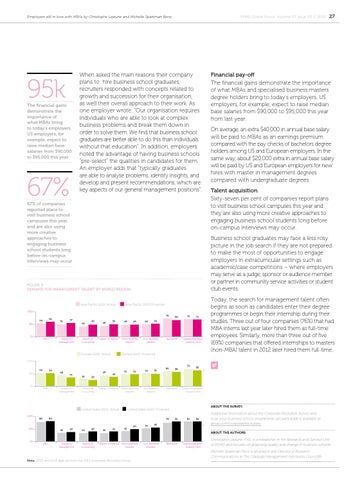
Financial pay-off The financial gains demonstrate the importance of what MBAs and specialised business masters degree holders bring to today’s employers. US employers, for example, expect to raise median base salaries from $90,000 to $95,000 this year from last year. On average, an extra $40,000 in annual base salary will be paid to MBAs as an earnings premium compared with the pay checks of bachelors degree holders among US and European employers. In the same way, about $20,000 extra in annual base salary will be paid by US and European employers for new hires with master in management degrees compared with undergraduate degrees. Talent acquisition Sixty-seven per cent of companies report plans to visit business school campuses this year and they are also using more creative approaches to engaging business school students long before on-campus interviews may occur. Business school graduates may face a less rosy picture in the job search if they are not prepared to make the most of opportunities to engage employers in extracurricular settings such as academic/case competitions – where employers may serve as a judge, sponsor or audience member or partner in community service activities or student club events.
Figure 2: Demand for Management Talent by World Region
Asia-Pacific 2012: Actual
27
49
Other business Masters
50
69
73
71
54
Non-business Masters
Bachelors
Experienced direct -industry hires
Europe 2013: Projected
Today, the search for management talent often begins as soon as candidates enter their degree programmes or begin their internship during their studies. Three out of four companies (76%) that had MBA interns last year later hired them as full-time employees. Similarly, more than three out of five (69%) companies that offered internships to masters (non-MBA) talent in 2012 later hired them full-time.
100% 54
54
50%
0%
MBA
48
41
Master in Management
49 33
51
51
Master of Accounting
Master of Finance
Other business Masters
Non-business Masters
39
Master in Management
35
73 58
Bachelors
79
36
MBA
65
66
40
Master of Accounting
35
41
Master of Finance
Experienced direct -industry hires
ABOUT THE SURVEY:
United States 2013: Projected
85
82
50%
0%
53
29
United States 2012: Actual 100%
51
42
42
50
54
81
81
84
56
Additional information about the Corporate Recruiters Survey and how your business school programme can participate is available at: gmac.com/corporaterecruiters ABOUT THE AUTHORS
Other business Masters
Non-business Masters
Bachelors
Experienced direct -industry hires
Christophe Lejeune, PhD, is a researcher in the Research and Surveys Unit of EFMD and focuses on analysing quality and change in business schools. Michelle Sparkman Renz is an analyst and Director of Research Communications at The Graduate Management Admission Council®.
Note: 2012 and 2013 data are from the 2013 Corporate Recruiters Survey