2024 ePLUS Report
Ohio State Digital Ag Program


2024 Research Recap
“connecting science to lands and communities” ePLUS
ePLUS represents an Ohio State University program dedicated to advancing production agriculture and wise use of natural resources through on-location research. The 2024 ePLUS Report is a culmination of the research conducted over the past year on partner locations throughout Ohio. Current research is focused on crop pest and cultural management, conservation, technology, mechanization, economic analysis, and community engagement.
ePLUS builds on the foundation of the successful eFields and eBarns programs which have grown since 2017 and 2022, respectively. 2024 marks the first year of ePLUS studies, representing 168 research sites in 54 counties.
2024 Research Recap
New for 2024
• Pest Monitoring Network Recaps
• Food and Market Reports
• Commercial and Home Garden Trials
• Forest and Aquaculture Water Quality Studies
66 Total Studies
• 17 Fruit
• 25 Vegetable
• 2 Other Specialty
• 2 Ornamental
• 16 Home & Consumer
• 1 Woodland
• 3 Aquatic
54 Counties 168 Research Sites


Disclaimer Notice: The information provided in this document is intended for educational purposes only. Mention or use of specific products or services, along with illustrations, does not constitute endorsement by The Ohio State University. The Ohio State University assumes no responsibility for any damages that may occur through adoption of the programs/techniques described in this document.


Welcome to the 2024 edition of the Ohio State ePLUS Report.
The 2024 ePLUS report is the 1st edition. Our team has worked hard over the 2024 growing season to report on the research being conducted across Ohio with farmers, land managers, and other partners. This year’s ePLUS report is a cooperative effort reflecting the dedication of everyone involved, especially our team members and collaborators. We extend appreciation to all who support the ePLUS program here at Ohio State and help ensure its continued success to support Ohio agriculture. Special praise goes to all the OSU Extension Educators, field and state specialists, faculty, staff, industry partners, and the many others that dedicated time and resources for all the different studies. ePLUS represents cross collaboration of all sectors of agricultural production, food, community, and envrionment to help farmers, consultants, land managemers, families, and other community members utilize results to improve Ohio’s agriculture and natural resource production.
As always, the 2024 growing season was unique for all regions of Ohio but provided an excellent opportunity to learn at the field and farm operation levels. In general, crops yields were good across the state with some areas having a bumper year with other areas experiencing extended drought conditions thereby limiting yields. Outbreaks of tornadoes and flash flooding added additional challenges to some regions. On-going global conflicts, such as between Russia and Ukraine and Israel and Hamas, dominated headlines throughout the year. High input costs, volatile weather, labor shortages and global market conditions remained stressors in 2024 and are likely to persist into the near future. Despite concerns, Ohio growers and natural resource managers remain optimistic, seeking ways to improve efficiency and manage costs effectively.
For the 2024 ePLUS Report, the team and partners were able to conduct 66 studies in 54 counties. The ePLUS team is pleased with the variety of trials being conducted across Ohio during this inaugural year. We are optimistic and excited about the future and the new research being planned to expand on what learning we can bring through the program. To review the 2024 and future reports, visit go.osu.edu/eplus
We hope you find value in the 2024 ePLUS Report. If you have interest in cooperating with the ePLUS program for the upcoming 2025 growing season or have any comments to share, please reach out to minter.21@osu.edu
Sincerely,


The 2024 ePLUS Team
Get Involved

Are you interested in contributing to the 2025 ePLUS Report? If so, visit go.osu.edu/eplus to review study implementation plus tips and tricks. See below for details on how to get involved and who to contact. We look forward to working with you!
Growers
Growers interested in hosting on-farm or on-location research trials for publication in the annual ePLUS report should reach out to their county Agriculture and Natural Resources Extension Educator (go.osu.edu/anrmap). To view a list of those educators who are already involved, see page 14. Standard protocols for pest monitoring, variety trials, market outlet surveys, and local food price reports have been developed for statewide implementation. Contact us today to find out how to get involved. Additional protocols and topics are being developed and can be customized to fit your questions and needs!
Industry Representatives
We are always looking for new partners to conduct on-farm trials! If you are interested in determining how you can support Ohio State University On-Location Research, reach out to your county Agriculture and Natural Resources (ANR) Extension Educator, or email Dr. Logan Minter (minter.21@osu.edu). We would love to discuss your involvement with the ePLUS program!
Extension Educators and Field Specialists
If you are a current ANR Educator and are interested in getting involved with ePLUS, contact us at digitalag@osu.edu or reach out to Dr. Logan Minter (minter.21@osu.edu).

Help Us Shape the Future of ePLUS!
Your input is valuable to us so we would like to invite you to participate in a survey to evaluate the impact of the OSU ePLUS program and assist us with making improvements. You can access the survey by scanning the QR code or by visiting this page: go.osu.edu/ePLUSimpact


“
I have long been fascinated by new and innovative farming practices and the research that has led to them. The opportunity for my family and farm to be active participants in one such study has been both exciting and rewarding.
- David Ernst Morrow County Farmer


“We have been informally trialing different red onion varieties for years, to find the best fit for my land, production system, and local market. This trial has yielded data and perspectives that will inform next steps in the long-term project of developing varieties and markets for red onions in our region. We plan to continue this work in years to come, in collaboration with our partner researchers and educators, and other farmers in our community
-Lindsay Klaunig Trouvaille Farm
Ohio State Digital Ag Program
OHIO STATE
DigitalAg


ABOUT US


The Digital Agriculture Program at The Ohio State University embodies the best of the land grant mission – creation, validation, and dissemination of cutting-edge agricultural production technologies. The central focus of this program is the interaction of automation, sensing, and data analytics to optimize crop production in order to address environmental quality, sustainability, and profitability. Research is focused on execution of site-specific nutrient management practices, development of hand-held devices for in-field data capture, autonomous functionality of machinery, remote sensing solutions, and data analytics to enhance timing, placement and efficacy of inputs within cropping systems.
VISION
The Digital Agriculture Program at The Ohio State University strives to be the premier source of research-based information in the age of digital agriculture.
MISSION
• Uniting the private and public sectors to drive innovation for the benefit of farmers.
• Partnering with farmers to translate innovation into long-term profitability for production agriculture.
• Delivering timely and relevant information for the advancement of digital agriculture technologies.
WHAT IS DIGITAL AGRICULTURE?
The premise of digital agriculture includes the advancement of farm operations through implementation of precision agriculture strategies, prescriptive agriculture and data-based decision making. Digital agriculture is a holistic picture of the data space in agriculture, trends related to services directing input management and the value of data usage for improving productivity and profitability of farm operations.
“Digital Agriculture” combines multiple data sources with advanced crop and environmental analyses to provide support for on-farm decision making.
ePLUS Initiatives


OBSERVATION
Scouting, phenology, monitoring, and detection surveys are important tools to inform decision making for farm, forest, soil, water quality, and garden management.
INTEGRATED PEST MANAGEMENT
Studies aimed specifically to better manage pests of crops, animals, forests, and people in a more sustainable manner.
VARIETY TRIALS
Evaluations of yield, economics, and preferences on new and estabished crop varieties.
CULTURAL MANAGEMENT
Fine-tuning tillage, fertility, environmental controls, and materials to enhance production.
CONSERVATION
Habitat studies or enhancements to conserve natural resoucres or improve regenerative agriculture practices.
URBAN
Studies directly linked to and conducted in urban communities.
ORGANIC
Studies conducted using NOP standards for management.
CONTAINED ENVIRONMENT
Studies conducted in greenhouse, high tunnel, and indoor facilities.
EQUIPMENT/ APPS/ TECHNOLOGY
Development and testing of digital resources/ tools for decision making and management as well as evaluation of new technology and infrastructure for management
POST-HARVEST
Considerations of handling, shipping, packaging, and food safety.
ECONOMIC
Analysis of farm management and business considerations considring economic return and market sales.
Report Guide
OBJECTIVE
Explains the primary aim or reason for the study and may contain brief context.

STUDY INFORMATION
Planting Date05/30/2024
Harvest Date09/16/2024
VarietyAutumn Gold
Acres3
Treatments3
Reps4
Treatment Width40 ft.
TillageConventional
ManagementFertilizer, Herbicide, Insecticide
Soil Type Crosby silt loam, 52% Celina silt loam, 48%
STUDY DESIGN
The study design provides a background on the study. This could include a brief history of research, observations that led to the implementation of this study, explanation of the study design, etc. This further explains the snapshop under study information.
Location Box
Look to see the county where the study was conducted.
WEATHER INFORMATION

Growing Season Weather Summary

Here you will find visuals of the study with short descriptions.
OBSERVATIONS
SUMMARY
The observations section of the report allows us to provide any relevant information that the researchers noticed throughout the growing season. Observations allow for a deeper understanding of the study results.

RESULTS
Treatments (XXX)
(scouting counts)
• The summary section highlights ‘big pictue’ results and findings from the study.
• Thank you for taking the time to explore our 2024 ePLUS Report!

Treatment Means with the same letter are not significantly different according to Fisher’s Protected Least Significant Differences (LSD) test at alpha = 0.1.
TOOLS OF THE TRADE
This section allows us to display the tools and technology used to make each study possible.

PROJECT CONTACT
The Project Contact section provides the name of the researcher along with their email address. We encourage you to contact them if you have questions about an indvidual study.
Calculations and Statistics
To effectively collect, analyze, and interpret data, statistical calculations were made for as many ePLUS studyies as possible. All statistical calculations were conducted using JMP Software or an ANOVA spreadsheet, using Fisher’s Protected Least Significant Differences (LSD, alpha = 0.05) method to determine if treatment differences are statistically significant.
Take a look at this example from a study:
Replication
• Allows one to estimate the error associated with carrying out the experiment itself.
• Without replication, it would be impossible to determine what factor contributed to any treatment differences.
• A minimum of 3 replications is required for a proper evaluation, with 4 or more recommended for field-scale research.
Randomization
• Randomization is as important as replication to help account for any variations in production practices and field conditions.
• Even if treatments are replicated, the conclusions you reach may not be correct if a treatment was always applied to the same part of the field.
• Randomization prevents data from being biased due to its field location.
Explanation:
LSD
Results show the average of the response variable (i.e. yield) for each treatment.


Least Significant Difference (LSD) is used to compare means of different treatments that have an equal number of replications. For this report, a significance level of 0.05 (or 5%) was used, which means when a treatment is statistically significant, a 95% confidence is attributed to that treatment actually being different from the comparisons.
• For treatment A to be statistically significant from treatment B, they must differ by at least 3 lbs/ac. (They do not, so they are not statistically different and are marked using the same letter).
• For treatment D to be statistically different from treatment A, they must differ by at least 3 lbs/ac (here they differ by 5 lbs/ac, so they are statistically significant and are marked using different letters).
Defined as the coefficient of variation (CV) is a measure of the variability between treatments (i.e. yields) reported as a percentage (%). CV is an indicator of data uniformity. Higher CV’s indicate more treatment or environmental variability.
In this example, since treatment A is different from treatment D by 5 lbs/ac, there is 95% certainity that the results of the treatments were indeed different and not just random chance. Treatment differences are represented by using a letter beside the reported value. Since the averages for treatment A and treatment B differ by less than 3, it cannot be concluded that the treatments are different from each other, so the same letter (e.g. “a”) is used to indicate they are the same.
For more information and examples on statistics and experimental setup, visit go.osu.edu/eplus
Understanding IPM Decision Making
Economic Injury Levels (EILs) are a central concept for decision making based on Integrated Pest Management (IPM). They define the breakeven point where pest damage equals the cost of managing the pest population. For damage below this level, insecticide application costs exceed the benefits.
EILs are calculated by considering likely product value, pesticide (or other) treatment costs, and crop damage/ financial loss caused by insect, pathogen, or weed injury. While the first two values are readily measurable, the latter requires extensive research spanning years. The resulting EIL represents the level where we want to prevent pest populations from escalating; marking the onset of economic damage or losses. To achieve this, we set an action threshold below the EIL, indicating the point where treatment should be initiated. The Economic Threshold (ET) serves as a trigger for growers to take proactive measures to prevent the EIL from being surpassed, rather than signifying the commencement of economic losses. Although we frequently discuss EILs, values presented to growers are typically ETs, as these correlate to when actionable steps should be taken.
Economic Injury Levels play a crucial role in IPM, emphasizing the importance of taking action only when economic damage is probable. EILs and ETs vary depending on the crop and pest species. In crops with aesthetic value, such as food crops or seed crops, EILs and ETs tend to be lower. For pests that impact human health and safety, they can be lower still. Values can fluctuate with changes in crop prices and management costs. Nevertheless, comprehending EILs and ETs is essential for making informed decisions that align with the principles of IPM and sustainable agriculture.
A practical example for growers involves cucumber beetles on pumpkin crops. An action level is reached when on average up to 2 beetles per plant, for fourthleaf stage plants, is reached based on scouting. This level corresponds to the Economic Threshold (ET). However, it typically takes many more beetles per plant before economic damage occurs, or the Economic Injury Level (EIL). Therefore, we recommend taking action or spraying insecticides when the population reaches 2 beetles per plant, which aligns with the ET.
For more information contact Dr. Logan Minter, Ohio IPM Coordinator, minter.21@osu.edu


ePLUS Contributors

Dara Barclay Program Manager, eFields & eBarns
OSU Extension

Alessandra Bertucci Graduate Student Department of Food, Agricultural and Biological Engineering

Ken Ford Extension Educator Fayette County OSU Extension

Frank Becker Extension Educator
Wayne County OSU Extension

Ed Brown
Extension Educator Athens County OSU Extension

Gary Gao Professor OSU Extension

Thomas Becker Extension Educator Lorain County OSU Extension

Pressley Buurma Extension Educator Seneca County OSU Extension

Michael Gastier Extension Educator Brown County OSU Extension

Pam Bennett Professor, Extension Educator
Clark County OSU Extension

Erik Draper Assistant Professsor, Extension Educator Geauga County OSU Extension

Thom Harker Research Associate OSU South Centers

Elizabeth Hawkins Associate Professor, Field Specialist OSU Extension

Dee Jepsen Professor Department of Food, Agricultural and Biological Engineering

Yu Ma
Assistant Professor Department of Horticulture and Crop Science

Kate Hornyak Progam Coordinator Delaware County OSU Extension


Carri Jagger Extension Educator Morrow County OSU Extension

Matthew Kleinhenz Professor Department of Horticulture and Crop Science

Tim McDermott Assitant Professor Extension Educator Franklin County OSU Extension
Fernanda Krupek Assistant Professor Department of Horticulture and Crop Science

Logan Minter Associate Professor, Field Specialist OSU Extension

Jim Jasinski Professor OSU Extension

Ashley Leach Assistant Professor Department of Entomology

Marina Miquilini Extension Educator Greene County OSU Extension

Lorrayne Miralha
Assitant Professor
Department of Food, Agricultural and Biological Engineering

Eric Richer
Associate Professor, Field Specialist
OSU Extension

Sabrina Schirtzinger
Extension Educator
Knox County
OSU Extension

Jo Peacock
Assistant Professor
School of Environment and Natural Resources

Maggie Rivera
Extension Educator
Summit County
OSU Extension

Hannah Scott
Program Manager
CFAES Center for Cooperatives
OSU South Centers

Herbert Quintero
Program Director
Aquaculture
OSU Extension
Francesca Rotondo
Program Director
C. Wayne Ellett Plant and Pest Diagnostic Clinic

Bradford Sherman
Program Assistant
OSU South Centers

Layla Ramsey Research Assistant Department of Food, Agricultural and Biological Engineering

Breh Ruger Graduate Student Department of Entomology

Ryan Slaughter
Extension Educator
Ross County
OSU Extension

Kendra Stahl Extension Educator Crawford County OSU Extension

Leeoria Willis Extension Educator Montgomery County OSU Extension


Jenny Stoneking Extension Educator Adams County OSU Extension

Aaron Wilson Assistant Professor, Field Specialist OSU Extension

Barry Ward Leader, Production Business Management OSU Extension

Ted Wiseman Associate Professor, Extension Educator Perry County OSU Extension


Christie Welch Program Specialist OSU South Centers

Kayla Wyse Extension Educator Williams County OSU Extension

2024 Weather
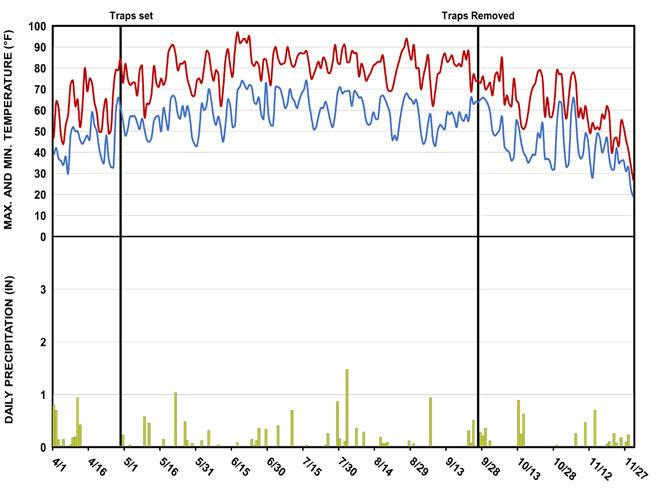
The biggest weather story of 2024 was the extreme to exceptional levels of drought acoss the state, particularly across southeast Ohio. The year began with a near-record warm winter, followed by ample spring moisture, early summer extreme heat, and very dry conditions from July through October. Two tropical systems did bring some temporary relief to portions of Ohio, but overall the warm, dry conditions persisted. Compared to our long-term average (1991-2020), growing season temperatures (March – November) were 2-5°F above normal (Fig. 1). The bulk of counties in Ohio received less than 30 inches of precipitation over this period, representing 50-75% of normal. Through November 2024 ranks as the warmest and 40th driest year on record (1895-present) for Ohio according the National Centers for Environmental Information. For more in-season climate analysis, please visit the State Climate Office of Ohio. The following is a summary of the growing season and seasonal breakdown of 2024.

Figure 1: (Left) Temperature departures (°F), (Middle) Precipitation departures (inches), and (Right) Precipitation departures (percent of normal) from the long-term (1991-2020) normal for March-November 2024. Figure courtesy of the Midwestern Regional Climate Center.
Winter (December – February)
The 2023-24 winter season brought mild conditions and only 25-75% of normal snowfall. The only sustained cold snap occurred during the third week of January. As a result, soil temperatures remained warmer than average most of the winter, with soils infrequently falling below freezing. Coupled with damp conditions, these warm soil temperatures and lack of snowfall led to reports of rutting along maple sap harvest routes. Winter temperatures averaged 6-8°F above normal across northern Ohio and 2-5°F above normal across the south (Figure 2). February was particularly warm, running 8-10°F above normal across much of Ohio. While January featured above normal precipitation for the state, both December and February were on the dry side. Winter 2023-24 ranks as the second warmest and 57th wettest for Ohio.
PROJECT CONTACT
For inquiries about this information, contact
Dr. Aaron B. Wilson, Assistant Professor and Field Specialist Ag Weather and Climate, OSU Extension wilson.1010@osu.edu

Figure 2: December – February average temperature difference compared to normal (1991-2020). Figure courtesy of the Midwestern Regional Climate Center.
Spring (March – May)
Warmer than normal conditions persisted throughout spring (March – May). All three months ranked near or in the top ten warmest all time. For most locations throughout the state, the last spring freeze (32°F) occurred near the climatological norm (April 21-30) though a few spots never dopped below freezing after April 10. Spring was a wet season for Ohio, especially April which ranked as the seventh wettest April on record with a statewide average of more than 5.5 inches (Figure 3). Three counties (Van Wert, Paulding, and Lucas) experienced their wettest April. Severe weather was a frequent occurrence as well, with historic tornado numbers for the season. Spring 2024 ranks as the second warmest and 28th wettest for Ohio.
Summer (June-August)
Hot weather was quick to start in June, with many stations reporting seven to nine consecutive days of at least 90°F during the middle part of the month. This led to the 15th warmest June on record (18952024). Both July and August were also warmer than normal. Drought conditions, which began in June intensified throughout the summer. Total summer precipitation for central and southeastern Ohio was less than 7.5 inches, 6-8 inches below normal (50% of normal; Figure 4). Though this caused significant stress on non-irrigated crops and rootstock, where enough moisture was present for emergence and growth, the dry weather contributed to decreased pest pressure and some reports of increased sweetness in apples. Soil moisture, rivers, and streams were well below average all season. Summer 2024 ranks as the 25th warmest and seventh driest on record.


Figure 3: County precipitation ranks for Ohio for April 2024. White shading indicates near normal conditions (130 years), while the top third (lighter colors) and top ten (darker colors) of the record are depicted for both dry (brown) and wet (green) conditions. Figure courtesy NOAA.
Fall (September – November)
Drought peaked in both intensity and areal covereage on September 24, 2024. According to the U.S. Drought Monitor, 2024 set records for the greatest coverage of D2-D4 drought conditions. Some relief came from the remnants of Hurricane Helene in late September, but dry conditions returned shorthy thereafter, with October reported as the 7th driest October on record. All three fall months ranked near or in the top 10 warmest on record as well. First fall freeze (32°F) conditions occurred between October 11- 20 for most of Ohio, with much later dates for the urban areas (Figure 5). These warm dry condtions brough mixed impacts, with very little disease and pest pressure but some negative effects on fall agrotourism activities. As November ended, early season cold swept across Ohio with a major lake snow event across Lake and Ashtabula Counties, where more than five feet of snow fell in some locations into the first week of December. Fall 2024 ranks as the third warmest and 38th driest on record.

Figure 4: Accumulated precipitation (inches) for June-August 2024. Figure courtesy of the Midwestern Regional Climate Center.
Figure 5: First freeze (32°F) dates for the Midwest. Figure courtesy of the Midwestern Regional Climate Center.
Noise on the Job
How much noise are workers exposed to during their daily routines? The answer is more than expected. Sounds that register 90 decibels for an 8-hour shift are considered hazardous. In fact, these noises are cumulative over one’s lifetime. Common highnoise sources include powered equipment like tractors, chippers, and lawn-care equipment. Unfortunately, hearing loss is a common hazard outcome for outdoor workers.
How to measure sound on the jobsite

Sound is measured in units called decibels (dB). Knowing the decibel level of a workplace makes it easy to determine if and where protection practices should be put in place.
To know if noise levels exceed the 90dB threshold, take a sound pressure reading. Handheld sound pressure meters record sounds instantaneously. If the business is covered under the Ohio Bureau of Workers’ Compensation (BWC) Program, BWC field specialists can provide a workplace noise reading upon request.
Another option for a mobile tool is a smart phone with a sound pressure APP. These APPS have similar capacity to sound pressure meters and provide a convenient and economical way to get instantaneous results. While smartphones do not meet the same accuracy as a certified sound pressure meter, they can provide a non-formal estimate of the workplace sound exposure. Search the APP store for “sound level meter” to find a variety of free options

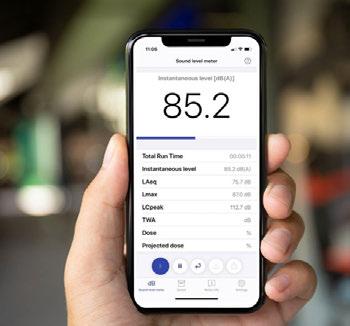
A sound level meter (left) takes instantaneous measurements of the environmental noise conditions at their source. A cell phone APP (sourced from NIOSH) uses the built-in microphone of the device to provide a good estimate of a worker’s noise exposure.
Prevention tips for workers:
1. Identify equipment and tasks that require hearing protection. These are areas or pieces of equipment where the sound level exceeds 85 decibels.
2. Require workers to wear hearing personal protective equipment (PPE) in workplaces that exceed 90 decibels. It’s a good practice to start wearing hearing protection at 85 decibels as a preventative measure.
3. There are many types of PPE ranging from ear plugs to muffs. All are acceptable if they are worn correctly. Ear plugs need to be inserted into the ear canal, while earmuffs cover the entire outer ear.
4. Choose PPE with a Noise Reduction Rating (NRR) of 20 or higher. The NRR is included on the package of each product. This number indicates the decibels that are reduced by wearing the hearing protection. The higher the rating, the better the product. As an example, if the workplace measures 100 dB, wearing hearing protection with an NRR rating of 22, makes the worker’s exposure 78 dB.
Control the noise at the source:
1. Perform routine maintenance on equipment. Well-lubricated equipment can reduce vibration and friction. Also ensure engines have properly installed mufflers and are in good condition.
2. Isolate the noise source from the worker. Insulating walls in buildings and the farm shop will reduce the transfer of noise to other work or office spaces. Also, cab tractors are good options for muffling engine noises and protect workers while performing other farm tasks.
3. While it is difficult to completely eliminate work around equipment sounds, workers can protect themselves by wearing hearing protection and rotate their work so that they limit the amount of time exposed to high noise activities throughout the day.
4. If the farm or small business hires more than 10 non-family members, employers should follow the recommended practice in the OSHA 1910.95 standard for Occupational Noise Exposure.
To learn more about noises on the farm, watch a video produced by the OSU Ag Safety and Health program in partnership with Ohio Bureau of Workers’ Compensation. This video explains the common ways hearing loss can occur in agricultural environments, how audiograms are used to detect hearing impairment, and the steps to take to prevent damage.
Summary:
Don’t wait to put a noise protection practice in place. Hearing loss is permanent! Unlike wearing corrective eyeglasses, hearing aids cannot restore a person’s hearing; these devices can only amplify the sounds detected by the auditory nerves.
Reference:
OSHA Standard 1910.95, Occupational Noise Exposure, Available at: https://www.osha.gov/laws-regs/regulations/ standardnumber/1910/1910.95


https://youtu.be/YxH10xQVTok
PROJECT CONTACT
For inquiries about this project contact
Dee Jepsen Professor, Agricultural Safety and Health Program OSU Food, Agricultural & Biological Engineering jepsen.4@osu.edu
Ohio Specialty Crop Enterprise Budgets
What are Enterprise Budgets?
Enterprise Budgets have been developed by faculty of the College of Food, Agricultural, and Environmental Sciences (CFAES) for decades. The 2024-2025 Ohio Crop Enterprise Budgets were developed by Extension Field Specialists in partnership with Barry Ward, Leader, Production Business Management at Ohio State. The budgets are tools that growers can use to examine different scenarios on their operation to help in decision making. The Enterprise Budgets can be found on Excel spreadsheets that users can download. Growers can then input their own production and price levels to calculate their own outputs. As seen below on this Jack-O-Lantern Pumpkin Budget, color coded cells allow users to plug in their own numbers and calculate the cost of production for different scenarios. More recently updated specialty crop budgets also include sunflowers, maple syrup, and Kernza perennial grains.
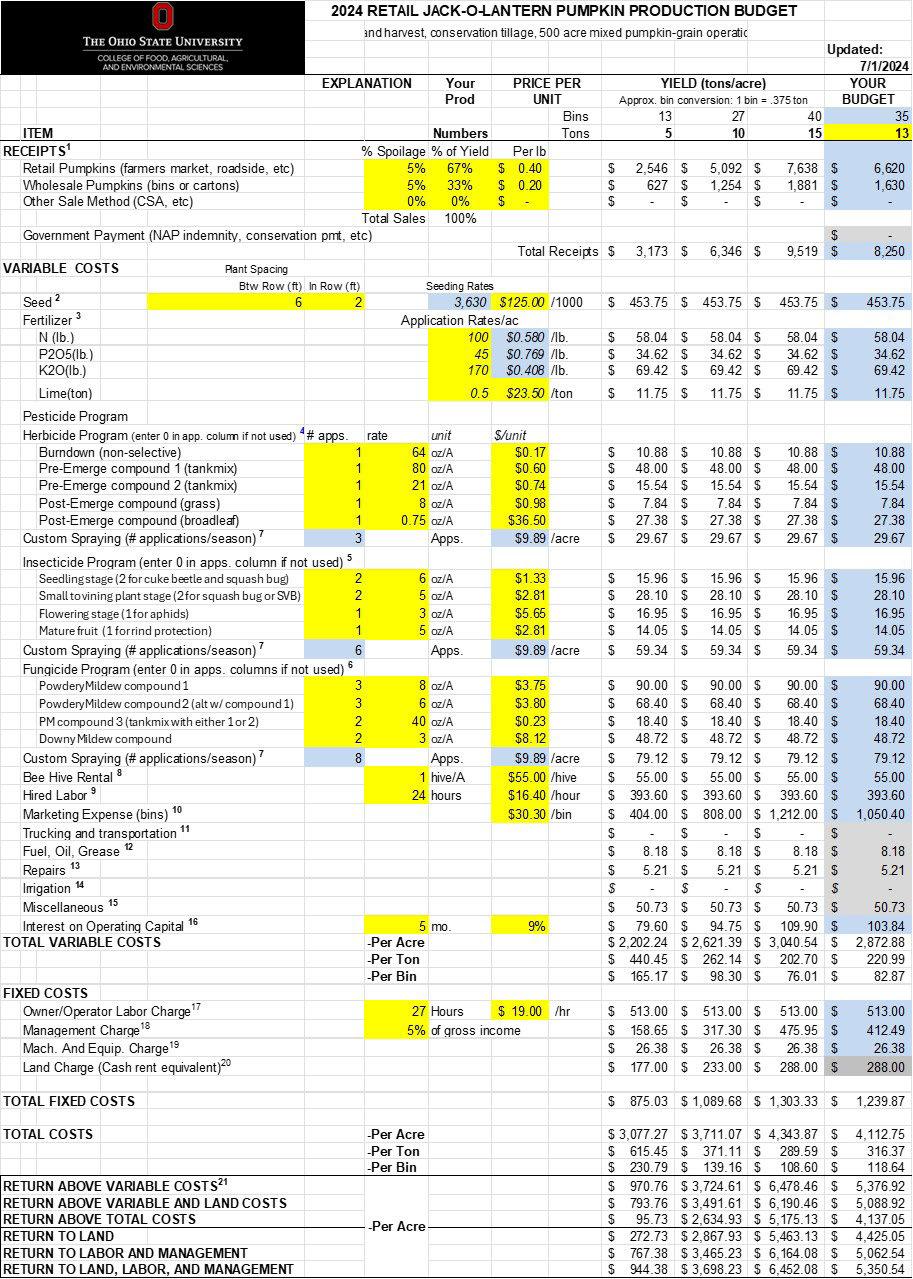
Cell Color Key:
Gold: Values may be changed to assist in computer the “Your Budget” column using macros embedded within the spreadsheet.
Blue: Values will be calculated for the user based on data entered. These cells may be input manually, but macros will be overwritten!
Gray: Values are stand-alone cells that require direct input from the user.
Key points to remember when utilizing the budget sheets:
• The budgets represent common, workable combinations of inputs that can achieve a given output.
• Amounts of seed, fertilizer, chemicals and other items reflect University recommendations informed by Extension Field Specialists and Ohio farmers.
• The combinations of inputs and prices presented will not precisely reflect any given farm.
• In practice, actual costs will be higher or lower than shown. Thus, the most important column is “Your Budget”.
Things not implied by an Enterprise Budget:
• It is not the only combination of inputs that can be used to produce this crop.
• It does not imply that anyone whose costs are different from this scenario must have incorrect data or poor records.
• It does not imply that all producers can achieve these costs and/or yields. Different soil types, production practices and weather in a given season can all cause the actual results to vary greatly from what is presented.
Yield Levels
Three yields are provided in each budget sheet. The middle yield is the long term trend yield for Ohio based on survey data. The other two yields are 50% lower and higher than the middle yield, which reflect differing yield potential.
Costing Methods
The budgets report all costs including cash, depreciation, and opportunity costs. Cash costs include categories such as seed, fertilizer, and pesticide costs. Depreciation on machinery is included in the “Machinery and Equipment Charge.” Some items may contain opportunity costs which reflect returns to a producer’s labor, capital, and managerial resources. Opportunity costs should be included in budgeting because they account for the use of the producer’s resources.
Fixed Costs
Four items are included as fixed costs, some of which may or may not be fixed for a particular operation. These items include labor, management, machinery and equipment, and land charges.
Variable costs
Seed, fertilizer, and pesticide requirements are based on agronomists’ recommendations. These quantities and prices can change to reflect your soil tests and local prices to provide a more accurate estimate of your costs of production..
Pricing Methods
Prices for specialty crops and inputs reflect estimates for a given year. Crop prices are estimates of harvest prices. If an improved price is achieved by your farm due to storage, marketing, or quality strategies, then any increased costs to achieve that price should be netted out of returns or added to costs.
Interpretation of Returns
All budgets report “Return above Variable Costs” and “Return above Total Costs”. Return above variable costs is useful in examining decisions that must be made within one year. Return above total costs would be used to examine “long-run” decisions.
PROJECT CONTACTS TOOLS OF THE TRADE
Specialty Crop Enterprise Budgets
You can access all of the Ohio Enterprise Budgets by visiting go.osu.edu/ enterprisebudgets or by using the QR code to visit the site

For inquiries about this information, contact
Eric Richer Associate Professor and Field Specialist OSU Extension richer.5@osu.edu
Barry Ward Leader, Production Business Management Agricultural, Environmental, and Development Economics ward.8@osu.edu
Statewide Pest Monitoring Network
Focus pest: Spotted-wing Drosophila
SIGNIFICANT FINDINGS IN 2024
Scentry Spotted-wing Drosophila (SWD) traps baited with Scentry lures were mostly deployed by early June, with the first detections of adults during the week of June 17-23. Mid-June is normally when SWD flies are detected across Ohio. Traps remaining in fields from July 15 through September were baited with 25% apple cider vinegar. Adult captures peaked from July 22 to August 25 at most sites. Normal population trends were seen despite drought conditions in central and southeast regions of the state.
CROPS IMPACTED
Raspberry, Blackberry, Strawberry, Blueberry, Peaches, Grapes and other soft skinned fruits.
BIOLOGY
First detected in Ohio in 2011. SWD overwinters as an adult in wood lots and other protected environments. The adults become active in the spring in wooded areas and by mid-June can be detected in cultivated crops. Without cultural or chemical intervention, most fruit may become significantly infested with larvae as adult populations continue to increase through the summer and into the fall.
THRESHOLDS
The current threshold for treatment is one fly per trap. If this threshold is exceeded, ripening or ripe berries should be protected with cultural methods or insecticide applications through harvest.

RESOURCES
Monitoring and managing SWD (YouTube videos on OSU IPM Library)

www.go.osu.edu/swdvideos
Spotted-wing Drosophila OSU Extension Factsheet

www.go.osu.edu/swdfacts
Raspberry fruit damage caused by SWD


Male SWD, note spots on wings and 2 black combs on front legs
TOOLS OF THE TRADE
Scentry traps are useful to detect presence of SWD near crops they may impact. The trap contains a lure that is highly attractive to SWD and 25% apple cider vinegar as a drowning solution.

www.go.osu.edu/swdtrap
Other OSU Extension Resources

www.go.osu.edu/swdnews
COOPERATOR RECRUITMENT
If you would like to participate in the monitoring network next year for Spotted-wing Drosophila, please send an email to Logan Minter, minter.21@ osu.edu or call (614) 292-3202. There is no cost to participate but monitoring sites are limited.

PROJECT CONTACT
For inquiries about this project contact Jim Jasinski Professor, OSU Extension jasinski.4@osu.edu
Female SWD, note saw-like ovipositor
SWD Monitoring
OBJECTIVE
Monitor insect pests on Ohio farms, for enhanced pest management, specifically the Spotted-wing Drosophila, on an elderberry farm in Adams county.
STUDY INFORMATION
Trap Set07/01/2024
Trap Removed08/01/2024
Crop MonitoredElderberry
Crop Area 1 acre
Production type Small Scale Commercial Production
ManagementOrganic
Number of sites monitored 1 Farm
Number of traps per site 2


ePLUS Collaborating Farm
OSU Extension
Adams County
WEATHER INFORMATION

STUDY DESIGN
Two Scentry traps baited with Scentry SWD lures were placed at an elderberry production site.
Trap 1 was placed on the middle of the field where the first set of elderberries were going to ripen, approximately 30 feet from the field edge.
Trap 2 was placed on the edge of the field, approximately 15 feet from the woods line. The traps were hung on a stake and were checked weekly for SWD flies.
The bait was changed from the Scentry lure to 25% Apple Cider Vinegar starting July 1 and was changed weekly until the traps were removed on week 5.
Sentry trap located in elderberry planting.
OBSERVATIONS
The season was very hot and dry.
SUMMARY
• This was the first year OSU Extension monitored for insects at this site.
• The grower has had a problem with Spotted-wing Drosophila for the past 3 years.
• The grower is testing all methods of control for Spotted-Wing Drosophila.
• According to the grower, this trapping year was considered normal.
RESULTS


PROJECT CONTACT
For inquiries about this project, contact
Jenny Stoneking Extension Educator, Adams, County stoneking.24@osu.edu
SWD Monitoring
OBJECTIVE
Monitor insect pests on Ohio fruit farms, for enhanced pest management, specifically the Spotted-wing Drosophila, near small fruit producers in Geauga county.
STUDY INFORMATION
Trap Set06/12/2024
Trap Removed10/09/2024
Crop Monitored Blueberries, raspberries, grapes
Crop Area 20 acres
Production typecommercial orchards & diverse small fruit farms
Managementconventional
Number of sites monitored 4 farms
Number of traps per site 2


ePLUS Collaborating Farm
OSU Extension Geauga County
WEATHER INFORMATION

STUDY DESIGN
Fruit farms were selected at the southern and northern ends of the county. Traps were placed on the east side of the field, approximately 50 feet from field edge in crops of blueberries and raspberries.
Traps were placed in the upper one foot of plant canopy and were checked weekly for SWD flies.
Throughout the study, traps used the Scentry lure with 25% apple cider vinegar as the trapping solution. Scentry lures were changed monthly and the trapping solution was changed weekly until the traps were removed.
OBSERVATIONS
Overall numbers of SWD remained consistent through midOctober due to the lack of any killing frost or freeze event. In fact, the first freezing temperatures really didn’t occur until late in the season; specifically, around the 27th of October. Even though the year was very dry, due to the irrigation capabilities on these high value crops, there was no impact on yields overall.
SUMMARY
• Compared with other years, the traps numbers were considered normal.
• The effect of management was observed due to the trap numbers were consistently lower after the growers applied an insecticide to manage adults.
• The growers used the trap captures as a guide to determine when to begin management sprays but also when to reapply sprays.
RESULTS


PROJECT CONTACT
For inquiries about this project, contact
Erik Draper Assistant Professor, Geauga
County
draper.15@osu.edu
SWD Monitoring
OBJECTIVE
Monitor insect pests on Ohio farms, for enhanced pest management, specifically the Spotted-wing Drosophila, near small fruit productions in Greene county
STUDY INFORMATION
Trap Set06/10/2024
Trap Removed09/29/2024
Primary Adjacent Crop Blackberries
Adjacent Area 1,500 sq. ft.
Production typeDiverse farm
Managementconventional
Number of sites2
Number of traps per site 2

ePLUS Collaborating Farm
OSU Extension
Greene County
WEATHER INFORMATION


STUDY DESIGN
Two Scentry traps baited with Scentry SWD lures were placed at two different blackberry production sites, approximately 100 feet apart.
The traps were hung on the trellis wire within the plant canopy and checked weekly for SWD flies by collecting and straining the 25% apple cider vinegar drowning solution.
Captured insects were sorted and identified under a stereo microscope. After July 15, the bait was switched to 100% apple cider vinegar, and weekly checks continued until the traps were removed on September 29 at Site 1 and August 2 at Site 2.
OBSERVATIONS
Traps were deployed in mid-June and removed at the end of September at Site 1 and the beginning of August at Site 2. SWD flies were detected at both sites within the first week of deployment (June 17–23). Peak captures occurred from July 22–28 at Site 1 and during July 1–7 and 15–21 at Site 2, with flies consistently detected each week throughout the season. Occasional insecticide applications by growers reduced fly populations but did not completely eliminate them.
SUMMARY
• Both sites have a known history of SWD flies.
• SWD flies were captured immediately after the traps were placed in the fields and continued to be detected weekly throughout the trapping period.
• SWD threshold is 1 fly per trap, therefore treatment could have been applied during the entire season.
• Growers sprayed insecticides infrequently, using damaged fruit as the action threshold; spraying when they saw increasing levels of damaged fruit
RESULTS


PROJECT CONTACT
For inquiries about this project, contact
Marina Miquilini Extension Educator, Greene County miquilini.1@osu.edu
Jim Jasinski Professor, OSU Extension jasinski.4@osu.edu
Blackberry fruit under attack by SWD egg-laying
SWD Monitoring
OBJECTIVE
Monitor insect pests on Ohio farms, for enhanced pest management, specifically the Spotted-wing Drosophila, near small fruit productions in Lorain County.
STUDY INFORMATION
Trap Set06/26/2024
Traps Removed07/17/2024 08/28/2024
Primary Adjacent Crop Blueberry and Blackberry
Adjacent Area12 Acres
Production typeCommercial small fruit/U-pick
ManagementConventional
Number of sites1
Number of traps per site 2

ePLUS Collaborating Farm
OSU Extension
Lorain County
WEATHER INFORMATION

STUDY DESIGN
The traps were placed initially in a blueberry field. The traps were hung on the plant and were checked weekly for SWD flies.
The bait was a Scentry lure with 25% Apple Cider Vinegar. Two traps were set in blueberries starting on 06/26/2024.
One trap was removed completely on 07/17/2024 and one was moved to blackberries on the same date. The trap was removed from blackberries on 08/28/2024.
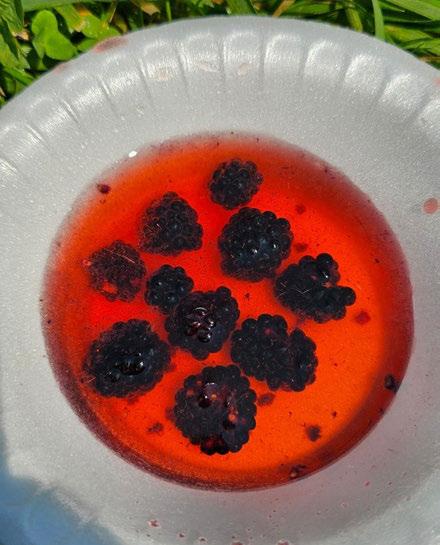
Saltwater test conducted on blackberries.
OBSERVATIONS
Did not remove Scentry lure from traps.
SUMMARY
• Since this was the first year trapping at this farm, any conclusions about pest pressure from previous years are unable to be compared
• Threshold was exceeded every time the traps were checked.
• Management decisions were made based on trap catches. There seemed to be positive results based on saltwater tests that were conducted in the field. Each saltwater test resulted on no larvae present in the fruit.


Male (left) and female (right) SWD flies
RESULTS

TOOLS OF THE TRADE
A saltwater test can be used as a quick method for detecting SWD larvae in fruit. This can be used to assess effectiveness of spray programs as well as marketability of fruit.

www.go.osu.edu/swdsalt
PROJECT CONTACT
For inquiries about this project, contact Thomas Becker Extension Educator, Lorain, County becker.643@osu.edu
SWD Monitoring
OBJECTIVE
Monitor insect pests on Ohio farms, for enhanced pest management, specifically the Spotted-wing Drosophila (SWD), near small fruit productions in Ross County.
STUDY INFORMATION
Trap Set06/06/2024
Trap Removed09/01/2024
Crop MonitoredThornless Blackberry
Crop Area 32,500sq.ft.
Production typecommercial orchard
Managementconventional
Number of sites monitored 1
Number of traps per site 1


ePLUS Collaborating Farm
OSU Extension Ross County
WEATHER INFORMATION

STUDY DESIGN
A Scentry trap was placed 4 rows in from the North side of the field, approximately halfway down the row.
The trap was hung from a trellis wire, close to the fruit zone and was checked weekly for SWD flies.
The bait was a Scentry lure suspended over 1 inch of 25% Apple Cider Vinegar plus a few drops of unscented dish soap to break water tension. Collecting solution changed weekly until the traps were removed.
OBSERVATIONS
There was exceptional drought conditions at this location. The fruit ripening window was shorter than in normal years.
SUMMARY
• Trapping for SWD has never happened here at this site, however fruit had been tested for larva activity in the past.
• Farmer stated that larva activity has been declining from year to year.
• Frequent harvesting seemed to mitigate SWD damage to fruit despite high numbers of adults.
RESULTS


PROJECT CONTACT
For inquiries about this project, contact Ryan Slaughter Extension
Educator, Ross County slaughter.71@osu.edu
Aquaponic Strawberry Substrate
OBJECTIVE
Evaluate substrate type and plant root condition at planting to increase yield of strawberries grown in a deep-water aquaponics system.
STUDY INFORMATION
Planting Date11/06/2023
Harvest Date(s) 12/08/202302/16/2024
VarietyAlbion
ManagementFungicide; Biological Controls
SystemDeep-water aquaponic; greenhouse
Study typeReplicated experiment Treatments4
Replications18
Size of trial~12sq ft; 72 plants
STUDY DESIGN
Experimental treatment combinations were imposed on individual plants as a complete randomized design. Each plant was contained in a ~2 x 2 in. (5.1 cu in.) basket as either a plug plant (retaining peat based growing media) or as bare root, along with either leca clay pebbles or coco coir croutons to volume.
Fruit number, weight, and quality was recorded and summed on an individual plant basis for a three-month harvest period. Leaf petiole sap was tested for dissolved nitrates at the conclusion of the study.

OSU South Center
OSU Extension
Pike County


Strawberry fruit nearing harvest
Strawberry plants shortly after planting in aquaponic float trays
OBSERVATIONS
Root development into the water system was visually much greater from bare root plants. Powdery mildew and spotted spider mites became pests across the board in the system towards the later part of the study.
SUMMARY
• Marketable yield: empirically, highest average per plant from those grown in clay pebble substrate, but not statistically different
• Fewer culls: bare root plants produced significantly fewer cull fruits than those in soil plugs
• Higher Plant Nitrogen: bare root plants showed much higher nitrogen concentrations in petiole leaf sap at conclusion of study (measured on 27 Feb. 2024)
RESULTS
Soil plug plants Clay
Bare
Treatment means with the same letter are not statistically different according to Fisher’s Protected Least Significant Differences (LSD) test at alpha=0.05 LSD: 1.01

TOOLS OF THE TRADE
Predatory mites are an example of biological control, a helpful tool in the integrated pest management toolbox, especially in aquaponics as chemical pesticides are limited.


Clay pebble substrate in foreground and coconut crutons in background

www.go.osu.edu/Cx26
PROJECT CONTACT
Report by: Dr. Logan Minter Field Specialist and Associate Professor OSU Extension
For inquiries about this project, contact Thom Harker Research Associate, OSU South Centers harker.7@osu.edu
Statewide Pest Monitoring Network
Focus pest: Brown Marmorated Stink Bug
SIGNIFICANT FINDINGS IN 2024
Clear sticky panel traps baited with Trece Pherocon dual lures were deployed at six sites across the state by the first week of August, with the first detections of adult and nymphal stinkbugs during the week of August 5-11. There was no distinct peak trap catch statewide as local populations of stinkbugs move to overwintering refugia based on warm weather following colder weather. Traps were removed from the field between September 16-29. Season long individual trap catches varied substantially by site, with as many as 212 BMSB or as few as 11 BMSB captured. Anecdotally, stinkbug damage to apples was reported higher this year by some growers. Drought conditions in central and southeast regions of the state did not seem to affect captures at most sites.
CROPS IMPACTED
Tree fruit, berry fruit, fruiting and non-fruiting vegetables, sunflower, corn, soybean; this pest has a very wide plant host range.
BIOLOGY
BMSB is a non-native pest first detected in Ohio in 2007. This insect overwinters as an adult, has five nymphal stages and can have up to two generations per year. This stinkbug has a large stylet mouth part that allows it to penetrate the skin of most fruits and vegetables, including seed pods. This stinkbug is now considered a perennial pest with varying significance on most food, fuel and fiber crops grown in the state.
THRESHOLDS
Apples are the only crop that a threshold exists for this pest. If at least two traps are placed at the perimeter and interior of an orchard, cumulative BMSB catches exceeding 10 stinkbugs on any trap, is the action threshold for insecticide treatment. This threshold was developed on apples grown on the mid-Atlantic and has not been validated in Ohio. Damage from BMSB can vary greatly from year to year and crop to crop. Historically, significant damage has been reported on sweet corn, apples and soybeans. Depending on the crop, cultural and insecticidal options are available.
RESOURCES
Monitoring and other aspects of BMSB (YouTube videos on OSU IPM Library)

www.go.osu.edu/bmsbvideos Clear sticky panel trap, baited with dual lures


COOPERATOR RECRUITMENT
If you would like to participate in the monitoring network next year for Brown Marmorated Stink Bug please send an email to Logan Minter, minter.21@osu.edu or call (614) 292-3202. There is no cost to participate but monitoring sites are limited.
TOOLS OF THE TRADE
The Samurai Wasp (Trissolcus japonicus), and egg parasitoid, was detected in the US around 2014. While this natural enemy of BMSB was already being evaluated as a biocontrol agent, it seems to have arrived in the U.S. naturally.

PROJECT CONTACT
For inquiries about this project contact Jim Jasinski Professor, OSU Extension jasinski.4@osu.edu
Feeding damage characteristic of BMSB on tomato
Adult BMSB
BMSB Monitoring
OBJECTIVE
Monitor Brown Marmorated Stink Bug (BMSB) activity near apple orchards and woodlands in the fall.
STUDY INFORMATION
Traps Set07/30/2024
Traps Removed09/26/2024
Primary Adjacent Crop Apple and Berry crops
Adjacent Area 8 acres
Production typeCommercial
ManagementConventional
Number of sites2
Number of traps per site 2

“Clean” clear sticky panel trap, before catching any insects
ePLUS Collaborating Farm
OSU Extension Greene County
WEATHER INFORMATION

STUDY DESIGN
This study aimed to monitor the Brown Marmorated Stink Bug (BMSB) during the fall migration into orchards and other crops enroute to overwintering sites in wooded habitat and structures.
Clear double sided sticky panel traps baited with dual pheromone lures were placed in a treeline adjacent to an apple orchard in Yellow Springs and along a treeline adjacent to a mixed berry crop in Xenia.
Data on adults and nymphs were collected weekly throughout the growing season, with panels being replaced every two weeks or as needed and pheromone lures replaced monthly.
OBSERVATIONS
Traps were deployed on schedule and began catching adult and nymph BMSB immediately during the first week of August 5-11. Trap catches were steady through August but increased during September 16-22. One site had noticeably higher trap catches.
SUMMARY
• Sticky panel traps were deployed to monitor late season crop infestation at two sites.
• Both adult and nymph BMSB were caught in sticky panel traps.
• BMSB activity in the fall is moderated by changes in the weather, not emergence.
• For the apple orchard site, if the threshold of 10 bugs cumulative per trap were used, insecticide sprays would have been recommended starting the week of August 19-25.
RESULTS


PROJECT CONTACT
For inquiries about this project, contact
Marina Miquilini Extension Educator, Greene County miquilini.1@osu.edu
Jim Jasinski Professor, OSU Extension jasinski.4@osu.edu
Immature BMSB on apple leaf
BMSB Monitoring
OBJECTIVE
Monitor insect pests on Ohio farms, for enhanced pest management, specifically the brown marmorated stink bug, near vegetable productions in Knox County.
STUDY INFORMATION
Trap Set07/29/2024
Trap Removed10/06/2024
Primary Adjacent Crop Tomatoes
Adjacent Area 60 row feet
Production typeCommercial
ManagementConventional
Number of sites1
Number of traps per site 2


ePLUS Collaborating Farm
OSU Extension
Knox County
WEATHER INFORMATION

STUDY DESIGN
Traps consisted of clear sticky panels each baited with a Trece pherocon dual lure.
Two traps were set on a mixed vegetable production farm. Trap one was on the west side of the farm 30 feet from a hay field. The trap was on the edge of the row. Row was 24 feet long, 7 rows of tomatoes in this field. Zucchini growing beside the tomatoes.
The second trap was on the west side of the property. The house, barn and a creek are between the two traps. The trap is on the edge of the field, 6 feet from the creek. 5 rows of tomatoes 50 feet in length. Pumpkins growing on one side and green beans on the other side.
Traps checked weekly. Sticky card replaced every two weeks, lures replaced monthly.
Clear sticky trap with dual lure
OBSERVATIONS
Major drought period during trapping may have affected trap catches. One trap consistently had more insects on them weekly than the other. This could be because it was next to a creek that was dry or because there were more weeds in this field compared to the other site.
SUMMARY
• Numbers of stink bugs were comparable to previous years.
• Trap two on the west side of the farm seemed to have more stink bugs than trap one.

RESULTS

PROJECT CONTACT
For inquiries about this project, contact
Sabrina Schirtzinger Extension Educator,
Knox County schirtzinger.55@osu.edu
BMSB Monitoring
OBJECTIVE
Monitor insect pests on Ohio farms, for enhanced pest management, specifically the Brown Marmorated Stink Bug, in apple orchards in Lorain County.
STUDY INFORMATION
Traps Set08/02/2024
Traps Removed09/26/2024
Primary Adjacent Crop Apple
Adjacent Area 22 acres (East Block – 8 acres) West Block – 14 acres)
Production typeCommercial orchard
ManagementConventional
Number of sites1
Number of traps per site 2

ePLUS Collaborating Farm
OSU Extension
Lorain County
WEATHER INFORMATION
STUDY DESIGN
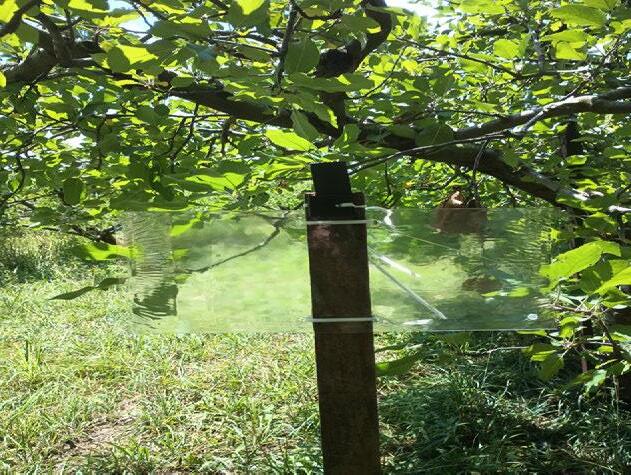
Sticky panels were placed on wooden stakes at the edge of an apple block. Sticky panels were placed about 4 ft off the ground using binder clips to fix them to the stakes.
A Trece Phercon dual lure was affixed at the top of the sticky panel and changed out the sticky panel every two weeks and the lure every month.
The total trap counts were a combination of adults and nymphs.
BMSB Trap on the edge of an apple block
OBSERVATIONS
Traps were unable to be checked the week of 09/19/2024. The following week’s count is a two week count conducted on 09/26/2024.
SUMMARY
• Since this was the first year trapping at this farm, any conclusions about pest pressure from previous years are unable to be compared.
• Counts never exceeded threshold.
• There were no specific management decisions made based upon brown marmorated stink bug.
RESULTS


PROJECT CONTACT
For inquiries about this project, contact
Thomas Becker Extension Educator, Lorain, County becker.643@osu.edu
BMSB Monitoring
OBJECTIVE
Monitor insect pests on Ohio farms, for enhanced pest management, specifically the Brown Marmorated Stink Bugs in sweet corn, tomatoes and peppers in Morrow county.
STUDY INFORMATION
Trap Set07/29/2024
Trap Removed10/06/2024
Primary Adjacent Crop Sweet Corn, Tomatoes and Peppers
Adjacent Area 0.25 acres
Production typeDiverse Farm
ManagementConventional
Number of sites1 farm
Number of traps per site 2 Traps


ePLUS Collaborating Farm
OSU Extension
Morrow County
WEATHER INFORMATION

STUDY DESIGN
Two sticky, clear panel traps were set near the area being studied that had wild flowers, brushy shrubs and trees.
The traps were set 100 ft apart. The sticky traps were checked weekly and the lure and traps were replaced weekly.
OBSERVATIONS
The weather was abnormally dry this year and stink bug damage on the produce was less than was noticed last year. The produce farm is surrounded by agronomy crop fields consisting of corn and soybeans.
Adult and nymph BMSB feeding through husks of sweet corn.
C. Welty
SUMMARY
• Crops were sprayed weekly with SiPhite (a natural fungicide and bactericide), SiGuard (liquid silica), Dreggo (natural insecticide blend of essential oils and Surround wp and pyrethrum was used once to control cucumber beetles.
• Crop damage was noticeably less this year than it was in 2023; trapping did not occur on this farm in 2023.
• Trapping was used to monitor stink bug activity on the farm but did not influence spray intervals.
• Trapping will take place on the farm again in 2025.

Stink bug damage on green pepper
RESULTS

PROJECT CONTACT
For inquiries about this project, contact
Carri Jagger Extension Educator, Morrow County jagger.6@osu.edu
BMSB Monitoring
OBJECTIVE
Evaluate brown marmorated stink bug populations in a commercial apple orchard in Ross county to determine if an insecticide was needed.
STUDY INFORMATION
Trap Set08/01/2024
Trap Removed09/25/2024
Crop MonitoredApple
Crop Area 2acres
Production typecommercial orchard
Managementconventional
Number of sites monitored 1
Number of traps per site 2

ePLUS Collaborating Farm
OSU Extension Ross County
WEATHER INFORMATION

STUDY DESIGN
Two traps were set for monitoring: one at the end of a row of apple trees approximately 20ft from a wood-line. The second trap was set approximately 50ft into the row. They were sticky cards placed approximately 4ft high on wooden stakes. A Pherocon lure was placed at the top of the sticky trap.
BMSB trap in front of an apple tree
OBSERVATIONS
Weather in this region was extremely dry. Fruit quality was very good, but the size of the apples was much smaller than in normal years. There was very little disease. Insect damage was also minimal, despite having fairly high number of trap-counts in September.
SUMMARY
• This was the first year for trap monitoring for this pest no comparisons can be made.
• The threshold for this pest was reached a few times in September, but the grower elected not to spray, because visible signs of apple damage was minimal, and the fruit was close to harvest.
• The grower would like to continue to monitor for pest populations in the future
RESULTS

PROJECT CONTACT
For inquiries about this project, contact Ryan Slaughter Extension Educator, Ross County slaughter.71@osu.edu
Closeup of sticky trap and Pherecon lure
IPM Trapping Network:
Codling Moth
OBJECTIVE
Monitor insect pests on Ohio farms, for enhanced pest management, specifically the Codling moth, in an orchard in Lorain County.
STUDY INFORMATION
Traps Set04/29/2024
Traps Removed09/26/2024
Primary Adjacent Crop Apple
Adjacent Area 22 acres (East Block – 8 acres) (West Block – 14 acres)
Production typeCommercial orchard
ManagementConventional
Number of sites2
Number of traps per site 3
ePLUS Collaborating Farm
OSU Extension
Lorain County
WEATHER INFORMATION

Codling Moth damage on calyx end of fruit.
STUDY DESIGN
Bucket traps were placed in 2 blocks of apples in the orchard. Three bucket traps were placed randomly in each block, for a total of 6 traps.
Each trap had a Trece pherocon codling moth lure that was changed out every 6 weeks. Each trap also had a Hercon Vaportape kill strip.
Traps were hung in trees about 6 feet from the ground and were checked weekly until traps were removed.
OBSERVATIONS
Traps were unable to be checked the week of 09/19/2024. The following week’s count is a two week count conducted on 09/26/2024. However, this should not greatly impact overall counts as the counts were all zero for this time period.
SUMMARY
• Since this was the first year trapping at this farm, any conclusions about pest pressure from previous years are unable to be compared
• The grower did use trapping data as well as growing degree day data from Network for Environment and Weather Applications (NEWA) to help determine a spray schedule.
RESULTS


PROJECT CONTACT
For inquiries about this project, contact
Thomas Becker Extension Educator, Lorain, County becker.643@osu.edu
Codling Moth adult in bucket trap.
IPM Trapping Network:
Codling Moth
OBJECTIVE
Monitor insect pests on Ohio farms, for enhanced pest management, specifically the Codling Moth, near orchard fruit productions in Wayne, Homles, Stark and Medina counties.
STUDY INFORMATION
Trap Set05/13/2024
Trap Removed09/09/2024
Crop MonitoredApples
Crop Area ~250 acres
Production typeCommercial Orchard
ManagementConventional and Organic
Number of sites monitored 9 Farms, 16 sites
Number of traps per site 3-18
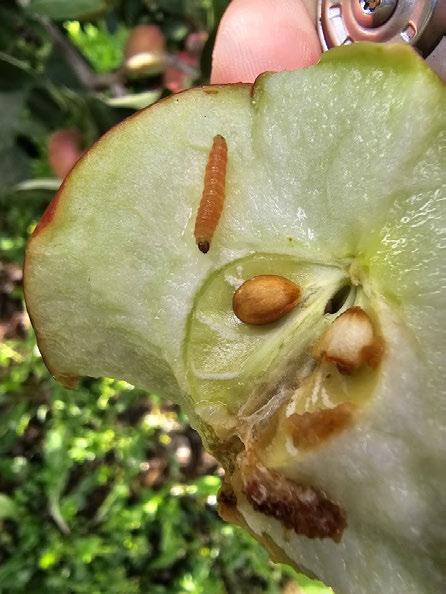
Codling Moth damage inside fruit

ePLUS Collaborating Farm
OSU Extension
Wayne, Homles, Stark, Medina
WEATHER INFORMATION

STUDY DESIGN
Bucket style traps were placed in orchard blocks of orchards in Wayne, Holmes, Stark and Medina counties. Two to three traps were placed in the blocks, scattered randomly throughout; placed in trees at least two rows in from the edge of orchard and five trees from ends of row. Each trap had a Trece pherocon codling moth lure that was changed out every 6 weeks. Each trap also had a Hercon Vaportape kill strip. Traps were hung in trees about 6 feet from the ground and were checked weekly until traps were removed. There were 7 sites in Wayne County, 3 sites in Holmes, 5 in Medina and 1 in Stark.
OBSERVATIONS
Due to warm spring, and trap deployment date, initial flight was observed in progress, rather than observing first catch, followed by consistent flight.
Any missing data is as a result of spray restrictions. Subsequent weeks to those missing data would be considered a “2-week” count.
• Comparatively, codling moth catch was consistent with previous years.
• Some orchard growers expressed their evaluation as the pressure being lower in this year compared to previous years.
• Trap data was utilized by growers, in conjunction with GDD modeling from NEWA to determine spray application timings and intervals.

RESULTS


PROJECT CONTACT
For inquiries about this project, contact
Frank Becker Extension Educator, Wayne County becker.587@osu.edu
IPM Trapping Network: Peachtree Borers
OBJECTIVE
Monitor insect pests on Ohio farms, for enhanced pest management, specifically the Greater and Lesser Peachtree Borer, near orchard fruit productions in Holmes County.
STUDY INFORMATION
Trap Set07/08/2024
Trap Removed08/26/2024
Crop MonitoredPeach
Crop Area 30 acres
Production typeCommercial
ManagementConventional
Number of sites monitored 1 farm
Number of traps per site 4 traps, 2 of each

ePLUS Collaborating Farm
OSU Extension
Homles County
WEATHER INFORMATION


STUDY DESIGN
Bucket style traps were placed in orchard blocks of peach orchards in Holmes County and were scattered randomly throughout; placed in trees at least two rows in from the edge of orchard and five trees from ends of row. Each trap had an either a Greater Peachtree Borer (GPTB) or Lesser Peachtree Borer (LPTB) Trece pherocon lure. Each trap also had a Hercon Vaportape kill strip. Traps were hung in trees about 6 feet from the ground, and near the trunk of the tree, and were checked weekly until traps were removed.
OBSERVATIONS
Due to warmer than average conditions, and trap deployment date, initial flight was observed in progress, rather than observing first catch, followed by consistent flight.
• Trap catch considered normal for this site
• Grower utilized trap data to make management decisions and narrow down application timings.
RESULTS


PROJECT CONTACT
For inquiries about this project, contact
Frank Becker Extension Educator, Wayne County becker.587@osu.edu
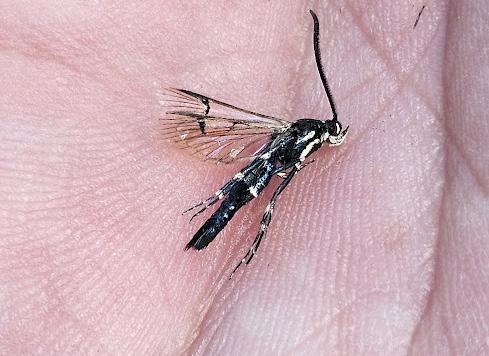
Adult male Lesser Peachtree borer
IPM Trapping Network: Oriental Fruit Moth
OBJECTIVE
Monitor insect pests on Ohio farms, for enhanced pest management, specifically the Oriental Fruit Moth, near orchard fruit productions in Wayne, Holmes, Medina and Stark counties.
STUDY INFORMATION
Trap Set05/13/2024
Trap Removed09/02/2024
Crop Monitored Peach, Pear, Apple
Crop Area~150 Acres
Production typeCommercial orchard ManagementConventional and Organic
Number of sites monitored 6 Farms, 11 sites
Number of traps per site 3-9

OFM damage to stem tip.
(Image: Jonas Janner Hamann, Universidade Federal de Santa Maria (UFSM), Bugwood.org)
ePLUS Collaborating Farm
OSU Extension
Wayne, Homles, Stark, Medina
WEATHER INFORMATION

STUDY DESIGN
Bucket style traps were placed in orchard blocks in orchards in Wayne, Holmes, Stark and Medina counties. Two to three traps were placed in the blocks, scattered randomly throughout; placed in trees at least two rows in from the edge of orchard and five trees from ends of row. Each trap had a Trece pherocon oriental fruit moth lure that was changed out every 6 weeks. Each trap also had a Hercon Vaportape kill strip. Traps were hung in trees about 6 feet from the ground and were checked weekly until traps were removed. There were 5 sites in Wayne County, 3 sites in Holmes, 1 in Medina and 2 in Stark.
OBSERVATIONS
Due to warm spring, and trap deployment date, initial flight was observed in progress, rather than observing first catch, followed by consistent flight.
Any missing data is as a result of spray restrictions. Subsequent weeks to those missing data would be considered a “2-week” count.
SUMMARY
• Observed catches and grower commentary both supported higher than normal OFM catch, as well as increased duration of flights.
• Trap data was utilized by growers, in conjunction with GDD modeling from NEWA to determine spray application timings and intervals.

RESULTS

PROJECT CONTACT
For inquiries about this project, contact
Frank Becker Extension Educator, Wayne County becker.587@osu.edu
Oriental Fruit Moth
(Image: Todd M. Gilligan and Marc E. Epstein, TortAI: Tortricids of Agricultural Importance, USDA APHIS PPQ, Bugwood.org)
Spotted Lanternfly Monitoring
OBJECTIVE
Monitor insect pests on Ohio farms, for enhanced pest management, specifically the Spotted Lanternfly, near small fruit production in Lorain County.
STUDY INFORMATION
Trap Set08/01/2024
Trap Removed11/20/2024
Primary Adjacent Crop Blueberry and Blackberry
Adjacent Area 12 acres
Production typeCommercial small fruit/U-pick
ManagementConventional
Number of sites1
Number of traps per site 2

ePLUS Collaborating Farm
OSU Extension
Lorain County
WEATHER INFORMATION

STUDY DESIGN
Spotted lanternfly traps were secured to trellising or netting support structures near small fruit plantings.
Each trap was on a field edge, one near the road (Trap 1), and the other near the driveway that serves as an entrance to the farm (Trap 2).
Each trap was placed about 5-6 ft above the ground. No pheromone lures were used. The trap utilizes netting and a funnel to guide the spotted lanternfly into a collection bag.
Adult SLF in trap collection bag.
OBSERVATIONS
Traps were set once adults were detected in the county. One trap was removed in September due to the renovation of a blueberry field.
SUMMARY
• SLF was detected in Lorain county in 2024
• Since this was the first year trapping at this farm, any conclusions about pest pressure from previous years are unable to be compared
• There were no specific management decisions made for SLF and thresholds have not been established
RESULTS


TOOLS OF THE TRADE
Scraping egg masses with a knife or edge of a credit card into soapy water (dish soap works) or rubbing alcohol will kill the eggs. OSU Entomology has also developed 3-d printed egg scraping tools to help woith ID

www.go.osu.edu/CyEK
PROJECT CONTACT
For inquiries about this project, contact
Thomas Becker Extension Educator, Lorain, County becker.643@osu.edu
Adult Spotted Lanternfly
Evaluating New Blackberry Cultivars for Orange Rust Resistance
OBJECTIVE
To evaluate two new blackberry cultivars that are supposed to be resistant to orange rust.
STUDY INFORMATION
Planting Date05/01/2024
Harvest Date(s)07/05/2024-08/14/2024
VarietyCaddo Ponca
Management Fungicide; Biological Controls
SystemCommercial Field on 2-wire trellis
Study typeReplicated Experiment
Treatments2
Replications3
Size of trial ~200ft x 50ft; 150 plants

Infected leaf discarded at the base of a new plant
ePLUS Collaborating Farm
OSU Extension Ross County
WEATHER INFORMATION

STUDY DESIGN
75 plants of each of the two cultivars “Caddo” and “Ponca” were planted within existing rows of blackberry plants that are known to have orange rust.
Half of these new plants were then inoculated by using leaves from existing plants that were covered with orange rust spores.
Visual evaluation was then conducted weekly for the remainder of the season.
OBSERVATIONS
Caddo and Ponca plants remained healthy despite extreme drought conditions.
SUMMARY
• All plants of Caddo and Ponca remained free of visual signs of orange rust infection for the entirety of the season.
• Evaluation will continue in the 2025 growing season.


PROJECT CONTACT
For inquiries about this project, contact
Ryan Slaughter Extension Educator, Lorain, County slaughter.71@osu.edu
Dr. Gary Gao Professor, OSU Extension gao.1@osu.edu
Orange Rust Spores on Bottom of Blackberry Leaf
New blackberry plant growing between two older plants
Onion Variety Trial
OBJECTIVE
Evaluate plant growth, establishment, yield, and postharvest shelf life of five red onion varieties grown in Ohio’s Appalachian region.
STUDY INFORMATION
Sowing Date02/13/2024 (early -
Rossa di Milano only)
03/06/2024 (all varieties)
Transplant Date05/03/2024
Harvest Date07/11/2024
VarietiesTranslyvanian Red
Rose de Roscoff Keravel
Rossa di Toscana
Rossa di Milano Karmen
ManagementOrganic
Study typeRandomized complete Block
Treatments6
Replications4
Soil typeGuernsey-Upshur complex, 8-15 % slopes
STUDY DESIGN

ePLUS Collaborating Farm
OSU Extension
Athens County
WEATHER INFORMATION

Growing Season Weather Summary
Experiments were performed in randomized complete block design with 4 replications. A total of five varieties of red onion were sown on March 6, 2024 and transplanted on May 3, 2024. For Rossa di Milano an additional early sowing date (on February 13) was included on the trial. For reporting purposes, early (February 13) and late (March 6) indicate Rossa di Milano’s sowing dates.
In Spring 2024, experimental beds were mowed and power-harrowed before transplant using a Grillo walking-behind tractor. Trial size detail: 30” bed width, 24” aisle width, 2 onion rows per bed with 14” between rows and 12” within rows. Buffer zone: 24” between plots and 48” at the end of each block. Plant population: total of 60 plants per variety per block (3 plants per hole times 20 holes, on stagger), 360 plants per block, and 1440 plants across all experiment.
At maturity, each 30”x 120” plot was harvested. The final number of plants for each plot was recorded and total yields were computed. Heat spike at the end of the growing season in late June led to crop harvest in early July and removal of the field curing process. Harvested onion bulbs were transferred to storage conditions immediately after harvest. Physiological loss in weight (PLW) was recorded at 57, 110, and 170 days post harvest. PLW included loss in weight of onion due to the drying effect of the atmosphere and due to rotting. Sprouted bulbs were also considered unsuitable for consumption and were taken for PLW count.
A pilot sensory evaluation was conducted (57 days of storage) with five trained assessors. Onion bulb quality attributes selected for sensory evaluation were appearance (both, raw and cooked onion), sweetness, pungency, aroma, texture, and taste (cooked onion only).
RESULTS


Effect of variety on onion total yield. Letters indicate significant differences (p < 0.05) among varieties.

Effect of variety on cumulative fresh weight loss measured at 57, 110, and 170 days of storage. Letters within each storage period indicate significant differences (p < 0.05) among varieties.
Full Report, including Sensory Analysis Report can be found here:

SUMMARY
• Bulb total yield: significant variation due to varieties

www.go.osu.edu/24onions
• Physiological loss in weight: significant variation in due to varieties, primarily at 27-day and 170-day storage.
• Appearance (both raw and cooked samples): highly appreciated for Karmen and Translyvanian Red. Taste was the best for Rossa di Milano. Karmen ranked highest in aroma and lowest in pungency, while both Rose de Roscoff Keravel and Rossa di Toscana ranked highest in texture preferences.
• It can be perceived that “Appearance” was given the highest preference by the consumer.
PROJECT CONTACT
For inquiries about this project, contact Dr. Fernanda Krupek State Specialist and Assistant Professor OSU Horticulture and Crop Sciences krupek.1@osu.edu
Northern Ohio Sh2 Sweet Corn
Variety Trial
OBJECTIVE
Evaluate new and existing varieties of Sh2 Sweet Corn based on their production potential, quality and predicted consumer acceptance.
STUDY INFORMATION
Planting Date05/20/2024
Harvest Date(s) 07/29-08/07/2024
Varieties27
ManagementConventional
SystemCommercial producion practices
Study typeVariety evaluation, Randomized block
TreatmentsMultiple harvests; variety
Replications4
Size of trial2.5 acres
Soil TypeHoytville silty clay loam
STUDY DESIGN

NC Ag Research Station
OSU Extension
Sandusky County
WEATHER INFORMATION

Growing Season Weather Summary
Growers and seed companies suggested varieties to be grown, with a strong preference for inclusion given to new and experimental varieties, for comparison alongside industry standard varieties. The evaluation used four replicated plots, grown under best management practices, to give growers a fair comparison of the different varieties grown on lakebed soils, within a normal Northern Ohio growing season. Plots were planted in 30-inch rows, 30 feet in length. Each variety is planted in a 4-row block, replicated 4 times, using randomized variety location within each replication. The centered 2 rows of each plot were harvested for data collection. After germination and stand counts, rows were trimmed to 25 feet. Plots were thinned to a final stand of 23,500.
Best management practices were utilized prior to and during the trial. Because of multiple heavy rain events during the summer of 2023, which cause compaction in the proposed test site, the areas were subsoiled with a Landoll 3 shank ripper. On April 29, 2024, the site was disk chiseled using a Brillion conservation tillage tool. On May 7, 2024, the test area was tilled using a Landall finisher and a finish packer. Fertilizer consisting of 400 lbs. 0-0-60, 150 lbs. 11-52-0, 150 lbs. 21-0-0-24 (sulfur), 175 lbs. 46-0-0, and 10 lbs. of Boron was spread on May 14 and incorporated lightly. Used a Kongskilde fine finisher and rolling basket. The plot was planted using a JD 7000 Planter equipped with Almaco cone units on May 20. Herbicide consisting of 20 oz/acre Dual Magnum and 5.75 oz/acre Justified was applied three days later and prior to emergence on 5/23/2024. As was feared prior to the season, the site was lumpier than we would normally expect at the research station. For this reason, a few of the plots were slow to emerge however, in due time, stands were adequate. The plots were thinned to a 9” in row spacing on June 10. On June 18, .75 inches of water was applied overhead. This was the only irrigation used.
Plot was side dressed on 6/6/2024 with 34 gal/acre, 28% UAN and 1 gallon/acre Aultramate LQ 12%.
Electric fence was installed around the entire trial in late July to protect against wildlife damage. No fungicide applications were made.Five insecticide applications were made.
Sweet corn plants were evaluated at harvest for the following characteristics, which are summarized in the tables: ease of harvesting ear (snap rating), ear height, stand population, harvested dozens per acres, and marketable dozens per acre. Immediately following harvest, 5 random marketable ears per variety were evaluated for flags, husk cover, tip fill, number of kernel rows/ear, kernel color, ear length, ear diameter, tenderness, sweetness, and overall flavor.
OBSERVATIONS
• Smut was a moderate concern this year with nearly half of the varieties displaying a noticeable amount. Smutty ears are reflected in the harvest data as ‘nonmarketable’
RESULTS
In determining the ear evaluation scores, a team of 5 individuals (the principal investigator, 2 members of the research station staff, and 2 student employees) each made their individual rankings on the 5 ears for each characteristic, and the final reported value was the combined average individual scores. This process held true for the tenderness, sweetness, and overall flavor scores as well, determined by raw taste testing of the 5 aforementioned individuals. Full Report, including yield and performance data can be found here:

www.go.osu.edu/24sweetcorn


PROJECT CONTACT
For inquiries about this project, contact Mike Gastier
Extension Educator Huron County gastier.3@osu.edu
Northern Ohio Processing Cabbage Variety Trial
OBJECTIVE
Evaluate varieties of cabbage to measure each variety’s usefulness as a processing cabbage for large scale production.
STUDY INFORMATION
Planting Date05/20/2024
Harvest Date(s) 08/23-11/15/2024
Varieties23
ManagementConventional
SystemCommercial kraut production practices
Study typeVariety evaluation, Randomized block
TreatmentsMultiple harvests; variety
Replications4
Size of trial1.5 acres
NC Ag Research Station
OSU Extension Sandusky County
WEATHER INFORMATION

Growing Season Weather Summary
STUDY DESIGN
The trial was to examine general characteristics of the cabbage, including observed maturity, tonnage harvested, internal color of heads, Brix levels, thrips severity, and disease activity at 3 different harvest dates. This trial was intended as an evaluation to establish a baseline for the varieties grown.
Harvest was judged by cutting heads and examining how many green leaves were on the head. Less than six green leaves indicated timing for the variety to be harvested. Second and third harvests were then approximately seven days and fourteen days later. This section also shows yield data. Charts show total yield, useable yield and may indicate the reason for the cull loss.
The Head Evaluation section gives all the data about each variety. The data is an average of two heads that were evaluated at each harvest. All three harvests are shown, and an average of all harvest is highlighted at the bottom of each variety. Included in this evaluation is the Onion Thrips Severity Rating. This rating examines both the severity of thrip damage and the leaf depth at which it was found.
The final chart is a rating index that ranks all the varieties based on an average of their scores on the traits that could be scored with a ranking system. Total harvested tons were not included in the average ranking, as this would have skewed data based on the variance in marketable and cull tonnage within varieties. Total harvested tons are however reported for observation. This ranking is informational only and does not necessarily indicate which varieties are most suitable for processing cabbage productions. Seed availability, soil types, contract dates, and other factors would influence the variety selection of individual growers.
OBSERVATIONS AND SUMMARY
• Plots were planted in 30” rows and were not on raised beds.
• Disease pressure was moderate this season.
• In general, the plot was below average in appearance and yield, due to wet weather at planting and dry weather after July 1.
• Thrip pressure was light this season.
RESULTS
Full Report, including yield and performance data can be found here:

www.go.osu.edu/24cabbage


PROJECT CONTACT
Squash Bug Management
OBJECTIVE
Evaluate how different insecticide products (Warrior & Assail) and application frequencies (3 thresholds & weekly) impact marketable yield in squash.
STUDY INFORMATION
Planting Date06/13/2024
Harvest Date(s)10/04/2024-10/07/2024
CultivarButternut
Management Insecticide; Fungicide
Study typeReplicated experiment
Treatments8 + Untreated Control
Replications5
Size of trial4500 ft²
STUDY DESIGN
Two products (Warrior and Assail) were evaluated in combination with four application frequencies: weekly, threshold 1(1 adult squash bug per plant), threshold 2 (1 adult squash bug or egg mass per plant), and threshold 3 (1 adult squash bug, egg mass, or nymph per plant).
Using a randomized complete block design, each treatment was randomly assigned to a plot within each of the five replications, with an untreated control included in every replication. Threshold-based applications were determined through weekly scouting beginning in early July.
For yield assessment, all squash within a 10 ft2 quadrat per plot were harvested, weight, and graded according to USDA standards.

NC Ag Research Station
OARDC
Sandusky County
WEATHER INFORMATION


OBSERVATIONS
Squash bug pressure was observed beginning early July. Yellowing of the squash plants was noted in several plots throughout the scouting period. Since squash bugs are vectors of the bacteria responsible for cucurbit yellow vine decline (YVD), plant samples were collected and analyzed post-harvest. YVD was detected in 7 out of 45 plots.
SUMMARY
• Product: Squash plots treated with Assail produced significantly higher marketable yield compared to plots treated with Warrior.
• Application Frequency: Weekly applications resulted in the highest marketable yields. However, thresholds 2 and 3, which account for multiple life stages of squash bugs, produced statistically similar marketable yields to the weekly application.
RESULTS
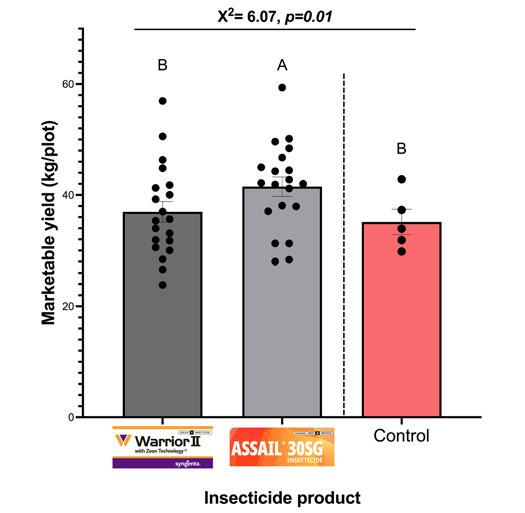
Product means with the same letter are not significantly different according to Fisher’s Protected Least Significant Differences (LSD) test at alpha = 0.05.


Application Frequency means with the same letters are not significantly different according to Fisher’s Protected Least Significant Differences (LSD) test at alpha = 0.05.
PROJECT CONTACT
For inquiries about this project, contact Breh Ruger Graduate Student, OSU Entomology ruger.5@osu.edu
Dr. Ashley Leach
State Specialist and Assitant Professor OSU Entomology leach.379@osu.edu
Perimeter Trap Cropping for Pumpkin
OBJECTIVE
Investigate potential effectiveness of using a treated trap crop to help protect pumpkin fields from insect pests.
STUDY INFORMATION
Planting Date06/10-28/2024
Harvest Date(s) 9/6-30/2024
VarietyField Trip
ManagementPreventative fungicides and herbicides; insecticides after reaching action threscholds
SystemConventional
Study typeReplicated experiment Treatments2
Replications3
Size of trial0.5 acres
STUDY DESIGN
At three OSU research stations, pairs of identical plots of pie pumpkins were planted. Each plot was comprised of eight rows (50 ft long) of pumpkin planted on raised beds with at least 400 ft between plots. Weed and disease management was provided by herbicides and fungicides; consistent within each site.
One of the plots at each site was randomly selected to receive a perimeter trap crop (PTC) planting of Blue Hubbard squash which was treated with Belay insecticide as a drench, following direct seeding. A second planting of PTC was added at Pike and Huron sites 3-4 weeks later. Additionally, The entire PTC was treated 3 weeks later with Entrust insecticide mixed with Cidetrak D feeding stimulant to further extend efficacy.
Plots and PTCs were scouted weekly for striped/ spotted cucumber beetle and squash bugs. Insecticide applications were made to plots exceeding recommended action thresholds.
All fruit were harvested and graded according to USDA standards.


OARDC Research Stations
OSU Extension
Pike, Huron, Wayne Counties


Control Pumpkin plot in Pike county showing stress of extreme drought compounded by insect feeding
Pumpkin plot in Huron county with PTC of Blue Hubbard
OBSERVATIONS
Overall, pest numbers observed through scouting were lower in plots baited with PTCs, thus triggering fewer insecticide sprays. The PTC plants at the Pike county site were heavily impacted by extreme drought at this location and did not grow as vigorously. Less yield difference was noted at the Wayne county site which employed a single strip of Blue Hubbard, rather than a complete perimeter. Other closely related varieties of Cucurbita maxima may hold promise for additional yield return from the PTC.
SUMMARY
• Lower pest numbers: scouting of plots revealed lower numbers of cucumber beetles and squash bugs in PTC plots.
• Fewer Sprays: reduced applications of insecticides to the plots with PTC were needed based on scouting and thresholds
• Dead Beetles: scouting of PTC itself revealed many dead cucumber beetles on the ground below plants, especially following treatments
• Less Unmarketable Fruit: losses due to insect feeding and sunscald were much lower in trap crop plots at Pike and Huron sites, but were not statistically different overall.
RESULTS
Addional yield of Blue Hubbard (Pike and Huron sites) Not recorded Not recorded
Treatment means with the same letter are not statistically different according to Fisher’s Protected Least Significant Differences (LSD) test at alpha=0.05
TOOLS OF THE TRADE
Integrated Pest Management utilizes multiple tools to balance insecticide inputs with environmental protection and economic gains.
Reduced insecticides can enhance benefits from natural enemis such as Trichopoda pennipes, a fly that parasitizes squash bugs.


Hubbard fruit gleaned from PTC could provide additional economic return beyond serving as a pest managment tactic.
PROJECT CONTACT
For inquiries about this project, contact
Dr. Logan Minter
Field Specialist and Associate Professor
OSU Extension minter.21@osu.edu
Dr. Ashley Leach
State Specialist and Assitant Professor
OSU Entomology leach.379@osu.edu
Blue
Perimeter Trap Cropping for Pumpkin
OBJECTIVE
Investigate potential effectiveness of using a treated trap crop to help protect pumpkin fields from insect pests.
STUDY INFORMATION
Planting Date06/152024
Harvest Date(s)09/21-27/2024
Variety Field Trip
ManagementPreventative fungicides and herbicides; insecticides after reaching action threscholds
SystemConventional
Part of larger replicated study? Yes
Treatments2
Replications1
Size of trial3 acres
STUDY DESIGN
This experiment was conducted on approximately three acres of commercial pumpkin and winter squash fields, using paired plots. Half of the field was designated for a perimeter trap crop (PTC) of Blue Hubbard squash, which was treated with a drench application of Belay insecticide following direct seeding. The remaining half of the field served as a control.
Weekly scouting was conducted to monitor striped (SCB) and spotted cucumber beetles (SPB) as well as squash bugs (SB). Insecticide applications were made to plots exceeding the recommended action thresholds, as time permitted.
All marketable fruit were harvested for commercial sales.

ePLUS Collaborating Farm
OSU Extension
Greene County
WEATHER INFORMATION


OBSERVATIONS
Pest numbers observed during scouting were generally lower in the PTC field, but the treatment did not affect yield. Squash bug damage was substantial across the entire field, with the control plot being particularly impacted.
SUMMARY
• Reduced Pest Populations: scouting of plots revealed fewer cucumber beetles and squash bugs in PTC plots.
• Dead Beetles: scouting of PTC itself revealed many dead cucumber beetles on the ground below plants, especially folllowing treatments
• Similar Yields: markertable fruit harvest was similar between the two plots
RESULTS

PROJECT CONTACT
For inquiries about this project, contact Marina Miquilini
Extension Educator, Greene County miquilini.1@osu.edu

Dr. Logan Minter
Field Specialist and Associate Professor OSU Extension minter.21@osu.edu
Dr. Ashley Leach
State Specialist and Assitant Professor OSU Entomology leach.379@osu.edu
Season-long Row Covers for Squash
OBJECTIVE
Demonstrate applicability of pest management tactics of using seasonlong row covers in winter squash production.
STUDY INFORMATION
Planting Date06/17-07/03/2024
Harvest Date(s)09/10/2024 – 10/2024
VarietyTable Ace
ManagementConventional
System Plasticulture, irrigation –drip tape, row covers
Study typeRandomized Complete Block
Part of larger replicated study? Yes
Treatments4
Replications3-4
Size of trial 1 acre
STUDY DESIGN
Plots consisted of three rows of winter squash, each 50 ft long which were either covered with lightweight mesh row covers (ProtekNet) supported by 3 ft tall hoops, polypropylene fabric (Remay) row covers supported by 18 in tall wire hoops, or left open as controls. Further, the row middles were either treated with pre-emergent herbicides or seeded with Teff grass, Eragrostis tef, as a weed suppressing cover. No fungicides or insecticides were at OSU South Centers or on covered plots, but commercial growers and NCARS sprayed open plots as typical for their operations.
At flowering, 25 native cucurbit bees, Peponapis pruinosa, were captured from nearby cucurbit fields while resting in closed flowers and transferred to a plastic bag. Any bycatch cucumber beetles were destroyed prior to released into each covered plot beneath the row covers.
All fruit were harvested and graded according to USDA standards.

ePLUS Collaborating Farms
OSU Extension
Pike, Highland, and Sandusky


Row covers worked well to exclude pests and offer a favorable environemnt for plant growth.
Eastern cucurbit bees, Peponapis pruinosa, were captured by picking closed flowers and transferring to a plastic bug for counting and removal of errant cucumber beetles.
OBSERVATIONS
Plant growth under the row covers was observed to be quicker and more vigorous, especially in early season. Squash bugs and cucumber beetles were often observed on the outside of the covers, unable to access the plants.
Pollination by released squash bees under the covers appeared to be very good and evidence of nesting was observed. Powdery mildew and sunscald appeared to be less impact to plants under the covers. Results of plots covered with Remay and low hoops not reported here or included in statistical analysis.
SUMMARY


• Row covers: generally worked well to keep pests from entering fields; Teff provided good weed suppression.
• Pollination: appeared very good under covers using released squash bees.
• Plant growth: and canopy establishment was much quicker under the row covers.
• Similar Yields: despite spaying of open plots, marketable yields were not distinguishable.
RESULTS
No treatment Means were significantly different according ANOVA, alpha = 0.05 Only 3 replications of herbicide treated plots were used, while 4 were available for treatments employing Teff
PROJECT CONTACT
For inquiries about this project, contact T
Dr. Logan Minter Field Specialist and Associate Professor OSU Extension minter.21@osu.edu
Season-long Row Covers for Squash
OBJECTIVE
Investigate and demonstrate the applicability of management tactics of using season-long row covers in winter squash production.
STUDY INFORMATION
Planting Date07/03/2024
Harvest Date(s)09/2024 – 10/2024
Varieties6
ManagementOrganic
System Plasticulture, irrigation –drip tape, row covers
Study typeSingle Replicate
Part of larger replicated study? Yes
Treatments3
Size of trial3,000 sq. ft.
Soil type Canfield silt loam
STUDY DESIGN
There were 3 growing beds that received three different 50’ long treatments. One treatment was covered with high hoops and a woven mesh floating row cover, the second treatment was covered with low hoops and traditional Remay cover and the third treatment wasn’t covered. The covered rows had sand bags and old drip tape holding down the row cover.
Fifty native cucurbit bees, Peponapis pruinosa, were caught in a neighboring pumpkin field and 25 were and released under each row cover treatment to pollinate the squash plants. The purpose of the row cover was to keep squash bugs and cucumber beetles away from the plants without using pesticides.
All marketable fruit were harvested for commercial sales.

ePLUS Collaborating Farms
OSU Extension
Morrow County
WEATHER INFORMATION


Row covers were supported by metal hoops and Teff grass was planted between rows as a weed suppressing cover.
OBSERVATIONS
Plants under the row covers grew very well but because they were planted late did not yield as high as anticipated. Plants under the row covers did not have damage from cucumber beetles or squash bugs. Pollination was delayed in covered plots because the cucurbit bees were released later than planned due to extreme weather. The late pollination equated to later maturing fruits; about three weeks behind the uncovered control plots. Powdery mildew was observed under the covered plot but not in the uncovered plot. The Jarrahdale and Black Hubbard only produced under the taller hoops with ProtekNet, although they were planted in all plots.


SUMMARY
• Row covers: worked to keep the cucumber beetles and squash bugs out.
Eastern cucurbit bees, Peponapis pruinosa, (left) were hand catured from nearby fields and released under the row covers (right).
• Releasing pollinators later: did slow down pollination and fruit set compared to the control uncovered treatment.
• Teff grass: that was planted between the rows helped to keep the weed pressure down and there was some powdery mildew on the covered plots.
• Remay with low hoops: seemed to suppress yield (pattern reflected by sites in Piketon and Fremont).
RESULTS

PROJECT CONTACT
For inquiries about this project, contact T
Carri Jagger
Extension Educator, Morrow County jagger.6@osu.edu
Dr. Logan Minter
Field Specialist and Associate Professor
OSU Extension
Season-long Row Covers for Melons
OBJECTIVE
Investigate and demonstrate the applicability of management tactics of using season-long row covers in muskmelon production.
STUDY INFORMATION
Planting Date06/18/2024
Harvest Date(s)08/19-08/30/2024
VarietyAthena
ManagementConventional
System Plasticulture, irrigation –drip tape, row covers
Study typeRandomized complete block
Treatments2
Replications4
Size of trial 7,200 sq. ft.
Soil type Omulga Silt Loam
STUDY DESIGN
Plots consisted of three rows of muskmelon, each 50 ft long which were either covered with lightweight mesh row covers (ProtekNet) supported by 3 ft tall hoops or left open as controls. The row middles were treated with pre-emergent herbicides prior to planting. No fungicides or insecticides were used.
At flowering, 25 native cucurbit bees, Peponapis pruinosa, were captured from nearby squash and pumpkin fields while resting in closed flowers and transferred to a plastic bag. Any bycatch cucumber beetles were destroyed prior to release into each covered plot beneath the row covers.
All fruit were harvested and graded according to USDA standards.

WEATHER INFORMATION


OBSERVATIONS
Plant growth under the row covers was observed to be quicker and more vigorous, especially in early season. Cucumber beetles were often observed on the outside of the covers, unable to access the plants. Pollination by released squash bees under the covers appeared to be very good, despite the fact that squash and pumpkin are typically their natural preference for visitation. High heat in late summer appeared to affect fruit quality plants under the covers, but pest pressure was extremely high in open plots.


SUMMARY
• Row covers: worked to keep the cucumber beetles out and allow air movement.
• Pollination: appeared very good under covers using released squash bees.
• Plant growth and canopy establishment: was much quicker under the row covers.
• High heat: along with irrigation issues likely compromised fruit quality.
RESULTS
Treatment Means with the same letter are not significantly different according to Fisher’s Protected Least Significant Differences (LSD) test at alpha = 0.05

Eastern cucurbit bees, Peponapis pruinosa, were captured by picking closed flowers and transferring to a plastic bug for counting and removal of errant cucumber beetles.
PROJECT CONTACT
For inquiries about this project, contact T
Dr. Logan Minter Field Specialist and Associate Professor OSU Extension minter.21@osu.edu
Vegitative plant growth was very lush and accelerated undeer covers. Exposed plaints in open plots quickly showing impacts of pest pressure.
Statewide Pest Monitoring Network
Focus pest: Squash Vine Borer
SIGNIFICANT FINDINGS IN 2024
Heliothis mesh traps baited with Trece Pherocon lures were deployed at 12 sites by early to midJune, with the first detections of adults during June 3-9. Peak trap catch statewide occurred during the week of June 24-30; late June is normally when SVB moth captures peak across Ohio. Traps remained in fields and were slowly withdrawn from the end of August through September. Normal population trends were seen statewide with the exception of Pike, Williams and Morrow counties which caught three moths or fewer during the season. Drought conditions in central and southeast regions of the state did not seem to affect most sites.
CROPS IMPACTED
Pumpkin, squash, zucchini, melons
BIOLOGY
Squash Vine Borer (SVB) is a perennial pest in Ohio. SVB overwinters as a pupa in or near cucurbit fields in the soil. Adults emerge in the following spring, becoming active in late May or early June. Female moths oviposit single eggs on the lower crown or stems of susceptible host plants. A small caterpillar emerges from the egg and bores into the stem of the plant. Once inside the stem, insecticide treatment is ineffective. As larvae grow and chew through water conducting xylem tissue in the vines, wilt results. There is one main generation per season with potential for some small second generation adults seen later in the season.
THRESHOLDS
There is no current threshold for SVB caught in traps. Increasing flight activity near a susceptible crop around mid to late June may justify 1-3 foliar insecticide sprays. Applications should be 7-10 days apart, aimed at the base of the plant to prevent caterpillars from boring into plant stems. Typically damage from SVB on most crops is very low; farm based historical damage from this pest should be taken into account prior to treatment. Row covers may be effective on smaller plantings.
RESOURCES
Monitoring and managing SVB (YouTube videos on OSU IPM Library)

www.go.osu.edu/svbvideos

Heliothis trap alongside pumpkin field


TOOLS OF THE TRADE
A sharp knife can be used to expose suspected SVB larvae where piles of yellow frass are noted on stems. On a small scale, larvae can be removed in this manner with the wound being covered by soil to induce rooting.

COOPERATOR RECRUITMENT
If you would like to participate in the monitoring network next year for Squash Vine Borer, please send an email to Logan Minter, minter.21@osu.edu or call (614) 292-3202. There is no cost to participate but monitoring sites are limited.

Jim Jasinski Professor, OSU Extension jasinski.4@osu.edu SVB management poster: www.go.osu.edu/svbposter
PROJECT CONTACT
For inquiries about this project contact
Wilting vines, which can be indicative of SVB damage
Adult SVB moth
SVB Monitoring
OBJECTIVE
Monitor squash vine borer (SVB) activity in squash and pumpkin fields throughout the growing season in Clark county.
STUDY INFORMATION
Trap Set05/28/2024
Trap Removed09/25/ 2024
Primary Adjacent Crop Squash and Pumpkin
Adjacent Area 3 acres
Production typeCommercial
ManagementConventional
Number of sites1 site
Number of traps per site 1 trap

Western Ag Research Station
OARDC Clark County
WEATHER INFORMATION


SVB moth resting on leaf
STUDY DESIGN
This study aimed to monitor squash vine borer (SVB) activity in squash and pumpkin fields throughout the growing season.
One Heliothis trap was used for monitoring SVB near the edge of a research squash and pumpkin field in South Charleston, Ohio.
Data were collected weekly throughout the growing season. Pheromone lures in the traps were replaced monthly.
OBSERVATIONS
SVB adults were initially caught during week of June 10-16 with moth flights peaking from June 24-30. A few adults were trapped in mid-late August. A few SVB-damaged plants were observed at the end of the season. This was a typical pattern of SVB emergence throughout the season.
SUMMARY
• The Heliothis trap was placed out in the field on time to detect early emerging adults.
• Peak trap counts were observed in late June followed by a second less pronounced emergence at the end of August. This is normal in Ohio.
• Despite distinct rising trap catches in June, no insecticide sprays were applied to the adjacent field, resulting in very few plants infested with SVB damage
RESULTS


PROJECT CONTACT
For inquiries about this project, contact
Jim Jasinski Professor, OSU Extension jasinski.4@osu.edu
SVB Monitoring
OBJECTIVE
Monitor squash vine borer (SVB) activity in squash and pumpkin fields throughout the growing season in Greene county.
STUDY INFORMATION
Trap Set05/30/2024 06/14/2024
Trap Removed09/18/2024 09/26/2024
Primary Adjacent Crop Squash and Pumpkin
Adjacent Area 3 acres
Production typeCommercial
ManagementConventional
Number of sites2
Number of traps per site 1


ePLUS Collaborating Farms
OSU Extension Greene County
WEATHER INFORMATION

STUDY DESIGN
This study aimed to monitor squash vine borer (SVB) activity in squash and pumpkin fields throughout the growing season.
Heliothis traps were used for monitoring and were strategically placed around a commercial squash and pumpkin field in Xenia and Yellow Springs, Ohio.
Data were collected weekly throughout the growing season and pheromone lures in the traps were replaced monthly.
OBSERVATIONS
Trap captures were below four moths per week the entire season for both sites. Two small periods of activity were seen in from late June to mid July and then again in mid August. Although SVB adults were detected in the vicinity of susceptible crops during the growing season, no SVB-damaged plants were observed.
SUMMARY
• Traps were placed in the field and removed on schedule.
• The traps captured generally fewer SVB adults throughout the growing season than normal, with no more than four adults recorded per week including several weeks of no moths caught.
• Two peaks in trap counts were observed: the first in mid-June and the second from late July to mid-August. Counts remained consistently at zero for the rest of the growing season. These timings are considered normal for this pest.
• Despite the target pest moth being in the vicinity of the pumpkin/ squash field, no larval damage was detected.
RESULTS


PROJECT CONTACT
For inquiries about this project, contact
Marina Miquilini Extension Educator, Greene County miquilini.1@osu.edu
Jim Jasinski Professor, OSU Extension jasinski.4@osu.edu
SVB Monitoring
OBJECTIVE
Monitor insect pests on Ohio farms, for enhanced pest management, specifically the Squash Vine Borer, near pumpkin production in Fayette County.

STUDY INFORMATION
Trap Set06/03/2024
Trap Removed09/13/2024
Primary Adjacent Crop Pumpkins
Adjacent Area 10 acres
Production typeCommercial operation as part of a larger grain farm
ManagementConventional
Number of sites1
Number of traps per site 1

ePLUS Collaborating Farms
OSU Extension Fayette County
WEATHER INFORMATION

STUDY DESIGN
The trap was placed on the east edge of the pumpkin patch. The Scentry, Heliothis trap was attached to a fence post and was checked and monitored weekly for SVB. The bait was Trece Pherocon lures.

Field scouting in field
OBSERVATIONS
The summer was very interesting, as it was very dry. The number of Squash Vine Borers found throughout the season was very insignificant. Even as we entered the beginning of August, and the actual pumpkin production was starting to ramp up towards harvest the numbers did not drastically change. The harvest was above average for this operator, and he harvested some really great pumpkins.
SUMMARY
• The results at this location were like previous years.
• The weather did not seem to be an issue for this collection site.
• The number of SVB for this location was very minimal.

RESULTS


PROJECT CONTACT
For inquiries about this project, contact
Ken Ford Extension Educator, Fayette County ford.70@osu.edu
Urban SVB Monitoring
OBJECTIVE
Monitor Squash Vine Borer activity on an urban farm through on-farm data collection.

STUDY INFORMATION
Trap Set06/14/2024
Trap Removed08/30/2024
Primary Adjacent Crop Pumpkin
Adjacent Area 1 acre
Production typeCommercial
ManagementConventional Number of sites1 site
Number of traps per site 1 delta trap
ePLUS Collaborating Farm
OSU Extension
Franklin County
WEATHER INFORMATION


STUDY DESIGN
A Delta trap was placed in a one-acre pumpkin planting approximately 6 weeks after planting. The trap was hung from a T post at the Western edge of the pumpkin planting at the canopy height of the crop. The lure was placed in the center of the sticky board and pictures were taken as close to twice per week as possible.
The pictures were uploaded the Purdue University IPM website for identification. Additional identification was provided by the OSU Extension IPM program. The traps were changed with new sticky boards and a new lure once per month or after getting a large population of insects caught.
Delta trap in urban pumpkin patch
OBSERVATIONS
The traps were very active in accumulating insects. Unfortunately, the predominant insect caught was the Grape Root Borer, a bycatch product. Of the 48 insects caught in the Delta traps over the threemonth trapping period, only 13 were Squash Vine Borer with the rest being Grape Root Borer.
SUMMARY
• We observed SVB activity in the pumpkin planting over the entire season with some variance in spikes of caught SVB.
• Next years trial will include more frequent changing of traps to facilitate positive identification of the insects both target and bycatch.

of delta trap. Note, majority of catch are Grape Root Borer, with some SVB present.
RESULTS


PROJECT CONTACT
For inquiries about this project, contact Dr. Tim McDermott Assistant Professor, OSU Extension, Franklin Co. mcdermott.15@osu.edu
Interior
Urban SVB Monitoring
OBJECTIVE
Monitor insect pests on Ohio farms, specifically the squash vine borer in an urban garden in Montgomery county using three trap types.

STUDY INFORMATION
Trap Set06/18/2024
Trap Removed09/29/2024
Primary Adjacent Crop Zucchini
Adjacent Area100 sq ft
Production typeLarge community urban garden
Managementorganic
Number of sites1 site
Number of traps per site 1 trap of each (delta, Heliothis, and bucket)

Heliothis trap set at urban garden.
ePLUS Collaborating Farm
OSU Extension
Montgomery County
WEATHER INFORMATION

STUDY DESIGN
The study was designed to understand differences in the catch efficiency between three Squash vine borer (SVB) trap types. The three trap types used were the bucket (or unibody) trap, Heliothis trap, and delta sticky trap.
All traps were placed at the same location, approximately 30 feet from each other, surrounding a 5’ x 20’ raised bed of zucchini plants in a Dayton area urban garden.
OBSERVATIONS
The three trap types appeared to catch moths at different rates. The Heliothis trap was the most sensitive, catching 35 moths over the season, while the bucket and delta sticky trap were similar to each other, catching 13 and 7 moths, respectively. Despite SVB adults being actively caught in the area of a susceptible crop from June –September, no SVB damaged plants or larvae were found.
SUMMARY
• Peak trap catch occurred between the last week of June and first week of July
• SVB adults were caught by all three trap types
• The Heliothis trap outcaught the bucket trap nearly 3:1 and the delta trap 5:1.
• The focus of this trial was exploratory to see if a replicated study involving different trap types is warranted given the range of traps currently used by urban growers and recommended by OSU Extension.
RESULTS


PROJECT CONTACT
For inquiries about this project, contact
Leeoria Willis Extension Educator, Montgomery County willis.615@osu.edu
Jim Jasinski Professor, OSU Extension jasinski.4@osu.edu
Interior of bucket trap
Two views of the delta trap set at garden location
SVB Monitoring
OBJECTIVE
Monitor insect pests on Ohio farms, for enhanced pest management, specifically the Squash Vine Borer in Morrow county.
STUDY INFORMATION
Trap Set06/05/2024
Trap Removed10/06/2024
Crop MonitoredSpecialty Pumpkins
Crop Area 0.5 acres
Production typeDiverse Farm
ManagementConventional
Number of sites monitored 1 farm
Number of traps per site 1 trap
ePLUS Collaborating Farm
OSU Extension Morrow County
WEATHER INFORMATION


STUDY DESIGN
A Heliothis trap was placed on the edge of the pumpkin patch next to a brushy, shrubby area. The lure was changed monthly and the trap was checked weekly.

OBSERVATIONS
The weather was abnormally dry this year. Only 3 SVB were caught in the trap early in the trapping season. However, there SVB damage was noticed in the pumpkin patch.
The crops were sprayed weekly with SiPhite (a natural fungicide and bactericide), SiGuard (liquid silica), Dreggo (natural insecticide blend of essential oils and Surround wp and pyrethrum was used twice to control cucumber beetles.

SUMMARY
• This was the first year to trap for SVB on this farm; trapping will occur next year.
• Spraying occurred even though there were not SVB in the trap.
• Weed control was great in the patch.
• The pumpkins were grown on bare soil raised rows.
RESULTS

PROJECT CONTACT
For inquiries about this project, contact Carri Jagger Extension Educator, Morrow County jagger.6@osu.edu
SVB Monitoring
OBJECTIVE
Evaluate squash vine borer populations in a commercial pumpkin patch to be able to determine if an insecticide was needed.
STUDY INFORMATION
Trap Set06/01/2024
Trap Removed09/06/2024
Crop MonitoredPumpkins
Crop Area 4 acres
Production typecommercial pumpkin patch
Managementconventional
Number of sites monitored 1
Number of traps per site 1

ePLUS Collaborating Farm
OSU Extension Ross County
WEATHER INFORMATION

STUDY DESIGN
One Scentry heliothis trap was set for monitoring at the edge of the commercial pumpkin field. The trap was baited with a Pherocon Squash Vine Borer Lure and changed once a month. Trap was checked weekly for the SVB.
Scentry heliothis trap and Pherocon SVB lure set
OBSERVATIONS
Weather in this region was extremely dry. Despite this, the pumpkin plants remained very healthy throughout the season. Occasional drought stress could be seen later in the season, but production did not seem to be affected by this. There was very little disease.
SUMMARY
• This was the first year for trap monitoring for this pest no comparisons can be made.
• No treatment action was taken based on trap results.
• The grower would like to continue to monitor for pest populations in the future.
RESULTS


PROJECT CONTACT
For inquiries about this project, contact Ryan Slaughter Extension Educator, Ross County slaughter.71@osu.edu
Pumpkin plants growing well Showing signs of drought stress
SVB Monitoring
OBJECTIVE
Monitor insect pests on Ohio farms, for enhanced pest management, specifically the Squash Vine Borer, near pumpkin fields in Seneca county.
STUDY INFORMATION
Trap Set05/31/24
Trap Removed09/4/24
Primary Adjacent Crop Pumpkin
Adjacent Area5 acres
Production typeVegetable and Small Fruit Farm
ManagementConventional
Number of sites1
Number of traps per site 1

SVB moth resting on leaf

ePLUS Collaborating Farm
OSU Extension
Seneca County
WEATHER INFORMATION

STUDY DESIGN
The Scentry “Heliothis” trap was placed on the north side of the field, approximately 6 feet from the field edge. The trap was hung on a t-post stake and was checked weekly for moths. The bait was a pherocon cap which was changed monthly until the trap was removed.
OBSERVATIONS
Had total crop loss starting August 2024 due to unrelated occurrences.
SUMMARY
• Typical number of insects collected for location.
•
• Very little svb damage seen on the crop

RESULTS
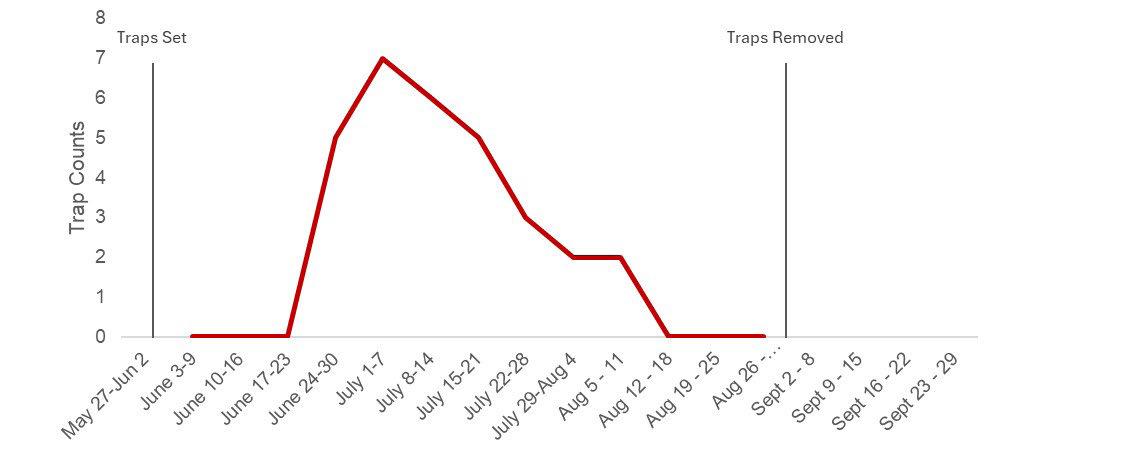
PROJECT CONTACT
For inquiries about this project, contact
Pressley Buurma Extension Educator, Seneca County buurma.20@osu.edu
Urban SVB Monitoring
OBJECTIVE
Monitor insect pests on Ohio farms, for enhanced pest management, specifically the SVB, near diverse urban cropping systems including pumpkin and squash crops in Summit County.
STUDY INFORMATION
Trap Set06/09/2024
Trap Removed09/29/2024
Primary Adjacent Crop Pumpkin
Adjacent Area 500 sq ft
Production typeDiverse farm
ManagementOrganic
Number of sites1
Number of traps per site 1

Heliothis trap with SVB lure and high tunnel in the background

ePLUS Collaborating Farm
OSU Extension
Summit County
WEATHER INFORMATION

STUDY DESIGN
This study aimed to monitor squash vine borer (SVB) activity in squash and pumpkin fields throughout the growing season.
Heliothis traps were used for monitoring and were strategically placed around an urban farm location in Akron, OH where many pumpkins are grown as a traditional crop for the farmers who immigrated from Bhutan and Myanmar.
Data were collected weekly throughout the growing season and pheromone lures in the traps were replaced monthly.
OBSERVATIONS
Trap not emptied on July 28, resulting in an increased number of pests found next week ( representing a 2-week catch), it is assumed to be likely an even split (6/7 per week).
High numbers at the beginning of the season (June 24-30, 23 in one week). Initially, over identifying was a concern, but on further review, it was believed the number was accurate. This spike was at a similar time as Montgomery and Clark counties. Continued monitoring is anticipated to see if the increased numbers found has something to do with the urban location or perhaps the legacy of growing pumpkins with little to no pest management strategies implemented.
SUMMARY
• Since this was the first year trapping at this farm, any conclusions about pest pressure from previous years are unable to be compared.
• The number of adult moths captured was in double digits for 3 consecutive weeks in mid June to beginning of July.
• The growers did not implement any pest management strategies
• Continued education on control options that suit growers’ organic growing traditions will be a priority going forward.
RESULTS


PROJECT CONTACT
For inquiries about this project, contact
Maggie Rivera Extension Educator Summit County rivera.482@osu.edu
SVB Monitoring
OBJECTIVE
Monitor insect pests on Ohio farms, for enhanced pest management, specifically the Squash Vine Borer (SVB), near small fruit productions in Williams County.
STUDY INFORMATION
Trap Set06/12/2024
Trap Removed09/24/2024
Primary Adjacent Crop Pumpkin/ Squash
Adjacent Area23 acres Pumpkin 112 acres Squash
Production typeCommercial Field
ManagementConventional
Number of sites1
Number of traps per site 1


ePLUS Collaborating Farms
OSU Extension Williams County
WEATHER INFORMATION

STUDY DESIGN
The Scentry Heliothis trap was placed on the west side of the field in the edge of the field at the height of the pumpkin plants.
The trap was hung on a push-in stake and was checked weekly for SVB. The bait was a Scentry SVB pheromone lure on June 10 and was changed every 4 weeks until the trap was removed.
Trap placement in field
OBSERVATIONS
Observations were cut short due to losing the lure early in the monitoring season and being unable to replace it until later in the season. Field was also weedy and not irrigated.
SUMMARY
• At this location, pest populations were low.
• Unfortunately, the lure was lost early in the season, inhibiting further population monitoring and observations.
• The field was not irrigated and had a prevalent population of weeds, which may have affected arthropod populations. This location is a newer partnership, and the grower is looking to continue improving management strategies.
RESULTS


PROJECT CONTACT
For inquiries about this project, contact
Kayla Wyse Extension Educator, Williams County wyse.34@osu.edu
Statewide Pest Monitoring Network
Monitoring Cucurbit Downy Mildew in Sentinel Plots
OBJECTIVE
Establishing sentinel plots in different geographical locations, aimed to monitor the presence of downy mildew across various cucurbit species— cucumber, squash, pumpkin, and melons—in Ohio and provide prompt alerts to growers across the state.
STUDY INFORMATION
Planting Date –Fremont (Sandusky co.)
Planting Date –Willard (Huron co.)
Planting Date –Wooster (Wayne co.)
Planting Date –Piketon (Pike co.)
06/07/2024
06/04/2024
06/13/2024
06/07/2024

OBSERVATIONS
OSU Reseach Stations
OARDC/OSU Extension Statewide
Fields were scouted weekly, and any leaves showing suspected symptoms were sent to the OSU C. Wayne Ellett Plant and Pest Diagnostic Clinic in Wooster for analysis. Positive cases of downy mildew were confirmed, and mating types (A1/A2) of the pathogen (Pseudoperonospora cubensis) were identified through PCR and sequencing.
SUMMARY
• The first downy mildew (DM) case on cucumber in Ohio was reported on July 8th in Medina County, outside the ePLUS trials.
• Subsequent cases in the ePLUS trials included Wayne County on July 22, Sandusky and Wayne Counties on July 23, and Piketon (suspected) on August 4.
• DM on cantaloupe was confirmed in Wayne County on July 31.
STUDY DESIGN
The field trials included the following standard varieties: Straight Eight cucumber, Betternut 900 butternut squash, Space Station buttercup squash, Sangria watermelon, Hale’s Best cantaloupe, Solid Gold pumpkin, and Martina Genovese basil. Guard rows will use Taybelle squash, with additional space available for other cucurbit varieties or basil.
The field sized 180’ by 35’, included a single replication with 25’ rows, 2’ between plants, 20’ alleys, and 5–6’ spacing between rows.
Seeds were sown in 72-cell trays with BACCTO potting soil, then transplanted into fertilized beds. Targeted fungicides for powdery mildew and insecticides were applied.
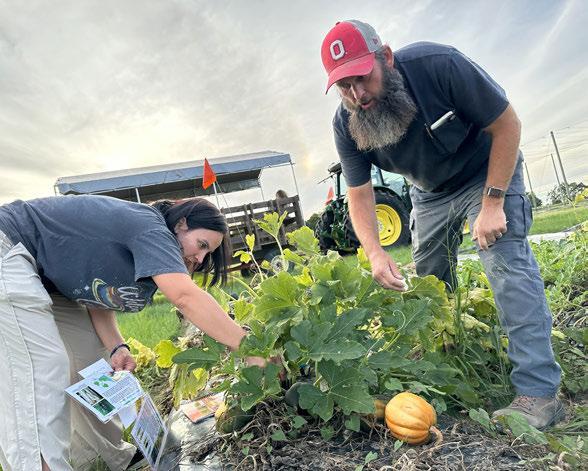
Scouting sentinal plot at Piketon site for Downy Mildew
SIGNIFICANT FINDINGS IN 2024
Positive cases of downy mildew were promptly reported on the Cucurbit Downy Mildew Forecast Homepage (https://cdm.ipmpipe.org) and communicated to growers through Extension educators, blog posts (OSU VegNet, OSU Bygl, and Ohio Veggie Diseases News), and social media. Mating types typically expected were confirmed as A1 for isolates from both cucumber and cantaloupe. Downy mildew was not observed in other cucurbit varieties. Cucurbit yellow vine decline (a bacterial disease transmitted by squash bugs) was a significant issue in the Piketon trials, while powdery mildew and squash vine borer were major problems on pumpkins and squash in Wooster.

Downy mildew symptoms on cucumber leaves: upper side (A) and under side (B), on cantaloupe (C), and P. cubensis sporangia and sporangiophores, 200 X magnification power (D).
TOOLS OF THE TRADE
The C. Wayne Ellett Plant and Pest Diagnostic Clinic provides fee-based pest and disease testing. Samples from Ohio vegetable and fruit growers in commercial production are analyzed at no charge, funded by the Ohio Vegetable and Small Fruit Research and Development Program, pending annual grant approval. Samples can be submitted digitally, by mail, or in person.

ppdc.osu.edu/home
PROJECT CONTACT
For inquiries about this project contact
Dr. Francesca Rotondo Program Director, C.W. Ellett Plant and Pest Diagnostic Clinic rotondo.11@osu.edu
Environmental Management to Improve High Tunnel Production Outcomes
BACKGROUND AND PROBLEM
High tunnels (HTs) are risk-mitigation tools. They help growers diversify, intensify, and scale-up their operations and become more efficient. Nearly half of all U.S. vegetable farms use some form of protected culture with an important percentage of that group employing HTs, including in year-round production during months when weather is very dynamic. Dynamic weather is a challenge for HT growers because using a HT is typically like farming in a clear box without the aid of active climate control systems. Therefore, growers can struggle to achieve and maintain target temperatures and other conditions, especially since they are very busy but typically required to change the positions of HT sidewalls and doors (according to weather and crop need) manually and in-person. Even more, there is no formula or DIY how-to guide on making those adjustments, so growers must learn HT environmental management through very costly trial and error. Also, importantly, they must spend money, time, and effort to adjust HT sidewalls and doors (ventilation statuses, VSs) and risk being injured in the process.

SOLUTION


The ODA Specialty Crop Block Grant “Advancing High Tunnel Production: Research-based Support and Technologies to Speed and Enhance Grower Success” supported our development of three tools that are helping growers manage the environments inside their HTs more efficiently, effectively, and safely. As a result, growers report that their productivity, income potential, and satisfaction have increased, and that they are less likely to be injured when adjusting HT VSs.
The decision-support dashboard (Follow QR link on next page) includes two resources that help growers select HT VSs based on weather and other conditions. Research leading to the resources is nonstop, active as sensors report data from more than ten locations in- and outside HTs every five minutes around the clock. Therefore, the resources are “living”, updated and improved continuously as additional data describing relationships between weather, VS, and conditions inside HTs become available. Using the resources can significantly reduce the guesswork involved in selecting optimal VSs and, thereby, improve growers’ production outcomes and save them valuable time, money, and effort.
It is one thing to know what a HT’s VS perhaps should be, but it is another to set it … which usually requires someone to visit the HT, perhaps multiple times per day and/or when weather is or fast-becoming bad. “Set it and forget it” automated control systems are one possible solution. However, concerns over their costs, expandability, use in dynamic conditions (e.g., high wind +/-rain or rising or falling temperatures), or unreported failure make some people hesitate to invest in them. Therefore, we developed a lower cost and expandable DIY-style system allowing growers to control the height of their sidewall openings (and, probably, other systems in or near the HT) remotely using their personal handheld device connected to a wireless network.


1. Standard sidewall motors powered by a battery-solar panel combination, as described above;
2. A standard voltage-regulating unit converting 12 volts from the battery to 24 volts needed by the motors (approx. $80.00);
2. A motor controller (available at electronics stores or online for approx. $15.00);
3. An off-the-shelf, WiFi-enabled microcontroller to act as the brains of the system (approx. $5);
4. WiFi already present on the farm property or wireless access with a hotspot or similar ($0 to monthly charge typical of a mobile phone plan);
5. Code for the motor controller (no charge)
SUMMARY:
• Growers often know best what to do but benefit from help in making the job easier.
• In this case, that growers know what position their sidewall openings should be in but will appreciate being able to set them from literally anywhere they have a cellular service connection
• Feedback from growers using the system since Spring-2023 has been unanimously positive and enthusiastic
PROJECT CONTACT
For inquiries about this project contact
Dr. Matthew Kleinhenz
Professor and State Specialist
OSU Horticulture and Crop Science kleinhenz.1@osu.edu


www.go.osu.edu/CyhK
Sonia D. Walker Research Associate OSU Horticulture and Crop Science
Megan
Chludzinski
Undergraduate Student
OSU Horticulture and Crop Science
Alex Herridge
Undergraduate Student
OSU Computer Science and Engineering
Statewide Pest Monitoring Network
Focus pest: Corn Earworm
SIGNIFICANT FINDINGS IN 2024
Hartstack or Heliothis traps baited with Hercon Luretape were deployed at eight sites across the state by the first week of June, catching CEW moths immediately during the week of June 3-9 at three sites. CEW is primarily a migratory pest in Ohio, arriving on weather fronts that dump moths near the boundary edge of colliding systems. Peak trap catch was seen across the network from August 19 - September 8, which is typical. Season long trap catch totals ranged from a high of 800 moths to a low of 6 moths. Traps were removed from the field between September 16-29. Drought conditions in central and southeast regions of the state did not seem to affect captures at most sites.
CROPS IMPACTED
Primarily sweet corn, but field corn, tomatoes, green beans and other crops can be attacked.
BIOLOGY
CEW is chiefly a migratory pest that arrives in mass in Ohio in August and September. Some CEW populations are thought to survive the winter in the southern part of the state, giving rise to small, local populations in the spring and early summer. Female moths preferentially seek out silking corn to deposit eggs on fresh silk. If the majority of corn is past silking, CEW moths will lay eggs on alternate “green” host crops such tomato and green beans. This pest is also known at the tomato fruitworm and cotton bollworm.
THRESHOLDS
CEW can be managed with insecticides using a table that tracks daily high temperature and number of moths trapped per night to determine days between applications. Treatment of CEW is during silking stage and can begin at 10% silk if moths are present. Early planted sweet corn usually avoids damage, with late planted corn experiencing the heaviest pressure from caterpillars feeding in and around the ear tip. Planting Bt hybrids with the proper genetic traits will also reduce or nearly eliminate ear damage.
RESOURCES
Monitoring and managing CEW (YouTube videos on OSU IPM Library)

www.go.osu.edu/cewvideos


and moth


Insecticides can be applied at effective timeings based on trap capture rates and weather observations
TOOLS OF THE TRADE
Pheromone baited traps can be effective tools for timely management of several insect pests.

www.go.osu.edu/corntrap
IPM for Sweet Corn Pests (CEW and treatment table):

www.go.osu.edu/sweetcornpests
COOPERATOR RECRUITMENT
If you would like to participate in the monitoring network next year for Corn Earworm, please send an email to Logan Minter, minter.21@osu.edu or call (614) 292-3202. There is no cost to participate but monitoring sites are limited.

PROJECT CONTACT
For inquiries about this project contact Jim Jasinski Professor, OSU Extension jasinski.4@osu.edu
CEW caterpillars
CEW Monitoring
OBJECTIVE
Monitor Corn Earworm (CEW) activity near a late planted sweet corn field.
STUDY INFORMATION
Trap Set05/28/2024
Trap Removed09/25/2024
Primary Adjacent Crop Sweet corn
Adjacent Area 0.5 acre
Production typeCommercial
ManagementConventional
Number of sites1
Number of traps per site 1

Western Ag Research Station OARDC
Clark County
WEATHER INFORMATION

Growing Season Weather Summary
STUDY DESIGN
This study aimed to primarily monitor migratory CEW brought into Ohio on northward moving weather fronts that are actively transporting moths from southern states. While all plantings of sweet corn (and other vegetable crops) are susceptible to attack from this pest, mid to late planted stands are at the highest risk of infestation due to seasonal weather patterns. Trap catch information from this study will inform the annual intensity of the infestation and alert growers so they may better manage and protect their crops.
OBSERVATIONS
Traps were deployed on schedule and began catching CEW the first week of June 3-9. Consistent double digit catches were seen through most of the season with a peak of 154 moths per week during August 19-25. The trap was not monitored during August 25 – September 5. Trap monitoring resumed for the remainder of September. This trap catch pattern is normal for this pest and is considered a light infestation compared to other seasons.
SUMMARY
• A Hartstack trap was used at this site to monitor CEW; this trap is known to be more sensitive in catching CEW moths compared to a Heliothis trap.
• CEW moths were caught season long with a peak near midAugust.
• Overall captures for this year were considered light compared to flight activity in previous years.
• Larval infestation in nearby crop was not monitored given the sweet corn hybrid was a Bt hybrid containing the Vip3A trait which is still highly effective against CEW larvae.
RESULTS


PROJECT CONTACT
For inquiries about this project, contact
Jim Jasinski Professor, OSU Extension jasinski.4@osu.edu
Ear damage from CEW caterpillar
CEW Monitoring
OBJECTIVE
Monitor insect pests on Ohio farms, for enhanced pest management, specifically Corn Earworm, in conventional field corn in Crawford County.
STUDY INFORMATION
Trap Set05/29/2024
Trap Removed09/162024
Primary Adjacent Crop Field Corn
Adjacent Area 58 acres
Production typeCommercial
ManagementConventional
Number of sites1
Number of traps per site 1

ePLUS Collaborating Farm
OSU Extension
Crawford County
WEATHER INFORMATION

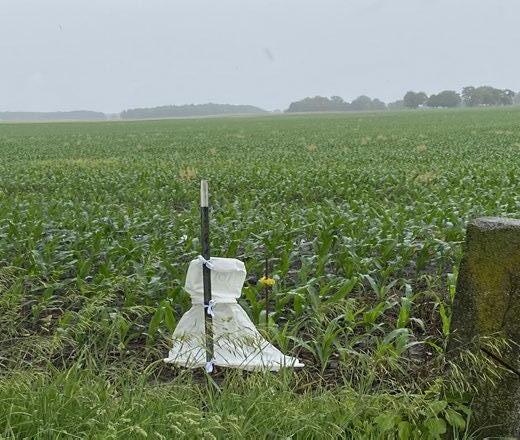
STUDY DESIGN
A heliothis trap was placed 5 feet from the field edge on the west side of the field. The trap was hung on a t-post and was checked weekly for Corn Earworm moths. The bait was changed every other week until the trap was removed.
OBSERVATIONS
There were very low levels of Corn Earworm sighted, with the highest amount found being three. Changing the bait every other week instead of every week could have influenced the number of insects caught.
SUMMARY
• Overall, the population of Corn Earworm was low in the central part of the county.
• Only one trap at a single location gives us a very small glimpse into the actual amount of insect that could have been present.

RESULTS


PROJECT CONTACT
For inquiries about this project, contact
Kendra Stahl Extension Educator, Crawford County stahl.221@osu.edu
CEW Monitoring
OBJECTIVE
Monitor insect pests on Ohio farms, for enhanced pest management, specifically the Corn Earworm, near sweet corn productions in Fayette County.
STUDY INFORMATION
Trap Set06/03/2024
Trap Removed09/13/2024
Primary Adjacent Crop Sweet Corn
Adjacent Area 10 acres
Production typeCommercial operation as part of a larger grain farm
ManagementConventional
Number of sites1
Number of traps per site 1

ePLUS Collaborating Farm
OSU Extension Fayette County
WEATHER INFORMATION
STUDY DESIGN
The trap was placed in a south side of the sweet corn patch, approximately 20 feet from the field edge. The Scentry, Heliothis trap was attached to a fence post and was checked and monitored weekly for CEW. The bait was hercon luretape.
OBSERVATIONS
The summer was very interesting as it was very dry. The number of Corn Earworm moths found throughout the season was very insignificant. As we entered the beginning of August, and the actual sweet corn production was starting to decline the number of moths began getting more prevalent. However, production was affected as the season was beginning to come to a close.
SUMMARY
• The results at this location were like previous years.
• The dry summer I believe had a drastic effect on the number of moths collected. As we began to get a little more moisture the number of moths increased.
RESULTS

Ear damage from CEW caterpillar

PROJECT CONTACT
For inquiries about this project, contact
Ken Ford Extension Educator, Fayette County ford.70@osu.edu
CEW Monitoring
OBJECTIVE
Monitor Corn Earworm (CEW) activity near a field corn and mixed vegetable plantings.
STUDY INFORMATION
Trap Set05/31/2024
Trap Removed09/30/2024
Primary Adjacent Crop Field Corn; Tomatoes
Adjacent Area 8 acres field corn 1600 sq ft tomato
Production typeCommercial/ Research
ManagementConventional
Number of sites1
Number of traps per site 1

OSU South Centers
OSU Extension/OARDC
Pike County
WEATHER INFORMATION

STUDY DESIGN
A Scentry, Heliothis trap was attached to a metal t-post on 31 May 2024. The trap was located on the eastern edge of a conventional field corn planting. This location was also approximately 500 feet from a small tomato plot. Trece Pherocon CEW lures were used as bait. Trap captures were monitored weekly with lures replaced every other week.
OBSERVATIONS
The trap was deployed on schedule and began catching within two weeks. Catches remained low until mid July when peak capture reached nine moths.
SUMMARY
• CEW moths were caught season long with the largest peak near mid-August.
• Overall captures for this year were considered light, but this was the first monitoring at this site in several years.
• Larval infestation in nearby crops was not specifically monitored, however very little CEW damage was noted in a nearby tomato trial at harvest.
RESULTS


PROJECT CONTACT
For inquiries about this project, contact
Logan Minter Field Specialist and Associate Professor OSU Extension minter.21@osu.edu
Sweet Corn Pest Monitoring
OBJECTIVE
Monitor insect pests on Ohio farms, for enhanced pest management, specifically the European Corn Borer (ECB) and Corn Earworm (CEW), near diversified horticultural crop productions in Wayne County.
STUDY INFORMATION
Trap Set07/15/2024
Trap Removed09/02/2024
Primary Adjacent Crop Sweet Corn
Adjacent Area 20 acres
Production type Commercial Diversified Hort Crop
ManagementConventional
Number of sites1
Number of traps per site 3 traps, 1 for each lure/ species


ePLUS Collaborating Farm
OSU Extension
Wayne County
WEATHER INFORMATION

STUDY DESIGN
Heliothis traps were placed in grassy areas nearby any silking and tasseling sweet corn. Lures were placed in the traps for the respective pests, and traps were checked weekly until the end of sweet corn harvest.
The CEW was placed as the center most trap, while the ECB traps were placed at least 100 feet away from each other, on either side of the CEW trap. ECB lures included both the E-strain (a.k.a. New York strain) pheromone and the Z-strain (a.k.a. Iowa strain) pheromone.
Adult European Corn Borer
OBSERVATIONS
Large animal and bird feeding destroyed some of the early sweet corn, which may have affected the patch’s attractiveness. Drought conditions were experienced for much of the duration of the trapping period.
SUMMARY
• Although some flight consistency was seen, as compared to years past, there was not nearly the intensity or duration of flights as previously experienced in this area.
• Grower utilized trap data to make timely pest management decisions and improve application timing for optimal efficacy and efficiency.
RESULTS


PROJECT CONTACT
For inquiries about this project, contact
Frank Becker Extension Educator, Wayne County becker.587@osu.edu
Adult Corn Earworm
Garlic Variety Trial 2024
OBJECTIVE
Compare the germination rates, bulb sizes, and yield of two soft neck and six hard neck garlic sub-types, evaluating their performance across key growth characteristics. key growth characteristics
STUDY INFORMATION
Planting Date11/04/2023
Harvest Date(s) 07/07/2024
Varieties2 Soft Neck and 6 Hard Neck sub-types
ManagementConventional Fertilization; no insecticides or fungicides
SystemMulched lightly in fall with additional mulch in the Spring
Study typeSingle replicate
Treatments15
Replicationss~25 cloves planted for each variety
Size of trial375 sq ft
Soil typeWellston silt loam
STUDY DESIGN

ePLUS Collaborating Farm OSU Extension
Perry County
WEATHER INFORMATION

Growing Season Weather Summary
Garlic cloves from each sub-type were planted without sorting by size, using all cloves from each head. The soil fertility was maintained at a pH of 7.0, with 206 ppm phosphorus and 50 ppm potash. Prior to planting, half a pound of nitrogen was incorporated into the soil, with an additional half-pound applied in late April.
The study aimed to assess the impact of these fertility levels and planting conditions on garlic growth, yield, and bulb characteristics across different soft neck and hard neck sub-types, with cloves planted directly from the harvested heads.
Scapes were removed on all varieties. Measurements were taken after drying and cleaning.

Early season vegetative growth;
Photo: March 6, 2024
OBSERVATIONS

Some varieties produced double heads resulting in higher germination rates. Not all varieties mature at the same time and with the drought this year harvest was much earlier than normal. No issues with insects or diseases were observed.
SUMMARY
• Germination Rates: Ranges from 59% (Silver White) to 114% (Asian Tempest).
• Larger Bulbs: Varieties like German Red (2.00 oz) and Blanak (1.83 oz) produce bigger bulbs.
• Smaller Bulbs: Ajo Roja (0.41 oz) has the smallest bulb size. Typically recommended for warm climates.
• Trend: Higher clove size often correlates with higher germination rates bulb size at harvest, but smaller cloves tend to have lower germination success.
RESULTS

*Soft neck varieties
TOOLS OF THE TRADE
Drying garlic in shaded wellventilated area.

PROJECT CONTACT
For inquiries about this project, contact Ted Wiseman Extension Educator and Associate Professor, Perry County wiseman.15@osu.edu
Under Sustainable Radar: Tracking Tradeoffs of Water Quality
OBJECTIVE
Track and quantify water quality and pathogen signatures from inlet to outlet within specialty crop farms located in climate-vulnerable regions of Ohio. The ultimate goal being to improve and encourage environmental sustainability within these crop systems.
STUDY DESIGN
Water samples were collected in different stages of three speciality crop farm systems, from initial water source to outlet. Water quality metrics measured included pH, total suspended solids (TSS), total phosphorus (TP), total nitrogen (TN), nitrate (NO₃), and phosphate (PO₄). Pathological metrics measured included microbial activity and mold.
STUDY INFORMATION
Sampling PeriodMay-August 2024
Sampling Frequency Biweekly
Farms Sampled3
Variety of Inlets2 (pond, groundwater wells)
Variety of Outlets 3 (greenhouse, ditch, recycling tank)
Samples Per Location Farm #1 - 5, Farm #25, Farm #3 - 1
OBSERVATIONS

ePLUS Collaborating Farms OSU Extension Statewide


Results displayed high variability in all metrics measured among farms utilizing water from distinct systems (i.e., pond, groundwater well, and public water). This variability may also be associated with differences in water processing at each farm. A steady flat trend in pH was observed from pond to post-filtration at farm one, and a decline in pH values was observed from groundwater to ditch at farm two. Farm three also had a slight decline in pH values from inlet to outlet.
Both TN and TP trends at farm one appeared constant, with NO₃ increasing slightly from the pond to before filter locations. At farm two, there were significant increases in TN, TP, NO₃ and PO₄ from the groundwater well to the location before field irrigation, which may be associated with addition of fertilizers. An increasing trend in TN and NO₃ was still observed when the water drained into the ditch. At farm three, significant increases in TN, TP, NO₃ and PO₄ were observed from groundwater to recycling tank, which may also be associated with the addition of fertilizers.
Increases in microbial activity from public water inlet to greenhouse outlet were observed at farm one. While microbial average counts were significantly low at the source (3 counts; tap water), at the greenhouse sample, an average of 43 counts of microbial activity after 7 days of growth in culture was found.
SUMMARY
• Water samples were collected at different stages from three speciality crop systems (inlet to outlet).
• Samples were analyzed for a variety of water quality and pathogen metrics.
• Preliminary results display high variation in water quality and pathogen metrics.
• High variation is likely due to initial water sources used for irrigation, as well as difference in irrigation practices (i.e., addition of fertilizer to water prior to application).
• Please reach out to the contacts below if interested in participating in this study.
RESULTS


PROJECT CONTACTS
Report Submitted by Layla Ramsey
Research Technician/ Undergraduate Student, OSU CFAES ramsey.577@osu.edu


For inquiries about this project, contact
Dr. Lorrayne Miralha
Assistant Professor
OSU Food, Ag, Biological Engineering miralha.1@osu.edu
Dr. Yu Ma
Assistant Professor
OSU Horticulture and Crop Sciences ma.2578@osu.edu
Dr. Logan Minter
Field Specialist and Associate Professor
OSU Extension minter.21@osu.edu
Irrigation pond, Farm 1
Herbaceous Cultivar Trial
OBJECTIVE
Observe the performance of new and recently introduced cultivars under the environmental conditions of central Ohio.
STUDY INFORMATION
Planting Date05/13/2024
Evaluation Dates 06/26/2024 07/24/2024 08/21/2024
Varieties147
System Raised beds; in ground ManagementConventional fertilizer Reps6
Study Area 13,000 sq ft.
STUDY DESIGN
Plants are started in a greenhouse either from seed or rooted cuttings in Feb. and March. They are planted in the ground in mid-May, six plants per variety. Varieties are spaced two feet apart unless they are trailing or vining, then they are planted four feet apart.
A slow-release fertilizer is added at planting and applied periodically throughout the season. Plants are deadheaded and watered with at least one inch of water per week. The planting beds are mulched after planting.
Evaluations with ratings from 1 (low) to 5 (high) are taken each month. The final evaluation is the average of the season’s evaluations.
The trails at Chadwick Arboretum are provided with a higher maintenance regimen then the trials at Snyder Park Gardens & Arboretum.
Chadwick Arboretum and Learning Gardens
OSU Columbus Campus Franklin County
WEATHER INFORMATION


Millet Jade Princess.

OBSERVATIONS
Data was gathered in September but was not included in the final average due to the extreme drought, which influenced plant performance.
SUMMARY
• The top performers in this trial were Petunia Supertunia Mini Vista® Plum Veined, Helianthus Suncredible® Yellow, Petunia Supertunia Vista® Bubblegum, Ornamental millet Jade PrincessPetunia Supertunia Tiara™ Blue and Heliotropium Augusta® Lavender, Begonia Megawatt Red Green Leaf, Coleus ColorBlaze™ ‘Lime Time’, Lantana ‘PassionFruit’, Petunia Supertunia ‘Tiara™ Pink’, Lantana ‘Shamrock™ Red’, and Begonia Megawatt Red Bronze Leaf Improved. ™ Read

www.go.osu.edu/24cvchadwick

For inquiries about this project, contact Pamela Bennett, Extension Educator and Professor, Clark County bennett.27@osu.edu
Helianthus Suncredible® Yellow
Herbaceous Cultivar Trial
OBJECTIVE
Observe the performance of new and recently introduced cultivars under the environmental conditions of central Ohio..
STUDY INFORMATION
Planting Date05/13/2024
Evaluation Dates 06/26/2024
07/24/2024 08/21/2024
Varieties148
System Raised beds; in ground ManagementConventional fertilizer Reps6
Study Area 13,000 sq ft.
STUDY DESIGN
Plants are started in a greenhouse either from seed or rooted cuttings in Feb. and March. They are planted in the ground in mid-May, six plants per variety. Varieties are spaced two feet apart unless they are trailing or vining, then they are planted four feet apart.
A slow-release fertilizer is added at planting and applied periodically throughout the season. Plants are deadheaded and watered with at least one inch of water per week. The planting beds are mulched after planting.
Evaluations with ratings from 1 (low) to 5 (high) are taken each month. The final evaluation is the average of the season’s evaluations.
The trails at Snyder Park Gardens & Arboretum are provided with a lower maintenance regimen then the trials at Chadwick Arboretum.
ePLUS Collaborating Site
OSU Extension Clark County
WEATHER INFORMATION


OBSERVATIONS
Data was gathered in September but was not included in the final average due to the extreme drought, which influenced plant performance.
SUMMARY
• The top performers in this trial were Ageratum ‘Monarch Magic’, SunPatiens® Vigorous Purple Elite, Lantana Shamrock™ Red, Dahlia Virtuoso™ Vibrant Violet™, Angelonia Guardian Angel™ Blue, and Celosia ‘Burning Embers’, SunPatiens® ‘Vigorous Orchid’, Coleus Premium Sun ‘Crimson Gold’, SunPatiens® ‘Vigorous Red’, Dahlia Virtuoso™ ‘Classy Carmine, and Gomphrena ‘Fireworks’.
Read full report and see evaluation tables, here:

www.go.osu.edu/24cvspringfield

For inquiries about this project, contact
Pamela Bennett, Extension Educator and Professor, Clark County bennett.27@osu.edu
Ageratum ‘Monarch Magic’
Urban Ticks: Not just in the woods
Ticks and the diseases that they vector to livestock, companion animals, and humans are not only a public health risk, but a potential cause of economic loss to producers.
The speed of tick and tick-borne disease in Ohio has been rapid, with us going from one tick of medical importance to humans, companion animals, and livestock 20 years ago to five now. There are a couple of myths that need to be dispelled:
• Myth #1: Ticks prefer to live in the woods. Actually, while some species of ticks prefer the woods, there are tick species that prefer and open habitat like pasture, meadow, public park, and backyard lawn grass.
• Myth #2: Ticks are only active in the summer. Actually, while ticks are most active from April – September, we have tick activity all 12 months of the year and in fact, have positive cases of Lyme disease diagnosed in Ohio every month of the year.

We have seen an increase in urban tick encounters over the past 8 years with a higher likelihood of encountering a tick in an urban area during the colder months of the year.


Deer ticks are noted for preferring more wooded habitat. We encounter them in urban environments as the number of wildlife living close to humans in urban environments has been steadily increasing. Deer ticks are the primary vector for Lyme disease in humans, cats, and dogs.

The map at the left shows the distribution of the Deer Tick by county. In nearly every urban county in Ohio. On the right, the map shows the times of peak activity of the three life stages of the Deer Tick. Note the period of increased activity of the adult stage of the tick deep into winter stressing the need for tick awareness all year long.
Source: Ohio Department of Health, https://odh.ohio.gov/know-our-programs/zoonotic-disease-program/diseases/tickborne-diseases

Prevention of tick bites is critical. Here are some ways a producer can stay tick safe:
• Wear permethrin treated clothing when outside in tick habitat. This can be purchased from an outfitter, or the clothing can be treated with permethrin labelled for use on fabric. Remember to read, understand, and follow the label on the permethrin product. The label is the law.
• Apply a repellent labelled for control of ticks topically to your skin, following the label usage of the product. See the BITE SITE link below for guidance.
• Do frequent tick checks to remove ticks before they can bite and attach.
• Familiarize yourself with the correct removal method of a tick. Use tweezers or a tick tool to remove a tick completely. After removing the tick, store it in hand sanitizer in a zipped plastic bag, wash the area, wash your hands, and contact your county Extension office or public health official for identification guidance.
• If you are bitten, contact your health provider for guidance on medical treatment.
• Work with your veterinarian to keep your companion animals tick safe.

While it would be uncommon to encounter the Lone Star tick in an urban environment, they have been found in Franklin and Cuyahoga Counties. The Lone Star tick is linked to the Alpha-gal Mammalian muscle allergy where a human bitten by a lone star tick can become allergic to non-primate mammalian muscle and the associated byproducts of this.
Summary:
For more information on tick safety, check out The BITE SITE:

www.go.osu.edu/BITE
In summary, we can encounter a tick in any habitat in any time of the year in Ohio, including in urban environments. Franklin County is the largest county by population in Ohio and while it is predominantly urban, all five ticks of medical consequence, Deer Tick, American Dog Tick, Lone Star Tick, Gulf Coast Tick, and Longhorned Tick have been found here.
The Lonhorned tick is a true invasive tick that has only been recently discovered in 18 Ohio counties, including Franklin County. It can reproduce via parthenogenesis meaning the female does not need to mate with a male to reproduce. Research is currently underway to evaluate this tick’s ability to vector disease in the US.

PROJECT CONTACT
For inquiries about this project contact
Dr. Tim McDermott Extension Educator and Assistant Professor, Franklin Co. mcdermott.15@osu.edu
Note: This outreach is supported by a grant from USDA NIFA 20247000643574
Local Food Market Price Report
OBJECTIVE
Systematically gather data about the pricing of a variety of local food products in Crawford, Huron, and Seneca counties.
STUDY DESIGN

ePLUS Collaborating Sites
OSU Extension Crawford, Huron, Seneca
Data collected from farmers markets in Crawford, Seneca and Huron Counties. Data was collected twice a month from May to October. Overall, price changes were not seen from month to month but however were fairly prevalent from market to market.
About half of the producers were small scale operations while the other half were larger scale to commercial operations. Several producers were organic while most were conventional. All producers seemed to have adequate labels, information and pricing with all products.
One market that was surveyed allowed for SNAP benefits and 2 markets surveyed included community based service providers as well. All markets allowed for non-food items to be sold along with live plants and arts and crafts items.
If an item only has a price in the low option, that means it was only seen being sold at 1 cost, it does not mean always mean it was only seen once or by one seller.
The information collected with this protocol will help develop a more robust understanding of local food markets to better inform producers’ business and marketing decisions. Potential uses of data include investigating the price of local foods by region or rural, suburban, or urban context and developing pricing reports for use by producers, business service providers, and policy makes.
Price data are reported for fresh produce, fresh/ processed farm items, and for animal products (meat, eggs, etc).


SUMMARY
Local Food Market Price Report
PROJECT CONTACTS
For inquiries about this project, contact
Pressley Buurma
Extension Educator, Seneca County buurma.20@osu.edu
Kendra Stahl
Extension Educator, Crawford County stahl.221@osu.edu
PROTOCOL DEVELOPMENT
Christie Welch, Direct Food & Agricultural Marketing Specialist, OSU South Centers
Hannah Scott, JD, Program Director, CFAES Center for Cooperatives
Dr. Logan Minter, Field Specialist and Associate Professor, OSU Extension
Local Food Market Price Report
(continued)
Acknowledgement: Protocols were developed based on University of Kentucky Center for Crop Diversification’s KY Farmers Market Price Report, including “3-year Average Weekly Prices at Kentucky Farmers Markets: 2021-2023,” by B. Wolff & M. Waldner (2023).


CSA Price Report
OBJECTIVE
Investigate CSA box prices per size across each region of Ohio.
STUDY DESIGN AND RATIONALE

ePLUS Collaborating Sites
OSU Extension Statewide
Community-supported agriculture (CSA) – A farm or association of multiple farms that offer consumers regular delivery or pick-up of locally-grown farm products on a subscription or membership basis, usually with a partial or total advance payment. (“Local Food Directories: Community Supported Agriculture (CSA) Directory.” (n.d.) U.S. Department of Agriculture Agricultural Marketing Service. https://www.ams.usda.gov/local-food-directories/csas)
Price data was collected from publicly accessible information posted by producer websites in addition to direct conversations with producers offering CSA options.
The goals of this project were to collect geographic distribution of local food market channels in Ohio that serve vital functions of connecting producers of fruits, vegetables, specialty crops, value-added products, and other food and farm products to users, including wholesale customers and individual shoppe
The information collected with this protocol will help develop a more robust understanding of local food markets to better inform producers’ business and marketing decisions. Potential uses of data include investigating the price of local foods by region or rural, suburban, or urban context and developing pricing reports for use by producers, business service providers, and policy makers.


OBSERVATIONS
All boxes were available for purchase online with the exact description of what’s in each box listed. Some places allowed for individual boxes to be bought while most required a subscription.
RESULTS
Acknowledgement: Protocols were developed partially based on University of Kentucky Center for Crop Diversification’s KY Farmers Market Price Report, including “3-year Average Weekly Prices at Kentucky Farmers Markets: 2021-2023,” by B. Wolff & M. Waldner (2023).
PROJECT CONTACTS
For inquiries about this project, contact
Pressley Buurma
Extension Educator, Seneca County buurma.20@osu.edu
PROTOCOL DEVELOPMENT
Christie Welch, Direct Food & Agricultural Marketing Specialist, OSU South Centers
Hannah Scott, JD, Program Director, CFAES Center for Cooperatives
Dr. Logan Minter, Field Specialist and Associate Professor, OSU Extension
Home Garden Myth Buster: Weed Killer
OBJECTIVE
Compare a homemade weed killer to Round Up and Horticulture Vinegar.
STUDY INFORMATION
Spray Date08/01/2024
Observation Dates 08/01/2024 – 10/01/2024
Weather at application Sunny, 80-88 ˚ F Wind: 4-6 mph
SystemMarginal areas
Study Type Replicated
Treatments4
Replications3
Size of trial 12 sq ft
STUDY DESIGN
This study was designed in response to frequent questions by home gardeners, spurred by information from the internet. The study was replicated across three counties with one site in each county.
At each site, four 1 ft² test plots were selected for application of either the homemade mixture (1 gallon vinegar, 1 cup salt, 1 tablespoon dawn dishsoap), Harris Vinegar Grass & Weed Killer (a.i. 20% Acetic Acid), Round Up easy spray (a.i. Triclopyr, triethylamine salt 0.122%, Fluazifop-P-butyl 0.097%, Diquat dibromide 0.073%), or left untreated as a control.
In Morrow county, this trial was conducted on tall fescue, clover, Canada thistle, clover, and other field weeds. It had been previously mowed and had about 6-8 inches of regrowth. In Delaware county, the trial was sited on previously mowed grass. The Knox county trial was located on a property line. One side of the property line was kept mowed, while the other side was overgrown with weeds.


ePLUS Collaborating Sites
OSU Extension
Deleware, Morrow, Knox County
OBSERVATIONS
The plots in Morrow county were checked the next day, and showed a visible difference. Each treatment showed signs of death and foliage discoloration. Weekly observations the rest of the summer did not show any signs of re-growth in the sprayed areas.
For the Delaware county site on grass, it was challenging to determine whether the products were effective due to several factors: the grass appeared to be dead before the trial began, there was a lack of rainfall, and the office management team mowed the grass prior to application. However, as the trial progressed, it became evident that both the homemade mixture and Roundup showed some effectiveness.
At the Knox county site, 24 hours after application of all the products there was browning of the plants observed. One week after application, the round up and horticulture vinegar were still brown (appearance of dying). One month later the round up was the only product that still appeared to be dead.

Morrow County site showing distinct dead foliage at application poiints al all three chemicals
SUMMARY
• All of the weed killers showed effectiveness this year in Morrow County.
• The Morrow county site received 7.1” of rain from August – October. The lack of rain might have contributed to the lack of re-growth.
• The trial in Delaware County faced challenges due to pre-existing grass conditions, lack of rain, and mowing before application. Despite this, both the homemade mixture and Roundup showed effectiveness.
• The property line trial aims to target specific weeds in the future.
• Next year, the inclusion of a new product designed to dehydrate weeds within 24 hours which contains geraniol, cornmint oil, and sodium lauryl sulfate is anticipated.

county site, as obseerved on August 5, 2024
PROJECT CONTACTS
For inquiries about this project, contact
Kate Hornack
Program Coordinator, Deleware County hornyak.26@osu.edu
Carri Jagger

August 9, 2024
Extension Educator, Morrow County jagger.6@osu.edu
Sabrina Schirtzinger
Extension Educator, Knox County schirtzinger.55@osu.edu
Deleware
Knox county Horticulture vinegar application site, as obseerved on
Ohio Home Garden Trials: Swiss Chard
OBJECTIVE
Evaluate the performance of vegetable, flower, and herb varieties under realworld gardening conditions using methods commonly practiced by Ohio gardeners.
STUDY INFORMATION
Planting Date 04/01/2024 – 09/15/2024
Harvest Date(s) 06/01/2024 – 10/31/2024
VarietiesCelebration Five Colors
Management Conventional and organic
FertilizerNone, Conventional, compost alone, compost and organic
PesticidesConventional, organic, none
Growing SystemBare ground, Garden soil in raised beds, Soilless mix in raised beds, Containers
Study typeReplicated by site
Treatments2
Replications22
Size of trial 484 sq ft
STUDY DESIGN
Gardeners across Ohio participated in a voluntary study comparing two varieties of a vegetable in side-by-side trials. Participants selected from ten vegetable trials, one flower trial, and one herb trial, growing the varieties using their usual methods rather than controlled experimental practices. At the end of the growing season, gardeners submitted evaluation forms detailing performance and their gardening methods. This self-selected approach provided practical insights into how varieties perform under diverse, real-world conditions, reflecting the typical practices of home gardeners rather than standardized protocols.
ePLUS Collaborating Sites
OSU Extension
Statewide


Residents in 15 Ohio counties participated in this trial. The counties indicated in red had at least one participant.
OBSERVATIONS
A total of 22 gardeners from 15 Ohio counties participated, selecting 22 variety trials for evaluation. Of these, 16 gardeners completed evaluations, reflecting a 27% failure rate.
Gardening experience ranged from 2 to 62 years.
Raised beds with garden soil were the most common gardening method, followed by traditional bare ground gardens.
Regarding soil amendments, 19% of participants used no fertilizer, while 72% used compost alone or combined with organic fertilizers, highlighting a preference for organic practices among the majority of participants
SUMMARY
• Each variety performed well with each having unique traits that set it apart from the other variety.
• Both varieties received an overall performance rating of 4 out 5.
• 87% would recommend either variety for other Ohio gardeners.


JOIN IN THE 2025 TRIALS
Be a citizen scientist and contribute to our vegetable trials for Ohio. We are looking for people excited about growing vegetables in their home gardens and then letting us know what they think. Youth and adults are welcomed to participate.

For inquiries about this project, contact
Celebration chard
Five colors chard
Ohio Home Garden Trials: Bell Peppers
OBJECTIVE
Evaluate the performance of vegetable, flower, and herb varieties under realworld gardening conditions using methods commonly practiced by Ohio gardeners.
STUDY INFORMATION
Planting Date 05/15/2024 – 09/15/2024
Harvest Date(s) 07/15/2024 – 10/31/2024
VarietiesRegulator Ninja S10
Management Conventional and organic
FertilizerNone, Conventional, compost alone, compost and organic
PesticidesConventional, organic, none
Growing SystemBare ground, Garden soil in raised beds, Soilless mix in raised beds, Containers
Study typeReplicated by site
Treatments2
Replications21
Size of trial 840 sq ft
STUDY DESIGN
Gardeners across Ohio participated in a voluntary study comparing two varieties of a vegetable in side-by-side trials. Participants selected from ten vegetable trials, one flower trial, and one herb trial, growing the varieties using their usual methods rather than controlled experimental practices. At the end of the growing season, gardeners submitted evaluation forms detailing performance and their gardening methods. This self-selected approach provided practical insights into how varieties perform under diverse, real-world conditions, reflecting the typical practices of home gardeners rather than standardized protocols.
ePLUS Collaborating Sites
OSU Extension
Statewide

Residents in 14 Ohio counties participated in this trial. The counties indicated in red had at least one participant.
OBSERVATIONS
A total of 21 gardeners from 14 Ohio counties participated, selecting 21 variety trials for evaluation. Of these, 12 gardeners completed full or partial evaluations, reflecting a 62% full or partial failure rate.
Gardening experience ranged from 1 to 70 years. Raised beds with garden soil followed by traditional bare ground gardens were the most common gardening methods.
Regarding soil amendments, 19% of participants used no fertilizer, while 62% used compost alone or combined with organic fertilizers, highlighting a preference for organic practices among the majority of participants
SUMMARY
• For most traits, half or more of gardeners found no difference between the varieties.
• For the traits of germination rate, plant health, and first harvest, gardeners rated Regulator higher.
• Ninja S10 received an overall performance rating of 3 out of 5.
• Regulator received an overall performance rating of 4 out of 5.
• 90% would recommend Regulator and 86% would recommend Ninja S10 for Ohio gardeners.

EVALUATION TRAITS
JOIN IN THE 2025 TRIALS
Be a citizen scientist and contribute to our vegetable trials for Ohio. We are looking for people excited about growing vegetables in their home gardens and then letting us know what they think. Youth and adults are welcomed to participate.


PROJECT CONTACT
For inquiries about this project, contact
Regulator peppers Ninja S10 peppers
© Enza Zaden
© Sakata
Ohio Home Garden Trials: Cucumbers
OBJECTIVE
Evaluate the performance of vegetable, flower, and herb varieties under realworld gardening conditions using methods commonly practiced by Ohio gardeners.
STUDY INFORMATION
Planting Date 05/15/2024 – 09/15/2024
Harvest Date(s) 07/15/2024 – 10/31/2024
VarietiesBush Crop Spacemaster 80
Management Conventional and organic
FertilizerNone, Conventional, compost alone, compost and organic
PesticidesConventional, organic, none
Growing SystemBare ground, Garden soil in raised beds, Soilless mix in raised beds, Containers
Study typeReplicated by site
Treatments2
Replications38
Size of trial 1520 sq ft
STUDY DESIGN
Gardeners across Ohio participated in a voluntary study comparing two varieties of a vegetable in side-by-side trials. Participants selected from ten vegetable trials, one flower trial, and one herb trial, growing the varieties using their usual methods rather than controlled experimental practices. At the end of the growing season, gardeners submitted evaluation forms detailing performance and their gardening methods. This self-selected approach provided practical insights into how varieties perform under diverse, real-world conditions, reflecting the typical practices of home gardeners rather than standardized protocols.
ePLUS Collaborating Sites
OSU Extension
Statewide

Residents in 19 Ohio counties participated in this trial. The counties indicated in red had at least one participant.
OBSERVATIONS
A total of 38 gardeners from 19 Ohio counties participated, selecting 19 variety trials for evaluation. Of these, 26 gardeners completed full or partial evaluations, reflecting a 50% full or partial failure rate.
Gardening experience ranged from 1 to 70 years. Raised beds with garden soil followed by traditional bare ground gardens were the most common gardening methods.
Regarding soil amendments, 18% of participants used no fertilizer, while 63% used compost alone or combined with organic fertilizers, highlighting a preference for organic practices among the majority of participants
SUMMARY
• For most traits, half or more of gardeners found no difference between the varieties.
• For the traits of germination rate, plant health, and taste, gardeners rated Bush Crop higher.
• Spacemaster 80 received an overall performance rating of 3 out of 5.
• Bush Crop received an overall performance rating of 3 out of 5.
• 82% would recommend Bush Crop and 82% would recommend Spacemaster 80 for Ohio gardeners.

EVALUATION TRAITS


JOIN IN THE 2025 TRIALS
Be a citizen scientist and contribute to our vegetable trials for Ohio. We are looking for people excited about growing vegetables in their home gardens and then letting us know what they think. Youth and adults are welcomed to participate.
PROJECT CONTACT
For inquiries about this project, contact Ed Brown Extension Educator, Athens County brown.6000@osu.edu
Bush Crop cucumbers
Spacemaster 80 cucumbers
Ohio Home Garden Trials: Lettuce
OBJECTIVE
Ealuate the performance of vegetable, flower, and herb varieties under realworld gardening conditions using methods commonly practiced by Ohio gardeners.
STUDY INFORMATION
Planting Date 04/01/2024 – 09/15/2024
Harvest Date(s) 06/01/2024 – 10/31/2024
VarietiesButtercrunch
Merville de 4 Seasons
Management Conventional and organic
FertilizerNone, Conventional, compost alone, compost and organic
PesticidesConventional, organic, none
Growing SystemBare ground, Garden soil in raised beds, Soilless mix in raised beds, Containers
Study typeReplicated by site
Treatments2
Replications39
Size of trial 858 sq ft
STUDY DESIGN
Gardeners across Ohio participated in a voluntary study comparing two varieties of a vegetable in side-by-side trials. Participants selected from ten vegetable trials, one flower trial, and one herb trial, growing the varieties using their usual methods rather than controlled experimental practices. At the end of the growing season, gardeners submitted evaluation forms detailing performance and their gardening methods. This self-selected approach provided practical insights into how varieties perform under diverse, real-world conditions, reflecting the typical practices of home gardeners rather than standardized protocols.
ePLUS Collaborating Sites
OSU Extension
Statewide

Residents in 21 Ohio counties participated in this trial. The counties indicated in red had at least one participant.
OBSERVATIONS
A total of 39 gardeners from 21 Ohio counties participated, selecting 39 variety trials for evaluation. Of these, 39 gardeners completed full or partial evaluations, reflecting a 41% full or partial failure rate.
Gardening experience ranged from 0 to 62 years. Raised beds with garden soil were the most common gardening method, followed by traditional bare ground gardens.
Regarding soil amendments, 8% of participants used no fertilizer, while 59% used compost alone or combined with organic fertilizers, highlighting a preference for organic practices among the majority of participants.
SUMMARY
• Buttercrunch was rated higher on all traits except taste.
• The taste of Merville de 4 Seasons and Buttercrunch equally divided the gardeners.
• Buttercrunch received an overall performance rating of 4 out of 5.
• Merville de 4 Seasons received an overall performance rating of 3 out of 5.
• 87% would recommend Buttercrunch and 87% would recommend Merville de 4 Seasons for other Ohio gardeners.

EVALUATION TRAITS


JOIN IN THE 2025 TRIALS
Be a citizen scientist and contribute to our vegetable trials for Ohio. We are looking for people excited about growing vegetables in their home gardens and then letting us know what they think. Youth and adults are welcomed to participate.
PROJECT CONTACT
For inquiries about this project, contact
County brown.6000@osu.edu
Buttercrunch lettuce
Merville de 4 Seasons lettuce
Ohio Home Garden Trials: Summer Squash
OBJECTIVE
Evaluate the performance of vegetable, flower, and herb varieties under realworld gardening conditions using methods commonly practiced by Ohio gardeners.
STUDY INFORMATION
Planting Date 05/15/2024 – 09/15/2024
Harvest Date(s) 07/15/2024 – 10/31/2024
VarietiesOne Ball Eight Ball
Management Conventional and organic
FertilizerNone, Conventional, compost alone, compost and organic
PesticidesConventional, organic, none
Growing SystemBare ground, Garden soil in raised beds, Soilless mix in raised beds, Containers
Study typeReplicated by site
Treatments2
Replications18
Size of trial 1440 sq ft
STUDY DESIGN
Gardeners across Ohio participated in a voluntary study comparing two varieties of a vegetable in side-by-side trials. Participants selected from ten vegetable trials, one flower trial, and one herb trial, growing the varieties using their usual methods rather than controlled experimental practices. At the end of the growing season, gardeners submitted evaluation forms detailing performance and their gardening methods. This self-selected approach provided practical insights into how varieties perform under diverse, real-world conditions, reflecting the typical practices of home gardeners rather than standardized protocols.
ePLUS Collaborating Sites
OSU Extension
Statewide

Residents in 14 Ohio counties participated in this trial. The counties indicated in red had at least one participant.
OBSERVATIONS
A total of 18 gardeners from 14 Ohio counties participated, selecting 18 variety trials for evaluation. Of these, 16 gardeners completed full or partial evaluations, reflecting a 33% full or partial failure rate.
Gardening experience ranged from 2 to 70 years. Raised beds with garden soil followed by traditional bare ground gardens were the most common gardening methods.
Regarding soil amendments, 6% of participants used no fertilizer, while 70% used compost alone or combined with organic fertilizers, highlighting a preference for organic practices among the majority of participants
SUMMARY
• For plant and fruit attractiveness and taste, half or more of gardeners found no difference between the varieties
• Gardeners rated One Ball higher for germination rate, plant health, first harvest, and yield.
• One Ball received an overall performance rating of 4 out of 5.
• Eight Ball received an overall performance rating of 4 out of 5.
• 84% would recommend One Ball and 78% would recommend Eight Ball for Ohio gardeners.

EVALUATION TRAITS
JOIN IN THE 2025 TRIALS
Be a citizen scientist and contribute to our vegetable trials for Ohio. We are looking for people excited about growing vegetables in their home gardens and then letting us know what they think. Youth and adults are welcomed to participate.


For inquiries about this project, contact
One Ball squash
Eight Ball squash
© Hollar Seed
© Hollar Seed
Ohio Home Garden Trials: Gourds
OBJECTIVE
Evaluate the performance of vegetable, flower, and herb varieties under realworld gardening conditions using methods commonly practiced by Ohio gardeners.
STUDY INFORMATION
Planting Date 05/15/2024 – 09/15/2024
Harvest Date(s) 07/15/2024 – 10/31/2024
VarietiesHoargarth Autumn Wings
Management Conventional and organic
FertilizerNone, Conventional, compost alone, compost and organic
PesticidesConventional, organic, none
Growing SystemBare ground, Garden soil in raised beds, Soilless mix in raised beds, Containers
Study typeReplicated by site
Treatments2
Replications10
Size of trial 400 sq ft
STUDY DESIGN
Gardeners across Ohio participated in a voluntary study comparing two varieties of a vegetable in side-by-side trials. Participants selected from ten vegetable trials, one flower trial, and one herb trial, growing the varieties using their usual methods rather than controlled experimental practices. At the end of the growing season, gardeners submitted evaluation forms detailing performance and their gardening methods. This self-selected approach provided practical insights into how varieties perform under diverse, real-world conditions, reflecting the typical practices of home gardeners rather than standardized protocols.
ePLUS Collaborating Sites
OSU Extension
Statewide

Residents in 10 Ohio counties participated in this trial. The counties indicated in red had at least one participant.
OBSERVATIONS
A total of 10 youth gardeners from 10 Ohio counties participated, selecting 10 variety trials for evaluation. Of these, 7 gardeners completed full or partial evaluations, reflecting a 50% full or partial failure rate.
Traditional bare ground gardens and raised beds with garden soil were the most common gardening methods.
Regarding soil amendments, 30% of participants used no fertilizer, while 47% used compost alone or combined with organic fertilizers, highlighting a preference for organic practices among the majority of participants.
SUMMARY
• For all traits germination rate, plant health and attractiveness, gardeners were evenly divided between Hoargarth, Autumn Wings, and no difference.
• Autumn Wings was rated highest on first harvest and higher yields.
• Autumn Wings received an overall performance rating of 4 out of 5.
• Hoargarth received an overall performance rating of 3 out of 5.
• 80% would recommend Hoargarth and 70% would recommend Autumn Wings for Ohio gardeners.
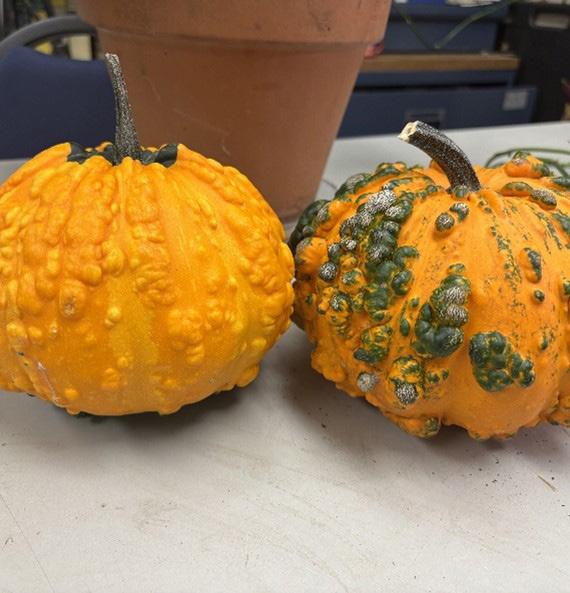

Hoargarth gourd Autumn Wings gourd
EVALUATION TRAITS

JOIN IN THE 2025 TRIALS
Be a citizen scientist and contribute to our vegetable trials for Ohio. We are looking for people excited about growing vegetables in their home gardens and then letting us know what they think. Youth and adults are welcomed to participate.
PROJECT CONTACT
For inquiries about this project, contact
Ed Brown
Extension Educator, Athens County brown.6000@osu.edu
Ohio Home Garden Trials: Zinnias
OBJECTIVE
Evaluate the performance of vegetable, flower, and herb varieties under realworld gardening conditions using methods commonly practiced by Ohio gardeners.
STUDY INFORMATION
Planting Date 05/15/2024 – 09/15/2024
Harvest Date(s) 07/15/2024 – 10/31/2024
Varieties Benary’s Giant Coral Queeny Red Lime
Management Conventional and organic
FertilizerNone, Conventional, compost alone, compost and organic
PesticidesConventional, organic, none
Growing SystemBare ground, Garden soil in raised beds, Soilless mix in raised beds, Containers
Study typeReplicated by site
Treatments2
Replications74
Size of trial 1480 sq ft
STUDY DESIGN
Gardeners across Ohio participated in a voluntary study comparing two varieties of a vegetable in side-by-side trials. Participants selected from ten vegetable trials, one flower trial, and one herb trial, growing the varieties using their usual methods rather than controlled experimental practices. At the end of the growing season, gardeners submitted evaluation forms detailing performance and their gardening methods. This self-selected approach provided practical insights into how varieties perform under diverse, real-world conditions, reflecting the typical practices of home gardeners rather than standardized protocols.
ePLUS Collaborating Sites
OSU Extension
Statewide

Residents in 31 Ohio counties participated in this trial. The counties indicated in red had at least one participant.
OBSERVATIONS
A total of 74 gardeners from 31 Ohio counties participated, selecting 74 variety trials for evaluation. Of these, 64 gardeners completed full or partial evaluations, reflecting a 24% full or partial failure rate. Gardening experience ranged from 0 to 84 years.
Traditional bare ground gardens followed by raised beds with garden soil were the most common gardening methods.
Regarding soil amendments, 22% of participants used no fertilizer, while 47% used compost alone or combined with organic fertilizers, highlighting a preference for organic practices among the majority of participants.
SUMMARY
• For all traits, gardeners rated Benary’s Giant Coral higher.
• Benary’s Giant Coral received an overall performance rating of 4 out of 5.
• Queeny Red Lime received an overall performance rating of 4 out of 5.
• 92% would recommend Benary’s Giant Coral and 84% would recommend Queeny Red Lime for Ohio gardeners.

EVALUATION TRAITS


JOIN IN THE 2025 TRIALS
Be a citizen scientist and contribute to our vegetable trials for Ohio. We are looking for people excited about growing vegetables in their home gardens and then letting us know what they think. Youth and adults are welcomed to participate.
PROJECT CONTACT
For inquiries about this project, contact
Benary’s Giant Coral zinnia
Queeny Red Lime Zinnia
Ohio Home Garden Trials: Basil
OBJECTIVE
Evaluate the performance of vegetable, flower, and herb varieties under realworld gardening conditions using methods commonly practiced by Ohio gardeners.
STUDY INFORMATION
Planting Date 05/15/2024 – 09/15/2024
Harvest Date(s) 07/15/2024 – 10/31/2024
VarietiesNewton Red Rubin
Management Conventional and organic
FertilizerNone, Conventional, compost alone, compost and organic
PesticidesConventional, organic, none
Growing SystemBare ground, Garden soil in raised beds, Soilless mix in raised beds, Containers
Study typeReplicated by site
Treatments2
Replications48
Size of trial 1056 sq ft
STUDY DESIGN
Gardeners across Ohio participated in a voluntary study comparing two varieties of a vegetable in side-by-side trials. Participants selected from ten vegetable trials, one flower trial, and one herb trial, growing the varieties using their usual methods rather than controlled experimental practices. At the end of the growing season, gardeners submitted evaluation forms detailing performance and their gardening methods. This self-selected approach provided practical insights into how varieties perform under diverse, real-world conditions, reflecting the typical practices of home gardeners rather than standardized protocols.
ePLUS Collaborating Sites
OSU Extension
Statewide


Residents in 30 Ohio counties participated in this trial. The counties indicated in red had at least one participant.
OBSERVATIONS
A total of 48 gardeners from 30 Ohio counties participated, selecting 38 variety trials for evaluation. Of these, 38 gardeners completed full or partial evaluations, reflecting a 53% full or partial failure rate. Gardening experience ranged from 0 to 70 years.
Raised beds with garden soil followed by traditional bare ground gardens were the most common gardening methods.
Regarding soil amendments, 33% of participants used no fertilizer, while 46% used compost alone or combined with organic fertilizers, highlighting a preference for organic practices among the majority of participants.
SUMMARY
• For all traits, gardeners rated Newton higher.
• Newton received an overall performance rating of 4 out of 5.
• Red Rubin received an overall performance rating of 3 out of 5.
• 92% would recommend Newton and 81% would recommend Red Rubin for Ohio gardeners.

EVALUATION TRAITS
JOIN IN THE 2025 TRIALS
Be a citizen scientist and contribute to our vegetable trials for Ohio. We are looking for people excited about growing vegetables in their home gardens and then letting us know what they think. Youth and adults are welcomed to participate.


PROJECT CONTACT
For inquiries about this project, contact
Newton basil
Red Rubin basil
Ohio Home Garden Trials: Tomatoes
OBJECTIVE
Evaluate the performance of vegetable, flower, and herb varieties under realworld gardening conditions using methods commonly practiced by Ohio gardeners.
STUDY INFORMATION
Planting Date 05/15/2024 – 09/15/2024
Harvest Date(s) 07/15/2024 – 10/31/2024
VarietiesCelebrity Patio
Management Conventional and organic
FertilizerNone, Conventional, compost alone, compost and organic
PesticidesConventional, organic, none
Growing SystemBare ground, Garden soil in raised beds, Soilless mix in raised beds, Containers
Study typeReplicated by site
Treatments2
Replications19
Size of trial 760 sq ft
STUDY DESIGN
Gardeners across Ohio participated in a voluntary study comparing two varieties of a vegetable in side-by-side trials. Participants selected from ten vegetable trials, one flower trial, and one herb trial, growing the varieties using their usual methods rather than controlled experimental practices. At the end of the growing season, gardeners submitted evaluation forms detailing performance and their gardening methods. This self-selected approach provided practical insights into how varieties perform under diverse, real-world conditions, reflecting the typical practices of home gardeners rather than standardized protocols.
ePLUS Collaborating Sites
OSU Extension
Statewide

Residents in 11 Ohio counties participated in this trial. The counties indicated in red had at least one participant.
OBSERVATIONS
A total of 19 gardeners from 11 Ohio counties participated, selecting 19 variety trials for evaluation. Of these, 12 gardeners completed full or partial evaluations, reflecting a 58% full or partial failure rate. Gardening experience ranged from 1 to 56 years.
Raised beds with garden soil followed by container grown and then traditional bare ground gardens were the most common gardening methods.
Regarding soil amendments, 39% of participants used no fertilizer, while 45% used compost alone or combined with organic fertilizers, highlighting a preference for organic practices among the majority of participants.
SUMMARY
• For the traits of germination rate and plant health many gardeners found no difference between the varieties.
• For the traits of first harvest and yields, gardeners rated Celebrity higher.
• Patio stood out on the trait of attractive plants and fruits.
• Celebrity received an overall performance rating of 4 out of 5.
• Patio received an overall performance rating of 4 out of 5.
• 79% would recommend Celebrity and 95% would recommend Patio for Ohio gardeners.

EVALUATION TRAITS
JOIN IN THE 2025 TRIALS
Be a citizen scientist and contribute to our vegetable trials for Ohio. We are looking for people excited about growing vegetables in their home gardens and then letting us know what they think. Youth and adults are welcomed to participate.


PROJECT CONTACT
For inquiries about this project, contact
Brown Extension Educator, Athens County brown.6000@osu.edu
Celebrity tomatoes
Patio tomatoes
© Seminis
© Seminis
Ohio Home Garden Trials: Carrots
OBJECTIVE
Evaluate the performance of vegetable, flower, and herb varieties under realworld gardening conditions using methods commonly practiced by Ohio gardeners.
STUDY INFORMATION
Planting Date 05/15/2024 – 09/15/2024
Harvest Date(s) 07/15/2024 – 10/31/2024
VarietiesBolero Musico
Management Conventional and organic
FertilizerNone, Conventional, compost alone, compost and organic
PesticidesConventional, organic, none
Growing SystemBare ground, Garden soil in raised beds, Soilless mix in raised beds, Containers
Study typeReplicated by site
Treatments2
Replications45
Size of trial 495 sq ft
STUDY DESIGN
Gardeners across Ohio participated in a voluntary study comparing two varieties of a vegetable in side-by-side trials. Participants selected from ten vegetable trials, one flower trial, and one herb trial, growing the varieties using their usual methods rather than controlled experimental practices. At the end of the growing season, gardeners submitted evaluation forms detailing performance and their gardening methods. This self-selected approach provided practical insights into how varieties perform under diverse, real-world conditions, reflecting the typical practices of home gardeners rather than standardized protocols.
ePLUS Collaborating Sites
OSU Extension
Statewide

Residents in 19 Ohio counties participated in this trial. The counties indicated in red had at least one participant.
OBSERVATIONS
A total of 45 gardeners from 19 Ohio counties participated, selecting 45 variety trials for evaluation. Of these, 36 gardeners completed full or partial evaluations, reflecting a 49% full or partial failure rate. Gardening experience ranged from 1 to 60 years.
Raised beds with garden soil were the most common gardening method, followed by traditional bare ground gardens.
Regarding soil amendments, 19% of participants used no fertilizer, while 64% used compost alone or combined with organic fertilizers, highlighting a preference for organic practices among the majority of participants.
SUMMARY
• Bolero ranked higher in days to germinate, Days to finish, yield, and attractiveness.
• Musico ranked higher plant health and taste.
• Most gardeners reported no significant difference between the varieties for most traits.
• Both varieties received an overall performance rating of 4 out of 5.
• 96% would recommend Bolero and 87% would recommend Musico for Ohio gardeners.

EVALUATION TRAITS


JOIN IN THE 2025 TRIALS
Be a citizen scientist and contribute to our vegetable trials for Ohio. We are looking for people excited about growing vegetables in their home gardens and then letting us know what they think. Youth and adults are welcomed to participate.
PROJECT CONTACT
For inquiries about this project, contact
Brown Extension Educator, Athens County brown.6000@osu.edu
Musico Carrots Bolero Carrots
Ohio Home Garden Trials: Peas, Shelling
OBJECTIVE
Evaluate the performance of vegetable, flower, and herb varieties under realworld gardening conditions using methods commonly practiced by Ohio gardeners.
STUDY INFORMATION
Planting Date 04/012024 – 09/15/2024
Harvest Date(s) 06/01/2024 – 10/31/2024
VarietiesShort Story Litle Marvel
Management Conventional and organic
FertilizerNone, Conventional, compost alone, compost and organic
PesticidesConventional, organic, none
Growing SystemBare ground, Garden soil in raised beds, Soilless mix in raised beds, Containers
Study typeReplicated by site
Treatments2
Replications32
Size of trial 352 sq ft
STUDY DESIGN
Gardeners across Ohio participated in a voluntary study comparing two varieties of a vegetable in side-by-side trials. Participants selected from ten vegetable trials, one flower trial, and one herb trial, growing the varieties using their usual methods rather than controlled experimental practices. At the end of the growing season, gardeners submitted evaluation forms detailing performance and their gardening methods. This self-selected approach provided practical insights into how varieties perform under diverse, real-world conditions, reflecting the typical practices of home gardeners rather than standardized protocols.
ePLUS Collaborating Sites
OSU Extension
Statewide

Residents in 25 Ohio counties participated in this trial. The counties indicated in red had at least one participant.
OBSERVATIONS
A total of 32 gardeners from 25 Ohio counties participated, selecting 32 variety trials for evaluation. Of these, 27 gardeners completed full or partial evaluations, reflecting a 41% full or partial failure rate. Gardening experience ranged from 1 to 84 years.
Traditional bare ground gardens followed by raised beds with garden soil were the most common gardening method.
Regarding soil amendments, 22% of participants used no fertilizer, while 65% used compost alone or combined with organic fertilizers, highlighting a preference for organic practices among the majority of participants.
SUMMARY
• For most traits, many gardeners found no difference between the varieties.
• Short Story produced first while Little Marvel was rated to have yields and more attractive plants and pods by those who found a difference between the varieties.
• Little Marvel received an overall performance rating of 3 out of 5.
• Short Story received an overall performance rating of 3 out of 5.
• 75% would recommend Short Story and 81% would recommend Little Marvel for Ohio gardeners.


JOIN IN THE 2025 TRIALS
Be a citizen scientist and contribute to our vegetable trials for Ohio. We are looking for people excited about growing vegetables in their home gardens and then letting us know what they think. Youth and adults are welcomed to participate.
For inquiries about this project, contact
Short Story peas Little Marvel peas
Ohio Home Garden Trials: Green Beans, Bush
OBJECTIVE
Evaluate the performance of vegetable, flower, and herb varieties under realworld gardening conditions using methods commonly practiced by Ohio gardeners.
STUDY INFORMATION
Planting Date 05/15/2024 – 09/15/2024
Harvest Date(s) 07/15/2024 – 10/31/2024
VarietiesBronco Dark Horse
Management Conventional and organic
FertilizerNone, Conventional, compost alone, compost and organic
PesticidesConventional, organic, none
Growing SystemBare ground, Garden soil in raised beds, Soilless mix in raised beds, Containers
Study typeReplicated by site
Treatments2
Replications36
Size of trial 396sq ft
STUDY DESIGN
Gardeners across Ohio participated in a voluntary study comparing two varieties of a vegetable in side-by-side trials. Participants selected from ten vegetable trials, one flower trial, and one herb trial, growing the varieties using their usual methods rather than controlled experimental practices. At the end of the growing season, gardeners submitted evaluation forms detailing performance and their gardening methods. This self-selected approach provided practical insights into how varieties perform under diverse, real-world conditions, reflecting the typical practices of home gardeners rather than standardized protocols.
ePLUS Collaborating Sites
OSU Extension
Statewide

Residents in 21 Ohio counties participated in this trial. The counties indicated in red had at least one participant.
OBSERVATIONS
A total of 36 gardeners from 21 Ohio counties participated, selecting 36 variety trials for evaluation. Of these, 33 gardeners completed full or partial evaluations, reflecting a 22% full or partial failure rate. Gardening experience ranged from 2 to 70 years.
Raised beds with garden soil followed by traditional bare ground gardens were the most common gardening method.
Regarding soil amendments, 14% of participants used no fertilizer, while 61% used compost alone or combined with organic fertilizers, highlighting a preference for organic practices among the majority of participants.
SUMMARY
• For the traits of germination rate, plant health, and attractiveness, many gardeners found no difference between the varieties.
• For the traits of first harvest and yields, gardeners were almost evenly divided.
• Dark Horse stood out on the trait of taste.
• Bronco received an overall performance rating of 4 out of 5.
• Dark Horse received an overall performance rating of 4 out of 5.
• 86% would recommend Bronco and 92% would recommend Dark Horse for Ohio gardeners.

EVALUATION TRAITS


JOIN IN THE 2025 TRIALS
Be a citizen scientist and contribute to our vegetable trials for Ohio. We are looking for people excited about growing vegetables in their home gardens and then letting us know what they think. Youth and adults are welcomed to participate.
PROJECT CONTACT
For inquiries about this project, contact
Brown Extension Educator, Athens County brown.6000@osu.edu
Bronco green beans
Dark Horse green beans
Impacts of Riparian Invasive Species Management in Forested Headwater Streams
OBJECTIVE
Quantify water quality signatures, specifically nitrogen, total suspended sediments, and phosphorus dynamics, during restoration efforts in Pomerene Forest and Agricultural Laboratory in Coshocton, OH.
STUDY DESIGN
Water samples were collected weekly May – July 2024 at seven key sites in Pomerene’s streams. Water quality metrics including nitrate (NO₃-N), orthophosphate (PO₄-P), total nitrogen (TN), total phosphorus (TP), pH, and total suspended solids (TSS) were measured from the grab samples.
STUDY INFORMATION
Sampling Period May – July 2024
Sampling Frequency Weekly Sites Sampled7
OBSERVATIONS

Each sampling site shows some variance across the metrics measured. Orthophosphate (PO₄-P) shows the most similar trends and concentrations across the sampling sites. Specifically, PO₄-P increased from 0.01 to 0.12 mg/l in week 6-7 before the confluence (sites 4, 5, and 7) and after the confluence (site 2). TP levels were somewhat similar across sites, with initial high concentrations during week 2 in sites 4 and 5. TP concentrations also increases from 0.2 mg/l to 0.7 mg/l around week 7. Nitrogen concentrations, both NO₃-N and TN, show the most variability. Interestingly, site 5 –located downstream from site 7 – reached the highest NO₃-N levels (0.43 mg/l) on week 7, just after a peak in NO₃-N level (0.18 mg/l) in site 7 at week 6. Additionally, we observed an interesting decline in TN from week 1 to 11, with site 7 reaching the highest TN levels (1.7 mg/l) on week 7 which quickly dropped to 0.6 on week 8. We observed a strong weekly fluctuation pattern in TN concentrations that started in week 6 in the wetland restoration site (site 2) after the confluence. These results may be indicative of N fixation processes occurring in the wetland region or may be related to rainfall patterns, but more data is necessary to best explain the weekly patterns observed. *Samples were unable to be collected from Site 1 from weeks 4-11, Sites 3 & 6 from weeks 1-11, and Site 4 from week 11 due to a lack of water.
Pomerene Forest Laboratory
OARDC
Coshocton County

RESULTS

Nitrate (NO₃-N) concentrations measured for each sampling site. Missing data is due to a lack of water at the time of sampling. All concentrations shown are in mg/L


Total nitrogen (TN) concentrations measured for each sampling site. Missing data is due to a lack of water at the time of sampling. All concentrations shown are in mg/L.

Total phosphorus (TP) concentrations measured for each sampling site. Missing data is due to a lack of water at the time of sampling. All concentrations shown are in mg/L.
SUMMARY

Orthophosphate (PO₄-P) concentrations measured for each sampling site. Missing data is due to a lack of water at the time of sampling. All concentrations shown are in mg/L.
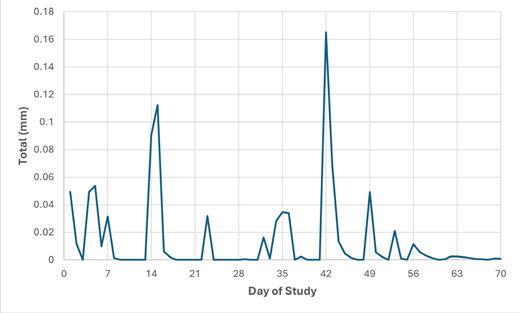
Average daily rainfall for the duration of the study, in mm
• Weekly water samples were collected from 7 sites at Pomerene.
• Water quality metrics were measured, including nitrate (NO₃-N), orthophosphate (PO₄-P), total nitrogen (TN), total phosphorus (TP), pH, and total suspended solids (TSS).
• Preliminary results show greater variation in nitrogen dynamics among sampling sites.
• N concentration fluctuated weekly, principally in the wetland restoration site, which warrants further investigation.
PROJECT CONTACTS
Report submitted by:
Alessandra Bertucci
Graduate Student
OSU Food, Ag, Biological Engineering miralha.1@osu.edu
For inquiries about this project, contact
Dr. Lorrayne Miralha
Assistant Professor
OSU Food, Ag, Biological Engineering miralha.1@osu.edu
Dr. Jo Peacock
Assistant Professor
OSU Food, Ag, Biological Engineering miralha.1@osu.edu
Production of Largemouth Bass in a floating
in-pond
raceway system
OBJECTIVE
This project is Evaluate production of Largemouth bass (LMB) as food-fish in a floating in-pond raceway system (IPRS) in a spring-fed pond rather large, traditional earthen ponds.
STUDY INFORMATION
Stocking Dates05/02,08,21/2024
Harvest Date(s) TBD
SpeciesLargemouth bass (Micropterus salmoides)
Stocking density3.6 kg/m3
Management Feed: 10,839 lb (until November 30, 2024)
System In-pond Raceway System (IPRS)
Study typeObservation
Size of IPRS 214 m3 (56,500 gallons)
STUDY DESIGN
A total of 10,058 feed-trained largemouth bass LMB fingerlings with an individual average weight of 76.2±19.8 g (CV=26.0%) were stocked early in May 2024, in one floating in-pond raceway system (IPRS). The IPRS is in a spring-fed pond derived from a reclaimed limestone quarry in Miami County.
Water quality parameters including water temperature, water pH, and dissolved oxygen; and feed consumption have been taking daily. Other water quality parameters such as ammonia, nitrite, hardness, alkalinity, and chloride have been measured monthly.
Fish weight and lengths have been taken regularly to evaluate growth response in the culture system. The floating IPRS draws water from deep in the pond using airlift pumps to circulate in the culture unit. Removal of solid waste produced by organisms has been done on a weekly basis

eFields Collaborating Farm
OSU Extension
Miami County


Floating in pond raceway system, placed in a large spring-fed pond derived from a reclaimed limestone quarry.
RESULTS


SUMMARY

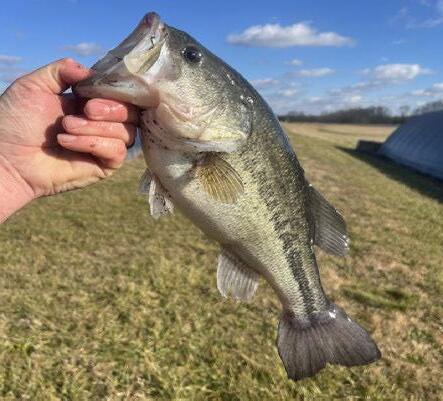
PROJECT CONTACT
• The production cycle reached 212 days as of November 30, 2024, with fish weighting in average 358.9±110.5 g (CV=30.8%), feed consumption of 4,926 kg (10,839 lb.), and observed mortality 5% which means that the estimated feed conversion ratio (FCR) could be 1.36.
• Since the fish did not reach food market size, they will be maintained over winter in the IPRS.
• This project is still in progress
For inquiries about this project, contact Dr. Herbert Quintero Program Director for Aquaculture OSU Extension quinterofonseca.1@osu.edu
Water temperature monitoring in three aquaculture facilities in Ohio.
OBJECTIVE
Monitor water temperature in three different aquaculture facilities as a baseline reference for future studies.
STUDY INFORMATION
Start monitoring06/01/2024
End monitoring10/11/2024
Total numbers of days 133
Equipment Five HOBO MX pH and temperature data loggers (MX2501)
SystemIn-pond Raceway System (IPRS) Split pond system (SPS) Traditional earthen ponds
Study typeObservation
Sites3
STUDY DESIGN
Aquaculture is the farming of aquatic organisms such as fish, shrimp, oysters, and algae. It is important to monitor water quality variables such as temperature, dissolved oxygen, pH, ammonia, nitrites, nitrates, etc.
Three outdoor aquaculture facilities participated in a water quality monitoring project aimed to characterize water temperature during a regular culture production cycle. The facilities included a floating in-pond raceway system (IPRS) in a reclaimed limestone quarry (17 acres in size, 22.5 ft deep) in Miami County; a splitpond system (Production pond 1 - 0.25-acre & waste treatment pond 1-acre) in Logan County; and two earthen ponds used as traditional aquaculture ponds in Union County (1 acre, 4 ft deep each, Pond 3 and 4). The monitoring was performed using automatic data loggers, registering water temperature every hour, 24 hours a day, for 133 days.

RESULTS
eFields Collaborating Farm
OSU Extension
Logan, Miami, Union County


Figure 1 – Daily water temperature (oC) in the three main systems.
Figure 2 – Daily water temperature (oC) in the split pond system..
Table 1 – monthly average temperature ± standard deviation, the coefficient of variance (CV, %), and the maximum and minimum temperatures for each aquaculture system that was monitored.
June
July 31
August 31
*There were only 9-days that were monitored due to failure in the equipment. **2635 data points were collected due to failure in the equipment n IPRS Pond 1
SUMMARY
• Water temperature was consistently more homogeneous in the floating in-pond raceways (IPRS) compared with earthen ponds from the split pond system, and the traditional ponds.
• The split-pond system (SPS) had minimal daily water quality variations (only during the first couple of weeks).
• Water temperature in Pond 3 was consistently higher than in Pond 4.
• The significance of these preliminary observations needs to be evaluated concerning other water quality parameters, and the growth performance of the species being cultured.

Figure 3 – Daily water temperature in traditional earthen ponds.
PROJECT CONTACT
For inquiries about this project, contact Dr. Herbert Quintero Program Director for Aquaculture OSU Extension quinterofonseca.1@osu.edu
Water pH monitoring in three aquaculture facilities in Ohio.
OBJECTIVE
Monitor water pH in three different aquaculture facilities as a baseline reference for future studies.
STUDY INFORMATION
Start monitoring06/01/2024
End monitoring10/11/2024
Total numbers of days 133
Equipment Five HOBO MX pH and temperature data loggers (MX2501)
SystemIn-pond Raceway System (IPRS) Split pond system (SPS) Traditional earthen ponds
Study typeObservation
Sites3
STUDY DESIGN
Aquaculture is the farming of aquatic organisms such as fish, shrimp, oysters, and algae. It is important to monitor water quality variables such as temperature, dissolved oxygen, pH, ammonia, nitrites, nitrates, etc.
Three outdoor aquaculture facilities participated in a water quality monitoring project aimed to characterize water pH during a regular culture production cycle. The facilities included a floating in-pond raceway system (IPRS) in a reclaimed limestone quarry (17 acres in size, 22.5 ft deep) in Miami County; a split-pond system (Production pond 10.25-acre & waste treatment pond 1-acre) in Logan County; and two earthen ponds used as traditional aquaculture ponds in Union County (1 acre, 4 ft deep each, Pond 3 and 4). The monitoring was performed using automatic data loggers, registering water pH every hour, 24 hours a day, for 133 days.
RESULTS
eFields Collaborating Farm
OSU Extension Logan, Miami, Union County

1 – Daily water pH in the three main systems.

Figure
Figure 2 – Daily water pH in the split pond system..
Table 1 – monthly average temperature ± standard deviation, the coefficient of variance (CV, %), and the maximum and minimum temperatures for each aquaculture system that was monitored.
n IPRS Pond 1 Pond 2 Pond 3 Pond 4
June 30 8.48±0.07
(0.87%)
±0.10
July 31
August 31
September 30
(1.23%)
±0.07 *
(0.80%)
±0.20
(2.32%)
±0.29
(3.31%)
±0.31
(3.90%)
±0.37
±0.17
±0.26
±0.29
±0.24
*There were only 9-days that were monitored due to failure in the equipment.
**2635 data points were collected due to failure in the equipment
SUMMARY
• pH was consistently more stable in the floating in-pond raceways (IPRS) compared with earthen ponds from the split pond system, and the traditional ponds.
• pH in the production pond in the SPS was very stable during the first month, while the waste treatment pond had a lower pH during the first week; then from week 2 until week 6, the pH was similar in the production pond and the waste treatment pond; finally starting the 7th week until the end of the monitoring the pH was consistently higher in the waste treatment pond.
• pH in ponds 3 and 4 started relatively high compared to ponds from the SPS, but after the first three weeks dropped below 8.5. In contrast, pH in the SPS drove up for July, and then dropped, with pH consistently lower in the production pond.
• The significance of these preliminary observations needs to be evaluated concerning other water quality parameters, and the growth performance of the species being cultured.

Figure 3 – Daily water pH in traditional earthen ponds.
PROJECT CONTACT
For inquiries about this project, contact Dr. Herbert Quintero
Program Director for Aquaculture OSU Extension quinterofonseca.1@osu.edu
Acknowledgements
Research Collaborators and Supporters
Acme Farm Market
Aiden Shepherd
Alison Circle
Anne Rauck
Arnold Gomez
Balmy Heights Orchard
Barb Dolce
Bauman Orchards
Baumhart Berry Farm
Ben Gantz
Beth Risby
Bill Lynch - Millcreek Perch Farm
Bob Filbrun
Bob Shaw
Brehm’s Perch Farm- John
Matthew Brehm
Brenda Allinger
Brie Dalton
Bruce Hanzel- The Fremont Company
Carol Williams
Caye Aiello
Chris Sutton - Berryhill Farm
Chris Zoller
Christine Osterman
Christy Lockhart
Conner Collins
Connie Mitchell
Daiyanera Kelsey
Dane Peck
David Ernst & Family
David Civittolo
Deb Brugger
Debbie Farynowski
Debbie Roshto
Denise Fields
Doug Wurtz- Akron Cooperative Farm
Dylan Leipold
Elise Gorsuch
Eric Barrett
Ernest Zimmerman- Scenic Valley Farm
Frank Thayer
Fred Weaver- Rainsboro Produce
Gail Walter
Geig’s Orchard
Grobe Fruit Farm
Gustavo Rossi
Herminio (Carlos) Perez
Hope Weber
Ian Kaplan
Isaac and Justine GarlandGraland Farms Sweet Corn
Jamie and Krista Arthur - Little
Miami Farms
Jane Skogstrom
Jeff Harriman
Jen Andon
Jennie Hayes
Jennifer Kuehn
Jenny McKillips
Jill Alexander
Jill Pfister
John Glacken
John Matthew Brehm – Brehm’s Perch Farm
John Peifer, Sam and Emma Burns - Peifer Orchards
Josh Lewis
Karen Parsons
Karen Titone
Kathy Krantz
Kathy Watson
Kayla Pumphrey
Ken Scaife
Kim Bachman
Kirk Manson - Hemloch Aquaculture
Krissi Oliver –Hemloch Aquaculture
Laura Foley
Lauren Breitenbach- Bee-Leaf Sustainable Produce
Linda Bauer
Linda McCann
Lindsay Klaunig- Trouvaille Farm
Logan Reese- Reese Farms
Loretta Graham
Lori Kingston
Love’Yah Stewart
Lynn Blanton
Lynn Giljahn
Maggie Harriman
Marge Ward
Margie Campbell
Marianne Robinson
Matheus Ogasawara
Matthew and Luticia Minter
Matthew Smith - Millcreek Perch Farm
Melina Gabele
Messenger Century Farm
Mindy Hartley
Moreland Fruit Farm
Mucky Boots Farm
Muskingum Watershed Conservancy District (MWCD)
Nancy Lamb
Natalie Constancio
Nathan Mast
Pat Martin
Patti Mikac
Paul O’Bryant
Paula Oliveira
Ransom Sage Fruit Farm
Raven Schaffter
Richardson Farm
Riehm Produce Farm, LLC
Rittman Orchards
Rosalind Soles
Rosie Wendt
Rural Action
Rylee Chandler
Sage’s Apple Farm
Shaunessy Everet
Shelli Manson - Hemloch Aquaculture
Silvio Ferraz
Snyder Park Gardens & Arboretum
Sophia Rhodes
South Plymouth PumpkinsJared Persinger
Stephanie Harrison
Steve & Mike Hirsch- Hirsch Fruit Farm
Steven Lyon
Sue Ann Dill
Sunny Slope Orchard
Sunnybank Farm - Don Shoemaker
Susan Peck
Suzy Levine
Theresa Gregory
Thomas Worley
Tiffin-Seneca Farmers Market
Wayne Lewis


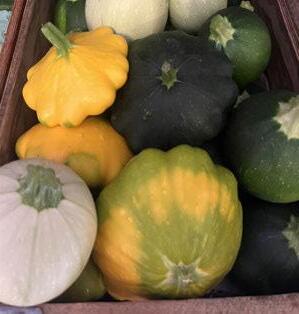

Acknowledgements
ePLUS Study and Production Support
The production and publication of ePLUS has been made possible through the following support:


USDA National Institute of Food and Agriculture, Ohio Extension Implimentation Program Awards: 2021-70006-35562 and 2024-70006-43574


USDA National Institute of Food and Agriculture, under agreement number 2023-38640-39573 through the North Central Region SARE program under project number ONC24-155.



Additional Support for Studies Reported in ePLUS


USDA is an equal opportunity employer and service provider. Any opinions, findings, conclusions, or recommendations expressed in this publication are those of the author(s) and do not necessarily reflect the view of the U.S. Department of Agriculture.
The OSU Office of the Provost, Global Gateways Initiative Grant Program


No endorcement from the Ohio State University for products shown is intended or implied.


ePLUS is an Ohio State program dedicated to advancing production horticulture and wise use of natural resources through on-location research. The program utilizes modern technologies and information to conduct applied, cooperative research with an educational and demonstration component used to help growers, managers, and advisors understand how new practices and techniques can improve farm, forest, and garden sustainability. ePLUS is dedicated to delivering timely and relevant, data-driven, actionable information to Ohio farmers and communities.