People
Project Restore Local organization does what it can to improve lives in Uganda
This is the harsh reality faced by thousands of families in Uganda every day which Project Restore, a not-for-profit humanitarian organization based in Glen Carbon, hopes to change. “Our core value is sustainability,” said Project Restore Executive
hunger and clean water. “We could have a fantastic education system, but if they’re starving to death it isn’t going to do them any good. They just all are interwoven together and they all need attention,” said Keck. “We didn’t want to introduce anything that isn’t sustainable.” For the past three years, Project Restore has been focusing the majority of its efforts on helping the community of Namulonge in Uganda, Africa. The connection was made when a mutual friend put Keck in touch with Dr. Fred Ssewamala, an associate professor of social work and international affairs at Columbia University. He grew up in Namulonge and suggested the village as the perfect place for the fledgling organization to direct its
place during previous visits. The team left on Aug. 3 and will be working in the community through Aug. 14. To help raise money for this trip, Edwardsville District 7 agreed to co-sponsor a dance fundraiser in
Director Catherine Keck. “For us, sustainability is moving a community to the next level of self-sufficiency and self-independence and really getting them out of that rut of poverty and breaking that cycle.” Keck said the organization was founded with the aim of tackling the basic human needs of people globally that are not currently being met. Everyday activities such as drinking a glass of clean water, feeding your child a nutritious meal, sending them off to school and watching them grow up without the fear of diseases such as malaria and Typhoid fever are all luxuries that we take for granted daily. Founded in 2007, Project Restore’s aim is to change all of that by addressing the four interrelated core values it has identified to achieve its goal of sustainability. These core values are: education, medical care,
mission of providing aid while also putting in place the necessary tools for the people to eventually become self-sufficient. Ssewamala also serves as the International Social and Economic Development Director on the Project Restore board of directors. Project Restore has sent teams each year to Namulonge since then. Much of the early work was devoted to providing access to clean water tho Namulonge and the surrounding villages. To date, the organization has repaired five fresh water wells in the area and installed five rain water harvesting tanks with two in Namulonge, one in Buso and two at the nearby Muslim school. As you read this, the next team will have already arrived in Namulonge ready to get to work carrying on the projects put into
conjunction with National Dance Day on July 30 and the popular “So You Think You Can Dance” television dance series. This involved teaching members of the community a routine choreographed by “So You Think You Can Dance” judge Mary Murphy. As a follow-up to the event, the team will teach the villagers the same routine performed in Edwardsville, film their performance and submit it to the television producers. All proceeds raised from the Edwardsville event will go to Uganda. The team of seven includes Keck; Jan Miller, a retired District 7 middle school music teacher, who will be heading up the education part of the trip; a dental assistant who will be providing follow-up care to previous trips; a social worker; a nurse from Maryville University who will
By KRISTA WILKINSON-MIDGLEY Of The Edge
I
magine going to school and trying to concentrate while your belly rumbles and cramps because you haven’t eaten for days. Or walking two miles every day just to get clean water for your family and then walking two miles back.
For The Edge
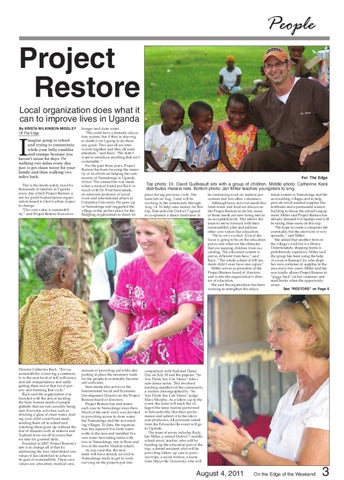
Top photo: Dr. David Guilbeault sits with a group of children. Middle photo: Catherine Keck distributes malaria nets. Bottom photo: Jan Miller teaches youngsters to sing. be continuing work on malaria prevention and two other volunteers. Although basic survival needs like fresh water and food are always on the Project Restore to-do list, many of those needs are now being met at an acceptable level. This allows the team to move forward with their sustainability plan and address other core values like education. “We’re very excited. A lot of the focus is going to be on the education pieces and what are the obstacles that are keeping children from succeeding. The education system is just so different from here,” said Keck. “The whole school of 450 students didn’t even have one copier.” Miller serves as president of the Project Restore board of directors and is also the organization’s director of education. She said the organization has been working to strengthen the educa-
August 4, 2011
tional system in Namulonge and the surrounding villages and to help provide much-needed supplies like textbooks and a permanent science building to house the school’s equipment. Miller said Project Restore has already donated five laptops and will be taking three more on this trip. “We hope to create a computer lab eventually, but the electricity is very sporadic,” said Miller. She added that another item on the village’s wish list is a library. Unfortunately, shipping books is prohibitively expensive. Miller said the group has been using the help of a nun in Kansas City who ships her own container of supplies to the area every few years. Miller said the nun kindly allows Project Restore to “piggy-back” on her container and send books when the opportunity arises. See "RESTORE" on Page 6
On the Edge of the Weekend
3