Preview Version - To order please call 1.866.422.7310 or email info@edvantageinteractive.com
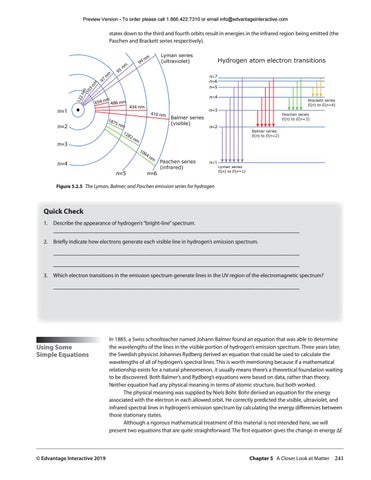
states down to the third and fourth orbits result in energies in the infrared region being emitted (the Paschen and Brackett series respectively).
94
9
m 656 n 486 nm
n=1 187
n=2
Hydrogen atom electron transitions n=7 n=6 n=5
122 nm 10 3n m 97
nm
m 5n
Lyman series (ultraviolet)
nm
n=4 434 nm
410 nm 5 nm
Brackett series E(n) to E(n=4)
n=3 Balmer series (visible)
Paschen series E(n) to E(n=3)
n=2
Balmer series E(n) to E(n=2)
12 82 n
m
n=3
10 94 nm
n=4 n=5
n=6
Paschen series (infrared)
n=1
Lyman series E(n) to E(n=1)
Figure 5.2.5 The Lyman, Balmer, and Paschen emission series for hydrogen
Quick Check 1. Describe the appearance of hydrogen’s “bright-line” spectrum. _________________________________________________________________________________________ 2. Briefly indicate how electrons generate each visible line in hydrogen’s emission spectrum. _________________________________________________________________________________________
_________________________________________________________________________________________
3. Which electron transitions in the emission spectrum generate lines in the UV region of the electromagnetic spectrum? _________________________________________________________________________________________
Using Some Simple Equations
© Edvantage Interactive 2019
In 1885, a Swiss schoolteacher named Johann Balmer found an equation that was able to determine the wavelengths of the lines in the visible portion of hydrogen’s emission spectrum. Three years later, the Swedish physicist Johannes Rydberg derived an equation that could be used to calculate the wavelengths of all of hydrogen’s spectral lines. This is worth mentioning because if a mathematical relationship exists for a natural phenomenon, it usually means there’s a theoretical foundation waiting to be discovered. Both Balmer’s and Rydberg’s equations were based on data, rather than theory. Neither equation had any physical meaning in terms of atomic structure, but both worked. The physical meaning was supplied by Niels Bohr. Bohr derived an equation for the energy associated with the electron in each allowed orbit. He correctly predicted the visible, ultraviolet, and infrared spectral lines in hydrogen’s emission spectrum by calculating the energy differences between those stationary states. Although a rigorous mathematical treatment of this material is not intended here, we will present two equations that are quite straightforward. The first equation gives the change in energy ∆E
Chapter 5 A Closer Look at Matter 241