Education International
Off Track:
Educators Assess Progress Towards SDG 4
EDUCATION 2030
EI-IE.ORG
J U LY 2 0 1 9
GRO.EI-IE 0302 NOITA CUDE
ii
This work is licensed under a Creative Commons Attribution-NonCommercialShareAlike 4.0 International License. (CC BY-NC-SA 4.0)
Published by Education International - July 2019 ISBN : 978-92-95109-87-2 (PDF)
Education International Research
Foreword In 2015, Education International ensured that the new international agenda for a better world included a commitment to quality education and recognised the importance of teachers in making this a reality. Four years later, teachers provide a highly concerning analysis of the progress made towards guaranteeing equitable and inclusive quality education for all and remedying the shortage of qualified teachers. Privatisation of education is intensifying and funding for public education is being cut, excluding the vulnerable from accessing quality education. Teachers and education support personnel suffer poor employment and working conditions — precarious contracts, unsafe work environments, high workloads, low salaries — while their status continues to decline. The basic trade union and human rights of teachers are being violated, and teachers are inadequately involved in policy development. Discrimination against minorities has spread with the rise of the far right, and vulnerable students do not receive the support they need to access, enjoy and remain in education. Teachers often lack the professional autonomy or support to teach students about education for sustainable development, including climate change, and the topic is marginalised despite being a central part of the full SDG agenda. The obstacles are many, but this report also underlines that failure to achieve SDG 4 by 2030 is not inevitable. Though time is running out, the world can be put back on track towards achieving the goal if immediate, bold action is taken now. Each of the key obstacles identified in this report can be solved with better, equity-focused policies developed in collaboration with members of the teaching profession. In order to get back on track, governments must demonstrate that their commitment to the SDGs goes beyond simply paying lip service to the agenda, using SDG language for existing policies and presenting positive portrayals of progress to the international community. Governments must urgently ensure that they have clear, realistic and financed plans for implementation until 2030. They must guarantee adequate coordination mechanisms and leadership within governments to monitor and drive implementation. They must put their money where their mouth is, ensuring that SDG implementation is prioritised and adequately funded. They must critically review existing policies and change any policies that undermine the SDGs — achieving SDG 4 will never be possible whilst democracy, human rights and public education remain under attack. And finally, to get back on track towards achieving SDG 4, governments must listen to and empower those on the ground, the teachers and education support personnel who, as education experts, are the most qualified to identify successes and bottlenecks; who actively contribute to SDG implementation both in their daily work and by advocating for change through their unions; and who are key policy actors in driving progress towards SDG 4 and a better world for all. GRO.EI-IE
But time is running out — Education International urges governments to act now.
David Edwards, General Secretary
0302 NOITA CUDE
iii
Education International Research
Executive Summary As governments report on progress toward implementation of SDG 4 and other goals at the 2019 High-Level Political Forum (HLPF), Education International provides an assessment of progress on SDG 4 from the perspective of teachers and education support personnel. This assessment draws from the daily experiences of teachers and education support personnel in the classroom and explores the challenges they face to provide quality education to all. Based on a survey of teacher and education support personnel representatives as well as outcomes from EI conferences and research conducted since the SDGs were adopted, the report provides a crucial reality check to offset the overly rosy assessments governments tend to present in their voluntary selfreports. The report focuses on SDG 4 target areas that educators are well placed to assess: primary and secondary education, early childhood education (ECE), technical and vocational education and training (TVET) and higher education, equity, education for sustainable development (ESD) and teachers, as well as financing and coordination issues.
Off Track The report reveals that, from the perspective of teachers and education support personnel, the world is severely off track to achieve SDG 4 by 2030. Some noteworthy government efforts toward implementing SDG 4 are highlighted, but many educators suggest that their governments have not taken the necessary steps to ensure they are able to monitor and implement SDG 4. Educators denounce governments for inadequate coordination, planning and funding of SDG 4. Worse still, some educators reveal that their governments’ policies are actively undermining SDG progress. For example, in Turkey, the government is repressing trade unions and has imprisoned academics. In the Philippines, schools in indigenous communities have been militarised and students and teachers harassed. In Morocco, the government has undermined teachers’ right to decent work by employing thousands of teachers on precarious contracts. Five key obstacles to progress stand out: 1. Teachers have low status and poor employment and working conditions, making teaching an unattractive profession. GRO.EI-IE
2. Human and trade union rights are still being violated and educators are inadequately involved in policy development. 3. Public systems are underfunded and education privatisation is expanding and intensifying. 4. Inequitable education systems exclude and discriminate against minorities and the vulnerable. 5. Education for sustainable development, including climate change, is marginalised.
0302 NOITA CUDE
iv
Education International Research
Urgent action now! The report emphasises that it is still possible to achieve SDG 4 by 2030 but continuing with “business as usual” is not an option. Immediate action must be taken. Governments must prioritise SDG 4 and ensure that adequate funding is allocated to achieve quality education for all. The report provides a series of specific recommendations for governments to accelerate progress toward achievement of SDG 4 across each of the main targets addressed. To address the obstacles highlighted above, education unions call on governments to: 1. Raise the status of teachers and guarantee decent working and employment conditions. 2. Guarantee educators’ trade union rights and strengthen social and policy dialogue with education unions. 3. Strengthen public systems and stop education privatisation. 4. Make education systems non-discriminatory and inclusive of the most vulnerable. 5. Ensure a holistic and broad curriculum and make education for sustainable development including climate change universal.
GRO.EI-IE 0302 NOITA CUDE
v
Education International Research
Abbreviations and Acronyms
CPD — Continuing professional development ECE — Early childhood education EI — Education International ESP — Education Support Personnel FFA — Education 2030 Framework for Action GPE — Global Partnership for Education HLPF — UN High-Level Political Forum ILO — United Nations International Labour Organisation PPP — Public-private partnership SDG — Sustainable Development Goal TVET — Technical and vocational education and training UIS — UNESCO Institute for Statistics UN — United Nations UNESCO — United Nations Educational, Scientific and Cultural Organisation
Acronyms are used to refer to education unions. The full names of the unions can be found in Appendix 1.
GRO.EI-IE 0302 NOITA CUDE
vi
Education International Research
Contents
Foreword . . . . . . . . . . . . . . . . . . . . . . . . . . . . . . . . . . . . . . . . . . . . . . . . . . . . . . . . . . . . . . . . . . . . . . . . . . . . . . . . . . . . . . . . . . . . . . . . . . iii Executive Summary
. . . . . . . . . . . . . . . . . . . . . . . . . . . . . . . . . . . . . . . . . . . . . . . . . . . . . . . . . . . . . . . . . . . . . . . . . . . . . . . . . . . . . .
iv
Abbreviations and Acronyms . . . . . . . . . . . . . . . . . . . . . . . . . . . . . . . . . . . . . . . . . . . . . . . . . . . . . . . . . . . . . . . . . . . . . . . . . . . . .vi Contents . . . . . . . . . . . . . . . . . . . . . . . . . . . . . . . . . . . . . . . . . . . . . . . . . . . . . . . . . . . . . . . . . . . . . . . . . . . . . . . . . . . . . . . . . . . . . . . . . . vii 1. Introduction: Educators Assess Progress Towards SDG 4 . . . . . . . . . . . . . . . . . . . . . . . . . . . . . . . . . . . . . . . . . . 1 2. Financing and Coordination . . . . . . . . . . . . . . . . . . . . . . . . . . . . . . . . . . . . . . . . . . . . . . . . . . . . . . . . . . . . . . . . . . . . . . . . . . . 9 3. Primary and Secondary Education . . . . . . . . . . . . . . . . . . . . . . . . . . . . . . . . . . . . . . . . . . . . . . . . . . . . . . . . . . . . . . . . . . .24 4. Early Childhood Education
34
. . . . . . . . . . . . . . . . . . . . . . . . . . . . . . . . . . . . . . . . . . . . . . . . . . . . . . . . . . . . . . . . . . . . . . . . . . .
5. Technical and Vocational Education and Training and Higher Education . . . . . . . . . . . . . . . . . . . . . . . . .40 6. Equity . . . . . . . . . . . . . . . . . . . . . . . . . . . . . . . . . . . . . . . . . . . . . . . . . . . . . . . . . . . . . . . . . . . . . . . . . . . . . . . . . . . . . . . . . . . . . . . . . .47 7. Education for Sustainable Development . . . . . . . . . . . . . . . . . . . . . . . . . . . . . . . . . . . . . . . . . . . . . . . . . . . . . . . . . . . .59 8. Teachers . . . . . . . . . . . . . . . . . . . . . . . . . . . . . . . . . . . . . . . . . . . . . . . . . . . . . . . . . . . . . . . . . . . . . . . . . . . . . . . . . . . . . . . . . . . . . . . .67 9. Conclusions and Recommendations . . . . . . . . . . . . . . . . . . . . . . . . . . . . . . . . . . . . . . . . . . . . . . . . . . . . . . . . . . . . . . . . 79 Appendix . . . . . . . . . . . . . . . . . . . . . . . . . . . . . . . . . . . . . . . . . . . . . . . . . . . . . . . . . . . . . . . . . . . . . . . . . . . . . . . . . . . . . . . . . . . . . . . . . 81
GRO.EI-IE 0302 NOITA CUDE
vii
Education International Research
1. I ntroduction: Educators Assess Progress Towards SDG 4 The 2030 Agenda for Sustainable Development is an intergovernmental commitment to work towards a better world. It comprises 17 interlinking goals that form a blueprint for transformative change. Governments adopted this ambitious plan for action in 2015, committing to achieve the goals by 2030. However, four years later, time is ticking and only 11 years remain for governments to fulfil their promises to transform our society and planet. It is therefore necessary to ask ourselves whether we are on track to achieve the goals by 2030. What progress has been made? Where are we lagging behind, and where has no progress been made? This report offers an assessment of the progress towards Sustainable Development Goal (SDG) 4 over the last four years from the perspective of educators.1
SDG 4 Education International (EI) campaigned vigorously for a stand-alone goal on education in the SDGs and a specific focus on educators. As one of the 17 goals, education is given the prominence it deserves in the 2030 Agenda. The ambitious SDG 4 goal, “Ensure inclusive and equitable quality education and promote lifelong learning opportunities for all”, calls on governments to go far beyond the objectives of the Millennium Development Goals and Education for All. Whilst the previous agendas focused on expanding access to basic education in low-income countries, SDG 4 focuses on ensuring inclusive and equitable access to quality education for all, at all levels, as part of a global commitment for both the Global North and Global South. The goal is operationalised through ten distinct targets. The Education 2030 Framework for Action (FFA)2, adopted by 184 states, provides guidance for the implementation of SDG 4. It outlines the visions and principles upon which SDG 4 is based, provides rationales and indicative strategies for each of the targets, and gives guidance on modalities for implementation including governance, accountability and coordination. GRO.EI-IE 0302 NOITA CUDE
1 The term “educators” is used in this report as a general term that encompasses teachers, researchers and education support personnel. 2 E ducation 2030. 2015. Incheon Declaration and Framework for Action for the Implementation of Sustainable Development Goal 4. p. 54. Retrieved from: https://unesdoc.unesco.org/ark:/48223/pf0000245656
1
Education International Research
The SDG 4 Framework
GRO.EI-IE 0302 NOITA CUDE
2
Target 4.1
By 2030, ensure that all girls and boys complete free, equitable and quality primary and secondary education leading to relevant and effective learning outcomes
Target 4.2
By 2030, ensure that all girls and boys have access to quality early childhood development, care and pre-primary education so that they are ready for primary education
Target 4.3
By 2030, ensure equal access for all women and men to affordable and quality technical, vocational and tertiary education, including university
Target 4.4
By 2030, substantially increase the number of youth and adults who have relevant skills, including technical and vocational skills, for employment, decent jobs and entrepreneurship
Target 4.5
By 2030, eliminate gender disparities in education and ensure equal access to all levels of education and vocational training for the vulnerable, including persons with disabilities, indigenous peoples and children in vulnerable situations
Target 4.6
By 2030, ensure that all youth and a substantial proportion of adults, both men and women, achieve literacy and numeracy
Target 4.7
By 2030, ensure that all learners acquire the knowledge and skills needed to promote sustainable development, including, among others, through education for sustainable development and sustainable lifestyles, human rights, gender equality, promotion of a culture of peace and non-violence, global citizenship and appreciation of cultural diversity and of culture’s contribution to sustainable development
Target 4.a
Build and upgrade education facilities that are child-, disability- and gender-sensitive and provide safe, non-violent, inclusive and effective learning environments for all
Target 4.b
By 2020, substantially expand globally the number of scholarships available to developing countries, in particular least developed countries, small island developing States and African countries, for enrolment in higher education, including vocational training and information and communications technology, technical, engineering and scientific programmes, in developed countries and other developing countriesÂ
Target 4.c
By 2030, substantially increase the supply of qualified teachers, including through international cooperation for teacher training in developing countries, especially least developed countries and small island developing States
Education International Research
Who is responsible for implementing SDG 4? The short answer is governments. Though educators, students, parents, civil society, communities, development partners, international organisations, bilateral donors and the private sector can all play a role, it is important to remember that the SDGs are an intergovernmental commitment, and ultimately it is governments that are responsible for ensuring their implementation. Underpinning SDG 4 is the key principle that education is a fundamental human right and public good, and international conventions make it clear that governments are the duty bearers that must protect, respect and fulfil the right to education. Governments must mainstream the goal within their national plans, ensure that their national education sector plans and policies align with the international goal, monitor progress on a national scale, evaluate whether and how their policies contribute or undermine progress towards the goal, and reform policies accordingly.
Why is an educators’ assessment necessary? Limitations of existing monitoring mechanisms Progress toward SDG 4 targets is monitored through global, thematic, regional and national indicators. The SDG 4 architecture also includes a multi-stakeholder Steering Committee, periodic Global Education Meetings and the annual and editorially independent Global Education Monitoring Report. Governments have the responsibility to establish effective mechanisms for monitoring at the national level, according to country priorities and context. The main political platform for review of the SDGs at the global level is the UN High-Level Political Forum (HLPF), which meets annually under the auspices of the United Nations Economic and Social Council. The theme of the 2019 HLPF is “Empowering people and ensuring inclusiveness and equality”. The 2019 forum will include a detailed review of the progress made towards the following goals: SDG 4
Quality Education
SDG 8
Decent Work and Economic Growth
SDG 10
Reduced Inequalities
SDG 13
Climate Action
SDG 16
Peace, Justice and Strong Institutions
SDG 17
Partnerships for the Goals
GRO.EI-IE
As part of the HLPF, member states present their Voluntary National Reviews of progress made. These are voluntary assessments that member states can choose to undertake, but as shown in the box below, the extent to which these reviews are able to sufficiently monitor progress is limited. Major Groups and other stakeholders such as the Workers and Trade Unions Major Group and the Education and Academia Stakeholder Group are also invited to report on progress. There is also an SDG report from the UN Secretary General. This year, the Global Education Monitoring Report has written a special progress review for the HLPF, showcasing countries’ self-selected examples of actions that have demonstrated their commitment to SDG 4. Nevertheless, there are gaps in the HLPF structures. Where are the voices from the ground? Where are the voices holding governments accountable for their inaccurately positive self-assessments? Where are the voices of the most important actors in education policy, teachers and other education professionals?
0302 NOITA CUDE
3
Education International Research
Box 1: SDG Monitoring at the HLPF: the Limitations of Voluntary National Reviews As part of its follow-up and review mechanisms, the 2030 Agenda for Sustainable Development encourages member states to “conduct regular and inclusive reviews of progress at the national and sub-national levels, which are country-led and country-driven”. These voluntary national reviews (VNRs) aim to facilitate the sharing of experiences, with a view to accelerating the implementation of the 2030 Agenda. They are one of the key mechanisms for monitoring SDG progress. However, they are far from sufficient to comprehensively, accurately and constructively monitor progress.
Voluntary reporting: As the name suggests, these reviews are voluntary. In 2018, 46 countries submitted a VNR; in 2017, 43 countries did; in 2016, 22 countries did. This year, 47 countries will submit a report (ten of whom will be presenting their second). At the time of writing, at least four countries had dropped out from the original group of volunteer countries (Brazil, El Salvador, Eritrea and France).
Self-reporting — “pat-on-the-back” reviews: Governments report on their own progress, increasing the likelihood that reviews present a rose tinted view of progress. Few governments provide adequate evidence that they have undertaken a critical analysis of how their policies are or are not contributing to meeting the SDGs. For instance, the Philippines is submitting a voluntary national review this year. Will the VNR reveal the government’s intimidation of union leaders, attacks on schools, and multiple violations of human rights? Our guess: almost certainly not.
Gaps: Though guidelines are provided for VNR reporting, an independent assessment 3 of the 2018 VNRs showed that countries’ submissions are often not structured according to the guidelines. In 2018 it was found that the reviews included only very limited references to linkages between the dimensions of sustainable development, and there was very sparse reporting on leaving no one behind. Only 13% of the VNRs submitted cited a human rights–based approach, even though this is a key principle of the 2030 Agenda. Furthermore, there were gaps in reporting on lessons learnt and areas where countries would like to learn from others. This gap undermines the VNR process and represents a missed opportunity for maximising the impact of HLPF discussions. Not all countries report on all SDGs, and some neglect to examine bottlenecks, avoiding confronting the systematic nature of barriers to implementation and their relation to power and politics.
Minimal civil society participation:
GRO.EI-IE
VNRs are supposed to be country-led but involve multiple stakeholders. The independent VNR assessment found that 93% of countries reported that non-state actors were engaged in the VNR itself. However, very few education unions have taken part in the VNR processes in their countries. It appears that civil society “involvement” too often takes the form of simply collecting “good news” stories to bolster the narrative that governments are doing substantial work to implement the SDGs, rather than meaningful engagement in the monitoring process from those on the ground.
High-income countries focus on progress abroad:
0302 NOITA CUDE
As stipulated in paragraph 84 of the 2030 Agenda, reviews are to be undertaken by all countries, as the SDGs are part of a global agenda that applies just as much to developed countries as to developing countries. In fact, with regard to environmental sustainability and sustainable consumption, it is the rich countries that have the furthest to go. However, the VNRs of some highincome countries focus mostly on presenting their efforts to support low-income countries in reaching the goals rather than critically examining how policies contribute to progress domestically.
3 Progressing National SDG Implementation: An independent assessment of the voluntary national review reports submitted to the United Nations High-level Political Forum on Sustainable Development in 2018. The Third Edition in an annual series commissioned by civil society organisations. Retrieved from: http://cepei.org/gobernanzas/progressing-national-sdgs-implementation/
4
Education International Research
More often than not, VNRs reporting on the international work of high-income countries paint them as generous donors doing good abroad, without critically evaluating whether their work actually contributes to or undermines SDG implementation (see Box 6 as an example — education unions critique the UK’s support for low-cost private schools in the Global South).
The limitations of VNR presentations: VNRs are presented at the High-Level Political Forum (HLPF). Each country is given 15 minutes for its presentation, with a similar amount of time allocated for questions from other countries and stakeholders. 4 Countries are then encouraged to be proactive in disseminating their reviews. However, the restricted time frame of the meetings themselves severely limits opportunities for in depth discussions and cross-country learning.
VNRs to Be Submitted in 2019, by EI Region
Latin America
North America-Caribbean
1. Chile
1. Guyana
2. Guatemala
2. Saint Lucia
Europe
5. Israel
Africa
9. Ghana
1. Azerbaijan
6. Kazakhstan
1. Algeria
10. Lesotho
2. Bosnia and Herzegovina
7. Serbia
2. Burkina Faso
11. Mauritania
8. Turkey
3. Cameroon
12. Mauritius
9. United Kingdom
4. Central African Republic
13. Rwanda
3. Croatia 4. Iceland
5. Chad
GRO.EI-IE
Asia-Pacific
7. New Zealand
6. Congo (Republic of)
1. Cambodia
8. Pakistan
7. Côte d’Ivoire
2. Kuwait
9. Philippines
3. Fiji
10. Timor-Leste
8. Eswatini (Swaziland)
4. Indonesia
11. Tonga
5. Iraq
12. Vanuatu
6. Mongolia
15. South Africa 16. Tunisia 17. United Republic of Tanzania
VNR Countries With No EI Members 1. Liechtenstein 2. Nauru
0302 NOITA CUDE
3. Oman 4. Palau 5. Turkmenistan
4 See: https://sustainabledevelopment.un.org/content/documents/20872VNR_hanbook_2019_Edition_v4.pdf
5
14. Sierra Leone
Education International Research
Co-optation of the SDGs The SDG monitoring architecture is non-binding and assumes political will on the part of governments to prioritise and ensure SDG implementation; it lacks any real accountability. Meanwhile, the SDGs are being utilised in multiple different ways by actors with vastly different policy objectives, exposing tensions within the SDG framework itself. For example, SDG 17 calls for strengthened multi-stakeholder partnerships in order to achieve the other goals, but the goal has been used by some to justify the intervention of for-profit commercial education providers in the highly profitable and expanding education market and the promotion of public-private partnerships (PPPs) in education under the guise of increasing access to quality education where governments have not yet met their commitments. However, such privatisation of education sits in direct opposition to Target 4.1, which emphasises that access to quality primary and secondary education must be free and equitable. A declaration issued by Latin American education unions during EI’s seventh regional conference argues that the SDGs “opened the door for financial organisms and the commercial private sector to act as a global government and define standards for those who write public policies”.5 Concern that the SDGs will continued to be co-opted, as well as awareness that this aspect of SDG progress will not be monitored by other mechanisms, has prompted EI to provide an educators’ assessment of SDG progress.
Educators taking the lead in monitoring SDG progress Educators are the eyes and ears on the ground, where teaching and learning happen. They see and experience the progress made towards quality education for all (or lack of thereof) directly in their everyday working lives. They know the reality on the ground and have an intimate understanding of the contextual challenges that can cause bottlenecks for implementation, and they experience firsthand where education policies are successful. Educators are therefore well placed to monitor the progress made in implementing the SDGs related to education and teachers’ work, and yet all too often their expertise and knowledge are ignored. This assessment captures the views of those on the ground in schools, colleges, universities and all education institutions, ensuring that their voices are heard in the global arena. This report will focus on the SDG areas that educators are best placed to assess (focusing on SDG 4 but are also linking to targets from other goals), namely:
GRO.EI-IE
-- Primary and Secondary Education: Goal 4.1 -- Early Childhood Education (ECE): Goal 4.2 -- Technical and Vocational Education and Training (TVET) and Higher Education: Goals 4.3 and 8.6 Target 8.6: By 2020, substantially reduce the proportion of youth not in employment, education or training -- Equity: Goal 4.5 -- Education for Sustainable Development: Goals 4.7, 5.6, 12.8 and 13.3 Target 12.8: By 2030, ensure that people everywhere have the relevant information and awareness for sustainable development and lifestyles in harmony with nature Target 13.3: Improve education, awareness-raising and human and institutional capacity on climate change mitigation, adaptation, impact reduction and early warning -- Teachers: Goals 4.c, 8.5 and 8.8 Target 8.5: By 2030, achieve full and productive employment and decent work for all women and men, including for young people and persons with disabilities, and equal pay for work of equal value Target 8.8: Protect labour rights and promote safe and secure working environments for all workers, including migrant workers, in particular women migrants, and those in precarious employment
0302 NOITA CUDE
5 Internacional de la Educación América Latina. 2019. Declaración de la XII Conferencia Regional de la Internacional de la Educación América Latina. 27 April. Retrieved from: https://ei-ie-al.org/sites/default/files/docs/declaracion_xii_conferencia_regional_ieal_0.pdf
6
Education International Research
In addition, the report will assess the progress made in ensuring adequate financing and coordination for the achievement of equitable, inclusive and quality education. Whilst there is no stand-alone chapter on learning environments (SDG 4.a), the report assesses the extent to which governments have taken action to ensure that education facilities are child-, disability- and gender-sensitive and that learning environments are safe, non-violent, inclusive and effective through the discussion of other targets.6
Purpose of the report In summary, the purpose of this report is to: 1. Provide an assessment of progress on SDG 4 from the perspective of key actors in education — teachers, researchers and education support personnel — as represented through their unions. In particular, the report aims to: a. Demonstrate that progress is possible by showcasing positive efforts to implement SDG 4 made by governments in the last four years b. Outline the key bottlenecks to progress, according to educators c. Speak truth to power — shedding light on instances in which governments have not only failed to make progress on the SDGs but have actually undermined them d. Showcase some of the actions taken by education unions to implement the SDGs, either on their own or in collaboration with governments and other stakeholders e. Provide recommendations for addressing the key challenges identified and accelerating progress towards the full implementation of SDG 4 The following general guiding questions were used for the report: a. What concrete steps have national governments taken to implement SDG 4 since 2015? b. What are the major obstacles to progress towards SDG 4? c. How are unions contributing to the implementation of SDG 4?
Methodology GRO.EI-IE
The report is based on input from 80 education unions in 60 countries across every world region. Information was gathered about progress towards SDG 4 from member unions through:
0302 NOITA CUDE
-- Two surveys (one short, one in-depth) inquiring on union perspectives of progress for all relevant targets -- Thematic surveys administered to education unions representing particular levels of education (focusing on the targets for ECE and TVET and Higher Education) -- In-depth, semi-structured interviews with union leaders to inform the case studies -- Focus group discussions on SDG progress held during EI’s Development Cooperation meeting In addition, the report draws on: -- Conclusions from EI regional, thematic and sectoral conferences that took place in 2018–19 -- EI research, publications, and policy published from 2015–2019. In particular, the report 6 In particular, Targets 4.1, 4.2, 4.3 and 4.5.
7
Education International Research
draws on EI’s research on the “The Global Status of Teachers and the Teaching Profession.”7 The research is based on a quadrennial Status of Teachers Survey that asks EI member unions to provide information on their perception of the status of teachers and the teaching profession in their country, their working and employment conditions, and the context in which teachers work. In 2018, 114 unions responded to the survey. Appendix 1 provides a list of all the organisations and countries that provided data for this report. The emerging findings for the report were discussed, debated and validated by EI’s Executive Board in April 2019.
Limitations -- The report includes very limited data from the Central and South American region. Our knowledge of the extent of SDG 4 progress in this region from educators’ perspectives therefore remains insufficient. -- The report gathers information from EI’s member organisations around the world (EI has about 400 member organisations in over 170 countries and territories across the globe). However, it is worth noting that there are a few countries committed to the SDG agenda in which EI does not have member organisations (some of which are submitting VNRs this year). This is often because there are no independent, representative national education unions, due in some cases to government repression of trade union activities and violation of the freedom of association. In these countries, EI is unable to gather information on teachers’ perspectives of SDG progress, but it is even more necessary to critically consider the government’s self-reporting of progress made towards SDG 4. -- The report does not presume to provide a comprehensive picture of progress on SDG 4. Rather, the report describes examples of positive steps towards implementation identified by education unions, identifies major bottlenecks, highlights key concerns about shortcomings that are shared widely across unions, and provides examples of major failings by governments to implement the Education 2030 Agenda.
Roadmap of the report The report comprises the following chapters: 2. Financing and Coordination 3. Primary and Secondary Education 4. Early Childhood Education 5. TVET and Higher Education GRO.EI-IE
6. Equity 7. Education for Sustainable Development 8. Teachers 9. Conclusions and Recommendations
0302 NOITA CUDE 7 Stromquist, N. 2018. The Status of Teachers and the Teaching Profession. Education International
8
Education International Research
2. Financing and Coordination Shockingly, SDG 4 does not include any targets for education financing. However, the FFA does include strategies for governance, effective coordination, monitoring and financing. It asserts that all implementation mechanisms should support country-led action, and in order to be effective they must be inclusive, participatory and transparent. Yet progress on SDG 4 has been hindered by low national education budgets, aid budgets that neglect the education sector, insufficient international, cross-country and cross-sectoral coordination, and lack of steps taken to put in place the apparatuses necessary for action.
Financing This section is not meant to provide a comprehensive review of financing for SDG 4. It highlights recent trends in education financing, many of which have been cause for great concern for educators and their unions.
Domestic funding for education must be prioritised and increased It will be impossible to achieve SDG 4 by 2030 without the necessary funds. To achieve SDG 4, global spending on education must rise annually from $1.2 trillion per year to $3 trillion by 2030. Sustainable development requires predictable, sustainable and sufficient education financing. Countries must not be dependent on donor aid but rather able to harness their own resources and prioritise education. For this to happen, governments must allocate at least 6% of their gross domestic product and/or at least 20% of total public expenditure to education. According to the Education Commission, in order to close the funding gap, 97% of funds must come from domestic budgets. This means that countries must not only increase the proportion of their budget spent on education, but they must also focus on expanding the tax base, putting an end to tax avoidance and closing tax havens to increase the public budget. On average, low-income countries currently spend 16% of their budgets on education,8 more than most high-income countries, but still not enough to fund the implementation of SDG 4. Education is still not a high enough priority for many governments — in both developed and developing countries. As many as 43 countries are spending less than 15% of their public budgets on education.9 The UNESCO Institute for Statistics (UIS) estimates that in 2017, Liberia spent only 7.06% of its total government expenditure on education, and Qatar only 8.8%.10 GRO.EI-IE
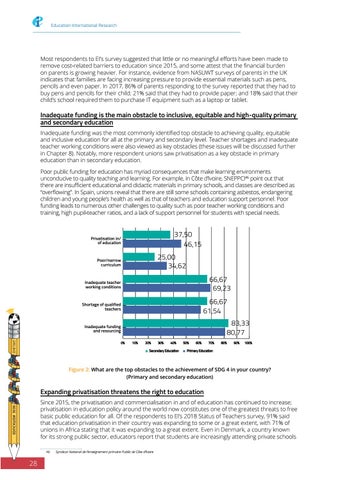
Over 80% of the unions that responded to our survey stated that inadequate funding and resources posed a major obstacle to achieving SDG 4. Inadequate funding was viewed as the most significant obstacle to achieving SDG 4 across all levels of education (ECE, primary, secondary, TVET and higher education), and this view was reported by low- and high-income countries alike, as ongoing austerity policies have led to widespread cuts to education budgets in the Global North.
International public funding for education is stagnating
0302 NOITA CUDE
The SDGs form part of a global agenda and therefore every country is responsible not just for achieving the goals domestically but also for supporting global implementation of the goals. In particular, the 2030 Agenda emphasises the importance of supporting sustainable development in low-income countries, conflict-affected or fragile countries, and small island States.11 Though governments of high8 UNESCO. Aid to education falls slightly in 2017, shifts away from primary education. Retrieved from: https://gemreportunesco.wordpress.com/2019/05/14/ aid-to-education-falls-slightly-in-2017-shifts-away-from-primary-education/ 9 UNESCO. 2019. Migration, Displacement and Education. Building Bridges not Walls. Global Education Monitoring Report. p. 23. Retrieved from: https:// en.unesco.org/gem-report/report/2019/migration 10 See: http://data.uis.unesco.org/Index.aspx?queryid=183 11 Education 2030. 2015. Incheon Declaration and Framework of Action for the Implementation of Sustainable Development Goal 4. p. 66. Retrieved from: https:// unesdoc.unesco.org/ark:/48223/pf0000245656
9
Education International Research
income countries committed to allocating 0.7% of their gross national income to foreign aid, many are not fulfilling these promises. According to the Global Partnership for Education (GPE), international finance for education must increase from $16 billion in 2015 to upwards of $90 billion by 2030 in order to adapt to rising needs. However, aid to the education sector is stagnating – it grew by only 1% on average from 2009 and fell slightly in 2017 (down 2% from the previous year).12
The international education financing architecture is fragmenting The GPE is the primary funding platform for financing education in low-income countries. Though preceded by a high-profile campaign to help boost funding for education, GPE’s replenishment of funds in 2018 fell far below the projected target of $3.1 billion — $2.3 billion was raised for the 2018–2020 funding cycle. In 2016, an additional fund, Education Cannot Wait (ECW), was established at the World Humanitarian Summit. Hosted by UNICEF, ECW focuses on funding education in emergency settings. Two new international funding mechanisms are currently under development: the International Finance Facility for Education and the Education Outcomes Fund. Though the FFA proposes that “alternative and innovative funding” must complement domestic and international aid, educators warn that these mechanisms could be detrimental to the realisation of the SDG 4 agenda.
The establishment of IFFED risks entrapping countries in debt The International Finance Facility for Education (IFFED) is a financing mechanism currently under development by the International Commission for Financing Education Opportunities (the Education Commission). Its aim is to unlock more funding for education through a new multilateral development bank (MDB) investment mechanism. However, educators are concerned that such a mechanism, which provides loans to low-and lower-middle-income countries, could push governments into debt and ultimately lead to a reduction in domestic funding for education. In addition, the terms and conditions for receiving an IFFED loan may skew country priorities. The fund currently has widespread political support, but the financial feasibility of the model is less clear.
Educators call on governments to reject the Education Outcomes Fund, which promotes the commodification of education The Education Outcomes Fund (EOF) is a proposed mechanism under development by the aforementioned Education Commission and the Global Steering Group for Impact Investment (GSG). It aims to finance successful education interventions in Africa and the Middle East13 using development impact bonds (DIBs). The proposed model is experimental — currently there are only ten examples of DIBs in education. In practice, it would work by having investors finance the work of education service providers. If the service provider achieves positive education outcomes, the investor receives a return, and the provider receives a reward, paid for by the EOF (funded by taxpayers through national aid budgets). GRO.EI-IE
Educators view EOF as a harmful distraction from strengthening national education systems. They warn that results-based financing of education creates perverse incentives for providers to focus on narrow, superficial, short-term “gains”, and this quest for narrow, fast outcomes can lead to further marginalisation of the most vulnerable groups in society. The EOF’s engagement with nonstate actors does not rule out providing funding to for-profit organisations and does not contribute to sustainably strengthening education systems. The model promotes the commodification and privatisation of education and signals to governments that they can relinquish their obligation to ensure quality education for all. Education unions in Ethiopia, Kenya, South Africa, Côte d’Ivoire, Morocco, Egypt, Tunisia, Lebanon and Palestine have all lobbied their governments to refrain from engaging with the EOF. In Kenya, the matter was put before the Senate Parliamentary Committee on Education.
0302 NOITA CUDE
12 GEMR. 2019. Retrieved from: https://gemreportunesco.wordpress.com/2019/05/14/aid-to-education-falls-slightly-in-2017-shifts-away-from-primaryeducation/ 13 The following countries are its principle targets: Burkina Faso, Chad, Côte d’Ivoire, Egypt, Ethiopia, Ghana, Jordan, Kenya, Lebanon, Liberia, Morocco, Nigeria, Palestine, Senegal, South Africa, Tanzania, Tunisia, Uganda, Zambia and Zimbabwe.
10
Education International Research
Box 2: Financing Education in Ghana: Operationalising “Ghana Beyond Aid” to Deliver SDG 4 Upon coming into government in January 2017, President Nana Akufo-Addo outlined “Ghana Beyond Aid”, his strategy for self-funded and self-directed national development. Domestic investment in quality education is one of the key pillars of the strategy, and in September 2017, Ghana introduced free senior high school (SHS). At the 2018 replenishment forum for the Global Partnership for Education, Akufo-Addo emphatically shared his vision of all African countries being independent from aid. He stressed that this is vital to ensuring African nations are able to remain in control of their own destiny when donor policies change. Akufo-Addo advocated for the crucial mobilisation of domestic resources to fund education by eliminating illicit financial flows, tackling corruption and stopping mismanagement of resources. His speech was very well received at the forum. However, some questions arise upon examining Ghana’s education financing and policies more closely.
Education expenditures First, a quick look at Ghana’s education expenditure. Ghana is among the top education spenders in Africa. Yet since 2015, government expenditure on education as a percentage of both GDP and total government expenditure has decreased. 2009
2010
2011
2012
2013
2014
2015
2016
2017
2018
Government expenditure on education as % of GDP
5.32
5.54
8.14
7.92
6.1
6.16
5.94
5.77
4.51
...
as % of total government expenditure
22.5
20.7
30.63
37.52
21.22
20.99
23.81
22.09
20.1
...
Source: http://uis.unesco.org/en/country/gh
Access, equity, quality and privatisation In the first year under the free SHS policy, 90,000 more students entered SHS than in the previous year. 14 Nevertheless, many challenges to access still remain. Since 2015, the overall numbers of out of school children and adolescents have grown to more than 700,000 out of school children and over 250,000 out of school adolescents in 2018.15 In 2018, the net enrolment in primary education was 84% and 59.01% in secondary education. Access to education is therefore far from ideal, and quality has been further affected by growing pupil-teacher ratios. GRO.EI-IE
Evidence shows that privatisation of education, through low-fee private schools and public private partnerships (PPPs) in particular, exacerbates inequality, does not support educational access for the poorest populations, and often results in poor quality of education. Yet Ghana’s current education sector plan (2018–30) refers to a new pilot PPP initiative as a “pillar of the reform agenda”.16 The implementation strategy calls for PPPs in the early childhood, primary, secondary and non formal education sectors.
0302 NOITA CUDE
Currently, the Ghanaian education system is highly privatised, especially in the early childhood and primary education sectors. Over 20% of early childhood and primary education students are enrolled in private schools, about one third of early childhood and primary schools in the country are private,17 and most growth in the number of schools built in recent years has been due to the expanding private sector. Ghana’s legislation encourages private involvement in education, and there 14 15 16 17
11
A ccording to president Akufo Addo, in his 2018 speech at the GPE replenishment meeting in Dakar, Senegal. See: https://www.youtube.com/watch?v=_PNJjpwQb4report/2019/migration See: http://uis.unesco.org/en/country/gh Ghana Education Sector Plan 2018–2030. p. 32 Ghana Education Sector Plan 2018–2030 p. 18
Education International Research
are no strong regulations to appraise the quality of private education providers. There is a great risk that further privatisation of Ghana’s education systems could lead the government to abdicate its responsibility to ensure quality education for all, including those in hard to reach areas. 18
Ghana Partnership Schools (GPS) Project One public-private partnership initiative, the Ghana Partnership Schools (GPS) Project, plans to hand over control of 100 kindergartens, primary schools and junior high schools in the Ashanti, Northern, Central and Greater Accra regions to private organisations, funded by loans and grants from the World Bank and the Global Partnership for Education. The pilot is set to run for three years beginning in September 2019, after which it will be expanded and institutionalised. Absolute Return for Kids (Ark), a UK organisation that runs “academies” (privately operated, government-funded schools) in the UK and is now involved in “partnering and advising governments [on PPPs] across several nations” 19 as the Education Partnerships Group, is currently providing advice to the Ghanaian government on implementing the program 20. Previously, Ark advised the Liberian government on the controversial Partnership Schools for Liberia 21 project — a failed experiment with the aim of privatising Liberia’s primary education system. In 2017, Ark cosponsored a visit to the UK by a group of Ghanaian Ministry of Education officials to study PPP implementation.22 Ark’s PPP advice to Ghana is being funded by the IDP Foundation 23, which appears to view the PPP as a good stepping stone to more low-fee private schools in Ghana. The proposed PPP programme in Ghana has been met by strong opposition from EI’s member organisations in Ghana, who point out that they have not been involved in the two-year planning process of the project. They have served notice that they will resist any attempt by the government to privatise, commercialise and commodify public education in the country.24
The Education Outcomes Fund (EOF) The EOF would like to partner with the Ghanaian government to facilitate the use of development impact bonds in the country’s education system. Investors would profit from the achievement of positive education outcomes by education service providers (both non-commercial and commercial) in Ghana, with returns paid for by taxpayers at home or in donor countries. At the time of writing, it still remains to be seen whether or not this will be operationalised. However, it is clear that engagement with the fund will not contribute to the government’s vision of self financing quality public education. In August 2018, education unions and the civil society coalition for education in Ghana25 released a statement denouncing the EOF. The statement expressed deep concern about the fund, noting that the fund’s focus on non-state actors “will contribute to commercialisation and commodification of education, legitimise profit-making in the provision of education and weaken efforts to strengthen and expand the provision of inclusive and equitable quality free education for all consistent with SDG 4”. GRO.EI-IE
Educators call on governments to operationalise “Ghana beyond aid” Ghanaian education unions call on their government to “wean itself from donor funding and its concomitant conditionalities” and to “operationalise the ‘Ghana Beyond Aid’ mantra by plugging the loopholes in tax mobilisation, eliminating harmful tax exemptions and prioritising its expenditure by investing in human capital development of the country through education”. As an alliance of unions in the education sector, educators are taking action to lobby the government to live up to its commitment to ensure that education reform is guided by national priorities.
0302 NOITA CUDE
18 19 20 21 22 23 24 25
12
See: http://www.ghananewsagency.org/print/137947 Junemann, C. and Ball, O. 2019. In Sheep’s clothing: Philanthropy and the Privatisation of the “Democratic” State. Education International. p. 33 See: https://epg.org.uk/projects/ghana/ S ee: https://www.unite4education.org/global-response/the-partnership-schools-for-liberia-a-critical-analysis/?utm_source=ActiveCampaign&utm_ medium=email&utm_content=EI+Global+Response+Newsletter&utm_campaign=EI+Global+Response+Newsletter Junemann, C. and Ball, O. 2019. In Sheep’s clothing: Philanthropy and the privatisation of the ‘democratic’ state. Education International. p. 81 See grant information here: http://www.idpfoundation.org/grantmaking/grant-recipients/ark-epg S ee: https://www.graphic.com.gh/news/general-news/ghananews-teacher-unions-raise-red-flag-over-govt-plans-to-privatise-public-education.html?_cl dee=YW5nZWxvLmdhdnJpZWxhdG9zQGVpLWllLm9yZw%3d%3d&recipientid=contact-0ccea2bcb4a0e411b1c5005056ad0002-02db7ed032794b2782d0 bc164890f013&esid=fe73b25c-1ac0-4d89-a7ec-56da5cf90bb9 National Association of Graduate Teachers (NAGRAT), Ghana National Association of Teachers (GNAT), Teachers & Educational Workers Union of Ghana (TEWU)
Education International Research
In order for Ghana to be able to sustainably finance equitable, inclusive, and quality education for all, it must focus on funding and strengthening public systems through domestic resources, stop further privatisation of its education systems, and reject “innovative” funding models from abroad that normalise profit-making and the commercialisation of education.
Coordination International coordination is inadequate; diverse international actors are using this gap to advance their own policy agendas In theory, as the coordinating agency behind SDG 4, UNESCO leads the global efforts to ensure its implementation. In practice, UNESCO’s financial situation makes it vulnerable to influence and pressure from donors. Numerous actors are competing for influence in the education space — and they often have very different approaches to SDG 4, which risks marginalising a rightsbased approach and defence of public quality education. This matters because it is yet to be established what the broad priorities within SDG 4 mean in practice, such as quality education or relevant learning. The question is to what extent players in the global education landscape promote the full scope of SDG 4. For example, the World Bank, as the largest funder of education in low-income countries, has a long history of undermining public education, and its private sector arm continues to invest in feecharging and profit-making education providers. The Systems Approach for Better Education Results (SABER) programme directly discourages governments from regulating education, setting standards for private schools or limiting private actors and education fees. Recently, the World Bank has attempted to take on more of a leadership role at the policy level. In 2018, for the first time ever the World Development Report26 was devoted to education, and later that year the World Bank launched the Human Capital Index,27 based in part on learning outcomes, while ostensibly encouraging member states to invest more in education. Both of these initiatives promote an instrumentalist view of education, in which its importance is viewed solely through the lens of the economic growth that it yields, despite the World Bank peppering its discourse with occasional references to SDG 4.
GRO.EI-IE
Alongside multilateral institutions, a range of private actors are emerging under the banner of implementation of SDG 4, such as the aforementioned Education Commission and its initiatives, or the Varkey Foundation and its annual Global Education and Skills Forum (GESF),28 a high-level gathering of actors in education promoted as a celebration of the teaching profession. The Varkey Foundation is the philanthropic branch of Dubai-based GEMS Education, the world’s largest forprofit private school system. Though fairly new on the scene, their de facto convening power seems to be far greater than that of UNESCO, which struggled to get Ministers of Education to attend its high-level Global Education Meeting in 2018, specifically aimed at measuring SDG 4 progress. Implementation and governance of SDG 4 should be member state–led. Yet many member states are pushing to give the private sector a greater role, eagerly calling for PPPs and private investments. Even though states are the duty bearers responsible for guaranteeing and providing access to education, the GPE is currently discussing whether it should also fund private providers. As long as governments continue to shy away from their responsibility, the scope and rights-based nature of SDG 4 will remain under threat.
0302 NOITA CUDE
26 See: http://www.worldbank.org/en/publication/wdr2018 27 See: http://www.worldbank.org/en/publication/human-capital 28 See: https://www.educationandskillsforum.org/
13
Education International Research
How is EI involved in SDG monitoring and coordination processes? The SDG-2030 Steering Committee EI is a member of the global multi-stakeholder coordination mechanism for Education under the 2030 Agenda. Hosted by UNESCO, the SDG-Education 2030 Steering Committee provides strategic guidance to member states and the international community for the realisation of the SDG targets and commitments. EI provides input to the committee, seeking to ensure that its recommendations prioritise equity, teachers, the broad scope of the SDG agenda, a rights-based approach to education, and the importance of strong public education systems. The Technical Cooperation Group (TCG) The TCG is a global platform hosted by the UIS and made up of 38 member states and other partners who discuss SDG indicators and strategies to build member states’ capacity to statistically monitor progress on the 2030 Agenda. EI sits on Working Group 1, which discusses and puts forward recommendations for SDG 4’s global and thematic indicators. EI seeks to ensure that the chosen indicators adequately correspond to the goal of the targets. EI has played a crucial role in calls to reform the TCG to make it more participatory and democratic, ensuring that the voices of statistical experts from across the world truly drive the decisions made at the TCG. The Global Alliance for Monitoring Learning (GAML) GAML is a multi-stakeholder group hosted by the UIS that aims to build consensus on the strategies for international reporting and measurement of SDG global and thematic indicators related to learning. EI sits on the taskforces that discuss strategies to monitor Targets 4.1 and 4.7. As part of GAML, EI advocates for SDG monitoring of learning outcomes to support the achievement of quality, holistic education and sovereignty of country priorities. EI also puts forward educators’ concerns that too much focus is placed on standardised assessments within education systems. EI has been instrumental in ensuring the increased participation and involvement of representatives from low-income countries in GAML.
In too many countries, SDG 4 has not been mainstreamed in national policy
GRO.EI-IE
Most educators suggest that SDG 4 has not been adequately prioritised within national education policy in the last four years. Of 30 unions answering the question, 13 responded that SDG 4 had been prioritised a little, whilst two unions responded that in their opinion, SDG 4 had not been prioritised in education policy at all. Six unions reported that it was a high priority within their national education policy.
0302 NOITA CUDE
14
Education International Research
7%
7% 10%
45%
A great deal
31%
A lot
A moderate amount
A little
None at all
Figure 1: To what extent has SDG 4 been prioritised in education policy in your country since 2015?
Thirty eight percent (38%) reported that their government had established an SDG 4 coordination mechanism. Examples of coordination mechanisms considered by unions as contributing to the facilitation of implementation included: -- In India, an organisation called NITI Aayog was set up in 2015 to replace the Planning Commission. It aims to enhance cooperative federalism for policies in order to achieve the SDGs. -- In Kenya, SDG 4 has been mapped in the Ministry of Education, Science and Technology’s Vision 2030, a plan to enable mainstreaming of the goal in policy, planning, budgeting, monitoring and evaluation systems and processes. Furthermore, information, education and communication materials on the SDGs have been produced and disseminated to raise awareness of the goals. -- In Ghana, an SDG coordination mechanism has been established. However, unions lament that it does not include representation from education unions. -- In Zambia, education unions note efforts to align National Development Plans with the SDGs. The theme of the Seventh National Development Plan (2017–21) is “Leave No One Behind”. GRO.EI-IE 0302 NOITA CUDE
15
Education International Research
Box 3: In Norway, Teacher Representatives Plan for SDG Implementation and Collaborate with Government to Make SDG 4 a Reality Though it was nearly four years ago that UN member states adopted the 17 goals for Sustainable Development to be achieved by 2030, many countries have yet to develop clear concrete plans for their national implementation, let alone make these plans a reality. However, this has not stopped education unions and other civil society groups from devising their own action plans for how to contribute to the implementation of the SDGs. In the case of Norway, the government has taken steps to put in place mechanisms for implementation and monitoring of the 2030 Agenda, but there is no national action plan for implementing the SDGs. Norway’s largest teachers’ union, Utadanningsforbundet (Union of Education Norway, UEN), which boasts over 175,000 members, has developed a plan for its own contribution to SDG implementation. They are motivated by the belief that their unique position as a trade union, able to engage in social dialogue, collective bargaining and negotiations with the government, means they have a responsibility to help achieve the SDGs. Therefore, core to UEN’s plan is engagement in social dialogue with the government (in particular the Ministry of Education, Science and Culture, the Ministry of Foreign Affairs and the Norwegian Association of Local and Regional Authorities, KS29), as well as the union’s own initiatives related to the SDGs.
The plan’s key objectives UEN’s plans for SDG implementation align with the policies of Education International in the international arena, as well as the national policy of Unio, the Confederation of Unions for Professionals in Norway. The plan30 outlines UEN’s priorities at the national, local and organisation level. Key objectives identified in UEN’s plan At the national level: Objective 1: Influence Norway's efforts to achieve SDG 4 Goal 2: Incorporate the SDGs into the social partnership Objective 3: Lobby the government over the SDGs in relation to foreign policy and international development policy At the local level: Goal 1: Incorporate the SDGs into the social partnership at a local level GRO.EI-IE
Goal 2: Ensure that the teaching profession is heard when implementing the SDGs locally At the organisation level (internally): Objectives: Members and union representatives will be able to identify relationships between local, national and international politics
0302 NOITA CUDE
The plan was adopted by UEN’s Executive Board in 2018, and there is ongoing dialogue with the KS regarding implementation of the plan.
29 The Norwegian Association of Local and Regional Authorities (KS) is the employers’ association and special interest organisation for municipalities, counties and local public enterprises in Norway.
30
16
See: https://www.utdanningsforbundet.no/globalassets/var-politikk/strategier/utdanningsforbundet_oppflg_barekraftsmal_sdg_nov-18.pdf
Education International Research
UEN’s 2017–19 Action Plan In the 2017–2019 period, UEN’s work on sustainable development has focused on three key areas: education for sustainable development, sustainability and work, and sustainability internally within the union. According to UEN, “Equality, social levelling, democracy and the fight against climate change and environmental destruction must be the focal point of any change in the education system. Education must contribute to sustainable social development.” 31 The union has been advocating for Education for Sustainable Development (ESD) to become one of three key crosscutting themes in the new interdisciplinary curriculum currently under development, and for the conceptual definition of the topic to remain appropriately broad. UEN has also been pushing to ensure that sustainable development is included in early childhood education as part of the “value base” and in teacher training programmes; new guidelines for primary and secondary teacher education programmes emphasise preparing teachers to provide ESD as an interdisciplinary topic. Regarding work life, UEN has aimed to ensure that sustainability and climate change are taken into account in collective agreements and included in tripartite cooperation, have made a commitment to provide their members with information about sustainability in the workplace, and have been advocating for sustainable procurement at education institutions. Internally, UEN works to mainstream the concept of sustainability across all its work so that, for example, the union’s offices and investments take sustainability into account. The union has also committed to organising courses for its members and elected representatives related to climate change and sustainable development. UEN organises an annual climate seminar for employees in schools and kindergartens.
Government monitoring of the SDGs Norway ranks high in terms of national implementation of the SDGs (one study32 found Norway to be among one of the five rich countries best positioned to implement the SDGs). However, its monitoring and implementation efforts do not focus solely on international work, but they also acknowledge the need to address remaining challenges at the national level. Norway’s priorities for national SDG implementation include education and sustainable consumption and production. Norway has put in place mechanisms to “harmonise” or align policies with the SDGs and to ensure annual national monitoring. The responsibility for different goals lies with various national ministries, and every year each ministry reports on progress to Stortinget, the Norwegian parliament, through their budget proposals.33 The aim is to make the 2030 Agenda for Sustainable Development the basis of a new paradigm that takes a human rights–based approach.
GRO.EI-IE
There is an annual report on Norway’s follow-up of the 2030 Agenda for Sustainable Development. In 2018, the report by the Ministry of Finance and Ministry of Foreign Affairs recognised that “collaboration between labour organisations and unions and the state is the backbone of the Norwegian labour market model”, and that collaboration is based on mutual respect and a shared commitment to work towards inclusive and sustainable growth and decent work for all.
Making SDG 4 a reality
0302 NOITA CUDE
This case study demonstrates the value of devising concrete, detailed plans for SDG implementation and union-government collaboration. A clear roadmap for implementation not only facilitates monitoring and progress of the goals, but also helps develop processes that are inclusive and participatory. Furthermore, this case study provides an example of how education unions can contribute to the implementation of the SDGs. Within tripartite systems, as professional organisations of workers, unions can play an important role in pushing governments to make systemic changes to implement the SDGs.
31 See: https://www.utdanningsforbundet.no/var-politikk/strategier/handlingsplan-for-utdanningsforbundets-arbeid-med-klima-og-barekraftigutvikling-20172019/ 32 See: https://www.bertelsmann-stiftung.de/fileadmin/files/BSt/Publikationen/GrauePublikationen/Studie_NW_Sustainable-Development-Goals_Are-therich-countries-ready_2015.pdf 33 As explained in Norway’s 2016 VNR: https://www.regjeringen.no/globalassets/departementene/ud/vedlegg/utvikling/sdg_rapport_full_en.pdf
17
Education International Research
Lack of political will for implementation remains a key obstacle to progress Timely implementation of SDG 4 requires effective coordination, planning, and fast action on the part of governments. However, 24% of unions responding to the question “What concrete steps has your government taken to implement SDG 4 since 2015?” replied that no concrete steps had been taken whatsoever. This lack of action is commonly attributed to a lack of political will rather than capacity (financial or otherwise). Educators point out that some governments simply have no interest in the global agenda, some have alternative priorities or policy distractions, and some have conservative agendas that are inherently in tension with the progressive SDGs agenda. As an example, the PTUZ34 in Zimbabwe remark that “very little progress has been made — there is more of a talk show, and less practical commitments towards achieving the SDGs”. In the US, the NEA point out that there is no reference to SDG 4 whatsoever on the Department of Education’s website, a telling sign of the government’s failure to mainstream it (or even make it visible). The union argues that no concrete steps have been taken to implement SDG 4; on the contrary, the government has actively sought to cut education funding, disempower regulations related to gender equity and sexual harassment, and implement initiatives to weaken public education. In the Democratic Republic of Congo, SYECO35 also claims that no concrete efforts have been made towards the goal. They attest that, although some initiatives have been undertaken and several meetings held, these have merely been part of an effort to justify the resources received from international partners such as the World Bank rather than to make progress towards ensuring education for all. In the UK, NASUWT36 note that the slow and complicated exit of the country from the European Union (Brexit) has meant that other policy agendas, including the SDGs, remain gravely neglected. According to EI’s chief regional coordinator in Latin America, unions in the region view the SDGs as having produced a “doble discurso” (doublespeak) — governments and international organisations pay lip service to the SDGs whilst promoting harmful education policies on the ground, in particular the commercialisation and privatisation of education.
Some high-income countries do not consider the SDGs relevant to them Some unions in high-income countries have observed a lack of sufficient action on the part of their governments to mainstream and ensure coordination of the SDGs domestically. In Denmark, DTU37 note that “action-oriented” interest in the SDGs from the government is low because statistically, Denmark is already among the top countries in the world when it comes to realisation of the SDGs. However, it is clear that there is still room for improvement in order to ensure quality education and lifelong learning for all in the country. Similarly, in Japan, teachers argue that the Japanese government has viewed SDG 4 as a goal for development rather than a domestic issue. Meanwhile, there are children in Japan who do not have access to education due to poverty, statelessness and other factors; the JTU38 had to lobby the government to monitor the numbers of out-of-school children.
Intersectoral coordination needs to be enhanced GRO.EI-IE
At the national level, coordination between government departments is often insufficient. In particular, educators point out that challenges arise when the work for SDG 4 targets involves multiple ministries, such as Target 4.2 on early childhood education, or Target 4.5 on equitable education. At the international level, there is still no forum for discussing the interdependence of the SDGs and the bridging of sectors and silos. Coordination between sectors and SDG governance structures must be improved to leverage synergies between goals, ensure that implementation efforts for specific goals support each other, and avoid duplication of efforts (or worse, efforts toward one goal being undermined by efforts toward another).
0302 NOITA CUDE
34 35 36 37 38
18
Progressive Teachers’ Union of Zimbabwe Syndicat des Enseignants du Congo NASUWT - The Teachers’ Union Danish Union of Teachers Japan Teachers’ Union
Education International Research
Box 4: Educators Call for Governments to Leverage Interlinkages Between SDG 4 and Other Goals There are two-way linkages between SDG 4 and each of the other targets highlighted during the 2019 HLPF. Governments must recognise and leverage these linkages, ensuring a congruent, coordinated approach to sustainable development.
SDG 4 is key to achieve SDG 8, SDG 10, SDG 13 and SDG 16 8: Though everyone has the right to decent work, in today’s knowledge economy, education helps people obtain jobs with the best labour conditions. Governments must: -- Ensure education is broad and holistic, providing students with transferable skills relevant to the 21st century -- Make higher education progressively free to enhance social mobility -- Encourage and incentivise girls and women to study STEM subjects, combating the global shortage of women in these (often high-paying) fields 10: Education can be a powerful tool for fostering equity and inclusion, but this requires consistent political attention and prioritisation. At present, most education systems are deeply inequitable. Governments must:
GRO.EI-IE
-- Abolish all direct and indirect costs to education. Tuition fees remain the largest obstacles to poor families, and research has found that boys are prioritised when fees force families to choose which child to send to school. -- Urgently Invest in public ECE. ECE is vital to overcome differences in children’s starting points, yet it remains one of the most privatised and expensive education sectors. -- Ensure education of equal quality for all. Too often, the poorest students tend to receive an education of poorer quality due to factors such as inadequate school buildings, unqualified teachers and lack of teaching and learning materials; governments must ensure that resources are allocated equitably (to where they are needed most). -- Stop the commercialisation of education. Private education providers exacerbate inequality in and through the education system. Governments are responsible for guaranteeing the right to education and should be the primary providers of education, ensuring that any other providers adhere to national quality standards. -- Ensure access to quality education for the most vulnerable in society and provide teachers with the training, tools and resources to provide students with relevant and inclusive schooling. -- Take action to make education systems gender-equitable, including by ensuring gender equitable curricula and textbooks, providing teacher training on gender sensitivity, putting gender equality on the curriculum, developing gender-equitable school infrastructures and combating SRGBV. 13: Climate change education is a key component of plans to stop climate change. All children, youths and adults should have the skills, knowledge and attitudes necessary to transform their societies. Governments must:
0302 NOITA CUDE
-- Implement the Action for Climate Empowerment (ACE) Agreement, as part of the full implementation of the Paris Agreement -- Ensure that climate change education is mainstreamed in all education systems, including in policies, teacher trainings and curricula -- Ensure that climate change education encourages students to take action to mitigate, adapt to and stop climate change as well as provide them with scientific theory -- Prioritise and invest in climate change education, ensuring that teachers have the tools, resources and continuing professional training needed to teach about climate change using suitable pedagogies -- Consult teachers and their peers to ensure that they have the training and resources they need to provide quality climate change education
19
Education International Research
16: Education can be a catalyst for peaceful societies. But not all education contributes to peacebuilding. Governments have the responsibility to ensure that education plays the transformative role that it should. Governments must: -- Mainstream education on human rights, tolerance, anti-racism, global citizenship and appreciation for cultural diversity, including in policies, teacher trainings and curricula -- Ensuring that teachers have the tools, resources and continuing professional training needed to teach about human rights, tolerance, anti-racism, global citizenship and appreciation for cultural diversity -- Develop history curricula with a view to enhancing peaceful societies, providing students with multiple perspectives and the skills to critically analyse sources -- Ensure that curricula foster students’ critical and analytical skills in order to participate fully in democratic societies
SDG 8, SDG 10, SDG 13 and SDG 16 are vital to achieve SDG 4 8: Teachers’ working conditions are students’ learning conditions. If we are to increase the global supply of qualified teachers, governments must urgently increase the attractiveness of the profession to recruit and retain quality teachers. Investing in the decent working conditions of teachers and education support personnel is crucial to enhance the quality of education. Governments must: -- Guarantee teachers and education support personnel decent salaries, adequate minimum wages, fair recruitment and employment, occupational health and safety, reasonable working hours, job security, career progression opportunities, and enjoyment of their right to collective bargaining and freedom of association through the implementation of ILO Conventions 87 and 98 -- Ensure equal pay for work of equal value and address the increase in insecure, fixed- and/ or short-term employment, which disproportionately affects female teachers and education support personnel -- Implement the provisions of the ILO/UNESCO Recommendation concerning the Status of Teachers (1966), the UNESCO Recommendation concerning the Status of Higher Education Teaching Personnel (1997), and the ILO Policy Guidelines on the promotion of decent work for ECE personnel. Eliminating child labour is crucial to ensure access to education for all. Governments must: -- Eradicate child labour by tightening labour market regulations, providing social protection to families as a way of compensating for the income otherwise earned by children, and educating communities on children’s right to childhood and the importance of education 10: Education is important, but it is not a panacea to combat inequality. Tackling inequality in society is key to enable students to achieve equitable learning outcomes. Governments must: GRO.EI-IE
-- Implement and enforce a statutory minimum wage guaranteeing an income that allows people to live with dignity -- Ensure multinational corporations respect fundamental human rights and provide fair pay and decent work for all employees -- Ensure social protection floors for all 13: Students, teachers and education support personnel are the victims of climate injustice, as education institutions and societies suffer the effects of natural disasters linked to climate change. Governments must:
0302 NOITA CUDE
-- Take the necessary measures to implement the Paris Agreement and curb global warming to 2 oC or lower by 2100 -- Urgently and dramatically reduce carbon emissions, moving towards carbon-neutral economies -- Prioritise efforts to develop early warning systems and build resilience to climate disasters in affected countries
20
Education International Research
-- Ensure a Just Transition to a sustainable low-carbon economy, guaranteeing decent work and dignity for all workers 16: Education institutions are too often attacked and militarised. Implementing SDG 16 is therefore crucial to enable access to quality education for all. Governments must: -- Endorse the Safe Schools Declaration and implement the 2015 Guidelines for Protecting Schools and Universities from Military Use During Armed Conflict -- Ensure access to quality education for all children in conflict and post-conflict contexts -- Immediately cease any government militarisation of education institutions and harassment of students and educators
SDG accountability must be strengthened at the national level There are no binding global mechanisms for governments to be held accountable for the implementation of the SDGs. However, governments are accountable to their citizens and should put in place their own mechanisms to ensure SDG implementation. Firstly, national indicators are a key part of the monitoring framework for the SDGs, and they provide governments with the opportunity to monitor the aspects of the 2030 Agenda that are most relevant to them in their context. Yet, so far, national indicators have not been given the attention they deserve. Secondly, due to politicisation, few governments have put in place transparent mechanisms for evaluating their own policies and implementation efforts. Thirdly, governments have not sufficiently leveraged social accountability. Education unions and civil society are all too often not adequately involved in monitoring and evaluation processes, including the development of VNRs. As laid out in the Brussels Declaration,39 governments must increase their efforts to “support meaningful involvement of youth, students, teachers, school and post-secondary institution leaders, and their representative organisations, as well as communities, parents, civil society and academia at all stages, from planning to monitoring progress in ensuring the right to quality education for all�.
Data, data, data! The opportunities and perils SDG 4 is monitored by 43 thematic indicators (including 11 global indicators) in addition to regional and national indicators. Monitoring progress towards SDG 4 is important to encourage improvement and identify where more work needs to be done. However, we currently have less than half the data necessary globally to monitor the thematic indicators. The global education community therefore has a strong desire for more and better education data. But what type of data do we need the most? And what are the potential risks of the drive for data used to monitor SDG 4? Data disaggregation GRO.EI-IE
Timely, quality data can help policymakers identify which children, youth and adults are making progress and which are not, and why. When disaggregated, data can be put into action to better support vulnerable groups and the most marginalised populations. Governments must ensure that their data are disaggregated beyond sex to capture the compounding impacts of, inter alia, gender, poverty, disability, conflict, migrant or refugee status, indigeneity and living in rural and/or remote areas. Is the drive for data distorting the SDG agenda?
0302 NOITA CUDE
EI is concerned that the last four years have seen a disproportionate focus of resources, time and expertise on developing the methodologies for assessing learning outcome indicators through GAML, at the expense of progress made to advance other SDG 4 indicators40 such as 4.7 and 4.c. This is likely due in part to UNESCO’s vulnerable financial situation and use of earmarked funding to develop globally comparable learning metrics. There is also the fact that assessment providers stand to gain something by developing the testing materials used to monitor learning outcomes. 39 See: https://www.sdg4education2030.org/brussels-declaration-5-december-2018 40 See: http://uis.unesco.org/sites/default/files/documents/report-of-director-on-activities-of-the-institute-2017.pdf
21
Education International Research
The risk of focusing too much on learning outcomes is that it undermines the comprehensive, broad scope of the SDG 4 agenda. The use of globally comparable learning metrics can potentially narrow the concept of quality education, encourage quick-fix policy solutions to drive test scores up, and marginalise subjects that are difficult to assess, such as education for sustainable development and climate action. Recommendations for governments: -
Fund better data as a public good, including disaggregated education data to shine a light on education inequalities
-
Make national statistical systems more transparent and democratic, and acknowledge data collected by civil society, academia and unions
-
Engage with and use the data drawn from student assessments wisely, refraining from overassessing students, sidelining subjects that are difficult to assess or resorting to reactionary policymaking based on test scores
Recommendations for the UIS (SDG 4 data coordinator): -
Take urgent steps to secure funding for and make progress toward developing robust methodologies for the indicators of neglected areas of the agenda, in particular 4.7 and 4.c
Conclusions Education is a public responsibility and in order to achieve the SDGs, governments must assume this responsibility. The SDGs require political will to guarantee a sufficient and sustainable source of public funding. We cannot rely on aid, charities, so-called “innovative” solutions or the private sector. If we believe that all children, regardless of their background or circumstances, regardless of the community, country or continent in which they live, have a right to quality education, governments and the international community must increase and sustain their investment in strong public education systems. To achieve the SDGs by 2030, solid and effective coordination mechanisms need to be in place both nationally and internationally. Four years after governments first committed to the SDGs, some countries have yet to even take the first steps to create national plans for implementing SDG 4 or ensure mechanisms are in place to monitor the goal. Internationally, numerous actors are spearheading progress in different areas of the SDG 4 agenda, but these efforts are not always aligned with the principles of the full 2030 Agenda. International actors must ensure that their interventions promote the full scope of the SDGs. GRO.EI-IE
Key recommendations for governments: 1. Prioritise education in domestic budgets. Allocate at least 20% of government expenditure and at least 6% of GDP to education. Increase the total public budget by combating tax avoidance, tax evasion and corruption.
0302 NOITA CUDE
2. Donor countries should honour their commitment to allocate at least 0.7% of GNI to foreign aid. The aid allocation to the education sector should be increased to 15% of ODA and prioritised, as education enables the achievement of all other SDGs. 3. Reject so-called “innovative” financing mechanisms for education that undermine the Education 2030 Agenda and countries’ sovereignty. 4. Ensure the goal is mainstreamed nationally through the establishment of a coordination mechanism, enhanced visibility of SDG 4 and alignment with national policies.
22
Education International Research
5. Take steps to improve coordination of implementation efforts across government departments. 6. Ensure that education unions are included in the development, implementation, monitoring and evaluation of SDG 4 efforts, as agreed in the FFA.
Key recommendations for international organisations: 1. Avoid further fragmentation of the SDG 4 financing architecture 2. Improve coordination of efforts to implement SDG 4 across key international actors 3. Ensure that all policy advice, tools and interventions respect country sovereignty and aim to strengthen education systems in a sustainable fashion
GRO.EI-IE 0302 NOITA CUDE
23
Education International Research
3. Primary and Secondary Education Target 4.1 By 2030, ensure that all girls and boys complete free, equitable and quality primary and secondary education leading to relevant and effective learning outcomes Target 4.1 is the target that has received the most attention from the education community since the adoption of SDG 4. However, focus has largely remained on “effective learning outcomes” rather than the importance of relevant and free education. It is concerning that “effective learning outcomes” have been commonly understood as referring to high test scores in numeracy and literacy, as quality education demands far more than this — it requires quality inputs (tools, teachers, learning environments) and quality teaching and learning processes. Meanwhile, children and young people’s right to free, quality, public education is under threat from privatisation, and access to education for all is far from universal.
Too many children remain out of school With the transition from the MDGs to the SDGs, international focus has shifted from access to quality. However, universal access to primary education was never achieved. The number of outofschool children has been stalling for over ten years; in 2017, 64 million children remained outof-school,41 showing that access must remain a major policy focus. Globally, completion rates are 73% for lower secondary and 49% for upper secondary education.42 Whilst access to primary and secondary education is slowly improving, equitable completion of education is a key issue, not just in low- but also high-income countries. In Europe, early school leaving is pinpointed by unions as being one of the top obstacles to achievement of SDG 4 in both Spain and Armenia. Disadvantaged or vulnerable students and students from minority groups are most often the ones forced to drop out when the curriculum or school culture are unable to adapt to their needs. Support strategies to help retain children in school are especially important in areas where child labour is prevalent. The box below shows how unions are working in collaboration with employers and local governments to put an end to child labour and keep children in school.
Box 5: Education Unions Use an Innovative, Multi-Faceted Approach to Combat Child Labour One Community at a Time GRO.EI-IE
Child labour is work performed by a child that is likely to interfere with his or her right to education or to be harmful to his or her health or physical, mental, spiritual, moral or social development. Worldwide, 152 million children are victims of child labour. Almost half of them (72 million) are in Africa, whilst 62.1 million are in Asia and the Pacific. Child labour is primarily concentrated in agriculture (71%) but can also be found in services, the industrial sector and mining.43
0302 NOITA CUDE
Many approaches to eradicate child labour focus on specific sectors or only on the worst forms of child labour. However, if we are to achieve SDG 4 and ensure education for all, we must make no distinction between the types of work children do but instead ensure that the right to quality education is guaranteed for every child.
41 UNESCO. 2019. Migration, Displacement and Education. Building Bridges not Walls. Global Education Monitoring Report. p. 145. Retrieved from: https:// en.unesco.org/gem-report/report/2019/migration 42 UNESCO. 2019. Migration, Displacement and Education. Building Bridges not Walls. Global Education Monitoring Report. p. 145. Retrieved from: https:// en.unesco.org/gem-report/report/2019/migration 43 See ILO statistics: https://www.ilo.org/global/topics/child-labour/lang--en/index.htm
24
Education International Research
The creation of child labour–free zones is an innovative approach that shows promise in making this goal a reality. Child labour–free zones are areas in which communities enact multiple, integrated interventions to end child labour and support every child to attend formal, full time education. Interventions include community mobilisation and sensitisation, lobbying and advocacy, and teacher training and school improvement. Child labour–free zones — using a multi-faceted approach to combat child labour and also guarantee every child’s right education o
Community moblisation and sensitisation
Lobbying and advocacy
Teacher training and school improvment
Education unions establish child labour–free zones with the support of Education International and in partnership with local governments, NGOs, corporations and communities. They are currently under development in ten countries in Africa, Asia and Central America: Burkina Faso, India, Malawi, Mali, Morocco, Nicaragua, Tanzania, Togo, Uganda and Zimbabwe. Case study: Uganda In Uganda, the Uganda National Teachers’ Union (UNATU) has developed a child labour–free zone in the Erussi sub-county (Nebbi District, West Nile sub-region) in collaboration with CEFORD, a local NGO, and the fair-trade coffee company Kyagalanyi, who committed to stop buying coffee from parents whose children did not attend school. By combining community mobilisation and sensitisation, lobbying and advocacy and teacher training, UNATU has secured a substantial increase in the enrolment and retention rates of students in schools in the area. One primary school saw its population increase by over 13%.
Community mobilisation and sensitisation GRO.EI-IE
With the support of local community leaders, UNATU spread awareness about the harm of child labour and the importance of education, and their message reached every member of the community, including children. Highly visible banners were placed on school grounds, advising children and teachers to report abuse and encouraging children to discuss their problems with teachers. Thanks to the project, the community is beginning to reassess the value of education. Parents have joined income saving initiatives to cover school costs, and some villages have launched income-generating activities. Cultural change is being achieved by first sensitising local leaders and teachers to various issues; for example, community-wide initiatives are emerging to tackle early marriage and teenage pregnancy.
Lobbying and advocacy 0302 NOITA CUDE
UNATU lobbied at the national level to call for increased recruitment of women teachers in the area in an effort to provide girls with women role models at school, and they succeeded in ensuring that every school employed at least one woman teacher. Lobbying at the national level also saw the successful introduction of feeding programmes in Erussi schools in 2017–2018. Lobbying continues, with the union calling for improved school facilities such as gender-specific toilets.
25
Education International Research
Teacher training and school improvement In Erussi, teachers in fifteen public schools were trained in strategies for identifying child labourers in the classroom and how to discuss child labour with students, parents and community members. They were also given training to enable them to make schools more conducive learning environments, ensuring safe school environments and using child-centred pedagogies in order to attract and retain children in school. These efforts were supplemented by equipping all schools with at least minimal sport and art equipment and establishing school clubs. Teacher training also focused on gender equality and the use of gender-sensitive pedagogies; according the project’s baseline study, dropout rates were highest among girls. Child Labour–Free Zones — Which SDG targets are addressed and how?
GRO.EI-IE 0302 NOITA CUDE
26
SDG 8.7
Take immediate and effective measures to eradicate forced labour, end modern slavery and human trafficking and secure the prohibition and elimination of the worst forms of child labour, including recruitment and use of child soldiers, and by 2025 end child labour in all its forms
In child labour–free zones, parents, teachers, community leaders, local governments, corporations and children all mobilise against child labour. Corporations take a zero-tolerance approach, and through community dialogue and home visits from “change agents”, parents are educated to help them see the value of sending their children to school.
SDG 4.1
By 2030, ensure that all girls and boys complete free, equitable and quality primary and secondary education leading to relevant and effective learning outcomes
In child labour–free zones, no distinction is made between different forms of child labour, as every child has the right to education. All children are urged to return to school. The formation of extracurricular school clubs helps attract children back to school. Unions lobby at the national level to introduce school feeding programmes in child labour–free zones, helping to combat the impact of poverty on children’s learning.
SDG 4.5
By 2030, eliminate gender disparities in education and ensure equal access to all levels of education and vocational training for the vulnerable, including persons with disabilities, indigenous peoples and children in vulnerable situations
Teachers are trained to use gendersensitive pedagogies, have equal expectations of boys and girls and provide boys and girls with equal opportunities for class participation. They are also trained to teach about and give guidance on issues related to puberty, menstruation and sexuality.
SDG4.7
By 2030, ensure that all learners acquire the knowledge and skills needed to promote sustainable development, including, among others, through education for sustainable development and sustainable lifestyles, human rights, gender equality, promotion of a culture of peace and non-violence, global citizenship and appreciation of cultural diversity and of culture’s contribution to sustainable development
Teachers are trained to educate children about their rights and to encourage children to talk about rights in classroom discussions.
Education International Research
SDG 4.a
Build and upgrade education facilities that are child-, disability- and gendersensitive and provide safe, nonviolent, inclusive and effective learning environments for all
In order to reduce the use of corporal punishment, teachers are trained in alternative disciplinary methods according to Ministry of Education guidelines. Schools are provided with small grants to buy sports and play equipment to make them more childfriendly environments. Unions lobby for girl’s washrooms and improved gendersensitive school facilities.
SDG 4.c
By 2030, substantially increase the supply of qualified teachers, including through international cooperation for teacher training in developing countries, especially least developed countries and small island developing States
Teachers are provided with the training and support necessary to improve their teaching practices, and unions lobby the Ministry of Education to recruit more female teachers, ensuring that every school in the child labour–free zone has at least one female teacher.
SDG 17.7
Encourage and promote effective public, public-private and civil society partnerships, building on the experience and resourcing strategies of partnerships
Education unions work together with NGOs (from both the Global North and Global South), corporations and governments (local and national) toward a shared goal.
Ending child labour through quality education for all Tackling the issue of child labour is an immense undertaking. In 2017, the ILO observed a dramatic decline in child labour over the 16 years that they had monitored the trend, but the rate of decline slowed from 2012 to 2016, precisely when the 2015 adoption of the SDGs should have accelerated progress. Urgent action is necessary if we are to eliminate child labour in all its forms by 2025 (yes — this cannot wait until 2030!). However, quick-fix approaches that simply stop children from working are unlikely to be enough to solve the problem. Rather, ending child labour must be considered an integral part of achieving SDG 4. In this regard, taking a community-based approach to combat child labour and ensure education for all is proving to be an effective method to create sustainable change. Furthermore, synergies with SDGs 10 (Reduced Inequalities), 5 (Gender Equality) and 1 (End Poverty) must be leveraged and multisectoral collaboration encouraged.
Direct and indirect costs remain a barrier to access GRO.EI-IE
Some countries such as Tanzania (2015), Ghana (2017) and Malawi (2018) have made important strides toward achieving Target 4.1 by making secondary school free. However, educators have observed that abolishing secondary school tuition fees is insufficient to grant all boys and girls with equitable access, as multiple other school costs remain. According to SYNTESPRIC44, in Cameroon, free primary education is the “official discourse”, but its implementation is “hardly perceptible”. Similarly, in Honduras, though education is free, it is common for schools to ask families to pay additional fees for matriculation, uniforms, supplies and lunches. In a 2017 study by the Global Partnership for Education (GPE),45 43% of households confirmed that they paid matriculation fees, which were compulsory in some cases. In Malawi, teachers reveal that schools’ budgets have been reduced due to the loss of tuition fees, as these funds have not been replaced by the government; meanwhile, students remain burdened by other costs including fees for boarding, textbooks and uniforms. In Nepal, the NNTA consider lack of free school meals to be a major barrier to equitable, quality primary and secondary education.
0302 NOITA CUDE
44 Syndicat des travailleurs des Etablissements scolaires privés du Cameroun 45 GPE, Gobierno de la República de Honduras & UNESCO. 5 November 2017. Análisis diagnóstico del sistema nacional de educación de la república de Honduras. Final version.
27
Education International Research
Most respondents to EI’s survey suggested that little or no meaningful efforts have been made to remove cost-related barriers to education since 2015, and some attest that the financial burden on parents is growing heavier. For instance, evidence from NASUWT surveys of parents in the UK indicates that families are facing increasing pressure to provide essential materials such as pens, pencils and even paper. In 2017, 86% of parents responding to the survey reported that they had to buy pens and pencils for their child; 21% said that they had to provide paper; and 18% said that their child’s school required them to purchase IT equipment such as a laptop or tablet.
Inadequate funding is the main obstacle to inclusive, equitable and high-quality primary and secondary education Inadequate funding was the most commonly identified top obstacle to achieving quality, equitable and inclusive education for all at the primary and secondary level. Teacher shortages and inadequate teacher working conditions were also viewed as key obstacles (these issues will be discussed further in Chapter 8). Notably, more respondent unions saw privatisation as a key obstacle in primary education than in secondary education. Poor public funding for education has myriad consequences that make learning environments unconducive to quality teaching and learning. For example, in Côte d’Ivoire, SNEPPCI46 point out that there are insufficient educational and didactic materials in primary schools, and classes are described as “overflowing”. In Spain, unions reveal that there are still some schools containing asbestos, endangering children and young people’s health as well as that of teachers and education support personnel. Poor funding leads to numerous other challenges to quality such as poor teacher working conditions and training, high pupil-teacher ratios, and a lack of support personnel for students with special needs.
37,50 46,15
Privatisation in/ of education
25,00 34,62
Poor/narrow curriculum
66,67 69,23
Inadequate teacher working conditions
66,67 61,54
Shortage of qualified teachers
83,33 80,77
Inadequate funding and resourcing GRO.EI-IE
0%
10%
20%
30%
40%
Secondary Education
50%
60%
70%
80%
90%
100%
Primary Education
Figure 2: What are the top obstacles to the achievement of SDG 4 in your country? (Primary and secondary education)
Expanding privatisation threatens the right to education 0302 NOITA CUDE
Since 2015, the privatisation and commercialisation in and of education has continued to increase; privatisation in education policy around the world now constitutes one of the greatest threats to free basic public education for all. Of the respondents to EI’s 2018 Status of Teachers survey, 91% said that education privatisation in their country was expanding to some or a great extent, with 71% of unions in Africa stating that it was expanding to a great extent. Even in Denmark, a country known for its strong public sector, educators report that students are increasingly attending private schools 46 Syndicat National de l’enseignement primaire Public de Côte d’Ivoire
28
Education International Research
instead of public schools. The main privatisation trends identified by educators as obstacles to Target 4.1 are the expansion of low-fee private schools, PPPs and managerial or “privatising” reforms within public education. Despite campaigning from education unions, corporate operators of so-called “low-fee” private schools offering poor-quality education to the poor in low-income countries (such as the infamous Bridge International Academies)47 continue to exist and have grown with support from international organisations and funding from the IFC and donors including the UK’s Department for International Development (DFID). The expansion of low-fee private schools undermines public education, risks transforming education from a public good into a commodity, and negatively affects progress towards equitable access for all. Eighty per cent (80%) of respondents to EI’s 2018 Status of Teachers survey said that PPPs in education are expanding to some or a great extent in their countries. The PPP model in education, while failing in Anglo-Saxon countries,48 is being promoted in low- and middle-income countries by numerous international organisations, most notably the World Bank, and it risks fuelling inequality rather than achieving education for all.49 In Spain, teachers observed that since 2015, “more money has been diverted to privately subsidised centres”. In the Philippines, ACT reports that approximately 30% of the public budget for primary and secondary education goes to private actors, lining the pockets of politicians who own private schools. Meanwhile, many “public schools have dilapidated classrooms”, and teachers are forced to buy teaching and learning materials for their classes.
In Argentina, privatisation processes are undermining public education A 2018 study by EI50 shows that privatisation in and of education in Argentina has intensified since the conservative government rose to power in 2015. The study identifies multiple forms of privatisation processes occurring throughout the country. First, it shows that enrolment in private education is expanding. In 2016, 29% of enrolment in primary school was in private schools. Most private schools are located in urban and wealthier areas where the market is larger; in rural areas, students rely mostly on state education. Second, the government invests in private sector education actors — in 2015, 17.5% of the education budget was spent on government subsidies to the private education sector. Third, the private sector has a growing presence in public education. Corporations, non-governmental organisations and philanthropic organisations have become involved in policy decisions, and PPPs are expanding. Fourth, there has been a decrease in public funding of key areas necessary for quality education such as teacher training, which is being increasingly outsourced to private providers. Finally, the study shows that the for-profit market of standardised testing is negatively impacting public education.
GRO.EI-IE
A recent study by EI51 of the trends and manifestation of the privatisation of education in Honduras illustrates the complexity of privatisation processes. The reasons for privatisation of education in the country are linked to the government’s lack of resources and inability to guarantee quality provision, failed decentralisation of education systems, and the influence of globalisation. The study deems privatisation and commercialisation “one of the greatest obstacles to equal access to quality education” in Honduras.
0302 NOITA CUDE
47 For more information about Bridge International Academies, see: Riep, C. 2019. What do we really know about Bridge International Academies? A summary of research findings. Education International. Retrieved from: https://issuu.com/educationinternational/docs/2019_ei_research_gr_bia 48 See: https://www.unite4education.org/resources/uk/the-uks-ppp-disaster-lessons-on-private-finance-for-the-rest-of-the-world/ 49 Malouf Bouf, K. 2019. False Promises: How delivering education through public-private partnerships risks fuelling inequality instead of achieving quality education for all. Oxfam. Retrieved from: https://www.oxfam.org/en/pressroom/pressreleases/2019-04-09/world-bank-must-stop-push-expand-private-education 50 Feldfeber, M., Puiggros, A., Robertston, S. and Dulhalde, M. 2018. La privatización educativa en Argentina. Education International (English summary), p. 1. Retrieved from: https://eiie.sharepoint.com/sites/eiwebsite/Shared%20Documents/Forms/AllItems.aspx?id=%2Fsites%2Feiwebsite%2FShared%20 Documents%2FPublic%20Links%2FWebDocs%2FCTERA%5FSummary%5FArgentina%5FENG%5Femail%2Epdf&parent=%2Fsites%2Feiwebsite%2FShared%20Documents%2FPublic%20Links%2FWebDocs&p=true&slrid=d731929e-b021-6000-1ba8-614bd376455b&_cldee=aWtwaXRpY m9jakBnbWFpbC5jb20%3d&recipientid=contact-edc6bdde41c1e611814f005056ad0002-8c025da0c9234472aa63093127e2e30c&esid=242c7b05-833647d6-bdfe-a8f92ac1e17d 51 Edwards, B., Moschetti, M. and Caravaca A. 2019. La Educación en Hondoras: Entre la Privatización y la Globalización. Education International. Retrieved from: https://issuu.com/educationinternational/docs/2019_ei-research_privatisation_hond?e=3689445/69325748
29
Education International Research
Box 6: In the UK, Ensuring a Coordinated Strategy for Implementing SDG 4 Has Not Been Prioritised; Abroad, DFID Support for Privatisation Continues to Undermine Public Education. Education unions NASUWT and NEU are concerned that the UK government has not put in place the necessary mechanisms and policies to implement SDG 4 domestically, viewing its implementation as something that the UK can support in developing countries, but not as a domestic concern.
UK SDG monitoring and implementation processes fall short For the SDGs to be prioritised in the UK, there needs to be leadership at the very highest level of government and within government departments. However, education unions report that there is currently no strategic leadership to implement the SDGs across government or within the Department for Education (DfE). According to the Chair of the International Development Committee, cross-government engagement with the SDGs has been “woefully insufficient”.52 The Department for International Development (DFID) is the lead department responsible for implementing the SDGs in the UK, but according to NASUWT, DFID does not have the necessary authority and oversight to coordinate implementation. DFID coordinated the UK’s 2019 VNR submission. There was a lack of meaningful engagement with unions and civil society as part of the process. The UK government asked that individuals and organisations to inform them of what they are doing to deliver the Sustainable Development Goals,53 but NASUWT notes that the request appeared to be more “about collecting information to enable the Government to suggest that it is doing a substantial amount of work to implement the SDGs” rather than real engagement. It is ironic that government discourse purports that the SDGs are a shared endeavour (thereby transferring their responsibility for the implementation of the SDGs to individuals, civil society, organisations and private corporations) whilst simultaneously failing to engage in meaningful social dialogue or provide strategic leadership for the implementation process.
Government policies undermine domestic implementation Unfortunately, the government has not undertaken a review and evaluation of its existing policies to establish whether and how they contribute to or undermine progress towards the SDGs, as well as identify any policy gaps. This is a grave omission, as civil society analysts’ measurements of progress toward the SDGs in the UK rate the government as performing well in only four of the ten SDG 4 targets,54 and education unions identify numerous education policies that are undermining the implementation of SDG 4, a few of which are outlined below. Firstly, Brexit distracts government attention from important policy concerns such as education; it is estimated that about one sixth of DfE officials have been redeployed to work on Brexit. 55
GRO.EI-IE
Meanwhile, austerity has led to high levels of poverty and drastic social cuts. Fourteen million people (about a fifth of the population) live in poverty, with 4 million being more than 50% below the poverty line and living in absolute poverty. 56 Evidence from the Office of the Children’s Commissioner for England reveals that between 2009 and 2019, public spending on children has been cut by 12%; local authority Children’s Services have been cut by 20%; children’s welfare has been cut by 17%; and education has been cut by 3%. According to NEU, the funding cuts that schools are suffering are “nothing short of a crisis”; recent reports show that head teachers are having to seek support to pay for basic pastoral support services for students.57
0302 NOITA CUDE
52 See: www.parliament.uk/documents/commons-committees/international-development/Letter-to-SoS-re-UK-VNR-on-SDGs-FINAL.pdf 53 See: https://www.gov.uk/government/publications/contribute-to-the-uks-voluntary-national-review-of-the-sustainable-development-goals 54 UKSSD. 2018. Measuring Up. Retrieved from: https://www.ukssd.co.uk/Handlers/Download.ashx?IDMF=c7d15beb-5e82-4e65-a84a-13d15d6e6b89 55 Times Education Supplement. 2019. Exclusive: DfE could lose 1,000 staff to no-deal Brexit planning. Retrieved from: www.tes.com/news/exclusive-dfe-couldlose-1000-staff-no-deal-brexit-planning 56 Philip Alston. 2018. Statement on Visit to the United Kingdom. United Nations Special Rapporteur on Extreme Poverty and Human Rights. Retrieved from: https://www.ohchr.org/en/NewsEvents/Pages/DisplayNews.aspx?NewsID=23881&LangID=E 57 See: https://www.theguardian.com/education/2019/jun/12/school-asks-bbc-children-in-need-to-cover-funding-gap
30
Education International Research
There is a teacher recruitment and retention crisis that government policies are failing to address. The NEU’s current priority campaigns focus on pay, funding and workload —since 2015, there has been an increase in shortages of teacher and education support personnel, attrition rates, casualisation of the workforce and teacher workloads. According to a 2018 survey of NASUWT’s members, 56% of teachers felt that their job satisfaction had declined over the past 12 months.58 In 2017, a total of 35,800 teachers left the profession for reasons other than retirement or death, the highest year on record. In the same year, there was a lack of trainee teachers recruited for the majority of school subjects, with only 47% of the target met for physics teachers, and only 25% for design and technology.59 Privatisation processes within public education increase exclusion of the most marginalised students, and research shows that in the UK, the best schools covertly select fewer disadvantaged students.60 Official data show that students with special educational needs are six times more likely to be permanently excluded than their peers.61 Commercialisation of education impacts on the cost of education, and parents are asked to pay increasing costs for trips, uniforms and other expenses. Nearly a quarter of respondents (24%) to the NASUWT’s Cost of Education survey (unpublished) reported that they had been discouraged from sending their child to a school due to the potential costs of sending their child there.
Abroad, DFID’s support for education privatization undermines target 4.1 Both unions recognise that DFID is a key donor for the education sector internationally. However, they are concerned by some of DFID’s policy choices. According to NEU, the SDGs are used in rhetoric to frame much of DFID’s work, but they have not adequately guided DFID’s policy strategy. For example, though teachers are one of DFID’s policy areas of focus, DFID’s policy 62 does not include strategies to increase the attractiveness of the profession, which are vital to increase the supply of qualified teachers and achieve SGD 4.c. In addition, DFID’s policy related to privatisation directly undermines target 4.1’s commitment to free education for all — DFID argues that low cost private schools play an important role in delivering education in low- and middle-income countries and that they should be supported.63
GRO.EI-IE
British tax money is used to enhance private education markets, such as through the DEEPEN (Developing Effective Private Education) project64 in Nigeria, 2013–19. DFID directly funds commercial low fee private schools, including controversial providers Bridge International Academies (Bridge), whose operations were declared illegal in Uganda and Kenya for failure to meet government standards. The UK International Development Committee, upon reviewing DFID’s work to leave no one behind, questioned the investment in Bridge and concluded that “it is imperative the Department [DFID] fully review available evidence when considering future support for [low fee private schools]”.65 DFID also promotes and supports public-private partnerships in education in developing countries, such as supporting non-state provision in Pakistan through the Punjab Education Foundation. In Uganda, Ark EPG66, PEAS67 and Cambridge Education are delivering components of a DFID programme in Uganda.68 Their work strengthens private sector involvement in education, even though the first annual review of the programme reports that locals had concerns about PPPs and wanted to phase them out. There is no ethical framework to ensure to hold who design and deliver education in Uganda democratically accountable to the people of Uganda in the long run, and to ensure that decisions about how the Ugandan education system is developed and delivered serve the interests of the people of Uganda rather than the interests of those companies and their subsidiaries.
0302 NOITA CUDE
58 NASUWT. 2018. The Big Question Survey. Retrieved from: www.nasuwt.org.uk/uploads/assets/uploaded/6c7508a4-9051-4d1d-8cdedb297ed7170a.pdf. 59 Department for Education (DfE) 2019. Initial Teacher Training (ITT) Census for the academic year 2018 to 2019, England. Retrieved from: www.gov.uk/ government/statistics/initial-teacher-training-trainee-number-census-2018-to-2019). 60 Sutton Trust. March 2019. Selective Comprehensives: Great Britain — Access to top performing schools for disadvantaged pupils in Scotland, Wales and England. Retrieved from: www.suttontrust.com/research-paper/selective-comprehensives-great-britain/. Andrews, J. 2019. Fair access to schools? Education Policy Institute. Retrieved from: https://epi.org.uk/publications-and-research/appeals-and-waitinglists/. 61 See National Statistics on Permanent and fixed period exclusions in England 2016–2017, published 19 July 2018: https://assets.publishing.service.gov.uk/ government/uploads/system/uploads/attachment_data/file/726741/text_exc1617.pdf 62 DFID. 2018. DFID Education Policy 2018: Get Children Learning. Retrieved from: https://www.gov.uk/government/publications/dfid-education-policy2018-get-children-learning 63 DFID. 2018. DFID Education Policy 2018: Get Children Learning. Retrieved from: https://www.gov.uk/government/publications/dfid-education-policy2018-get-children-learning p. 22 64 Developing Effective Private Education – Nigeria (DEEPEN). See: https://devtracker.dfid.gov.uk/projects/GB-1-202678/ 65 House of Commons International Development Committee. 2017. DFID’s work on Education: Leaving No-one Behind? Retrieved from: https://publications. parliament.uk/pa/cm201719/cmselect/cmintdev/367/367.pdf 66 Education Partnerships Group. See: https://epg.org.uk/ 67 Promoting Equality in African Schools. See: https://www.peas.org.uk/ 68 The “Strengthening Education Systems for Improved Learning” programme. See: https://devtracker.dfid.gov.uk/projects/GB-1-204641
31
Education International Research
Realising SDG 4 in the UK and abroad The government needs to take a closer, more critical look at whether its policies — both domestic and international — are hindering or helping the realisation of SDG 4. The government also needs to identify any gaps in policy. The government must engage meaningfully with unions and civil society organisations regarding implementation of SDG 4 both domestically and internationally. This includes ensuring that unions and civil society organisations can influence decisions about government policy and priorities. Implementation of SDG 4 in the UK must be prioritised. Robust mechanisms must be put in place to monitor and drive progress. DFID’s international education policy must be amended to ensure that it champions equity and the interests of learners and communities rather than private interests.
Since 2015, some positive curricular reforms have been made with the involvement of teachers; others have narrowed education and impacted quality Numerous countries have introduced curricular reforms since 2015 to encourage studentcentred learning, the development of competencies, and teaching about global issues. Where unions have been involved in the curricular design, educators welcome having co-constructed a curriculum that corresponds to 21st-century labour and societal needs. For instance, in Sweden, the curriculum has been renewed to include Sustainable Development as one of the overarching themes. However, in countries such as Algeria and Kenya, teachers note that these curricular reforms have been made without being supported by sufficient resources or adequate teacher training on how to teach the new curriculum. Many curricular reforms have aimed to ensure that students finish primary and secondary education with adequate proficiency in numeracy and literacy. For example, in Trinidad and Tobago, the government has introduced a “national literacy initiative” which includes, among other things, training administrators and teachers in literacy leadership and instructional practices and the revision of primary school literacy standards. In South Africa, educators report that the Department for Basic Education is engaged in a national reading programme aimed at improving learner literacy levels through the National Education Collaboration Trust.
GRO.EI-IE
However, unions point out that an increased focus on numeracy and literacy, coupled with the expansion of standardised assessments, has too often come at the expense of a broad, holistic curriculum. For example, the Danish Union of Teachers argue that test and accountability pressures have taken time away from “test-free” areas of the curriculum, and the increasing bureaucratic and administrative responsibilities placed on teachers have limited the time they have to prepare studentcentred lessons and collaborate with colleagues. In the UK, educators explain that curricular reforms have concentrated on numeracy and literacy whilst neglecting “non-core” subjects such as art, languages and humanities. In New Zealand, NZEI notes that the introduction of national standards was an unsuccessful attempt to improve literacy and numeracy, and the legislation has now been reversed. In South Africa, SADTU69 argue that a key obstacle to achieving Target 4.1 is that “a focus on compliance distorts coherent, meaningful teaching and learning”.
Conclusions
0302 NOITA CUDE
Inadequate funding is the top obstacle to quality primary and secondary education, and privatisation can be seen as the reverse side of the same coin. Where there are underfunded education systems, privatisers justify policies that commercialise education by pointing to poorquality public schools. Despite the SDGs, many governments continue to undermine public education systems by allowing commodification of education and corporate profit to be placed before student wellbeing. However, through EI’s Global Response to Privatisation and Commercialisation of Education campaign, education unions around the world are fighting to stop privatisation trends in defence of SDG 4.1’s commitment to free education. 69 South African Democratic Teachers Union
32
Education International Research
Education unions demand that curriculum reforms to improve education in primary and secondary education be developed in conjunction with educators and their unions, and that curricular reforms always be made with a view to improving student learning and wellbeing rather than in pursuit of high rankings on learning metrics in examination subjects.
Key recommendations for governments: 1. Substantially increase public investment in education and allocate at least 6% of GDP and/or at least 20% of the national budget to education. States should take all necessary measures to ensure they have sufficient revenue to fund their public education systems. This includes closing tax havens, combating tax minimisation, avoidance and evasion, and ensuring companies pay their fair share of taxes. 2. Stop privatisation and commercialisation in and of education. 3. Abolish all direct and indirect costs of education and prioritise equitable access and completion of primary and secondary school. 4. Build systems around students, not tests, providing a broad curriculum that is relevant and responsive to student and societal needs. This must include education about human rights, sustainable development and climate change. 5. Ensure that teachers and education support personnel are involved in curricular development and have adequate professional autonomy.
GRO.EI-IE 0302 NOITA CUDE
33
Education International Research
4. Early Childhood Education Target 4.2 By 2030, ensure that all girls and boys have access to quality early childhood education, care and preprimary education so that they are ready for primary education The right to education begins at birth. ECE is also crucial to cognitive and socioemotional development. It plays an important role in determining future educational outcomes and in levelling the playing field between disadvantaged children and their more advantaged peers. Equitable access to free ECE also plays a vital role in promoting gender equality, as it can enable mothers to engage in work outside the home. The evidence base on the importance of ECE has expanded considerably in recent years, and the sector has been receiving increased attention from the education community since the adoption of the SDGs. The World Bank’s 2018 World Development Report presented new neuroscientific research on the cognitive benefits of ECE and called on governments to recognise how important providing high-quality, equitable and inclusive ECE for all is to their countries’ economic development. Universal participation in one year of ECE is now the norm in nearly all OECD countries.70 However, across the world, universal access to quality ECE is far from a reality. Though the sector is receiving increased attention, progress toward Target 4.2 remains slow, as many governments still fail to adequately prioritise ECE and ECE remains highly privatised.
ECE versus pre-primary education Target 4.2 refers to “early childhood development, care and pre-primary education” for children to be “ready for primary education”. Among the target’s thematic indictors are the number of years of free, compulsory pre-primary education guaranteed in legal frameworks and the gross enrolment rate in pre-primary education and early childhood educational development. However, EI member organisations point out a problem with the language used in the target and indicators, preferring to speak of “early childhood education”. This preferred term recognises that the institutionalised learning that takes place before primary school is education (not just care), and it therefore frames ECE educators as teachers and professionals. It also recognises the importance of ECE in its own right, rather than only as a means to prepare children for primary school.
GRO.EI-IE
Legislation is widely insufficient to guarantee free and compulsory early childhood education Some jurisdictions such as Taiwan have no legislation regarding free and compulsory ECE. However, other countries have taken steps to ensure free and/or compulsory ECE since the SDGs were adopted. For instance, educators report that Nepal introduced free ECE in 2015, and New Zealand made ECE compulsory in 2018. Others are working to increase the number of years provided. In South Africa, the Department for Basic Education is pushing to increase the provision of free and compulsory early childhood education from one year to two years. In Saint Lucia, all public schools have been mandated to offer compulsory ECE, but this is still being piloted.
0302 NOITA CUDE
Over half the unions surveyed reported that their countries did not have legislation for both free and compulsory ECE. Even in countries where this legislation does exist, many unions point out that it is not enforced. Lack of legislation guaranteeing ECE is not an issue exclusive to developing countries, but rather one that spans across both the Global South and Global North. For instance, Australia has a policy of one year of guaranteed access to ECE, but it is not a legislated right. 70
34
OECD. 2017. Starting Strong: Transitions from Early Childhood Education and Care to Primary Education. Retrieved from: http://www.oecd.org/education/ school/starting-strong-v-9789264276253-en.htm
Education International Research
In Australia, universal ECE policy increases access to ECE, but few have access to two years of ECE In 2013, the Australian government introduced a policy of universal access to one year of ECE, providing every child with access to 15 hours of ECE per week (delivered by a qualified ECE teacher) in the year before beginning formal schooling. Enrolment rates vary across the states and territories, but they have increased each year since the policy was introduced. Between 2015 and 2017, enrolments increased by 4.1%. Enrolment of Aboriginal and Torres Strait Islander children has increased by 11.6%. In 2016, 92.4% of ECE-aged children and 90.4% of Aboriginal and Torres Strait Islander children were enrolled in an ECE program. Prior to this policy, in 2005, the average preschool enrolment rate was 53%. This policy is part of a broader National Quality Framework that focuses on improving educational standards and outcomes, staff qualification levels, pupil-teacher ratios and educational leadership. Plans are currently under way in some parts of Australia to provide a second year of ECE (for 3yearolds), as only 15% of 3-year-olds currently attend ECE. Nonetheless, ECE in Australia is still not universally free. The AEU71 report that the Australian government makes a joint investment together with state and territory governments toward the cost of provision, but service providers and families also contribute to costs. In the state of Victoria for example, 75% of families pay a fee of $4/hour or less, and 25% of families (eligible for subsidies due to low income) pay nothing.
Too many governments fail to prioritise investment in ECE The education unions surveyed viewed inadequate funding as the primary barrier to achievement of SDG 4 at the ECE level, with inadequate teacher working conditions and privatisation in/of education seen as significant, interdependent obstacles.
56,52
Privatisation in/ of education
8,70
Poor/narrow curriculum
69,57
Inadequate working conditions
47,83
GRO.EI-IE
Shortage of qualified teachers
82,61
Inadequate funding and resourcing 0%
10%
20%
30%
40%
50%
60%
70%
80%
90%
100%
Figure 3: What are the top obstacles to the achievement of SDG 4 in your country? (ECE)
0302 NOITA CUDE
Despite widespread consensus among researchers on the importance of quality ECE, too many countries are failing to sufficiently invest in ECE. In Taiwan, less than 5% of education funding is allocated to ECE, whose students represent 9% of the school population. Our survey shows that, rather than having individual ECE budgetary allocations specifically for the ECE sector, most countries include ECE under the budgetary allocation for “basic education�; as a result, ECE is often neglected and receives poor funding that is disproportionate to its importance. For example, in Kenya and 71 Australia Education Union
35
Education International Research
mainland Tanzania, ECE is included as part of the “basic education” framework, meaning the sector competes for funding with other (underfunded) levels of education. In some cases, lack of investment in ECE is a consequence of low political will or lack of awareness of the benefits of ECE investment and the social and economic repercussions of insufficient investment. In Japan, the Japan Teachers’ Union reports that the government has a policy to ensure free ECE, but “they cannot secure the budget to make it happen”. In other countries, low investment in ECE is linked to wider social austerity policies. In high- and low-income countries alike, poor funding of ECE limits access. Educators across the African region explain that many children of ECE age are unable to access ECE due to sparse provision in rural areas, long distances to schools/centres, inadequate infrastructure and lack of school feeding programmes.72 In the UK, unions lament that lack of funding for ECE has led to the recent forced closure of some high-quality nurseries and “Sure Start” centres.73 A lack of government investment in ECE teacher salaries in Zimbabwe means that the ECE sector relies heavily on engaging paraprofessionals, parents and community caregivers as volunteers. In Benin and Senegal, unions report that communities often have to pay for ECE teacher salaries.
ECE remains highly privatised, prohibiting access to education in the early years Participation in ECE one year before the official entry age for primary education varies from 93% in highincome countries to 42% in lowincome countries, with a current global average of 69%.74 The inequality of access globally is striking, but it conceals further inequalities within countries according to income and multiple other intersecting areas of marginalisation. In Armenia, for instance, CRSTESA75 report that gross enrolment in ECE for children up to 6 years old was 29.2% in 2016, but only 17.2% in rural areas. Of children with disabilities, 71% did not attend pre-school. According to educators, privatisation of ECE is the greatest obstacle to ensuring access to quality ECE for all. Within highly privatised ECE systems, students from socioeconomically disadvantaged backgrounds are excluded from crucial early learning opportunities. In the US, educators estimate that as many as 75–100% of ECE services are private and fee-based. According to the American Federation of Teachers, increased investment in public ECE is inhibited by the current political climate. Polling shows that 79% of the public support making quality ECE more affordable, but it is often not considered a high-priority issue by voters and the administration. Furthermore, there is a paradoxical public resistance to increased taxes.
GRO.EI-IE
Many educators attest that regulations are not tight enough to ensure quality private sector provision of ECE. In Uganda, for example, UNATU76 explains that there are no minimum qualifications for teachers to be hired by private ECE providers, and the curriculum is not harmonised with that of the public sector. In Mauritius, GTU77 state that “private, on-the-corner pre-primary schools still exist and do not offer the right environment for quality education”. In Taiwan, approximately 70% of ECE institutions are private. According to NTA, amendments to the Early Childhood Education and Care Act made in 2015 mean that private ECE institutions can hire unlicensed teachers. Government policy can also indirectly encourage privatisation of ECE. In Quebec, for instance, the government changed the fee structure for ECE in 2015. Rather than charging set fees for ECE universally, the government began charging fees according to parental income, providing subsidies to parents who choose to send their children to private day centres. It is now cheaper for many parents to send their children to private day care rather than to public centres, even though public ECE is of higher quality.
0302 NOITA CUDE
72 73 74 75 76 77
36
ECE age ranges vary depending on the country. Centres providing ECE and family support. GEMR. 2018. Accountability in Education: Meeting our Commitments. Global Education Monitoring Report. p. 140. Branch Republican Union of Trade Union Organizations Workers of Education and Science of Armenia Uganda National Teachers’ Union Government Teachers Union
Education International Research
Quality of ECE provision is too often compromised Though some concrete efforts to improve ECE provision were identified by education unions, over half the unions surveyed perceived that no improvements to ECE had been made whatsoever since governments committed to the SDGs in 2015, and in some cases educators attest that the quality and quantity of ECE provision has actually declined. Some countries are taking steps to improve ECE curriculum by making it more holistic, such as Sweden, whose new ECE curriculum is due to be implemented in 2019. Education unions often play a role in securing these positive changes. In 2018, Denmark introduced a new, more holistic curriculum that celebrates the importance of children’s play, wellbeing and perspectives after BUPL (the Danish Union of Early Childhood Educators) encouraged the establishment of a commission to include the perspectives of social partners, experts and stakeholders in the development of curricula. In Ghana, GNAT78 reported that they are involved in strategic planning for ECE and are advocating for their government to review the ECE curriculum and make it more “childcentred”. However, some educators noted that ECE curricula in their countries had narrowed as a result of an increasing focus on learning outcomes in core (examination) subjects. Though fewer unions identified narrow curricula as an obstacle at the ECE level than at the primary and secondary level, some educators noted that they were concerned by the increasing prevalence of assessments for very young children, as these can inhibit children’s right to childhood and play. In the UK, NASUWT stated that the bureaucracy associated with assessment systems hinders ECE educators from focusing on their primary responsibilities for teaching and learning. Educators in Turkey denounced the spread of “Sibyan” (Islamic) ECE schools, which offer a narrow curriculum that focuses on religion at the expense of other subjects and uses conservative pedagogical methods. Pupil-teacher ratios remain too high to ensure quality in both low- and high-income countries. The ILO Policy Guidelines on the promotion of decent work for ECE personnel recommend maximum class sizes of 20 children and qualified staff–child ratios of approximately 1:10 or less for better learning outcomes in developed countries.79 In Norway, unions report an increase in these ratios since 2015. Unions in multiple low-income countries report that ECE institutions are not childfriendly learning environments, lacking basic facilities and pedagogical materials.
Fragmented, uncoordinated ECE governance hinders quality Educators note that fragmented coordination of ECE can pose difficulties for effective provision. ECE is often not considered part of the education sector or is split between multiple sectors. In India, for example, educators report that ECE is not coordinated by the Department of Education. Similarly, in Quebec, unions indicate that ECE is not included in the ECE budget but rather in the Ministry of Family’s budget. In South Africa, efforts are under way to bring ECE, which currently sits between education, health and social development, under the umbrella of the Department of Basic Education. Recently in Ghana, unions celebrated the mainstreaming of ECE when the sector moved from under the control of the Department of Social Welfare to the Ghana Education Service. GRO.EI-IE
Despite the benefits of being considered part of the education sector, educators advise that in order to guarantee quality ECE, it is also important to ensure strong cooperation between sectors. As such, unions in Ghana and Kenya are currently campaigning for intersectoral approaches to ECE. Ensuring better coordination between the Ministries of Education and Health, for example, is deemed vital for quality ECE policies such as facilitating school feeding and vaccinations for ECE students.
There is a shortage of qualified ECE teachers 0302 NOITA CUDE
Education unions responding to EI’s Status of Teachers survey perceived ECE to have the most “serious shortages” of teachers of any sector. The shortage presents a challenge that affects both low and highincome countries. In Zambia, ZNUT80 reported that public ECE centres recruited over 1,000 new teachers in 2018, but shortages remain. In Australia, improvements to qualification levels have taken longer than expected, and a shortage in the workforce has meant that requirements have been “softened”. 78 Ghana National Association of Teachers 79 ILO Policy Guidelines. 2014. p. 28. Retrieved from: https://www.ilo.org/sector/Resources/codes-of-practice-and-guidelines/WCMS_236528/lang--en/index.htm 80 Zambia National Union of Teachers
37
Education International Research
In Germany, the GEW81 estimates that 300,000 more ECE educators must be recruited by 2025 to maintain current quality standards; the current shortage has resulted in some ECE institutions being shut down. The union views low teacher status as a key contributor to this shortage — ECE training in Germany can take up to five years and must be financed by students, unlike male-dominated sectors, which enjoy better reputations and have tuition fees paid for by the government.
ECE teachers have low status, poor working conditions and precarious employment contracts ECE teachers reported a few improvements to working conditions since 2015. In Tanzania, the government is developing a new scheme of service for ECE teachers, and in India, unions report minor increases in ECE teacher wages. However, over half of unions surveyed reported that no improvements had been seen in the working conditions of ECE educators since 2015. On the contrary, their low status is highlighted by low pay, inadequate access to and/or low-quality continuing professional development (CPD) programmes, excessive workloads and lack of time for preparation and planning, lack of opportunities for career progression, poor employment conditions including lack of social protections, precarious employment and exploitation by private employers. According to EI research on the Status of Teachers, 14% of teachers in ECE work under “another type of legal status”, short-term appointments being a key indicator. Less than 17% of ECE teachers reported receiving “fair salaries”. The ECE workforce is predominantly female, meaning gendered, unfair labour norms influence the prevalence of poor ECE employment conditions, and these poor conditions negatively impact gender equality. In some countries such as Trinidad and Tobago, ECE educators are “not recognised as teachers and therefore do not have the same opportunity for collective bargaining as enjoyed by primary and secondary teachers”. In Kenya, KNUT82 has gone to court with the aim of ensuring that ECE educators are recognised as “teachers”. Without this status, they cannot be employed by the Teachers’ Service Commission. The minimum qualifications for ECE educators vary greatly between countries, but also according to the type of ECE. For example, in Canada, ECE day centre staff must undergo 45 hours of training and mandatory professional development each year, whilst kindergarten educators must have a bachelor’s degree. In Kenya, there are no standard minimum requirements to teach in an ECE setting, nor is there a legal framework for minimum qualifications to enrol in ECE courses. In Malawi, it is not uncommon for ECE to be taught by unqualified volunteers.
ECE teachers lack sufficient quality teacher training, support and CPD opportunities ECE-specific, high-quality initial teacher training is crucial to equip teachers with the knowledge and skills necessary to provide quality education. In Nigeria, unions are pleased that the government has recently introduced ECE as a specialisation in teaching colleges; prior to this, primary and ECElevel teachers received the same training. GRO.EI-IE
Access to CPD for ECE educators is incredibly varied due to the diversity of the sector. However, ECE unions across the world report inadequate relevant CPD opportunities. ECE educators in the Democratic Republic of Congo say that they lack any quality CPD and are forced to “fend for themselves”. In Germany, CPD is generally provided on an individual basis at a fee to the educator, whilst in Australia, teachers covered by a collective enterprise agreement have a good degree of autonomy in determining suitable learning and development, but those not covered by such an agreement have minimal or no access to CPD. In response to such deficiencies, some unions like the Nigeria Union of Teachers provide CPD to ECE educators.
0302 NOITA CUDE 81 Gewerkschaft Erziehung und Wissenschaft 82 Kenya National Union of Teachers
38
Education International Research
Conclusions “Evidence from good practices in ECE systems shows that sustained public funding combined with standard setting and regulation are essential factors to achieve quality goals, especially ensuring the recruitment of highly qualified ECE personnel”.83 Though educators around the world have observed some progress towards Target 4.2 , there is still much to be done. The ECE sector is beginning to receive increased global attention as the multiple benefits of high-quality public ECE are now understood more widely, yet actions to prioritise and sufficiently invest in the sector are not following fast enough. To have any hope of achieving Target 4.2 by 2030, EI urges governments to take urgent action to sustainably fund public ECE and guarantee ECE educators’ right to decent work.
Key recommendations for governments: 1. Raise the status of ECE educators and drastically improve their working conditions to help attract young people — both female and male — to the profession. 2. Provide quality training and CPD for ECE teachers and ensure that ECE teachers have decent working conditions and clear career pathways. 3. Invest in and build public systems of early childhood education, accelerating the development of ECE infrastructure. 4. Allocate funding specifically for ECE in education budgets. 5. Strictly regulate private provision of ECE to ensure quality and equity. 6. Recognise the importance of ECE beyond its role in “school readiness”. Abolish highstakes standardised assessments at the ECE level, and ensure that play is included in ECE curricula as a vital part of development, care and effective pedagogy. 7. Adopt an intersectoral approach to ensure quality in ECE, allowing for cooperation across sectors, e.g. education and health. 8. Implement the UN International Labour Organisation (ILO) Policy Guidelines on the promotion of decent work for ECE personnel.
GRO.EI-IE 0302 NOITA CUDE 83 I LO guidelines on the promotion of decent work for ECE personnel (par. 29). Retrieved from: https://www.ilo.org/sector/Resources/codes-of-practice-andguidelines/WCMS_236528/lang--en/index.htm
39
Education International Research
5. T echnical and Vocational Education and Training and Higher Education Target 4.3 By 2030, ensure equal access for all women and men to affordable quality technical, vocational and tertiary education, including university Target 4.4 By 2030, substantially increase the number of youth and adults who have relevant skills, including technical and vocational skills, for employment, decent jobs and entrepreneurship Target 8.6: By 2020, substantially reduce the proportion of youth not in employment, education or training Global participation in tertiary education is on the rise. Participation rates reached 38% in 2017 and now exceed 50% in middle-income countries,84 but the high cost of courses mean that access is not yet equitable. Educators attest that privatisation and managerial reforms in higher education impede quality and can sometimes lead to violations of educators’ right to decent work. There has been increased awareness of the importance of vocational education in recent years, perhaps in part due to its inclusion in the SDGs. In Ghana for instance, TVET has become a key portfolio for the Deputy Minister of Education, providing the sector with increased visibility and resources. In Pakistan, it is reported that the government has made efforts to highlight the importance of TVET through the media. However, in many countries TVET remains underfunded and lacking in quality, deterring potential students.
Affordable versus free — TVET and higher education remain prohibitively expensive for many It is deeply regrettable that SDG 4 refers to “affordable education” even though the Bill of Human Rights calls for higher education to become “progressively free”.85 Education is a human right and public good, and governments should aim to make TVET and higher education universally free and therefore accessible to all, regardless of income. GRO.EI-IE
Since 2015, governments have failed to devote sufficient effort to providing socalled “affordable” TVET and higher education (it remains unclear exactly how “affordability” is defined for target monitoring purposes), and they have done even less to provide free TVET and higher education. As a result, lowincome students are often excluded from engaging in further and higher education. Tertiary education is least affordable in Sub-Saharan Africa, with costs exceeding 60% of the average national income in most countries.86 Some countries have introduced new schemes to enable students to obtain student loans, but this places them at risk of leaving university with large debts. In the US, the NEA87 argues that the government’s reluctance to address “exorbitant and fraudulent” student loans (the country’s collective debt amounts to approximately $1.5 trillion)88 is one of the biggest obstacles to achieving SDG 4. In May 2019, the AFT89 filed a classaction lawsuit against the student loan servicer Navient for misleading borrowers and providing them with insufficient and deceptive information.
0302 NOITA CUDE
84 UNESCO. 2019. Migration, Displacement and Education. Building Bridges not Walls. Global Education Monitoring Report. p. 145. 85 As emphasised in the Joint Vision for Secondary and Higher Education for All in Europe from EI and the Organising Bureau of European School Student Unions (OBESSU) and ESU (the European Student’s Union). Retrieved from: https://issuu.com/educationinternational/docs/en_joint-vision/8 86 UNESCO. 2019. Migration, Displacement and Education. Building Bridges not Walls. Global Education Monitoring Report. p. 149. Retrieved from: https://en.unesco. org/gem-report/report/2019/migration 87 National Education Union 88 Make Lemonade. 2019. Student Loan Statistics for 2019. Retrieved from: https://www.makelemonade.co/student-loan-debt-statistics/ 89 American Federation of Teachers
40
Education International Research
Top obstacles to TVET and higher education according to education unions The graph below illustrates that unions considered inadequate funding to be the primary obstacle to quality TVET, followed by inadequate teacher working conditions and shortages of qualified teachers. Respondents identified the same major obstacles for higher education, but privatisation in/of education was the third most commonly reported obstacle to SDG progress in the higher education sector. A 2017 review90 that mapped trends in higher education identified the following key challenges facing the sector: austerity, academic freedom, increasingly casualised faculty, growing privatisation, and the extent and potential of unionisation (suggesting that higher education is an under-unionised sector).
50 40,91
Privatisation in/ of education
27,78 22,73
Poor/narrow curriculum
66,67 59,09
Inadequate working conditions
33,33
Shortage of qualified teachers
54,55 83,33 81,82
Inadequate funding and resourcing 0%
10%
20%
30%
40%
Secondary Education
50%
60%
70%
80%
90%
100%
Primary Education
Figure 4: What are the top obstacles to the achievement of SDG 4 in your country? (TVET and higher education)
Inadequate funding for TVET, higher education and research limits both access and quality
GRO.EI-IE
In low-income countries where governments abide by their commitments to implement Target 4.1, a greater number of students will complete secondary education, and these countries will subsequently need to increase the number of places available at national TVET institutions, colleges and universities. Similarly, in high-income countries, the qualification levels required for employment are increasing, and more students than ever are pursuing education at the tertiary level. Sufficient funding for either the expansion of existing TVET and higher education institutions or the construction of new facilities is therefore crucial to prevent overcrowding. In South Africa, SADTU reports that the limited capacity of universities restricts the number of spaces available for new learners to approximately 127,000 each year, and there are a limited number of TVET colleges available (approximately 50). In Japan, the JTU reveals that their government is actually decreasing the number of “technical” high schools due to budget concerns.
0302 NOITA CUDE
Fifty-two per cent (52%) of unions responding to EI’s Status of Teachers survey reported that research and development is a low priority for their government. There are large disparities between governments with regard to the prioritisation of this field. Whilst Sweden spends almost 3.3% of its GDP on research and development, many low-income countries have inadequate funding for research, limiting the quality of higher education institutions. Sometimes even the most basic materials for TVET and higher education are scarce. Unions in Liberia, Uganda and Ghana highlighted a lack of inadequate equipment and resources in their laboratories and libraries. 90 S tromquist, N. 2017. Twenty years later: International efforts to protect the rights of higher education teaching personnel remain insufficient. Education International. Retrieved from: http://download.ei-ie.org/Docs/WebDepot/2017_EIResearch_1997_NellyStromquist.pdf
41
Education International Research
TVET is too often of poor quality, failing to provide students with a broad-based education and the necessary competencies for life and work Target 4.4 takes a human capital approach to TVET by framing TVET as a means to acquire relevant skills for “employment, decent jobs and entrepreneurship”. However, context and uncertainty render the relationship between education, skills and economic growth neither linear nor clear. Furthermore, TVET plays a crucial role in fostering social justice, self-fulfilment and social inclusion, as well as economic development. A “capabilities approach” is therefore more suitable for understanding TVET.91 Under this approach, quality TVET should not only train students to be productive workers but also promote agency, develop competencies and reasoning skills, and prepare graduates for educational and occupational advancement. Furthermore, TVET courses must be offered in well-resourced public institutions, supported by qualified teachers. However, the reality is that the quality of TVET is often substandard, with poorly funded institutions and courses that are to narrow in scope to effectively enhance students’ capabilities and expand their choices. In Australia, for example, the AEU has seen years of reforms aimed at weakening public TVET institutions peak in the years following the adoption of the SDGs. Since 2015, the government has enforced adherence to the narrow Competency-Based Training curricular model, reduced public funding to the sector, and introduced policies to increase privatisation and commercialisation of TVET provision. Private providers now receive large profits by offering training packages, capturing public wealth,92 whilst teachers and ESPs are left under-resourced and lacking adequate professional development opportunities. Enrolment in TVET has decreased, and a failed student loan scheme has resulted in nearly $4 billion Australian dollars being lost to the system.93 In the UK, concerns about the value of some TVET qualifications have led the government to stop funding them, but the NASUWT reports that “no real alternatives have been put in place”. In the Philippines, educators are witnessing a mushrooming of corporate APEC schools, forprofit private schools that fail to provide a holistic, quality curriculum, opting instead to prepare students for menial jobs such as working in call centres.94 In numerous countries, there is still a stigma attached to TVET, which is viewed as inferior to higher education. For this to change, governments must improve the quality of TVET courses.
Government policies are insufficient to ensure equitable completion of higher education and TVET courses Completion rates in higher education can differ greatly according to students’ socioeconomic status, race and gender, suggesting that governments are not doing enough to support equitable TVET and higher education. More targeted support is needed to help disadvantaged and vulnerable students smoothly transition from school to further and higher education, and to ensure that they are able to complete their studies rather than being pushed out by an education system that does not respond to their backgrounds and needs. Worldwide, women outnumber men in higher education, yet they are still underrepresented in STEM subjects, and the number of women in doctoral or research positions remains disproportionately low.95 GRO.EI-IE
Privatisation, commercialisation and managerial reforms in TVET and higher education negatively impact quality Educators in every world region have witnessed a rise in privatisation, commercialisation and managerial reforms in TVET and higher education. Eighty-seven per cent (87%) of unions responding to EI’s Status of Teachers survey reported a growth in the privatisation of higher education. UNESCO’s 2015 Recommendation concerning Technical and Vocational Education, adopted in November 2015, reflects the broad aspirations of Education 2030, but rather than urging governments to invest in TVET, it unfortunately calls for diversified and innovative funding.
0302 NOITA CUDE
91 Wheelahan, et al. 2019. Global Trends in TVET: A framework for Social Justice. Education International. Retrieved from: http://download.ei-ie.org/Docs/WebDepot/ GlobalTrendsinTVET.pdf 92 Yu, S. and Oliver, D. 2015. The Capture of Public Wealth by The For-Profit Vet Sector: A Report Prepared For The Australian Education Union. Workplace Research Centre. Retrieved from: http://www.aeufederal.org.au/application/files/9614/3315/0486/WRCAEU2015.pdf 93 AEU. 2016. Response to Redesigning VET FEE-HELP: Discussion Paper. Retrieved from: http://www.aeufederal.org.au/application/files/3514/7122/0196/ subRedesigVETFEEHelp2016.pdf 94 For more information about APEC schools, see: Riep, C. 2015. Corporatised education in the Philippines: Pearson, Ayala Corporation and the Emergence of Affordable Private Education Centres (APEC). Education International. Retrieved from: https://ei-ie.org/media_gallery/Research_C.%20Riep_APEC%20Philippines_final.pdf 95 UNESCO. 2017. Women are Missing from the Ranks of Higher Education and Research. Retrieved from: http://uis.unesco.org/en/news/women-are-missingranks-higher-education-and-research
42
Education International Research
The orientation of further and higher education toward commercial gain and away from the broad aims of education has had multiple consequences. In Sweden, Lärarförbundet identify “efficiency requirements” as the top challenge facing higher education staff and educators today. According to the Tertiary Education Union in New Zealand, managerial reforms have placed “too much focus on counting things that do not count rather than engaging with learning processes that do count”. Quality assurance measures used to assess the quality of institutions are often far too simplistic. At the 2018 EI International Further and Higher Education and Research Conference, unionists from around the world agreed that performance metrics such as student evaluation surveys, citation indexes and university rankings were inadequate measures of teaching, research and institutional performance, as they tended to focus on quantity rather than accurately determining quality. Educators have called for quality assurance methods that are fair, transparent and context-sensitive, and they demand that quality be recognised as an interaction between teachers, students and institutional learning environments. Centralisation of decision-making and micromanagement of institutions limit teachers’ voices and autonomy. Forty-three per cent (43%) of unions responding to the Status of Teachers survey reported industrial and corporate influences on teaching and learning in higher education. In Norway, members of NAR96 argue that recent managerial reforms have led to a more competitive, less collaborative culture for higher education staff. In New Zealand, 40% of TEU97 members responding to a recent survey98 said they felt pressure to pass students had become worse in the last three years, as institutions have increased pressure to meet targets.
Poor employment conditions, casualisation and precarious contracts violate higher education personnel’s right to decent work International efforts to protect the rights of higher education teaching personnel and to implement the 1997 UNESCO Recommendation on the Status of Higher Education Teaching Personnel (over 20 years after its adoption) are insufficient.99 Casualisation and fixed-term contracts are widespread and on the rise, violating TVET and higher education personnel’s right to decent work and negatively impacting their wellbeing. Women and minorities are usually overrepresented amongst casual staff. Tertiary education teaching personnel on fixedterm contracts face job insecurity; lack of recognition by their tenured peers; lack of involvement in decision-making; exclusion from entitlement to paid leave, occupational pension schemes or health benefits and promotional opportunities; and an inability to apply directly for research funding. In France, adjunct faculty are estimated to constitute nearly 60% of total faculty.100 In Canada, a recent survey conducted by the CAUT101 found that 69% of contracted educators agreed that the contingent nature of their work “is a major source of stress and concern”.102 This stress is further compounded by high workloads for staff employed in underfunded and understaffed institutions. In the UK, research shows a recent increase in demand for mental health support from higher education staff, a fact attributed to new workload models, short-term contracts and more directive approaches to performance management.103 GRO.EI-IE
The right to academic freedom is too often violated by both governments and institutions Educators attending the 2018 EI International Further and Higher Education and Research Conference in Taiwan identified multiple concerning political trends that have placed increasing pressure on academic freedom since 2014: the emergence of authoritarian governments, the weakening of and continued assault on democratic institutions and rights, and the fuelling of xenophobia and racism by many political leaders. The increasing prevalence of precarious, shortterm contracts also affects the exercise of academic freedom, as educators are less likely to speak out in opposition to their employer, institution or government if they risk reduced hours or non-renewal of their contracts.
0302 NOITA CUDE
96 Norwegian Association of Researchers 97 New Zealand Tertiary Education Union 98 Tertiary Education Union. 2017. Education Under Pressure. Retrieved from: http://media.nzherald.co.nz/webcontent/document/pdf/201713/Education%20 Under%20Pressure%20Repor1.pdf 99 Stromquist. 2017. Twenty years later: International efforts to protect the rights of higher education teaching personnel remain insufficient. Education International. Retrieved from: http://download.ei-ie.org/Docs/WebDepot/2017_EIResearch_1997_NellyStromquist.pdf 100 pp. 6–7. Retrieved from: https://www.ilo.org/wcmsp5/groups/public/---ed_dialogue/---sector/documents/publication/wcms_638341.pdf 101 Canadian Association of University Teachers 102 CAUT. 2018. Out of the Shadows: Experiences of Contract Academic Staff. p. 232 Retrieved from: https://www.caut.ca/sites/default/files/cas_report.pdf 103 Morrish, L. 2019. Pressure Vessels: The epidemic of poor mental health among higher education staff. HEPI number Occasional Paper 20. Retrieved from: https:// www.hepi.ac.uk/2019/05/23/pressure-vessels-the-epidemic-of-poor-mental-health-among-higher-education-staff/
43
Education International Research
Direct suppression of academic freedoms through government/institutional censorship or repression was reported by 16% of unions that participated in EI’s Status of Teachers survey, including a shocking 50% of unions in Latin America. Globally, 29% of unions reported limited or highly restricted freedom of expression in higher education institutions, with 54% of unions in Asia affected. The “influence of politics” was deemed a major concern for educators in higher education in Bosnia and Herzegovina, and educators in Nepal identified politicised leadership in public universities as one of their top obstacles to quality higher education. The Universal Declaration of Human Rights and the International Covenant on Civil and Political Rights both enshrine the right of scholars to freedom of expression. The 1997 UNESCO Recommendation concerning the Status of Higher Education Teaching Personnel provides clear guidelines for ensuring academic freedom,104 which are monitored by the Committee of Experts on the Application of the Recommendations concerning Teaching Personnel (CEART). Nevertheless, violations remain prevalent. Figure 4 below documents the number of known attacks on higher education in the last year. Many of the imprisonments have been in Turkey (for more information on the unjust imprisonment of Turkish scholars, see Box 14 in Chapter 8).
GRO.EI-IE
Figure 5: Reported Attacks on Higher Education. Source: Scholars at Risk Network. Academic Freedom Monitoring Project. Retrieved from: https://www.scholarsatrisk.org/academic-freedom-monitoring-project-index/
Educational and research materials are becoming less accessible as knowledge is increasingly privatised
0302 NOITA CUDE
Education is a public good and a human right that should be available and accessible to all on an equitable basis. As recognised in the FFA, qualified and trained teachers require access to appropriate “books, other learning materials, open educational resources and technology”. Yet far too many teachers, education support personnel, researchers and students lack affordable access to the materials they need for quality education and research due to prohibitive book prices and restrictive copyright regimes.
104
44
See the 1997 UNESCO Recommendation concerning the Status of Higher Education Teaching Personnel (Part VI): http://portal.unesco.org/en/ev.php-URL_ ID=13144&URL_DO=DO_TOPIC&URL_SECTION=201.html
Education International Research
In the higher education sector, for instance, publishing power is becoming increasingly concentrated in the hands of fewer private sector corporations. This has led to exorbitant rises in journal and textbook costs. One major scholarly publisher in particular, Elsevier, severely restricts the right to access knowledge by charging extortionate fees and generating high profits, often from publicly funded research.105 It is currently being boycotted by over 17,000 researchers, and university libraries from major institutions around the world are starting to cancel their subscriptions. UNESCO is about to adopt an Open Educational Resources (OER) Recommendation to address access to educational resources.106 As an official instrument, it will provide national governments with advice on OER policies and practices and ask countries to report on their efforts and progress. In 2016, EI introduced its Policy Statement on Open Access in Further and Higher Education and Research.107 The results for Asia-Pacific108 and Africa109 from a recent EI consultation on copyright systems reveal that the laws are outdated in many countries, hindering teachers from accessing and using important works. This is partly due to the growing commercial lobby, which promotes profitdriven copyright regimes. EI is currently advocating for broader copyright exceptions and limitations for education and research, as well as campaigning for an international World Intellectual Property Organisation (WIPO) treaty110 that would promote cross-border collaboration and exchange in addition to ensuring more equal rights for teachers, education support personnel, students and researchers, no matter where they are in the world. Unions are also responding at the national level. In South Africa, for instance, SADTU is promoting open access to research by establishing its own universally accessible independent peerreviewed journal, the Journal of the South African Democratic Teachers’ Union, in partnership with local universities.
Conclusions In the last four years, educators have observed worrying trends in education policies in the further and higher education sector that have obstructed equitable access and damaged overall quality. Governments around the world must recognise the importance of investing in quality public further and higher education and supporting equitable access by budgeting to make it progressively free. Furthermore, it is crucial to recognise that quality further and higher education and research depend on a foundation of dignified terms and conditions of employment and respect for and enforcement of professional rights. Academic freedom continues to be infringed upon due to both political pressure and casualisation — governments must prioritise its protection and recognise the crucial role it plays in fostering robust democracies.
GRO.EI-IE 0302 NOITA CUDE
105 106 107 108 109 110
45
Tennant, J. 2018. Democratising Knowledge: a report on the scholarly publisher, Elsevier. Education International. Retrieved from: https://issuu.com/ educationinternational/docs/2018_eiresearch_elsevier_final_en See: https://unesco.ijs.si/project/unesco-recommendation-on-open-educational-resources/ Education International. 2016. Policy Statement on Open Access in Higher and Further Education and Research: https://download.ei-ie.org/Docs/WebDepot/ Policy%20Statement%20on%20Open%20Access%20in%20FHER.pdf Nobre, T. 2019. Copyright and Educational Activities in Asia-Pacific. Education International. Nobre, T. 2019. Copyright and Educational Activities in Africa. Education International. Retrieved from: https://spaces.hightail.com/space/B8sx4keGxH/ files/fi-69d077a2-b33c-4d0c-8fc9-a1d5660f11e8/fv-434c847f-0a36-44ad-9b77-0e180fac8840/Copyright%20and%20Educational%20 Exceptions%20in%20Africa.pdf For more information, see: https://worldsofeducation.org/en/woe_homepage/woe_detail/16238/“let’s-spark-a-global-discussion-on-copyrightexceptions-for-education-and-research”-by-david-edward
Education International Research
Key recommendations for governments: 1. Progressively provide free TVET and higher education, and adopt measures to significantly reduce the indirect costs of tertiary education. 2. Provide support to vulnerable students to complete TVET and higher education, responding to diversity and individual needs. 3. Ensure professional autonomy and academic freedom from institutional or political censorship for educators in higher education. 4. Drastically improve employment conditions for higher education personnel, eliminating zero-hour contracts and ensuring that all educators receive decent salaries and working conditions no less than those enjoyed by professionals with similar qualifications in other sectors. 5. Realise full implementation of the 1997 UNESCO Recommendation concerning the Status of Higher Education Teaching Personnel. 6. Ensure that TVET and higher education enhance students’ capabilities, preparing them not only for the job market but also for life and encouraging them to play an active role in society. 7. Curb privatisation in and of TVET and higher education. 8. Safeguard against the use of narrow performance metrics that risk distorting the teaching and learning process. 9. Make educational materials more accessible by ensuring that use for educational purposes is an exception within copyright laws. Increase access to teaching, learning and research materials by promoting the development of open educational resources, open access to research, and adequate copyright exceptions and limitations for education and research, both at the national level and before the World Intellectual Property Organisation (WIPO).
GRO.EI-IE 0302 NOITA CUDE
46
Education International Research
6. Equity Target 4.5 By 2030, eliminate gender disparities in education and ensure equal access to all levels of education and vocational training for the vulnerable, including persons with disabilities, indigenous peoples and children in vulnerable situations Target 4.5 is at the heart of SDG 4, as it seeks to ensure that countries operationalise a core principle of the SDGs — leaving no one behind. Education currently remains highly inaccessible to the most marginalised populations; many students find themselves pushed out of systems that are neither equitable nor inclusive. The students most vulnerable to exclusion are those who face multiple and intersecting forms of discrimination. Monitoring and implementation efforts on Target 4.5 over the last four years have mostly focused on gender equality, but other forms of discrimination also violate the right to education, which must be guaranteed to the most vulnerable in society. Globally, gender parity has been achieved at all education levels except tertiary education. However, this is not the case for some regions, countries or country income groups. Five million more girls than boys are out of school,111 and only 66% of countries have achieved gender parity in primary education, 45% in lower secondary and 25% in upper secondary.112 Although Target 4.5 references “gender parity”, it is crucial that governments look beyond parity and ensure gender equality in and through education, including gender-equitable access, participation, resources and learning environments, teaching and learning processes, and completion rates. Governments signing the Incheon Declaration have committed to support “gendersensitive policies, planning and learning environments; mainstreaming gender issues in teacher training and curricula; and eliminating gender-based discrimination and violence in schools”. It is crucial that governments take action to realise this commitment, as the issue of equitable education opportunities impacts the full SDG agenda.
Some governments have taken action to enhance gender equality in education since the adoption of the SDGs
GRO.EI-IE
The graph below shows that 18% of unions responding to the question reported that enhancing gender equality is a priority in their national education systems, with 51% reporting that their governments have taken “some action” to enhance gender equality. Thirty per cent (30%) of unions responded that “little action” has been taken, but no unions suggested that their government has taken no action.
0302 NOITA CUDE
It is a positive sign that some governments are recognising the importance of achieving Target 4.5. For example, in Cameroon, unions report that the government is increasing outreach to parents and traditional leaders to help end child marriage. In Zambia, ZNUT have commended the government for developing a framework for Comprehensive Sexuality Education, introducing Comprehensive Sexuality Education into teacher training colleges and producing textbooks for years 5–12 on the topic. In 2017, Uganda reduced the tax on sanitary pads, boosting girls’ school attendance. In Ghana, unions report that the government has consistently provided a budget for implementation of the national gender policy. There is a “Girl-Child Coordinator” position in the Ghana Education Service Directorate, and recent efforts have included a programme to reintroduce girls and young women into schools after dropping out as a result of teenage pregnancy. 111 112
47
UNESCO. 2018. Did you know there are just as many boys out of school than girls? World Education Blog. Retrieved from: https://gemreportunesco. wordpress.com/2018/06/15/did-you-know-there-are-just-as-many-boys-out-of-school-as-girls/ UNESCO. 2018. Meeting our commitments to gender equality in education. Global Education Monitoring Report Gender Review. Retrieved from: http://www. ungei.org/resources/files/GEM_Report_Gender_Review_2018(1).pdf
Education International Research
18,52
It is a priority
51,85
Some action
29,63
Little action
No action
0%
0 10%
20%
30%
40%
50%
60%
Figure 6: To what extent has your government taken action to enhance gender equality in education since 2015?
EI is taking action to secure girls’ access to and participation in quality public education EI’s Gender Equality Action Plan113 takes a three-pronged approach aimed at: 1. promoting gender equality within unions; 2. securing girls’ access to and participation in quality public education; and 3. promoting and securing women’s economic empowerment. In order to contribute to securing girls’ access to and participation in quality public education, EI and its member unions engage in collective action that includes:
GRO.EI-IE
-
Highlighting and addressing the impact of child labour on girls and their access to and participation in education;
-
Contributing equitable and inclusive pedagogical perspectives to national, regional and international policy processes;
-
Working towards the eradication of gender stereotypes within teaching methods, tools and materials;
-
Identifying and addressing gaps in the number of women teachers at the primary, secondary and tertiary levels and in vocational training and education in countries with EI member organisations; and
-
Building and strengthening strategic relationships with other key stakeholders engaged in progressive work addressing key barriers to girls’ education (including genderbased violence in and around educational settings and privatisation and commercialisation in and of education).
0302 NOITA CUDE 113
48
Education International. 2015. Gender Equality Action Plan. Retrieved from: https://download.ei-ie.org/Docs/WebDepot/EI_GEAP_2015_ENG_web.pdf
Education International Research
Obstacles to gender equality in education are pervasive A GPE review114 revealed that only 25 of the 42 Education Sector Plans surveyed were gendersensitive. Three main criteria were used to assess their gender sensitivity: 1. availability of genderdisaggregated statistical data; 2. analysis of barriers to girls’ education; and 3. implementation of specific strategies for girls’ education, including “gender-mainstreaming” strategies Nine countries did not meet any of the three criteria: Central African Republic, Chad, Comoros, Guyana, Haiti, Madagascar, Nicaragua, the Republic of Moldova and Uzbekistan. This is unacceptable, as having gender-sensitive Education Sector Plans with concrete genderequality strategies is the first step toward ensuring equitable education systems. Even when countries do have gendersensitive policies, these policies are not always implemented. In Morocco, for example, the SNE-CDT115 note that the government has developed initiatives that address gender equality, but they “remain at the level of discourse”. Asked about the top obstacles to gender equality in education, unions identified a variety of different bottlenecks, including school environments, lack of appropriate infrastructure, schoolrelated genderbased violence (SRGBV), safety, genderbiased learning materials, curricula, resources and support. Deep-seated cultural norms or religious beliefs that oppose gender equality were cited as the most difficult challenges to overcome. For example, in 2019 the Council of Higher Education in Turkey cancelled a gender equality programme that had been implemented in universities since 2015 following pressure from Turkish religious groups.
Examples of obstacles to gender equality in education: “Few female teachers, especially in rural schools, to act as role models to the girls” — Uganda “The inability of institutions to break existing patterns of discriminatory practices” — South Africa “The failure to take a holistic view of curriculum and learning that seeks to challenge gender stereotypes and engage [with] and build on pupils’ interests” — UK “Early marriages, unwanted pregnancies in schools and a lack of adequate infrastructure for girls” — Burkina Faso “The patriarchal structure of society” — India
Gender-based violence in schools remains rampant GRO.EI-IE
Every year, an estimated 246 million girls and boys experience some form of school-related violence.116 School-related gender-based violence (SRGBV) affects all children, but girls are the most vulnerable. The abuse occurs across all nationalities, races, ethnicities, classes, income levels, religions, migration statuses, disabilities, sexual orientations, ages and occupations, but it affects marginalised populations the most and is particularly prevalent during and after conflict or emergency situations.
0302 NOITA CUDE
Governments must urgently step up their efforts to end SRGBV by adopting comprehensive, integrated and multisectoral action plans to prevent and respond to SRGBV. The plans should include ensuring expanded funding for combating SRGBV; designing quality curricula, tools and materials; providing gender-transformative teacher training; and implementing systematic reporting on SRGBV as part of Education Sector Plans, inter alia. 114 GPE. 2017. Girls’ Education and Gender in Education Sector Plans and GPE-funded Programs. Retrieved from: http://www.ungei.org/resources/files/201705-gpe-gender-stocktaking-report.pdf Syndicat National de l’Enseignement - Confédération Démocratique du Travail Global Working Group to End School Related Gender-Based Violence. Why Ending School-Related Gender-Based Violence (SRGBV) Is Critical To Sustainable Development. Retrieved from: http://www.ungei.org/resources/files/SDGsEnglish.pdf
115 116
49
Education International Research
Box 7: African Education Unions Take Action to End School Related Gender Based Violence Teachers play a pivotal role in the fight against gender inequality, and they are key to ending gender based violence in schools. EI member organisations117 in East, West and Southern Africa are taking action to end school-related gender-based violence (SRGBV) as part of a joint initiative between Education International (EI), the United Nations Girls’ Education Initiative (UNGEI) and Gender at Work (G@W) that is supported by the government of Canada. Since 2016, the initiative has sought to enable education unions in Africa to develop effective and sustainable approaches to addressing gender-based violence in the education system, within unions and in wider country contexts. Education unions in Ethiopia, The Gambia, Kenya, Sierra Leone, Uganda, South Africa and Zambia are involved in the project. Union members participated in “gender action learning” processes, which used experiential, peer based learning techniques to enable organisations to challenge and change gender power dynamics, both internally and in their programmatic work. The unions then focused on advocacy, policy dialogue and knowledge-sharing activities to leverage their experience with a broad range of actors and stakeholders. Regional peer-learning workshops enabled knowledge sharing between unions across the countries as they planned and implemented action and activities to end SRGBV. The activities implemented by unions included: awareness-raising (both within the union and in the wider education community); training programmes on SRGBV for union members; and collaboration with external stakeholders. The initiative aims for these activities to be sustainable as unions integrate the SRGBV campaign into their core programmes. According to education unions involved in the project, the prevailing gender norms in Africa make it challenging to combat SRGBV. However, over the years that the project has been running, they have seen SRGBV become a more prioritised issue in the region. Unions’ efforts to train their members on gender sensitivity and their advocacy efforts to end SRGBV demonstrate that unions are key partners in ending SRGBV. Governments, unions, students, parents and communities must work together and all do their part to combat SRGBV.
SDG indicators related to SRGBV:
GRO.EI-IE
•
Percentage of students experiencing bullying, corporal punishment, harassment, violence, sexual discrimination and abuse (Target 4.a)
•
Prevalence of girls aged 15 or older who have experienced sexual violence by persons other than an intimate partner in the last 12 months, by age group and place of occurrence (Target 5.2)
•
Percentage of children aged 1–17 who experienced any physical and/or psychological aggression by caregivers in the past month (Target 16.2)
•
Percentage of young women and men aged 18–29 who experienced sexual violence by age 18 (target 16.2)
0302 NOITA CUDE 117
50
Ethiopia Teachers’ Association (ETA); Kenya National Union of Teachers (KNUT); Uganda National Teachers’ Union (UNATU); National Professional Teachers’ Organisation of South Africa (NAPTOSA); South African Democratic Teachers’ Union (SADTU); Basic Education Teachers’ Union of Zambia (BETUZ); Zambia National Union of Teachers (ZNUT); The Gambia Teachers’ Union (GTU); and Sierra Leone Teachers’ Union (SLTU)
Education International Research
Persons with disabilities are denied the right to education; we have a long way to go to provide inclusive education for all Data on persons with disabilities’ participation in education remain limited. However, a 2018 UIS analysis118 of 49 countries revealed that persons with disabilities are nearly always worse off than persons without disabilities: on average, the former are less likely to ever attend school, more likely to be out of school, less likely to complete primary or secondary education, more likely to complete fewer years of schooling, and less likely to possess basic literacy skills. Only 35% of 49 unions that responded to a 2018 EI survey on inclusive education119 indicated that children and youth with disabilities “mostly attend” primary school. Nineteen per cent (19%) of 47 respondents said that children and youth are kept at home specifically because of their gender. Eight of ten unions stated that girls are kept at home more often than boys, confirming other studies that have shown girls with disabilities to be disproportionately marginalised.120 Teacher training on inclusivity remains insufficient. Only 13.5% of 24 respondents confirmed that higher education teachers received training on inclusivity, while 72.5% of 40 unions said that training on inclusive education offered across all levels of education was not sufficient (see Figure 6 below).
Value
Percent
Count
Yes
10.0%
4
No
72.5%
29
In some cases
0.0%
0
I don’t know
17.5%
7 Total
40
Figure 7: Is teacher training on inclusivity sufficient? Source: EI. 2018. Are we there yet? Education Unions assess the bumpy road to inclusive education. p. 19. Retrieved from: https://issuu.com/educationinternational/docs/2018_eiresearch_disability_arewethe
GRO.EI-IE
Unions said that the accessibility resources and facilities available to children and young people were insufficient, especially in higher education, and they emphasised that the inclusiveness of learning environments varied considerably from school to school in primary and secondary education. This variation was due to geography, individual school budget management, and how funding for individual students was allocated by ministries to schools. Class sizes were said to be a key barrier to inclusion, as well as a lack of support staff. Forty-nine per cent (49%) of respondent unions said they had a specific policy on inclusive education, whilst others mainstreamed inclusivity across other policy areas. Some unions are engaged in campaigns for inclusive education. For example, the Japan Teachers’ Union has successfully changed the School Education Law to ensure that the Convention on the Rights of Persons with Disabilities is respected and that children are able to attend special education institutions or mainstream schools.
0302 NOITA CUDE
118 119 120
51
UIS. 2018. Education and Disability: Analysis of Data from 49 countries. Information paper no 49. Retrieved from: http://uis.unesco.org/sites/default/files/ documents/ip49-education-disability-2018-en.pdf Education International. 2018. Are we there yet? Education Unions assess the bumpy road to inclusive education. Retrieved from: https://issuu.com/ educationinternational/docs/2018_eiresearch_disability_arewethe United Nations Girls’ Education Initiative. (2017). Still left behind: Pathways to inclusive education for girls with disabilities. London, England: Leonard Cheshire Disability. Retrieved from www.ungei.org/Still_Left_Behind_Full_Report.PDF
Education International Research
While the academic and rights-based discourse on disability has significantly improved in some countries, the implementation of inclusive education has been slow. This shift toward rethinking disability in the implementation phase is a difficult one, but it is key to truly transforming education systems.121
Teachers are not adequately trained and supported to provide migrants, refugees and internally displaced peoples with quality education To achieve Target 4.5, teachers and education support personnel must be empowered and provided with the necessary skills, tools and support to help migrants and refugees recover, adjust and flourish in their new environment. However, teachers are inadequately prepared to teach migrants, refugees and internally displaced students. Seventy-three per cent (73%) of Syrian teachers surveyed by an NGO had received no training on providing children with psychosocial support.122 Teachers often lack necessary support to face the challenges posed by students who require individual attention. An EI toolkit123 for teachers who work with migrant and refugee children aims to help fill this gap by providing teachers with advice on strategies and practical actions they can take to make their classrooms more inclusive and effective for all children. A 2018 study by EI124 of how education systems integrate refugees in four European countries found that in all four cases, coordination and cooperation between different levels of the education system (between teachers and support staff at the classroom level, among schools, between schools and municipalities, and between local authorities and national governments) and adequate resources (such as multilingual teaching assistants and professional development) were both lacking. Some countries are better prepared than others. Box 8 below shows how unions and governments in Sweden have collaborated on strategic approaches to integrate not only refugee students, but also refugee teachers, into the system.
Box 8: In Sweden, Teacher Representatives and Governments Are Working Together to Welcome New Arrivals into Swedish Schools In an increasingly mobile world with people constantly on the move, education systems need to find ways to respond to and benefit from changing demographics. There is much to be learnt from the mechanisms that have been developed in Sweden since 2015 to help integrate refugee teachers into the local teaching workforce and refugee students into schools. Since the adoption of the SDGs in 2015, Sweden has seen changes in its demographics as the country welcomes numerous new arrivals. In 2015, 15% of the total population in Sweden was born abroad, making Sweden one of the OECD countries with the largest foreign-born population. 125 GRO.EI-IE
Integrating newly arrived teachers into the workforce Sweden suffers from a shortage of qualified teachers. There are also numerous refugee teachers arriving in Sweden. Therefore, with the input of Lärarförbundet (the Swedish Teachers’ Union), a fasttrack initiative has been developed to facilitate qualified refugee teachers’ entry into the workforce, a solution that aims to solve both problems. Prior to 2015, teachers who had an adequate level of Swedish but needed further training before being able to apply for the Swedish teachers’ certificate were able to access the necessary training at higher education institutions through the “foreign teachers’ continuing education” programme (ULV).
0302 NOITA CUDE
121 122 123 124 125
52
Principe, T. Rethinking disability: a primer for educators and education unions. Education International. Retrieved from: https://issuu.com/ educationinternational/docs/rethinking_disability_-_a_primer_fo?e=3689445/66100655 UNESCO. 2019. Migration, Displacement and Education. Building Bridges not Walls. Global Education Monitoring Report. p. 72. Retrieved from: https:// en.unesco.org/gem-report/report/2019/migration Education International. 2018. Promoting integration of migrants and refugees in and through education: A toolkit. Retrieved from: https://eiie.sharepoint. com/:b:/s/refugeesandmigrants/ES5-8MzrCqlLt5UEBR1Mzp8BrOMcCpYAeGr_Oup7Rohu7w?e=qd4axL Bunar, N. (ed.). 2018. Education: Hope for Newcomers in Europe. Education International. Retrieved from: https://issuu.com/educationinternational/ docs/28_feb_doc_web Cordingley, P. et al. Constructing teachers’ professional identities: case studies. Education International.
Education International Research
However, as it required a high level of Swedish, the programme was deemed insufficient to enable refugee teachers to access the workforce, prompting the subsequent development of the Snabbspår fast-track initiative. Snabbspår is a tripartite solution developed between the Public Employment Service, education unions and government municipalities to respond to jointly identified obstacles that complicate or delay refugee teachers’ entry into the workforce. Through Snabbspår, 126 new arrivals who are already trained as teachers can gain entry into the profession. New arrivals are provided with support (including financial support) to obtain certification, work experience, language training and tailor-made complementary training and education, enabling them to integrate into the Swedish teaching workforce. Professions covered by the fast-track process include university and college lecturers, other university and college teachers, teachers of vocational subjects, secondary school teachers, primary school teachers, preschool teachers and special education teachers. Fast-tracking refugee teachers into the workplace How it works (government description of Snabbspår): •
First, we review your past experience together with you.
•
We can help you to translate degrees and certificates and send them to the right authorities for assessment.
•
We assess whether the fast track is suitable for you.
•
We help you find a fast track and activities that suit you.
•
Your competencies are formally recognised and you complement these with the parts you lack.
Source: https://arbetsformedlingen.se/other-languages/english-engelska/stod-och-ersattning/stod-a-o/snabbspar
Training is provided over 26 weeks at one of six Swedish universities. Everyone participating in the fast track initiative receives a financial allowance. The course covers a variety of priority areas including the history of the Swedish school system, Swedish values, and pedagogical leadership. Lectures and course material are available in both Arabic and Swedish, aiding understanding whilst also supporting participants to develop their command of the Swedish language. The course includes a workplace placement during which participants are mentored by Swedish teachers (who, according to Lärarförbundet, appreciate being involved and enjoy learning from the mentoring experience).
GRO.EI-IE
Participants who have completed Snabbspår and have an adequate level of Swedish are able to continue their training through the ULV programme, but this transition is not without its challenges. Teachers note that some participants of Snabbspår have to wait up to a year before gaining a place on the ULV course due to a disconnect between the Snabbspår, which is organised by the municipality, and ULV, which is organised by the national government. Furthermore, once in the classroom, communication between refugee teachers and students can sometimes be strained due to pronunciation difficulties.
0302 NOITA CUDE
Nonetheless, a review of the Snabbspår programme conducted in June 2018127 by the Swedish Public Employment Service shows the success of the programme. Although the fast–track initiative encompasses numerous different professions, teaching is the profession with the highest number of participants. Between 2016 and 2018, 1,304 people participated in the programme. Of these participants, 62% were women and 38% were men.128 The initiative is considered to be particularly successful in the teaching profession compared to other professional sectors, perhaps partly 126 For more information, see: https://arbetsformedlingen.se/other-languages/english-engelska/stod-och-ersattning/stod-a-o/snabbspar 127 https://www.arbetsformedlingen.se/download/18.62e81508163a1ec9d4ec1e0e/1528460978051/lagesbedomning-av-snabbsparsarbetetjuni-2018.pdf 128 https://www.arbetsformedlingen.se/download/18.62e81508163a1ec9d4ec1e0e/1528460978051/lagesbedomning-av-snabbsparsarbetetjuni-2018.pdf p. 17.
53
Education International Research
because, as noted by Lärarförbundet, Swedish teachers are keen to have new teachers enter the profession and are therefore supportive of the programme. Continuous dialogue with the social partners has been identified as key to Snabbspår’s success in the education sector.
Responding to the needs of refugee children The Education 2030 Framework for Action highlights the need for governments to implement “initiatives that respond to the needs of children, youth and adults affected by disaster, conflict, displacement and epidemics, including IDPs and refugees” and develop “targeted urgent strategies for vulnerable and excluded groups”. Sweden has become well known in Europe for having a well-developed system for integrating refugee children into public schools.129 In Sweden, all asylum-seeking children and young people have the right to attend school, and it is the local municipality that is responsible for ensuring they have access to school (and preschool) under the same conditions as everyone else in the municipality. Legally, they must gain access to school within one month. Newly arrived students are provided with immersive second language training in Swedish, but once in school, they have the right to access education in their first language. In line with findings from research on bilingualism and language acquisition, most choose to receive some instruction in their mother tongue in combination with classes with their peers in Swedish. Teachers are provided with professional learning and development (PLD) relating to refugee students, such as pedagogy for teaching multilingual classes and responding to special educational needs. Nonetheless, the programme has its challenges, and there are ways in which the system could be improved. Three will be discussed here. Firstly, Sweden’s teacher shortage means that it is more difficult for teachers who are already overworked to adequately respond to the diverse needs of refugee students. For schools to be sufficiently staffed with qualified teachers, more teachers need to be encouraged to train to enter the profession. Secondly, school segregation poses a challenge. In Sweden, schools are diverse, with high levels of school autonomy, and as a result there are often large discrepancies in education quality and differences in schools’ socioeconomic intake. Whilst some schools have few refugee students, other schools have to respond to the needs of large numbers of refugees. According to the OECD, this can be remedied by facilitating new arrivals’ access to school choice,130 but this solution fails to address the deeper systemic issues with a school system built on market principles.131 Thirdly, according to Lärarförbundet, better education for refugees could be achieved if the PLD offered to teachers was more systematic. Currently, teachers in Sweden should receive about 100 hours of PLD per year, as agreed between teacher representatives and the governments. However, in practice, this is not regulated, and the PLD teachers receive is often piecemeal and on an ad hoc basis rather than focused on building teachers’ skills using a long-term approach and taking into account the lifelong learning perspective of SDG 4. The union regrets that they are not adequately consulted in regards to the content and relevance of the PLD offered.
Conclusions GRO.EI-IE
Though not a perfect policy scenario, numerous lessons can be drawn from Sweden’s efforts to integrate newly arrived teachers and students into local Swedish schools. This case study demonstrates the potential of initiatives in which governments and education unions work collaboratively towards shared goals. If quality initiatives are in place, newly arrived teachers and students (both refugees and immigrants) can be an asset rather than a challenge to the education system and society.
0302 NOITA CUDE
129 See for example this comparison of education for refugee children in Sweden, Germany, The Netherlands and Turkey: https://research.vu.nl/en/ publications/no-lost-generation-education-for-refugee-children-a-comparison-be 130 https://research.vu.nl/en/publications/no-lost-generation-education-for-refugee-children-a-comparison-be 131 See for example, evidence of segregation as an effect of school choice in Sweden https://www.researchgate.net/publication/233071074_School_Choice_ in_Sweden_Effects_on_Student_Performance_School_Costs_and_Segregation
54
Education International Research
Indigenous teachers face discrimination, impeding the provision of culturally responsive quality education for indigenous children and young people Despite Target 4.1’s stipulation that children should be attaining “relevant” learning outcomes, Target 4.7’s focus on respecting cultural diversity and Target 4.5’s explicit mandate to ensure equal access to education for indigenous peoples, indigenous children and youth are still less likely to be enrolled in school or training and more likely to underperform than non-indigenous children.132 Some UN member states have not only failed to guarantee the right of indigenous peoples to education, but they also continue to systematically oppress indigenous people, violate their cultural freedoms and encroach on their lands, territories and resources. Box 9 below details how educators have responded to the Filipino government’s attacks on indigenous schools. The cultural knowledge and multilingualism possessed by indigenous teachers are too often overlooked by education systems. In Paraguay, for example, OTEP-AUTENTICA NS133 is fighting for the human, labour, cultural and professional rights of indigenous teachers because they do not have access to the same titles and seniority benefits as other teachers.134
Box 9: In the Philippines, Schools Serving Indigenous Communities Are Under Attack In the Philippines, not only is the government neglecting its responsibility to fulfil every child’s right to education, but it is also violating human rights. Since the adoption of the SDGs in 2015, rights violations of indigenous teachers and students in Mindanao have intensified, rendering progress toward ensuring that all students are safe at school (Target 4.a) and that indigenous students have equitable access to quality education (Target 4.5) impossible. Schools in Mindanao have long suffered from neglect and lack of funding from the government due to their geographical isolation. However, even with limited resources, Lumad schools strive to provide free, quality education and to offer a curriculum tailored to the needs of their indigenous students. The curriculum aims to keep indigenous culture and history alive and to be relevant and responsive to the needs of the student population, ensuring that indigenous students receive a quality education leading to relevant and effective learning outcomes in line with SDG Target 4.1.
Atrocities and attacks For years, schools in Mindanao have been subjected to attacks, harassment and intimidation by both military and paramilitary forces. The occupation and destruction of school premises violates the right to education of thousands of Lumad children.
GRO.EI-IE
The government itself has incited attacks in Mindanao, labelling Lumad educators as communists and terrorists and making references to “counter-insurgency operations”. On 24 July 2017, President Duterte publicly called for airstrikes against Lumad schools “who teach children to rebel against the government”.135 Since Rodrigo Duterte became president in 2016, campaigners report that there have been at least 535 attacks against Lumad schools. Three Lumad activists were killed in 2017: Emelito Rotimas, killed on 6 February, and Leonila Tapsadan and Ramon Dagaas Pesadilla, killed on 2 March. Human rights activists have also been harassed. On 28 November 2018, a solidarity mission of over 70 teachers, students, human rights defenders and volunteers, including a member of the Filipino House of Representatives, France Castro, were attacked by a paramilitary group whilst trying to provide support to Lumad school communities. Rather than being helped by the police, the group were arbitrarily detained. According to campaigners, trumped-up illegal arrests and abductions have become an emerging trend in the militarisation of Mindanao’s schools.136
0302 NOITA CUDE
132 UNESCO. Education for Indigenous People. Retrieved from: https://en.unesco.org/themes/inclusion-in-education/indigenous 133 Organización de Trabajadores de la Educación del Paraguay – Auténtica. Sindicato Nacional 134 Education International. Paraguay: Union leads effort to defend the rights of indigenous teachers. Retrieved from: https://www.ei-ie.org/en/detail/15935/ paraguay-union-leads-effort-to-defend-the-rights-of-indigenous-teachers 135 See: http://nine.cnnphilippines.com/news/2017/07/25/Duterte-threatens-to-bomb-Lumad-schools.html 136 See: http://davaotoday.com/main/human-rights/attacks-on-lumad-schools-continue/
55
Education International Research
According to Lumad communities, attacks on schools and harassment of the Lumad population have worsened since Mindanao was placed under martial law on 23 May 2017. Martial law has been extended multiple times, and it is approved until the end of 2019.
Defending the right to education The Alliance for Concerned Teachers, an education union representing educators from primary, secondary and tertiary levels, is a member of the Save our Schools network, which campaigns to raise awareness of and stop the militarisation of Lumad communities. In an effort to enable Lumad students to have access to quality education despite intimidation and the closing down of their schools, ACT has supported the development and running of a Bakwit (evacuee school) for 75 students at the University of the Philippines in Manila. These representatives from years 3–10 come from four different Lumad schools and are taught by 15 teachers from Mindanao, as well as numerous volunteer teachers from the University of the Philippines. ACT is involved in recruiting and coordinating the volunteers, for example by informing them that volunteering at the Bakwit school can be accredited as part of their teaching workload. Teachers have donated food and other resources to help the Bakwit school function. The “evacuee” school aims to replicate the curriculum that indigenous students received at indigenous schools in Mindanao and includes both “core” subjects and subjects related to the indigenous culture. On 29 March 2019, a “moving-up ceremony” was held, showing that the students were able to complete the standard curriculum requirements for the year.
Educators call for urgent action The Philippines is submitting a Voluntary National Review this year, but this report is highly unlikely to recognise the militarisation of schools in Mindanao. Educators and students from Mindanao want to go home and continue to teach and learn in safety and without harassment. Currently, however, students say that they are still at risk from armed forces. According to ACT, new schools are being built in the area in which students are taught by the military, and “community members are obliged to transfer their children to these schools lest they be accused of rebellion”. Educators from around the globe 137 have condemned the continued harassment of and attacks against students, teachers and human rights activists from the Lumad indigenous communities, and they call on the government of the Philippines to end martial law and ensure that the right to quality education for all indigenous students is fulfilled. EI calls on the Philippines to endorse the Guidelines for Protecting Schools and Universities from Military Use During Armed Conflict, an intergovernmental instrument to protect students, teachers, schools and universities from attacks.
GRO.EI-IE
Segregation and exclusion of vulnerable populations have increased due to growing commercialisation of education
0302 NOITA CUDE
Market reforms in education, which have intensified since 2015, aim to provide parents with the freedom to select their school of choice and improve education quality through competition between institutions. However, the poor often have very little choice in practice, and commercialisation leads to segregation of students as privately operated institutions “cream skim” students and exclude marginalised learners. Unions in both Sweden and Trinidad and Tobago point out that although primary and secondary education in their countries is free, the level of quality varies greatly between schools. Segregation is a major issue, and schools with large numbers of vulnerable students are often those with the least resources, rendering them less able to provide adequate support systems to identify and address student needs. 137 Education unions in solidarity include: the Australian Education Union/Australia; the Confederaçao Nacional dos Trabalhadores em Educação/Brazil; the Syndicat des enseignants bulgares/Bulgaria; the Asociación Nacional de Educadores/Costa Rica; the Fédération Formation et Enseignement PrivésConfédération française démocratique du travail/France; the Fédération Syndicale Professionnelle de l'Education/Guinea; the Japan Teachers’ Union/Japan; the Utdanningsforbundet/Norway; the Organización de Trabajadores de la Educación del Paraguay/Paraguay; the National Association of Schoolmasters Union of Women Teachers and the National Union of Teachers/United Kingdom; and the National Education Association/United States of America.
56
Education International Research
The GEM report estimates that in many low- and middle-income countries, rural students have half the chance — and often much less — of completing upper secondary school when compared with their urban peers.138 Some countries are adopting teacher incentive policies to enhance educational equity and improve education quality for the disadvantaged. In Uganda, teachers report that hardtoreach allowances aim to attract quality teachers to remote areas. However, privatisation and publicprivate partnerships are exacerbating the disadvantage already felt by rural students. In Liberia, the failed Partnership Schools for Liberia (PSL) PPP policy experiment showed that nonstate school operators such as Bridge International Academies preferred to run schools in areas with internet access and better transport connections. Class numbers were reduced, and the operator was able to push excess students and underperforming teachers off onto other government schools.139
LGBTI people do not receive adequate protection in schools Discrimination, bullying, harassment and attacks against persons who identify as lesbian, gay, transgender, or intersex (LGBTI) continue to persist in direct contravention of the Universal Declaration of Human Rights. Internationally, there are still at least 69 countries with laws criminalising samesex relations.140 Educators denounce these hatemongering laws141 and decry the lack of legal provisions in place to protect LGBTI students. In some countries, legal protections for LGBTI students are worsening rather than improving. In the US, educators report having witnessed civil and human rights violations, and they say that protections for LGBTI people have been rescinded rather than protected since the adoption of the SDGs. In 2017, the Department of Education scaled back investigations into systemic discrimination such as sexual and genderbased abuse and weakened protections for transgender students that enabled them to use bathrooms corresponding with their gender identity.
Many marginalised groups remain excluded from quality education Numerous other groups remain marginalised and excluded from access to quality education opportunities. These groups vary from country to country, but they include students in conflict and post-conflict contexts, students who face discrimination based on race, refugees, internally displaced persons and immigrants, and Roma and Traveller communities, inter alia.
Conclusions Equity forms the core of the 2030 Agenda. Despite the visibility shed on the importance of leaving no one behind within the SDG agenda, much work remains to be done. Too many students are still excluded from education — in order to achieve truly inclusive education, governments must build strong public education systems that provide the resources, infrastructure and support necessary to offer equitable education opportunities to all students.
GRO.EI-IE 0302 NOITA CUDE
138 UNESCO. 2019. Migration, Displacement and Education. Building Bridges not Walls. Global Education Monitoring Report. p. 171. Retrieved from: https:// en.unesco.org/gem-report/report/2019/migration 139 Romero, M., Sandefur, J. and Sandholtz, W. A. (2017). Can Outsourcing Improve Liberia’s Schools? Preliminary Results from Year One of a Three-Year Randomized Evaluation of Partnership Schools for Liberia. CGD Working Paper 462. Washington, DC: Center for Global Development. Retrieved from: https://www.cgdev. org/publication/partnership-schools-for-liberia 140 Human Rights Watch. LGBTI rights. Retrieved from: http://internap.hrw.org/features/features/lgbt_laws/ 141 See 2015 EI resolution on LGBTI rights: https://ei-ie.org/en/detail/14752/resolution-on-lgbti-rights
57
Education International Research
Key recommendations for governments: 1. Build strong public education system; this is the best way to guarantee equitable and inclusive education systems. 2. Gather disaggregated data on education access, participation, completion and outcomes in order to shine a light on educational inequalities and identify where targeted support is needed. 3. Take urgent action to make education free at all levels and abolish all indirect expenses of education such as costs for books, materials, uniforms, school meals and transport. 4. Target additional funding for disadvantaged areas, communities and groups, including rural areas in many countries. 5. Finance the development of gendersensitive curricula, tools and materials, and training for teachers and support personnel on how to best address and challenge gender and other stereotyping in educational tools and materials. 6. Take action to make education more inclusive of and responsive to multiple forms of diversity. Develop relevant curricula and provide resources to support disadvantaged or vulnerable students including the poor, refugee and immigrant students, indigenous students and LGBTI students. 7. Provide teachers with quality training on gender-sensitive pedagogies and how to meet the diverse needs of all students. 8. Guarantee that schools remain safe spaces for teaching and learning. Ensure that all education institutions have access to singlesex sanitation facilities and basic handwashing facilities, adapted infrastructure for students with disabilities, and basic drinking water.
GRO.EI-IE 0302 NOITA CUDE
58
Education International Research
7. Education for Sustainable Development Target 4.7 By 2030, ensure that all learners acquire the knowledge and skills needed to promote sustainable development, including, among others, through education for sustainable development and sustainable lifestyles, human rights, gender equality, promotion of a culture of peace and nonviolence, global citizenship and appreciation of cultural diversity and of culture’s contribution to sustainable development Target 12.8: By 2030, ensure that people everywhere have the relevant information and awareness for sustainable development and lifestyles in harmony with nature Target 13.3: Improve education, awareness-raising and human and institutional capacity on climate change mitigation, adaptation, impact reduction and early warning EI member organisations affirm the vital link between education and sustainable development.142 Education is a catalytic force for the full SDG agenda, as children, youth and adults need to have the knowledge and skills necessary to combat climate change and create a sustainable, more just and more inclusive society. Globally, however, education for sustainable development and all its components are far from sufficiently included in national education policies and curricula. Though Target 4.7 is arguably the most important target for the success of the whole SDG agenda, paradoxically, it is one of the most ignored. The target is seen as long and unwieldy, the methodology for monitoring the global indicator has not yet been decided, and many countries do not recognise the urgency and necessity of prioritising all aspects of the target. As a result, implementation has been slow.
Some countries are reforming their curricula to include ESD Ensuring ESD is mainstreamed across national policies, teacher education and assessments, and curricula may take time, but some countries are beginning to change their national curricula to include ESD as the first step on the road to full implementation of the target. In Saint Kitts and Nevis, human rights and citizenship have now been included in the primary school social studies curriculum. In India, educators celebrate the introduction of human rights and gender studies as standalone subjects in schools. In the UK, schools have been provided with funding to support educating students on global citizenship and sustainability, including by partnering with other schools internationally.143 GRO.EI-IE
However, efforts to include ESD must be made not only in primary and secondary education, but also in ECE, TVET and higher education, and nonformal education. According to the FFA, “an interdisciplinary, and if necessary, multi-stakeholder approach”144 should be taken at all levels.
Few countries have created clear, costed strategies for ESD implementation across all education institutions
0302 NOITA CUDE
Careful planning is needed for full implementation of all aspects of Target 4.7 — governments must devise budgeted action plans for ESD. Box 10 below outlines how German educators, in collaboration with civil society allies, have taken the initiative (where government planning and budgeting have been lacking) to create a costed plan for implementing ESD nationally.
142 See EI 2015 Resolution on Education for Sustainable Development: https://ei-ie.org/en/detail/14736/resolution-on-education-for-sustainabledevelopment 143 See: www.britishcouncil.org/school-resources 144 Education 2030. 2015. Incheon Declaration and Framework of Action for the implementation of Sustainable Development Goal 4. p. 21. Retrieved from: https:// unesdoc.unesco.org/ark:/48223/pf0000245656
59
Education International Research
Box 10: In Germany, Teachers Take the Lead to Develop a Roadmap for Implementing Education for Sustainable Development for All Education for sustainable development and global learning is a key concept in the policy of the German education union, Gewerkschaft Erziehung und Wissenschaft (GEW). The union is demanding that the full scope of SDG 4.7 be included in Germany’s action plan for sustainable development, and it has published a budgeted, costed roadmap to fully implement SDG 4.7 nationally.
Educators advocate for the broadness of the German ESD action plan The Global Action Programme145 on Education for Sustainable Development (GAP) is a UNESCO initiative for sharing and learning through international networks. In Germany, the Federal Ministry of Education and Research set up a national platform for the process in 2017. Though trade unions were underrepresented in the platform, GEW joined together with other members of civil society to advocate for the national platform to adopt a broad conception of ESD. Teachers wanted to make sure that the platform’s notion of ESD was not reduced to focus on environmental education alone.146 GEW points out that in order to successfully implement ESD in all German schools, action must be taken to ensure an enabling context. For instance, they note that acceptance of cultural and individual heterogeneity is a prerequisite for the educational approach of ESD, that schools must be managed sustainably to exemplify sustainable practices, that pedagogical approaches that champion democracy and student voices must be used, and that ESD must be comprehensively integrated into teacher training.
Educators come up with a plan The union, as part of a civil society alliance, commissioned a study that presents a roadmap for how education for sustainable development (ESD) can be implemented in all schools at the national level. Eight key steps were identified that included agreeing upon a strategy for implementation; integrating ESD into school laws, curricula, teaching materials and teacher training; and ensuring adequate funding and human resources for ESD, including introducing ESD coordinators into every schools. The report provides a roadmap and cost analysis for the implementation of each step. In total, the projected cost of the plan is €13.7 billion euros. To put this into perspective, this will require a 3.6% increase in education spending. Decisive and urgent action must be taken in order for countries to implement SDG 4.7. Recent student school strikes might play a role in placing ESD high on the political agenda. GEW lent their support to the striking students, saying, “The students, who take to the streets despite threatened sanctions and demand a radical change of course in climate policy, are right. It is now important that the policy implements these demands”.147
GRO.EI-IE
International efforts to realise national commitments to implement ESD are important but fall short The Global Action Programme (GAP) on ESD148 seeks to generate and scale up ESD and to accelerate progress toward sustainable development. UNESCO works with governments in countries such as Kenya and Costa Rica to develop ESD policies and action plans, whilst partner networks drive implementation of the GAPs. The programme helps governments to transform teaching and learning environments, build educators’ capacity to teach ESD, empower and mobilise youth, and accelerate sustainable solutions at the local level.
0302 NOITA CUDE
Educators and their unions have been at the forefront of efforts to address the climate crisis. Apart from calling for urgent government action to reduce global warming, educators have taken concrete 145 See: https://en.unesco.org/gap 146 See: https://www.gew.de/schule/oekonomische-bildung/nachhaltigkeit/aktuelles/detailseite/neuigkeiten/bildung-fuer-nachhaltige-entwicklungist-mehr-als-umweltbildung/ 147 See: https://www.gew.de/schule/oekonomische-bildung/nachhaltigkeit/aktuelles/detailseite/neuigkeiten/demonstrieren-fuer-klimaschutz/ 148 For more information about the Global Action Plan on Education for Sustainable Development, see: https://en.unesco.org/gap
60
Education International Research
steps to address climate change through education by greening their own schools and other education institutions. Teachers and education support personnel continue to empower children and young people to adopt sustainable lifestyles and to take the lead in defence of the planet and environment. In 2017, education unions in the Sahel region of Africa established an online network to share strategies for combating and coping with the effects of climate change, including drought and desertification. However, many governments still fail to appreciate the urgency of mainstreaming education for sustainable development, including climate change education. In 2018, member states adopted Action for Climate Empowerment (ACE) at the 24th Conference of the Parties (COP24), or the 2018 UN Climate Change Conference. The plan urges investment in climate change education, integration of education and training into all mitigation activities carried out by countries, and the appointment of national coordinators for climate change education. However, it includes no clear strategy or accountability mechanisms to ensure that climate change education is included in national school curricula, teaching and learning materials, and teacher training.
Teaching sex education poses the biggest challenge for educators When asked whether there were challenges to teaching about various ESD topics, only 7.7% of unions responded that they faced no challenges in teaching sex education, and only 8% said there were no challenges for teaching global citizenship. Peace and non-violence was considered by unions to be the easiest ESD subject to teach, with the least amount of challenges (29% of respondents said that there were no challenges to teaching this topic). Inadequate teaching and learning materials was identified as the greatest challenge to teaching about gender equality (as reported by 46% of respondents), global citizenship (54%), and peace and non-violence (45%). Lack of inclusion as a topic in teacher training was deemed the greatest challenge to teaching about human rights (38%) and climate change (42%). Both of these challenges were rated as equally significant for teaching about cultural diversity and tolerance. Both lack of inclusion as a topic in teacher training (46%) and restrictions on teachers’ professional autonomy (46%) emerged as the greatest challenges to teaching about democracy.
Human rights Democracy Global citizenship Sexuality GRO.EI-IE
Gender equality Climate change Cultural diversity and tolerance Peace and non-violence 0%
0302 NOITA CUDE
Not included in the curriculum
10%
No time
20%
Not included in teacher training
30%
40%
Inadequate teaching materials
50%
60%
Restrictions on teacher professional autonomy
Figure 8: The challenges to teaching students about various ESD topics
61
Education International Research
ESD is generally understood too narrowly; political and cultural barriers can lead to neglecting parts of Target 4.7 SDG 4.7 is controversial. Although all UN member states have agreed to the target, many do not seem to fully support all aspects of the target and are picking and choosing parts of the target according to their cultural or political preferences, outlooks or ideologies. Some governments appear to prefer gender inequality, opting to exclude gender equality from classrooms, whilst others, denying the climate crisis, neglect to mainstream climate change. Unsurprisingly, authoritarian countries are not always so keen to include democracy and human rights in national curricula, whilst some countries prefer curricula that prioritise nationbuilding over promoting peace. Some parts of the target have been widely sidelined. Globally, little action has been taken to mainstream human rights education across the world. Although the 1974 UNESCO Recommendation concerning Education for International Understanding, Cooperation and Peace and Education relating to Human Rights and Fundamental Freedoms has been around for a long time,149 in 2016, only 28 countries submitted their national reports to UNESCO, and only seven indicated that they had integrated human rights into pre-service teacher education. Some countries have narrowed the target, emphasising and investing in just one aspect of it. In South Korea, the government has made expansion of GCED a key priority, but according to KTU,150 this has come at the expense of implementing other parts of the target.
ESD is widely neglected in favour of literacy and numeracy In both the Global South and Global North, many countries still view ESD as secondary to and less important than the “core” curriculum (literacy, numeracy and so-called “traditional” subjects). In the UK, the government used to support schools in embedding “big ideas” including sustainability and global citizenship into the curriculum, but it has now reformed the curriculum to focus on “essential knowledge”. Governments in low-income countries are often encouraged by international partners and donors to focus on a narrow curriculum as resultsbased financing, which focuses on learning outcomes determined by examinations on testable subjects, becomes more common. Global privatisation and commercialisation of education increases competition between schools and encourages a narrow focus on examination results in core subjects. According to education unions in Latin America151, international organisations “want teachers to provide companies with a workforce that is capable of solving mathematical problems and reading instructions, but they reject the exposure of our students to critical thinking…The privatisation vision wants to deprive public education of its transforming nature and requires teachers to work according to a minimal and poor curriculum”. Educators are concerned that the global architecture for monitoring the SDGs may also be contributing to an over-focus on numeracy and literacy and subsequent sidelining of ESD, as global efforts to report on Target 4.1 have overshadowed Target 4.7.
GRO.EI-IE
ESD is insufficiently mainstreamed in education systems Some educators point out that their governments have paid lip service to the multiple components of Target 4.7 but have yet to take any action to ensure their timely implementation. In the Democratic Republic of Congo, educators’ experience is that “these themes are simply slogans”. The graph below illustrates that education unions found ESD to be insufficiently included in national policies, curricula, teacher education and student assessment (the four components of the global indicator152) particularly in student assessment and teacher education.
0302 NOITA CUDE
149 UNESCO. 1974. Recommendation concerning Education for International Understanding, Co-operation and Peace and Education relating to Human Rights and Fundamental Freedoms. Retrieved from: http://portal.unesco.org/en/ev.php-URL_ID=13088&URL_DO=DO_TOPIC&URL_SECTION=201.html 150 Korean Teachers’ and Education Workers’ Union 151 As stated in the 2019 EI Latin America Conference declaration: Internacional de la Educación América Latina. 2019. Declaración de la XII Conferencia Regional de la Internacional de la Educación América Latina. 27 April 2019. Retrieved from: https://ei-ie-al.org/sites/default/files/docs/declaracion_xii_conferencia_ regional_ieal_0.pdf 152 4.7.1 Extent to which (i) global citizenship education and (ii) education for sustainable development, including gender equality and human rights, are mainstreamed at all levels in: (a) national education policies, (b) curricula, (c) teacher education and (d) student assessment
62
Education International Research
Student assessment Teacher education Curricula National policies
0%
10%
20%
30%
Yes
40%
50%
60%
70%
80%
To some extent but not sufficienly
90%
100%
No
Figure 9: Union perceptions on prioritisation of ESD — To what extent is education for sustainable development promoted in your education system?
Educators do not feel adequately supported in promoting ESD The graph below shows that of the unions responding to the survey, not one felt they were adequately supported to ensure that students acquire the knowledge and skills needed to promote sustainable development.
0
52%
48%
Yes
No
To some extent but not sufficiently
GRO.EI-IE
Figure 10: Are educators adequately supported to ensure that students acquire the knowledge and skills needed to promote sustainable development?
0302 NOITA CUDE
It is impossible for students to receive quality ESD if teachers do not have the training necessary to deliver it, yet ESD is insufficiently included in both initial teacher training and CPD. Educators suggest that training should focus not only on content but also on quality pedagogy for ESD. Teaching methods for ESD should be geared towards action and cooperation, providing students with the knowledge, skills and attitudes necessary to become agents of change for a better society. Teachers need the necessary resources to match their responsibilities. Many unions report that teachers have insufficient resources for teaching ESD. SNEPPCI in Côte d’Ivoire assert that there are “few didactic materials” for teaching ESD. In Zambia, ZNUT consider inadequate teaching materials, including textbooks on ESD topics, to be one of the biggest challenges to mainstreaming ESD.
63
Education International Research
Education systems are not walking the talk to promote ESD Mainstreaming ESD is not simply a matter of integrating its components into policy, school curricula, teacher training, and assessments. It also requires education reform to ensure that educational institutions, processes and policies model the appreciation of sustainability, diversity, equality, gender sensitivity and cultural respect we want students to develop. As we move into the fifth year of the Education 2030 Agenda, we must recognise the importance of environmentally friendly education institutions, as well as processes and policies in the education sector that reflect the principles of the SDG agenda such as “leaving no one behind”. In Spain, some schools are beginning to introduce solar panels and improved waste management and recycling systems. The case study below (Box 11) outlines how educators in the US are opposing the government’s violation of students’ civil rights, which thwarts progress towards Target 4.7.
Box 11: Respecting Immigrants’ Education Rights — Union Action for Students in the United States Educators in the United States have witnessed a spike in aggressive federal immigration law enforcement activities on or around public schools. These activities have invasively interrupted public education in school districts across the nation; as a result, some parents have hesitated to send their children to school. These actions harmfully disrupt the learning environment and significantly interfere with the ability of all students, including US citizens, to access free quality public education. In the current political context of heightened levels of anti-immigrant rhetoric and actions on the part of US federal officials, recent detentions of child immigrants at the Mexican border, and the rise in hate crimes, all of these actions have inflicted trauma on students, families and communities. While the US should be making strides to implement SDG 4 and ensure quality, inclusive, and equitable education for all, there are unfortunately many examples of the current United States administration acting regressively to limit students’ civil rights, impeding progress on gender equality and cultural diversity in education. The National Education Association (NEA), which boasts 3 million public education members in the US, is pushing for the implementation of SDG Target 4.7, which would ensure that “all learners acquire the knowledge and skills needed to promote” human rights, peace and non-violence, and appreciation of cultural diversity, inter alia. The right to education is at the core of the Education 2030 Agenda. While the right to education is not enshrined in the United States Constitution, there is an important Supreme Court ruling, Plyer v. Doe, that provides foundational precedent establishing access to public education for immigrant children, regardless of their immigration status. In the highly decentralised public education system of the United States, policies are decided at the state and local level. The NEA has developed a sample Safe Zone School policy153 for school districts, which clarifies and amplifies the right to education of immigrant students. There is also a higher education version154 for use at the community college and university levels. GRO.EI-IE
There are numerous examples of student advocacy and education union leadership related to the Safe Zone School policy, including:
0302 NOITA CUDE
Las Cruces, New Mexico — In 2017, a total of 2,100 students stayed home from school for several days, fearing that immigration raids at school would impact them and their families. This sparked concerns across Las Cruces, which is located 40 miles (64 km) from the Mexican border. The Las Cruces public school system includes children whose families are undocumented, as well as children whose parents work for ICE and law enforcement. An education union partnership organised the Informational Immigration Seminar, which focused on ICE interventions and impacts on students and their families. This community conversation led to greater advocacy, and the School Board unanimously adopted a “Safe Zone” resolution to protect the rights of students within the school system.155
153 See: https://neaedjustice.org/wp-content/uploads/2018/04/12.13.16-Sample-Board-Resolution-Immigration-Safety-FINAL.pdf; https://neaedjustice. org/safe-zones 154 See: https://neaedjustice.org/wp-content/uploads/2018/04/12.15.16-Template-Safe-Zone-Resolution-Higher-Ed.pdf 155 Telephone and text conversations with Steve Sianez, NEA UniServ Director, Las Cruces, New Mexico, USA. 15–17 May 2019
64
Education International Research
Milwaukee, Wisconsin — Student members of Youth Empowered in the Struggle (YES) used the power of storytelling to share their refugee experiences and recount challenging interactions with immigration and law enforcement officials acting on behalf of the US Immigration and Enforcement (ICE) agency. With the support of the local education union, the students led a petition drive and convened hundreds of organising meetings with school district officials. This culminated in a new school district policy that: a.
Protects student information regarding family immigration status;
b. Bars school employees and volunteers from aiding or assisting in immigration arrests; and c. Establishes school protocols for what to do if ICE officers or cooperating law enforcement officers enter schools to pursue undocumented students or their families. Des Moines, Iowa — In 2017, the public school system’s Board of Directors adopted a resolution that the system “will do everything in its power to afford equal protection of all members of our community from attempts to criminalise or target them based on race, ethnicity, citizenship, immigration status or national origin”. The two local education unions lobbied the local school district for this policy over several months.156 Nationally — Actualising its union vision to “fulfil the promise of public education to prepare every student to succeed in a diverse and interdependent world”, the NEA has numerous initiatives that advance the implementation of Target 4.7 by addressing student achievement and social justice in relation to race/ethnicity, gender, language and LGBTQI equity.157 These initiatives advance true appreciation of cultural diversity and educational equity while addressing discrimination, bullying and hate crimes. From curriculum and pedagogy support for educators to partnerships with civil society and litigation in the courts,158 the education union takes action to protect human and civil rights. As part of its commitment to make all schools Safe Zones, NEA members work to ensure that all students have the opportunity to learn without fear. This pragmatic approach by the NEA equips educators, human rights activists and students with the tools to advocate for the implementation of the Safe Zone Schools policy and embrace the right to education. Thus, it fully embodies Target 4.7. In light of the US government’s retreat on civil rights and its SDG responsibilities, actions by education unions and civil society are essential to making progress.
Conclusions “Education and sustainability go hand in hand” — European Students’ Union
GRO.EI-IE
In 2019, a wave of student strikes, protests and rallies spread across industrialised countries as students demanded that decision-makers take urgent measures to tackle climate change. Students’ engagement in this action constitutes a lesson on global citizenship for them, but above all, their definitive, clamorous call for climate action shows that “business as usual” is not an option. We are in a time of climate crisis — the future of today’s children is at stake. To achieve the SDGs and to maintain the health of the planet, mainstreaming ESD must be prioritised not just by countries that face imminent climate emergencies, but by all countries, both low- and high-income.
0302 NOITA CUDE
In some countries, decentralised education systems pose a challenge to ensuring full coverage of ESD, as it cannot be smoothly and simply integrated into the national curriculum. The United States, for example, has over 14,000 education districts, each with some curricular autonomy. However, this cannot be an excuse. Education about sustainability, including climate change, gender equality and human rights, is too important to ensuring the rest of the SDG agenda — governments must introduce policies or lead campaigns to ensure that ESD is nationally implemented in every education institution. 156 Telephone conversation with Greg Harris, Executive Director, Des Moines Education Association, Des Moines, Iowa, USA. 15 May 2019 157 NEA Ed Justice. See: https://neaedjustice.org/ 158 United States Supreme Court, 2017. The National Education Association submitted an amicus brief on cases Trump v. IRAP and Trump v. Hawaii, 161436 and 16-1540, arguing that Executive Order No 13,780 (the “Muslim Ban”) violated the Establishment Clause of the First Amendment of the US Constitution due to the preference it conferred on certain groups based on religion. See: https://www.supremecourt.gov/qp/16-01436qp.pdf and https://www.supremecourt.gov/qp/16-01540qp.pdf
65
Education International Research
Key recommendations for governments: 1. Urgently mainstream education for sustainable development, and especially climate change education, across education systems, including in curricula, teaching and learning materials, and assessments. 2. Ensure that all teachers receive the necessary training and professional development to teach education for sustainable development and climate change education, as well as to empower the next generation (students) to protect the environment and adopt sustainable lifestyles. 3. Ensure a broad understanding of education for sustainable development, including human rights, global citizenship, gender equality, peace and non-violence alongside education on environmental issues and climate change. 4. Take care not to limit education for sustainable development to its cognitive dimension, but rather ensure to encompass behavioural, social and emotional learning as well. 5. Put in place policies to encourage education institutions to model sustainable practices. Education institutions should be environmentally friendly (making efforts to reduce waste, using renewable energies, etc.), and schools should champion civil rights.
GRO.EI-IE 0302 NOITA CUDE
66
Education International Research
8. Teachers Target 4.c By 2030, substantially increase the supply of qualified teachers, including through international cooperation for teacher training in developing countries, especially least developed countries and small island developing States Target 8.5: By 2030, achieve full and productive employment and decent work for all women and men, including for young people and persons with disabilities, and equal pay for work of equal value Target 8.8: Protect labour rights and promote safe and secure working environments of all workers, including migrant workers, particularly women migrants, and those in precarious employment “Teachers are the key to achieving all of the SDG 4 Education 2030 Agenda”159 It is now widely recognised that the quality of an education system cannot exceed the quality of its teachers160, and that teachers161 are essential actors in improving education. Ironically, since 2015 concrete efforts toward Target 4.c have been conspicuously absent. Globally, approximately 69 million more teachers are needed in primary and secondary education by 2030 in order to achieve education for all.162 To close this gap, governments must introduce teacher policies that make teaching an attractive, first-choice profession. The Incheon Declaration commits to “ensure that teachers and educators are empowered, adequately recruited, well-trained, professionally qualified, motivated and supported within well-resourced, efficient and effectively governed systems”.163 Yet education unions around the world have witnessed deterioration in the attractiveness of the profession. Despite unions’ key role in advocating for decent work for teachers (crucial not only for quality education but also to achieve SDG 8), union rights continue to come under attack.
Poor employment and working conditions exacerbate the global teacher shortage
GRO.EI-IE
According to 69% of the unions that responded to EI’s survey on the status of teachers, the teaching profession is not attracting young people. Twenty-two per cent (22%) of unions across all levels of education reported a significant decline in teachers’ working conditions over the past five years. The reasons for this deterioration in teaching conditions are complex, but they are linked to decreasing funding for education, privatisation and managerial reform policies, decreasing respect for the profession, and a neoliberal ideology that calls for increased control and stricter teacher accountability. Teachers across all regions have experienced casualisation of the teaching force and increasing precarious contracts. According to the Status of Teachers report, 35% of teachers are employed under fixed-term contracts. In Mexico, 55% of teachers in middle and upper schools work on a perhour basis and are forced to take on extra jobs. The case study below (Box 12) describes how the Moroccan government has recently employed thousands of new teachers, but only on short-term, precarious contracts.
0302 NOITA CUDE
159 Education 2030. 2015. Incheon Declaration and Framework of Action for the implementation of Sustainable Development Goal 4. p. 54. Retrieved from: https://unesdoc.unesco.org/ark:/48223/pf0000245656 160 McKinsey. 2007. How the world’s best performing education systems come out on top. Retrieved from: https://www.mckinsey.com/~/media/mckinsey/ industries/social%20sector/our%20insights/how%20the%20worlds%20best%20performing%20school%20systems%20come%20out%20on%20 top/how_the_world_s_best-performing_school_systems_come_out_on_top.ashx 161 The term “teachers’’ is used in this chapter, reflecting the language of the target. However, many of the challenges mentioned also refer to researchers and education support personnel. 162 UNESCO. 2016. The world needs almost 69 million new teachers to reach the 2030 Education goals. Retrieved from: http://uis.unesco.org/en/files/fs39-worldneeds-almost-69-million-new-teachers-reach-2030-education-goals-2016-en-pdf 163 Education 2030. 2015. Incheon Declaration and Framework of Action for the implementation of Sustainable Development Goal 4. p. 8. Retrieved from: https:// unesdoc.unesco.org/ark:/48223/pf0000245656
67
Education International Research
Box 12: In Morocco, Teachers Protest Precarious Employment Contracts That Disregard SDG Commitments to Improve Teacher Employment Conditions The 2030 Framework for Action, the roadmap for SDG 4, affirms that teachers “have socioeconomic and political rights, including the right to seek decent working conditions and adequate renumeration”. The Framework calls on governments to “attract the best and most motivated candidates to teaching” by, inter alia, “improving working conditions” and “guaranteeing social security benefits”. However, in Morocco, rather than improving working conditions and social protections, in 2016 the government began hiring teachers on precarious fixed term contracts with reduced social protections. Moroccan education unions have condemned this policy move. The introduction of these contractual employment conditions for teachers emerged following pressure from international finance institutions (IFIs) to usher in austerity measures. This drive for reduced public spending and a trimmed-down civil servant wage bill is a dominant feature of International Monetary Fund lending programmes, not just in Morocco but in numerous other countries in the Middle East North Africa (MENA) region as well, including Egypt, Iraq, Tunisia, Yemen and Jordan. The pressure put on borrowing countries by IFIs to promote reduced public expenditure and labour market deregulation has been strongly criticised by the UN Independent Expert on the Effects of Foreign Debt, Juan Pablo Bohoslavsky. In a 2016 report,164 he noted that austerity-related labour reforms reduce social protections in contravention of international human rights obligations, weaken worker protections, undermine collective labour rights and contribute to an increase in inequality. In Morocco, 55,000 teachers are hired on precarious contracts, representing almost 30% of the teaching workforce. Teachers employed on these contracts can be fired without notice, compensation, or recourse for “making a mistake” (what constitutes a mistake is not defined in the contract). They receive only two weeks of training after their university studies (as opposed to one year school based training), few opportunities for promotion and no clear career pathway. They do not enjoy the same healthcare or pension benefits as teachers employed as permanent public employees. Though they have the same starting salary as permanent teachers, there is clearly a deep inequality within the workforce, as teachers on contracts lack basic labour rights and job security. Eighty per cent (80%) of the teachers who work under contractual conditions are less than 30 years old, and according to representatives, they felt coerced into accepting the poor employment conditions due to a lack of alternative employment options (23.2% of Moroccans under 30 are unemployed).
GRO.EI-IE
In 2019, teachers’ unions have been coming together to protest the precarity of their employment conditions. On 20 February 2019 (the anniversary of the Arab Spring), thousands of teachers took to the streets peacefully in Rabat to demand the government respect their labour rights, but they were met with violence as security forces fired water cannons and charged at teachers with batons, injuring dozens.165 This was followed by cross-union strikes of an unprecedented scale, with over 70,000 teachers laying down their tools for over three weeks. On 23 March (the anniversary of the student protests in 1965 that resulted in several deaths), over 10,000 teachers protested in Rabat to demand change. The National Coordination of Forcibly Contracted Teachers (NCFCT), a group formed in 2017 to represent contract teachers, calls for legal due process for teachers facing dismissal, protection of the right to strike, periodic pay increases, increased teacher training, improved student transport and construction of more schools. Moroccan unions are also joining together to oppose Law 51-17, which implements the government’s “2015–2030 Strategic Vision”. Articles 45 and 48 of the law impose school fees at secondary schools and universities, undermining free public education. The Casablanca declaration,166 signed by three national education unions, 167 condemns the government’s failure to implement SDG 4 and the increasing privatisation of the education system, which is illustrated by the hiring of teachers on precarious contracts, imposition of tuition fees and decentralisation of teacher employment. The 2019
0302 NOITA CUDE
164 See: https://www.brettonwoodsproject.org/wp-content/uploads/2017/03/UN-IE-on-foreign-debt-2016-report-on-labour.pdf Documents%2FDocument%20download&p=true&cid=5c5bd367-4c90-43d7-b418-ca7f9f2ff27b 165 See: https://www.aljazeera.com/news/2019/02/moroccan-police-crack-protesting-teachers-190220173941088.html 166 See: https://eiie.sharepoint.com/sites/eiwebsite/Shared%20Documents/Forms/AllItems.aspx?id=%2Fsites%2Feiwebsite%2FShared%20 Documents%2FDocument%20download%2F%D8%A5%D8%B9%D9%84%D8%A7%D9%86%20%D8%A7%D9%84%D8%AF%D8%A7%D8%B1%20 %D8%A7%D9%84%D8%A8%D9%8A%D8%B6%D8%A7%D8%A1%20%20%281%29%2Epdf&parent=%2Fsites%2Feiwebsite%2FShared%20 Documents%2FDocument%20download&p=true&cid=5c5bd367-4c90-43d7-b418-ca7f9f2ff27b 167 The Syndicat National de l’Enseignement adhérent à la Confédération Démocratique du Travail, the Syndicat National de l'Enseignement Supérieur and the Syndicat National de l'Enseignement membre de la Fédération Démocratique de l'Enseignement.
68
Education International Research
amendment of teachers’ contracts gives more power to local authorities (“regional academies”), and teachers fear they will become subject to the employment conditions of the private sector. For every student to be taught by a qualified, quality teacher, governments must make teaching a more attractive profession for young people. Moves to deregulate the teaching force and employ teachers on fixed-term precarious contracts contribute to the growing global teacher shortage. This case study in Morocco illustrates the harm that can be done by IFI loan conditions that push austerity policies related to the public service workers. Labour rights are violated, and inequality only increases. Furthermore, it demonstrates that if governments fail to listen to teachers’ concerns, teachers will exercise their right to strike, and students therefore suffer the effects of reduced learning time. If SDG 4 is to be achieved, governments such as Morocco must urgently strengthen mechanisms for social dialogue with education unions and ensure that teachers are involved in developing education policies, including making decisions on teacher employment conditions. If teachers are involved in developing such policies from the beginning, not only will implementation be smooth, but the policies developed in collaboration with teachers will also be more likely to prove effective in recruiting high-calibre candidates to the teaching profession.
Precarious, contract-based work for teachers is exceedingly widespread Teachers are often poorly remunerated. Too many teachers and education support personnel are so-called working poor, and many of them have to hold several jobs to make ends meet. In Cameroon, teachers report that salaries are “often below $50 a month”. In the Kurdistan region of Iraq, teachers report severe salary reductions of 70% since the fall of the Iraqi regime in 2014. Fifteen per cent (15%) of respondents to the Status of Teachers survey reported having experienced payment delays (most commonly in Latin America). In Ghana, thousands of newly recruited teachers recently had to wait over five months to be paid their salaries; some are still waiting at the time of writing. Seventy-nine per cent (79%) of unions responding to the Status of Teachers survey in the African region reported having to travel long distances to collect their payments. Not only is this detrimental to student learning, as teachers are forced to be absent from the classroom, but it can also be dangerous, deterring women from teaching in rural areas.
Performance-related pay is mistakenly viewed as a solution to enhance teacher quality Research shows that introducing performance-based pay is not an effective method to improve teacher practices.168 Instead, decent salaries, a high-status profession, good working environments, professional support and good career prospects come together to improve overall teacher quality, motivation and performance. Performance-related pay promotes “teaching to the test” and encourages teachers to work in isolation rather than collaboratively. It can demotivate teachers, and these payment schemes are sometimes on inaccurate or irrelevant data. Unions in Japan, Malaysia, Afghanistan and the US reported in the Status of Teachers survey that teacher evaluations based on student tests resulted in salary decreases. GRO.EI-IE
“Value-added” measurements or modelling (VAM) is being popularised as a way to evaluate teachers’ impact and improve teacher quality when combined with financial (or nonfinancial) incentives and/or sanctions. However, VAM can be highly unpredictable and inaccurate, making them an unfair method of measuring teacher quality.169
Teachers are not always deployed where they are needed most
0302 NOITA CUDE
Many countries have not yet developed systematic, fair and equitable deployment systems. In systems with diversified provision, school choice and privately run schools, there are often great disparities in the working conditions of teachers between urban and rural postings, disadvantaged and advantaged schools, and/or well-run or poorly run schools. Without adequate incentives for the best teachers to choose to teach in hard-to-reach areas or disadvantaged schools, they will not 168 OECD. 2012. Does performance-based pay improve teaching? PISA in focus. Retrieved from: https://www.oecd.org/pisa/pisaproducts/pisainfocus/50328990.pdf 169 Sorenson, T. 2016. Value added measurement or modelling (VAM). Education International. Retrieved from: https://www.ei-ie.org/media_gallery/2016_EI_VAM_ EN_final_Web.pdf
69
Education International Research
be attracted to where they are needed most. Current deployment systems are often unstructured, ineffective and politicised. In Sri Lanka, the Ceylon Teachers’ Union reports that the government has not appointed principals for 312 out of the 354 national schools. Many schools are functioning with acting principals instead of permanent principals, with political appointments being made instead.
Teacher wellbeing is affected by high workloads and stress Teachers are overworked, limiting the attractiveness of the profession and deterring them from remaining in the profession. In the UK, over two thirds of teachers are seriously considering leaving the teaching profession, and workload is cited as the number one reason for their desire to leave.170 EI’s Status of Teachers survey report revealed that in Japan, 41% of women teachers believe their working environment affected their experiences with pregnancy and childbirth, while 20% of those expecting a child reported “maternity disorders”, indicating high stress at work.
Some countries face a shortage of female teachers, especially in higher levels of education and rural areas Though teaching is a feminised profession overall, some countries suffer extreme shortages of female teachers, especially in secondary, TVET and higher education. This is detrimental to quality education, as the workforce should be diverse and representative of both genders (as well as all identities, ensuring the inclusion of racial, ethnic and sexual minorities and other minority groups). Participants at the EI World Women’s Conference noted that more gender-specific government support is needed for women to enter teaching at the higher levels of education. Furthermore, better data on teacher identities are important to ensure diversity. Eighty-five per cent (85%) of union respondents to the global Status of Teacher survey reported that the estimated number of migrant and/or refugee teachers practising in their countries was not nationally accessible data. Providing safe teaching and learning environments is crucial to attracting women to the profession. In Malawi, women are often deterred from accepting teaching posts in rural areas due to a lack of teacher housing and electricity, unsafe travel conditions and risk of sexual violence.
Female teachers lack access to leadership roles and suffer poor, gendered employment conditions Barriers to leadership opportunities for women are a global phenomenon. Even though the teaching profession is feminised at lower levels of the sector in much of the world, men hold the majority of leadership positions. Women around the world have to negotiate a complex labyrinth to become leaders and decision-makers within education institutions, at the policy level and within unions.
GRO.EI-IE
Women dominate sectors of education with the worst employment conditions. Even though ECE is the level of education most crucial to children’s educational success, ECE workers often suffer exploitative employment conditions and ECE is the level of education with the most feminised workforce. A recent EI survey171 of over 7,000 education support personnel across seven countries in every region of the world showed that the majority of ESP are women. Most were between 40–60 years old and were likely to occupy caring roles in their families, either caring for their children or caring for older family members. They are subject to poor employment conditions including pay inequity, casualisation and precarity. The case study below (Box 13) describes in more detail the challenges faced by ESP in Brazil.
0302 NOITA CUDE
170 NASUWT The Teachers’ Union. 2018. The Big Question. Retrieved from: https://www.nasuwt.org.uk/uploads/assets/uploaded/6c7508a4-9051-4d1d8cdedb297ed7170a.pdf 171 Education International. 2019. Understanding the Invisible Workforce: Education Support Personnel’s roles, needs and the challenges they face. Retrieved from: https://eiie.sharepoint.com/sites/eiwebsite/Shared%20Documents/Forms/AllItems. aspx?id=%2Fsites%2Feiwebsite%2FShared%20Documents%2FDocument%20download%2FCOM_ESPday2019%2FEN%2FResearch_ESP_Final%20 Report%2Epdf&parent=%2Fsites%2Feiwebsite%2FShared%20Documents%2FDocument%20download%2FCOM_ESPday2019%2FEN&p=true&cid=14f c6a65-0fc5-41cd-8ea5-71171cf269ff
70
Education International Research
Box 13: In Brazil, Most Education Support Personnel Face Low Pay, Precarious Contracts and Poor Working Conditions Education support personnel (ESP) are professionals in a broad range of roles (from food and nutrition to administration; career guidance/counselling to security) who work in educational institutions. They provide a vital contribution to ensuring that students receive a quality education, and they are particularly important to facilitating the achievement of inclusive education, a key component of SDG 4. A survey of ESPs conducted by CNTE as part of an EI multi-case study172 research paper173 on ESP working conditions found that the profession is female-dominated. The ESPs surveyed reported that they faced poor working conditions and received little recognition for the work they did. Research shows that ESPs in Brazil are highly qualified and highly experienced — 53% of respondent ESPs had a higher education or postgraduate qualification, and 26% of ESPs had been in their current job for over 25 years. Despite being highly qualified professionals, nearly all of them (91%) felt they were not fairly paid. In addition, they reported precarious employment conditions, with 43% of surveyed ESPs saying they lack an official employment contract or agreement, and 50% reporting that they do not feel they have any job security. The research demonstrates that ESPs are not adequately respected or supported. Many ESPs in Brazil felt they were not adequately recognised for the work they do to contribute to quality education. According to one respondent, “people in general have no idea how important each job is for the functioning of the school” (ESP #5, Food and Nutrition). Another said that “most parents think that we are their children’s maids. They do not see us as part of their education” (ESP #422, Maintenance). Meanwhile, opportunities for professional development and career progression are scarce. Sixty per cent (60%) of respondents said they have no access to formal professional learning and development opportunities. Sixty-three per cent (63%) do not have the opportunity to engage in informal professional learning and development. Sixty-six per cent (66%) of ESPs stated that they do not have access to opportunities for promotion or higher responsibilities. Many ESPs in Brazil work in challenging work environments. Thirty-one per cent (31%) of respondents did not agree that their institution was a safe and healthy workplace. One ESP reported that “the school infrastructure is completely obsolete; there is no adequate lighting or piped water in the toilets and sinks. There are also no guards and porters during school hours”. (ESP #57, Administrator). There is a clear mismatch between the low status of ESPs in Brazil and the important contribution they make to the education community. ESPs are crucial to the adequate functioning of educational institutions in Brazil, but the majority receive extremely low pay, precarious contracts and poor working conditions. Governments must guarantee all ESPs the right to decent work. This requires curbing the privatisation of education, as outsourcing the hiring of ESPs to private contractors too often means that ESPs are employed under unacceptably poor conditions. GRO.EI-IE
Too many teachers are unsafe at work, especially women
0302 NOITA CUDE
Teachers in every region of the world are put at risk by teaching in unsafe conditions. According to unions responding to EI’s Status of Teachers survey, the main source of danger is lack of access to adequate infrastructure in the form of housing, latrines, access to water or other related facilities. However, violence within education institutions is also reported by a majority of respondent unions, and attacks on schools are reported by a shocking 41% of unions. Though it may seem an obvious truth, it is often forgotten that school attacks and militarisation, such as the ones documented in the case study of Lumad schools in the Philippines (see Box 9 in Chapter 6), affect teachers and education support personnel as well as students. 172 The case studies included: Brazil, Canada (Quebec), France, New Zealand, the Philippines, the United States of America and Zimbabwe. 173 Butler, P. 2019. Understanding the Invisible Workforce: Education Support Personnel’s Roles, Needs and the Challenges they Face. Education International. Retrieved from: https://eiie.sharepoint.com/sites/eiwebsite/Shared%20Documents/Forms/AllItems. aspx?id=%2Fsites%2Feiwebsite%2FShared%20Documents%2FDocument%20download%2FCOM_ESPday2019%2FEN%2FResearch_ ESP_Final%20Report%2Epdf&parent=%2Fsites%2Feiwebsite%2FShared%20Documents%2FDocument%20download%2FCOM_ ESPday2019%2FEN&p=true&cid=c04cd185-d8b4-4286-93a1-3b2e835f6810
71
Education International Research
100% 90%
80%
51.70% General student on staff violence
Other - Write In
Gender-based violence
24.10%
25.90%
50%
63.80% 32.80% Inadequate infrastructure (e.g. lack of latrines, sanitation facilities, water,
Physical attacks on educational institutions by third parties (groups/individual
0%
Structures unfit to withstand natural disasters (e.g. floods, earthquakes, etc.)
10%
25.90%
20%
Structures not resilient to natural disaster
30%
41.40%
50%
40%
General student on student violence
70%
60%
Figure 11: Reasons for feeling unsafe in the workplace. Source: Stromquist, N. 2018. The Status of Teachers and the Teaching Profession. Education International. p. 17.
Thirty-five per cent (35%) of women over the age of 15 — 818 million women globally — have experienced sexual or physical violence at home, in their communities or in the workplace.174 At the time of writing, education unions are campaigning for the June 2019 adoption of a binding ILO instrument with a strong focus on combating genderbased violence in the work world. Although there are currently 189 ILO conventions on rights at work, this will be the first of the ILO’s conventions to focus on gender-based violence.
Unions are taking action to ensure their female members are safe at work The EI World Women’s Conference showed that numerous unions are acting to stop genderbased violence at work. For example:
GRO.EI-IE
-- In Romania, the FSLE175 initiated formulation of a law on the protection of teachers against violence in schools, signed an agreement with the national police in support of the campaign against domestic violence, and organised meetings with parents to discuss the issues. -- In Botswana, the BTU176 has been putting pressure on the government to make sexual harassment in the workplace illegal, conducting capacity-building workshops to empower women to feel able to speak about and report sexual violence, and organising men’s forums to help prevent SRGBV. -- In the Philippines, ACT has participated in “One Billion Rising”, a global campaign to end violence against women, and in the annual solidarity march for International Women’s Day (8th March). They have also been lobbying to strengthen women’s rights within national legislation. -- In Sweden, Lärarförbundet are forming a union network to enable women in unions to speak to and support each other, creating a dedicated website for members to seek support and guidelines on existing procedures for reporting sexual violence and harassment, and they have collaborated with a student organisation on an open letter calling for an education system free from sexual harassment.
0302 NOITA CUDE 174 See: ITUC. Gender-based violence at work. Retrieved from: https://www.ituc-csi.org/gender-based-violence-at-work-583 175 Fédération des Syndicats Libres de l'Enseignement 176 Botswana Teacher Union
72
Education International Research
Quality, relevant, free teacher training must be made a higher priority In order to provide quality education, teachers must receive quality initial education and training, including in-service training. Yet professional development and support is often scarce, expensive low in quality and irrelevant to the needs of teachers and education support personnel. Teachers are often expected to pay for their own CPD — the EI Status of Teachers survey found that even in Europe, only 20% of unions indicated that the state covers the full cost of teachers’ professional development. In-service training for teachers has become increasingly privatised and fragmented in some countries. This is cause for concern about the quality of the training, which is why it is important for governments to maintain strict quality standards. In India, educators report that over 90% of teacher training colleges are private. In the UK, channels into the profession are highly diversified, and teachertraining institutions have considerable freedom over the content provided in training. Trainees report that they received very limited training that prepared them to teach learners from diverse backgrounds or learners with special educational needs (SEN). Few providers are likely to offer training that addresses the SDGs.
Trained versus qualified teachers There has been some confusion within the international community regarding the definitions of “trained” and “qualified” teachers in the SDG agenda. Though Target 4.c refers to “qualified” teachers, the global indicator refers to teachers who have received the minimum amount of organised teacher training necessary to teach at the relevant level in a given country, and the current thematic indicators monitor both trained and qualified teachers separately. Four years have passed since the adoption of the SDGs, but there is still no common understanding of what defines a trained and qualified teacher. The UIS defines a qualified teacher as one who has the necessary academic qualifications to teach (i.e. the level of education a teacher has completed). However, this definition conflicts with the Incheon Declaration, which commits to ensuring teachers are “professionally qualified”. In line with the Incheon Declaration, EI understands a qualified teacher to be someone who holds the prerequisite academic qualifications to enter training and who has been trained and subsequently certified, accredited and licensed to teach. For example, teachers in England must hold a Qualified Teacher Status (QTS) certification. In Mali, teachers need to pass a national examination. In many countries, one simply needs to register with the relevant teachers’ registration council or equivalent body, but not all countries have an additional mechanism for qualifying teachers after training; teachers are therefore automatically qualified to teach after completing their training. To raise the status of the teaching profession and ensure that all students have access to quality teachers, governments must monitor and ensure that all teachers are both highly trained and professionally qualified.
GRO.EI-IE
In far too many countries, professional autonomy and trade union rights are under attack Professional autonomy is essential at every level of education, yet many unions in both high- and lowincome countries consider political influences in education to be stifling their professional and academic freedom. In Germany, the Netherlands and Brazil, alt-right parties have been urging students to report what teachers say and teach in the classroom. In May 2019, a teacher in Italy was suspended for 15 days after being accused of “not supervising her student’s work” in connection with her students’ critical analysis of government policy.177
0302 NOITA CUDE
According to the ILO/UNESCO Recommendation concerning the Status of Teachers, the right to association must be universally enjoyed. One hundred and sixty-six (166) countries have ratified ILO Convention 98 on the Right to Organise and Collective Bargaining. Twenty-one (21) countries have not (of these, Oman, Palau and Tonga are submitting VNRs this year). However, even some countries that have ratified the convention do not have valid collective agreements in practice. For example, at 177 See: https://www.ei-ie.org/en/detail/16265/in-italy-unions-mobilise-to-defend-academic-freedom
73
Education International Research
the time of writing, teachers in Saint Lucia are currently without a collective agreement, even though SLTU178 has been requesting negotiations with the government since 2017. One hundred and fifty-five (155) countries have ratified ILO Convention 87 on Freedom of Association and Protection of the Right to Organise. Thirty-two (32) countries have not (of these, New Zealand, Oman, Palau and Tonga are submitting VNRs this year). However, trade union rights are still violated even in some countries that have ratified these crucial conventions. Sixteen per cent (16%) of respondents to the Status of Teachers survey reported that teachers in their country have limited, restricted, highly restricted or no freedom of association at all. Repression includes various forms of discrimination against trade unionists such as harassment, torture, imprisonment and even assassination in extreme cases. In the Philippines, ACT members have been harassed, labelled as terrorists and illegally profiled by the police. The union leaders have received death threats. In Iran, there have been systematic attacks on trade unionists, including imprisonment of teacher union leaders. The case study below (Box 14) shows how freedom of expression and union rights in Turkey have been forcefully undermined.
Box 14: Government Violation of Trade Union Rights and Educators’ Academic Freedom in Turkey In Turkey, violations of human and trade union rights have intensified following the adoption of the SDGs. Teachers and academics lack academic freedom, as those who oppose the government’s policies and aims for the education system are targeted and punished. Attacking the academic freedom and professional autonomy of teachers through spreading fear: mass teacher dismissals and imprisonment of academics In July 2016, there was an attempted coup in Turkey, which was blamed on the Hamihad movement associated with Muhammed Fethullah Gulen. As a result, a state of emergency was declared, and the Turkish government began to target and persecute any citizens who appeared to have Gulenist sympathies. According to Stevenson and Bascia,179 “Schools and universities with Gulenist links were closed down, and thousands of teachers and academics were dismissed and suspended. However, the reprisals went far beyond the Gulenist movement, and the coup has clearly been used as an opportunity to also attack those with a history of supporting oppositional political opinions, including many teachers and university academics. All of this has created a climate of mistrust and fear amongst Turkish teachers”.
GRO.EI-IE
In July 2018, the state of emergency was lifted, but an anti-terrorism law was introduced, which meant that the “witch hunt”, as many deemed it, could continue. Since 2016, approximately 140,000 public servants have been dismissed. There is now an Inquiry Commission in place to deal with appeals against unfair dismissals. Over 125,000 people made appeals, but 93.24% of the appeals were rejected.180 As of April 2019, only 37 teachers had gotten their jobs back. In 2016, six months before the attempted coup, 1,128 academics published a declaration stating “We will not be party to this crime” 181 on behalf of the Academics for Peace Initiative (the petition has now reached 2,212 signatures). It calls on the Turkish government to end state violence and demands immediate peace in the southeast of the country. Lawsuits were filed against all 1,128 academics for “propagandising for a terrorist organisation”. Many are still embroiled in court cases, whilst all those who have already stood trial were sentenced to prison sentences ranging from 15 months to over three years.
0302 NOITA CUDE
178 St. Lucia Teachers’ Union 179 Bascia, N. and Stevenson, H. 2017. Organising Teaching: Developing the Power of the Profession. Education International. Retrieved from: https://download.ei-ie. org/Docs/WebDepot/Research_institute_mobilising_final.pdf 180 Statistics from Amnesty campaign. See: https://www.amnesty.org/en/latest/campaigns/2018/10/turkey-purged-beyond-return/ 181 Read the full declaration here: http://bianet.org/english/human-rights/170978-academics-we-will-not-be-a-party-to-this-crime
74
Education International Research
Violation of trade union rights In Turkey, far from meeting their SDG obligations, the government has violated ILO Conventions 87 (Freedom of Association and Protection of the Right to Organise) and 98 (Right to Organise and Collective Bargaining). As a result, Eğitim Sen, the Education and Science Workers’ Union, submitted a report to the ILO in 2018, outlining the violations and instances of anti-union discrimination. Numerous individuals, being members of the union, were dismissed from their school positions (since 2016, over 10,000 Eğitim Sen members have been suspended, and 1,628 members of Eğitim Sen have been dismissed without explanation or the possibility of a fair appeal), relocated to remote areas or prevented from engaging in trade union activities. Most school principals who are members of Eğitim Sen have been dismissed, teachers who are members of pro-government trade unions are favoured for promotions, and most union activities have been banned or prevented by authorities. Velat Kaya, General Secretary of Eğitim Sen, has been subject to a travel ban after being arrested in May 2019. The ban prevented him from attending the International Labour Conference in Geneva, where Turkey’s (lack of) implementation of ILO Convention 87 was to be discussed at the Committee on the Application of Standards.
The Government’s Teacher Strategy 2017–2030: promoting precarious teacher employment This strategy182 is a roadmap for reforms in the education sector until 2030, and as such it should demonstrate how Turkey’s teacher policy is going to support the achievement of SDG 4. On the surface, the strategy appears to support teacher professionalism. The three key objectives of the strategy include highly qualified and well-trained teachers, high-quality teacher CPD, and a highstatus teaching profession. The Minister of Education’s foreword emphasises that teachers are critical actors in any education reforms, and he even notes that “if reform attempts are not interiorised and adopted by teachers and reflected in the classroom, they become unsuccessful”. However, a closer look at the strategy reveals policy proposals that not only detract from teacher professionalism but also threaten students’ right to quality education. The government would like to update and strengthen the “contract teacher” model that was introduced in 2016 following Law 652. The contract model, combined with oral examinations for recruitment and regular performance audits, mean that teachers are employed under precarious conditions and risk being dismissed if they do not comply with the political leanings of the government. According to Eğitim Sen, “teachers are expected to demonstrate loyalty and obedience to political power… being forced to work by using insecure employment as a threat means, in effect, being forced to act for the benefit of the political power, not for our students”.183 Eğitim Sen is strongly resisting the passing of a new law to implement the strategy. The union is organising gatherings, centrally and in four regions of the country, to protest the law.
Increasing politicisation and privatisation of the education system GRO.EI-IE
According to Özgür Bozdogan, Secretary for Education and Higher Education of Eğitim Sen,184 the government’s education reform project is based on two interlinking pillars: Islamicisation and privatisation. These pillars constitute obstacles to many aspects of the SDG 4 agenda: free education, quality ECE, primary, secondary, TVET and higher education, and teaching of ESD and gender equality in education.
0302 NOITA CUDE
With regard to the first pillar, by publicising their vision for Turkey’s schools to be modernised, the Ministry of Education are introducing system and curricular changes that focus on increasing the influence of religion in schools. The spread of Islamic “Sibyan” early childhood education institutions is understood to be damaging the quality of ECE provision as a result of the use of traditional pedagogies based in direct instruction. Recent curricular reforms have limited the teaching of science 182 See: http://oygm.meb.gov.tr/meb_iys_dosyalar/2018_05/25170118_Teacher_Strategy_Paper_2017-2023.pdf 183 See: https://worldsofeducation.org/en/woe_homepage/woe_detail/16110/udhr70-%E2%80%9Cteachers-must-feel-safe-for-educating-freegenerations%E2%80%9D-by-%C3%B6zg%C3%BCr-bozdogan 184 Interview with EI, 12. 4.19
75
Education International Research
and humanities whilst expanding the teaching of religious studies. In Year 9, five courses (chemistry, physics, biology, philosophy and geography) have been integrated into one course (“Basic Science”), and the number of hours spent on the subjects has been reduced from ten hours to one. According to teacher representatives, the Islamicisation of the education system also hinders the achievement of educational gender equality for SDG 4.5. The erosion of the public education system comes hand in hand with increasing education privatisation. Just as parents who disagree with the government’s political interference in education choose to send their children to private education institutions, the government is supporting the conversion of dershanes (private tuition centres) into fully private schools.185 Eğitim Sen’s view is that the government want to ensure that teacher profiles are in harmony with these pillars. By creating a climate of fear within the teaching profession, the government is moulding teachers into public servants whose teaching is controlled by government rather than professionals who are committed to the needs of their students.
Conclusions This case study demonstrates the importance of peering beyond the veil of government rhetoric. Too often, governments use language of participation, inclusion and professionalism in relation to teachers and the SDGs whilst simultaneously introducing policies and taking actions that limit freedom of expression, attack teacher professional autonomy and attack fundamental trade union freedoms in contravention of international law. If SDG 4 is to be achieved, international labour conventions must be respected, and governments must take seriously the agreed strategies for implementation outlined in the Education 2030 Framework for Action. “Official” government statistics that countries provide to monitor SDG commitments are far from sufficient to monitor the reality on the ground. Above all, the Turkish case shows the difficulty of achieving the full scope of the 2030 Agenda in countries in which the political standpoint of the government clashes with the transformative vision of the SDG agenda. In Turkey, there is some hope for change, as the 2018 local elections (which had a turnout of over 50%) showed that AKP’s hold on urban areas is weakening. However, as long as there is still repression of trade union rights, teachers’ freedom of expression and the teaching of science and sustainable development, SDG 4 will remain a far-off dream. Urgent change is vital.
There is insufficient institutionalised and meaningful social and policy dialogue
GRO.EI-IE
The FFA affirms that governments should “set up or strengthen mechanisms for institutionalised social dialogue with teachers and their representative organisations, ensuring their full participation in the development, implementation, monitoring and evaluation of education policy”.186 However, the graph below shows that 59% unions responding to the question believed that since 2015, teachers’ and education support personnel’s involvement in developing education policy has remained low, and 11% said that it had decreased. Thirty-three per cent (33%) of unions responding to the Status of Teachers survey reported that they are not consulted on the development and selection of teaching materials, and 25% reported not being consulted on curriculum development. 29% responded that they were rarely or never consulted on education policy.
0302 NOITA CUDE
According to SNEPPCI, the Côte d’Ivoire government “is not quick to include unions and teachers’ organisations in implementing the SDGs. Unions are kept out of major decision-making and are seen as troublemakers”. In Portugal, FNE187 say that unions in the education sector are working together to improve poor dialogue between government and education unions.
185 Buyruk, H. 2015. Current Developments in School Education in Turkey: education “reforms” and teacher trade union responses, Forum. 57(2). pp. 147–166. Retrieved from: http://doi.org/10.15730/forum.2015.57.2.147 186 Education 2030. 2015. Incheon Declaration and Framework of Action for the Implementation of Sustainable Development Goal 4. p. 55. Retrieved from: https:// unesdoc.unesco.org/ark:/48223/pf0000245656 187 Federação Nacional da Educação
76
Education International Research
11,54
Decreased
69,57
Remained low
7,69
Remained high
23,08
Increased
0%
10%
20%
30%
40%
50%
60%
70%
Figure 12: Since 2015, teachers and education support personnel’s involvement in developing education policy has …?
In Africa, unions in Burkina Faso, Ghana, Malawi and Uganda are working together with EI to strengthen social and policy dialogue As part of the multi-partner initiative “Strengthening Multi-Partner Cooperation to Support Teacher Policy and Improve Learning”,188 EI is working to strengthen institutionalised social and policy dialogue between government and education unions in Burkina Faso, Uganda, Malawi and Ghana, as well as to improve and increase teachers’ involvement in the development of education policy. It was revealed that none of the four countries had seen adequate involvement of education unions in the development of their countries’ Education Sector Plans. EI has therefore supported education unions in advocating for increased union involvement in policy development, and it has conducted multiple training workshops with union members to enhance their ability to engage in technical policy discussions. Union members analysed current policies and developed joint union policy proposals related to teacher policies such as recruitment, deployment, initial teacher training, professional development, remuneration, motivation and retention.
GRO.EI-IE
In May 2019, education unions and Ministry of Education representatives from Burkina Faso, Ghana, Malawi and Uganda gathered to exchange experiences, enhance their knowledge of strategies for effective dialogue and determine concrete steps to collectively strengthen social and policy dialogue.
Conclusions
0302 NOITA CUDE
Funding for teachers is critical. To attract and retain teachers in the profession, teachers must be guaranteed good employment and working conditions, and they should be provided with the tools, resources and environment they need to provide quality education. In countries that have cut funding to education since 2015, educators report that not only have they suffered cuts to their salaries, but they have also experienced a decrease in the support and resources available to them, an increase in hours and pupil-teacher ratios, and an increase in their responsibilities and workload. Teachers are more than just supply. Teachers have the right to decent employment and working conditions. They also have fundamental trade union and human rights. They are experts in education 188 See: https://en.unesco.org/themes/teachers/nti
77
Education International Research
who work on the front lines of SDG implementation — to implement quality education systems, teachers must be involved in the development of education policies. To make progress on SDG 4, governments must prioritise education reforms that focus on teachers in order to achieve the rest of the agenda.
Key recommendations for governments: 1. Invest in teachers. Provide salaries comparable with those of similarly qualified professionals in other sectors and ensure that teachers are paid in a timely manner and can easily access their salaries. No teacher should live in poverty. 2. Ensure that every student is taught by a trained, qualified teacher. To this end, governments must increase the attractiveness and status of the profession and recruit adequate candidates for free, quality initial training. 3. Provide teachers with decent working conditions, ensuring that all educational institutions are safe and secure places to work. Reduce teacher workloads and support teachers’ wellbeing. 4.
Respect teachers’ professional expertise and autonomy.
5. Guarantee fair and transparent recruitment, employment and deployment processes, and provide adequate career progression opportunities. 6. Halt the use of contract teachers and ensure that no teachers are employed under precarious employment conditions, whether in the public or private sector. 7.
Guarantee educators’ right to unionise, strike and engage in collective bargaining.
8. Strengthen mechanisms for social dialogue with unions and ensure teachers’ meaningful involvement in policy and curricular decisions and reforms. 9. Ensure equal pay for work of equal value, and address the increase in insecure, fixed term and/ or short-term employment, which disproportionately affects female teachers and education support personnel. 10. Identify and define professional teaching standards in collaboration with educators and their unions. 11. Recognise the crucial role of education support personnel in providing quality education, ensuring they have decent working and employment conditions. 12. Provide free, quality professional development and training courses and confirm their relevance to teachers’ needs by consulting teachers through their unions. GRO.EI-IE
13. Fully implement the 1966 UNESCO-ILO Recommendation concerning the Status of Teachers and the 1997 UNESCO Recommendation concerning the Status of Higher Education Personnel.
0302 NOITA CUDE
78
Education International Research
9. Conclusions and Recommendations This report provides a crucial reality check to offset the overly rosy assessments governments often present in their voluntary self-reporting on progress made towards the SDGs. It reveals that, from the perspective of teachers and education support personnel (education experts who are on the ground, experiencing first-hand the successes and challenges of education systems on a daily basis), the world is severely off track to achieve SDG 4 by 2030. Though governments have made some noteworthy efforts toward implementing SDG 4, many educators suggest that overall, their governments have not taken the necessary steps to ensure that they are able to monitor and implement SDG 4 in a timely manner. Worse still, some educators reveal that their governments are actively undermining SDG progress through bad policies. It is still possible to achieve SDG 4 by 2030, but continuing business as usual is not an option. Immediate action must be taken to accelerate progress towards SDG 4.
The SDG policy paradox For educators, the progressive goals of the SDGs clash with conservative policies. There is a profound paradox here that must be addressed: the SDGs are about progress for humankind, but politicians cannot deliver this whilst hanging on to policies such as austerity and privatisation. Equitable, inclusive, quality education for all requires that governments make sufficient investments to build strong public education systems and to recognise their responsibility to guarantee education as a human right and public good. At their core, the SDGs are about solidarity. In adopting a global agenda for a better world, governments committed to work together to leave no one behind. However, since 2015 we have witnessed the rapid rise of far-right fascist ideologies, anti-immigration policies and nationalist populism. There is a glaring disparity between the SDG’s progressive agenda, which focuses on social justice and the health of planet Earth, and the intensifying attacks on democracy and human rights. According to the UNPEF in Algeria, “there is no real progress towards SDG 4 due to a lack of political, economic and social democracy�. The growing global attack on democracy shows the increasing relevance and necessity of advocating for the realisation of the 2030 SDG Agenda. The SDGs are a global shared agreement for a better world, and the roadmap to get there is underpinned by solidarity, not hate. Rising xenophobia, racism, discrimination and intolerance demonstrate more than ever the importance of quality education as an antidote to bigotry and injustice. GRO.EI-IE
Major obstacles to progress identified in the report: 1. The status of the teaching profession is low and, in some cases, even declining. Working and employment conditions are too often poor, resulting in a severe shortage of qualified teachers. 2. Human and trade union rights are often under threat, and union involvement in education policy development is all too often lacking, insufficient, spontaneous or cursory (even in countries that have ratified ILO Conventions 87 & 98 and 151 & 154).
0302 NOITA CUDE
3. Domestic funding for education remains insufficient, and in too many cases, it has actually decreased in real terms since 2015. Meanwhile, privatisation and commercialisation of education has expanded and intensified since 2015. 4. Numerous marginalised groups such as persons with disabilities, indigenous peoples, remote and/or rural populations, ethnic minorities, the poor, women and girls, and refugees and displaced persons remain unable to enjoy their right to quality education due to prohibitive costs, discrimination, lack of support, irrelevant curricula or exclusionary practices in schools.
79
Education International Research
5. Some education systems are disproportionately focused on numeracy and literacy whilst education for sustainable development is marginalised. Schools and teachers often face multiple challenges (including political interference, limited training and few resources) when it comes to teaching about human rights, democracy, global citizenship, nondiscrimination, gender equality and climate change.
Recommendations: Priority actions to accelerate progress: 1. Guarantee decent working conditions for teachers and education support personnel. Educators’ working conditions are students’ learning conditions. Raise the professional status of teachers and invest in teachers to make teaching an attractive profession. 2. Guarantee educators’ right to unionise and engage in collective bargaining. Strengthen mechanisms for social dialogue with education unions to ensure that social dialogue is regular, institutionalised and constructive. Involve teachers and education support personnel in the development of education policy. 3. Increase investment in public education, guaranteeing that education accounts for at least 20% of total government spending. Stop tax evasion and combat corruption in order to increase the tax base. Protect education from for-profit commercial education providers and strengthen regulations for quality assurance of private providers. 4. Abolish all indirect and direct costs to education and take measures to make education more inclusive of and responsive to diversity. Strengthen public systems. 5. Ensure that education systems are broad and holistic and prioritise education for sustainable development. Teachers must retain professional autonomy. Time is running out. We have no time to lose — failure is not an option.
GRO.EI-IE 0302 NOITA CUDE
80
Education International Research
Appendix List of contributors to the educators’ assessment of SDG progress:
GRO.EI-IE 0302 NOITA CUDE
81
COUNTRY
UNION
Algeria
Union Nationale des Personnels de l’Éducation et de la Formation (UNPEF)
Argentina
Confederación de Trabajadores de la Educación de la República Argentina (CTERA)
Armenia
Branch Republican Union of Trade Union Organizations Workers of Education and Science of Armenia (CRSTESA)
Australia
Australian Education Union (AEU)
Bosnia and Herzegovina
Independent Trade Union Primary Workers in Federation of Bosnia and Herzegovina (ITUPEW FBiH)
Brazil
Confederação Nacional dos Trabalhadores em Educação (CNTE)
Burkina Faso
Fédération des Syndicats nationaux des Travailleurs de l’Éducation et de la Recherche (F-SYNTER)
Cape Verde
Federaçao Caboverdiana dos Professores (FECAP)
Cameroon
Fédération Camerounaise des Syndicats de l’Education (FECASE)
Cameroon
Syndicat des travailleurs des Etablissements scolaires privés du Cameroun (SYNTESPRIC)
Canada
Canadian Teachers’ Federation (CTF-FCE)
Canada (Quebec)
Centrale des syndicats du Québec (CSQ)
Chad
Syndicat des Enseignants du Tchad (SET)
Ivory Coast
Syndicat National de l’enseignement primaire Public de Côte d’Ivoire (SNEPPCI)
Ivory Coast
Syndicat National des Formateurs de l’Enseignement Technique et de la Formation Professionnelle (SYNAFETP-CI)
Ivory Coast
Syndicat National Des Enseignants Du Second Degré De Côte D’Ivoire SYNESCI
Czech republic
Českomoravský Odborový Svaz Pracovníků Školství (ČMOS PŠ)
Denmark
Danish Union of Teachers (DTU)
Spain
Federación de Servicios Públicos de UGT — Enseñanza (FeSP-UGT)
Spain
STERM Enseñanza Intersindical (STERM Intersindical)
Spain
Sindicato de Trabajadores y Trabajadoras de la Enseñanza de Castilla-La Mancha (STE-CLM Intersindical)
Spain
Federación de Enseñanza CC.OO. (F.E.CC.OO.)
Ethiopia
Ethiopian Teachers’ Association (ETA)
France
Syndicat National des Chercheurs Scientifiques (SNCS-FSU)
France
Union Nationale des Syndicats Autonomes — Education (UNSA)
Germany
Gewerkschaft Erziehung und Wissenschaft (GEW)
Ghana
Ghana National Association of Teachers (GNAT)
Ghana
University Teachers’ Association of Ghana (UTAG)
Education International Research
GRO.EI-IE 0302 NOITA CUDE
82
Ghana
National Association of Graduate Teachers (NAGRAT)
India
All India Primary Teachers’ Federation (AIPTF)
Iraq (Kurdistan region)
Kurdistan Teachers’ Union (KTU)
Japan
Japan Teachers’ Union (JTU)
Kenya
Kenya National Union of Teachers (KNUT)
Kenya
Universities’ Academic Staff Union (UASU)
Kiribati
Kiribati Union of Teachers (KUT)
Korea
Korea Teachers’ Union (KTU)
Lebanon
Comité des Enseignants Techniques Officiels (CETO)
Lesotho
Lesotho Association of Teachers (LAT)
Liberia
National Teachers’ Association of Liberia (NTAL)
Malawi
Teachers’ Union of Malawi (TUM)
Morocco
Syndicat National de l’Enseignement — Confédération Démocratique du Travail (SNE-CDT)
Morocco
Syndicat National de l’Enseignement Supérieur (SNES)
Morocco
Syndicat National de l’Enseignement — Fédération Démocratique du Travail (SNE-FDT)
Mauritius
Government Teachers’ Union (GTU)
Mongolia
Federation of Mongolian Education and Science Unions (FMESU)
Nepal
Nepal National Teachers’ Association (NNTA)
New Zealand
New Zealand Educational Institute — Te Riu Roa (NZEI)
Nigeria
Nigeria Union of Teachers (NUT)
Norway
Union of Education Norway (UEN)
Norway
Norwegian Association of Researchers (NAR)
Pakistan
Federation of All Pakistan Universities Academic Staff Associations (FAPUASA)
Palestine
General Union for Palestinian University Employees (GFPUE)
Philippines
Teachers Organization of the Philippine Public Sector (TOPPS)
Philippines
Alliance of Concerned Teachers (ACT)
Portugal
Federação Nacional da Educação (FNE)
Democratic Republic of Congo
Féderation Nationale des Enseignants et Educateurs sociaux du Congo (FENECO/UNTC)
Democratic Republic of Congo
Syndicat des enseignants du Congo (SYECO)
Saint Kitts and Nevis
Nevis Teachers’ Union (NTU)
Senegal
Syndicat National de l’Enseignement Elémentaire (SNEEL/CNTS)
Senegal
Syndicat des Professeurs du Sénégal (SYPROS)
South Africa
South African Democratic Teachers Union (SADTU)
Sri Lanka
All Ceylon Union Of Teachers (Government) (ACUT(G))
St. Lucia
St. Lucia Teachers’ Union (SLTU)
Sweden
The Swedish Association of University Teachers and Researchers (SULF)
Sweden
Lärarförbundet
Tanzania
Tanzania Teachers’ Union (TTU)
Thailand
Nation Thai Teachers’ Union (NTTU)
Education International Research
GRO.EI-IE 0302 NOITA CUDE
83
Togo
Federation des syndicats de l’education national (FESEN)
Tonga
Friendly Island Teachers’ Union (FITU)
Trinidad and Tobago
Trinidad and Tobago Unified Teachers’ Association (T&TUTA)
Tunisia
Fédération Générale de l’Enseignement de Base (FGEB)
Turkey
EĞİTİM SEN (EDUCATION AND SCIENCE WORKERS TRADE UNION)
Uganda
Uganda National Teachers’ Union (UNATU)
UK (England)
National Education Union (NEU)
United Kingdom
NASUWT — The Teachers’ Union (NASUWT)
United States
National Education Association (NEA)
US
American Federation of Teachers (AFT)
Zambia
Secondary School Teachers Union of Zambia (SESTUZ)
Zambia
Zambia National Union of Teachers (ZNUT)
Zimbabwe
Progressive Teachers’ Union of Zimbabwe (PTUZ)
TOTAL: 60
TOTAL: 80
Education International Research
This work is licensed under a Creative Commons Attribution-NonCommercial-ShareAlike 4.0 International License. (CC BY-NC-SA 4.0)
You are free to: Share — copy and redistribute the material in any medium or format Adapt — remix, transform, and build upon the material Under the following terms: Attribution — You must give appropriate credit, provide a link to the license, and indicate if changes were made. You may do so in any reasonable manner, but not in any way that suggests the licensor endorses you or your use. NonCommercial — You may not use the material for commercial purposes.
GRO.EI-IE
ShareAlike — If you remix, transform, or build upon the material, you must distribute your contributions under the same license as the original.
0302 NOITA CUDE
The views, recommendations and conclusions in this study are those of the author/s, unless explicitly stated otherwise, and are not necessarily endorsed by Education International. All reasonable precautions have been taken to verify the information contained in this publication. However, the published material is being distributed without warranty of any kind, either expressed or implied. Neither Education International nor any person acting on its behalf may be held responsible for the use which may be made of the information contained therein.
84
Education International
Off Track:
EI-IE.ORG
Educators Assess Progress Towards SDG 4�
Head office 5 bd du Roi Albert II 1210 Brussels, Belgium Tel +32-2 224 0611 headoffice@ei-ie.org www.ei-ie.org #unite4ed
EDUCATION 2030
Education International represents organisations of teachers and other education employees across the globe. It is the world’s largest federation of unions and associations, representing thirty million education employees in about four hundred organisations in one hundred and seventy countries and territories, across the globe. Education International unites teachers and education employees.
This work is licensed under a Creative Commons Attribution-NonCommercialShareAlike 4.0 International License. (CC BY-NC-SA 4.0)