Education: Hope for newcomers in Europe
Unaccompanied minors make up an increasingly significant number of the total of minors arriving by sea: from 50 per cent in 2014 to 91.5 per cent in 2016. Except for 2014 (a year in which a particularly high number of Syrian and Eritrean families arrived by sea), the proportion of unaccompanied minors has always been higher than minors arriving with at least a parent or responsible adult.
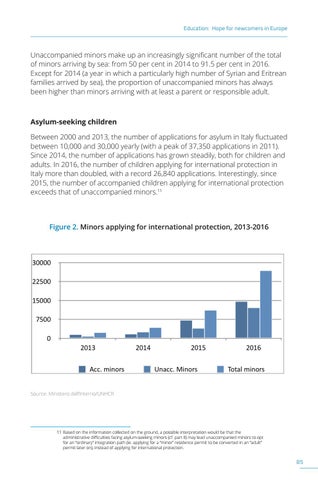
Asylum-seeking children Between 2000 and 2013, the number of applications for asylum in Italy fluctuated between 10,000 and 30,000 yearly (with a peak of 37,350 applications in 2011). Since 2014, the number of applications has grown steadily, both for children and adults. In 2016, the number of children applying for international protection in Italy more than doubled, with a record 26,840 applications. Interestingly, since 2015, the number of accompanied children applying for international protection exceeds that of unaccompanied minors.11
Figure 2. Minors applying for international protection, 2013-2016
Source: Ministero dell’Interno/UNHCR
11 Based on the information collected on the ground, a possible interpretation would be that the administrative difficulties facing asylum-seeking minors (cf. part II) may lead unaccompanied minors to opt for an “ordinary” integration path (ie. applying for a “minor” residence permit to be converted in an “adult” permit later on), instead of applying for international protection.
B5