Education International Research
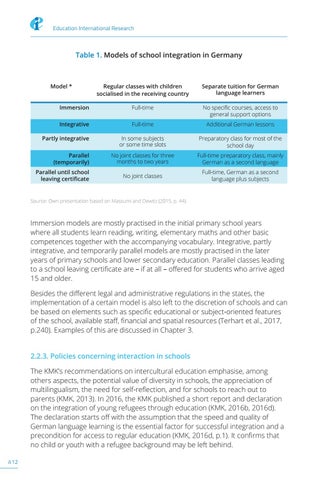
Table 1. Models of school integration in Germany
Model *
Regular classes with children socialised in the receiving country
Separate tuition for German language learners
Immersion
Full-time
No specific courses, access to general support options
Integrative
Full-time
Additional German lessons
In some subjects or some time slots
Preparatory class for most of the school day
No joint classes for three months to two years
Full-time preparatory class, mainly German as a second language
No joint classes
Full-time, German as a second language plus subjects
Partly integrative Parallel (temporarily) Parallel until school leaving certificate
Source: Own presentation based on Massumi and Dewitz (2015, p. 44).
Immersion models are mostly practised in the initial primary school years where all students learn reading, writing, elementary maths and other basic competences together with the accompanying vocabulary. Integrative, partly integrative, and temporarily parallel models are mostly practised in the later years of primary schools and lower secondary education. Parallel classes leading to a school leaving certificate are – if at all – offered for students who arrive aged 15 and older. Besides the different legal and administrative regulations in the states, the implementation of a certain model is also left to the discretion of schools and can be based on elements such as specific educational or subject-oriented features of the school, available staff, financial and spatial resources (Terhart et al., 2017, p.240). Examples of this are discussed in Chapter 3. 2.2.3. Policies concerning interaction in schools The KMK’s recommendations on intercultural education emphasise, among others aspects, the potential value of diversity in schools, the appreciation of multilingualism, the need for self-reflection, and for schools to reach out to parents (KMK, 2013). In 2016, the KMK published a short report and declaration on the integration of young refugees through education (KMK, 2016b, 2016d). The declaration starts off with the assumption that the speed and quality of German language learning is the essential factor for successful integration and a precondition for access to regular education (KMK, 2016d, p.1). It confirms that no child or youth with a refugee background may be left behind. A 12