Education International Research
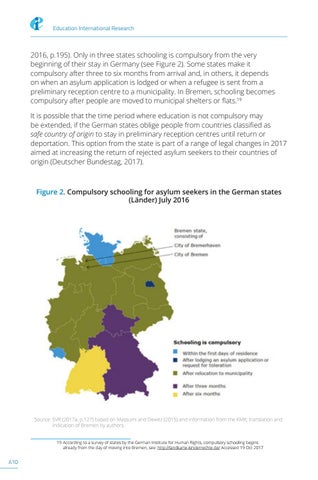
2016, p.195). Only in three states schooling is compulsory from the very beginning of their stay in Germany (see Figure 2). Some states make it compulsory after three to six months from arrival and, in others, it depends on when an asylum application is lodged or when a refugee is sent from a preliminary reception centre to a municipality. In Bremen, schooling becomes compulsory after people are moved to municipal shelters or flats.19 It is possible that the time period where education is not compulsory may be extended, if the German states oblige people from countries classified as safe country of origin to stay in preliminary reception centres until return or deportation. This option from the state is part of a range of legal changes in 2017 aimed at increasing the return of rejected asylum seekers to their countries of origin (Deutscher Bundestag, 2017).
Figure 2. Compulsory schooling for asylum seekers in the German states (Länder) July 2016
Source: SVR (2017a, p.127) based on Massumi and Dewitz (2015) and information from the KMK; translation and indication of Bremen by authors. 19 According to a survey of states by the German Institute for Human Rights, compulsory schooling begins already from the day of moving into Bremen, see: http://landkarte-kinderrechte.de/ Accessed 19 Oct 2017
A10