Education: Hope for newcomers in Europe
Newly arrived in Swedish schools – challenges and opportunities This section addresses three main topics: (i)
Newly arrived students in elementary schools, their numbers, social and demographic characteristics, achievement and challenges
(ii)
Unaccompanied minors and the language introduction programme at upper-secondary level
(iii) Recent government measures, as well as resources possessed by newly arrived children themselves
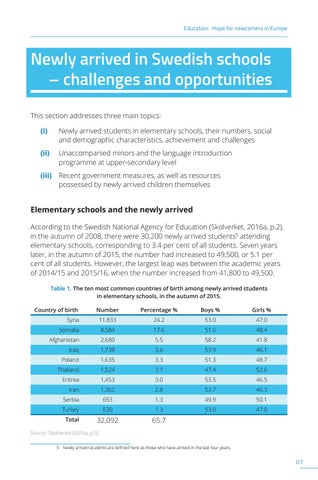
Elementary schools and the newly arrived According to the Swedish National Agency for Education (Skolverket, 2016a, p.2), in the autumn of 2008, there were 30,200 newly arrived students5 attending elementary schools, corresponding to 3.4 per cent of all students. Seven years later, in the autumn of 2015, the number had increased to 49,500, or 5.1 per cent of all students. However, the largest leap was between the academic years of 2014/15 and 2015/16, when the number increased from 41,800 to 49,500. Table 1. The ten most common countries of birth among newly arrived students in elementary schools, in the autumn of 2015. Country of birth
Number
Percentage %
Boys %
Girls %
Syria
11,833
24.2
53.0
47.0
Somalia
8,584
17.6
51.6
48.4
Afghanistan
2,680
5.5
58.2
41.8
Iraq
1,738
3.6
53.9
46.1
Poland
1,635
3.3
51.3
48.7
Thailand
1,524
3.1
47.4
52.6
Eritrea
1,453
3.0
53.5
46.5
Iran
1,362
2.8
53.7
46.3
Serbia
653
1.3
49.9
50.1
Turkey
630
1.3
53.0
47.0
Total
32,092
65.7
Source: Skolverket (2016a, p.5) 5 Newly arrived students are defined here as those who have arrived in the last four years.
D7