, 2016
1|
|2
3|
|4
Refugees in a conventional meaning are "people who have been involuntarily displaced from their homes and dispossessed of their livelihoods, normally without the protection of their own government."1 For the purpose not to confuse this meaning with the legal status of refugee, refugee in a conventional meaning is referred in this paper as Forcibly Displaced Person Refugee in a legal meaning is “someone who is unable or unwilling to return to their country of origin owing to a well-founded fear of being persecuted for reasons of race, religion, nationality, membership of a particular social group, or political opinion.”2 People granted political asylum or protection may also be included in this group, though sometimes they are counted separately as political refugees in the distinction to war refugees, referring to the stated reason for seeking asylum. Being granted refugee status means not only being a forcibly displaced person, but also following the procedure of asylum application in another country, and getting the application status approved. Asylum Seeker – “is someone whose request for sanctuary has yet to be processed” (UNHCR). It is somebody, who fled to another country and followed the procedure of asylum application, but who have not been yet granted a refugee status. Internal Displaced Persons are “people who are forcibly displaced within their countries of origin or habitual residence but who have not cross an internationally recognized State border. People may be internally displaced as a result of armed conflicts, situations of generalized violence, violations of human rights or natural or humanmade disasters” (UNHCR). This group of people is an example of people in refugee-like situations, not covered by UNHCR mandate. There are still many other forcibly displaced people, who are not affected by UNHCR programmes. Migration is “the residential relocation of an individual, family or group from one place to another.”3 Migration has different forms and types. Often it is classified on the base of the dominant reason for migration. Economic Migration is one of such types when the main motive of migration is improving personal or family welfare. Forced Migration is “a general term that refers to the movements of refugees and internally displaced people (those displaced by conflicts) as well as people displaced by natural or environmental disasters, chemical or nuclear disasters, famine, or development
1
Gregory at Al, The Dictionary of Human Geography, 5th edition, Wiley-Blackwell, 2012, p. 628 The 1951 Refugee Convention 3 Gregory at Al, The Dictionary of Human Geography, 5th edition, Wiley-Blackwell, 2012, p. 462 2
5|
projects� (International Association for the Study of Forced Migration). It is also applicable to other forcibly displaced people, including smuggled people, trafficked people, or unregistered as such refugees. Forced migration is not economic migration. Forced migrants have sufficient reasons to leave home for their safety. It does not mean that forced migrants have no economic priorities and goals, but that they have some special needs, including need for additional support in achievement of basic human rights, including the right for education.
|6
ASCD - Association for Supervision and Curriculum Development CTQ – Center for Teaching Quality EI – Education International EU – European Union GMR – UNESCO’s Global Monitoring Report GPE – Global Partnership for Education iEARN - International Education and Resource Network ILO – International Labour Organization ITEN - InterAmerican Teacher Education Network OECD - Organisation for Economic Co-operation and Development SDG – Sustainable Development Goals TEN Global – Teacher and Educator Network UN – United Nations UNDP – United Nations Development Programme UNESCO – United Nations Educational, Scientific and Cultural Organization UNHCR – United Nations High Commissioner for Refugees UNICEF – United Nations Children's Fund WHO – World Health Organization
7|
|8
Quality education is key to the achievement of the UN Sustainable Development Goals. It is crucial in confronting the social, economic, cultural and political challenges that are causing and resulting from the “global refugee crisis." Education is also the most effective tool to help forcibly displaced people integrate into their new home countries. With millions of forced migrants from Afghanistan, Pakistan, Yemen, Syria, Iraq and several African countries fleeing their homes, desperately trying to reach and settle in neighbouring countries, in Europe and in North America, there is a need to identify the subsequent challenges posed to the education sector of transit and host countries. Education is the fast track to integration. However, how do we define “integration” and what are its goals? Which education programmes would help achieve these goals? Are our school systems equipped to welcome large groups of refugee children and youth? How do we create favourable school environments? How do we fight racism and xenophobia? How do we prevent bullying? How do we prevent students from going astray? What are the specific needs of forcibly displaced children and how can teachers meet those needs? Are we to adjust our curriculum? Does the refugee crisis give reason to enforce global citizenship education? These and many other questions are to be addressed both during the international dialogue between education union leaders, refugee teachers, education ministers and international experts during this conference and for the foreseeable future.
KEY POINT TO BE CONSIDERED
Quality education is a “corner stone” of successful integration policy
As a launching pad for ongoing international dialogue between educators on the improvement of refugee education, the conference plans to address systemic as well as professional challenges confronting classroom teachers4. Although discussions are to focus on forcibly displaced children and youth from conflict areas in the Middle East, potential conference conclusions and debates should be relevant for the delivery of quality education to children of forced migrants and migrants in general around the world. Furthermore, the conference is the launching pad of an ongoing international dialogue.
This conference reader provides relevant background information about the political and humanitarian aspects of the refugee crisis, the integration of refugees in their new countries, the role of international agencies, the policy framework in which Education International (EI) operates as well as its programmes. It also contains a list of recommendations based on EI case studies in 2010, which are to be followed with some information from EI member organisations and new up-to-date research data. The topics of workshop and roundtables are described on page 40.
4
The term “refugee education” should be understood as education to forcibly displaced children, i.e. children of refugees, asylum seekers, other forced migrants and unaccompanied minors.
9|
Wars and armed conflicts, human rights violations and political prosecutions, hunger, and extreme poverty have led to a massive increase of displaced persons, asylum seekers and refugees. The UNHCR estimated that there were 65.3 million forcibly displaced persons in 2015, a number which equals the size of the entire population of some countries, such as France and the United Kingdom. According to the UNHCR, this meant that every minute 24 persons were forced to migrate. Many fled and continue to flee to neighbouring regions and countries in search of safety, political stability, and a better quality of life. Unfortunately, despite the risks involved, too many have ended up in tent camps with poor conditions and a lack of necessities. Distressingly, children made up an astonishing 51 percent of the world’s refugees in 2015, according to data the UNHCR was able to gather. Many were separated from their parents or traveling alone5. More than ever before regional challenges to security, democracy, and sustainable development have a global dimension. Moreover, the current trends of forced migration may not be of a temporary character.
KEY POINT TO BE CONSIDERED
Migrants and refugees perform better in countries with inclusive public school systems
The complex refugee crisis poses humanitarian and political challenges to every nation and the international community as a whole. There is no escape possible from confronting those problems. Governments, civil society, and the trade union movement must stand together to ensure that the rights of all displaced persons, asylum seekers and refugees are respected. However, the rise of populist movements in Europe and North America, the spread of racism and xenophobia, local protests against the settlement of refugees, fear of misbehaviour, crime, or terrorism, have made some countries reluctant to welcome large groups of refugees, close their borders or even build walls. The humanitarian challenge is indisputably stark. Poverty, vagrancy, insecurity, will be the fate of many millions seeking new homes across borders, unless all nations commit to the implementation of a global plan adopted by the UN Summit for Refugees and Migrants in September 2016. The struggle against poverty, disease, exclusion, and many other sources of conflict and involuntary migration starts in the classroom. Quality education for all, the UN Sustainable Development Goal 4, is the key to social, economic and democratic development, as well as a long-term and sustainable solution to massive migration flows. At the same time, education is the most effective tool to help forced migrants integrate into their new home countries, introduce them to a new culture, to new value sets and to enable them to be productive
5
| 10
Global Trends: Forced Displacement in 2015, UNHCR annual report
citizens. Education unions and the teaching profession have a special responsibility to make this happen. The numbers of school-age refugees in the countries neighbouring Syria have grown beyond the capacity of these nations' school systems, as a result of which too many children and young people have no access to education. Turkey has now the world's largest refugee population; Lebanon has the largest number of refugees per capita, while Jordan hosts the world's biggest refugee camp. The challenge for Europe and other developed countries is not only to reduce the burden on Syria’s neighbours by providing financial assistance, but also to accept a “fair share” of forced migrants, including those who are “in transit” in Turkey, Greece, Italy, and Balkan countries.
KEY POINT TO BE CONSIDERED
Induction programmes and language courses are the first steps towards successful integration
Both developed and developing countries need to take action to confront the challenges of forced migration to secure rights and welfare of refugees, local communities, and the global system. Education is one of the core human rights and a keystone of the global development agenda. Governments have the responsibility to ensure quality education for every child, let alone every forced migrant. Teachers carry the responsibility of caring for and educating the younger generation of forced migrants to prevent them from becoming a "lost generation."
11 |
Poor living conditions, social exclusion, alienation, stress and psychological problems mark the daily lives of many forcibly displaced people after their arrival in the country of destination, or areas of their countries of origin. The conditions of those who have not yet arrived, but who are “trapped” in transit countries waiting to be registered and hoping to obtain visas, are even worse. Reports have shown that many citizens in transit and host countries have given forcibly displaced people a warm reception, have organized activities on a voluntary basis, or have invited them to their homes. Volunteers have set up language courses, help forced migrants to get registered and make their first steps towards "integration." But there are many obstacles, including lengthy bureaucratic procedures and the limited capacity of host countries to provide adequate housing, create space for their children in schools and provide employment opportunities. Furthermore, the arrival of forcibly displaced people is not without controversy. Residents sometimes object to the establishment of (planned) “refugee centres” in their neighbourhoods, organize protest activities, call for action against the newcomers. Forced migrants are often seen as a burden.
KEY POINT TO BE CONSIDERED
In a report entitled “A New Beginning: Refugee Integration in Europe” (published by the UNHCR and the European Refugee Fund of the European Education Commission in 2013) it is noted that many countries in Europe have been programmes in working to improve integration of third-country nationals generally and that refugee centres efforts have also been made to measure both the social and economic impact should be led by of integration policies and support. The report warns that refugees, as part of qualified teachers this group, have specific needs due to their loss of the protection of their country; their experiences of persecution or armed conflict; their particular difficulties obtaining documentation; and the separation and loss of family which often follows as a consequence of flight.
“Measuring the impact of integration policies on refugees without an understanding of their particular needs may lead to misguided policy development and to lack of crucial support needed to avoid long-term dependency, marginalization and isolation of refugees. This can in turn lead to an increase in irregular movements or challenge social cohesion in the host state.” What does “integration” mean and what is the integration “goal”? The report notes that there is no consensus on the definition of immigrant integration and there is no formal definition in international law. Broad understanding of integration as processual, individual and two-way underpins many governmental and academic attempts to define what integration or an integrated society looks like.
| 12
“The lack of a firm definition may reflect the subjective character of integration as a process and the way in which an individual can be integrated in one area of the receiving society but not in others. It may also reflect the way in which an immigrant can simultaneously create and maintain strong links with his or her country of origin, the receiving country and countries of transit. In the increasingly connected 21st century, migration no longer means leaving behind one set of connections and replacing them with another; each may be maintained alongside the other via a large range of instant communication technologies." “For some in the receiving society, such parallel maintenance of connections may be interpreted as lacking commitment to the receiving society or as an impediment to participation in, or contribution to, society. For the migrant, it may simply be a way of living which allows him or her to span geographic space and retain or create multiple belongings and affiliations which may actually assist integration by offering emotional or even financial security." “Defining integration is complex because it is not KEY POINT only something that happens to a passive TO BE CONSIDERED individual over time, but is a process in which an individual may actively and selectively control Barriers to access certain aspects. Nonetheless, governments further and higher require newcomers to engage with certain education should be aspects of integration in order to ensure a removed including functioning cohesive society in which all high tuition fees and members contribute and benefit. The range of the lack of recognition ways in which governments do this varies from of prior learning facilitation and enablement, to encouragement, to coercion. Put simplistically, the goal of integration is equality, inclusion and achievement, however disparity may intervene as governments may view integration one way, while newcomers live it another way.” Education is one of the main policy areas that are key to integration, irrespective of how integration is defined. However, integration goals affect educational targets, priorities, and programmes. It makes a difference for education systems whether they aim more toward assimilation of newcomers or to sustaining different cultures with their traditions, rites, and way of life. The question whether practices such as veiling or wearing the hijab (typically in Muslim cultures) should be allowed in (public) schools, is only one example of the many questions that arise around integration goals. Migrant students’ connections and loyalty with their or their parents’ countries of origin – rampant among West European students with a Turkish background - is another example. Although refugee students who fled their countries
13 |
may not have such feelings, the question of identity is crucial. Our schools should recognize the identities of each student, whatever his or her origin or background. Pride in one's identity should go hand in hand with respect for the identity of others. Schools should be places where children and young people learn to live together, understanding the richness of diversity, because the societies in which they must live in the future will all be diverse, multicultural societies or - more accurately: multi-cultural democracies. The debate “assimilation vs multiculturalism� is far from over. For educators to successfully help migrant students integrate, they must have the professional freedom to select and use the appropriate teaching and learning tools and have these not prescribed by education authorities.
KEY POINT TO BE CONSIDERED
In-service training programmes should be established to equip teachers with knowledge, skills, and competences to meet the educational needs of refugee children and youth
| 14
KEY POINT TO BE CONSIDERED
Adequate budgetary provisions are to be made by governments of transit and host countries for education to forcibly displaced children and youth
Among the most relevant international conventions and recommendations pertaining to asylum-seekers, internally displaced persons or refugees are the United Nations Convention relating to the Status of Refugees (1951) and its protocol (1967), the UN Convention on the Rights of the Child (1989) and the ILO Conventions on Migrant Workers (C97 and C143). The UN Refugee and Migration Summit on 19 September provides further guidance and commitments.
KEY POINT TO BE CONSIDERED
Curriculum reforms should be directed towards whole child education and include world citizens’ education
UN Refugee and Migration Summit declared: “We, the Heads of State and Government and High Representatives, meeting at the United Nations Headquarters in New York on 19 September 2016 to address the question of large movements of refugees and migrants, have adopted the following Political Declaration. Excerpts: •
2.11 (…) We will work to provide for basic health, education, and psychosocial development and for the registration of all births on our territories. We are determined to ensure that all children are in education within a few months of arrival, and we will prioritize budgetary provision to facilitate this, including support for host countries as required. We will strive to provide refugee and migrant children with a nurturing environment for the full realization of their rights and capabilities.
•
2.18 We commit to combatting xenophobia, racism and discrimination in our societies against refugees and migrants. We will take measures to improve their integration and inclusion, as appropriate, and with particular reference to access to education, healthcare, access to justice and language training. We recognize that these measures will reduce the risks of marginalization and radicalization. (…)
•
3.4 Recognizing that lack of educational opportunities is often a push factor for migration, particularly of young people, we commit to strengthening capacities in countries of origin, including in educational institutions. We commit also to enhancing employment opportunities, particularly for young people, in countries of origin. We acknowledge also the impact of migration on human capital in countries of origin.
•
3.17 We will consider facilitating opportunities for safe, orderly, and regular migration, including, as appropriate, employment creation, labour mobility at all skills levels, circular migration, family reunification and education-related opportunities. (…)
15 |
KEY POINT TO BE CONSIDERED
New technologies should be made available to teachers and students to enhance the quality of teaching and learning
•
3.19 We reaffirm our commitment to protect the human rights of migrant children, given their vulnerability, particularly unaccompanied migrant children, and to provide access to basic health, education and psychosocial services, ensuring that the best interests of the child is a primary consideration in all relevant policies.
•
4.16 We will consider developing measures such as the expansion of existing humanitarian admission programmes; possible temporary evacuation programmes (including evacuation for medical reasons); flexible arrangements to assist family reunification; private sponsorship for individual refugees; and labour mobility opportunities for refugees (including through private-sector partnerships) and for education (e.g. scholarships and student visas).
•
4.18 We are determined to provide quality primary and secondary education in safe learning environments for all refugee children, and to do so within a few months of the initial displacement. We commit to providing host countries with support in this regard. Access to quality education, including for host communities, gives fundamental protection to children and youth in displacement contexts, particularly in situations of conflict and crisis.
• 4.19 We will support early childhood education for refugee children. We will also promote tertiary education, skills training and vocational education. In conflict and crisis situations, higher education serves as a powerful driver for change, shelters and protects a critical group of young men and women by maintaining their hopes for the future, fosters inclusion and non-discrimination, and acts as a catalyst for the recovery and rebuilding of post-conflict countries. • 4.21 Welcoming the positive steps taken by individual States, we encourage host governments to consider opening their labour markets to refugees. We will work to strengthen host countries’ and communities’ resilience, assisting them, for example, with employment creation and income generation schemes. In this regard, we recognize the potential of young people and will work to create conditions for growth, employment and education which allow them to be the drivers of development.”
Education is an individual and collective right. It is the basis of all sustainable development and one of the main conditions for social progress, economic growth and democratic development. It is one of the prime tasks of any government to provide quality education to all, including refugee children and youth. “Inclusive and equitable quality education and lifelong learning opportunities for all”,, including free primary and secondary education, is one of the Sustainable Development Goals set by the General Assembly of the United Nations in September 2015 (SDG4). The achievement of the SDG’s by 2030 will determine the agenda of the UN and its specialised agencies in the coming 15 years. Refugee and migrant education has been given a prominent place on the agendas of UNESCO, GPE, UNICEF, UNHCR, UNDP, WHO, ILO and various other specialized organisations.
| 16
Intergovernmental organisations such as OECD and World Bank, also contribute to the improvement of integration and education policies and programmes. In December 2015 the OECD published a report: “Immigrant students at School”, providing valuable data for education policy makers.
In May 2016 UNESCO’s “Global Monitoring Report” and UNHCR released a joint policy paper (#26) entitled “No more excuses: Provide education to all forcibly displaced people”. The report notes that for children and youth who have been forcibly displaced, education is especially important: by simply being in school, they are better protected from trafficking, illegal adoption, child marriage, sexual exploitation and forced labour — both immediately after displacement and long term. Education also builds knowledge and skills for self-reliance and resilience. It can also contribute to peace and security and mitigate factors that led to conflict and displacement in the first place, according to GMR/UNHCR.
“Among refugees, only 50% of children are in primary school and only 25% of adolescents are in secondary school. Access to quality education should be provided to all internally displaced and refugee children and youth from the onset of an emergency and into long-term displacement. Countries and their humanitarian and development partners must urgently ensure that internally displaced, asylum seeking and refugee children and youth are included in national education plans, and collect better data to monitor their situation” GMR/UNHCR draws attention to the fact that many refugees are displaced for very long periods, and 86 percent of refugees are hosted in developing countries.
“Among the major refugee-hosting countries in mid-2015 were Ethiopia, the Islamic Republic of Iran, Jordan, Lebanon, Pakistan and Turkey. Some of these host countries have weak education systems and limited capacity to support new populations. Moreover, refugees are often concentrated in the most educationally deprived regions of host countries, including Iraqi and Syrian refugees in poor areas of Jordan, Syrian refugees in south-eastern regions of Turkey, and Sudanese refugees in eastern Chad” The report stresses that responsibility and decision-making belongs to states:
“That is why countries must take the initiative to include refugee, internally displaced, asylum seeking and stateless populations in their national education plans. They need to respond in a flexible way to strengthen and expand the formal education system in order to absorb displaced children and youth and also to provide certified accelerated education programmes that are accredited as well as non-formal options that have pathways into the formal education system”
17 |
GMR/UNHCR report advocates four main policy directions for governments and their partners:
KEY POINT TO BE CONSIDERED
Integration policy should allow cultural and religious practices of refugees and migrants provided they are not in conflict with democratic values and human right standards
(1) Enshrine forcibly displaced people’s rights to education in national laws and policy; (2) Include displaced children and youth in national education systems; (3) Enable accelerated and flexible education options to meet diverse needs; and (4) Ensure an adequate supply of trained and motivated teachers. The level of protection of IDP, refugee and stateless children depends on national laws and their implementation. Yet in many countries, these groups face institutional barriers that can directly and indirectly harm these children’s prospects of receiving an education. Only 21 of the over 50 countries who have internally displaced persons referenced IDP children in national laws and policies (Brookings Institute, 2016; Elizabeth G. Ferris, 2010). In most cases, inclusion of refugees in national education systems is the most sustainable option, according to GMR/UNHCR.
“To ensure education quality, inclusion requires early and sustained attention from national authorities and development partners to enhance national capacity and infrastructure, provide conducive legal and policy frameworks, adopt appropriate curriculum and language of instruction, and prepare refugee students and communities for the transition to host country education” The report recommends accelerated education programmes which can provide refugee and IDP children and adolescents with a viable option for certified education.
“There are large numbers of over-age learners who have missed significant periods of schooling. When over-age children return to school, there is not only a risk of overcrowding classrooms and difficult teaching conditions with multiple age ranges, but there are also considerable protection risks in mixing older and younger children in one class. Certified accelerated education programmes are a key way to allow older children and adolescents to access condensed primary education services in conditions appropriate for their age” The GMR/UNHCR Report is very outspoken on teachers:
“IDPs and refugees need trained, supported and motivated teachers but all too often their teachers are poorly paid and inexperienced, and work in demanding conditions with little opportunity for professional development. Governments and their partner agencies need to ensure not only that sufficient funds are available to pay teachers appropriately but also that teachers are able to advance in their careers.”
| 18
“One of the challenges facing (…) countries is that refugees and resettled persons who could work as teachers may be unable to provide evidence of qualifications. In 2007, the Supreme Court of Ontario, Canada, set an important precedent by ruling that the Ontario College of Teachers must find a way to assess the qualification of a resettled refugee who could not produce an original government-certified proof of her academic qualifications (Medic, 2007).” For more information, see GMR/UNHCR policy paper #26.
In 2015 UNESCO calculated that governments must double education spending as a share of national income to achieve Sustainable Development Goal 4 by 2030. “The International Commission on Financing Global Education Opportunity” established in 2015 at the initiative of the Norwegian government submitted proposals for the financing of global education to the Secretary-General of the UN on 18 September 2016. The Commission, which is chaired by UN Envoy for Global Education, Gordon Brown, makes three recommendations for increasing and improving domestic and international financing of education from all sources:
KEY POINT TO BE CONSIDERED
Schools should be enabled to give extra attention to refugee children and youth with special needs and to provide trauma counselling
Mobilize more domestic resources for education. This will require governments to substantially increase public investment in education by devoting more of the proceeds of growth to education, by reallocating spending based on greater priority for education and by improving overall revenue mobilization. To do so, governments could commit to reallocating resources from for example expensive energy subsidies and commit to improving their tax collection including through addressing tax avoidance and considering earmarking resources for education, alongside wider tax reforms. Increase the international financing of education and improve its effectiveness. This will require innovative thinking about the priority international development partners attach to education; as well as increased leadership and advocacy to promote increased financing from donors, investors, and philanthropists. It will also require more multilateral cooperation, improvements in the way international financing is deployed and monitored, and the encouragement of innovation in financing to mobilize new sources of funding and new partnerships. Establish a Multilateral Development Bank (MDB) investment mechanism for education to deliver improved MDB financing including global and regional development banks. Education could capitalize on the unique opportunities MDBs currently have to leverage their capital bases significantly. This mechanism would deliver improved MDB financing for education and the engagement
19 |
The Commission's vision will require total spending on education – from domestic and international expenditures combined – to rise steadily from $1.2 trillion USD per year today to $3.0 trillion USD by 2030 across all low- and middle-income countries. Much of this will come from a dividend available to national governments from the growth expected over the next decade and a half. But even with higher GDP growth rates, the Commission's proposals require governments to give greater priority to their education services. The Commission expects to see a rise in the total spending (public and private) on education from an average of 6 percent of a country's GDP to 8.5 percent across low and middle-income countries. In its report, the Education Commission draws attention to the unfulfilled need for support for education in emergencies.
“Sixty-three million out of school children and youth live in conflictaffected areas. Children in these countries are 30 percent less likely to complete primary school and half as likely to complete lower- secondary school. Just one in two refugee children attend primary school, while just one in four attend secondary school; in 2014 this meant that there were 32 million children and adolescents who were refugees and out of school. The reduced capacity and finances of the state to deliver education, coupled with inadequate international financing for education in emergencies, compound the problem and its lasting effects for postconflict states and their neighbours. Today, about one million Syrian refugee children are out of school. Most of those who are in school will drop out before starting their secondary education. In the space of a single primary -school generation, Syria has suffered what may be the greatest education reversal in history. At the time of publication, just 39% of the $662 million in urgent education aid sought by United Nations humanitarian agencies in 2016 has been funded, and only a fraction of the $1.4 billion pledged in London in February 2016 has been delivered. Emergencies could add approximately $9 billion to the projected education costs overall by 2030. Based on projections for countries at risk of violent or natural disasters. it is likely that most of the future emergencies will continue to occur in low- and lower-middle-income countries, and that the proportion of pupils affected will not decline. Emergencies are becoming extremely protracted in nature: 90 percent of countries with a Humanitarian Response Plan in 2014 have had an appeal for three or more years, underlining the importance of improving coordination between development and humanitarian aid.”
In April 2016, the European Commission announced an initial €83 million worth of humanitarian funding for emergency support projects to assist refugees in Greece. The
| 20
projects address the most urgent humanitarian needs of some 50 000 refugees and migrants currently hosted in over 30 sites in Greece. The Commission supports refugees in Turkey who have fled violence in both Syria and Iraq, with particular emphasis on vulnerable people living outside of camps. Since the beginning of the Syria crisis in 2011, the Commission has provided a total assistance of €455 million in Turkey, including humanitarian aid and longer-term assistance. Turkey is hosting more than 3.1 million registered refugees. It has already spent more than €7 billion of its own resources on addressing this crisis. In November 2015, the EU set up the Refugee Facility for Turkey. EU institutions and the Member States committed to funding up to €3 billion to be coordinated via the Facility. Over €240 million worth of projects has already been released to date, which includes €55 million assistance in the form of neighbourhood funding that allows 110 000 Syrian children in Turkey to attend school this current academic year. The assistance will be disbursed to UNICEF through the EU Regional Trust Fund in response to the Syrian crisis. Since the beginning the refugee crisis, the Commission has provided humanitarian aid amounting to over €22.5 million to the Western Balkans, notably to Serbia and the former Yugoslav Republic of Macedonia. Aid is channelled via humanitarian partner organisations to the most vulnerable people, and consists of emergency assistance (food, water, hygiene, nonfood items, health, basic protection) distributed at transit points such as borders and registration facilities. In Libya, the Commission has contributed more than €8 million in humanitarian aid since mid2014, supporting internally displaced people and other vulnerable groups with the provision of protection, health care, cash support, psycho-social assistance, as well as non-food and hygiene items. Through the EU Civil Protection Mechanism, the Commission coordinates the delivery of immediate material to support the Member States and neighbouring countries facing major peaks in the refugee crisis that overwhelm their immediate response capacities. The assistance, provided only upon the request of the affected country, is based on voluntary contributions from countries participating in the Mechanism. The Mechanism has been activated to help cope with an increase of refugees several times in 2015, and it is still active in some member states of the Mechanism in 2016. Hungary, Serbia, Slovenia, Croatia and Greece have received material assistance such as winterized tents, beds and blankets from the Mechanism participating countries to help them better cope with the arrival of refugees and asylum seekers. The Mechanism is coordinated by the European Commission's Emergency Response Coordination Centre (ERCC), which is closely monitoring the refugee crisis and facilitates a coherent and efficient European response. http://ec.europa.eu/echo/refugee-crisis_en The European Union has also published an action plan to support the Member States in the integration of third country nationals. The action plan calls education and training one of the most powerful tools for integration, noting that "education and language training will indeed be critical as half of the refugees are children and many of them are unaccompanied minors." The Commission will give the opportunity to 100 000 refugees over the next three years to
21 |
receive online language support through the Erasmus + to learn the language of their host country. http://ec.europa.eu/education/policy/migration/index_en.htm
| 22
Education International (EI) is the global voice of the teaching profession and education support staff. It represents the national education unions of 170 countries with a combined membership of 32 million. Among its main objectives are the achievement of quality education for all and the promotion of the professional status of teachers. Education International promotes education as a fundamental human right and as the principal key to social, economic and democratic development. Education International’s Seventh World Congress, held in Ottawa, Canada (July 2015) adopted a resolution on the right to education of displaced people, refugees, and stateless children: http://pages.eiie.org/library/en/libraries/detail/231. It was resolved that EI should: •
• •
•
KEY POINT TO BE CONSIDERED
Education Advance the ideals, aims, and objectives of the EI Unite for Quality 6 programmes in Education campaign in the interests of refugee and displaced refugee centres children; ensuring that the problem of the language of schooling is should be led by not an obstacle for refugees. qualified teachers provide support and assistance to member organisations in countries where there are large numbers of refugees and displaced children. Maintain pressure on national governments and on international institutions to prioritize financial assistance for the education of refugees and internally displaced people, especially in states having a common border with a country in conflict and welcoming a very important number of them. Work with affiliates, the UNHCR, and other partner organisations to assist refugees in developing the skills and knowledge they need, and to plan activities and actions that promote self-reliance and sustainable, peaceful coexistence.
The policy framework in which Education International operates is determined by a number of resolutions and statements of which the following are relevant to the rights of refugees and refugee education. All of these included below can be found on the EI website: Policy Paper on Human and Trade Union Rights (July 2015)
6
The Unite for Quality Education Campaign was launched in September 2013 with the purpose of persuading the United Nations to declare "free quality education" as a Sustainable Development Goal. The active engagement of many EI member organisations in this global campaign and the political pressure they were able to exert on UN member states, resulted in the acceptance by the international community of SDG4: "Inclusive and equitable quality education and lifelong learning opportunities for all." The EI 7th World Congress decided in July 2015 to extend the Unite for Quality Education Campaign with a focus on the achievement of SDG4 and on advocacy against privatization and commercialization of education services.
23 |
Resolution on the promotion and protection of standards and values in the world (July 2015) Education Policy Paper: Building the future through quality education (July 2011) Addendum to Education Policy Paper: Privatization of education services (July 2015) Addendum to Education Policy Paper: The role of education unions in the use of ICT (July 2015) Addendum to Education Policy Paper: Leadership in educational institutions (July 2015) Addendum to Education Policy Paper: Financing of education (July 2015) Addendum to Education Policy Paper: Equitable and inclusive education (July 2015) Resolution on Teacher migration and mobility (July 2011) Resolution on international migration (July 2007) Declaration on professional ethics (July 2004) Resolution on Education for cultural diversity (July 2004) Resolution on the Societal Alienation of Children Due to "Kokoro-No-Are" (Emotional and Mental Stress) (July 1998) Resolution on Children of refugees and asylum seekers (July 1998) Other relevant materials: EI strategy "Realizing the rights of Migrants and Refugees" (2016); Statement on the refugee situation “We must take collective action” (17 September 2015); ETUCE statement “Refugees & Education: Human rights for all” (18 September 2015); EI policy brief "Equitable and Non-discriminatory Quality Education".
Education International’s Quadrennial Programme 2016-2019 entails a range of activities, all centred around five priority tasks.
| 24
KEY POINT TO BE CONSIDERED
Schools should be Advocating for the sufficient and equitable long-term safe sanctuaries financing of education and protecting (public) education where prejudice and systems, teachers, researchers and education employees, bigotry, intolerance students and children against the negative effects of political and bullying are and economic crises, trade and investment deals, detrimental taboo market mechanisms, and policies imposed by the international financial institutions. Promoting the status of the teaching profession, researchers and support personnel, improving professional standards, terms, and working conditions, and countering deprofessionalization trends. Confronting attacks on education unions and their members, particularly with respect to freedom of association, collective bargaining rights, and professional freedoms; Challenging the erosion of democratic and social values, and addressing gender inequality, racial intolerance and xenophobia, through the promotion of human rights, equality and trade union rights for sustainable societies;
Strengthening and mobilizing EI and its member organisations in the light of the above challenges and priorities.
Advocacy, research, information, assistance, and capacity building are the main components of EI activities in support of refugee education and the rights of refugees and migrants in general. Access to quality education of refugees, asylum seekers, displaced persons and other minorities is subject of ongoing research and of advocacy with all appropriate intergovernmental agencies. Particular attention is given to gender equity and to the protection of refugee women and girls. Training programmes are organized to strengthen the capacity of EI affiliates and help them effectively address trade union and professional challenge to be confronted in their countries, including refugee education. In 2010 EI published a study on "Education for refugee and asylum seeking children in OECD countries." The conclusions of this study listed on p. 30, are more relevant than ever.
EI affiliates around the world are engaged in promoting and protecting the rights of children through advocacy with their governments, by helping create better learning opportunities for young people, and by mobilizing their membership when children’s rights are violated, such as is the case when children are forcibly displaced without access to education. It is not surprising that education unions show particular concern about the plight of children of forced migrants. The determination to contribute to the safety and well-being of children is at the core of the teaching profession. KEY POINT Refugee education programmes set up by Egitim Sen in the Turkish-Syrian border area and by KTU in northern part of Iraq (Kurdistan);the establishment of refugee teacher training courses in Ontario by OTF/CTF; the development of teaching materials by NUT/UK, the publication of a guide for parents of refugee students in the USA by AFT; the campaign for humane migration policies by the Australian authorities by AEU; these are only a few examples of the many initiatives taken by EI member organisation in all continents.
TO BE CONSIDERED
Special programmes should be established to train forcibly displaced teachers to become qualified teachers in their host countries
In response to the refugee challenge affecting Europe and the Mediterranean region, EI and OSF have partnered to focus on both creating quality education opportunities for refugees as well as better understanding the integral role education unions play in making them possible. Through its funding, OSF, an organisation with a mission to build tolerant and democratic societies, has looked to EI to turn its vision into reality for refugees fleeing inhospitable living situations. Under the umbrella of “Realizing the right to education of refugees,” EI has launched two target projects to address refugee education at the national and local levels. The first is to Mobilise School Communities for the Rights of Refugee Children and Teachers, which looks to bring about concrete change within the classroom and the surrounding
25 |
community. Fourteen local projects are foreseen, with one in France, three in Spain and three in Italy already underway. At the time of publication of this reader, preparation started for local projects in Belgium, Germany, The Netherlands, Poland, Hungary, and Greece. Each local project is modelled around the needs and circumstances of the school, its students, and teachers. Various initiatives, such as workshops to improve and enhance capacity building, and integration events aimed at bringing schools and neighbourhoods together, will help break down barriers inside the classroom and out. It is expected that families and communities play a significant role in creating the positive living and learning environments for all children. The second, “Teacher Unions activate for education quality and equity for refugees through schools�, addresses the role which unions can and do play in providing their teachers with the training and tools to ensure quality education to refugee children. This project involves national surveys of OECD countries to not only better understand what unions have done to prepare their members in order to adapt to migrant and refugee children, but how the unions have advanced since EI last carried out such studies in 2010. In addition to the surveying of EI affiliates, case studies have been undertaken in Italy, Spain and Sweden in order to provide an in-depth analysis of how unions and education ministries are handling the arrival of refugees in schools. Preliminary results of the case studies will be distributed during the Stockholm conference, with completed reports expected by January 2017.
| 26
To date, more than 4,8 million Syrians have fled their country. Roughly half of them are children under 18. Turkey is hosting most Syrian refugees, including a vast group that will seek refugee status in Europe. With over two million Syrian refugees, Lebanon has the largest number of refugees per capita. Today 35 percent of the Lebanese population are refugees. Jordan’s “refugee burden” amounts to 1.4 million Syrian KEY POINT refugees representing 20.6 percent of its population. The school systems of TO BE CONSIDERED these countries do not have the capacity to ensure education of all Syrian refugee children and youth. Procedures should The very large number of refugees is affecting all aspects of life, creating tensions between refugees and host communities. There is a growing concern among EI affiliates in the region about the recruitment of children by armed and extremist groups. Alarming also is the sexual exploitation of young girls who are sold as sex slaves when captured by armed groups, or who are forced into early marriages to help support their families financially.
be established for the recognition of prior learning, acquired skills and professional qualifications
Education unions in the region are also concerned about public schools working in double shifts with teachers being employed on a contract basis through international aid agencies often ignoring the terms of existing collective agreements. Also, international aid agencies funding education emergency plans are sometimes imposing privatization and de-professionalization policies.
Syrian refugees in Lebanon are not confined to camps as is the case in Jordan and Kurdistan in Iraq but are settling mainly in the northern and eastern areas of Lebanon, which are already poor and marginalized areas. Around 450,000 Syrian refugees in Lebanon are of school age. In addition to 275,000 Lebanese students enrolled in public schools, 123,000 Syrian refugees attended classes in these schools during the 2015-2016 school year. The Ministry of Education of Lebanon aims at increasing that number to 200,000 refugees. Public schools work "double shifts," providing morning and afternoon learning sessions. Around 43,000 refugee students were enrolled in the morning session following the Lebanese curriculum, and 80,000 in the afternoon session also following the Lebanese curriculum but using the Accelerated Learning Programme (ALP) developed by the education ministry. For the afternoon session, teachers are contracted by the hour ($12USD/h). For the remaining 270,000 refugee children who never attended school, attempts are made to establish “summer school sessions” also using the Accelerated Learning Programme. “The (double shift) approach can pose problems as the same
27 |
teachers often teach both shifts and report being overworked. It can also undermine the provision of good quality education and learning outcomes.” (GMR/UNHCR Policy Paper 26, May 2016) Education programmes are led by the Education Ministry in close cooperation with UNHCR, UNICEF, and other aid agencies. EI member organisations in Lebanon report that obstacles to the delivery of quality education to both Lebanese and Syrian students are: differences between Lebanese and Syrian curriculums, classroom size, different academic levels, transportation costs for the refugees, limited psycho-social interventions to help traumatized children, and lack of trained teachers to teach children in crisis.
Jordan has a population of around 6.8 million. There are 1.4 million Syrian refugees, mostly in camps established by the government. The Zaatari camp established in July 2012 is one of the largest refugee camps in the world – with 12 schools for some 20,000 students. The country provides free education for primary and secondary Syrian refugees. Around 145,000 Syrian refugee students are attending Jordan’s public schools. This makes up 12 percent of the Jordanian public school population. Some 90,000 Syrian refugee students remain out of school. Forty-six percent of the public schools in the northern and central regions of Jordan, where most Syrian refugees are concentrated, are overcrowded. As a result, 98 public schools operate in double shifts. Jordan needs around 450 new schools to accommodate the growing number of Jordanian and Syrian students. There is also a need for additional training of teachers as is the case in Iraq and Lebanon. Jordan is a poor country. Yet only 38 percent of the cost of refugee education is covered by funding agencies.
Once Iraq had the highest literacy rates in the region. Due to the armed conflicts, illiteracy is on the rise, particularly among displaced Iraqis and refugees. Iraq has a population of around 35 million, including 2.3 million in Kurdistan. This province hosts 300,000 Syrian refugees of which 31 percent children. Less than half of the Syrian refugees live outside the camps. EI member organisations report that around 170,000 refugee students are registered. In addition, 4 million Iraqis were internally displaced since the ISIS invasion of northern Iraq in 2014. They fled to the other provinces of Iraq, including Kurdistan with 1.5 million internally displaced persons.
“Turkey hosts almost 3 million registered Syrian refugees. As of late 2015, almost 700,000 Syrian refugee children and adolescents aged 6 to
| 28
17 needed access to education. Around 85 percent were scattered outside camps in towns and cities. The percentage of refugee children enrolled in formal education was over 85 percent in camp settings but only 30 percent in urban areas. Overall, enrolment rates were 7 percent in pre-primary education, 52 percent in primary education, 31 percent in lower secondary education, and 10 percent in upper secondary education (Turkey Ministry of Education, 2016). A 2013 survey of 2,700 households conducted in the camps and out of the camps yielded similar results. In the 10 cities with the highest proportion of Syrian refugees, about 83 percent of children in the camps were found to attend school compared with only 14 percent of those living out of the camps. UNHCR will implement a large-scale European Commission project that will support the development of intensive Turkish-language support programmes to facilitate enrolment and retention of Syrian refugees in Turkish schools, provide training for teachers on the effects of displacement on learning, and introduce initiatives to promote social inclusion." EI’s affiliate in Turkey has engaged in providing education to forcibly displaced Syrian children in the Turkish-Syrian border area.
29 |
The OECD countries have historically produced strong national education systems, yet refugee education in Europe faces multiple challenges, often due to the failure to recognize refugee education as a new and integral part of education system, rather than a temporary problem. Some countries, especially those greatly affected by large refugee arrivals, tend to develop their refugee education systems in a complex way. Others with large numbers of refugee students, yet not overwhelming, have taken some initiatives to address refugee education. However, such initiatives are found to experience budget cuts and/or lack proper actions aimed at its realization. The European countries least affected by the refugee crisis barely have any programmes to show for, and as a result many refugees suffer multiple violations in pursuit of their right to quality education. We asked several affiliated organisations to provide information answering some questions on refugee education in their countries. A short summary of this data is shown below, however, More data will be presented during the information session.
The number of refugee children in schools and their “visibility� directly relates to the attention to the problem of refugee education in corresponding countries. Unfortunately, there is no public data on this share for many OECD countries. National surveys keep track of the nationalities and language skills of students, yet not of their legal status and KEY POINT special needs of refugees. Rough estimations show that countries with the TO BE CONSIDERED least share of refugee and asylum-seeking children demonstrate the least attention paid to the problems of refugee education; yet the actual Public authorities of transit activity in this area also greatly depends on the budget of these and host countries should countries. In Poland far less than 0,01 percent of students are refugees. give first priority to the As a result no special programmes or initiatives exist on the national care of unaccompanied and regional level. Though in Sweden this share goes up to 15 percent minors by providing in some sectors of education, creating a great demand for special shelter, food, healthcare, programmes, refugee education specialists and relevant programmes, education and protecting which is being addressed. In Spain, where about 0,015 percent are them against abuse refugee students, there exist many programmes, but their development is severely limited by budget cuts and by being considered low priority. When we look to Canada, where roughly 0,13 percent of pupils are refugee children, and of whom only children under 14 are considered part of this group, programmes are mainly designed and distributed by NGOs and other public organisations, while national priorities concern mostly more general immigrant education. In the Netherlands there are 0,5-1 percent of refugee children in schools and there are many programmes focused on language and integration, yet they are limited in budget. In the United Kingdom and Germany, the share of refugee students is 1-1.3 percent and 1-3 percent respectively. Refugee education in these
| 30
countries is important, yet it is controlled by regions, which do not provide enough information about the programmes and efficiency. In Italy, though the number of refugee students is 9 percent, refugee education policies differ from school to school, and budget programmes are severely limited.
Most refugee programmes aim to integrate students into the regular education process and quickly transition them to normal classes. Yet low budget priority makes it difficult for such programmes to run efficiently. Refugee education in OECD countries is built around three types of programmes: language courses, introduction courses, and support programmes.
KEY POINT TO BE CONSIDERED
Refugee children and youth in transit countries should have access to these countries’ school systems
Language programmes are important since inclusion is one of the major principles of refugee education. And although language courses for forced migrants are developed in most OECD countries, in the least affected countries, such as Poland, they are not sufficient and not wide-spread. In many countries there is a severe lack of skilled language teachers, as well as budget deficit in this area. In the United Kingdom the number of running language programmes is in decline due to financial cuts, and the same problem exists in Spain, the Netherlands, and Italy. Often governments tend to employ less skilled native speakers for that purpose, while training language teachers of national language is barely a priority. As for Integration programmes, they do not exist in every country. Germany has “welcome classes”, the United Kingdom is home to special schools for immigrants, Sweden hosts preparatory classes, Spain offers introduction classes, and Greece has reception classes. Other programmes may run on a local basis, funded by schools, local authorities, or NGOs. Special support is the least developed refugee education programme variation. It exists in Spain and concerns psychological health and the well-being of refugees. In some form such programmes locally exist in other countries as well.
Most common problems of refugee education include: 1) 2) 3) 4) 5)
Lack of skilled teachers Lack of special training for teachers in refugee education Lack of funds High mobility of forced migrants, both inside the country and beyond Age limit of compulsory or guaranteed education. In most countries this is 18 years, but in Spain and Italy this is just 16. 6) High number of unaccompanied minors. 7) Lack of accurate data about refugee students, their success and dropping out rates.
31 |
Other problems include huge administrative problems in the United Kingdom and the Netherlands, uneven distribution of refugees in Sweden, and high tuitions for student teachers in Italy. These problems indicate that there should be great awareness in the importance of refugee education, as well as administrative changes relating to the limitations of refugee children in their right to quality education and especially lifelong learning.
The lack of skilled educators, as well as lack of specific training for those teachers, working with refugees, are among the most important problems surrounding Refugee Education in OECD countries – and Worldwide. Such programmes exist in many OECD countries, but yet need to be developed. In Sweden such programmes exist and funded at the national level, while in Germany and the United Kingdom such programmes depend on local authorities in every region. In Greece, Spain, and Italy such programmes also exist, but greatly affected by budget cuts and by far not always sufficiently funded. In France special training is designed only for language teachers. In the Netherlands and Poland training is provided by NGOs only.
| 32
In 2010 EI published a study on Education for Refugee and Asylum-Seeking Children in OECD countries. The report, based on case studies in Australia, Spain, and the United Kingdom, concluded that:
Contemporary societies have the responsibility to ensure than no child is denied its right to education. Ensuring the access of all children to education is not an easy task. Faced with challenges that process such as increased migration flows can pose to societies; school systems are encouraged to revisit their founding principles. At all times, school systems should be guided by the principle of inclusion, and as such aim for the incorporation of all children – regardless of their legal status – into education.
Integration of migrants into societies is not only a moral obligation, but it is also a tremendous potential benefit for host societies as it brings new cultures, perspectives, skills and talented people into the citizenry of nations. Schools are the key institutions in this.
The report recommended that:
Teachers’ unions should: • Assume their function in society in communicating their values, and take strong ethical standpoints which can play an important role in influencing national policy; • Support the professional development of their members by disseminating magazines and articles, and by providing for training and courses on raising awareness of the specific needs of refugee and asylum seeking children; • Disseminate good practice among members (e.g. by facilitating meetings where their members can exchange ideas and learn from each other’s experiences); • Continue their lobby with governments for the amelioration and increased attention in teacher training regarding educating in a multicultural environment and teaching refugee and asylum seeking children; • Expand the pool of information available to teachers on how to teach groups consisting of children with various cultural, ethnic, socioeconomic and educational backgrounds, by calling for or initiating more research on this specific topic. • Critically analyse the impact of different educational initiatives for refugee children, in terms of whether they foster well-being or
33 |
instead pose barriers to integration of migrant children, including refugee and asylum seeking children. Governments and authorities should: • Understand and meet international obligations (e.g. UN Convention and European frameworks); • Listen to refugee children themselves and their peers, and critically ask whether their voices are included in policies and the services they receive. A sound identification of needs; • Establish and (financially) support practitioner networks to disseminate good practices regarding the education of refugee children; • Provide more and better training and increase professional development opportunities for educators and teachers in multicultural settings; • Make sure sufficient resources are made available for the proper training of additional language teachers and mother tongue teachers; • Ensure that in teacher training attention is directed to how to work with traumatized children; • Make sure issues related to multiculturalism and related issues such as xenophobia are included within school’s curricula: • Ensure that all policies and guidance to support refugee and asylum seeking children in schools are implemented adequately; • Provide advice and guidance on access to education to refugee and asylum seeking children and – when accompanied – their parents or caretakers upon arrival; • Provide parents or caretakers with an overview of the schools in the area to support them to make better-informed choices; • Financially support children or – when accompanied – their parents or caretakers with schools’ additional costs (e.g. for uniforms, school trips, travel to school, materials); • Provide specialist staff to schools with issues relating to refugee and asylum seeking children; • Ensure that sufficient resources should be available for additional language teachers and mother tongue teachers; • Ensure the proper training of mother tongue teachers. Research has shown that mother tongue education facilitates the learning of a second language.
| 34
Schools should: • Make sure issues related to multiculturalism and related issues such as xenophobia are included within the curricula; • Deliver tuition, support, and guidance to refugee and asylum seeking children in careful ways to prevent marking them out as different from their autochthonous peers; • Involve parents or caretakers in extra-curricular activities to raise cultural understanding across the school community; • Raise awareness in schools regarding refugee and asylum seeking issues to challenge myths perpetuated sometimes by the media; • Ensure the existence and implementation of anti-bullying and antiracism policies; • Be sensitive towards the specific educational needs and experiences of refugee and asylum seeking children; • Ensure induction processes for newly-arrived children that provide general orientation and curriculum-related information, for instance through the use of mentors; • Provide induction for the parents or caretakers about the education process in a language they understand; • Not refuse children based on their legal status or (cultural and socioeconomic) background; • Eliminate costs leading to front-door selection; • Make available sufficient resources for additional language teachers and mother tongue teachers; • Provide for proper in-service training for teachers who deal with newly arrived children. NGOs should: • Empower refugee and asylum-seeking children and their parents or caretakers by for instance informing them properly on their educational rights and options; • Expand their awareness-raising efforts about (educational) inclusion (e.g. by organizing symposia, carrying out research, publicizing); • Develop partnerships with other stakeholders to combine and strengthen their forces.
35 |
[EDUCATION FOR REFUGEE AND ASYLUM SEEKING CHILDREN IN OECD COUNTRIES, Paloma Bourgonje, © 2010 Education International ISBN 978-92-95089-44-0] A new study is being developed parallel to the conference. Some materials will be presented during the conference and on related electronic platforms.
| 36
The objective of the conference is to exchange information and experiences on education to forcibly displaced children, identify challenges and good practices at system and classroom levels; to recommend policies and strategies to ensure access to quality education to all refugee and migrant children and youth. The conference will focus on refugee and asylumseeking children from Syria and Iraq in schools and refugee centres in neighbouring countries (Turkey, Lebanon, Jordan) and in Europe and North America. The conference consists of plenary sessions, parallel workshops, and information sessions, which are described below.
Plenary sessions are attended by all participants. Several key note speakers will address the plenary sessions. Two panel discussions are foreseen. One on the challenges confronting national school systems with education ministers from selected host countries participating. Another panel of educators and experts in refugee education will discuss school and class room challenges. During the last plenary session, the conference moderators will present Workshops’ reports and recommendations. The participating education unions will present their plans and intentions to improve refugee education in their countries.
Discussions on the various aspects of refugee education are held in 6 Workshops. Each Workshop consists of a number of “roundtables” addressing a certain topic. Participants can move from table to table during workshop sessions, which will allow them to discuss the problem from different angles. Workshops are led by a moderator. For each roundtable, a facilitator will be assigned.
There will be "information sessions" on refugee education in Lebanon, Jordan and Turkey, including a presentation of an EI study on for-profit education of Syrian refugees.
37 |
Venue:
Teachers’ House, Essinge Conference Centre, Segelbåtsvägen 15, Stockholm, Sweden
Date:
21-22 November, 2016
Focus:
Education for forcibly displaced children from Syria and other conflict areas in the Middle East in schools and refugee centres in host and transit countries
Objective: Exchanging information and experiences, identifying challenges and good practices at system and classroom levels; recommending policies and strategies to ensure access to quality education to all refugee and migrant children.
| 38
DAY 1 – MONDAY 21 NOVEMBER 2016 08:00 – 08:50 ESSINGEFOAJEN
REGISTRATION OF PARTICIPANTS
09:00 – 09:40 ESSINGESALEN
OPENING
09:40 – 10:15 ESSINGESALEN
SETTING THE CONTEXT
• Mr. Fred van Leeuwen, General Secretary, Education International • Ms. Johanna Jaara Åstrand, President, Lärarförbundet Sweden • Mr. Gustav Fridolin, Minister of Education, Sweden
Moderator: Ms. Haldis Holst, Deputy General Secretary, Education International Presentations by the UNHCR and UNESCO: • Ms. Ellen Maree Al Daqqa, Education Officer, UNHCR • Ms. Kerstin Holst, Coordinator Desk of Education in Emergencies, UNESCO
10:15 – 10:30 ESSINGESALEN
KEYNOTE • Ms. Hanan Al Hroub, Laureate of the Global Teacher Prize 2016
10:30 – 11:00
Coffee Break
MARMORGÅNGEN
11:00 – 11:40 ESSINGESALEN
1st PLENARY SESSION Description of national refugee education situations Moderator: Ms. Haldis Holst, Deputy General Secretary, Education International
11:40 – 11:50
Mr. Adnan El Bourji, International Officer, Public Primary School Teacher League, Lebanon Ms. Eleni Zografaki-Teleme, President, Secondary teachers’ union OLME, Greece Ms. Elif Cuhadar, President Treasurer, Egitim Sen, Turkey Participants take their place in the workshop rooms
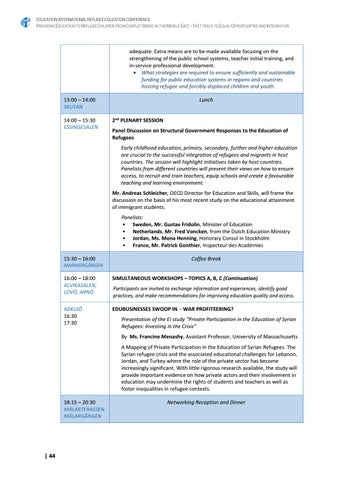
11:50 – 13:00 ALVIKASALEN, LOVÖ, ARNÖ
SIMULTANEOUS WORKSHOPS – TOPICS A, B, C
ALVIKASALEN
Workshop A – ACHIEVING THE RIGHT TO QUALITY EDUCATION
Participants are invited to exchange information and experiences, identify good practices, and make recommendations for improving education quality and access.
Moderator: Ms. Philippa Cordingley, Chief Executive of the CUREE research institute Round Table 1: The Role of National Public School Systems Refugee children and youth, including those who stay in refugee centres, should have access to the national (public) school systems of the host and transit countries. Initially, they need targeted support, such as through intensive language and orientation programmes to allow them to participate in mainstream classes as soon as possible. Some have been traumatized by the circumstances leading to them fleeing their countries,
39 |
suggesting that schools need to offer trauma counselling programmes. It is important that students feel welcome at school. Equally important is that funding for the delivery of education services to refugee children and youth is not found by diverting funds allocated to existing school programmes. Where no schools are situated in the vicinity of refugee centres, education programmes are to be provided within those centres by public authorities and carried out by qualified teachers. What steps have been taken to ensure refugee children and youth’s access to education? What are the main systemic challenges to be met and which priorities are to be set? Should education programmes in transit countries be targeted at integration in their future host country? Should education programmes take into account a possible return of refugees to their home countries? Is there a role to be played by the private sector? If so, what role and under which conditions. Round Table 2: Opening Doors to Further and Higher Education Further and higher education, particularly vocational education and training, are an important gateway to the labour market. Refugee youth who have completed primary and secondary education in their home countries will seek access to jobs as part of their economic integration into host countries. However, further and higher education opportunities for refugees have historically been limited with less than 1 percent of refugee youth able to access universities. Interrupted education, learning gaps, language, confusing application procedures, lack of accreditation of local programmes, distance from education opportunities, and costs are among the challenges that need to be overcome. How to remove barriers such as high tuition fees and the lack of recognition of prior learning? Should schools establish partnerships with local businesses to enable refugee internships? Could distance and e-learning blended with on-site tutoring, provide students with certification from accredited institutions? Round Table 3: The Disadvantaged among the Disadvantaged Within the education systems of transit and host countries, special attention should be given to the most disadvantaged among refugee children and youth. These include girls; children with special needs; children engaged in child labour, those who belong to ethnic or religious minorities; and from other vulnerable groups, such as the LGBTQ minority. Some, particularly women and girls, may suffer from the effects of discrimination in their home countries and have new possibilities in their host societies. The empowerment of girls and the awareness raising of boys and adult males should be a focal point for discussion and role clarification regarding their successful integration and optimal contributions in their new environments. What measures should be taken to address the needs of the most disadvantaged among refugee children and youth?
| 40
Round Table 4: Preventing Young People from Going Astray In countries with inclusive education systems, immigrants integrate more successfully than in countries where students are segmented into different types of schools based on socio-economic or religious grounds. Whether they are a refugee, immigrant or native-born students, adolescents and young adults searching for identity and social inclusion are vulnerable to making wrong choices, particularly when they feel ignored, not accepted or even excluded. The use of extreme violence, whether self-inflicted, driven by frustration or invoked by indoctrination, is on the rise. Apart from pedagogical methods to prevent young people from going astray, school systems should have the capacity to detect behavioural abnormalities at an early stage and obtain professional support. Should data related to individual students be shared with institutions for social protection, health care, and law enforcement? Should teachers report unusual behaviour of students
LOVÖ
Workshop B – SUPPORTING TEACHERS Moderator: Mr. Fernando M. Reimers, Ford Foundation Professor of the Practice in International Education, Harvard Graduate School of Education Round Table 5: Addressing Teachers’ Shortages To keep their national teaching forces on steam, governments have the possibility of establishing retention programmes, developing special programmes to attract young people into the profession or to facilitate career switches. None of these programmes, however, would remedy acute shortages caused by a large increase flux of refugees. What measures can transit and host countries take to address acute teacher shortages? Could these measures include the temporary employment of not yet qualified teachers and/or teachers’ assistants? Could these measures include the engagement of volunteers? If so, under which conditions? Round Table 6: Teaching in Refugee Centres Refugee camps and centres in Europe and the Middles East often lack qualified teachers, basic infrastructure, and teaching and learning resources which hamper the provision of quality education for refugee children and youth. The GMR/UNHCR policy paper 26 (see also page …) notes that in refugee camps in developing countries qualified teachers are often not available at all. “In the Dadaab camps in Kenya, about 10% of teachers are qualified Kenyan teachers, the remaining 90% being refugee teachers drawn from the camps, only 2% of whom are qualified. Several international NGOs provided new teacher recruits with 5 to 14 days of induction training. However, these workshops lacked a common framework identifying the basic knowledge and skills teachers should be expected to demonstrate. To address this, a teacher management and development strategy for 2013–15 recommended a shift towards schoolbased development and problem-solving. The strategy also proposed qualification and certification options for teachers who meet minimum
41 |
higher education admission requirements, as well as options for the majority who do not meet the requirements (UNESCO, 2014).” What are the main obstacles confronting teachers in refugee camps and refugee centres and how should these be removed? Round Table 7: Teacher Professional Development and Support Whatever educational path young people are going to follow, adequately trained teachers are key to their integration and educational attainment, whether they follow special “bridge programmes” focused on learning the language of the host country or are being taught in mainstream classes. For teachers to deliver quality education, they should be given professional autonomy, tools and time to meet the needs of individual refugee students, to design lesson plans and collaborate with colleagues. Collaboration among teachers and their exchange of information and experiences, both within schools and across the profession, will enhance quality teaching. In-service training programmes should be established to equip teachers with the knowledge, skills, and competences to meet the educational needs of refugee children and youth. Such programmes should help teachers familiarize with the cultural backgrounds of refugees, with new methods of language teaching, with "values education," relevant to the host country, in ways that are culturally sensitive and uplifting for all. What measures are needed to facilitate the work of teachers to meet the diverse learning needs of refugee children and youth? What should in-service programmes for teachers educating refugee children, entail? Round Table 8: Giving Refugee Teachers Work Opportunities Among the refugees are qualified and experienced school teachers. Common sense dictates that these “refugee teachers” be given the opportunity to teach or assist teaching refugee children and youth. There are many legal and practical obstacles to optimizing the contributions of refugee educators, including non-recognition of qualifications, as well as the integration of these refugee teachers themselves into their new societies. Special programmes may be established to guide and to make the most of the talents of these refugee teachers in the education sector of their new host countries. Should refugee teachers be engaged in the formal education of refugee children and youth? If so, under which conditions? What experiences in host and transit countries can be learned from?
ARNÖ
Workshop C – THE GLOBAL PERSPECTIVE Moderator: Ms. Francine Menashy, Assistant Professor, University of Massachusetts Round Table 9: International Instruments Protecting the Rights of Refugees Wars and persecution have driven more people from their homes than at any time since the UN Refugee Agency (UNHCR) records began. 65.3 million people were displaced at the end of 2015, compared to 59.5 million just 12 months earlier. Millions of men, women, and children face an uncertain road ahead. Measured against the world's population of 7.4
| 42
billion people, one in every 113 people globally is now either asylumseeker, internally displaced or a refugee. Among the most relevant international conventions and recommendations pertaining to asylum-seekers, internally displaced persons or refugees are the United Nations Convention relating to the Status of Refugees (1951) and its protocol (1967), the UN Convention on the Rights of the Child (1989) and the ILO Conventions on Migrant Workers (C97 and C143). The UN Refugee and Migration Summit in September 2016 is expected to provide further guidance and commitments. Other important UN decisions concern the Sustainable Development Goals, including Quality Education for All (SDG 4), to be achieved by 2030. What strategies are required to improve countries' ratification and implementation record, and to ensure the development of national plans to implement the SDG's? Should national education unions, given the large numbers of school-aged children and youth among refugees, exert pressure on their governments to apply the appropriate international standards? Round Table 10: Reaching out to Unaccompanied Minors The number of asylum applications by unaccompanied minors tripled in 2015. National legislations show significant differences of treatment across borders regarding detention, family reunification, and school access, despite the fact that international law provides for specific protection regimes for this vulnerable group. Large numbers of children have even disappeared from governments’ radar, sometimes forced into early marriage or employment, or even crime and prostitution. How can education unions, schools and teachers help identify and prevent child labour, child exploitation and child abuse in general? Round Table 11: Burden or Blessing While public debates are still predominantly focused on the burden countries accommodating large groups of refugees are to carry, efficient integration programmes may also be of great benefit to both refugees and host countries - economically, socially and culturally. Without playing down the short-term budgetary implications to meet social and educational needs of refugees, or the risks of exploitation and crime, these problems do not outweigh the valuable long-term contributions refugees are able to make to their host countries' economic development - by creating new workplaces, strengthening the labour force, raising demand, and bringing along new ideas for growth. Quality schooling, which reduces the risk of alienation, plays a vital role in maximizing the social, economic and cultural benefits. What are current examples of successful integration of refugees in host countries? What educational programmes have demonstrated to be effective in helping refugees contribute to local economies? Round Table 12: Sustainable Funding for Quality Public Education The international community has the responsibility of making financial resources available to ensure the education of all refugee and forcibly displaced children and youth. The support provided to countries which border conflict areas, such as Turkey, Lebanon, and Jordan, is not
43 |
adequate. Extra means are to be made available focusing on the strengthening of the public school systems, teacher initial training, and in-service professional development. What strategies are required to ensure sufficiently and sustainable funding for public education systems in regions and countries hosting refugee and forcibly displaced children and youth. 13:00 – 14:00 SKUTAN 14:00 – 15:30 ESSINGESALEN
Lunch
2nd PLENARY SESSION Panel Discussion on Structural Government Responses to the Education of Refugees Early childhood education, primary, secondary, further and higher education are crucial to the successful integration of refugees and migrants in host countries. The session will highlight initiatives taken by host countries. Panelists from different countries will present their views on how to ensure access, to recruit and train teachers, equip schools and create a favourable teaching and learning environment. Mr. Andreas Schleicher, OECD Director for Education and Skills, will frame the discussion on the basis of his most recent study on the educational attainment of immigrant students. Panelists: • Sweden, Mr. Gustav Fridolin, Minister of Education • Netherlands, Mr. Fred Voncken, from the Dutch Education Ministry • Jordan, Ms. Mona Henning, Honorary Consul in Stockholm • France, Mr. Patrick Gonthier, Inspecteur des Académies
15:30 – 16:00
Coffee Break
MARMORGÅNGEN
16:00 – 18:00 ALVIKASALEN, LOVÖ, ARNÖ
SIMULTANEOUS WORKSHOPS – TOPICS A, B, C (Continuation)
ADELSÖ 16:30 17:30
EDUBUSINESSES SWOOP IN - WAR PROFITEERING?
Participants are invited to exchange information and experiences, identify good practices, and make recommendations for improving education quality and access.
Presentation of the EI study “Private Participation in the Education of Syrian Refugees: Investing in the Crisis" By Ms. Francine Menashy, Assistant Professor, University of Massachusetts A Mapping of Private Participation in the Education of Syrian Refugees. The Syrian refugee crisis and the associated educational challenges for Lebanon, Jordan, and Turkey where the role of the private sector has become increasingly significant. With little rigorous research available, the study will provide important evidence on how private actors and their involvement in education may undermine the rights of students and teachers as well as foster inequalities in refugee contexts.
18:15 – 20:30 MÄLARTERASSEN MÄLARGÅNGEN
| 44
Networking Reception and Dinner
DAY 2 – TUESDAY 22 NOVEMBER 2016 09:00 – 10:30 ESSINGESALEN
3rd PLENARY SESSION Panel Discussion: Classroom Practices to Realise the Right to Education of All Displaced Children What are refugee education’s prime objectives? Which every day challenges are teachers confronted with? Does teaching forcibly displaced children require special skills? How to engage parents? Are Accelerated Education Programmes and Adaptive Learning Methods suitable solutions to the problem of teaching large and diverse groups? How to create a favourable learning environment? When to integrate into mainstream classes? Moderator: Ms. Susan Hopgood, President, Education International Panelists: • Ms. Hanan Al Hroub, Laureate of Global Teacher Prize 2016 • Mr. Hussein Jawad, Headmaster from Lebanon • Ms. Martina Hilmer, Secondary school teacher, Germany • Ms. Natalie Scott, Teacher for refugees, United Kingdom • Ms. Petra Elio Serti, Teacher upper secondary, Sweden
10:30 – 11:00
Coffee Break
MARMORGÅNGEN
11:00 – 11:50 ESSINGESALEN
4th PLENARY SESSION Description of national refugee education situations Moderator: Ms. Haldis Holst, Deputy General Secretary, Education International
11:50 – 12:00
Ms. Johanna Jaara Åstrand, President, Lararforbundet Sweden Ms. Marlis Tepe, President GEW Germany Ms. Melissa Cropper, Vice President, AFT United States of America Ms. Rossella Benedetti, International Officer, UIL Scuola, Italy Participants take their place in the workshop rooms
12:00 – 13:00 ALVIKASALEN, LOVÖ, ARNÖ
SIMULTANEOUS WORKSHOPS – TOPICS D, E, F
ALVIKASALEN
Workshop D – CONFRONTING THE PROFESSIONAL CHALLENGE
Participants are invited to exchange information and experiences, identify good practices, and make recommendations for improving education quality and access.
Moderator: Mr. Fernando M. Reimers, Ford Foundation Professor of the Practice in International Education, Harvard Graduate School of Education Round Table 13: From Learning the Language to Embracing Values Refugee children and youth have different educational experiences in their home countries, while the duration of their ‘journey’, often under difficult if not extreme conditions and with no or little access to education, vary. One of the first steps in the integration process is learning the language of the host country. There are several teaching
45 |
methods which have proven to be successful. Inculcating the core values of the secular, democratic and multi-cultural society is another pedagogical challenge which requires different approaches depending on background and age group. Views whether the first steps towards integration should be made within or outside the regular school environment differ. What are effective models to successfully interact with refugee students, evaluate their education level, build resilience and selfconfidence? When and how to unobtrusively integrate refugee students in the classroom? How to prepare students and the school population in general to the arrival of refugee classmates, including parents? Round Table 14: Adaptive Learning and Supportive Learning & Teaching Methods Adaptive learning methods provide individualized instruction to students using new technologies as interactive teaching and learning devices. These methods may help refugee students swiftly acquire the required knowledge and skills levels in certain subjects. Adaptive learning, however, does not warrant the absence of a qualified teacher, who is to oversee and steer the learning process. What are the experiences with adaptive learning methods? Are there other learning and teaching methods which have proven to be effective? What materials and tools, including new technology, are required to facilitate the teaching and learning of refugee children and youth? Round Table 15. Educating the Whole Child Students and communities will benefit from a holistic and "whole child" approach to education through which the values are imparted that underpin democratic, multicultural societies and through which skills are transferred that are required to lead meaningful and productive adult lives. A narrow focus on skills and academic objectives combined with strict testing regimes may prevent schools from accomplishing physical, moral, social, emotional, spiritual, and aesthetic aims, and may hamper swift integration of refugee children and youth in their new home countries. http://www.ascd.org/publications/educationalleadership/sept05/vol63/num01/What-Does-It-Mean-to-Educate-theWhole-Child percentC2%A2.aspx Skills or values? Are curricula sufficiently balanced to ensure that both skills and values education are adequately provided for? Round Table 16: Making the case for Global Citizenship Education The global refugee crisis and current political developments in Europe and in the United States signal that a significant proportion of the population does not embrace globalization, including the increased frequency and intensity of interactions with people from many different identities. At worst, the rejection of the results of globalization will lead to social instability and conflict. Which way things go rests on what teachers do. The world is changing rapidly and schools must evolve to prepare young people to understand the world in which they live, in all its complexity, to recognize the way in which global and local affairs are
| 46
intertwined, to understand globalization and its consequences, including global risks, and to have the skills and the desire to contribute to improving the world. Global citizenship education could drive curriculum reform integrating twenty-first century competencies, deeper learning and deploying pedagogies that cultivate student responsibility, imagination and creativity, such as project-based learning and design thinking. [From: Empowering Global Citizens – A World Course (2016), Fernando Reimers et al. ISBN 978-1-5335-9454-9] http://www.usnews.com/news/best-countries/articles/2016-0812/education-must-focus-on-globalization Do globalization and its consequences, including global risks, give reason to pursue global citizenship education and other curriculum reforms? What can be learned from current experiences? What support should be given to teachers and schools? Are there obstacles to the introduction of global citizenship education? ARNÖ
Workshop E – CREATING A FAVOURABLE SCHOOL ENVIRONMENT Moderator: Ms. Samia Hathroubi, European Director Foundation for Ethnic Understanding Round Table 17: Building a Harmonious School Community Children and youth should feel safe and secure in their school environments. A harmonious school community is crucial to successful learning. Building and maintaining such environment requires the engagement of school management, teachers, education support professionals, students, and parents, as well as a relationship with the local community. Parents are to be well informed and consulted, as well as committed to and engaged in the school's activities. What constitutes a safe and harmonious school community? What school strategies have proven successful? How can teachers involve refugee families in the education of their children? Should schools work together with civil society organisations and faith-based institutions to help them overcome language and cultural barriers? What practices have proven successful? Round Table 18: Combatting Racism and Xenophobia Racism and xenophobia, fed by populist movements, are on the rise in many countries. Although education is not the remedy for all evils, there is an undeniable educational challenge to be met. The public school is to be a safe sanctuary as well as the gateway to living and working in multicultural democracies. There is a need to find better methods to combat prejudices against minority groups, to teach children to distinguish fact from fiction and use social media responsibly. All education institutions should establish guidelines and protocols to confront (cyber) bullying and prevent racist and xenophobic behaviour in schools. What are effective educational and pedagogical tools? What are the gaps that prevent teachers from tackling bigotry, intolerance, and bullying effectively? How can parents be engaged in fighting bigotry and intolerance?
47 |
Round Table 19: Addressing the Aftermath – Training on PTSD & violent behavior The experience of war, loss of family members or friends during the voyage, the aftermath of sexual assault; primitive living conditions in camps, and restricted movement may cause behavioural problems or even lead to psychological trauma affecting learning abilities. What are effective models of trauma counselling? LOVÖ
Workshop F – EDUCATION UNIONS TAKING RESPONSIBILITY Moderator: Mr. David Edwards, Deputy General Secretary, Education International Round Table 20: Establishing Partnerships Education unions should create awareness among their membership of the education dimension of the refugee crisis and of the responsibility of the teaching profession to deliver quality education to all refugee children and youth. They should advocate for measures enabling school systems to welcome and integrate refugee children and youth, and promote relevant teachers’ training programmes. They should work together with the public authorities, the trade union movement and civil society organisations, both at local and national levels. Partnerships should be established with associations of parents and students. Should education unions bring together or establish networks of their members who are teaching refugees? How could partnerships with parents and students' organisations help enhance the accessibility of refugee children and youth to quality education? Round Table 21: Sustainable Development Goals What initiatives can Education Unions and their members take to advance the Sustainable Development Goals Round Table 22: Supporting the Global Teachers’ Networks Quality education and high professional standards require an ongoing discussion among education unions and their members. Education International will launch a virtual multilingual platform enabling education unions and their members to exchange information and experiences, engage in a global discussion on the future of the profession, TEN Global will be a “network of networks” bringing together existing networks, including EI, iEARN, ASCD, ITEN, CTQ, Ashoka, and many others, into one “metanetwork”. The roundtable will address ways education unions and their members can get involved into TEN Global. How to facilitate an ongoing international conversation between educators to help ensure the delivery of quality education to all forcibly displaced children and young people
13:00 – 14:00 SKUTAN 14:00 – 15:30 ALVIKSALEN, LOVÖ, ARNÖ
| 48
Lunch
SIMULTANEOUS WORKSHOPS – TOPICS D, E, F (Continuation)
Participants are invited to exchange information and experiences, identify good practices, and make recommendations for improving education quality and access 15:30 – 16:00
Coffee Break
MARMORGÅNGEN
16:00 – 16:45 ESSINGESALEN
5th PLENARY SESSION The Way Forward for Education Unions Moderator: Ms. Haldis Holst, Deputy General Secretary, Education International
Moderators’ Feedback - Lessons Learnt and the Way Forward EI’s policy, strategy and tools What are the future plans of the participating organisations?
Delegations are requested to make three pledges in relation to improving refugee education in their countries. 16:45 ESSINGESALEN
CLOSURE
Ms. Susan Hopgood, President, Education International
DAY 3 – WEDNESDAY 23 NOVEMBER 2016 09:00 – 11:30
School visits Activities: 09:00 arrival, presentation of the school 09:30 joint tour and discussion with students and teaching staff
11:30 – 12:00 09:00 – 12:30 SCANDIC HOTEL 14:00 – 15:00
Transportation of participants to the central station Face to face meeting for the stakeholders of the EI/OSF project (closed meeting on invitation only) Transportation of participants to the central station
49 |
UNHCR reports about 65,3 million of forcibly displaced people worldwide, of which 21,3 million are considered refugees. UNHCR latest report “Missing Out: Refugee Education in Crisis” highlights that more than a half of all the refugees under UNHCR mandate are children, from which 6 million are of the age of primary and secondary school. The real number of forcibly displaced children of school age is much higher. UNHCR also highlights, that the average time of refugee being in exile is about 20 years – a huge part of people’s life and more, than entire childhood. Once displaced, refugee children have few chances to get home before becoming an adult, and they can get primary and secondary education only in their hosting country. The report also highlights the huge crisis in refugee education:
“Of the six million primary and secondary school-age refugees under UNHCR’s mandate, 3.7 million have no school to go to. Refugee children are five times more likely to be out of school than non-refugee children. Only 50 per cent have access to primary education, compared with a global level of more than 90 per cent. And as they get older, the gap becomes a chasm: 84 per cent of non-refugee adolescents attend lower secondary school, but only 22 percent of refugee adolescents have that same opportunity. At the higher education level, just one per cent of refugees attend university compared to 34 per cent globally.” UNHCR in annual report Global Trends: Forced Displacement in 2015 gives useful numbers on different other aspects, such as lists of countries, hosting most refugees in numbers or in ratio per capita, or countries, from which refugees originate from.
UNICEF in recent report Uprooted: The Growing Crisis for Refugee and Migrant Children emphasized the high numbers of children refugees, and that refugee population is much younger, than general migrant population.
“31 million children live outside their country of birth, including 11 million child refugees and asylum-seekers. Nearly one in three children living outside their country of birth is a refugee; for adults, the proportion under UNHCR’s mandate is less than 1 in 20. In 2015, just two countries – the Syrian Arab Republic and Afghanistan – accounted for nearly half of all child refugees under UNHCR’s mandate;
| 50
about three-quarters of all child refugees under UNHCR’s mandate came from only 10 countries. Today, nearly 1 in every 200 children in the world is a child refugee. Between 2005 and 2015, the number of child refugees under the UNHCR’s mandate more than doubled. During the same period, the total number of all child migrants rose by 21 per cent. Approximately 10 million child refugees are hosted across the world, primarily within the regions where they were born. Girls and boys are equally represented among registered refugees, although children’s risk of specific protection violations – such as recruitment by armed forces and armed groups, or sexual and genderbased violence – may differ between girls and boys. Overall, the refugee population is much younger than the migrant population. While a clear majority of the world’s migrants are adults, children now comprise half of all refugees. The 10 countries hosting the largest numbers of refugees are all in Asia and Africa, with Turkey hosting by-far the largest total number of refugees under UNHCR’s mandate. Although complete agedisaggregated data are not available for refugees in Turkey, its substantial share of total refugees makes Turkey likely the host of the largest number of child refugees in the world. By the end of 2015, some 41 million people were displaced by violence and conflict within their own countries; an estimated 17 million of them were children. At the end of 2015, 19.2 million people had been internally displaced by violence and conflict across Asia, a staggering 47 per cent of the global total for similar internal displacements. Together, the Syrian Arab Republic, Iraq and Yemen accounted for nearly one-third of the world’s total of conflict-induced internal displacements by the end of 2015. There were 12.4 million people internally displaced by violence and conflict across Africa in 2015. Four countries in Africa – Nigeria, Democratic Republic of the Congo, Central African Republic and South Sudan – were among the top 10 countries globally for new, violenceinduced internal displacements in 2015.”
Eurostat possesses the wide range of statistics, concerning hosting refugees in Europe. It refers to the numbers of asylum applications in every country within European Union, number of
51 |
applications per capita in such countries, nationalities of applicants, and how many applications have been approved per country and per nationality of an applicant. BBC in article “Migrant crisis: Migration to Europe explained in seven charts� illustrates some of such statistics.
Eurostat provides extensive statistics on unaccompanied minors among forcibly displaced people residing in European Union:
“In 2015, 88 300 asylum seekers applying for international protection in the Member States of the European Union (EU) were considered to be unaccompanied minors. While their number always stood between 11 000 and 13 000 in the EU over the period 2008-2013, it almost doubled in 2014 to reach slightly more than 23 000 persons, then nearly quadrupled in 2015. In 2015, a substantial majority of unaccompanied minors were males (91%) and over half were aged 16 to 17 (57%, or 50 500 persons), while those aged 14 to 15 accounted for 29% (25 800 persons) and those aged less than 14 for 13% (11 800 persons). Around half (51%) of asylum
| 52
applicants considered to be unaccompanied minors in the EU in 2015 were Afghans.” “In 2015, the highest number of asylum applicants considered to be unaccompanied minors was registered in Sweden (with almost 35 300 unaccompanied minors, or 40% of all those registered in the EU Member States), followed by Germany (14 400, or 16%), Hungary (8 800, or 10%) and Austria (8 300, or 9%). Together these four Member States accounted for three-quarters of all asylum applicants considered unaccompanied minors registered in the EU in 2015.” “The largest shares of unaccompanied minors among all young asylum applicants in 2015 were recorded notably in Italy (where 56.6% of all asylum applicants aged less than 18 were unaccompanied in 2015) and Sweden (50.1%), followed by the United Kingdom (38.5%), the Netherlands (36.5%), Denmark (33.7%), Finland (33.2%) and Bulgaria (33.1%). In total in the EU, unaccompanied minors accounted for almost a quarter (23.0%) of all asylum applicants aged less than 18 in 2015.” More relevant information and links are available in the documents section of the conference mobile/internet application.
53 |
| 54
55 |
| 56
57 |
Compiled by Mikhail Smirnov
| 58