continued from page 40...
Now Routt County had two great horses: Old Fred and Peter McCue. Si bred Peter McCue to several of his top mares. Those mares that were not bred to Peter McCue were bred to Silver Tail and Wildcat. These two stallions had been on the Dawson Ranch for several years. As we noted above Coke Roberds bred Colorado Queen, dam of the quarter horse Plaudit. Colorado Queen was out of a Silver Tail mare. Some pedigrees show that her dam a Silver Tail mare was sired by Silver Tail and out of a daughter of Silver Tail. This shows the ties between Roberds and Dawson in the scheme of things. Denhardt in his FOUNDATION SIRES OF THE AMERICAN QUARTER HORSE reports that Silver Tail and Wildcat were sons of Jim Ned, the Billy bred stallion that was owned by William Anson. This is interesting because Anson owned Harmon Baker by Peter McCue and he successfully bred him to his Jim Ned mares producing many fine quarter horses. Coke wanted a colt or two from Queen Litz. Queen Litz had a great racing record in New Orleans, Louisiana. Si loaned the Queen to Coke. Coke bred the Queen to Old Fred and got Bob H and Fred Litz. “They both turned out to be something,” stated Coke. For Si Dawson, the race ended in 1914 when the Dawson’s sold their ranch and moved to Albuquerque, New Mexico. In 1918 Si moved to Brazil to manage the Fazenda Morungava, a cattle ranch in the State of Parana. Si died a year later of a ruptured appendix. (1919) Before leaving Routt County, Si asked Coke to take care of thirty-five of his best mares until he had a place for them. Si gave Peter McCue to Coke. But as it turned out Si died before he could return. When Mrs. Dawson came back from Brazil after Si’s death
she told Coke, “All of the kids wanted to keep a horse or two. They all live in cities and I think that would be too expensive all the way around.” Coke agreed with her and told her that she should have a horse sale. Mrs. Dawson asked Coke to take care of the details for her. Coke said he would. Coke asked Bob Norell to be the auctioneer. Bob said that he would. Bob asked Coke how much he was charging. Coke said, “Nothing.” Bob said that he wouldn’t charge anything either. This all happened in 1919. The first horse in the ring was Crackerjack. She only brought twenty dollars. Then Coke said that they were going to stop giving these horses away and he bid one-hundred and fifty dollars on the next horse in the ring. The next horse in the ring was Mary McCue. Mary McCue was by Peter McCue and out of First Out, a palomino Fred mare. This is where a young newcomer came into the picture. His name was Marshall Peavy. He finally outbid Coke for the young two-year-old filly and that is where the third man came into the race. A pedigree that accompanied this material gives the pedigree of Mary McCue. She was sired by Peter McCue. Her dam was listed in this pedigree as a Palomino mare by Old Fred. The dam of the Palomino mare was First Out, a full sister to Coke Roberds’ lost stud Primero. Evelyn told that this pedigree was copied directly off of Coke Roberds papers at his home and the date was 1939. Marshall was born in Georgia, on August 22, 1898. He moved to Deep Creek between 1914 and 1916. His mother bought a ranch on upper Deep Creek, which is now the Haystack Ranch, managed by Joe Flores. continued on page 48...
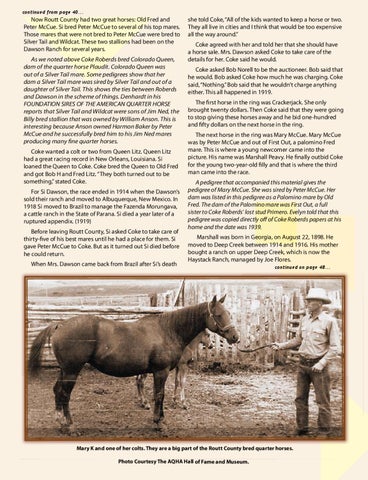
Mary K and one of her colts. They are a big part of the Routt County bred quarter horses. Photo Courtesy The AQHA Hall of Fame and Museum. Page 44
THE WORKING HORSE •MARCH 2010