By Todd Lowe, USGA Senior Agronomist, Florida Region
live golf
Summertime Cultivations Wrapping Up In The Rain Bermudagrass fairways respond well to aggressive summer cultivation, including aggressive ‘Celebration®’ Bermudagrass fairways, which can be verticut up to eight times in the summer. Planning an afternoon outing with friends and family has been almost impossible in some regions, as you may be dodging heavy rainfall and lightning as some point. Now imagine being a golf course superintendent trying to schedule necessary renovation work under these conditions. Timing of weed control treatments is difficult at times, but cultivations like core aeration and verticutting are even more difficult as they generate lots of organic debris that must be removed. Most of Florida is only a few feet above sea level, and the water table is generally not far from the surface. The increased rainfall has caused the water table to rise and soils remain saturated. As such, tire rutting from vehicles has been a common sight on recent visits. At times, even daily mowing has been impossible. The plant growth regulator, Primo® has been helpful at slowing turf growth and preventing excessive clippings and mower scalping.
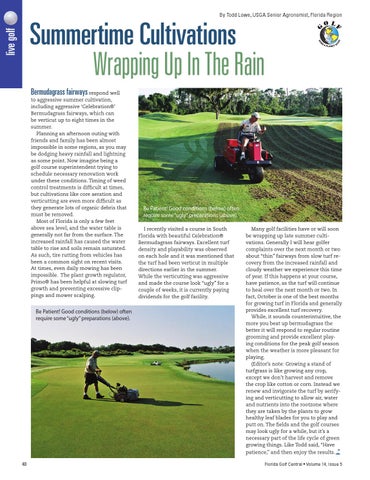
Be Patient! Good conditions (below) often require some “ugly” preparations (above).
40
Be Patient! Good conditions (below) often require some “ugly” preparations (above). I recently visited a course in South Florida with beautiful Celebration® Bermudagrass fairways. Excellent turf density and playability was observed on each hole and it was mentioned that the turf had been verticut in multiple directions earlier in the summer. While the verticutting was aggressive and made the course look “ugly” for a couple of weeks, it is currently paying dividends for the golf facility.
Many golf facilities have or will soon be wrapping up late summer cultivations. Generally I will hear golfer complaints over the next month or two about “thin” fairways from slow turf recovery from the increased rainfall and cloudy weather we experience this time of year. If this happens at your course, have patience, as the turf will continue to heal over the next month or two. In fact, October is one of the best months for growing turf in Florida and generally provides excellent turf recovery. While, it sounds counterintuitive, the more you beat up bermudagrass the better it will respond to regular routine grooming and provide excellent playing conditions for the peak golf season when the weather is more pleasant for playing. (Editor’s note: Growing a stand of turfgrass is like growing any crop, except we don’t harvest and remove the crop like cotton or corn. Instead we renew and invigorate the turf by aerifying and verticutting to allow air, water and nutrients into the rootzone where they are taken by the plants to grow healthy leaf blades for you to play and putt on. The fields and the golf courses may look ugly for a while, but it’s a necessary part of the life cycle of green growing things. Like Todd said, “Have patience,” and then enjoy the results. Florida Golf Central • Volume 14, Issue 5